Category Archives: New Testament

Walls Around Jerusalem National Park – # 2

As we walk south in the garden, or along the paved path, we come to an area that looks like it might have been an approach to a gate with walls on either side. Against the Ottoman city wall we see steps but no gate in the wall. The sign at this part of the wall is labeled The “Hidden” Gate which Shimon Gibson thinks is the Gate of the Essenes.

Recognizing that there are scholars who dismiss the Gospel account of the trial of Jesus, Gibson says there is reason to take a more positive approach based on recent archaeological evidence.

This chapter cautiously argues against taking such a negative approach to the subject of the trial of Jesus as portrayed in the Gospels. The basis for this conclusion is a new study I have made on the overall layout of the palace of Herod the Great, which later became the seat of the Roman governor when in residence in Jerusalem, the praetorium. My work also highlights previously unpublished archeological discoveries pertaining to the appearance of the western gateway of the palace/praetorium, which I think is the Gate of the Essenes referred to by Josephus. This monumental gateway had inner and outer gates flanked by large towers, and these gates were separated one from the other by a large, open, and paved court at its center, with a rocky area on its north. In the first century CE, the gateway undoubtedly provided direct access to the palace grounds, which incorporated palace residences, an ornamental pleasure garden, and military barracks. Remarkably, these archeological remains fit very well with John’s description of the place of Jesus’ temporary incarceration and the trial in front of Pilate, and with the two topographical features that are mentioned by him, the lithostrotos and gabbatha. (“The Trial of Jesus at the Jerusalem Praetorium: New Archaeological Evidence,” pp. 97-118 in C.A. Evans (ed.), 2011 The World of Jesus and the Early Church: Identity and Interpretation in Early Communities of Faith. Peabody: Hendrickson.)

Our photo below shows the gateway approach, the stone steps leading to a gate that is no longer there, and (to the left) a bema or sort of platform where a temporary judgment seat could have been erected. All of this area was covered with earth and debris before excavations were undertaken.
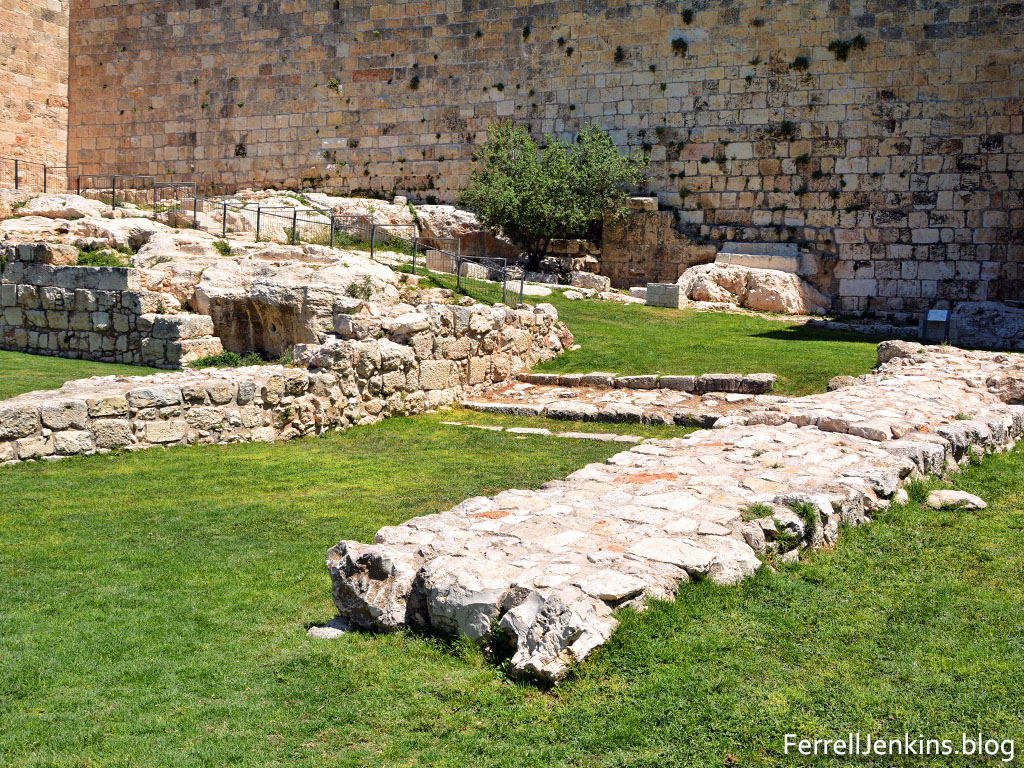
The Herodian gateway approach to the Praetorium and Herodian palace. Photo by Ferrell Jenkins.

The Herodian gateway approach to the Praetorium and Herodian palace. The bema or judgment seat is the large stone to the left of the image. Photo by Ferrell Jenkins.

As we take a closer look at the steps cut into the bedrock and a jumble of stones of various periods built into the wall we realize that we need an illustration to help us understand what we have here.
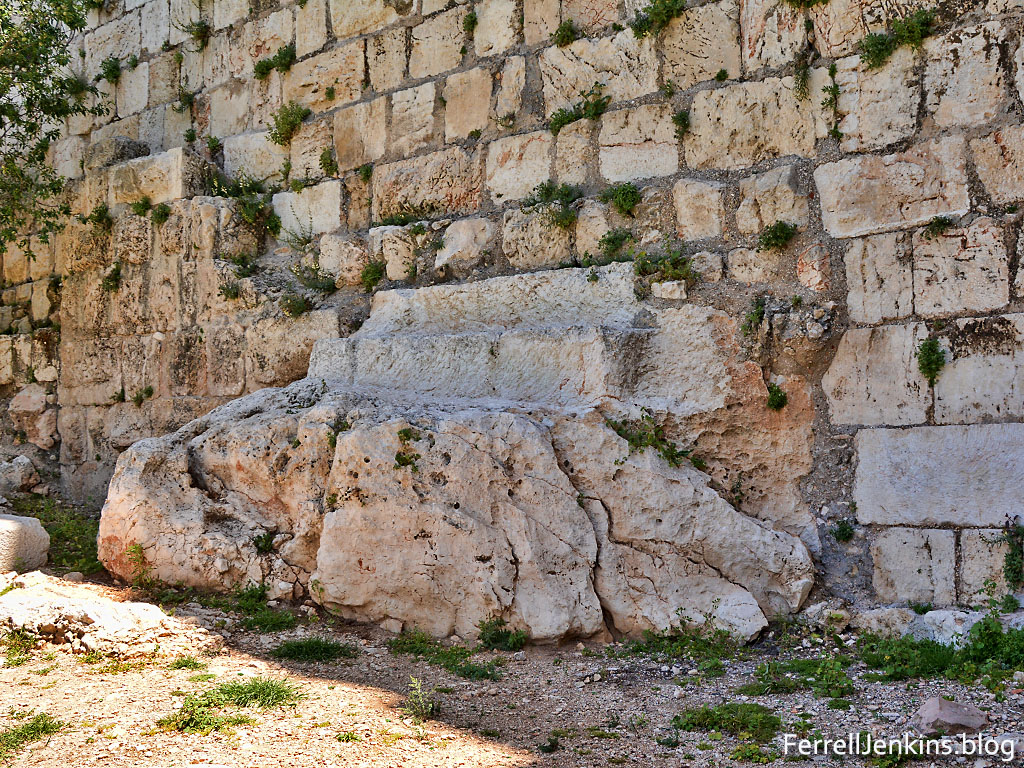
The Hidden Gate built on bedrock. Photo by Ferrell Jenkins.

The Hidden Gate built on bedrock. Photo by Ferrell Jenkins.

The sign at the site illustrates what has been found in the various archaeological excavations in the area. There was a gate here, designated as the “Hidden” Gate, which Gibson thinks was the Gate of the Essenes mentioned by Josephus.
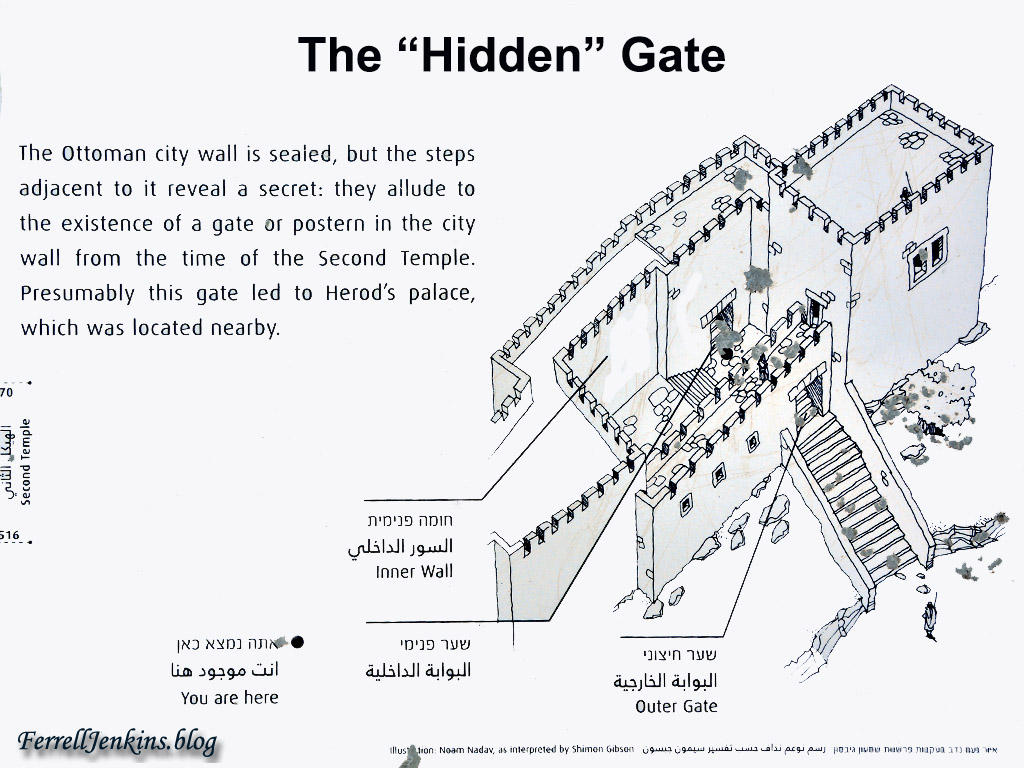
Sign explaining the "Hidden" Gate in the west wall of the ancient city of Jerusalem. Photo by Ferrell Jenkins.

Sign explaining the “Hidden” Gate in the west wall of the ancient city of Jerusalem. Photo by Ferrell Jenkins.

Several excavations have taken place in the general area both inside and outside the gate (see the references at the end of this article). The sources that I list at the end of the article have good drawings to show the location of Herod’s Palace and the Praetorium.

The aerial photo below begins on the left (north) with the Citadel. As we move to the right (south) we have the area of Herod the Great’s palace, then the area of the Praetorium (now known as the Armenian Garden). The gateway which is marked with a yellow circle would have been the entrance to this area. Click on the image for a larger photo.
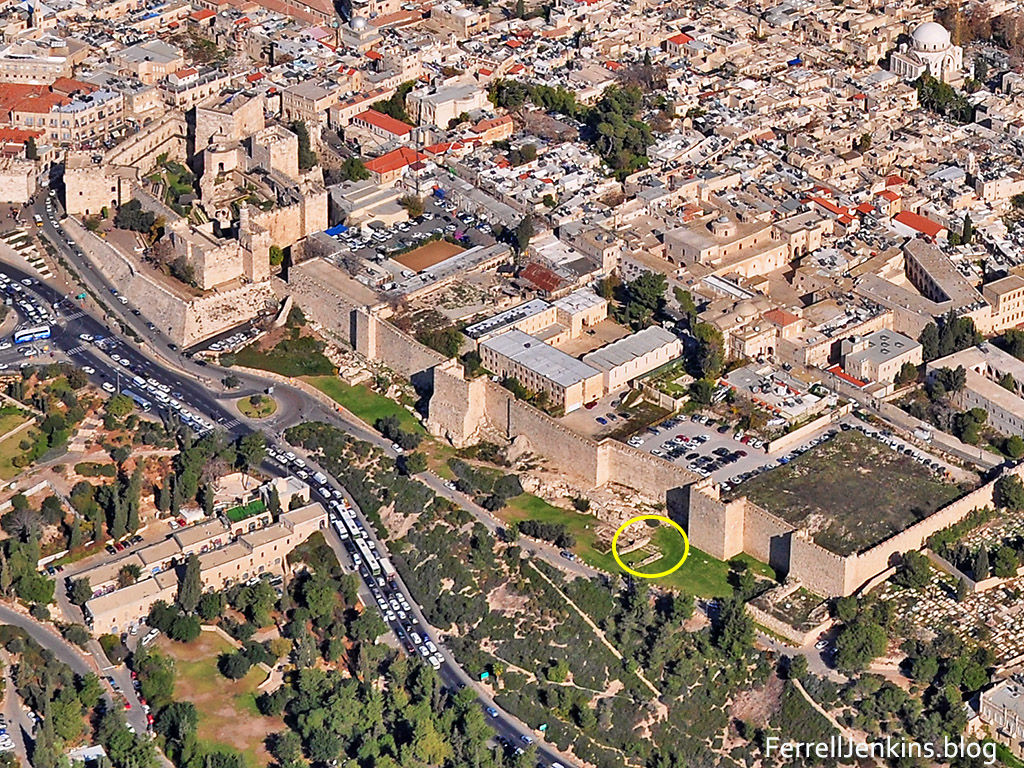
Aerial view of the portion of the west wall under consideration. In it you will see the Citadel and the Armenian Garden. The place of the "Hidden Gate" is circled. Photo by Ferrell Jenkins.

Aerial view of the portion of the west wall under consideration. In it you will see the Citadel and the Armenian Garden. The place of the paved approach and the “Hidden Gate” is circled. Photo by Ferrell Jenkins.

Here is another aerial view made from the southeast showing the entire area from the Jaffa Gate and the Citadel to the southern wall.
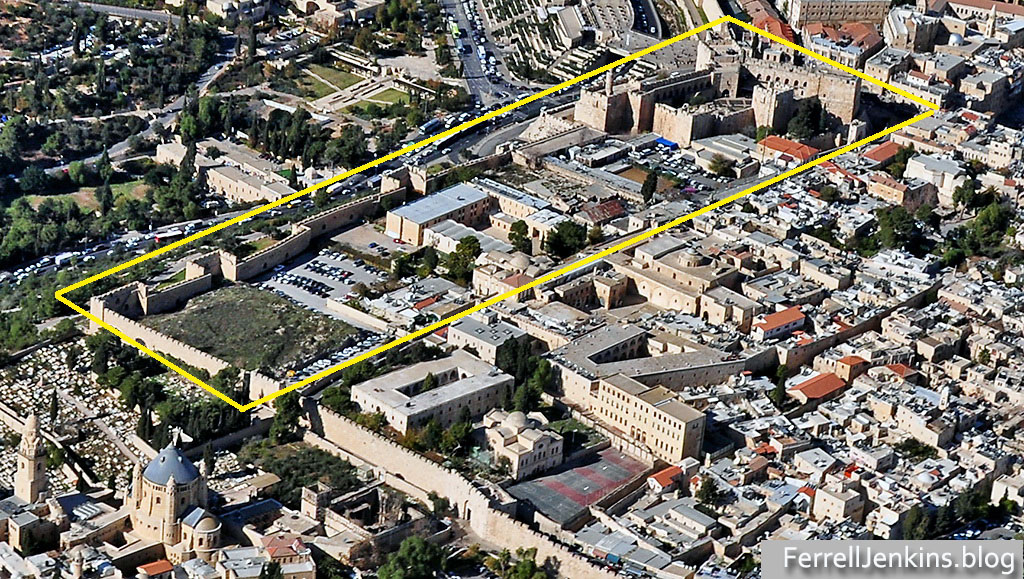
Armenian Quarter of the Old City. Photo by Ferrell Jenkins.

Armenian Quarter of the Old City. Photo by Ferrell Jenkins.

Our next photo shows the citadel and the palace of Herod the Great in the Second Temple model at the Israel Museum. The palace is shown with two buildings and a large courtyard between them. Gibson and others would make that area smaller as a square area. The “Hidden Gate” is approximately where the letter “g” of blog is located. Archaeologists point out that Herod’s palace was not a single building but a complex. The Roman prefect (governor) resided at Caesarea Maritima, but made his residence here when in Jerusalem (Matthew 27:2, 11, et al.).

The Herod ruling at the time of the crucifixion was Herod Antipas (Mark 6:21; Luke 3:1; 23:7). He was the son of Herod the Great who was Tetrarch of Galilee from 4 B.C. to A.D. 39. The Gospel account in Luke 23:1-12 agrees with the view that Antipas and Pilate were residing in close proximity to each other.
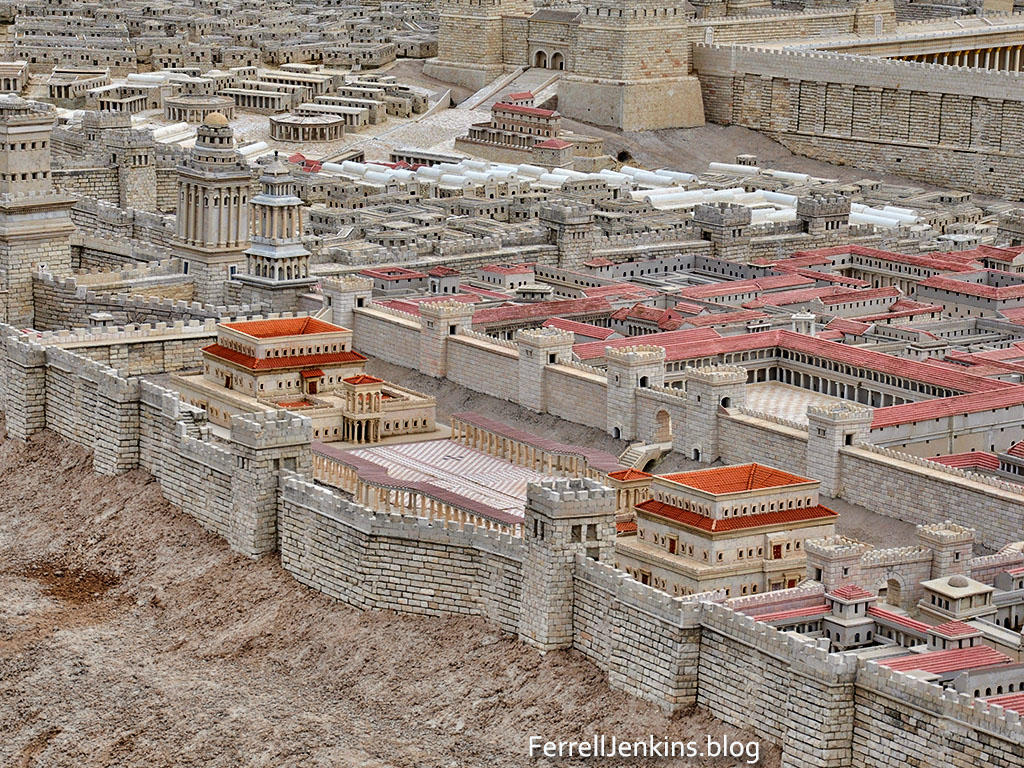
Herod's palace depicted in the Second Temple Model at the Israel Museum. Photo by Ferrell Jenkins.

Herod’s palace depicted in the Second Temple Model at the Israel Museum. Photo by Ferrell Jenkins.

Balage (Archaeology Illustrated) has graciously allowed us to use his drawing which illustrates the viewpoint of Shimon Gibson. There are problems associated with this location. Would this be a suitable area for a crowd of Jews to gather, and how would Jesus get from here to the place of crucifixion? Gibson suggests that Jesus went back through the Praetorium. At the current time it would be easy to return to Jaffa gate and continue to Golgotha, but I do not know how easy that would have been in A.D. 33.
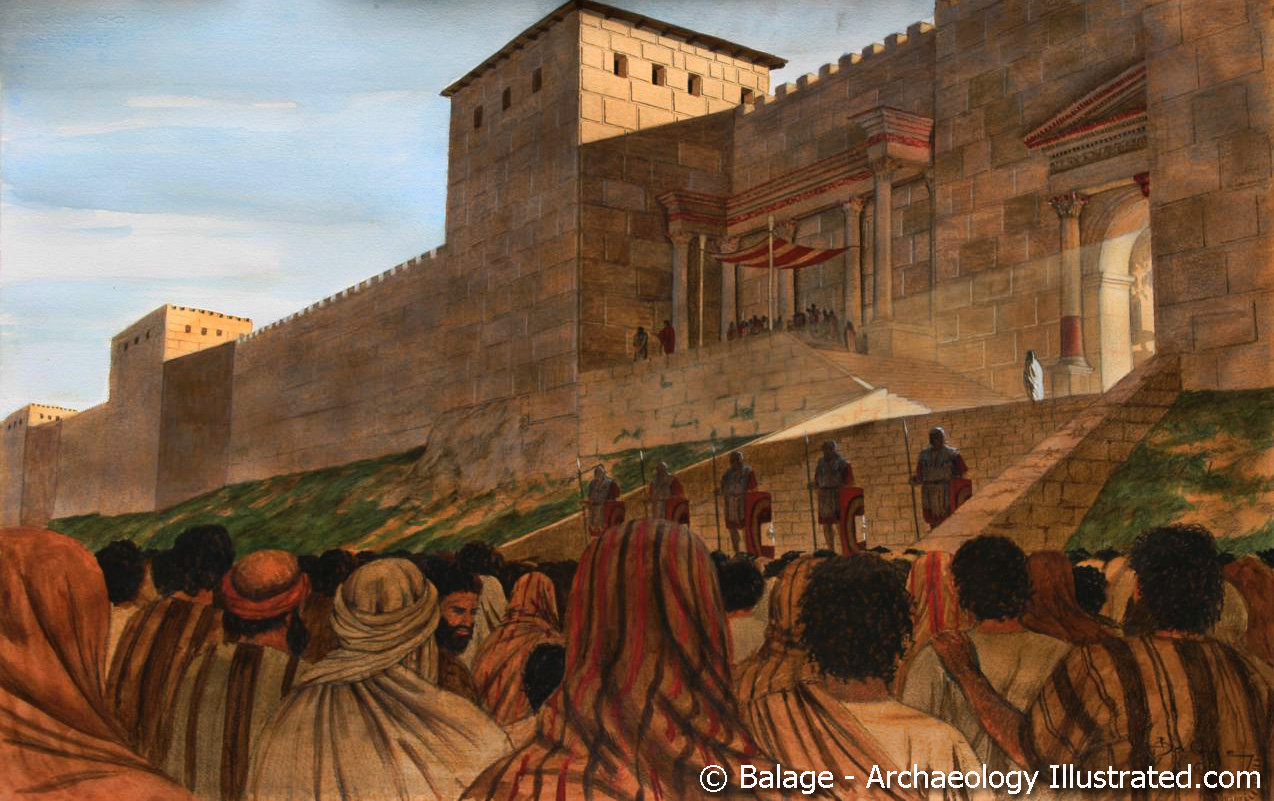
The site where Jesus stood before Pilate, according to Gibson. Art used by permission of Balage, Archaeology Illustrated.

The site where Jesus stood before Pilate, according to Gibson. Art used by permission of Balage, Archaeology Illustrated.

The Gospel of John provides a fairly detailed account of the movement of Pilate when he was responsible for Jesus. John states that the Jews led Jesus from the house of Caiaphas, the priestly ruler,  to the governor’s headquarters (18:28). We understand that Pilate stayed in the Palace of Herod when he visited Jerusalem.

Since the Jews would not enter the area where the Gentile Prefect was staying, Pilate “went outside to them” (v. 29), then “entered his headquarters again” (v. 33). After questioning Jesus, Pilate “went back outside to the Jews” (v. 38), then he “took Jesus and flogged him” (19:1). I take this to mean that he took Jesus back in. After Jesus was flogged, crowned with thorns, arrayed in a purple robe, and mistreated by the soldiers, Pilate “went out again” (19:4).

At this point “Jesus came out, wearing the crown of thorns and the purple robe” (v. 4). Pilate presented Jesus to the Jews with what might have been a scoffing tone: “Behold the man!” (v. 5). When the chief priests and the officers called for the crucifixion of Jesus, and heard the charge that Jesus “made himself the Son of God”, Pilate “entered his headquarters again” (v. 9) and spoke with Jesus. Pilate was unsuccessful in releasing Jesus. When the Jews threatened Pilate with no longer being a friend of Caesar, Pilate “brought Jesus out and sat down on the judgment seat at a place called The Stone Pavement and in Aramaic Gabbatha (v. 13). Further demands for the crucifixion of Jesus prompted Pilate to deliver him over to them (v. 16).

Finally, the text says that Jesus “went out, bearing his own cross, to the place called The Place of a Skull, which in Aramaic is called Golgotha. There they crucified him, and with him two others, one on either side, and Jesus between them. (vv. 17-18).

Where was the pavement? There was a pavement at this “Hidden Gate”. To the right of the steps that led through the wall you will see a section of paving just above the yellow line I have made. You must recall that the area we have been looking at did not always have this nice manicured look. Much soil and stones had to be removed by the archaeologists as they did their work.
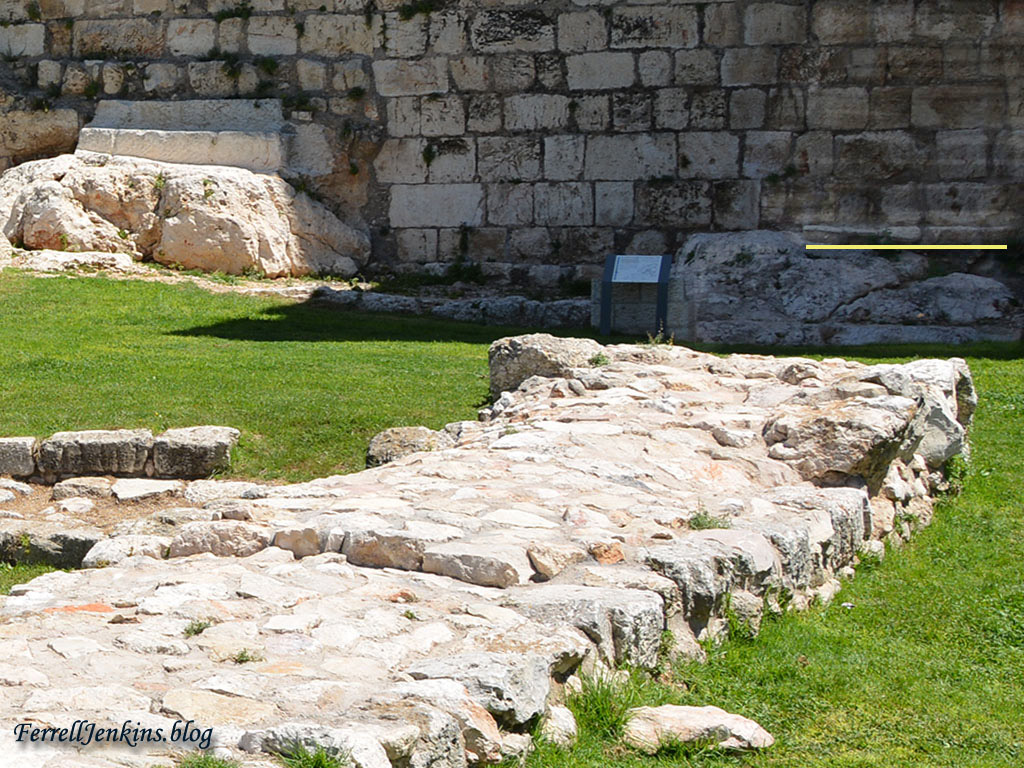
To the right of the bedrock steps that led through the outer wall you will see a section of pavement with a yellow line below it. Photo by Ferrell Jenkins.

To the right of the bedrock steps that led through the outer wall you will see a section of pavement with a yellow line below it. Photo by Ferrell Jenkins.

Some Suggested Sources:

The major sources I used are listed by author.

Bahat, D. and M. Broshi. “Excavations in the Armenian Garden.” Jerusalem Revealed: Archaeology in the Holy City. Ed. Yigael Yadin. Jerusalem: Israel Exploration Society, 1968-1974. 55-56.

Broshi, Magen and Shimon Gibson. “Excavations Along the Western and Southern Walls of the Old City of Jerusalem.” Ancient Jerusalem Revealed. Ed. Hillel Geva. Jerusalem: Israel Exploration Society, 1994. 147-155.

Gisbson, Shimon. The Final Days of Jesus: The Archaeological Evidence. New York: Harper One, 2009.

__________. “The Trial of Jesus at the Jerusalem Praetorium: New Archaeological Evidence.” The World of Jesus and the Early Church: Identity and Interpretation in Early Communities of Faith. Ed. C. A. Evans. Peabody: Hendrickson, 2011. 97-118. *This paper is also available on Gibson’s page at Academia.edu.

Kramer, Joel, Actor. Praetorium Jerusalem Part 1 with Joel Kramer, You Tube, 2018. Accessed 24 May 2018.*There are several different videos available of Joel Kramer explaining the Praetorium.

Kramer, Joel, Actor. Praetorium, You Tube, 2015. Accessed 24 May 2018.
Walls Around Jerusalem National Park – #1

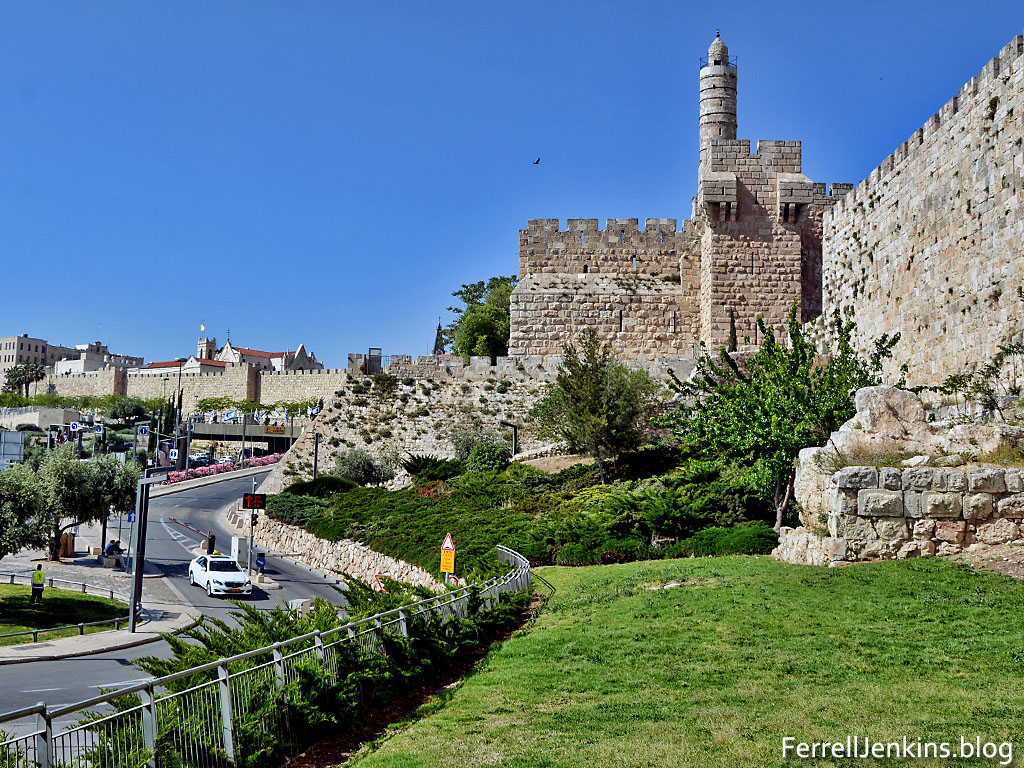
Most readers will know that the Old City of Jerusalem is surrounded by a wall built by the Ottomans in the 16th century. The Israelis have designated a park on both the east side and the west side of the Old City. The park is designated as the Walls Around Jerusalem National Park. In this post we will show you some of the highlights of the west wall.

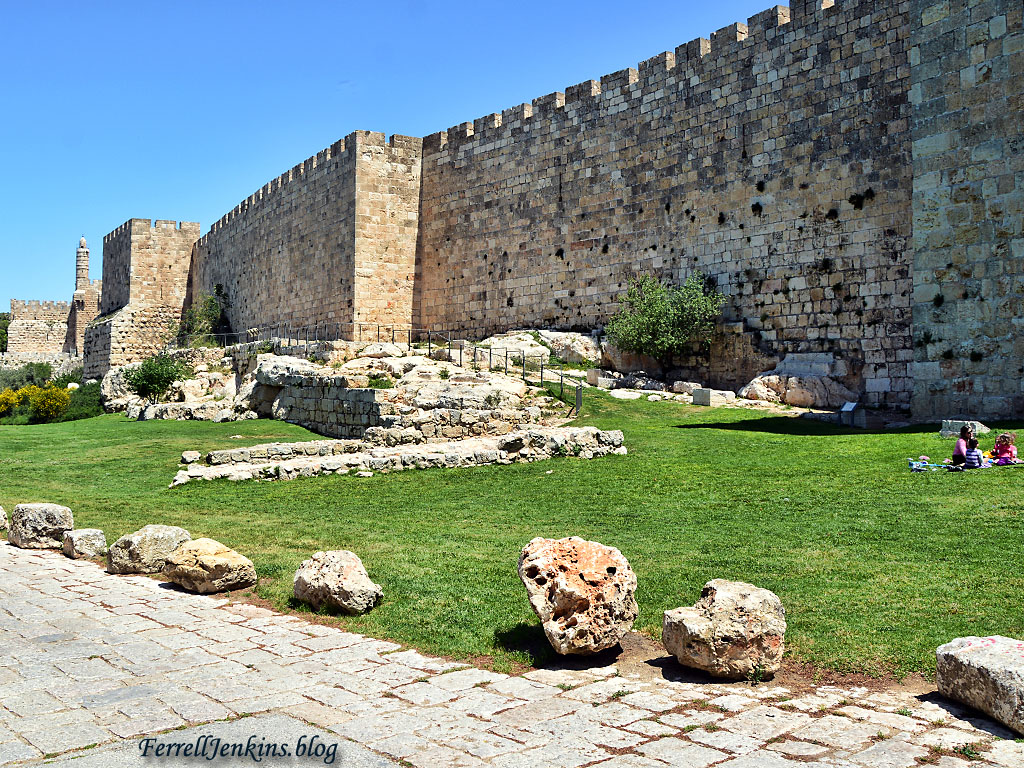
Let’s begin at the Citadel. If you are at Jaffa Gate you should exit and follow the road that goes down to the main street. A smaller road also extends along the west wall, at which point you can walk on the grass in this beautiful garden.

The garden of Walls Around Jerusalem begins on the west at the Jaffa Gate and extends south. Photo by Ferrell Jenkins.

The garden of the Walls Around Jerusalem begins on the west at the Jaffa Gate and extends south. Photo by Ferrell Jenkins.

This extended view shows the citadel and a sizable stretch of the wall south. We will be calling special attention to the section on the right of the image.

View of the garden and the west wall of the Old City. The view is from the south. Photo by Ferrell Jenkins.

View of the garden and the west wall of the Old City. The view is from the south. Photo by Ferrell Jenkins.

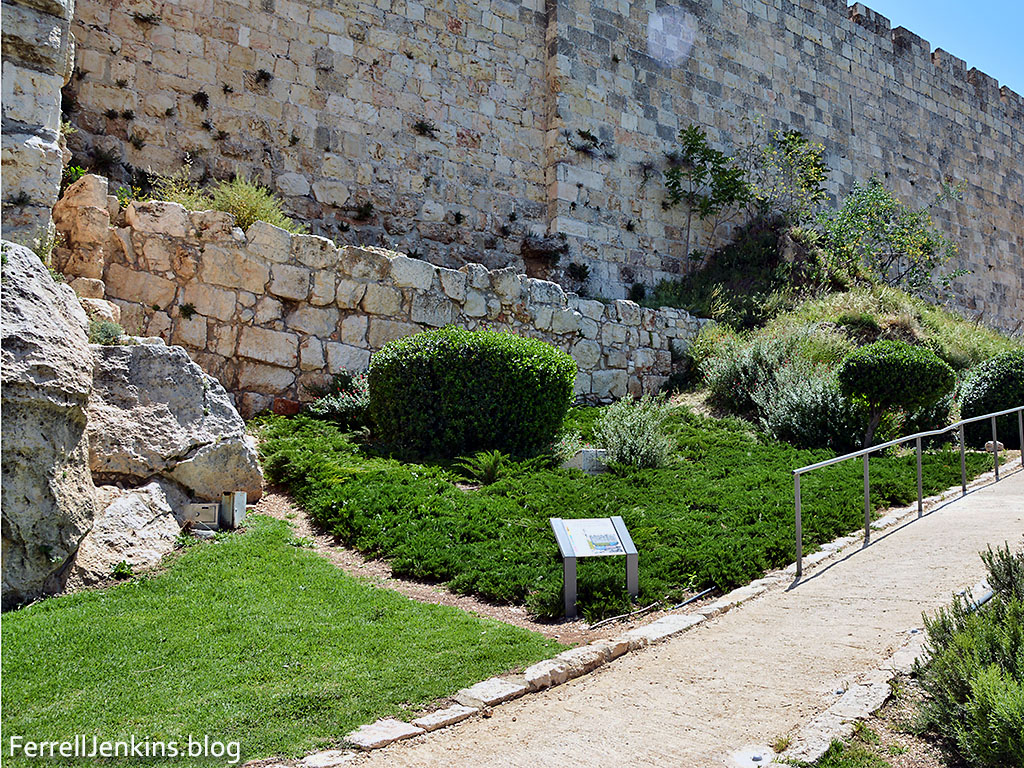
Let’s go back north and begin our tour with a view of stones from various historical periods.

Jerusalem Garden Wall shows stones from various historical periods. Photo by Ferrell Jenkins.

Jerusalem Garden Wall shows stones from various historical periods. Photo by Ferrell Jenkins.

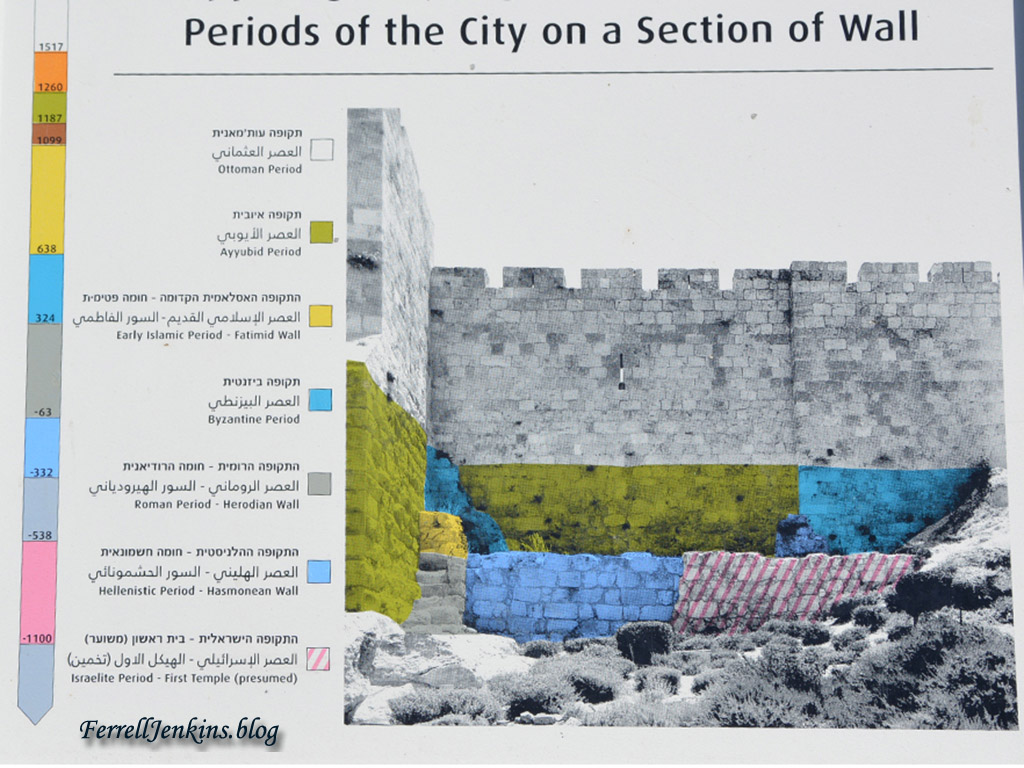
The walk in the Garden is relaxing and the signs are helpful. The captions are in Hebrew, Arabic, and English. I suggest you click on the photos to see a larger image.

There are some helpful signs providing information about the wall. Photo by Ferrell Jenkins.

There are some helpful signs providing information about the wall. This one illustrates the historical periods. Photo by Ferrell Jenkins.

The various periods represented in this little stretch of wall are listed here, beginning from the earliest at the bottom:

  • Israelite Period wall (presumable the First Temple period)
  • Hellenistic Period (a Hasmonean wall)
  • Roman Period (Herodian wall). This is the wall from the time of Christ.
  • Byzantine Period
  • Ayyubid Period
  • Ottoman Period

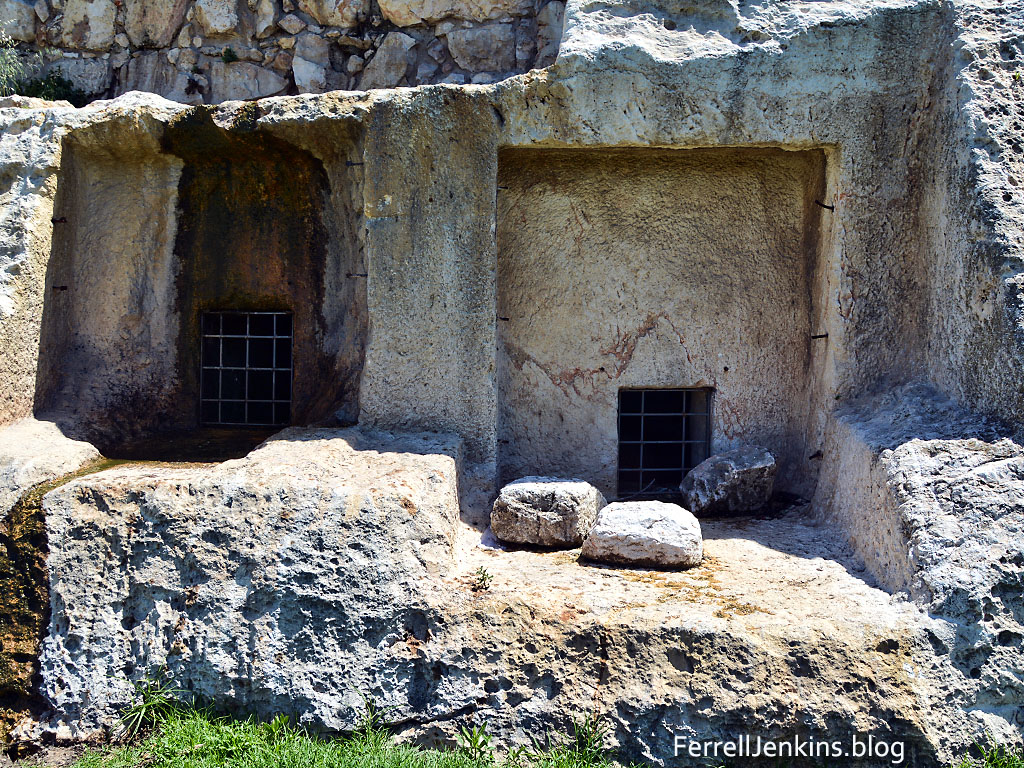
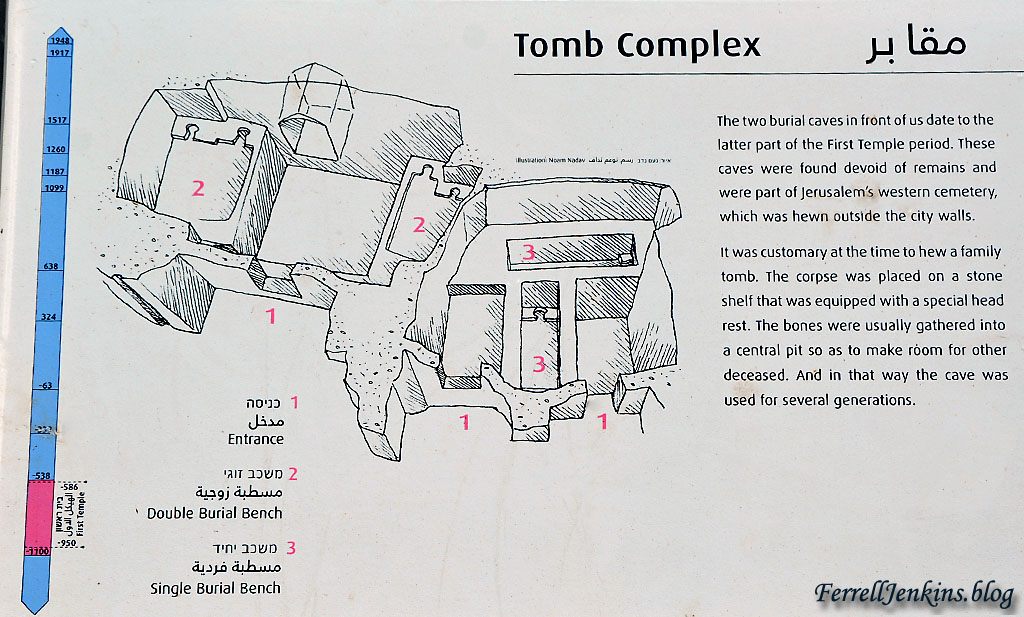
The next thing you will see as you walk south are rock-cut tombs from the first temple period (Iron Age). The sign explaining these tombs date to the period from 950 to 586 B.C. Notice that the tombs are cut from the bedrock, and that the wall is built on top of the tomb.

These rock-cut tombs belong to the Israelite (First Temple) period. Photo by Ferrell Jenkins.

These rock-cut tombs belong to the Israelite (First Temple) period). Photo by Ferrell Jenkins.

The sign at the tombs show the interior of the tomb complex. We see the same type tomb across the Hinnom Valley at the Ketef Hinnom tombs.

This sign shows the typical Iron Age tombs. Photo by Ferrell Jenkins.

This sign shows the typical Iron Age tombs. Photo by Ferrell Jenkins.

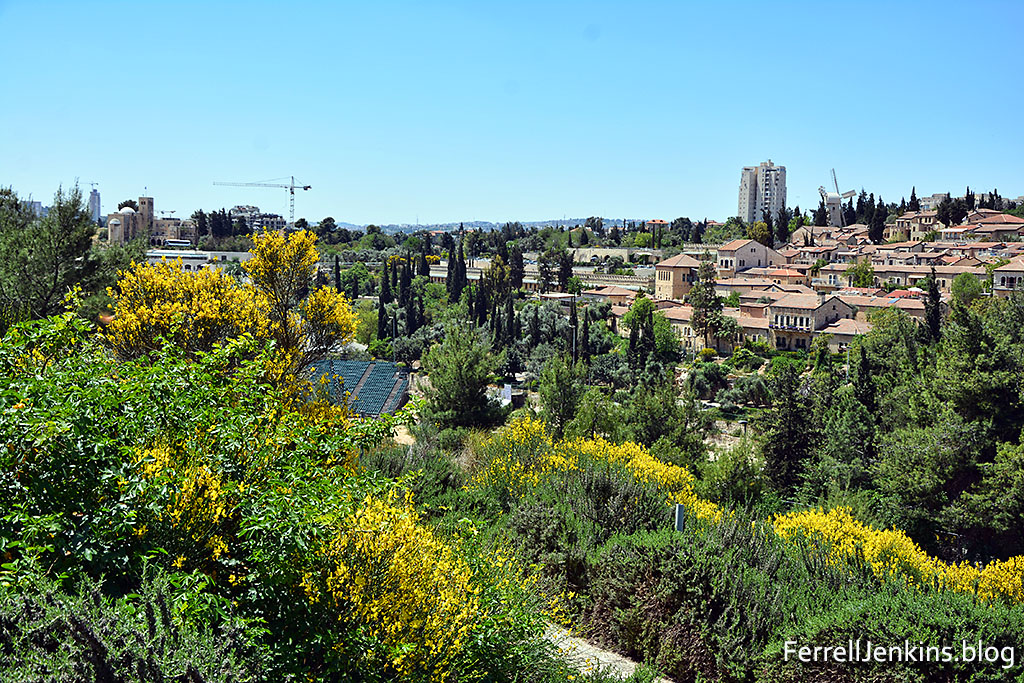
In this pleasant park there are also signs to identify the buildings to the west. The valley between the upper city of ancient Jerusalem and the hill to the west is the upper Hinnom Valley. Here it is running north-south, but it takes a turn to the east around the southern wall of the Old City.

Notice the green seating visible left of center among the trees in the valley. These are part of a concert venue in the Valley of Hinnom (Joshua 15:8). The ridge to the west is the central mountain ridge that runs north–south in Israel, serving as a watershed with Jerusalem on the east side of the ridge. If I added one more photo showing structures to the north (right) you would see the famous King David Hotel.  In the picture posted here you see the Montifiore Windmill, a structure built as a flour mill in the mid-19th century. (Click on the photo for a larger image.)

On the left of the photo you will see a building crane, sometimes called the national bird of Israel. Below the arm of the crane and partly framed by the yellow flowers is the Begin Center. The building to the left of it is the Scottish Church. Between the Begin Center and the Scottish Church is the location of the Ketef Hinnom (shoulder of Hinnom) iron age tombs.

View west from the west wall of Jerusalem. Photo by Ferrell Jenkins.

View west from the west wall of Jerusalem showing the valley of Hinnom and the central mountain ridge. Photo by Ferrell Jenkins.

In the next post about the west wall of the Old City we will continue south along the wall and take a look at the site that Professor Shimon Gibson, and some other scholars, have identified as an entrance to the Pretorium and the stone pavement where Jesus was tried before the Prefect Pilate (John 19:13).

The Arabah (introduction)

Recently I was doing some reading in the late Denis Baly’s Geographical Companion to the Bible (1963) and decided to share his description of the Arabah (Arava in Israel).

The southern section of the Rift Valley is normally known as the Arabah, and it is, to the surprise of many people, almost as long as the section of the valley between the south end of the Dead Sea and the Lake of Galilee. A north-east-south-west upfold running across it raises the central part of the Arabah to 1,000 feet above sea-level, and then it sinks southwards again towards the Red Sea. Everywhere it is desert, save where occasional springs provide a welcome supply of water. However, historically it has had a double importance: as a trade route to the Red Sea and as a source of cooper. This is found in the dark-red Nubian sandstone which outcrops particularly on the eastern, or Edomite, side of the rift. The most important of these copper mines was at Punon (the modern Feinan), almost certainly the place where Moses raised the serpent in the wilderness (Num. 21:4-10; 33:42-43). On the western side the copper-bearing rock outcrops only in the extreme south, and is being mined today at Timna, where also it was obtained in ancient times. This is the place known to the modern tourist as “King Solomon’s Mines” (Deut. 8:9). (p. 57).

I propose in a series of posts to discuss briefly Lot’s Wife, views of the Arabah, the excavations at Tamar, Keturah, Timnah, and Eilat.

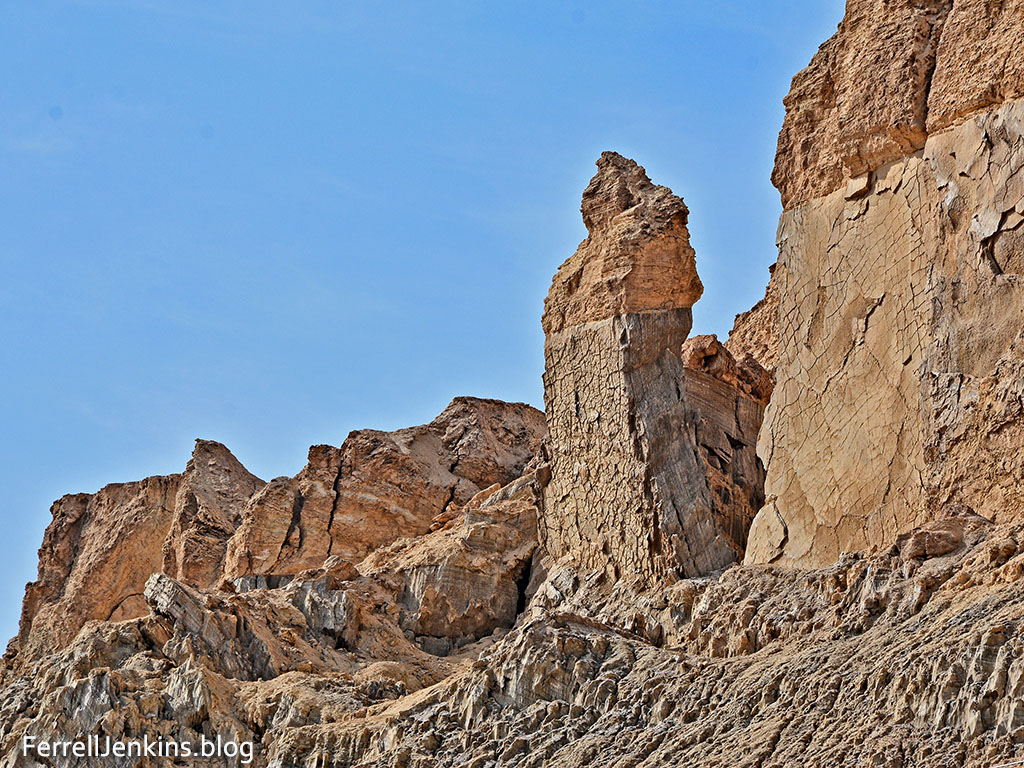
A short distance south of the southern end of the Dead Sea is a formation called Lot’s wife. While there is no historical reality to the formation being Lot’s wife it is an interesting natural formation that promotes the memory of Lot and his family. In the biblical description of the overthrow of the cities of Sodom and Gomorrah we are told,

But Lot’s wife, behind him, looked back, and she became a pillar of salt. (Genesis 19:26 ESV)

Lot's Wife, a natural formation south of the Dead Sea. Photo by Ferrell Jenkins.

Lot’s Wife, a natural formation south of the Dead Sea. Photo by Ferrell Jenkins.

Lot’s wife stands as a perfect illustration of those who turn back from doing the will of the Lord. Even Jesus called attention to this Old Testament event.

Remember Lot’s wife. (Luke 17:32 ESV)

In the next post we plan to show you some of the arid terrain as we continue south in the Arabah.

Sadly, I see that neither Logos nor Accordance have Denis Baly’s The Geography of the Bible or The Geographical Companion of the Bible available.

Some recommended resources

Sale Deadline on The Book of Ruth collection

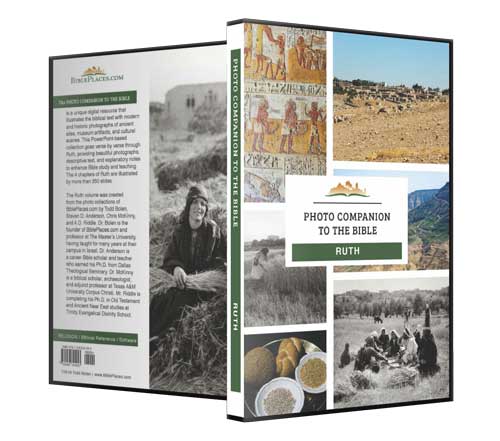
If you received the BiblePlaces Newsletter for April  a few days ago you already know about the new volume in the Photo Companion of the Bible series. This one is on The Book of Ruth. I received a complimentary advance copy and found some of this material to be helpful on the recent study trip to Jordan. I am confident that anyone studying or teaching the book of Ruth will find the material helpful. You can download the recent BiblePlaces Newsletter filled with much helpful information here.

Available through April 22 for $20.

There are 350 images in PowerPoint to illustrate the four chapters of the Book of Ruth. The collection is on sale until midnight April 22 for $20. Bolen says, “Shipping is free in the US and satisfaction is guaranteed.” Go here for ordering information. Take a look at the four volume set on the Gospels.

Appian Media Producing New Series

Our friends at Appian Media have already produced a wonderful set of high-quality videos entitled Following the Messiah. They will soon be returning to Israel to film a new series dealing what many of us call the Biblical period of the United Kingdom. The series will be called Searching for a King.

Appian Media Searching for a King

Filming for this series begins very soon.

Appian Media provides membership access to their material, and they are seeking donations to assist in the work. See details here. Some videos are available for viewing on the website.

A New Video on Lachish

Lachish: The Epic Unearthed, a 48 minute video about the history and excavations of the biblical city of Lachish has been produced by Dr. Robert Henry and Rachel Martin. Henry summarizes the film:

This documentary brings you into the exciting world of Biblical Archaeology as it reveals the history of one of the largest Old Testament cities and tells the story of the volunteers who dig it up. This epic story reveals the turbulent warfare of the first temple period of Biblical history, the discoveries that expand the Biblical narrative and the impact this experience had on the people who came to Israel to dig. Watch as these determined volunteers unearth a Biblical land mark that hasn’t been touched in over two thousand five hundred years.

The video features comments by Prof. Yosef Garfinkle and Prof. Michael Hasel, directors of the fourth excavation at Lachish, as well as interviews with some of those working on the dig including my friend Luke Chandler.

Some viewers will be unfamiliar with the pronunciation of such sites as Lachish and Azekah. Instead of Lake-ish and ah-ZECK-ah, you will hear LAH-KISH and AZ-e-kah, pronunciations more common in Israel.

I am thankful to have provided a few of my aerial photographs for the video. Henry and Martin encourage you to use this video in your teaching and for personal study free of charge.

Walking the Bible Lands with Dr. Wayne Stiles

Wayne Stiles, whose web site we have mentioned several times, is now developing a video series called Walking the Bible Lands. This is old hat for Wayne who had been traveling to the Bible lands, teaching and writing about them for many years.

Wayne’s new material is available on a membership arrangement. Detailed information is available at his Walking the Bible Lands website here. You will find some samples there.

Welcome to ferrelljenkins.blog

The change is so subtle that you probably didn’t even notice that the address bar or location line now reads https://ferrelljenkins.blog/.

Anyone who can spell Will Ferrell and Florence Foster Jenkins can handle ferrelljenkins.

Our first post was dated May 2, 2007. This is now our 1984th post. Admittedly some of the posts are insignificant  (like this one). But I think that many of the posts continue to be helpful to Bible students and teachers who are searching for information, and photos, of Bible lands and customs.

You may ask, “Why did you change the domain, and if it is important why did you not do it sooner.” Here are a few reasons. This blog has been hosted free of charge by WordPress all these years. For a long time there were no advertisements appearing with the blog, but lately that has changed. I can’t blame WordPress. The company wants to make a profit. To do so they sell services including ads for the blogs they host. Sometimes these ads showed up in the right column. Others showed up at the bottom of a post. I noticed them especially when searching for a particular subject such as Bethlehem or shepherds (just examples). Some ads were innocuous, but others promoted viewpoints that I do not hold or approve.

WordPress has been peppering me with Emails advertising new URL’s. The hundreds of photos that have appeared here and the tremendous cost to procure them have been covered exclusively by me. It is true that I do license a few photos for various publishers, but this would not pay for my flight from Tampa to New York, let along to Israel, Jordan, Turkey, Egypt, or Greece, to mention a few of the places we have traveled to study and make photos.

ferrelljenkins.blog

It takes a lot of travel and work to prepare Ferrell’s Travel Blog.

No complaint. I consider this work part of my service to the LORD and His servants who want to enhance their understanding of the Bible.

Those who have followed the blog for any length of time have undoubtedly noticed that my posts have been few and far between in the past two or three years. This is due to some health issues in my family. Often I prepare photos for presentation but never get around to writing the information to accompany them. Not promising, but I do hope to do better in the months to come.

Many thanks to our faithful readers. Will you do me a favor? Send an Email to a few friends and encourage them to follow this blog. This means they will be notified each time we post something. The blank to fill in to be added to the list is near the top of the right column.

By the way, if you have a link or bookmark to the old URL it will still work, but change it for future use.

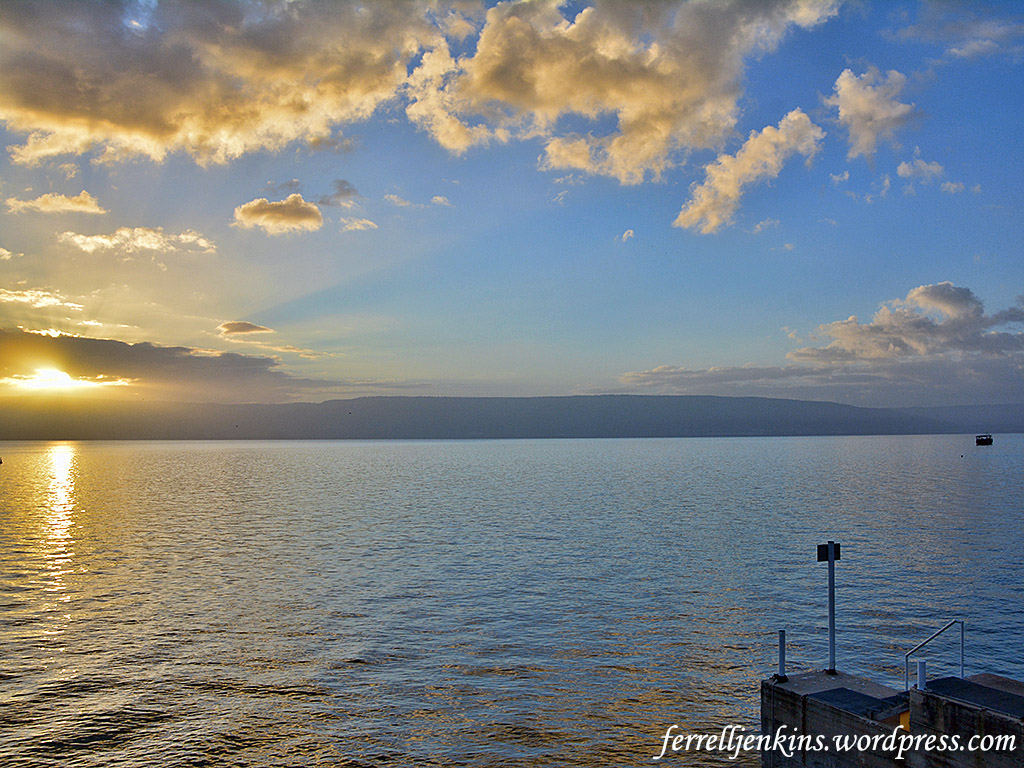
An unusual sunrise on the Sea of Galilee

Those who have followed this blog for any length of time have probably seen several of my sunrise photos on the Sea of Galilee. We often stay at the Ron Beach Hotel which is situated on the west shore of the Sea on the north side of Tiberias. Sometimes I have been able to capture some great shots from my room. Yesterday, however, was one of those days when the was hidden from us by low, heavy clouds.

This morning there were low clouds on the eastern horizon. The sun only occasionally peeked through, but this did not affect the reflection of the sun on the clouds above.

When I realized what was happening I moved my camera to place the sun on the left side of my image in order to show the beautiful sky and clouds. I thought you might enjoy seeing this different sort of image.

Sunrise on the Sea of Galilee, March 25, 2018. Photo by Ferrell Jenkins.

Sunrise on the Sea of Galilee, March 25, 2018. Photo by Ferrell Jenkins. Click on the image for a larger image.

Tonight Leon Mauldin and I are on the Dead Sea at Ein Bokek.

The Sea of Galilee played a prominent role in the ministry of Jesus. Take this example, for example:

From that time Jesus began to preach, saying, “Repent, for the kingdom of heaven is at hand.”
While walking by the Sea of Galilee, he saw two brothers, Simon (who is called Peter) and Andrew his brother, casting a net into the sea, for they were fishermen. And he said to them, “Follow me, and I will make you fishers of men.” Immediately they left their nets and followed him. And going on from there he saw two other brothers, James the son of Zebedee and John his brother, in the boat with Zebedee their father, mending their nets, and he called them. Immediately they left the boat and their father and followed him. (Matthew 4:17-22 ESV)

Traveling in Jordan again

For the past week I have been traveling in Jordan with long-time traveling friend Leon Mauldin on a personal study trip. We enjoy these trips going to places that  we miss during regular tours. That is because some of the places are difficult to reach and would have little interest to the first-time traveler to the Bible Lands. It sometimes takes us half a day to locate a place and visit it.

The tourist folks in Jordan like to call their country “the other Holy Land.” Not only did Jesus visit this area but it was often the area of travel for the patriarchs, prophets, and kings of ancient Israel.

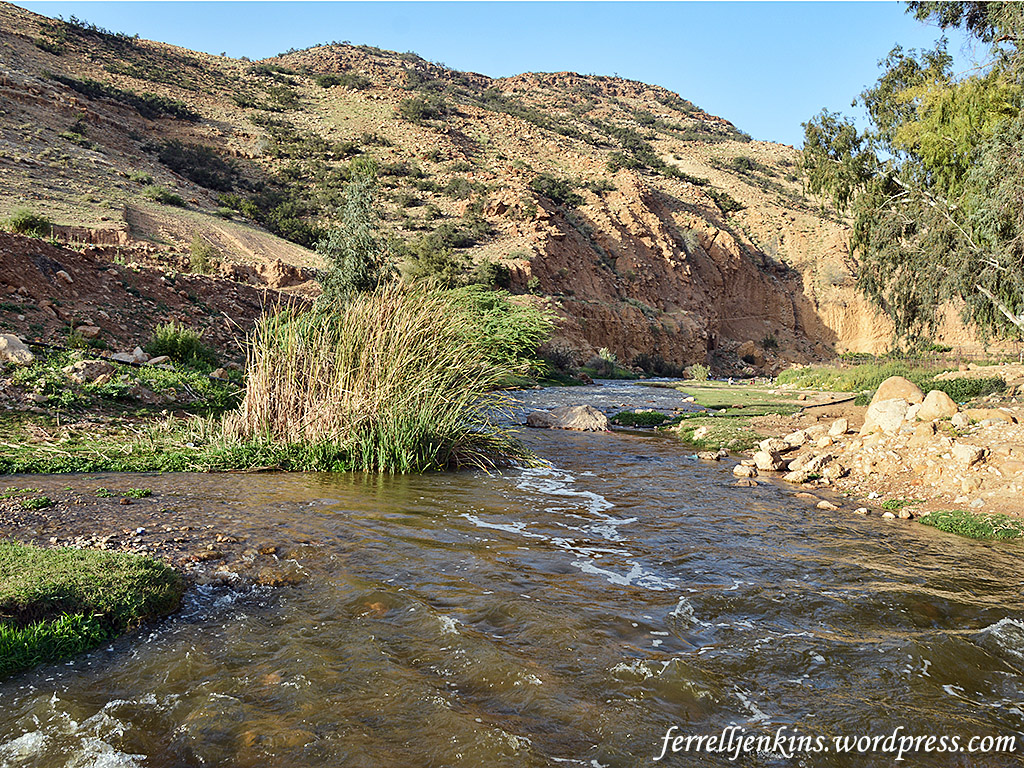
Today we visited the Jabbok River a few miles east of the Valley Road (Roman Perea) and Deir Allah. This is thought by some to be the place where Jacob met his brother Esau on the return from Padan Aram. See Genesis 32 for the full story). This photo will give you some idea of the terrain and the small river, now called the Zarka.

The Jabbok River east of the River Jordan. Near here Jacob a life-changing encounter with the LORD. Photo by Ferrell Jenkins.

The Jabbok River east of the River Jordan. Near here Jacob had a life-changing encounter with the LORD. Photo by Ferrell Jenkins.

Clearing the landmines at Qasr al-Yahud baptism site

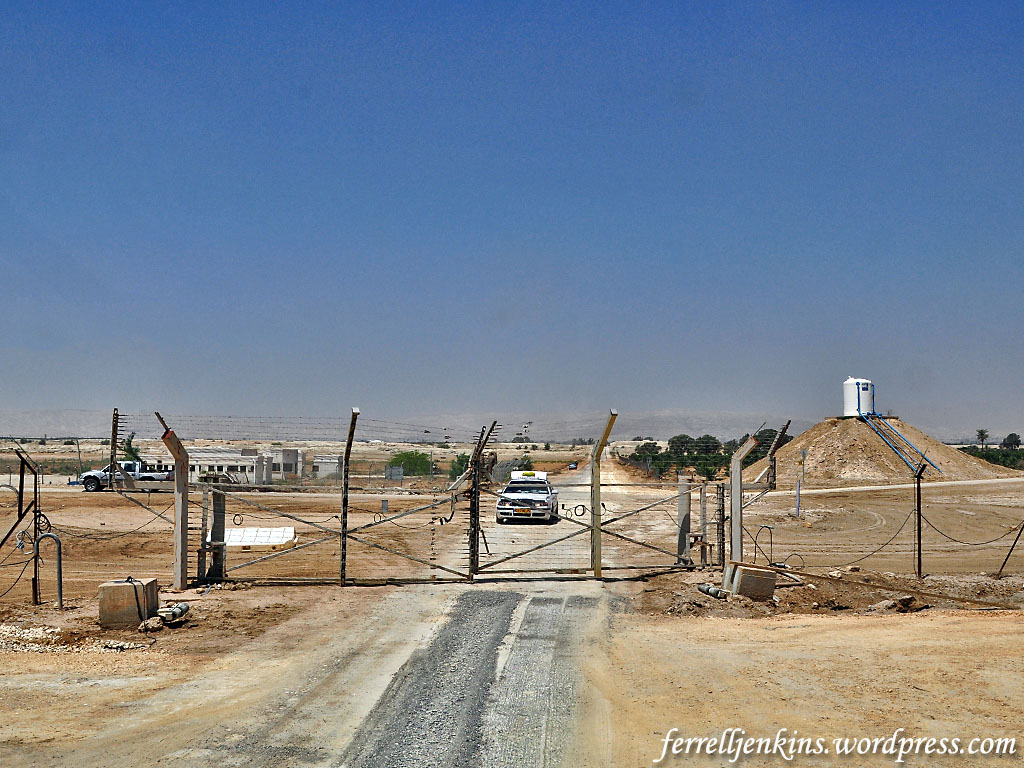
My first visit to the traditional site of the baptism of Jesus and the work of John the Baptist was in 1967 (see photo of the group here). After the Six Days War in June, 1967, it was not possible to visit the site until about 2011. My next visit to the site in Israel was in May, 2011. In the meanwhile I had already taken three groups to Jordan so we could visit the site, traditionally known there as Bethany Beyond the Jordan.

In May, 2011, we had to stop at this gate and wait for someone from the military to come and open the gate for the bus to enter. Photo by Ferrell Jenkins.

In May, 2011, we had to stop at this gate and wait for someone from the military to come and open the gate for the bus to enter. Photo by Ferrell Jenkins.

The expression “beyond the Jordan” in John 1:28 distinguishes this Bethany from the Bethany on the east slopes of the Mount of Olives, the home of Mary, Martha and Lazarus (cf. John 11:1). Jesus was with John “beyond the Jordan” (3:26), and went away to this region prior to his final work in Judea (10:40). The Greek word for beyond is peran, from which comes the geographical term Perea. Perea was on the east side of the Jordan River.

The NKJV follows late manuscripts in the reading Bethabara. There are textual variants on this point, but the earliest and best reading is Bethany in John 1:28.

One reason for the long delay in opening the site in Israel was that it was in a military area. Much of the area had been filled with landmines and anti-tank mines after the 1967 war to prevent Jordanian tanks from crossing it.

Seven churches had been constructed in the area during the British Mandate period in the 1930s. A drone video included in the The Times of Israel article (link below) shows ruins of the Franciscan Compound, the Ethiopian Church, the Syrian Church, and the Romanian Church. Greek Orthodox pilgrims were already allowed to visit the baptism site to celebrate Epiphany.

Now, the HALO Trust fund has begun raising money to rid the area of mines. The TOI article says the Israel Defense Ministry contributed funds as well.

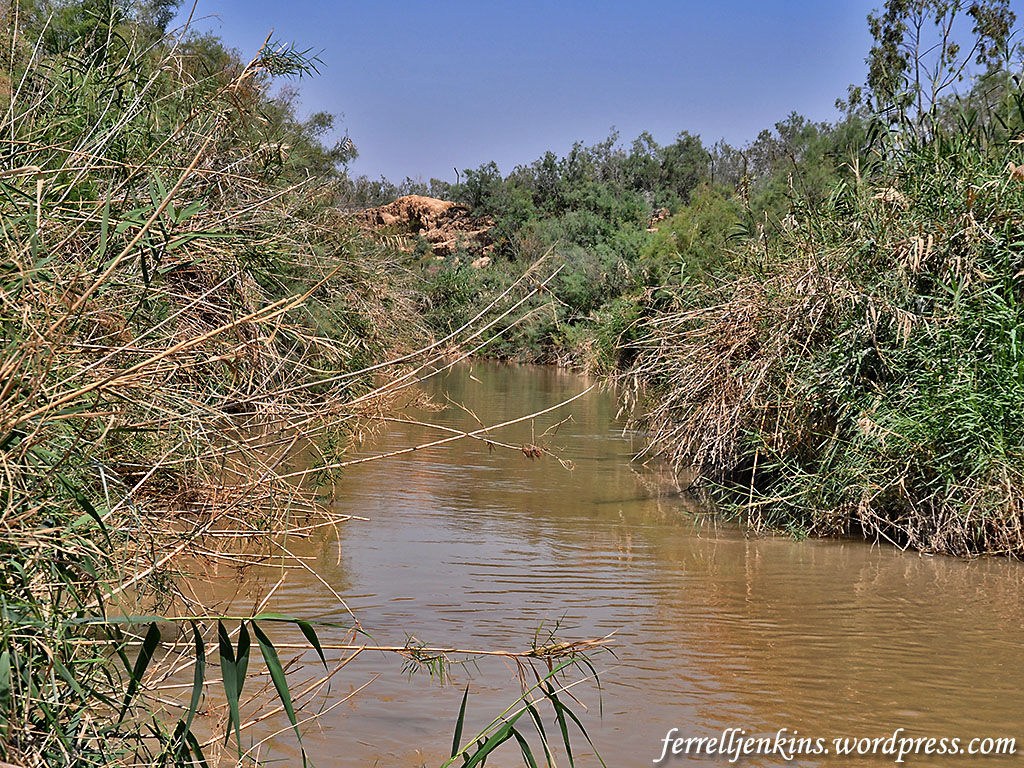
I call the Jordan a shy river that seldom shows itself. One can drive through the Jordan Valley from Tiberias to the Dead Sea and rarely get a glimpse of this famous River. That is because of the depth of the Jordan Valley and the growth along the banks of the River.

The River no longer floods the valley as it once did, and it is no longer as wide as it once was. This is because the water is now being used by both Israel and Jordan for agriculture and to provide drinking water for the growing population.

A view to the north of the Jordan River at Qasr al-Yahud. Photo by Ferrell Jenkins.

A view of the Jordan River to the north at Qasr al-Yahud. At this point the river is about 405 meters (1330 feet) below sea level. Photo by Ferrell Jenkins.

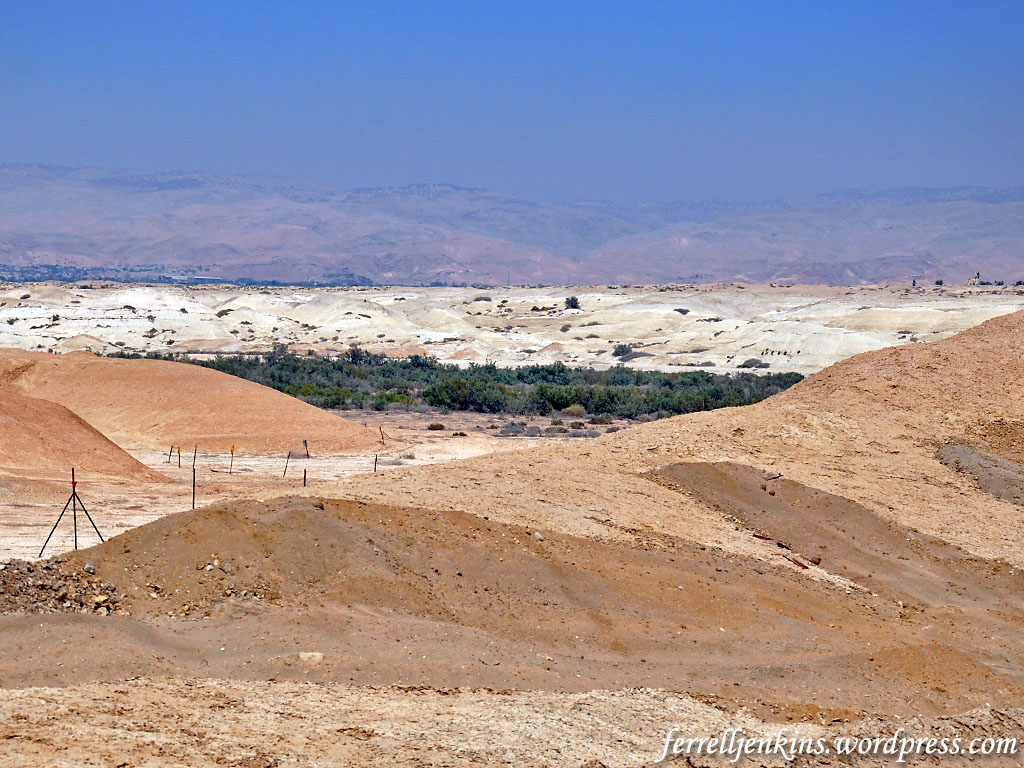
As we leave the River we stop to look back across the Ghor (depression) to the Zor (the thicket, shown as the green line) where the River flows. This is the view slightly north of the baptism site.

This photo shows the east side of the Jordan River in the foreground, the Ghor (depression) of the Jordan River, the Zor (thicket), the land of Perea on the east side of the Jordan and the mountains of Ammon. Photo by Ferrell Jenkins.

This photo shows the west side of the Jordan River in the foreground, the Ghor (depression) of the Jordan River, the Zor (thicket), the land of Perea on the east side of the Jordan, and the mountains of Transjordan in the haze. Photo by Ferrell Jenkins.

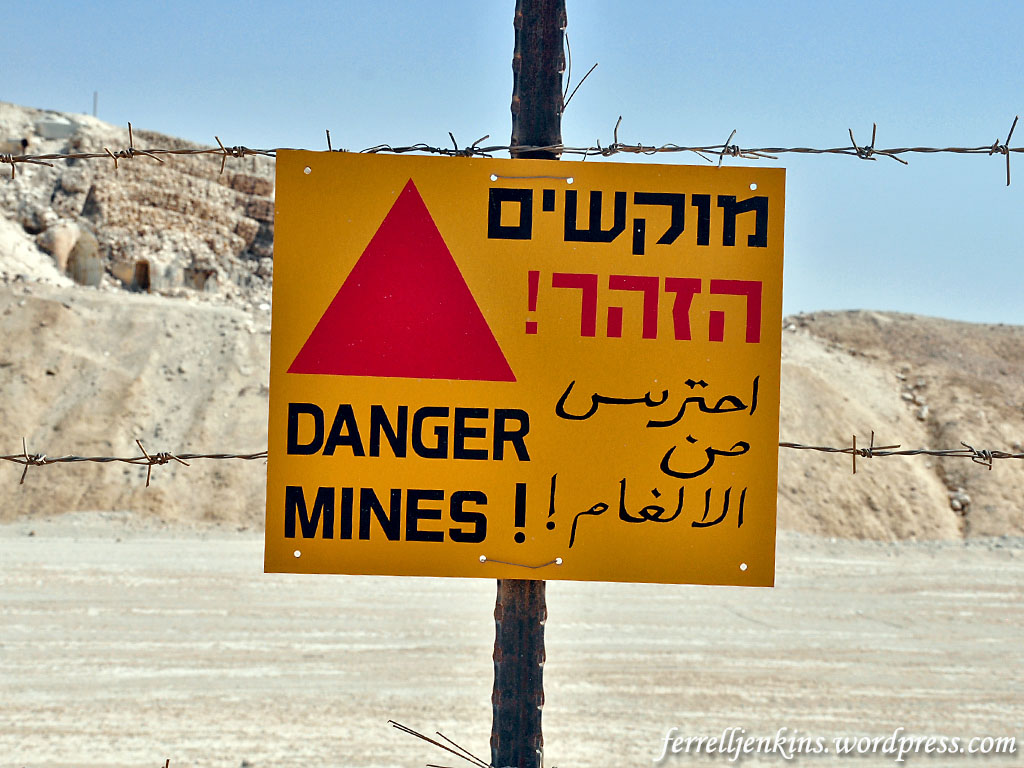
Barb wire and signs warn the adventurous from wandering off the dirt road leading back to Highway 90.

This is one of the signs warning of the landmines. We also see these in certain area of the Golan Heights. Photo by Ferrell Jenkins.

This is one of the signs warning of the landmines. We also see these in certain areas of the Golan Heights. Photo by Ferrell Jenkins.

Here are links to two recent articles from Israeli papers that I have enjoyed.

  • “Christian Pilgrims From Across the World Come to Israel to Visit This Site. There’s Just one Problem: It’s Sitting in a Minefield” (Haaretz).
  • “Israel will soon clear 4,000 landmines at Qasr al-Yahud baptism site” (Times of Israel).

In spite of many environmental warnings about the impurity of the water in the Jordan River at this site many groups continue to baptize there.

“I will make your enemies your footstool” – # 2

In the previous post we discussed the common motif found in the Ancient Near East showing a monarch with his foot on the neck of a subdued enemy. We discussed how this helps us visualize certain Biblical texts.

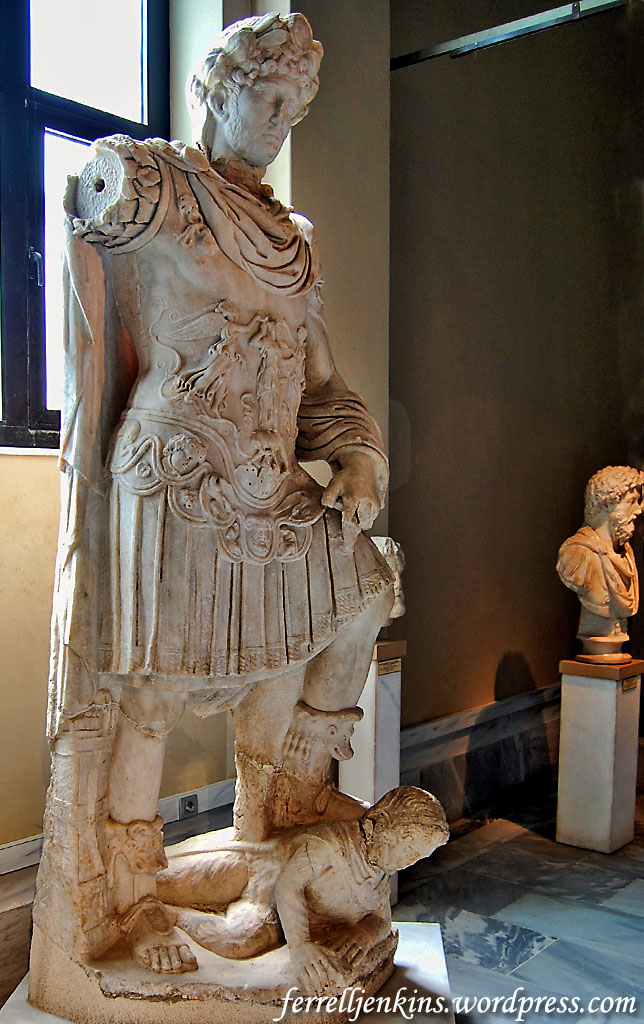
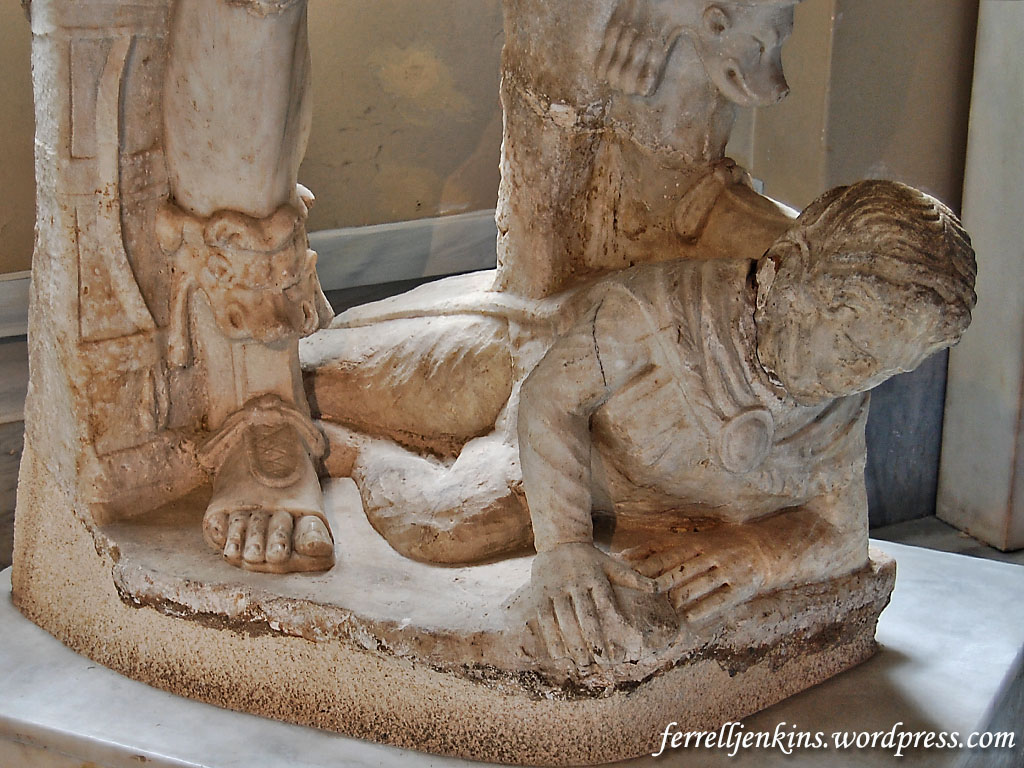
Here I wish to add an illustration from the Roman world shortly after New Testament times. In the statue below we see the Emperor Hadrian (A.D. 117-138) with his foot on the neck of an enemy.

Hadrian has his foot on the neck of an enemy. Istanbul Archaeology Museum. Photo by Ferrell Jenkins.

Hadrian has his foot on the neck of an enemy. Istanbul Archaeology Museum. Photo by Ferrell Jenkins.

This statue is displayed in the Istanbul Archaeology Museum in Istanbul, Turkey. It is made of marble and is said to have come from Hierapitna, Crete.

The photo below is a closeup of the captive with the Emperor’s foot on his neck.

Closeup of Hadrian with his foot on the neck of an enemy. Photo by Ferrell Jenkins.

Closeup of Hadrian with his foot on the neck of an enemy. Photo by Ferrell Jenkins.

In the New Testament, Peter quotes Psalm 110:1 to show that Jesus is now seated on the throne of David at the right hand of God (Acts 2:35).

The apostle Paul understood this. He said of Jesus,

For he must reign until he has put all his enemies under his feet. (1 Corinthians 15:25 ESV)

The last enemy is death (1 Corinthians 15:26).

The illustrations here and in the previous post are suitable for use in PowerPoint presentations for sermons and Bible classes. We only ask that you leave our credit line intact so others will know how to reach our material.

“I will make your enemies your footstool”

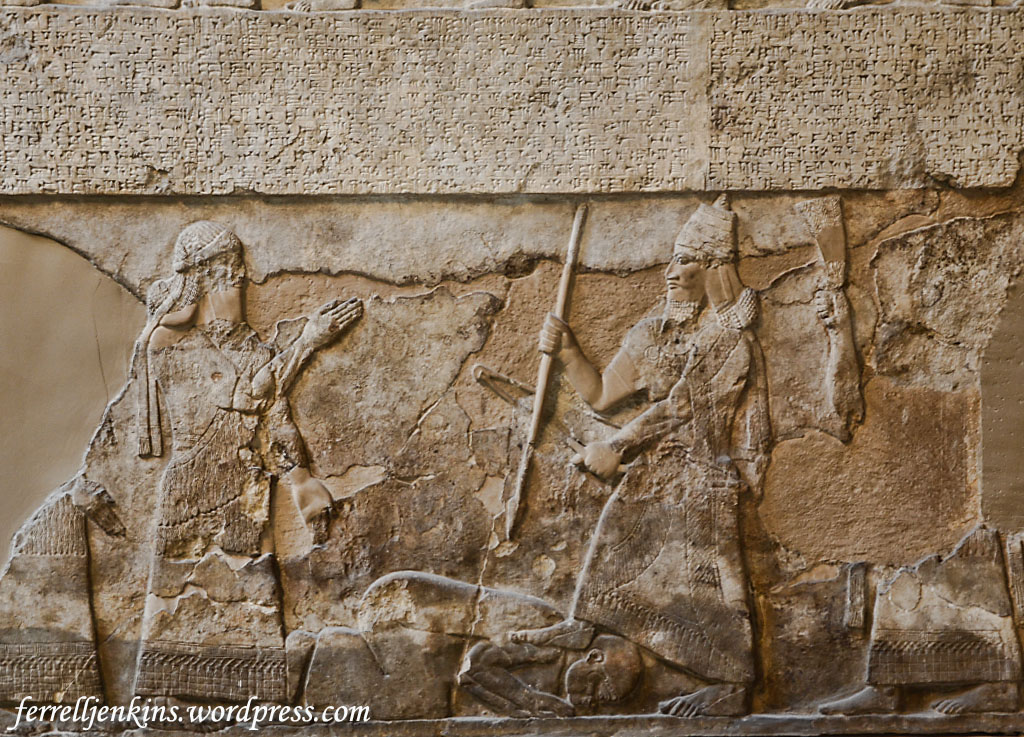
A common motif found in Ancient Near East reliefs shows a monarch placing his foot on his enemy. One illustration of this is the large relief showing the Assyrian King Tiglath-Pileser III (reigned 745-727 B.C.) with his foot on the neck of an enemy. Tiglath-Pileser III is known as Pul in the Bible.

Pul the king of Assyria came against the land, and Menahem gave Pul a thousand talents of silver, that he might help him to confirm his hold on the royal power. (2 Kings 15:19 ESV)

So the God of Israel stirred up the spirit of Pul king of Assyria, the spirit of Tiglath-pileser king of Assyria, and he took them into exile, namely, the Reubenites, the Gadites, and the half-tribe of Manasseh, and brought them to Halah, Habor, Hara, and the river Gozan, to this day. (1 Chronicles 5:26 ESV)

The Assyrian relief below is displayed in the British Museum.

Tiglath-Pileser III Subjugates an Enemy. British Museum. Photo by Ferrell Jenkins

Tiglath-Pileser III Subjugates an Enemy. Note the spear held above the body of the enemy. British Museum. Photo by Ferrell Jenkins

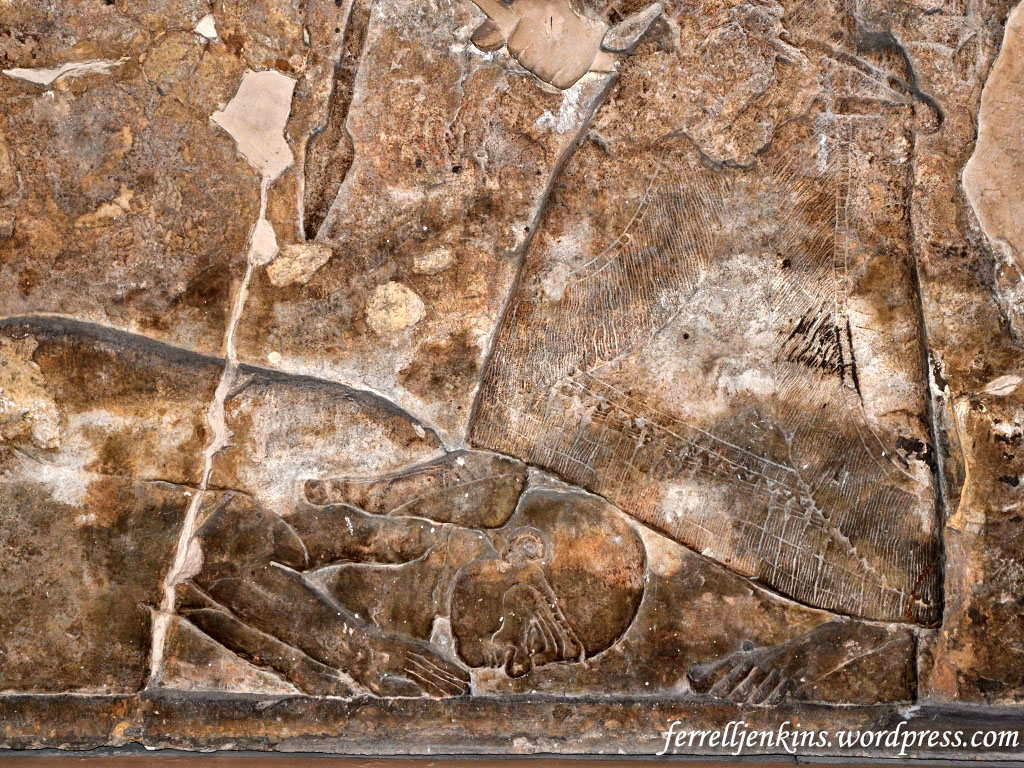
Here is a closeup of what we are seeking to illustrate.

Tiglath-Pileser III Puts His Foot on the Neck of an Enemy. BM. Photo by Ferrell Jenkins.

Tiglath-Pileser III Puts His Foot on the Neck of an Enemy. BM. Photo by Ferrell Jenkins.

Several biblical passages come to mind in this connection.

And when they brought those kings out to Joshua, Joshua summoned all the men of Israel and said to the chiefs of the men of war who had gone with him, “Come near; put your feet on the necks of these kings.” Then they came near and put their feet on their necks. (Joshua 10:24 ESV)

The LORD says to my Lord: “Sit at my right hand, until I make your enemies your footstool.” (Psalm 110:1 ESV)

Peter quotes Psalm 110:1 to show that Jesus is now seated on the throne of David at the right hand of God (Acts 2:35).

And Paul says,

For he must reign until he has put all his enemies under his feet. (1 Corinthians 15:25 ESV)

The last enemy is death (1 Corinthians 15:26).

Note: This post is a repeat of one we published October 21, 2011, but we have exchanged the photos for more recent ones.

In the next post we plan to show an illustration from the Roman world.