Category Archives: Jordan

A question about dolmen

A reader who read our report on the dolmen field in the Golan Heights ask on Facebook if these structures could be the high places or altars mentioned in the Old Testament. The simple answer is “No.” They are thought to be tombs.

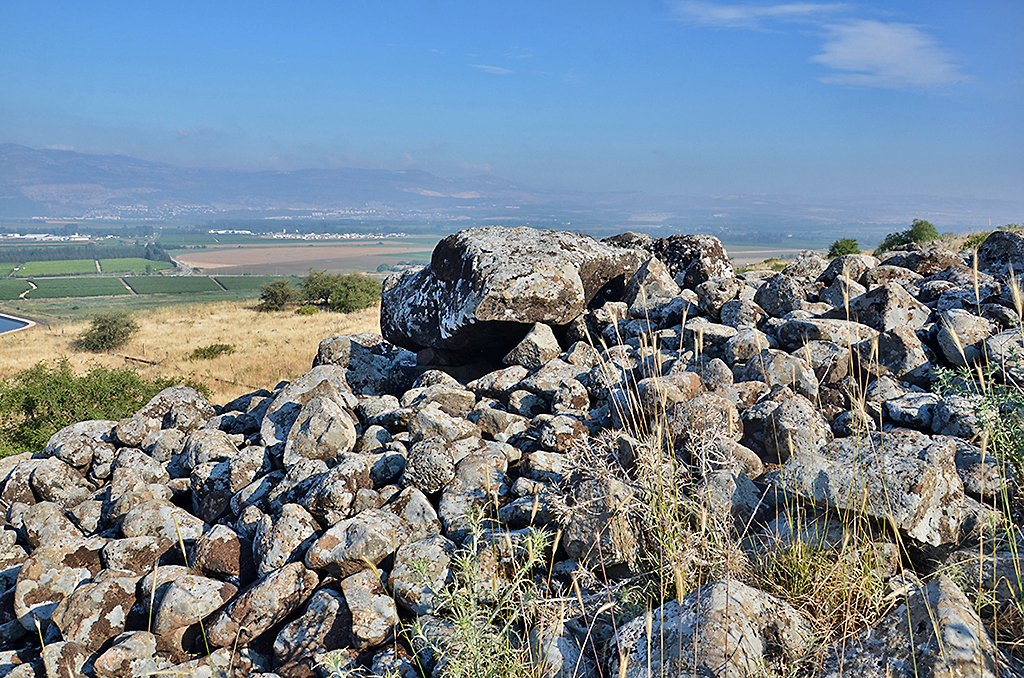
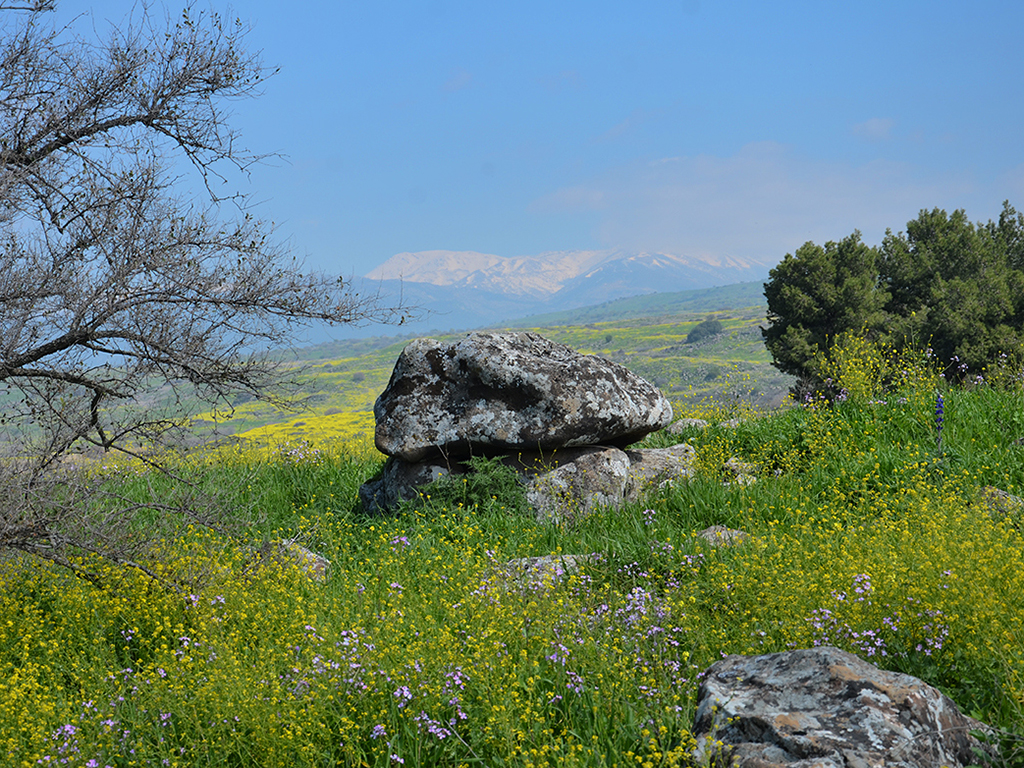
This photo of a dolmen was made at Gamla in the Golan Heights.

Dolmen at Gamla in the Golan Heights. Photo by Ferrell Jenkins.

Dolmen at Gamla in the Golan Heights. Photo by Ferrell Jenkins.

In an article about the Golan Archaeological Museum at Qatzrin in the Golan Heights, Nemlich and Killebrew make these comments:

Another strange sight on the Golan is fields of dolmens. Throughout the Golan, hundreds of dolmens are visible on the horizon. They are made of huge unworked basalt slabs and resemble giant stone tables. In fact the word dolmen derives from two Old Breton words—dol, meaning table, and men, meaning stone.

Dolmens were built to serve as tombs. Because of the absence of any associated contemporary house remains, we infer that the dolmen builders were nomadic or seminomadic tribesmen.

The Golan dolmens vary in size, ranging from those built of three or four large boulders to the giants measuring over 20 feet wide and rising to heights of over 10 feet. Some dolmens are free-standing, but many others are partially—or completely—covered by stone heaps, or tumuli. Still others are surrounded by circles of stones.

Beneath each table-like structure is a rectangular underground chamber with a paved floor and a roof made with heavy slabs. Apparently, this chamber was used for a secondary burial: About a year after death, when the flesh of the deceased had decayed, the bones were reburied in the chamber beneath the dolmen, together with a few funerary gifts of pottery vessels and weapons, usually of copper. Many dolmen chambers were reused as ready-made tombs, both in ancient and modern times. The earliest artifacts found in them, however, enable us to date them to the period archaeologists call Middle Bronze I—about 2200–2000 B.C. (a little before the most commonly dated period for the patriarchal age). (Nemlich, Shlomit and Ann Killebrew. “Recovering the Ancient Golan—The Golan Archaeological Museum.” Biblical Archaeology Review.  Nov/Dec 1988.)

There are other suggestions about the purpose of the dolmen. David E. Graves left this comment, with photos, on our Facebook page:

In 2009 we excavated an undisturbed dolmen in Jordan at Tall el-Hammam and recovered 16 EB whole vessels. We did not discover any skeletal remains and so hypothesis they were family memorials and used the table top to de-flesh the remains before reburial.

Perhaps the most fascinating thing about the recently announced discovery reported this past week is the images inscribed on the dome of the dolmen. The recent IAA Press Release says this,

The chamber inside the dolmen where the engravings were found on its ceiling is large, measuring 2 × 3 meters, and the stone covering it is also huge, weighing an estimated fifty tons at least! This is one of the largest stones ever used in the construction of dolmens in the Middle East. The dolmen was enclosed within an enormous stone heap (tumulus) c. 20 meters in diameter, and its stones are estimated to weigh a minimum of 400 tons. At least four smaller dolmens that were positioned at the foot of the decorated dolmen were identified inside the stone heap. In other words, what we have here is a huge monumental structure built hierarchically (with a main cell and secondary cells). This is the first time such a hierarchical dolmen has been identified in the Middle East.
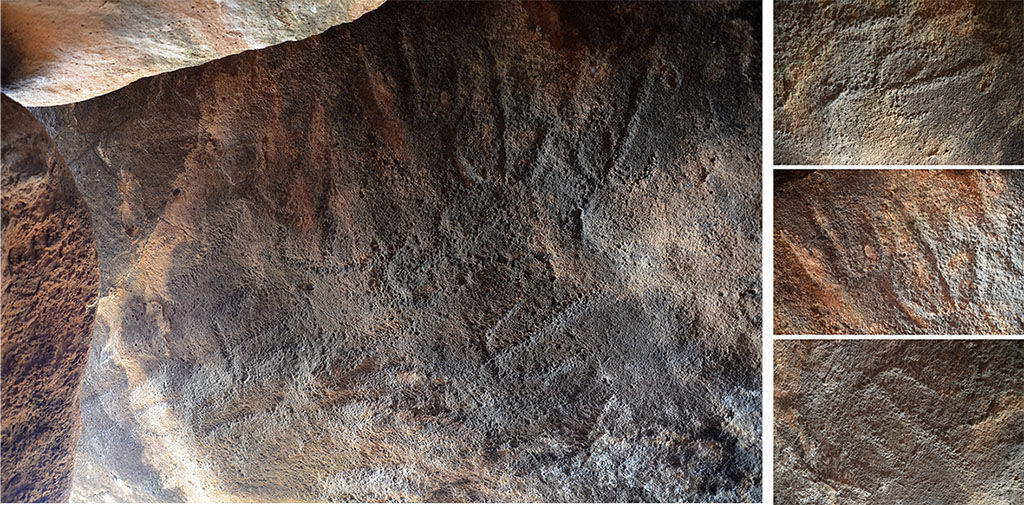
The engravings that were exposed on the inside of the built chamber. Photographic credit: Gonen Sharon, Tel Hai College.

The engravings that were exposed on the inside of the built chamber. Photographic credit: Gonen Sharon, Tel Hai College.

There is much more to learn about the dolmen.
Surprising ancient dolmen exposed in the Galilee

The Israel Antiquities Authority, in conjunction with Tel Hai College and Hebrew University of Jerusalem, released the following Press Release March 5, 2017.

The 4,000 year old dolmen.View facing north toward Mount Hermon. Photographic credit: Gonen Sharon, Tel Hai College.

The 4,000 year old dolmen.View facing north toward snow-covered Mount Hermon. Photographic credit: Gonen Sharon, Tel Hai College.

— “ —

A rare and mysterious ancient dolmen was  exposed that is more than 4,000 years old and decorated with ancient rock art

According to researchers, “This is the first art ever documented in a dolmen in the Middle East”

Archaeologists from Tel Hai College, the Israel Antiquities Authority and the Hebrew University of Jerusalem have recently discovered a mysterious dolmen (a large table-like stone structure) over 4,000 years old in a large field of dolmens, adjacent to Kibbutz Shamir in the Upper Galilee. What makes this dolmen so unique is its huge dimensions, the structure surrounding it and most importantly the artistic decorations engraved in its ceiling. The study was published last weekend (2/3) in the scientific journal PLOS One.

Aerial photograph of the dolmen field. Photo: Shmuel Magal, Courtesy Israel Antiquities Authority.

Aerial photograph of the dolmen field. Photo: Shmuel Magal, Courtesy Israel Antiquities Authority.

The dolmen was discovered during a fortuitous visit to the site by Professor Gonen Sharon of the Galilee Studies Program at the Tel Hai College. It is just one of more than 400 huge stone structures dating to the Intermediate Bronze Age (over four thousand years ago) that are located in the dolmen field around Kibbutz Shamir. When Professor Sharon entered the chamber built beneath the largest dolmen he was surprised to discover rock drawings engraved in its ceiling.

From left to right: Professor Gonen Sharon of Tel Hai College and Uri Berger of the Israel Antiquities Authority. Photographic credit: Shmuel Magal, courtesy of the Israel Antiquities Authority.

From left to right: Professor Gonen Sharon of Tel Hai College and Uri Berger of the Israel Antiquities Authority. Photographic credit: Shmuel Magal, courtesy of the Israel Antiquities Authority.

The discovery of the engravings led to a research project of the dolmen and its environs which produced new revelations concerning the dolmen phenomenon in Israel. “This is the first art ever documented in a dolmen in the Middle East”, said Uri Berger, an archaeologist with the Israel Antiquities Authority and partner in the study. “The engraved shapes depict a straight line going to the center of an arc. About fifteen such engravings were documented on the ceiling of the dolmen, spread out in a kind of arc along the ceiling. No parallels exist for these shapes in the engraved rock drawings of the Middle East, and their significance remains a mystery. The panel depicting the art was scanned in the field by the Computerized Archaeology Laboratory of the Hebrew University. By means of an innovative technique, a three-dimensional model of the engraving was produced. “The three-dimensional scan enabled us to identify engravings that otherwise could not be seen with the naked eye”, explained Professor Lior Grossman, the laboratory director.

The chamber inside the dolmen where the engravings were found on its ceiling is large, measuring 2 × 3 meters, and the stone covering it is also huge, weighing an estimated fifty tons at least! This is one of the largest stones ever used in the construction of dolmens in the Middle East. The dolmen was enclosed within an enormous stone heap (tumulus) c. 20 meters in diameter, and its stones are estimated to weigh a minimum of 400 tons. At least four smaller dolmens that were positioned at the foot of the decorated dolmen were identified inside the stone heap. In other words, what we have here is a huge monumental structure built hierarchically (with a main cell and secondary cells). This is the first time such a hierarchical dolmen has been identified in the Middle East.

The 4,000 year old dolmen. Credit: Gonen Sharon, Tel Hai College.

The 4,000 year old dolmen overlooking the Hula Valley. Credit: Gonen Sharon, Tel Hai College.

The 4,000 year old dolmen. Credit: Gonen Sharon, Tel Hai College.

The 4,000 year old dolmen. Credit: Gonen Sharon, Tel Hai College.

The huge dolmen at Kibbutz Shamir is just one of hundreds of enormous densely scattered structures in this region. It bears witness to the existence of a significant and established governmental system in the region during the “Middle Ages” of the Bronze Age. Archaeologists tend to interpret the past based on material finds. The absence of cities, large settlements and monumental buildings attests to the collapse of the governmental and economic systems during a “dark period” in history. The dolmens tell a different story about the period – a story about a society that had a complex governmental and economic system that executed monumental engineering projects but did not leave behind any other archaeological evidence.

“The gigantic dolmen at Kibbutz Shamir is without doubt an indication of public construction”, says Professor Sharon, “that required a significant amount of manpower over a considerable period of time. During that time all of those people had to be housed and fed. The building of such a huge construction necessitated knowledge of engineering and architecture that small nomadic groups did not usually possess. And even more importantly, a strong system of government was required here that could assemble a large amount of manpower, provide for the personnel and above all direct the implementation and control of a large and lengthy project”.

Despite all this, the circumstances surrounding the construction of the dolmens, the technology involved in it and the culture of the people who built them are still one of the great mysteries of the archeology of Israel.

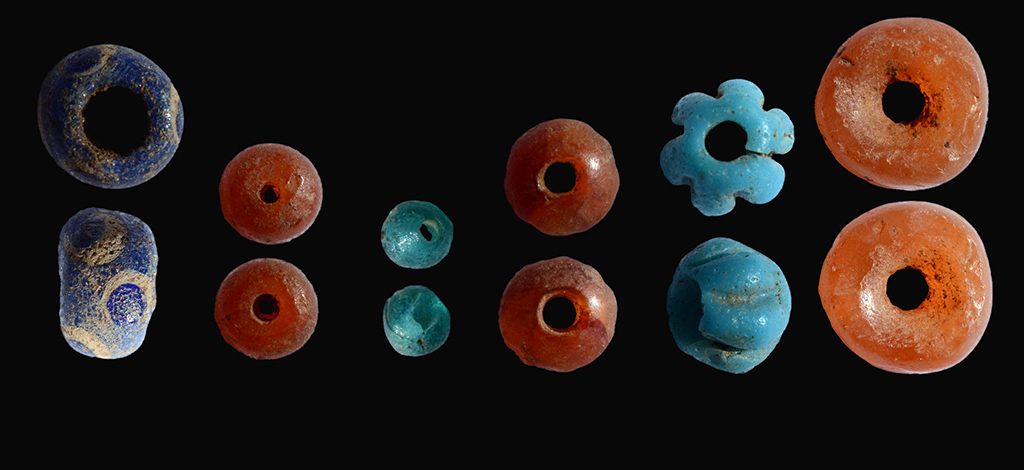
Colored beads that were uncovered in the archaeological excavation inside the dolmen. Credit: Shmuel Magal, courtesy of the Israel Antiquities Authority.

Colored beads that were uncovered in the archaeological excavation inside the dolmen. Credit: Shmuel Magal, courtesy of the Israel Antiquities Authority.

What is a Dolmen – A dolmen (stone table) is a megalithic structure (mega = large, lithos = stone) thousands of years old that is built of huge stones. The basic shape of the dolmen resembles a table, and most of them are surrounded by a heap of stones. Dolmens are known elsewhere in the world, from Ireland to Korea. Thousands of dolmens are scattered across the Middle East, from Turkey to Yemen. In the Golan Heights thousands of dolmens of different types were identified which are scattered in concentrations (dolmens fields) on the plateau. Although they are very common and stand out quite prominently in the landscape of ancient Israel, the mystery surrounding the dolmens’ age and their purpose have still not been resolved.

The Dolmen Field at Kibbutz Shamir– the field was first surveyed by the late Moshe Kagan in the 1950’s. More than 400 huge structures overlooking the Hula Valley were identified in the field.

— ” —

HT: Israeli newspapers; Joseph Lauer

Roman soldiers in the region of Decapolis

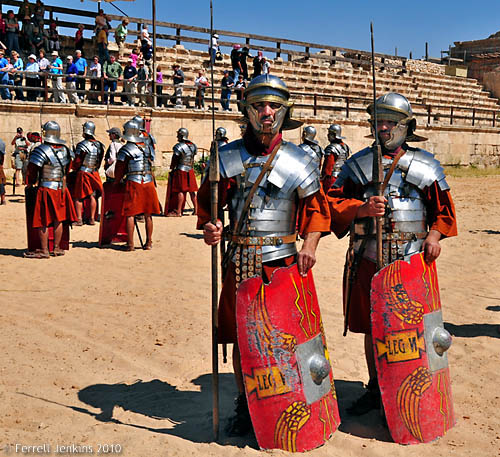
The RACE show at Jerash, Jordan, is a must if you have the opportunity to visit the area. RACE stands for Roman Army and Chariot Experience. You will see actors in authentic dress as armed legionaries, gladiators, and a short chariot race. The show takes place in the Roman hippodrome of Jerash. The view of the city ruins in the vicinity make this a wonderful setting for the performance. Full details may be found here. I have seen the program three times. On the last visit, earlier this year, I thought the performers showed less discipline and the show was not quite as good as on my previous visits.

Jerash was the second largest city of the Decapolis (after Damascus) in New Testament times. People from the Decapolis followed Jesus during His ministry in Galilee (Matthew 4:23-25). When Jesus traveled through the Decapolis he possibly visited the area around Jerash (Mark 7:31).

The photo shows the Roman soldiers of the 6th Legion from the time of the Emperor Hadrian (A.D. 117-138). A visit to this show provides several good photographs to illustrate New Testament times.

Roman soldiers at Jerash, Jordan. Photo by Ferrell Jenkins.

Roman soldiers at Jerash, Jordan. Photo by Ferrell Jenkins.

Repeat from October 8, 2010.

A wadi along the King’s Highway

The King’s Highway is mentioned by name in Numbers 20:17 and 22. As the Israelites made their slow trek toward the promised land (Genesis 12:7; 15:7) they asked permission to go through the land of Edom.

 17 Please let us pass through your land. We will not pass through field or vineyard, or drink water from a well. We will go along the King’s Highway. We will not turn aside to the right hand or to the left until we have passed through your territory.”
18 But Edom said to him, “You shall not pass through, lest I come out with the sword against you.”
19 And the people of Israel said to him, “We will go up by the highway, and if we drink of your water, I and my livestock, then I will pay for it. Let me only pass through on foot, nothing more.”
20 But he said, a”You shall not pass through.” And Edom came out against them with a large army and with a strong force.
21 Thus Edom refused to give Israel passage through his territory, so Israel turned away from him. (Numbers 20:17-21 ESV)

After going around Edom, Israel sent messengers to the Amorites with a request to go through their land.

“Let me pass through your land. We will not turn aside into field or vineyard. We will not drink the water of a well. We will go by the King’s Highway until we have passed through your territory.” (Numbers 21:22 ESV)

Rasmussen suggests that the first reference is to the East-West route from Kadesh Barnea to Edom. He says,

The second reference is possibly to a portion of the N-S Transjordanian route that connects Edom/Arabia with points to the N. (Zondervan Atlas of the Bible, p. 290).

Sihon, the king of the Amorites, went out to fight Israel. According the the biblical account Israel was successful and settled in cities of the Amorites. Reference is made to Heshbon and the Arnon, now known as the Arnon Gorge or Wadi el-Mujib. As a point of reference the Arnon is about 35 miles south of modern Amman, Jordan.

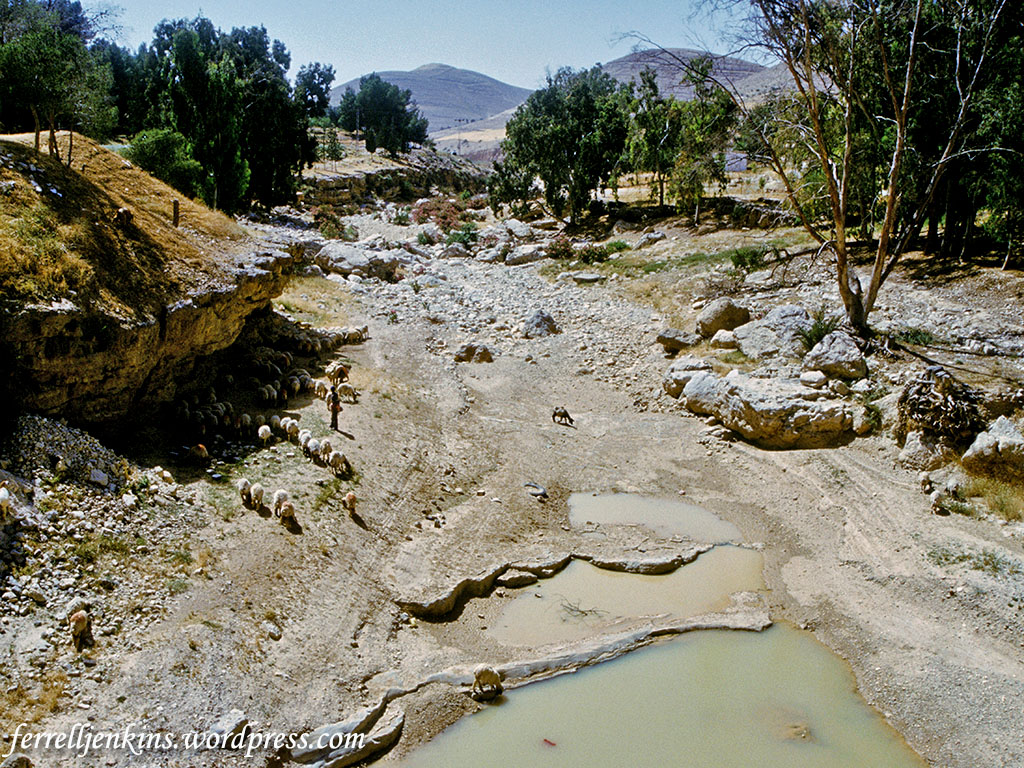
Our photo shows a wadi along the King’s Highway between Heshbon and the Arnon.

A wadi between Madaba and the Arnon Gorge along the King's Highway in transjordan. Photo by Ferrell Jenkins.

A wadi between Heshbon and the Arnon Gorge along the King’s Highway in transjordan. Photo by Ferrell Jenkins.

This photo was made in mid-May. The shepherd finds shade for his sheep, and a place where some water remains. I think the overhanging rock gives us some indication how high the stream gets when it rains. (NB: I wonder if perhaps this water has been brought in by truck for the sheep.)

Thomas Levy reminds us that “Nahal, incidentally, is Hebrew for a dry river bed or valley that flows at most a few times a year. In Arabic, the word is wadi. The two words are used interchangeably in Israel today.” The wadi is similar to the arroyo of the American southwest. (Biblical Archaeology Review, 1990).

“You brood of vipers”

When the Pharisees and Sadducees came to John the Baptist for baptism, John said,

But when he saw many of the Pharisees and Sadducees coming to his baptism, he said to them, “You brood of vipers! Who warned you to flee from the wrath to come?”  (Matthew 3:7 ESV)

Jesus used the same language of the Scribes and Pharisees.

You serpents, you brood of vipers, how are you to escape being sentenced to hell? (Matthew 23:33 ESV) cf. 12:34)

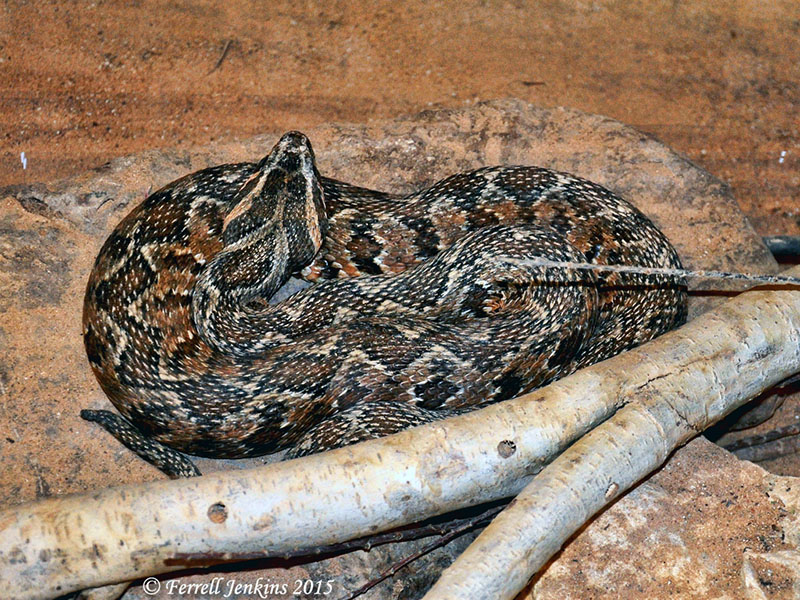
The photo below shows the Palestinian Viper (behind tough plastic!) at the Hai Bar Animal and Nature Reserve, north of Eilat, Israel.

Palestinian Viper at the HaiBar Reserve near Eilat, Israel. Photo by Ferrell Jenkins.

Palestinian Viper at the HaiBar Reserve near Eilat, Israel. Photo by Ferrell Jenkins.

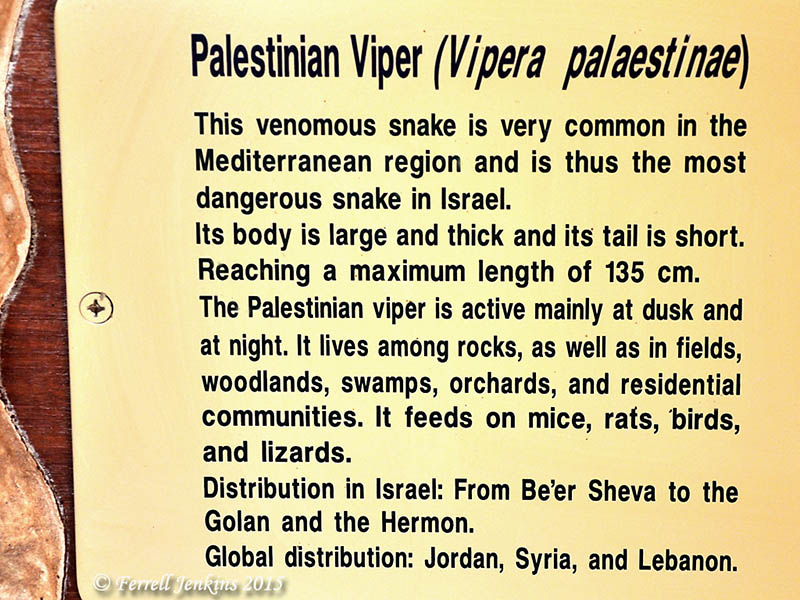
The sign at the Reserve gives some explanation about this poisonous viper.

Description of the Palestinian Viper at HaiBar Reserve.

Description of the Palestinian Viper at HaiBar Reserve.

A visit to Hai Bar is a wonderful experience.

Update

Dr. David E. Graves left a photo and some comments to this post on Facebook. I wanted to repeat them here so more readers could see.

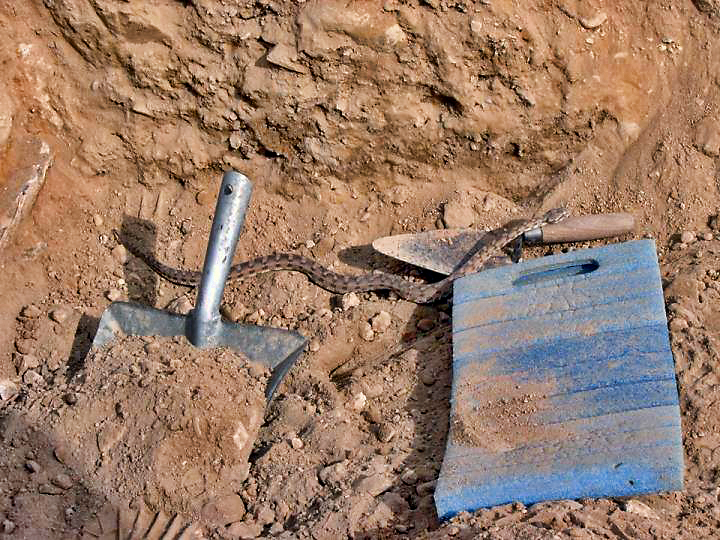
Palestinian Viper at Tall el-Hammam. Photo by Dr. David E. Graves.

Palestinian Viper at Tall el-Hammam. Photo by Dr. David E. Graves.

David says, “I was sitting on a rock excavating [at Tall el-Hammam in the Jordan Valley] and the snake was hibernating (winter) under it. I stood up to take a picture of a lizard and the snake appeared out of the same hole.

He adds, “The locals call the snake a 5 stepper!! If you get bit you get 5 steps and your down.”

Tristram’s Grackle and other Grackles

Today’s The New York Times has an article in the Science section about “The Grackle’s Secret to Success” here, including a short video of the experiments. It seems that many parts of earth have their own variety of Grackle. And some of them are causing lots of problems for cattle and dairy farms.  The particular bird causing problems for the USA is the great-tailed bird, native to Central America.

Over the past century or so the bird has spread north and its range is still expanding, particularly in the West, where it haunts cattle feed lots and big dairy farms.

Looks like we need a bird wall. Anyway, the article says the birds look smart, but the experiments that were conducted with the birds seemed to prove otherwise.

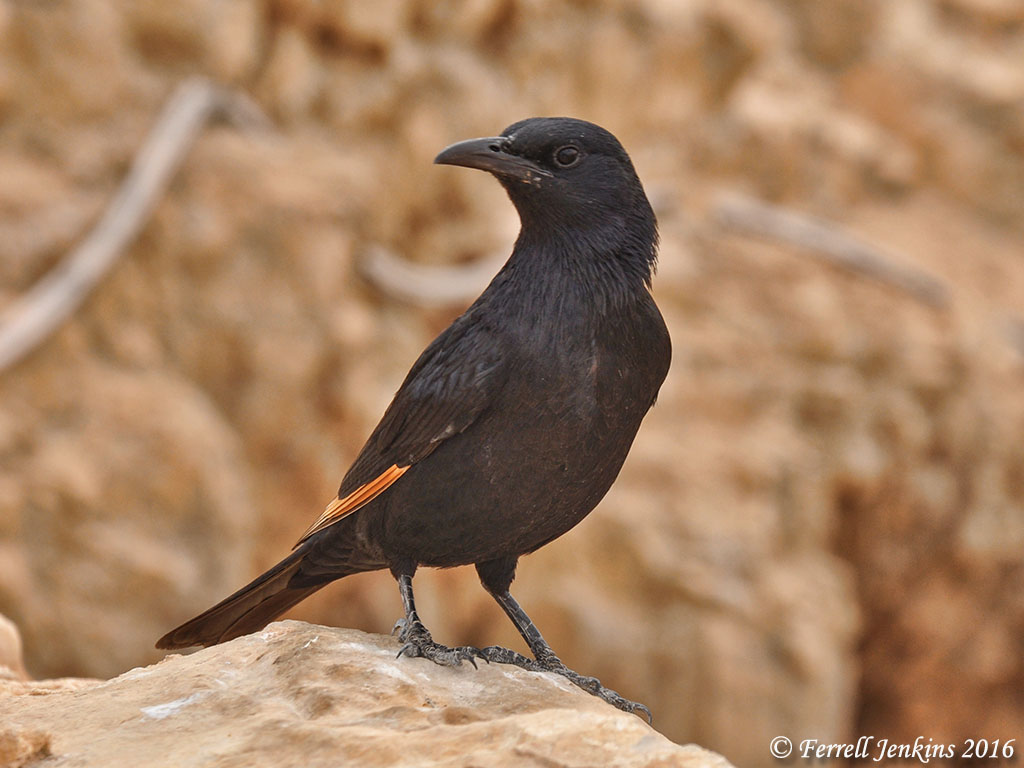
In the desert areas of Israel and Jordan the Grackle is known as Tristram’s Grackle, named for Henry B. Tristram who wrote The Natural History of the Bible in 1868, and numerous other books about the Bible Lands. I am intrigued by the bird every time I visit Masada, along the shore of the Dead Sea. This black bird with some distinctive orange feathers is known as Tristram’s Grackle, or Tristram’s Starling, and is easy to photograph. They like to pose.

Tristram's Grackle at Masada. Photo by Ferrell Jenkins.

Tristram’s Grackle at Masada. Photo by Ferrell Jenkins.

Other photos of the bird may be seen here and here. The photo in the last entry reminds me of the experiments mentioned in the NYTimes article.

“It is the Land of Honey” – Tel Rehov discoveries on display at Eretz Israel Museum

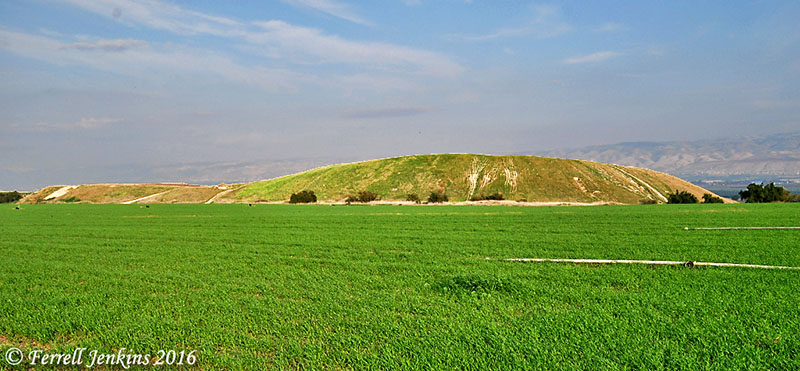
Tel Rehov is located about three miles south of Beth-Shean (Beth-Shan) on the east side of Highway 90. Rehov is not mentioned in the Old Testament, but it is known from Pharaoh Shishak’s city list on the wall of the temple of Amun in the Karnak Temple at Luxor, Egypt. This campaign is also mentioned in the pages of the Bible (1 Kings 14:25-28; 2 Chronicles 12:2-9).

Tel Rehov was occupied during the Bronze Age and the Iron Age. The city may be one of those not captured by Israel when they entered the Land under the leadership of Joshua.

The men of Manasseh did not conquer Beth Shan, Taanach, or their surrounding towns. Nor did they conquer the people living in Dor, Ibleam, Megiddo or their surrounding towns. The Canaanites managed to remain in those areas. Whenever Israel was strong militarily, they forced the Canaanites to do hard labor, but they never totally conquered them. (Judges 1:27-28 NET; cf. Joshua 17:12)

The city was destroyed by the Assyrians in the eighth century B.C. as they made their steady trek south.

Archaeological excavations were conducted at Tel Rehov from 1997 to 2012 under the direction of Prof. Amihai Mazar and Dr. Nava Panitz-Cohen of the Hebrew University of Jerusalem. For information and photos see the excavation website here.

View east of Tel Rehov in the Beth Shean Valley. Photo by Ferrell Jenkins.

Tel Rehov in the Beth-Shean Valley to the east of Highway 90. The mountains of Gilead are visible in the distance. Photo by Ferrell Jenkins.

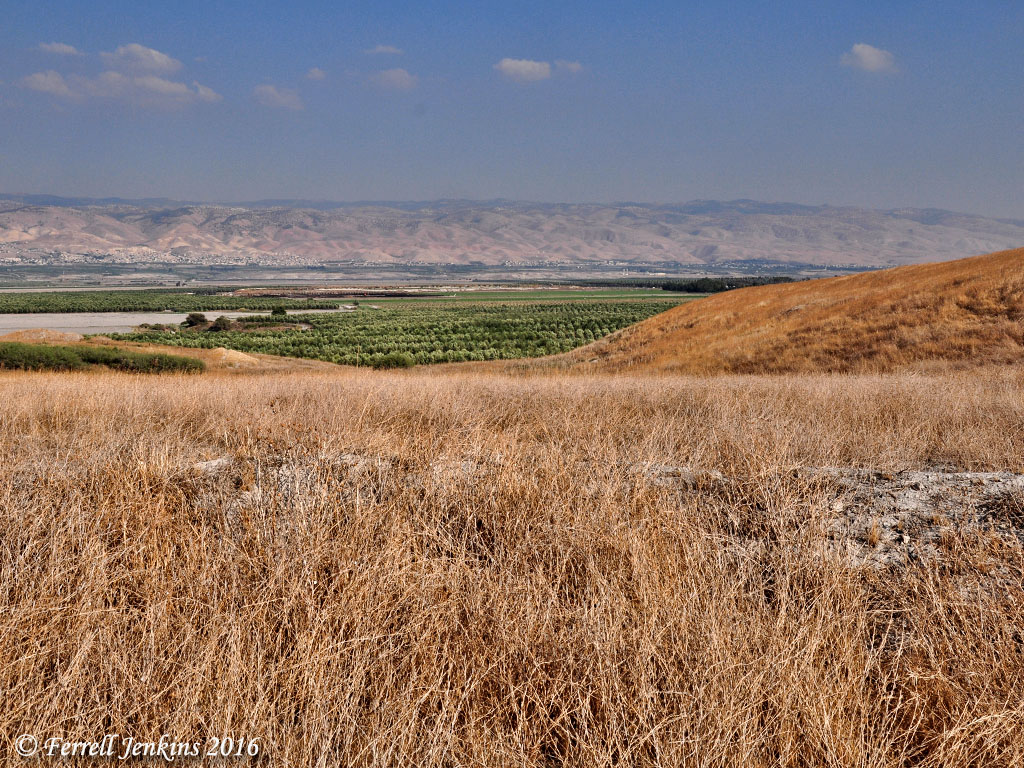
The next view takes us to the top of the mound. From there we see the Jordan Valley and a nice view of the Gilead mountains in modern Jordan.

View east from atop Tel Rehov. We see the Jordan Valley and the Gilead mountains. Photo by Ferrell Jenkins.

View east from atop the north end of Tel Rehov. We see the Jordan Valley and the Gilead mountains in the distance. Photo by Ferrell Jenkins.

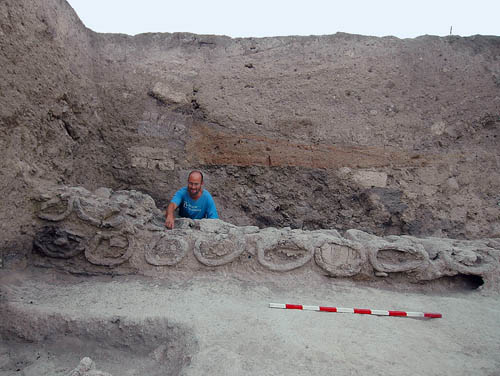
Many artifacts, including numerous household and cult objects, were uncovered at Tel Rehov. Perhaps the most unusual find was an industrial apiary. The small photo below from the excavation web site shows some of the beehives made of clay.

 Apiary at Tel Rehov, the eastern row of hives © Copyright - The Beth-Valley Archaeological Project, Hebrew University of Jerusalem,

Apiary at Tel Rehov, the eastern row of hives. © Copyright – The Beth-Shean Valley Archaeological Project, Hebrew University of Jerusalem,

From January 12 to October 31, 2016, items from Tel Rehov are exhibited at the Eretz Israel Museum in Tel Aviv under the title It Is the Land of Honey. I had the opportunity to visit this exhibition in April. The Museum website provides detailed information about the exhibition and a few small photos here.

The houses at Tel Rehov during Iron Age IIA differed from the typical houses found in known Israelite cities. According to the Museum website,

A salient feature of the Iron Age IIA city was the exclusive use of mudbrick to construct all buildings, incorporating wooden beams in walls and floors. Each building was unique in its architectural plan, and did not resemble any of the common blueprints of the Iron Age II, such as four-room houses or pillared buildings.

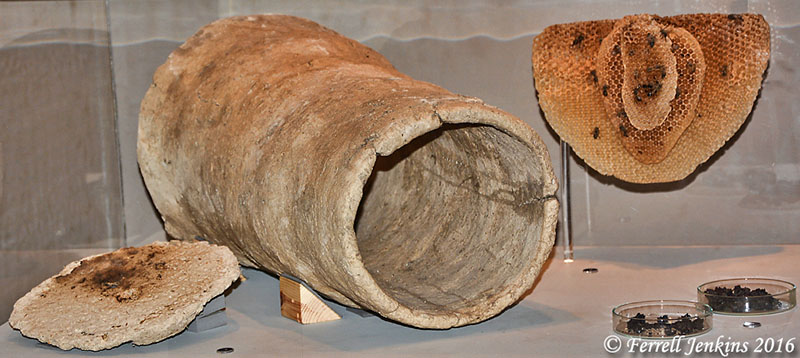
The photo below shows one of the clay beehives. A reconstruction of a honeycomb is visible on the right. Some of the bees found in the hives were determined to be from Anatolia, modern central Turkey. This adds one more piece of evidence showing how interconnected the nations of the ancient Middle East were. Some of the bees found in charred honeycombs are in the petri dishes in the front right of the photo. The lid of the beehive, with a hole in the center, is to the left of the hive. Click on the photo for a larger image.

One of the beehives from the Tel Rehov apiary. Eretz Israel exhibit. Photo by Ferrell Jenkins.

One of the beehives from the Tel Rehov apiary. Eretz Israel exhibition. Photo by Ferrell Jenkins.

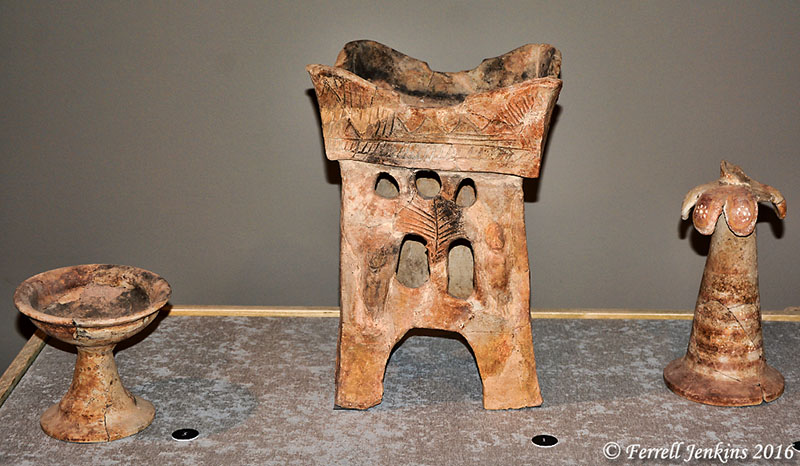
The exhibition includes a large display of items from Tel Rehov. I will list just a few.

  • Several four horned altars made of clay.
  • A wide variety of household pottery, including an oven of the period.
  • One of the mud bricks of which the houses were constructed.
  • A reconstructed loom with weights found during the dig. Several others items from the “House of Elisha” are on display. The ostracon with the name of Elisha written on it in red ink is not displayed, but there is information about it in the exhibition book. There were several altars in this house.
  • A storage jar had the name Nimshi inscribed on it – the name identical to that of King Jehu’s grandfather (1 Kings 19:16; 2 Kings 9:2).
  • Some iron blades, arrow heads, and possibly a sickle.
  • Some typical Canaanite clay fertility goddesses.
  • Stamped jar handles unique to Tel Rehov.
Horned altar and chalices from Tel Rehov. Photo by Ferrell Jenkins.

Tower shaped horned altar and chalices from Tel Rehov found in the area of the apiary. This altar is listed as being on loan from the Israel Museum in the exhibition book. If you miss the exhibition in Tel Aviv, perhaps you can see it later in the Israel Museum. Photo by Ferrell Jenkins.

The Museum has produced a nice 256-page book in Hebrew and English about Tel Rehov and the exhibition. I don’t see it listed at Amazon, but if you visit the exhibition you will probably wish to purchase a copy at the Museum shop.

Mazar and Panitz-Cohen published a brief article, with several photos of Tel Rehov artifacts, under the title “To What God? Altars and a House Shrine from Tel Rehov Puzzle Archaeologists” in the July/August 2008 Biblical Archaeology Review.

A glimpse of the River Jordan

The Jordan River is shy, rarely revealing very much of itself. As we travel in the Jordan Valley from the Sea of Galilee to the Dead Sea we only see the river on a few occasions. Even then we only see short distances.

The photo below is one I made yesterday about 12 km. south of the Sea of Galilee. You can see the dirt road on the Israeli side of the border and the River in Jordan.

The Jordan River flowing into Jordan for a short distance. Photo by Ferrell Jenkins.

The Jordan River flowing into Jordan for a short distance. Photo by Ferrell Jenkins.

Bible students enjoy visiting the Jordan River for several reasons.

  • The ancient Israelites crossed the Jordan to enter the land that had been promised to the seed of Abraham (Joshua 3).
  • Elijah and Elisha crossed the river (2 Kings 2).
  • John baptized in the Jordan (Matthew 3:6ff.; Mark 1:5-9; John 1:28; 10:40).
  • Jesus was baptized in the Jordan (Matthew 3:13).
  • Naaman, the Aramean [Syrian] military commander, dipped in the Jordan at a site further south (2 Kings 5).

I have been unable to post very much while traveling in Israel, but the mother of my favorite grandson said I should be posting more. She knows how to get things done.

The Dead Sea: what is deader than dead?

Haaretz, an Israeli newspaper, has a fabulous article about the Dead Sea which they call “Israel’s endangered natural wonder.” This report consists of an article, photographs, aerial footage, and an animated map showing how the Dead Sea is drying up. The article is by Nir Hasson. Use this link to access all of the material.

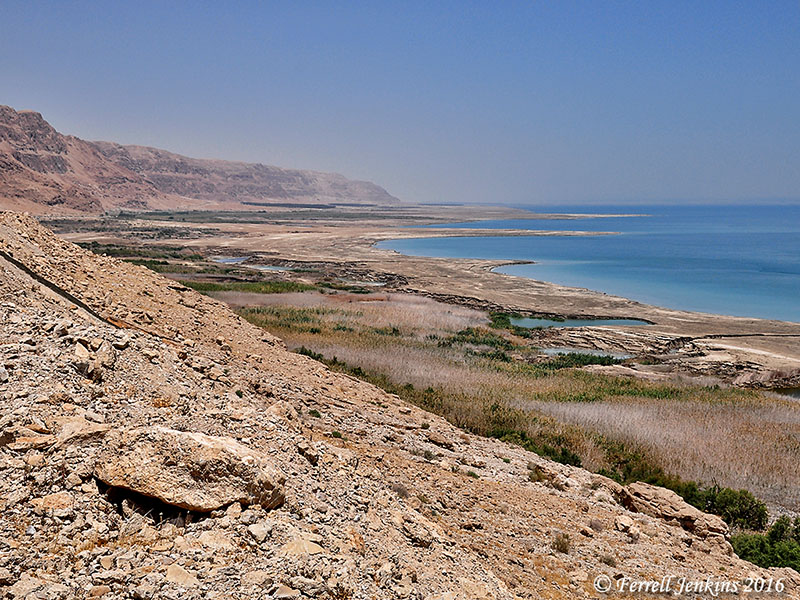
In 1972 the Dead Sea was about 1301 feet below sea level. This year it is more than 1407 feet below sea level. Water that once flowed all the way from Mount Hermon and the streams of both Cis-Jordan and Trans-Jordan is now being used to provide water for the population and agricultural interests.

In my photo below you will see a few of the sinkholes that have been formed in recent years. According to Hasson there were 220 sinkholes along the shore in 1996, but in 2015 the count had risen to 5,548. The water of the Sea once covered all of the area below where I was standing to make the photo.

Sinkholes along the western shore of the Dead Sea. Photo by Ferrell Jenkins.

Sinkholes along the western shore of the Dead Sea. Photo by Ferrell Jenkins.

Previously we have called attention to the photos of the sinkholes by Shmuel Browns, Israel Tour Guide. This would be a good time to take a look at them if you have not done so before. Go here.

The Dead Sea is called the Salt Sea in the Old Testament (Genesis 14:3; Numbers 34:3, 12; Deuteronomy 3:17, et al.

The Jordan River

Bible students enjoy visiting the Jordan River for several reasons.

  • The ancient Israelites crossed the Jordan to enter the land that had been promised to the seed of Abraham (Joshua 3).
  • Elijah and Elisha crossed the river (2 Kings 2).
  • John baptized in the Jordan (Matthew 3:6ff.; Mark 1:5-9; John 1:28; 10:40).
  • Jesus was baptized in the Jordan (Matthew 3:13).
  • Naaman, the Aramean [Syrian] military commander, dipped in the Jordan at a site further north (2 Kings 5).

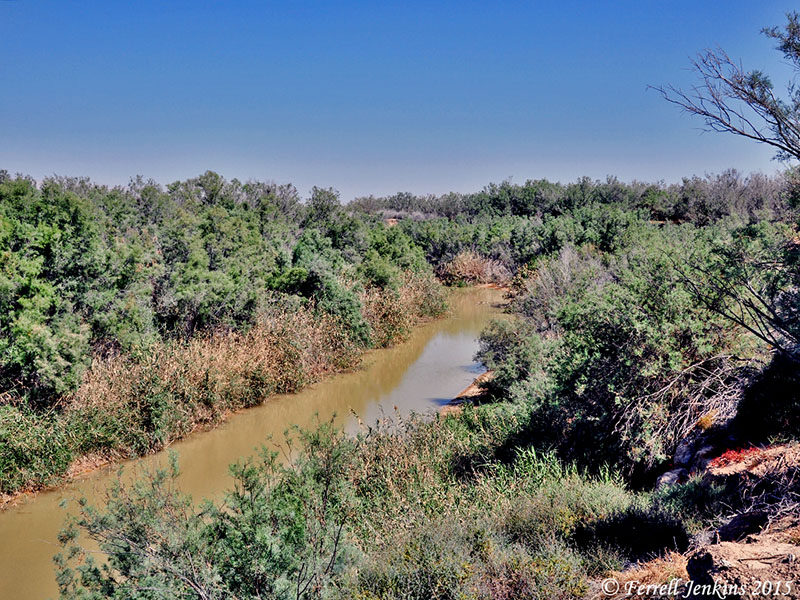
This photo of the Jordan River was made from Bethany Beyond the Jordan, in Jordan, May, 2010.

The Jordan River at Bethan Beyond the Jordan. Photo by Ferrell Jenkins.

The Jordan River at Bethany Beyond the Jordan. Photo by Ferrell Jenkins.

At this point the river is about 405 meters (1330 feet) below sea level.