Category Archives: Jordan

The popularity of inspirational religious tours

USA Today has an article about “Inspirational religious tours” about the variety of tours available to people who wish to follow the steps of this or that religious person. Here are some comments about Israel and Jordan that you might find interesting.

Kevin Wright says the volatile political situation in the Middle East can present challenges for religious-themed tour operations. “The perception of violence is always the number one challenge for tour operators and travel providers selling trips to the Holy Land,” he explains. “However, any violence that takes place in the Middle East is typically far removed from the traditional tourist sites. Hence, the biggest challenge for travel companies selling the Holy Land is overcoming the misperceptions of violence in tourist areas.”

Lately, that perception hasn’t slowed visitation to Israel and Jordan—both countries had record numbers of visitors last year. Israel hosted more than half a million Americans in 2007, an all-time high, (according to the country’s tourism commissioner), and Jordan’s Tourism Board said the country’s tourism revenues increased by more than 13% in 2007.

Is they have for millennia, the world’s holy sites continue to exert a powerful draw over the faithful and the curious. These days, with modern transportation and updated standards of travel, it’s getting easier to walk in the footsteps of the holy ones, with much less of that ancient travail.

Read the entire article here.

The tours I direct are study tours, but almost everyone who travels with us finds the tour inspirational. Most of those who travel with us do so in an effort to increase their understanding of the Bible. This view of Jerusalem from the Mount of Olives is inspirational to a lot of people.
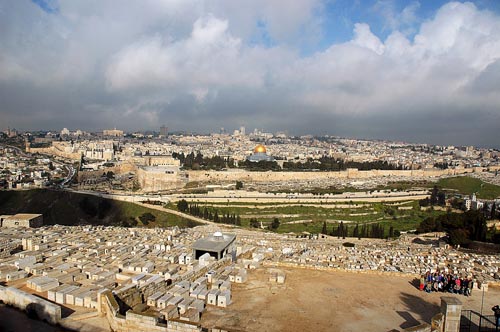
Jerusalem From the Mount of Olives. Photo by Ferrell Jenkins.

The Death of Aaron on Mount Hor

When Aaron, Israel’s first High Priest, died his son Eleazar became the High Priest. The book of Numbers says that Aaron died on the mountain top of Mount Hor.

“Take Aaron and his son Eleazar and bring them up to Mount Hor; and strip Aaron of his garments and put them on his son Eleazar. So Aaron will be gathered to his people, and will die there.” So Moses did just as the LORD had commanded, and they went up to Mount Hor in the sight of all the congregation. After Moses had stripped Aaron of his garments and put them on his son Eleazar, Aaron died there on the mountain top. Then Moses and Eleazar came down from the mountain. When all the congregation saw that Aaron had died, all the house of Israel wept for Aaron thirty days.” (Numbers 20:25-29, NASB).

Deuteronomy records that Aaron died at Moserah (10:6), but it also records that he died on Mount Hor (32:50). We need not think of this as a discrepancy.

The best solution that can be posed to this problem so far is that Moserah is probably a larger area that included Mount Hor. Thus it would be quite correct to declare that Aaron’s death was either on Mount Hor (Num 20:22–29; 33:38–39; Deut 32:50) or Moserah (Deut 10:6). (Hard Sayings of the Bible, 166).

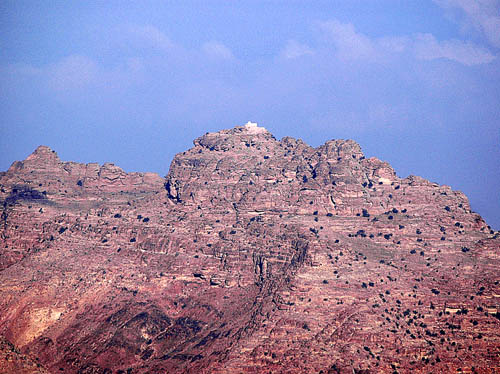
Mount Hor is identified traditionally with Jebel Nebi Harun in the territory of ancient Edom near Petra. From the area of the hotels above Petra one can see the white Moslem shrine marking the tomb of Aaron on the top of Mount Hor. This photo shows the monument in the distance. The mountains reflect the typical color of the area around Petra.

Mount Hor near Petra in Jordan. Photo by Ferrell Jenkins.

Sunset at the Dead Sea

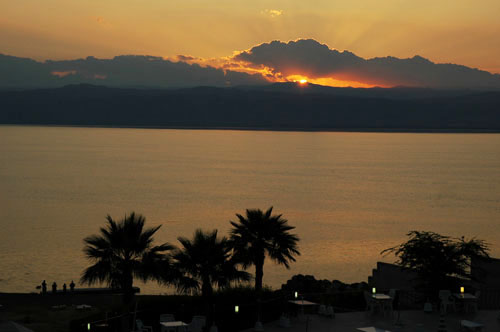
Here is a photo that I made at sunset on the shores of the Dead Sea in Jordan. The view looks west over the sea and the mountains of Judea between Bethlehem and Jerusalem. The Dead Sea is called the Salt Sea in the Bible (Genesis 14:3; Numbers 34:3, 12). The width of the sea at this point is about 11 miles. The level of the Dead Sea is now almost 1400 feet below [Mediterranean] sea level. This northern end of the Dead Sea is about 1300 feet deep.

Sunset at the Dead Sea, looking toward the mountains of Judea. Photo by Ferrell Jenkins.

Approaching Y20K

When we began this little blog to post photos of our Ancient Crossroads Tour of Biblical and Historical Turkey, we never even thought about reaching 20,000 hits. But, it should happen today. Thanks for making this a site you visit regularly.

There are many things I would like to blog about if I could find the time, but I have basically tried to limit myself to things pertaining to travel in the Bible lands.

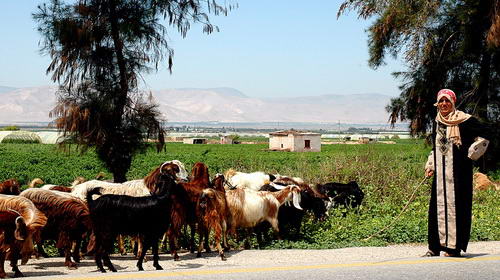
As our gift to you for traveling along with us, here is a picture of a woman caring for goats in the Jordan River valley on the east side. This photo was made in the Hashemite Kingdom of Jordan, looking across to Israel. In Roman times (the period of the New Testament) this area was known as Perea. The New Testament never uses the word Perea, but the Greek New Testament has the word peran (translated beyond), in the phrase “beyond the Jordan” (Matthew 19:1; John 1:28; 10:40). Jesus spent a considerable about of time in this region (John 10:40-42; Luke 13:22-35, et al.).

Caring for Goats in the Jordan Valley, the area of Perea in New Testament times. Photo by Ferrell Jenkins.
The desolate looking area across the valley is the northern end of the Wilderness of Judea. The Jordan River is rarely visible because it flows in a depression known as the Zor. The Zor is a depression cut into a wider depression called the Ghor. This valley is several hundred feet below sea level, making it ideal for truck farming today. If that expression (truck farming) is new to you, it means the growing of vegetables for use by people outside the area.
Thanks. Visit often.

The Executable Preacher

Mark Copeland, over at Executable Preacher, has been kind enough to mention Ferrell’s Travel Blog. Mark and his wife were among my early students. He has preached for years at Fortune Road in Kissimmee, FL. Anyone visiting the Disney/Universal area should look up these brethren. I keep a link to both Fortune Road and Executable Preacher at the Biblical Studies Info Page under Links.

Mark mentions that his father-in-law, Steve Hudgins, was on one of my earliest tours. It fact, it was the first one in 1967. If you know Steve you can locate him in the photo of that group at the Jordan River in our post of September 4. For many years Steve supplied the pens and travel bags that we distributed to tour members. He also painted many of the banners that we used in the group photos.

Thanks, Mark. If there are any readers here that do not visit your blog with regularity, I hope that will do so now. I miss it when you go too long without writing. The page should be of interest to preachers, elders, and Bible teachers generally.

Weeping for the Jordan

“Weeping for the Jordan” is the title of a short news item in Christianity Today, Sept., 2007, p. 17. The article from the RNS says the lower portion of the Jordan River “is so polluted that the World Monuments Fund (WMF) has designated it an Endangered Cultural Heritage Site.”

We often point out to audiences that the Jordan has much less water flowing through it now than it did even 50 years ago. This is because Israel uses much of the water of the Jordan and its tributaries for water and agricultural irrigation. Jordan has dams on the Yarmuk and Jabbok rivers, tributaries from the east.

There is not full agreement among scholars, but many believe that the site where Jesus was baptized by John is a few miles north of the Dead Sea. In 1967 I was able to visit that site. Since the 1967 war it has not been possible for tourists to visit there. A few years back a site was excavated in Jordan that has been claimed to be Bethany Beyond the Jordan (Jn. 1:28).

The CT article points out that the Jordan River is “highly polluted with sewage and agricultural runoff” near Bethany Beyond Jordan, but that some tourists do not realize this and wade in the water.

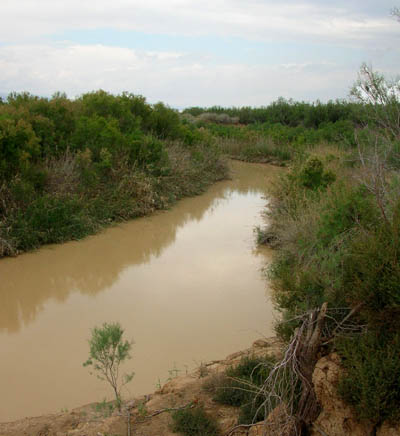
In 2006 I was able to take my group to Bethany Beyond Jordan and visit the Jordan River. Here is one of the photos made at that time.

Jordan River at Bethany Beyond the Jordan.

We are hopeful of visiting this site again in 2008. Perhaps it is in the area where John did some of his baptizing (cf. Jn. 10:40). The Israelites crossed the Jordan somewhere near here (Josh. 3), and the prophets Elijah and Elisha crossed in the opposite direction near here (2 Kings 3).

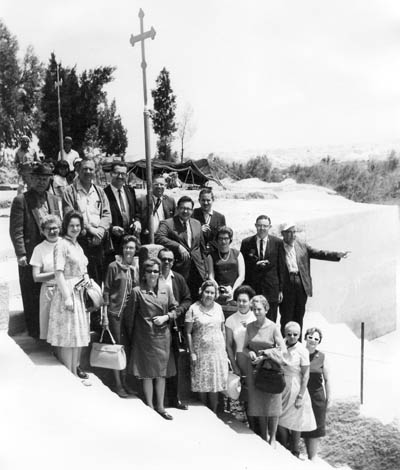
This photo was made on the West side of the Jordan River, in the country of Jordan, in 1967. This is directly across from the Bethany Beyond Jordan site.

1967 Bible Land Group led by Ferrell Jenkins and William E. Wallace.

The photo was made on or about May 5, 1967. Notice the attire. Women wore hosiery and other items to help their body hold an ideal shape. Most men wore a coat, and many wore ties on the plane and throughout the entire trip, even in hot weather. Some hotels would not allow a man in the dining room unless he was wearing a coat. Were these the good old days?