Category Archives: Jordan

Bethshan – Bet She’an

Bethshan is mentioned only a few times in the Old Testament. The New American Standard Bible uses the following spellings for this town: Beth-shean; Beth-shan; Bethshan. Today the modern town and ancient site go by the name Bet-She’an. The site was important because of its location at a major junction of two valleys, the Jordan valley with the Jezreel valley. The tell, called Tell el-Husn or Tel Bet She’an, commands an impressive view of the area, including a great view of the land of Gilead.

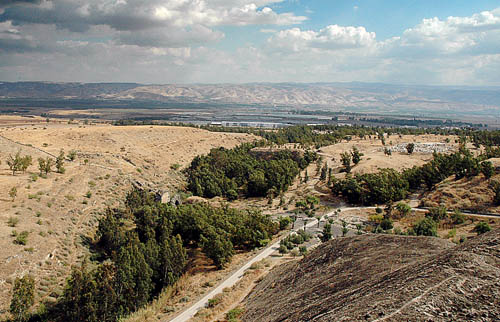
Today I am preparing a class dealing with the account of the eastern tribes building an altar “in the region of the Jordan which is in the land of Canaan” (Joshua 22:10). While looking for some photos to illustrate this episode in the history of Israel I thought of the view from the tell of Bethshan. We do not know the exact location, but this view provides a wonderful view of the land of Gilead (now in Jordan) which was given to Gad and Manasseh. You will observe trees below the tell. This is the where the River Harod flows, continuing down to the Jordan. You will notice ruins of a bridge that once crossed the river.

More on the Jordan church

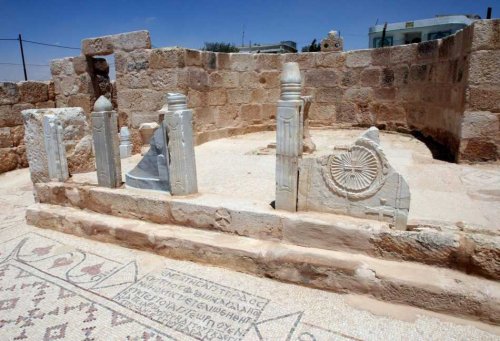
Monster Critic has posted some small photos of the Rehab, Jordan, Byzantine church building, and of the cave under the church. Detailed information is still sketchy. Ruins of Byzantine period church buildings are prevalent in both Jordan and Syria.

I think you will need to click on these thumbnail images a second time to see the largest size.

HT: Calude Mariottini

First century church (building) found?

Several blogs have noted the report of a claim out of Jordan than a first century church has been found. The Jordan Times report by Rula Samain follows:

AMMAN – Lying underneath Saint Georgeous Church in Rihab, Mafraq, is what archaeologists describe as the first Christian church in the world.

“We have uncovered what we believe to be the first church in the world, dating from 33 AD to 70 AD,” said Archaeologist Abdul Qader Hussan, head of the Rihab Centre for Archaeological Studies.

The discovery was “amazing”, Hussan told The Jordan Times.

“We have evidence to believe this church sheltered the early Christians: the 70 disciples of Jesus Christ,” the scholar said.

The early Christians, described in the mosaic inscription on St. Georgeous floor as “the 70 beloved by God and Divine”, are said to have fled from Jerusalem during the persecution of Christians, to the northern part of Jordan, particularly to Rihab, he added.

Citing historical sources, the expert said the 70 lived and practised their rituals in secrecy in this underground church.

We believe that they did not leave the cave and lived until the Christian religion was embraced by Roman rulers.

“It was then when St. Georgeous was built,” said Hussan.

Saint Georgeous is believed to be the oldest “proper” church in the world, built in 230 AD. This status is only challenged by a church unearthed in Aqaba in 1998, also dating back to 3rd century.

The findings in the graveyard near the cave offer valuable clues, according to Hussan.

“We found pottery items that date back from the 3rd to 7th century,” he added. The findings show that the first Christians and their offshoot continued living in the area till the late Roman rule.

“Going down a few steps into the cave, one would see a circle shape area, believed to be the apse, and several stone seats for the ecclesiastics,” he added.

Archimandrite Nektarious, Bishop Deputy of the Greek Orthodox Archdiocese, described the discovery of the cave as an “important milestone for Christians all around the world”.

“The only other cave in the world similar in shape and purpose is in Thessalonica, Greece,” the bishop said in an interview in Amman.

The cave also embraces the living place of the first Christians. “A wall with an entrance is the only partition separating the altar from the living area,” Hussan said.

There is also a deep tunnel, which is believed to have led the 70 Christians to their source of water, the archaeologist added.

Officials in Mafraq say they will capitalise on the discovery to further promote the area.

Governor Zeid Zreiqat, who noted Rihab is rich in unique archaeological sites, said that together with the new discovery, these sites can be invested to attract religious tourism.

“We are working on developing Rihab to become a major tourist attraction in the near future,” he told The Jordan Times.

So far, 30 churches have been discovered in Rihab,” Hussan said. It is also believed that Jesus Christ and the Virgin Mary have passed through this area, he added.

Are you excited about this discovery? Note that the report claims that the St. Geogeous Church “is believed to be the oldest proper church in the world, built in 230 AD.” The new discovery seems to have been a cave under the third century church. We must await further information on the inscription about the 70 disciples of Jesus.

There are several things in this report that arouse suspiction. Who were the 70 disciples? Were they the 70 of Luke 10:1-12? What rituals did they practice in secret? The church dates from 33 AD to 70 AD, yet they stayed in the cave until Christianity was embraced by the Roman government (early 4th century).

The pottery is said to date from the 3rd to the 7th century. Did the first century residents of the cave church leave no pottery? Do you really think a first century church had circular shaped seats for the clergy? (This is stated in the caption under a photo with the article.) We have no historical evidence for this clergy-laity distinction until well into the 2nd century.

We are told that the city of Mafraq will “capitalize on the discovery to further promote the area” and to help it become a major tourist attraction.

An MSNBC report cites Thomas Parker, of the University of North Carolina-Raleigh, as saying that this information should be greeted with a degree of caution. Read it here.

Pseudo Archaeologists

Gordon Govier, editor of Artifax, and producer of The Book & the Spade weekly radio program and podcast, has written about about a group of amateur archaeologists who are now being called Pseudo Archaeologists. These individuals, such as the late Ron Wyatt, Robert Cornuke. The discoveries claimed by these men make Indiana Jones look like a kid playing with his first shovel.

Several times a year someone sends me information about the claim of Ron Wyatt that he found Pharaoh’s chariot wheels in the Red Sea, etc. The ABR (Associates for Biblical Research) web page includes several articles dealing with these subjects. The page has been recently redesigned and you will profit by spending some time there. I also urge you to read Govier’s good article in Christianity Today here.

Some people think I know a lot about archaeology, but they know very little. I have been a student of the subject for more than 50 years, have participated in a dig, and am acquainted with several real archaeologists, but I am not an archaeologist. I frequently presents lessons on Bible History and Archaeology because I think the information can be extremely helpful to Bible students.

Sometimes we expect too much of archaeology. We should remember the old maxim, “If it sounds too good to be true, it probably isn’t true.”

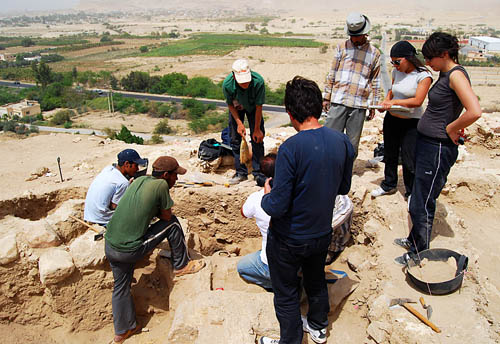
Archaeology is hard work, and often requires many years of diligent work at a single tell. In April I stopped at Tell Kafrein in the Jordan Valley and visited with the staff there for a while. This view shows a group gathered to hear the supervisor explain how to remove a Middle Bronze jar. The excavation at this yet unidentified site is under the direction of Professor Thanasis Papadopoulos of the University of Ioannina in northern Greece. I promised that I would not publish a photo of the jar, but I can tell you that it was beautiful (if you like that sort of thing). Notice that none of the works have a whip or a leather jacket. I don’t even see a fedora.

Another kind of Poppy

A few days ago I posted a photo of some poppies in Turkey and included the term anemone with it here. Reader J. P. Van de Griessen, of the Netherlands, informed us that he thinks that this is the “Papaver rhoeas or family of it.” I do not have much knowledge about plants, but I had noticed that the poppies in Turkey were a bit different from the ones I have seen in Israel and Jordan in the spring of the year. J. P. has a section of his blog dealing with flora. Even if you can not read the Dutch you might be able to make a suitable translation using the Google language tools.

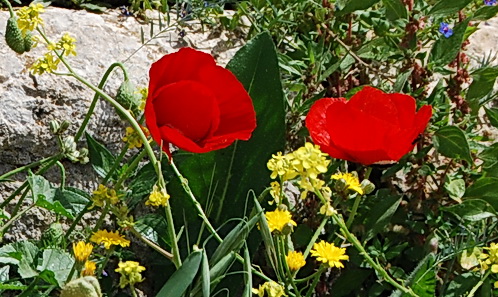
In the past three trips to Israel, with good digital equipment, I have not seen many poppies growing. In past visits, earlier in the year, we have seen entire fields colored with them. Here is a photo of some poppies among the ruins at Jerash in Jordan.

I understand this to be the anemone. Dr. David Darom, in Beautiful Plants of the Bible, calls it the common poppy (Papaver sp.). One Wikipedia article indicates that there are more than 150 varieties of the poppy. Darom links this plant with the “lilies of the field” mentioned by Jesus.

And why are you worried about clothing? Observe how the lilies of the field grow; they do not toil nor do they spin, yet I say to you that not even Solomon in all his glory clothed himself like one of these. “But if God so clothes the grass of the field, which is alive today and tomorrow is thrown into the furnace, will He not much more clothe you? You of little faith! (Matthew 6:28-30)

The UBS Fauna and Flora of the Bible comments on the New Testament word krinon:

It is used by Jesus in the Sermon on the Mount, when he says: ‘Even Solomon in all his glory was not arrayed like one of these.’ Most commentators now think of the Anemone coronaria, the anemone with beautiful bright colours which is to be found on the hills of Galilee, where it would undoubtedly have been seen by the people listening to Jesus. (page 135)

Thanks, J.P. Any other help will be appreciated.

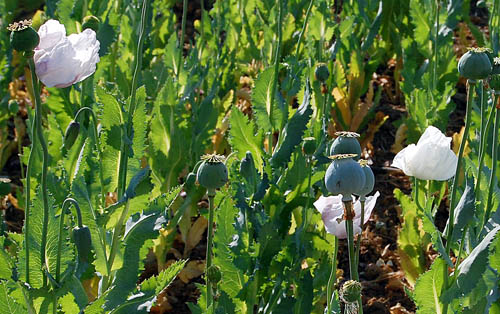
Speaking of poppies. In Turkey, another type of poppy is legally cultivated. On the outskirts of Yalvac (near Pisidian Antioch of Acts 14), I have seen cultivated fields of white poppies along the road. Under U. S. pressure, Turkey outlawed the growing of poppies in 1971. By 1974 they were allowing them to be grown under strict government control. Government factories convert the dried stems into poppy-straw concentrate (PSC) and then into morphine and codeine (See “The Poppy,” National Geographic, Feb., 1985, pp. 143-189). Here is a photo I made last year. I trust that I will not be charged with possession of a poppy photo!

From the mountains of Ararat to the island called Patmos

Or, from Genesis to Revelation. I did not make an intentional plan to do so, but within the past twelve months I have visited areas of the Bible world, from the mountains of Ararat to the island of Patmos. What a blessing to have the opportunity to spend about four weeks in Turkey, covering most of the sites mentioned in the Bible, about 10 days in Greece, more than a week in Israel, and a week in Jordan.

This means that I have been able to visit some of the most significant portions of the Bible world. Better than visiting the area alone, I have been able to share the area with other teachers (both men and women) who will be incorporating this information into their lessons for years to come.

When I first reflected on the past year and realized that I had been to Mount Ararat, in the mountains of Ararat, and on the Island of Patmos, I realized that this covers from Genesis 6 to the book of Revelation. Of course, this doesn’t mean that I have visited every place in between, but it does give a sense of comprehensive overview.

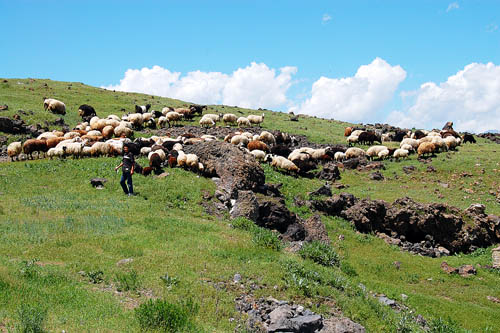
Here are a couple of photos I trust you will find helpful. The first is of a shepherd with his sheep in the mountains of Ararat. Remember that the book of Genesis records that Noah’s ark rested “upon the mountains of Ararat” (Genesis 8:4).

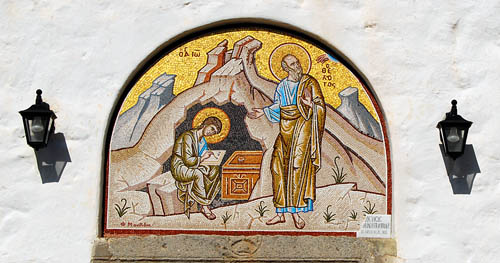
This photo was made at the entry to the cave of the Apocalypse on “the island called Patmos” (Revelation 1:9). John was exiled here during the reign of the Roman emperor Domitian. Whether the book of Revelation was written on Patmos, or after John’s release, we can not say with certainty. The mosaic over the entry to the cave shows John dictating the revelation given to him by the Lord.

It is my conviction that Bible land travel can enhance one’s Bible study and improve one’s understanding of the text. This, in turn, needs to be converted to action in obedience to the will of the Lord, and in service to Him.

Unleash your inner Indy

Anything Indiana Jones is the fad now since the release of the fourth movie featuring the adventuresome archaeologist. The USA Today Travel Newsletter (May 27, 2007) lists 10 great places to unleash your inner Indy. One of the places mentioned is Petra in Jordan. The article says,

“Hike or ride donkey-drawn carts through a slot canyon to arrive at this ancient city carved out of the sandstone cliffs,” [National Geographic’s Boyd] Matson says. “Petra offers the chance to hook up with nomadic tribesmen and do either a one-day or multi-day camel safari in the desert.” Now a UNESCO World Heritage Site, this once-vibrant Nabataean city was an oasis where Greeks, Romans and Arabs met for caravan trading. visitjordan.com

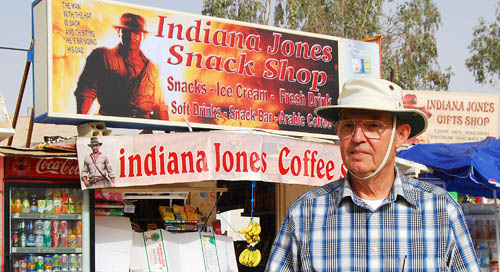
Parts of Indiana Jones and the Last Crusade was filmed at Petra. In this photo we see the snack shop, coffee shop, and gifts shop, all named for Indiana Jones.

The site of Petra is identified as the biblical Sela (rock; 2 Kings 14:7; Isaiah 16:1), and the home of the ancient Edomites (descendants of Esau). From about 300 B.C. the area was inhabited by the Nabataeans from North Africa. G. Ernest Wright once described them as,

one of the most gifted and vigorous peoples in the Near East of Jesus’ time. (Biblical Archaeology, 229).

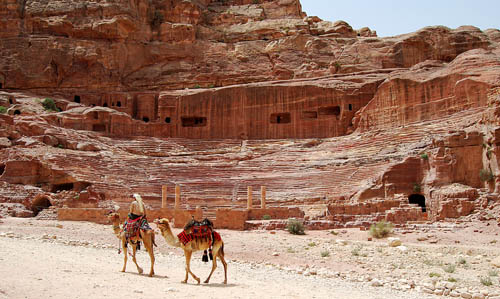
This photo shows the Roman theater at Petra which was cut out of the rock in the 2nd or 3rd century A.D. The theater seated about 3,000.

Several archaeologists have already pointed out that what Indiana Jones does is a far cry from real archaeological work. The real work is sometimes exciting, but always tedious. Bryant Wood is cited here:

“It is rather adventurous in a way, because for the most part, you’re going to some exotic country and delving into their past. But it’s not an adventure with a whip and chasing bad guys and looking for treasure,” said Bryant Wood, an archaeologist with Associates for Biblical Research.

“You’re working at one site tediously, probably for many, many years and spending more time processing the finds and writing reports than you do actually digging at the site. But that wouldn’t make for a very good story, spending 70 percent of the time in a library.”

Pictures of Adam?

The title could be misleading. It could be like all of those drawings showing John the Baptist pouring water over the head of Jesus. The Adam we speak of is a place mentioned in the account of the Israelite crossing of the Jordan River.

the waters which were flowing down from above stood and rose up in one heap, a great distance away at Adam, the city that is beside Zarethan; and those which were flowing down toward the sea of the Arabah, the Salt Sea, were completely cut off. So the people crossed opposite Jericho. (Joshua 3:16)

Our fellow-blogger over at Aantekeningen bij de Bijbel in the Netherlands asks,

Do you have also pictures from the Jordan in the neighbourhood of Adam? The place where the Jordan was halted for some time?

To my knowledge It is not possible to approach the Jordan except an area between the Sea of Galilee and Beth-shan, and at Bethany Beyond the Jordan. Photos are not allowed at the various military check points.

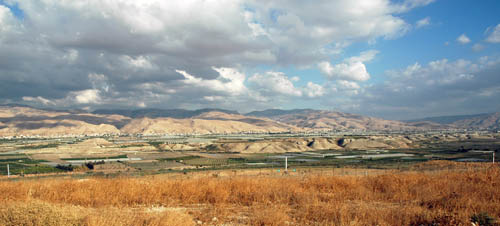
The best I can do is to show you a photo I made in November of 2005. This photo is looking east toward the mountains of Gilead. I think the rift to the right of the middle of the photo is the Jabbok Valley. Adam would be located somewhere to the right in this photo. If some other reader can be more specific I would be happy to know.

The fence in the foreground of the photo is the boundary between Israel (West Bank area) and Jordan. I often describe the Jordan River as being shy. All along the Jordan Rift, one only sees the River at a place or two. The Jordan flows in the green area in the bottom of the rift. All of the white horizontal lines in the photo are hot houses use for growing agricultural produce.

The Jordan River

The distance from the principal source of the Jordan at the foot of Mt. Hermon to the northern end of the Dead Sea is about 135 miles, but the serpent-like Jordan flows over 200 miles. At the source, the elevation is about 1150 feet above sea level. By the time the river reaches the Sea of Galilee it is about 700 feet below sea level, and when it reaches the Dead Sea it is more than 1300 feet below sea level. These and other unusual physical characteristics make the Jordan a significant river. To the Bible student the importance of the river is found in the events which transpired in it.

Israel crosses the Jordan. The children of Israel crossed the Jordan when the water was out of all its banks during the time of harvest (Josh. 3:15). An American reader might think of this as the fall of the year, but actually it was in the spring, at the time of the latter rain (Joel 2:23). As spring approached in Bible times the Jordan would overflow its banks due to the heavy latter rains (about early April) and the melting snows of Mount Hermon. Conditions are different in modern times. Water that once flowed south from the Sea of Galilee and from tributaries such as the Yarmuk River is now used for irrigation. This makes the Jordan much smaller than in earlier times. The crossing of the Jordan by the Israelites provided the imagery for our hymn, “On Jordan’s Stormy Banks I Stand.”

Elijah and Elisha. Both of these oral prophets crossed the Jordan on dry ground prior to Elijah=s being taken up by a whirlwind into heaven. Elisha later used the mantle of Elijah which had fallen upon him to smite the Jordan so that he was able to return (2 Kings 2:8-14).

Naaman the leper. Naaman, captain of the army of the king of Aram, was told by the prophet Elisha to wash seven times in the Jordan to be cleansed of his leprosy. For a reason not explicitly given, Naaman complained that the Abanah and Pharpar, the rivers of Damascus, were better than all the waters of Israel. When he eventually obeyed the Lord, he was made clean (2 Kings 5:1-14). We understand that it was not in the properties of the water but by the power of the Lord that Naaman was made clean through his obedience.

John and Jesus. John immersed in the Jordan River (Mt. 3:1-6). The last important biblical event and the crowning glory of the Jordan was the baptism of Jesus (Mt. 3:13-17).

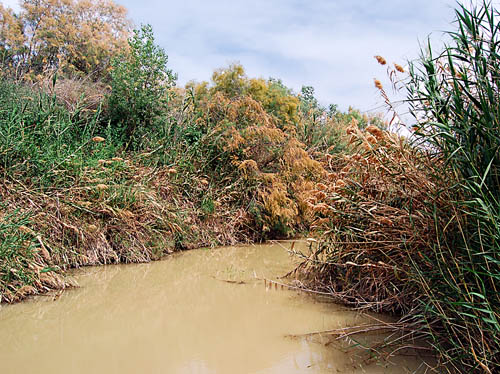
Photographs of the Jordan south of the Sea of Galilee have been difficult to make since 1967 because the river has served, more or less, as the boundary between Israel (or the occupied West Bank) and Jordan. This photograph was made at the site across from Jericho that may be identified as “Bethany beyond the Jordan” (John 1:28), where John the Baptist baptized at first (John 10:40).

“I press on toward the goal…”

Paul’s admonition to the brethren at Philippi is often used in sermons.

Not that I have already obtained it or have already become perfect, but I press on so that I may lay hold of that for which also I was laid hold of by Christ Jesus. Brethren, I do not regard myself as having laid hold of it yet; but one thing I do: forgetting what lies behind and reaching forward to what lies ahead, I press on toward the goal for the prize of the upward call of God in Christ Jesus. (Philippians 3:12-14)

Most often we hear speakers compare what Paul said to the effort put forth by individuals running in a race. This is certainly not inappropriate. However, many years back I ran across a statement by E. M. Blaiklock that changed my thinking. Blaiklock was a noted classicist. This particular comment comes from Cities of the New Testament.

One mark of the Roman colony is perhaps to be detected in the letter which Paul wrote, over ten years later, to the Macedonian church which he had come to love. It is a hidden metaphor from the chariot race. Exhorting his Philippians to effort and single-minded endurance, Paul writes: ‘This one thing I do-forgetting the things behind, and stretching out to those before, I make for the mark, the prize of the upward calling’.

Commentators generally have not marked the fact that Paul appears to have in mind, not the athletic contests of the Greeks, from which he commonly drew illustration, but the chariot racing of Rome. He was writing to a Roman colony. He was writing also from Rome itself, and never was there such rivalry of racing colours, and circus fever than at that time. The common talk of the soldiers of the soldiers was of the chariot racing, and Paul would gain a vivid impression of this most perilous of sports.

Such a race as that which forms the substance of Paul’s figure is described well in Ben HUR. The charioteer stood on a tiny platform over sturdy wheels and axle. His knees were pressed against the curved rail, and his thighs flexed. He bent forward at the waist, stretching out hands and head over the horses’ backs. This is surely what he means by ‘stretching out to the things before’. The reins were wound round the body, and braced on the reins the body formed a taut spring. It can easily be seen how completely the charioteer was at the mercy of his team’s sure feet and his own fine driving skill. Euripides, in his Hippolytus, tells how the hero fell and was killed in such conditions. Ovid describes the same disaster in Book XV of his Metamorphoses. In his intense preoccupation the driver dare not cast a glance at ‘the things behind’. The roaring crowd, crying praise or blame, the racing of his rivals, all else had perforce to be forgotten. One object only could fill the driver’s eye, the point to which he drove at the end of each lap.

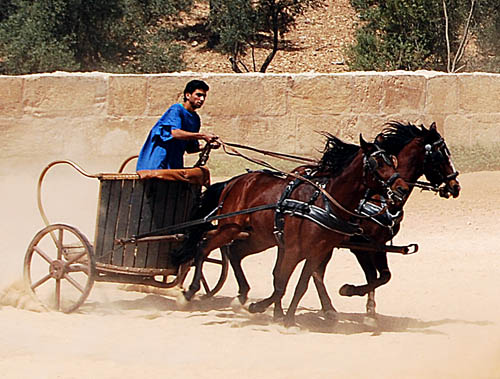
Here is a photo that might help to illustrate what Blaiklock said. It was made at the RACE show (Romy Army and Chariot Experience) at Jerash, Jordan.