Category Archives: Jordan

Jerusalem at 3800 feet altitude

In the last post about the aerial photos (January 18) we showed the mountains of Judea as we approached the central mountain ridge. Today’s photo shows the Old City of Jerusalem from about 3800 feet above sea level. The city itself is about 2400 to 2500 feet above (Mediterranean) sea level. The view is looking southeast across the Wilderness of Judea to the mountains of Moab in the Transjordan tableland.

Old City of Jerusalem - view toward SE. Photo by Ferrell Jenkins.

Old City of Jerusalem - view toward SE. Photo by Ferrell Jenkins.

In this photo one can see the proximity of Jerusalem to the Wilderness of Judea. The distance from Jerusalem to the Dead Sea is not more than 20 miles. The elevation drops from about 2600 at the Mount of Olives to (currently) about 1384 feet below sea level at the surface of the Dead Sea. The Transjordan Tableland is about 3000 above sea level.

As the mountains surround Jerusalem, So the LORD surrounds His people From this time forth and forever. (Psalm 125:2 NAU)

Blog about Jordan sites

Dr. David Graves writes an infrequent blog called Deus Artefacta. When he does write, the material is worthwhile. David has been participating in the excavation of Tall el-Hammam in the Jordan Valley (Transjordan) east of Jericho for several years. He is working on locating the site of Roman Livias.

Tall el-Hammam in the Jordan Valley. Photo by Ferrell Jenkins 2008.

Tall el-Hammam in the Jordan Valley. Photo by Ferrell Jenkins 2008.

Dr. Steven Collins, Dean, College of Archaeology, Trinity Southwest University, thinks that Tall el-Hammam is the site of Sodom. Info about the excavation may be located here. Other scholars suggest that Tall el-Hammam is the site of Abel-shittim (Numbers 33:49; Shittim, Numbers 25:1), in the plains of Moab. See Rainey and Notley, The Sacred Bridge, 125. The Israelite spies went out from here to view the land, especially Jericho (Joshua 2:1).

The excavation at Tall el-Hammam is now in progress through January 29, 2010. Graves has posted some good photos, and associated information, about Heshbon, Umm Quis [Gadara], and Jerash in the land of Gilead. Before crossing into Jordan he spent some time with the Temple Mount Salvage Operation in Jerusalem, visited Qumran, Masada, and Jericho.

Don’t try this on your first trip

Some adventuresome souls who have been reading the posts about the recent trip to Israel may have in mind doing the same. After all, you have some friends who went to Europe on their own, bought an Eurail pass and saw everything in two weeks.

Not that I think that is the best way to see Europe in a limited amount of time, but I definitely warn against this for the first trip or two to Israel, Turkey, Jordan, or Egypt. When you read about a trip like the one I just completed the first two weeks of December, keep in mind that I have been traveling to Israel almost annually since 1967.

Your best choice for a first or second trip to the Bible Lands (or Holy Lands) is to travel with someone who has experience in this area. Look at a lot of itineraries before you make a decision. Look at the qualifications of the person leading the tour. Examine carefully the details such as class of hotels, number of meals, etc.

The most important thing you can do is to study about the places you will visit for several months in advance of the trip. A few weeks ago we presented a list of books that we suggest for this purpose here. Your most important study will come during the first year after you return from your trip. Because then you will have a better understanding of what you are reading about.

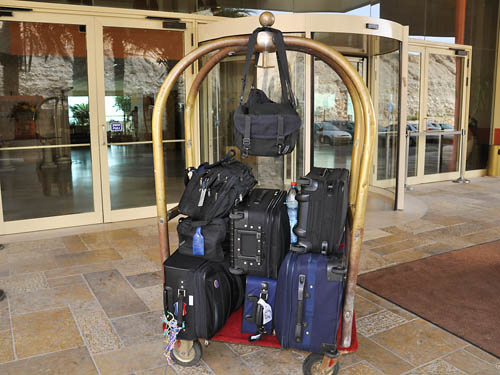
And don’t take too much luggage. It can spoil a good trip. I caught this photo of two tourists coming out of a hotel near the Dead Sea. Perhaps they had packed for a group.

Overloaded at the Dead Sea.

Overloaded at the Dead Sea. Photo by Ferrell Jenkins.

Traveling in the Great Rift

Today we traveled from the southern end of the Dead Sea to Tiberias on the shore of the Sea of Galilee. This area is a geological phenomon of great significance. The Dead Sea is now about 1340 feet below sea level. The Sea of Galilee is currently more than 700 feet below sea level. I don’t think we have been above sea level all day.

We made a stop at the Dead Sea to get some photos showing the salt accumulation on the rocks along the shore. There are few places where the sea shore is easily accessible. I have seen more salt other times. The area shown in our photo is near En Gedi and is a used often by swimmers.

The Dead Sea is called the Salt Sea in Genesis 14:3 and other places in the Bible.
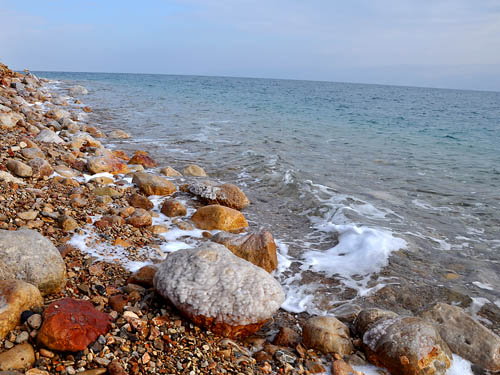
Along the shore of the Dead Sea. Photo by Ferrell Jenkins 2009.

Along the shore of the Dead Sea. Photo by Ferrell Jenkins 2009.

We stopped at En Gedi, a place associated with Davi.

Then David went up from there and stayed in the strongholds of En Gedi. (1 Samuel 23:29 NET).

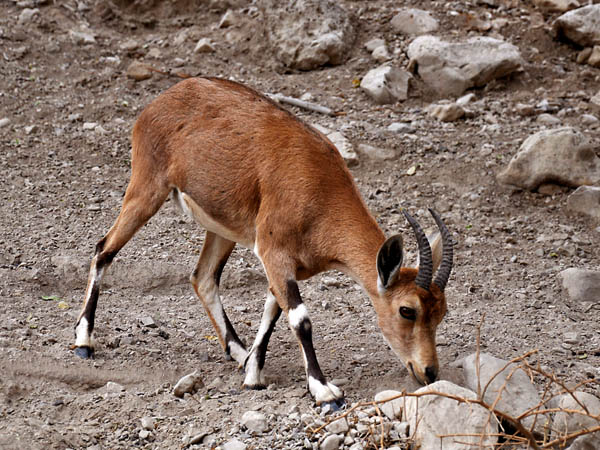
En Gedi means ‘spring of the wild goat” or “spring of the kid.” Some associate the Ibex which can be seen in the area with the wild goats.
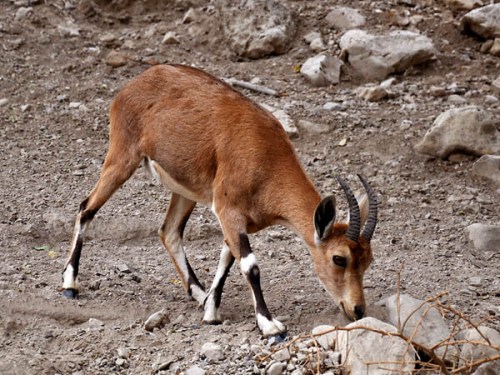
An Ibex at En Gedi. Photo by Ferrell Jenkins 2009.

An Ibex at En Gedi. Photo by Ferrell Jenkins 2009.

We hiked all the way to the highest and longest water fall. This was about a two hour stop. It was tiring but enjoyable.

We stopped at Qumran so Leon could get a few photos and we could pick up some Ahava products.

We continued north in the Jordan Valley. At about the mid-point between the Dead Sea and the Sea of Galilee the air cleared and we could easily see the area on the east side of the Jordan known as Perea in Roman times. We tried to make a few photos but twice Israeli soldiers told us not to make photos in the area.

About 10 miles south of Bethshan (Beit Shean) we stopped to make a few photos of the possible site of Abel-Meholah, the home of the prophet Elisha.

The prophet Elijah was told,

You must anoint Jehu son of Nimshi king over Israel, and Elisha son of Shaphat from Abel Meholah to take your place as prophet. (1 Kings 19:16 NET)

The village at that site today is called Meholah. No significant archaeological work has been done here.
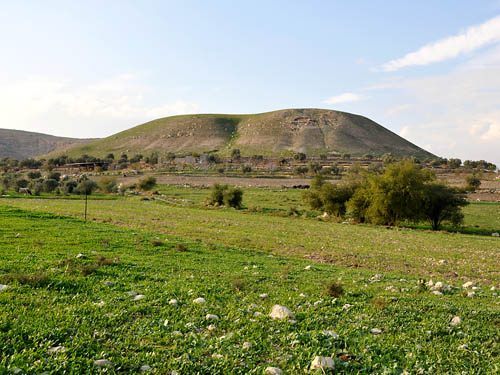
A suggested site for Abel-Meholah, home of Elisha. Photo by Ferrell Jenkins 2009.

A suggested site for Abel-Meholah, home of Elisha. Photo by Ferrell Jenkins 2009.

We noticed that the people at Meholah were growing rocks. The hills visible in the distance are in Jordan.
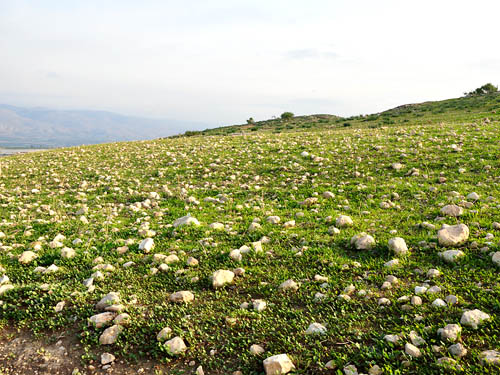
Rocks in the Jordan Valley at Meholah. Photo by Ferrell Jenkins.

Rocks in the Jordan Valley at Meholah. Photo by Ferrell Jenkins.

We tried to get to Tiberias before sunset to make photos, but the clouds were dark and thick in the later afternoon. Our hotel is literally on the shore of the Sea of Galilee. Maybe tomorrow will be a good day for photos.

Jabbok River valley inhabited and irrigated for millennia

A recent report by Dutch researchers calls attention to the relation of the irrigation, especially that in the Zerqa River triangle of Jordan, to population and the nature of the communities.

You can make major discoveries by walking across a field and picking up every loose item you find. Dutch researcher Eva Kaptijn succeeded in discovering – based on 100,000 finds – that the Zerqa Valley in Jordan had been successively inhabited and irrigated for more than 13,000 years. But it was not just communities that built irrigation systems: the irrigation systems also built communities.

Archaeologist Eva Kaptijn has given up digging in favour of gathering. With her colleagues, she has been applying an intensive field exploration technique: 15 metres apart, the researchers would walk forward for 50 metres. On the outward leg, they’d pick up all the earthenware and, on the way back, all of the other material. This resulted in more than 100,000 finds, varying from about 13,000 years to just a few decades old. Based on further research on the finds and where they were located, Kaptijn succeeded in working out the extent of habitation in the Zerqa Valley in Jordan over the past millennia.

Read the longer report here.

The Zerqa River is known as the Jabbok in the Bible. It is probably best known as the place where Jacob met with Esau as he returned from Paddan Aram, and where his name was changed to Israel (Genesis 32).

The same night he arose and took his two wives, his two female servants, and his eleven children, and crossed the ford of the Jabbok. (Genesis 32:22 ESV)

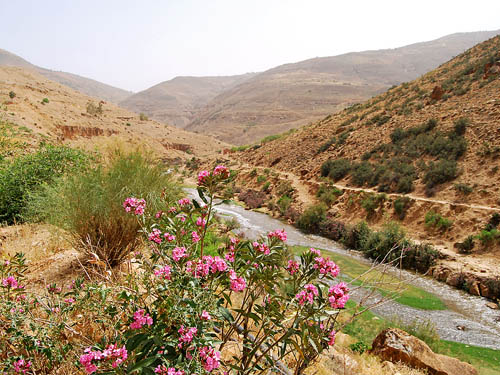
Jordan utilizes the water of the Jabbok (Zerqa) for irrigatation, especially in the Jordan Valley. This photo which I made last year shows the Jabbok a few miles from the Jordan Valley. The mountains are in the Biblical land of Gilead. Before the river reaches this point much of the water has been caught in reservoirs for use by the Jordanians.

The Jabbok (Zerqa) River near the Jordan Valley. Photo by Ferrell Jenkins.

The Jabbok (Zerqa) River near the Jordan Valley. Photo by Ferrell Jenkins.

HT: Biblical Paths.

Unique Archaeology Map of the West Bank and East Jerusalem

Suzanne Muchnic, of the Los Angeles Times, reports on a new online map that will be of interest to students of the archaeology of Palestine. Here is a portion of that report.

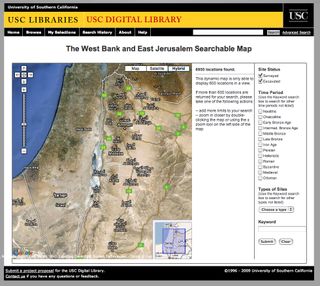
A searchable map detailing 40 years of Israeli archaeological work in the West Bank and East Jerusalem, developed for the USC Digital Library, has won the 2009 Open Archaeology Prize from the American Schools of Oriental Research.

Project leaders Lynn Swartz Dodd of USC and Rafi Greenberg of Tel Aviv University are expected to accept the award on behalf of an international team composed of Americans, Israelis and Palestinians.

The West Bank and East Jerusalem Digital Map

The digital map apparently won the approval of jurors because it offers a body of information previously unavailable to the public about sites surveyed or excavated since 1967, when Israel occupied the West Bank and East Jerusalem.

USC’s website is part of an effort to establish a framework for the disposition of the region’s cultural heritage in the event of a peace agreement between Israel and Palestine. Interactive satellite maps on the website show about 7,000 archaeological locales, including Shiloh, where the original tabernacle of the Hebrews is thought to have been located, and the Qumran caves, where the Dead Sea scrolls were found.

The public can access the West Bank and East Jerusalem Archaeology Database at http://digitallibrary.usc.edu/wbarc. Users must have Google Earth to get full use of the information.

Read the complete article in The Los Angeles Times. A UCLS news release may be read here.

This is a remarkable map. It includes only sites in the West Bank and East Jerusalem that have been surveyed or excavated. A search may be made by archaeological period, or by type: burial, cave, cistern, winepress, synagogue, mikveh, tell, etc.

I have added a link to this map on the Biblical Studies Info Page under Scholarly/Archaeology.

This video features Lynn Swartz Dodd and Ran Boytner discussing the importance of this project.

Earlier we reported here on the interactive map of the Dead Sea by A.D. Riddle and David Parker showing the history of change. We look forward to more material of this sort in the years to come as scholars make their information available to the wider public.

HT: Joseph Lauer.

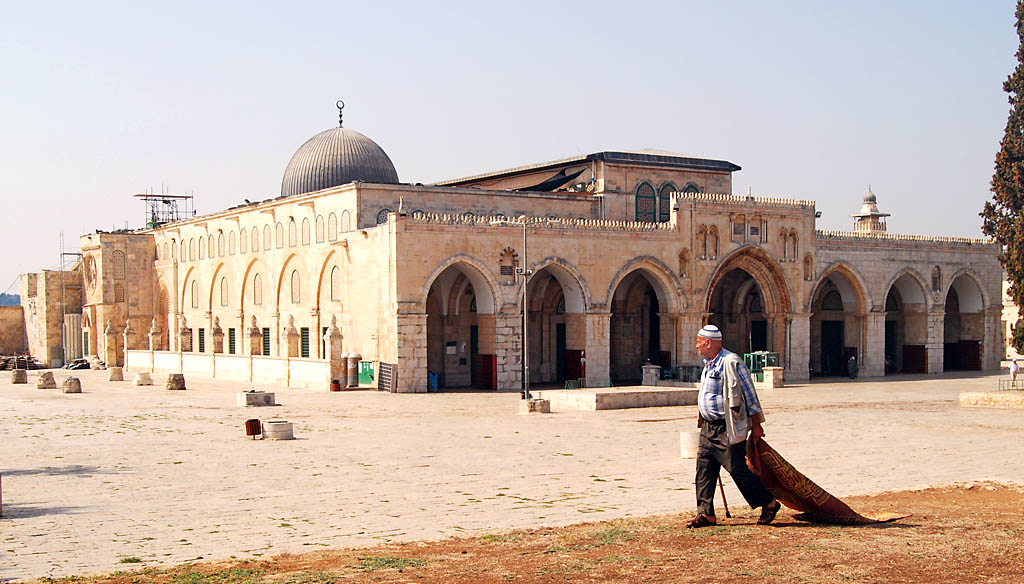
Al Aqsa Mosque in Jerusalem

The Al-Aqsa (or Al-Aksa) Mosque is one of the two important buildings erected by Moslems on the platform built by Herod the Great. A Brief Guide to the Dome of the Rock and Al-Haram Al-Sharif, published in 1965, says the Al-Aksa Mosque was built in A.D. 693 or A.D. 705. The other significant building on the platform is called The Dome of the Rock or the Mosque of Omar. It is built over the rock where, according to tradition, Abraham offered Isaac (Genesis 22), and where the Temple of Solomon once stood (1 Kings 6).

Al-aksa Mosque. View toward south west. Photo by Ferrell Jenkins.

This building has often been in the news. In 1951 King Abdullah of Jordan was assassinated in the Mosque. In 1969 an Australian tourist set fire to the building. Just a couple of days ago we saw news reports of disturbances in the Mosque. The Guardian of London headline reports,

Palestinians clash with Israeli troops at al-Aqsa mosque in Jerusalem. Demonstrations at holy shrine erupt into violence as youths fight battles with riot police.

Pressing on toward the goal

Paul’s admonition to the brethren at Philippi is often used in sermons.

Not that I have already obtained it or have already become perfect, but I press on so that I may lay hold of that for which also I was laid hold of by Christ Jesus. Brethren, I do not regard myself as having laid hold of it yet; but one thing I do: forgetting what lies behind and reaching forward to what lies ahead, I press on toward the goal for the prize of the upward call of God in Christ Jesus. (Philippians 3:12-14)

Most often we hear speakers compare what Paul said to the effort put forth by individuals running in a race. This is certainly not inappropriate. However, many years back I ran across a statement by E. M. Blaiklock that changed my thinking. Blaiklock was a noted classicist. This particular comment comes from Cities of the New Testament.

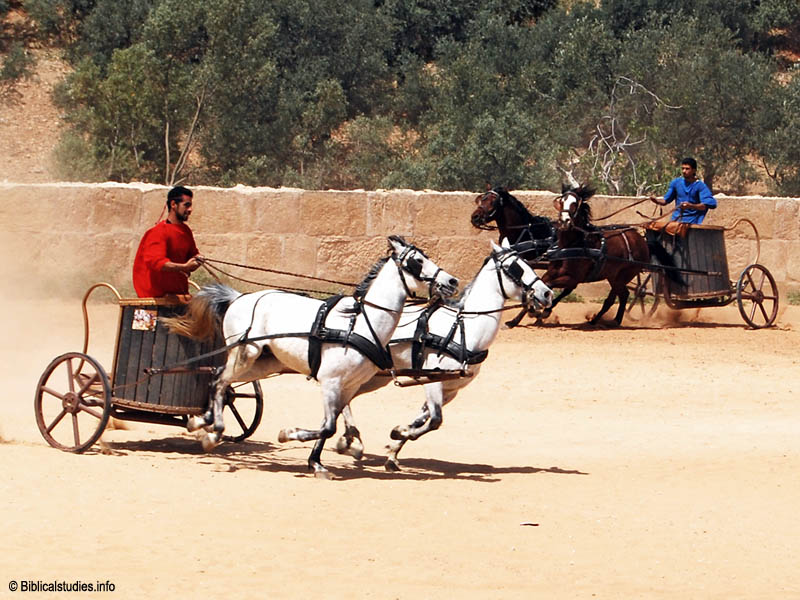
One mark of the Roman colony is perhaps to be detected in the letter which Paul wrote, over ten years later, to the Macedonian church which he had come to love. It is a hidden metaphor from the chariot race. Exhorting his Philippians to effort and single-minded endurance, Paul writes: ‘This one thing I do-forgetting the things behind, and stretching out to those before, I make for the mark, the prize of the upward calling’.

Commentators generally have not marked the fact that Paul appears to have in mind, not the athletic contests of the Greeks, from which he commonly drew illustration, but the chariot racing of Rome. He was writing to a Roman colony. He was writing also from Rome itself, and never was there such rivalry of racing colours, and circus fever than at that time. The common talk of the soldiers of the soldiers was of the chariot racing, and Paul would gain a vivid impression of this most perilous of sports.

Such a race as that which forms the substance of Paul’s figure is described well in Ben HUR. The charioteer stood on a tiny platform over sturdy wheels and axle. His knees were pressed against the curved rail, and his thighs flexed. He bent forward at the waist, stretching out hands and head over the horses’ backs. This is surely what he means by ’stretching out to the things before’. The reins were wound round the body, and braced on the reins the body formed a taut spring. It can easily be seen how completely the charioteer was at the mercy of his team’s sure feet and his own fine driving skill. Euripides, in his Hippolytus, tells how the hero fell and was killed in such conditions. Ovid describes the same disaster in Book XV of his Metamorphoses. In his intense preoccupation the driver dare not cast a glance at ‘the things behind’. The roaring crowd, crying praise or blame, the racing of his rivals, all else had perforce to be forgotten. One object only could fill the driver’s eye, the point to which he drove at the end of each lap.

Here is a photo that might help to illustrate what Blaiklock said. It was made at the RACE show (Romy Army and Chariot Experience) at Jerash, Jordan.

Chariot race at the RACE show in Jerash, Jordan. Photo by Ferrell Jenkins.

Chariot race at the RACE show in Jerash, Jordan. Photo by Ferrell Jenkins.

This is a reprint from April 30, 2008, but with a different photo suitable for use in presentations. Click on the image for the larger photo.

Todd Bolen announces the Jerusalem CD

Todd Bolen has announced the publication of Jerusalem: Volume 2 of The American Colony and Eric Matson Collection. We mentioned this marvelous set of photographs earlier here. For more information on the current CD on Jerusalem click here

Todd Bolen’s new collection of old photos

Todd Bolen has produced a new collection of photos. These are not his photos. They are the famous photos of The American Colony and Eric Matson Collection. This set of 8 volumes features 4,000 high-resolution photographs taken by resident photographers in the Holy Land from 1898 to the 1940s.

Every Bible student who has been using Bible study resources for several years has seen the photographs of The American Colony photographers and Eric Matson. When I edited the Truth in Life Bible class literature in the early 1970s we purchased and obtained permission to use several of the photographs in the literature.

The American Colony in Jerusalem was founded in 1881 by Horatio Spafford (author of the famous hymn, It is Well With My Soul). Eric Matson, one of the photographers inherited the collection, added his own work, and later donated his negatives to the Library of Congress. These photos have been available to the public for some time, but it has been difficult to locate a particular photo. And the quality of some of them, after so many years, is not good.

Bolen describes the collection:matson_dvd_front_200

This collection includes more than 4,000 selected photographs of sites and scenes from Palestine, Lebanon, Syria, Jordan, and Egypt. All of the images are included in pre-made PowerPoint® files for quick and easy use, as well as in high-resolution jpg format, suitable for projecting or printing. Quotations from 19th-century travelers give additional context to many of the photographs.

The Collection Includes:

  • Volume 1: Northern Palestine
  • Volume 2: Jerusalem
  • Volume 3: Southern Palestine
  • Volume 4: Lebanon, Syria, and Jordan
  • Volume 5: Egypt and Sinai
  • Volume 6: Traditional Life and Customs
  • Volume 7: Early 20th-Century History
  • Volume 8: People of Palestine

The first volume has been released on CD. Other volumes are being released one CD a month. The complete 8-volume set is available now on 2 DVDs.

In recent weeks Todd has written about Shechem, Samaria, and Beth Shean. Almost every tour group visits Beth Shean, but many are unable to go to the other sites. Take a look here at the way Beth Shean looks now and the way it looked in the 1920s.

Complete information on this set is available at Life in the Holy Land.