Category Archives: Jordan

Back in Israel from Jordan

Yesterday we visited Petra and enjoyed the evening on the shores of the Dead Sea in Jordan. I did not have a good connection at the Dead Sea hotel, so I was unable to post anything.

This morning we crossed back into Israel. These crossings always take a bit of time. We left our hotel at 8 a.m. and arrived at the border before 9:00 a.m. It probably took an hour or more to complete the procedures.

We visited Masada, Qumran, and Jericho. I am sure that I will later want to tell you some things about Jericho, but it will have to wait. After I take care of some of the details of the tour with a group of 46 persons it doesn’t leave a lot of time or energy for blogging.

Everyone in our group is doing well. I don’t think there is anyone who is not enjoying this travel experience.

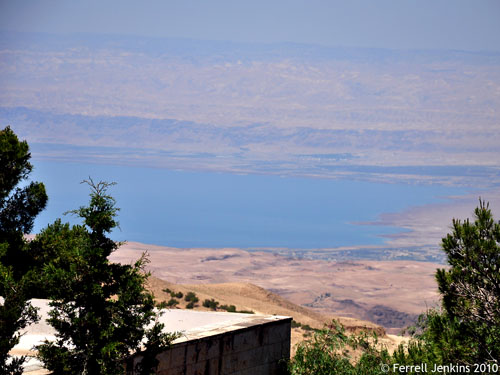
Tuesday we went to Mount Nebo. From there it is possible to see the northern end of the Dead Sea. I think the view was the clearest I have ever seen, and I have been there numerous times since 1967.

The Dead Sea as seen from Mount Nebo. Photo by Ferrell Jenkins.

The Dead Sea as seen from Mount Nebo. Photo by Ferrell Jenkins.

Mount Nebo is the place from which Moses viewed the land that the LORD had promised to Abraham’s seed (Deuteronomy 34:1-8).

Some of the other members of our group are posting interesting material. Scroll down to May 2 for a post containing the links.

The Jordan River today

Today we returned to the Jordan Valley (Roman Perea) to a site designated Bethany Beyond the Jordan in the country of Jordan. Enough evidence was presented to easily convince various religious orders to build new churches in the area. The site on the west bank of the Jordan that I visited in 1967 has been closed to the general public since June of 1967 I think.

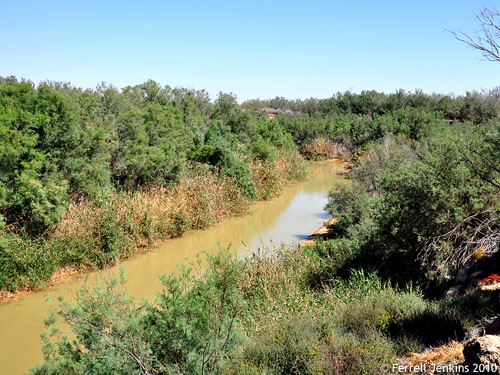
You will see by the photo that I made this morning that the river is extremely low. Just last evening I read the article from The Jerusalem Post by way of the Bible Places Blog about the study that says the river will be dry by next year.

Jordan River at Bethany Beyond the Jordan. Photo by Ferrell Jenkins.

Jordan River at Bethany Beyond the Jordan. Photo by Ferrell Jenkins.

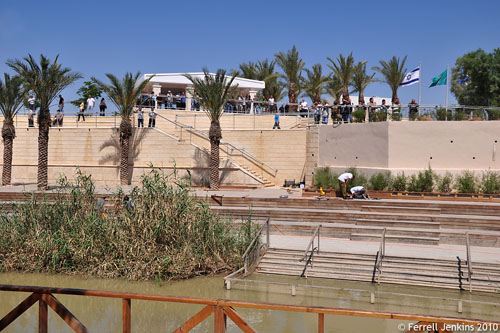
Now that Jordan is seeing many tourists come to the eastern side of the river, Israel is preparing to open the site on the western side of the river. There were several people on the Israel side today where construction continues.

Jordan River Baptism Site in Israel and Jordan. Photo by Ferrell Jenkins.

Jordan River Baptism Site in Israel and Jordan. Photo by Ferrell Jenkins.

In spite of the fact that the river water is reported to be mostly sewage, several were being baptized, or dipping themselves, in the water when we were there.

These things took place in Bethany beyond the Jordan, where John was baptizing. (John 1:28 NAU)

We also visited Mount Nebo and Madaba before traveling south about 4 hours to Petra for the night.

The Roman Army & Chariot Experience in Jerash

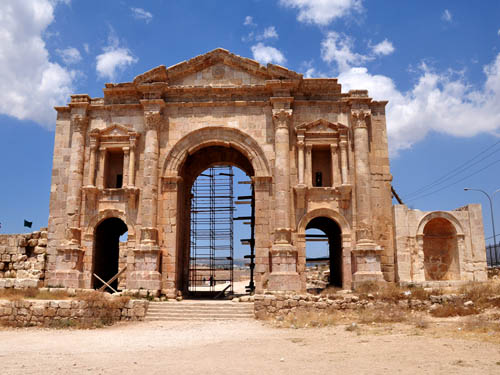
Jerash was one of the cities of the Decapolis in New Testament times. The impressive Roman ruins include a monumental arch, a hippodrome, s theater, a well-preserved cardo, and numerous byzantine churches. The Roman Emperor Hadrian visited Jerash about 130 A.D.

Hadrian's Monumental Arch at Jerash. Photo by Ferrell Jenkins.

Hadrian's Monumental Arch at Jerash. Photo by Ferrell Jenkins.

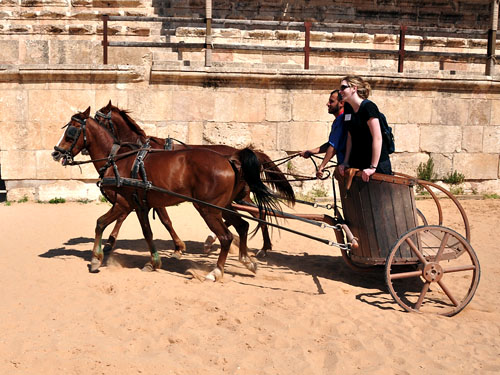
We crossed from Israel into Jordan at the Sheik Hussein bridge a few miles south of Bethshean. Our plan was to be at the 11 a.m. RACE (Roman Army Chariot Experience) at Jerash. Because it took a little longer at the bridge, we had to attend the 2 p.m. show. The show was good, but the sun was already to the back of the performers. This caused the photos to be less than ideal. After the show I made a few photos in the Hippodrome with the sun over my shoulder. One of the young ladies in our group decided she would like to ride in the chariot. See for yourself.

Erin gets a chariot ride at Jerash. Photo by Ferrell Jenkins.

Erin takes a chariot ride at Jerash. Photo by Ferrell Jenkins.

When Jesus traveled through the Decapolis He possibly visited the area around Jerash (Mark 7:31).

Departing for Israel and Jordan

Shortly we will be departing Atlanta for Israel.

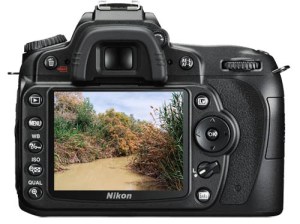
Nikon D90. Photo of the Jordan River by Ferrell Jenkins.

Ready to photograph scenes of the Bible World.

Thanks for following the blog. Hopefully you will find it interesting and helpful. After a few days in Israel we will cross the Jordan River into Jordan to visit important sites there. Then we will cross back into Israel for the conclusion of our tour.

The photo in the camera LCD screen is of the Jordan River at the traditional Bethany Beyond the Jordan from the Jordan side of the River.

These things took place in Bethany beyond the Jordan, where John was baptizing. (John 1:28 NAU)

Jodanian students work at Umm Qais

Jordanian students from the International Academy Amman spent a week excavating at Umm Qais. The full article may be read in The Jordan Times here.
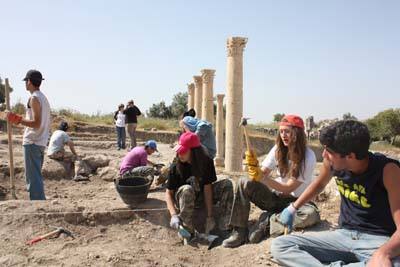
Students from the International Academy in Amman work at Um Qais. Photo by Taylor Luck, Jordan Times.

Students from the International Academy in Amman work at Um Qais. Photo by Taylor Luck, Jordan Times.

Umm Qais (a common spelling) is the site of Gadara, one of the cities of the Decapolis. Mendel Nun discovered 16 ancient ports around the Sea of Galilee, including one for the city of Gadara. He describes Gadara:

Gadara, the most magnificent of the Hellenistic towns that circled the Sea of Galilee, was located on the heights of Gilead above the Yarmuk River. The marine suburb and the city’s harbor were located on the southeastern shore of the lake, at Tel Samra (now Ha-on Holiday Village). In form, Gadara’s harbor resembles that of Sussita—a closed basin with an opening to the south—but it is much larger and more luxurious. The central breakwater is 800 feet long and its base 15 feet wide. The promenade was 650 feet long, built with finely chiseled stones, only one of which remains. The 150-foot-wide basin covered an area of 3 acres.

This harbor is superior to the one at Sussita not only because of its size but also because of its facilities. At the center of the promenade are the remains of a tower. Ruins of a large structure—probably the building of the harbor administration—are scattered on the ground near the harbor gate.

Gadara’s maritime character is attested by its coins, which depicted ships of war for some 250 years. The city’s harbor at Tel Samra was almost certainly not only an anchorage for ships. Second-century coins from Gadara commemorate the Naumachia—naval battle games performed for the inhabitants of Gadara. Until recently, researchers assumed that these games took place on the Yarmuk River, which flows into the Jordan just south of the Sea of Galilee; but this does not seem likely, and no remains of a facility of this kind have been found at this site. The large harbor basin at Tel Samra, however, with its 1,600-foot-long combined promenade and breakwater, would surely have been more suitable to accommodate the throngs of spectators as they arrived. In addition, Gadara’s harbor must have been used by thousands of visitors to the famous baths at Hamat Gader, located 5 miles southeast of the sea. The ancient Roman road connecting Beth Shean and Sussita passed near Tel Samra, and the road to Hamat Gader branched off this road. (Mendel Nun. “Ports of Galilee.” Biblical Archaeology Review 25:04; July/Aug 1999)

From Umm Qais (Gadara) one has a great view of the Sea of Galilee and the Yarmuk River valley. We are told that Jesus visited the region of Decapolis.

Then he returned from the region of Tyre and went through Sidon to the Sea of Galilee, in the region of the Decapolis. (Mark 7:31 ESV)

The Gospel of Matthew informs us about the healing by Jesus of two demon-possessed men in the country of the Gadarenes (Matthew 8:28). Mark puts this event in the country of the Gerasenes (Mark 5:1-20). Luke adds that they “sailed to the country of the Gerasenes, which is opposite Galilee” (Luke 8:26).

The photo below was made in the late afternoon when citizens of the local Jordanian village came out to enjoy the view. The view across the Sea is not clear, but you can see the entire western coast line. In the right foreground you can see a bunker used by the Jordanians in recent wars in the region. The hill directly across from the bunker is the beginning of the Golan Heights. Prior to 1967 this was in Syria. The Yarmuk River flows into the Jordan River south of the Sea of Galilee. All of the significant rivers of Jordan that flow into the Jordan River have dams on them, thus decreasing the amount of water flowing into the Jordan.
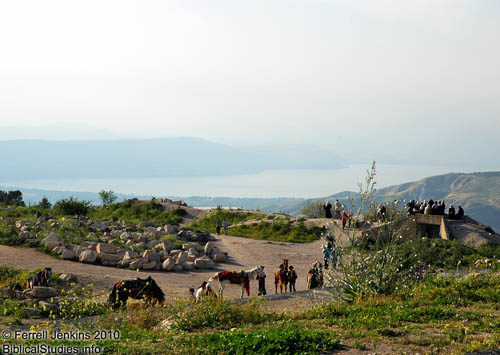
Late afternoon view of the Sea of Galilee from Umm Qais. Photo by Ferrell Jenkins.

The next photo was made in 2002. It shows a portion of the nymphaeum (attractive water fountain) and the Yarmuk Valley.
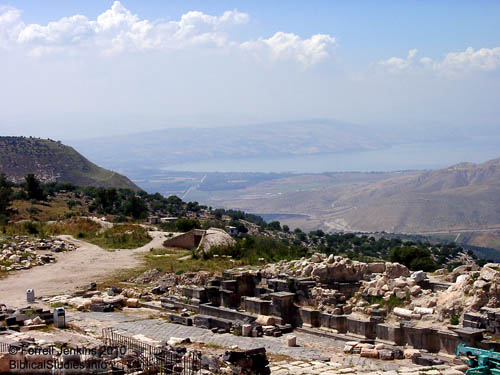
The Sea of Galilee from Umm Qais (Gadara). Photo by Ferrell Jenkins.

The Sea of Galilee from Umm Qais (Gadara). Photo by Ferrell Jenkins.

Todd Bolen posted a beautiful, clear photo that also shows the Yarmuk River valley and the nymphaeum here. Note that the nymphaeum had undergone some reconstruction when his photo was made.

HT: Joseph Lauer

Jaffa Gate unveiling tomorrow

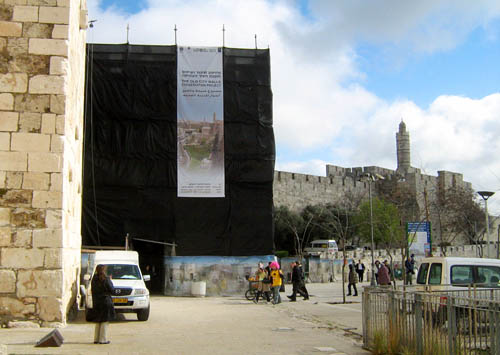
The newly rehabilitated Jaffa Gate will be unveiled tomorrow, April 21, after several months of conservation work. Jaffa Gate is the only one of the seven gates of the Old City on the western side of Jerusalem.

Jaffa Gate awaiting unveiling. Photo: IAA.

Jaffa Gate awaits unveiling after several months of rehabilitation. Photo: IAA.

The Israel Antiquities Authority press release briefly describes the history of the gate:

Jaffa Gate was first inaugurated in 1538. It constituted part of the city walls and in fact it was only toward the end of the nineteenth century did it become a center of bustling and prosperous activity. The period culminated in the year 1898, when it was decided to breach a wide entrance in the city wall of Jerusalem (as we know it today) and thereby allow the German Kaiser, Wilhelm II and his wife, Augusta Victoria, to enter the city in their carriage. Thus, for the first time in the history of modern Jerusalem, carts could enter the Old City.

In the War of Independence the gate was the focal point of some very harsh battles. During the war Jaffa Gate was completely blocked by an armored vehicle that had been damaged in the fighting and was wedged in the opening. In the cease-fire agreements between Israel and Jordan Jaffa Gate stood at the opening to the no man’s land that stretched from Jaffa Gate to Zahal Square and the Mamilla neighborhood and separated it from Jordanian controlled Jerusalem in the east. Consequently, the blocked armored vehicle was not removed, and the gate remained closed the entire period that the city was divided. The remains of the bullets that pierced the stones of the gate are clearly visible on the upper parts of the structure.

You may read the press release in its entirety here.

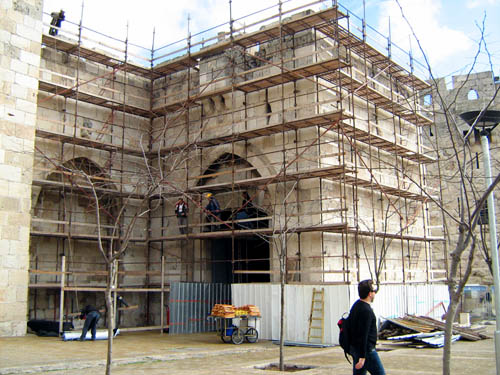
Jaffa Gate during rehabilitation. Photo: IAA.

Jaffa Gate during rehabilitation. Photo: Israel Antiquities Authority.

English Bible students will recognize the word Jaffa as Joppa. This is the gate through which one would leave Jerusalem to go to Joppa on the Mediterranean coast. Cedar timber from Lebanon was brought from Joppa to Jerusalem for the building of Solomon’s temple.

And we will cut whatever timber you need from Lebanon and bring it to you in rafts by sea to Joppa, so that you may take it up to Jerusalem. (2 Chronicles 2:16 ESV)

HT: Joseph I. Lauer

Dead Sea rises 8 centimeters

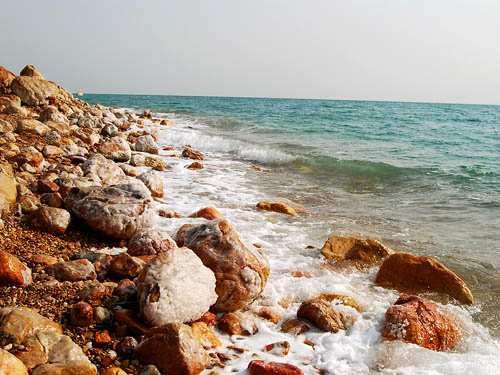
Haaretz reports that the water level of the Dead Sea rose 8 centimeters (3.15 inches) last year. This brings to mind the saying, “Every little bit helps.” Especially after the sea plummeted by more than 45 feet in the past 13 years. Read the report here.

The Salt Sea of the Bible (Genesis 14:3). Photo by Ferrell Jenkins.

HT: Bible Places Blog.

Todd Bolen’s Bible Places Newsletter

The February issue of the Bible Places Newsletter has been released. If you do not receive the Newsletter, I suggest you check it now (here). When you reach the bottom of the page you will see a link that allows you to subscribe.

The current issue of the Newsletter features photo from the Early 20th-Century History, the seventh volume in The American Colony and Eric Matson Collection. You will be able to download a PowerPoint presentation featuring these historic photos.

The entire album of more than 400 historic photos is available at the discounted price of $15. The entire 8-volume collection is on sale for $99. This is a great and important collection. Read about it at Life in the Holy Land.

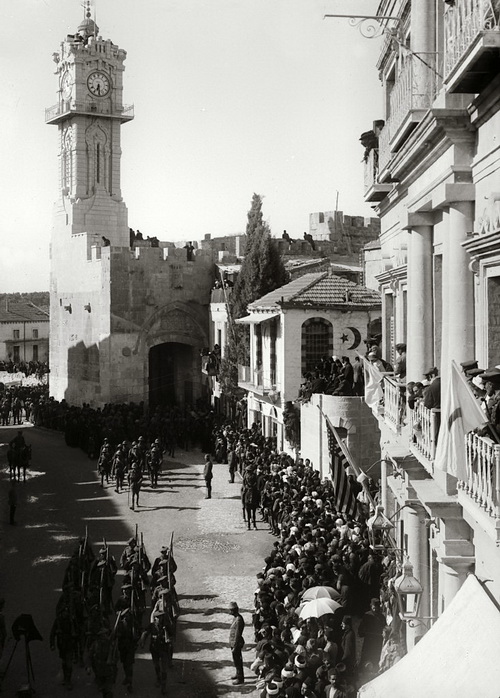
Palestine was under the control of the Turkish Ottoman Empire from 1517 to 1917. The photo below shows General Allenby and the British troops entering Jerusalem through the Jaffa Gate, Dec. 11, 1917.

General Allenby enters Jerusalem through Jaffa Gate - 1917.

General Allenby enters Jerusalem through Jaffa Gate - 1917.

Kudos to Riddle & Parker for Dead Sea: A History of Change

A.D. Riddle and David Parker have been honored by the North American Cartographic Information Society for their Dead Sea: A History of Change. Congratulations. I used this great resource a couple of days ago.

Our earlier post is here.

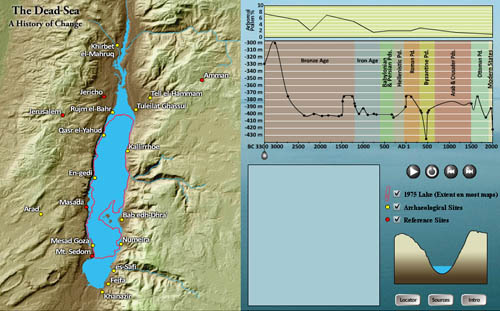
The Dead Sea may be the most fascinating body of water on earth. It lies along the Great Rift (Afro-Arabian Rift), and is the lowest body of water on earth. A.D. Riddle and David Parker have created a relief map showing the level of the Dead Sea from 3500 B.C. to the present. The authors explain how they made the map at the site.

The Dead Sea: A History of Change

HT: Bible Places Blog.

Main E-W Byzantine Road uncovered in Jerusalem

The Israel Antiquities Authority announced today the discovery of the main East-West road of Jerusalem from the Byzantine period. Todd Bolen correctly guessed yesterday, after the IAA sent out a teaser, that this discovery would be the Decumanus of the city.

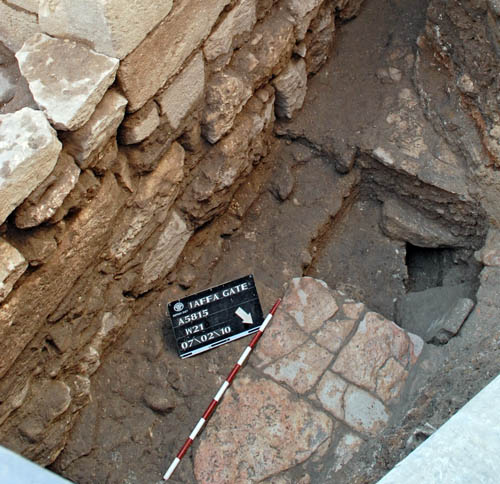
A portion of the broken flagstone pavement is shown below about 4.5 meters below the present street level. That is 14.76 feet — pretty close to the proverbial one-foot-per-century of debris buildup.

Remains of 1500 year old street. Photo: Assaf Peretz, IAA.

Remains of 1500 year old street. Photo: Assaf Peretz, courtesy IAA.

Below is a photo of the Madaba [Medeba], Jordan, mosaic map of Jerusalem from about A.D. 560-565. I have put red lines on each side of the road that has been discovered. The main north-south road, the Cardo, was discovered in the 1970s.

The original Madaba mosaic map with new discovery marked. Photo by Ferrell Jenkins.

The original Madaba mosaic map with new discovery marked. Photo by Ferrell Jenkins.

The IAA explains how the excavation came about.

Various evidence of the important buildings in Jerusalem that appear on the map has been uncovered over the years or has survived to this day – for example the Church of the Holy Sepulcher – but the large bustling street from the period when Jerusalem became a Christian city has not been discovered until now. The reason for this is that no archaeological excavations took place in the region due to the inconvenience it would cause in stopping traffic in such a busy central location.

Now, because of the need for a thorough treatment of the infrastructure in the region, the Jerusalem Development Authority has initiated rehabilitation work and is renewing the infrastructure in this area in general, and next to the entrance to David Street (known to tourists as the stepped-street with the shops) in particular. Thus it is possible for both archaeologists and the public to catch a rare glimpse of what is going on beneath the flagstone pavement that is so familiar to us all.

The full IAA report is here. The Arutz Sheva article includes a short video featuring an interview with Dr. Ofer Sion, the excavation director.

HT: Joseph Lauer