Category Archives: Jordan

The Spafford grave in the Protestant Cemetery

How the Spaffords came to make Jerusalem their home is an interesting story, but I will leave it for you to read in Bertha Spafford Vester, Our Jerusalem: An American Family in the Holy City 1881–1949. It may be difficult to locate a copy of the book for a reasonable price, but it is available in Kindle format for $8.39. Click here: Our Jerusalem.

The members of the American Colony lived under a series of governments — the Turks, British, Jordanians, and Israelis. Horatio died in 1888 during the Turkish rule. The American Colony had secured a place for burials on the south eastern slope of the traditional Mount Zion overlooking the Hinnom Valley.

Before I can show you the grave marker of Horatio Spafford I should tell you about the desecration of his original grave. Toward the end of the 19th century, when the members of the American Colony needed a grave site, they learned that earlier burials had been removed and the remains placed “temporarily” in a large pit. After much effort, permission was granted by various ruling authorities for the bones to be gathered, and a small plot was granted for the burial of the American Colony members.

That small plot is pictured below. It is immediately inside the gate to the cemetery. The large marker identifies seven members of the American Colony whose remains were recovered: John C. Whiting; Horatio G. Spafford; William C. Sylvester; Herbert Drake; Margaret W. Lee; Geo. A. Fuller; John Miller. I have noticed at least four of these names in Vester’s Our Jerusalem. Whiting was also from Chicago. He and his family came to Jerusalem with the Spaffords, as did Margaret Lee.
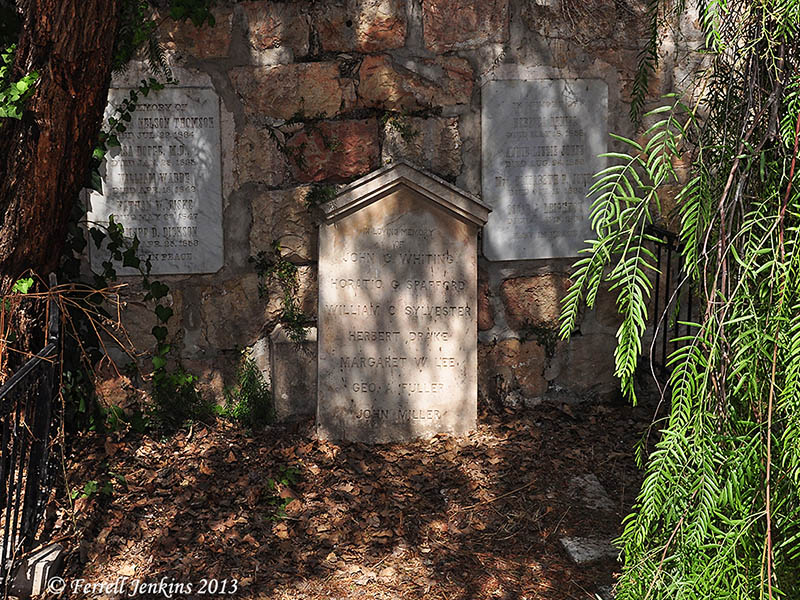
Grave stone for Spafford and other members of the American Colony in the Protestant Cemetery on Mount Zion. Photo by Ferrell Jenkins.

Grave stone for Spafford and other members of the American Colony in the Protestant Cemetery on Mount Zion. Photo by Ferrell Jenkins.

The two smaller markers in the wall identify others whose bones were recovered and buried in the common grave.

In 1896 a group of 37 Swedish farmers left Nås, Sweden, and made their way to Jerusalem. They took up residence at the American Colony. (Vester says there were 38, including 17 children, and a babe in arms. Perhaps the infant was born after leaving Sweden.) The Swedes mostly engaged in farming in the nearby Kidron Valley. I think you would enjoy reading the comment to the last post written by reader Erik Wold. You may see his photographs of Nås and read his Norwegian comments here (use Google Translate if you do not read Norwegian). The Swedish writer Selma Lagerlöf won a Nobel prize for her novel called Jerusalem, which was based on the American Colony. Bertha Vester says that her mother, Anna Spafford, “is the heroine in her book and is called Mrs. Gordon.”

Something else that has fascinated me is the fact that Eric Matson and the American Colony photographers worked from this location. About 40 years ago I edited a series of Bible Class literature called Truth in Life. We used some of Eric Matson’s wonderful Bible land photographs in the series. For more information about the work of Matson and the other photographers see Life in the Holy Land. I think Matson was the heir of one of the settlers from Sweden.

I do not know anything about the present ownership of the American Colony Hotel, but it is a prestigious 5-star luxury hotel.
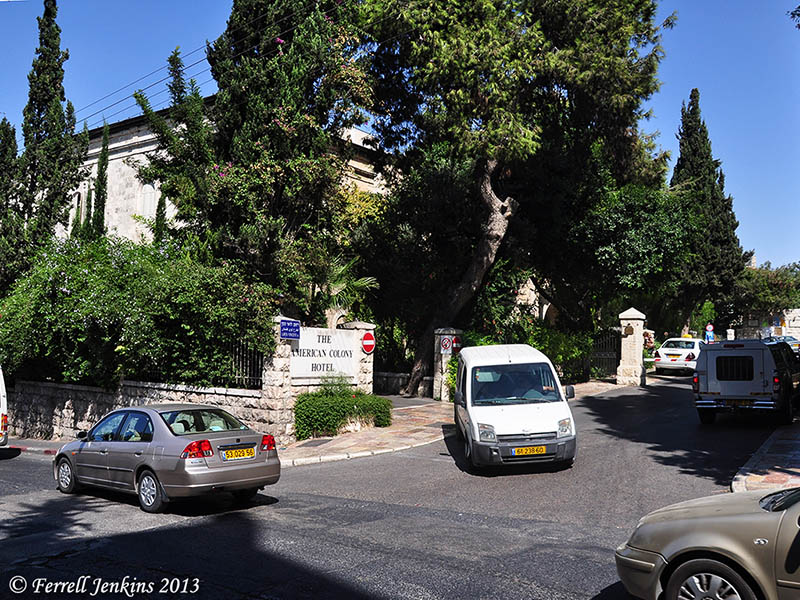
Entrance to the American Colony Hotel, Jerusalem. Photo by Ferrell Jenkins.

Entrance to the American Colony Hotel, Jerusalem. Photo by Ferrell Jenkins.

Would you like to see more photographs from the Protestant Cemetery?
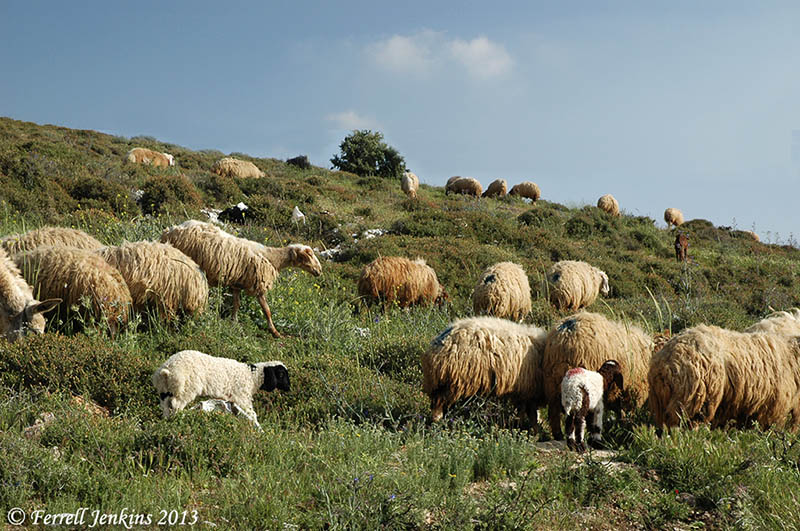
Green pastures

David, in describing the LORD as his shepherd, pictures himself as a sheep.

The LORD is my shepherd; I shall not want. He makes me lie down in green pastures. He leads me beside still waters. (Psalm 23:1-2 ESV)

The picture below was made near Heshbon on the Transjordan plateau. It is rare in Israel or Jordan to see sheep in such an abundance of grass.

Sheep near Heshbon in Trans-Jordan. Photo by Ferrell Jenkins.

Sheep near Heshbon in Trans-Jordan. Photo by Ferrell Jenkins.

The Hebrew term mishor describes “level country, table-land, plain … specifically of the elevated plateau or table-land between the Arnon and Heshbon” (Brown, Driver, Briggs). Take a look at Joshua 13:17 in several English translations. Most of the popular English versions use the term plain. The NIV and the CSB use the term plateau.

We describe the area east of the Jordan Valley, now in the Hashemite Kingdom of Jordan, as Transjordan (the area across the Jordan). There are many hills, even mountains, in Transjordan, but the entire area is a plateau. In Israel there is a central mountain range between coastal plains and the Jordan Valley.

The significance of Gaza

After my first tour to the Bible Lands, including Rome, Greece (Athens and Corinth), Egypt, Lebanon, Syria (Damascus), Jordan, and Israel, in April/May, 1967, I decided to make a second tour the following year. For many years, I always added some new places on each tour. In 1968 I added Beersheba and Gaza. The Gaza Strip (named such because of the long, narrow size of the small entity) had been under Egyptian control for several decades until June, 1967.

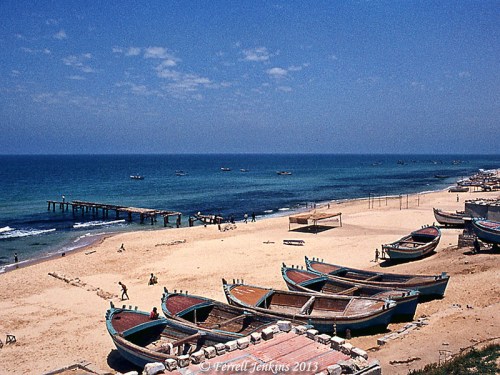
There was not much to see at Gaza. By the time we visited in 1968, Gaza was under Israeli control. We drove to the coast where there were only a few houses and some small fishing boats. This is one of the few slides that I have to illustrate the visit to Gaza.

Gaza on the Mediterranean Sea in May, 1968. Photo by Ferrell Jenkins.

Gaza on the Mediterranean Sea in May, 1968. Photo by Ferrell Jenkins.

Gaza is mentioned several times in the Old Testament. Here is a summary of these references.

  • Gaza was the southwestern boundary of the Canaanites in the table of Nations (Genesis 10:19).
  • The original inhabitants of Gaza were replaced by the Caphtorim, likely the ancestors of the Philistines (Deuteronomy 2:23).
  • Joshua defeated Canaanites “even as far as Gaza” (Joshua 10:41).
  • Joshua eliminated the Anakites except in Gaza, Gath, and Ashdod (Joshua 11:21-22). We recognized these cities as later belonging to the Philistines.
  • Gaza is listed as belonging to the tribe of Judah (Joshua 15:47; Judges 1:18).
  • The Midianites oppressed Israel, “as far as Gaza”, for seven years (Judges 6:4).
  • Samson had contact with the inhabitants of Gaza (Judges 16).
  • Gaza is listed as one of the five Philistine cities in the time of the Israelite Judges (1 Samuel 6:17).
  • Solomon controlled territory as far southwest as Gaza (1 Kings 4:24).
  • Hezekiah defeated the Philistines as far as Gaza and its territory (2 Kings 18:8).
  • Jeremiah makes reference to Gaza being conquered by Pharaoh (Jeremiah 47:1).
  • The prophets of Judah pronounced judgments upon Gaza (Amos 1:6-7; Zephaniah 2:4; Zechariah 9:5).

The only New Testament reference to Gaza is in Acts 8:26. Philip the evangelist was instructed to go south on the road that descends from Jerusalem to Gaza. English translators struggle with the issue of whether the city was desert, or the road leading to the city ran through a desert area. (I will leave that for some other time.)

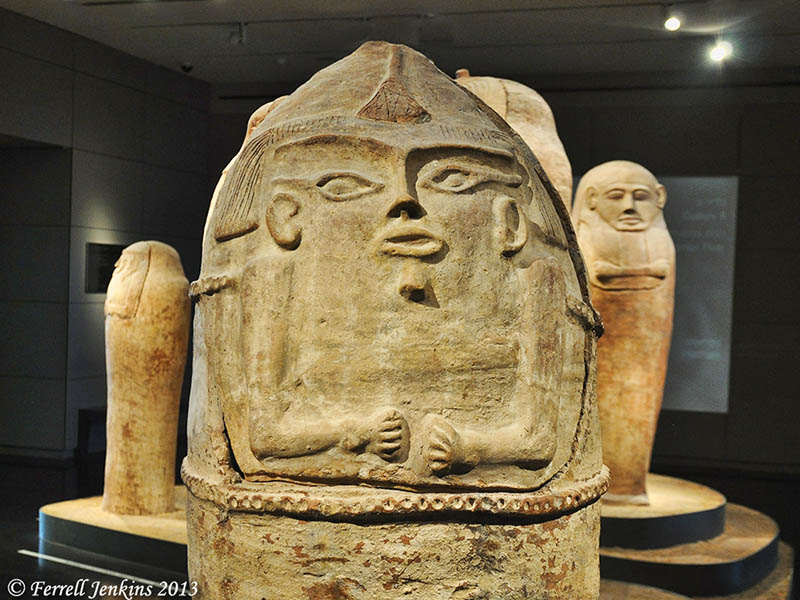
The first display one sees as he enters the archaeology wing of the Israel Museum is that of the anthropoid coffins from Deir el-Balah, a site south of Gaza city. The coffins, excavated by Trude Dothan in 1972, bear evidence of Egyptian influence. They date to the 13th century B.C.
Anthropoid Coffins from Deir el-Balah in the Israel Museum. Photo by Ferrell Jenkins.

Anthropoid Coffins from Deir el-Balah in the Israel Museum. Photo by Ferrell Jenkins.

“You could feel the wheels turning”

Obituaries for Frank Moore Cross (1921–2012) are beginning to appear in various sources. William Yardley writes in The New York Times about Cross:

Dr. Cross studied culture, religion and politics of the period in which the Hebrew Bible, or Old Testament, was written and revised, and he traced the ways different nations and cultures had translated its early texts. He also traced the evolution of ancient script and developed expertise in dating documents by the slightest shifts in writing style.

“That we know that a particular scroll comes from 100 B.C. and not 50 A.D. is almost entirely due to the study of the scripts and their development that he worked out,” Mr. Machinist said. “That may seem like a trivial point, but if you don’t have a sense of when these texts are dated, you have no sense of their historical importance.”

Once, several colleagues said, after carbon dating confirmed dates that he had established through script analysis, Dr. Cross joked that he was happy to hear that his script studies had validated the practice of carbon dating.

The article mentions the study habits of Dr. Cross.

Dr. Cross often sequestered himself in his study at home until late into the night.

“He was very intense, and we would just kind of tiptoe by the study,” Ms. Gindele [one of his daughters] recalled. “My mother liked to say you could feel the wheels turning and not to bother him.”

The full article may be read here.

Hershel Shanks, editor of Biblical Archaeology Review, writes here about the life and influence of Cross under the title, “The End of an Era.”

Jim Davila, who wrote a dissertation under Cross, offers some interesting reminiscences here.

HT: Jack Sasson and Joseph Lauer

Thomson’s “The Land and the Book” on Logos community pricing

William Thomson’s 3-volume set, The Land and the Book, is now on community pricing at Logos.

http://www.logos.com/product/26753/the-land-and-the-book

Thomson - The Land and the Book

The Land and the Book

This set of books was published by Harper & Brothers between 1880 and 1886.

Thomson spend many years living in Beirut and traveling throughout the region. This is one of the excellent books telling of travel in those days, and of the then-current understanding of the location of various sites.

I am delighted that this book is now on community pricing for $18. If enough people place a bid the price could be lower. Place your bid today.

HT: Brooks Cochran

Traveling in Israel

This afternoon we arrived in Israel. My first tour was in 1967, a few weeks before the Six-Day War when Jerusalem was in Jordan. The traditional site of the baptism of Jesus by John the Baptist was easily accessible.  That changed after the War, and we had no access to the River until Jordan opened a site thought to be the location of Bethany Beyond the Jordan (John 1:28). By 2006 we were able to visit the site.

Last year (2011) Israel opened access to the river, by special permission, on the west side. I understand the site is now open to anyone who wishes to visit.

Then Jesus came from Galilee to the Jordan to John, to be baptized by him.  John would have prevented him, saying, “I need to be baptized by you, and do you come to me?”  But Jesus answered him, “Let it be so now, for thus it is fitting for us to fulfill all righteousness.” Then he consented.  And when Jesus was baptized, immediately he went up from the water, and behold, the heavens were opened to him, and he saw the Spirit of God descending like a dove and coming to rest on him;  and behold, a voice from heaven said, “This is my beloved Son, with whom I am well pleased.” (Matthew 3:13-17 ESV)

The River Jordan at the Israel-Jordan border north of the Dead Sea. Photo by Ferrell Jenkins.

Jordan River at the traditional site of the baptism of Jesus. Photo by Ferrell Jenkins.

This will be my eightieth foreign tour to direct in these past 46 years. Not all of these have been to Israel, but I’ve led tours to the land so central in the Biblical story almost annually except for those years when political conditions made it impossible. Occasionally there was a second tour the same year. I have made numerous personal study trips in addition to the tours I lead. I’m still learning, and still making efforts to see places I have not yet visited. Last year I spent about six weeks in the country.

Through this blog I have tried to share a little bit of information and a few of the photos I have accumulated. Over the next two or three weeks I hope to share a bit of the excitement of this tour.

Tell your friends about the blog.

At least three blogs are being written about the tour. You might enjoy them, especially if you know someone traveling with us.

Steven Braman — Braman’s Wanderings
http://bramanswanderings.wordpress.com

Barry Britnell — Exploring Bible Lands
http://exploringbiblelands.com

Trent and Rebekah Dutton
http://www.trentandrebekah.com

Our flight from New York was delayed due to bad weather in New York and connecting cities. We were too late to visit Joppa today. Trent and Rebekah Dutton arrived in Israel yesterday. I see they have already posted some information about Joppa.

Tonight all 39 tour members are settled on the Mediterranean coast at Netanya, Israel. Looking forward to a great day of learning tomorrow.

Acts 10 & 11 — Photo Illustrations

Cornelius was the first Gentile convert to the faith. This case illustrates clearly that morality alone is not adequate to save one. It was necessary for Cornelius to hear and obey the word of God (Acts 11:14).

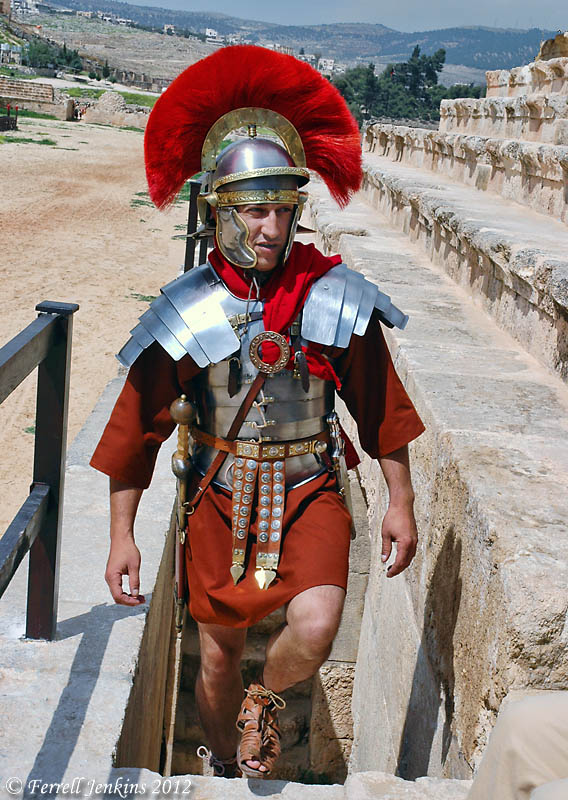
A centurion enters the hippodrome. An actor in the RACE show at Jerash, Jordan. Photo by Ferrell Jenkins.

An actor playing the role of a centurion in the RACE show at Jerash, Jordan, enters the hippodrome. Photo by Ferrell Jenkins.

A centurion in the Roman army normally had charge of 100 men (= to Army captain). A regular cohort was one tenth of a legion and had a paper strength of 600 men. An auxiliary cohort was usually comprised of 1,000 men. Cornelius was of the Italian cohort. There is inscriptional evidence for the “Italian cohort” from Syria (See Bruce, The Book of Acts in NICNT, 215). When Paul set sail from Caesarea for Rome he was accompanied by a centurion of the Augustan cohort named Julius (Acts 27:1).

The centurions mentioned in the New Testament make a favorable impression:

  • At Capernaum – Matthew 8:5-13; Luke 7:2-10
  • At the crucifixion – Luke 23:47.

This was not true of soldiers generally (Luke 3:14).

Paul and the Nabatean ruler Aretas IV

Luke’s account of the conversion of Saul and his subsequent time in Damascus records the nighttime escape from the city.

When many days had passed, the Jews plotted to kill him, but their plot became known to Saul. They were watching the gates day and night in order to kill him,  but his disciples took him by night and let him down through an opening in the wall, lowering him in a basket.  (Acts 9:23-25 ESV)

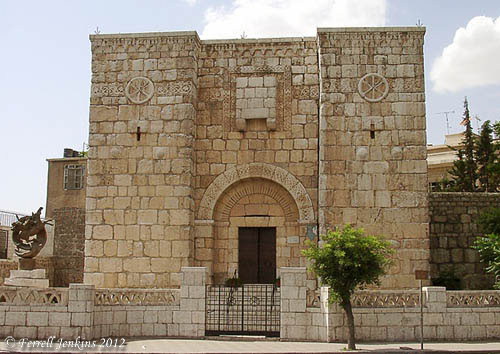
A modern chapel built into the old city wall marks a spot where this might have happened. Tradition calls it St. Paul’s Window.

St. Paul's Window in Damascus. Photo by Ferrell Jenkins.

St. Paul’s Window in Damascus. Photo by Ferrell Jenkins.

In 2 Corinthians, Paul provides historical context for this event.

At Damascus, the governor under King Aretas was guarding the city of Damascus in order to seize me,  but I was let down in a basket through a window in the wall and escaped his hands. (2 Corinthians 11:32-33 ESV)

Paul says that the governor (literally ethnarch) under Aretas the king was guarding the city. Aretas IV was a Nabatean ruler whose jurisdiction, in some way, extended to Damascus. The king, whose rule extended from 9 B.C. to A.D. 40, was father-in-law to Herod Antipas. This chronological note lets us know that Saul’s conversion was prior to A.D. 40.

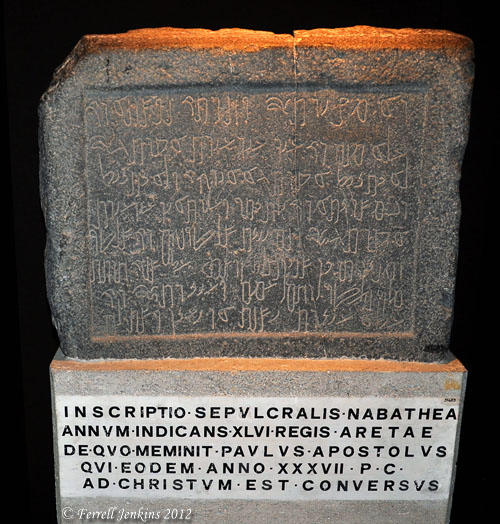
Sometimes one gets lucky when visiting certain sites or museums. My last visit to the Vatican Museum in Rome provided a nice surprise. A Nabatean tomb inscription mentioning Aretas was on display in a special exhibit.

Nabatean inscription mentioning King Aretas. Vatican Museum. Photo by Ferrell Jenkins.

Nabatean inscription mentioning King Aretas. Vatican Museum. Photo: Ferrell Jenkins.

A friend in Pisa, Italy, Dr. Arrigo Corazza, has provided me with a quick translation of the Latin sign underneath the inscription:

NABATEAN SEPULCHRAL INSCRIPTION REFERRING TO THE 46th YEAR OF THE KING ARETAS (37 AD), WHO IS QUOTED BY THE APOSTLE PAUL (WHO CONVERTED AROUND THIS TIME).

For those who may have forgotten, the Nabateans were responsible for the beautiful temples and tombs we see when we visit Petra.

Another PLBL Giveaway

Todd Bolen, over at the Bible Places Blog, is giving away another five volumes of the Pictorial Library of the Bible Lands. Any five you choose. The entry period ends Friday. Check details here.

Major revision of the Pictorial Library of the Bible Lands

Todd Bolen announces the release of a total revision of the Pictorial Library of Bible Lands. This revised and expanded edition is the culmination of 9 years of work. The previous version contained 6000 photographs in 10 volumes. According to the announcement,

This new edition consists of 18 volumes with nearly 18,000 photographs, adding hundreds of new sites and re-visiting the old favorites.

Here are just a few features of the new edition of the Pictorial Library of Bible Lands.

  • Eight new volumes: (Lebanon, Eastern and Central Turkey, The Greek Islands, and more. New subjects include Cultural Images, Signs, and Trees, Plants, and Flowers.
  • New Photos: For example, more than 1000 new photos have been added to the Jerusalem volume.
  • New Photographers. In addition to the photos by Todd Bolen, the work of more than 40 photographers are included in this new set.
  • New Maps. New, original maps have been created to identify the sites.
  • New Indexes. Every photograph is indexed in a list of more than 400 pages.
  • You get the hi-res photos and the photos already in PowerPoint. You can use the presentation as it is or include individual slides in your own lesson.
  • And more…
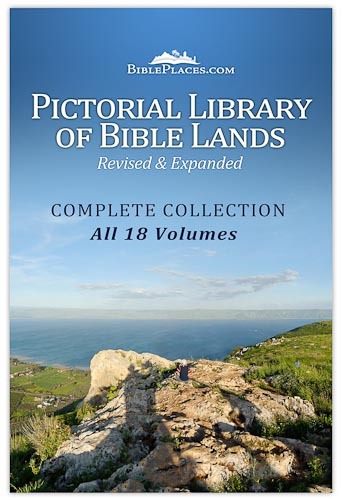
Pictorial Library Complete Collection. BiblePlaces.Com.

Front cover of the new Pictorial Library Complete Collection.

For those who already own the previous collection, Bible Places is offering the new 18-volume set for the upgrade price of $179. The entire set for new purchasers is $389.

Would you prefer to make your own photos? Try buying a good digital SLR camera starting at about $1500, flying to Israel (not to mention Lebanon, Egypt, Turkey, Greece, the Greek Islands, Italy, et al.), renting a car for a few weeks, buying the gas. Oh, and don’t forget to hire a private plane for a few hours so you can get some good aerial photos. That might cost at least $389. 🙂 And what if the lighting conditions were not right for a good photos the day you were at a site? What if you don’t have time to get your photos organized and write a description of each one? Need I go on to make a point? Did I mention that living and teaching in Israel for a decade helps?

Every church should have a set of this material for the teachers to use in their teaching. Over the years I have found that some short-sighted groups (churches) will not make such an expenditure. The other choice is to buy the set for yourself.

I hear several lessons a week, and every one of them could be improved by the use of photos from this wonderful collection.

Learn more about the new Pictorial Library of Bible Lands in the following places:

Charles Savelle has a good interview with Todd Bolen at the BibleX blog here.

I have profited much from the work of Todd Bolen and am delighted to count him as a friend and to recommend this collection of photographs to every teacher of the Bible.

Follow the BiblePlaces.com Blog here.