Category Archives: Israel

Cultic complex at Hazor

Hazor was one was the most important Canaanite cities when the Israelites entered the land.

And Joshua turned back at that time and captured Hazor and struck its king with the sword, for Hazor formerly was the head of all those kingdoms. (Joshua 11:10 ESV)

Stone stelae are commonly found during the excavation of Biblical cities. Archaeologists and Biblical scholars refer to an area of this type as a cultic center or complex. The word cult is used in several ways in modern writing and conversation, but it has a specialized meaning when we think of the archaeological context. The Hypertext Bible Commentary – Amos defines cultic as it is used in this context.

To do with organized religion and public worship, so “Israel’s cult” refers to the organized public religion of the kingdom of Israel. The word, when used in biblical studies, implies nothing (either way) about how theologically correct such worship or practice might be. It simply means public religion rather than private.

The photo below shows a cultic center found at Hazor from the Middle Bronze Age II (c. 1800-1550 B.C.). Sharon Zucherman, co-director of the Hazor excavations, refers to an area like this as “a ceremonial religious precinct” and “a cultic and ceremonial precinct” (BAR March/April 2006). An area like this is sometimes called a high place (Hebrew bamah).

Then I said to them, “What is the high place to which you go?’ So its name is called Bamah to this day.” (Ezekiel 20:29 NAU)

The crudely chiseled stones are designated by the Hebrew word massebah (plural masseboth). Some English translations use the phrase “standing stones” to translate massebah. Others use “sacred pillars” (NAU, NKJ, CSB) or “sacred stones” (NIV). The New Jerusalem Bible uses the phrase “cultic stones.”

The Israelites were instructed by the Lord to destroy these religious centers.

You will not bow down to their gods or worship them or observe their rites, but throw them down and smash their cultic stones. (Exodus 23:24 NJB)

In the left foreground of the area below there is a round basin. Perhaps for a libation?

Middle Bronze Age cultic complex at Hazor. Photo by Ferrell Jenkins.
Middle Bronze Age cultic complex at Hazor. Photo by Ferrell Jenkins.

Earthquake felt in Galilee

Haaretz reports a minor quake in the Galilean town of Carmiel (Karmiel). Carmiel is located west of the Sea of Galilee about half way to the Mediterranean town of Acco (Acre).

Residents near the northern town of Carmiel reported late-night vibrations which seismologists later confirmed as a minor quake measuring 3.0 on the Richter scale. No damage or injuries were caused.

In 2008 Israel was hit by a 4.1-magnitude quake with its epicenter in Lebanon, which caused damage across the country, ripping open a large hole in the Temple Mount plaza outside the Al-Aqsa mosque in Jerusalem and bringing down a house in the West Bank.

Israel also suffered four successive jolts in a four-week period in 2007.

The last major earthquake to strike the area was in 1927, measuring more than 6.0 Richter scale and killing 500 people.

Israeli experts say that because of population growth and high-rise construction, an earthquake of the same magnitude today would kill more than 18,000.

Read the complete article here.

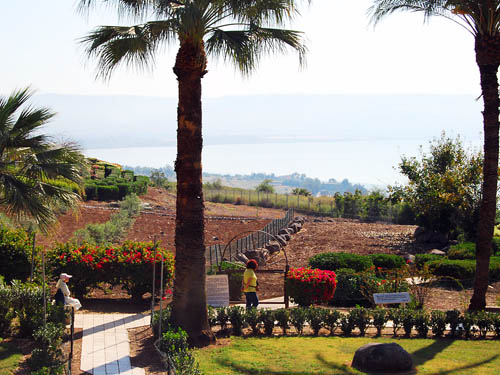
Our photo was made looking east from the traditional Mount of Beatitudes.

View east across the Sea of Galilee from Mount of Beatitudes. Photo by Ferrell Jenkins.

View east across the Sea of Galilee from Mount of Beatitudes. Photo by Ferrell Jenkins.

We have written about earthquakes in the Bible World several times. Check here, and use the Search box for the other posts.

A new Bible atlas

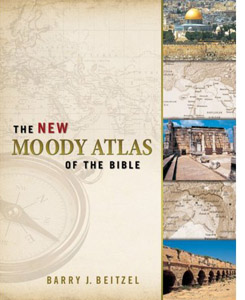
For the past three weeks I have had the opportunity to consult The New Moody Atlas of the Bible by Barry J. Beitzel.
The New Moody Atlas of the Bible
This work is a revision of The Moody Atlas of the Bible, published in 1985. This edition is a worldwide co-edition organized and produced by Lion Hudson in Oxford, England. You surely have seen some of their beautiful work in other publications. The USA edition is published by Moody Publishers. Many high quality books today are printed in the Orient. This one was printed in China. Amazing, isn’t it.
I don’t intend this as a review, but I am impressed with the clarity with which Beitzel discusses controversial material. In “The Route of the Exodus” he clearly discusses the historical background, the geographical setting, searching for Mt. Sinai in Saudi Arabia/South Jordan, searching for Mt Sinai in the northern Sinai peninsula, and searching for Mt. Sinai in southern Sinai. Pros and cons of the various positions are briefly set forth. No, I won’t tell!
This atlas sells for $49.99. I wish the publisher would sell it for $50. Does that one cent difference make anyone think they are getting a bargain? Amazon currently has the book for $31.49 (there we go again) from this link: The New Moody Atlas of the Bible.
Beitzel, with degrees from Dropsie, Fuller, and the University of Pennsylvania, is professor of Old Testament and Semitic Languages at Trinity Evangelical Divinity School.

The fish of ancient Egypt and Ashkenazi Jews

A human interest story by Stephen Gabriel Rosenberg draws a connection between the fish eaten by the Israelites in ancient Egypt and the fish eaten by Ashkenazi Jews today during Passover (Pesach). The Ashkenazi Jews of Israel and America are those who descended from Jews living along the Rhine River in Germany. Because of their movement to other areas, we think of them as having come from central and eastern Europe. Non-Ashkenazi Jews are known as Sephardic Jews. We typically think of them as having lived in the Iberian peninsula and Yemin, among other places.

Rosenberg paints a fascinating history of the gefilte fish which is eaten on the Passover and as the Sabbath (Shabbat) afternoon meal. He cites the work of the late George Freudenstein of Riverdale, New York. He calls Freudenstein “an eminent nutritional scientist and Hebrew scholar.  Freudenstein was chief chemist of the Jewish food giant Rokeach for 50 years and also an ardent talmudist.”

IN ANCIENT Egypt fish was a staple diet for the workers, and that included the Hebrew slaves. Not satisfied with the manna, they complained to Moses, “We remember the fish that we ate in Egypt for nothing” (Numbers 11:5) and the Egyptian sources confirm that Rameses II, perhaps the pharaoh of the Exodus, gave his workers a free allowance of 10 kilos of salted fish each month. Under his descendent Rameses III, around 1150 BCE, it is recorded that the grave diggers requested an increase in this generous amount to compensate them for their heavy and unpleasant work.

In spite of the hot climate, Nile fish could be preserved by drying and salting, as evidenced by the discovery of a warehouse of dried fish at the Sun Temple of El-Amarna, in central Egypt.

Freudenstein quotes a German Egyptologist, who claims that the composition of the fish in the Nile Delta has hardly changed over the last five millennia and that there are 30 species still active from ancient times. These include carp, pike and mullet, and the species of Nile mullet is exactly the one that is in use for today’s gefilte fish, at least as produced by Rokeach.

Let it be noted that we do not concur that Rameses II was the Pharaoh of the Exodus, but that is for another time. Rosenberg’s fascinating article, “In praise of gefilte fish,”  may be read in its entirety here in the Jerusalem Post. We learn that Secretary of State Hillary Clinton “is engaged in diplomatic moves” to resolve a USA export/Israel import issue dealing with the gefilte.

We noted that the ancient Israelites longed for the fish of Egypt (Numbers 11:5). After the return from exile in Babylon, Nehemiah informs us that the men of Tyre sold imported fish in Jerusalem.

The people from Tyre who lived there were bringing fish and all kinds of merchandise and were selling it on the Sabbath to the people of Judah– and in Jerusalem, of all places! (Nehemiah 13:16 NET)

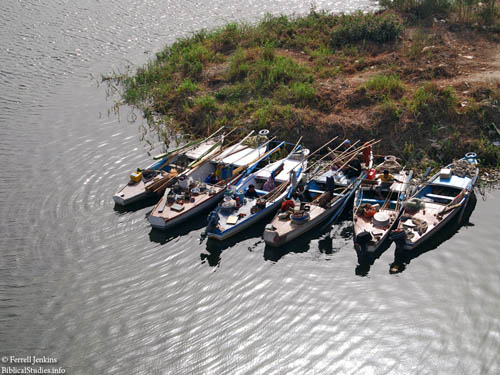
Our photo today shows the Nile River immediately south of Cairo where it divides to go around the islands, such as Roda Island, in the river. Fishermen get ready to go out for the day’s catch.

The Nile River near Cairo. Photo by Ferrell Jenkins.

The Nile River near Cairo where the river goes around the islands that are visible in the city. Photo by Ferrell Jenkins.

HT: Joesph I. Lauer

Jarmuth – a city of the Shephelah

Jarmuth (or Yarmuth) is located about 1 1/4 miles north of  the Valley of Elah, and 5 miles south of Beth-shemesh and the Sorek Valley. The site is mentioned 6 times in the book of Joshua (10:3, 5, 23; 12:11; 15:35), and in Nehemiah 11:29). The name is used in Joshua 21:29, but the Jarmuth mentioned there seems to be a town in the territory of Issachar.

Jarmuth was a Canaanite city conquered by the Israelites in the days of Joshua. It became part of the kingdom of Judah.

Michael Avi-Yonah says,

It has been identified with Khirbat al-Yarmūk (Eusebius calls it Iermochus), a large and prominent mound east of Kafr Zakariyya where surveys have revealed a large city surrounded by a massive stone wall from the Early Bronze Age and a smaller but higher mound containing pottery ranging from the Late Bronze to Byzantine periods. (Encyclopaedia Judaica)

Some excavations were conducted in the 1980s by Pierre De Miroschedji. The excavator says,

Given its size and the density of its construction, the EB III [about 2300 B.C.] city of Jarmuth may have had a population of about 3,000, engaged mainly in agriculture (cereals, vegetables, grapes, and especially olives) and animal husbandry (mostly sheep and goats, cattle and donkeys being used for traction and transport). (The Anchor Bible Dictionary 3:646)

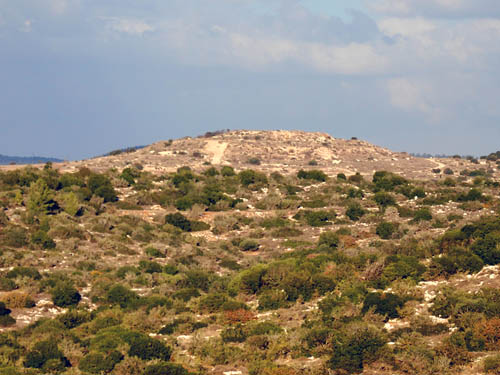
The photo below was taken from Khirbet Qeiyafa, 1 1/4 miles south of Jarmuth.

Jarmuth from Khirbet Qeiyafa. Photo by Ferrell Jenkins.

Jarmuth from Khirbet Qeiyafa (above the Valley of Elah). Photo by Ferrell Jenkins.

Dead Sea rises 8 centimeters

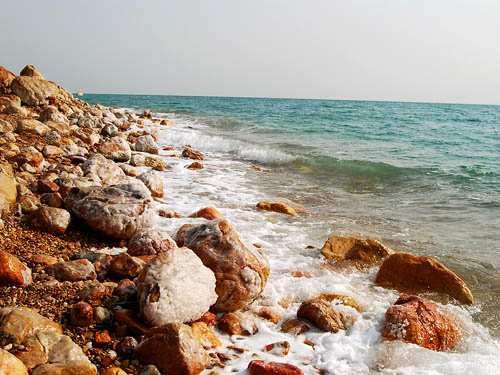
Haaretz reports that the water level of the Dead Sea rose 8 centimeters (3.15 inches) last year. This brings to mind the saying, “Every little bit helps.” Especially after the sea plummeted by more than 45 feet in the past 13 years. Read the report here.

The Salt Sea of the Bible (Genesis 14:3). Photo by Ferrell Jenkins.

HT: Bible Places Blog.

Earthquake hits Eastern Turkey

The earth seems to be shaking a lot in recent months. This morning we have reports of an earthquake which measured 6.0 on the Richter scale hit the mainly Kurdish region of eastern Turkey.

A powerful earthquake in eastern Turkey on Monday buried villagers as they slept in mud-brick houses, killing at least 57 and injuring dozens more, officials said.

The quake, which measured 6.0 on the Richter scale, struck at 4:32 am (0232 GMT) at a depth of five kilometres, with an epicentre near the Karakocan town in Elazig province, the Istanbul-based Kandilli observatory said.

Rescuers struggled to dig survivors from the rubble after the quake tore down mud-brick houses in several mountainous villages in the mainly Kurdish area, killing whole families in their sleep.

The report may be read in its entirety here.

In January I wrote about some preparations for earthquakes that I saw in eastern Turkey here.

Preparations for earthquake in Eastern Turkey

Preparing for an earthquake in Eastern Turkey. Photo by Ferrell Jenkins.

Several other blogs about earthquakes and the Bible World are here, and here, and here.

  • Earthquakes common in the Bible World here.
  • Earthquakes still a problem in the Middle East here.
  • Philadelphia (Revelation 3) – Church with an open door here.
  • Earthquake felt in Israel, Syria, and Lebanon here.

Earthquakes were so common in the Bible World that they are often used to provide imagery for the direct action of God. John uses this symbolism to describe what happened when the Lamb (Christ) broke the sixth seal (Revelation 6:12-17). A few words from the Dictionary of Biblical Imagery will give us something to think about today.

Some references to earthquakes appear to be bald statements of historic fact and seem to have little, if any, symbolic value (Amos 1:1, cf. Zech 14:5; Acts 16:26). Most references, however, particularly in the poetic parts of the Bible, accord a high degree of symbolism to earthquakes. Earthquakes in Scripture are often seen as manifestations of the direct action of God’s power. The example that is probably alluded to most is the earthquake at the giving of the law at Sinai (Ex 19:18). In their poetic reviews of the Exodus, later writers seem to have emphasized this element (Ps 68:8; 77:18; 114:4–7) and broadened its scope to cover the whole exodus event. Matthew’s linkage of the earthquake at Jesus’ crucifixion with the rending of the temple veil (Mt 27:54) is thus far more than a statement of physical cause and effect: it is profoundly symbolic. (225)

From the Temple Mount to the Pool of Siloam

Chris Mitchell, CBN News, reports on the steps leading from the Temple Mount to the Pool of Siloam.

Ancient steps and a storm sewer dating back to King Herod are two of the recent finds in Jerusalem.

The discoveries help tell the story of the Jewish pilgrimage to the Temple in the time of Jesus.

“I was glad when they said to me let us go to the house of the Lord,” King David wrote in the Psalms.

Some 2,000 years ago, Jewish pilgrims might have recited this psalm of ascents as they climbed stairs on their way to worship at the Temple.

Three times a year, the Bible commanded the Jewish people to go up to Jerusalem to celebrate the Feasts of the Lord.

“They probably camped outside the city in the valleys in the Kidron Valley… came in the city through the southern gate into the pool to take a ritual bath and then went up to the Temple Mount to pay their respects to the God of Israel,” said Haifa University archaeologist Roni Reich.

The excavation is located just outside the City of David. Many believe the area was Jerusalem at the time of King David.

Recently archaeologists uncovered the other side of the broad stairway leading to the Temple Mount. Paved with large limestone blocks, it is thought to be about 140 feet wide and climbs less than a half mile uphill to the Temple Mount.

Reich said Jesus, too, most likely walked the steps.

Just outside is the pool of Siloam, where Jesus healed the blind man as mentioned in the Gospel of John.

Read the full report, or watch a nice video featuring Archaeologists Ronnie Reich, here.

HT: Dr. Claude Mariottini

Todd Bolen’s Bible Places Newsletter

The February issue of the Bible Places Newsletter has been released. If you do not receive the Newsletter, I suggest you check it now (here). When you reach the bottom of the page you will see a link that allows you to subscribe.

The current issue of the Newsletter features photo from the Early 20th-Century History, the seventh volume in The American Colony and Eric Matson Collection. You will be able to download a PowerPoint presentation featuring these historic photos.

The entire album of more than 400 historic photos is available at the discounted price of $15. The entire 8-volume collection is on sale for $99. This is a great and important collection. Read about it at Life in the Holy Land.

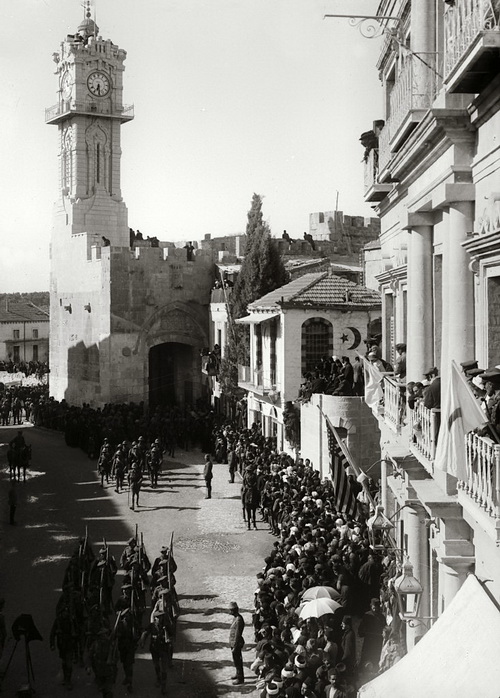
Palestine was under the control of the Turkish Ottoman Empire from 1517 to 1917. The photo below shows General Allenby and the British troops entering Jerusalem through the Jaffa Gate, Dec. 11, 1917.

General Allenby enters Jerusalem through Jaffa Gate - 1917.

General Allenby enters Jerusalem through Jaffa Gate - 1917.

Manatees and Rock Badgers

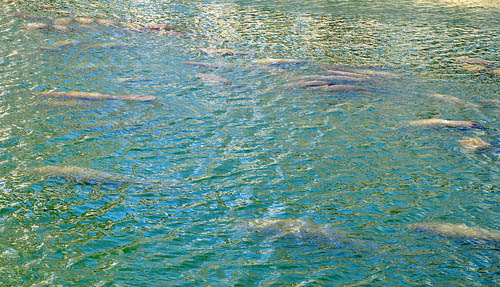
Tuesday we took our 5-year-old grandson to the Manatee Viewing Center on Tampa Bay (Gulf of Mexico). Our local electric power company (TECO) has provided excellent walkways that allow visitors to see the Manatees who come during the winter months to enjoy the warm water discharged from the power plant.

Manatees at the TECO Manatee Viewing Area. Photo by Ferrell Jenkins.

Manatees at the TECO Manatee Viewing Center. Photo by Ferrell Jenkins.

Our grandson enjoyed the visit, especially when he saw a large number of the Manatees moving about in the water. Well, he enjoyed turning $1.53 into three smashed pennies, too. In the learning center there are several exhibits of interest both to children and adults.

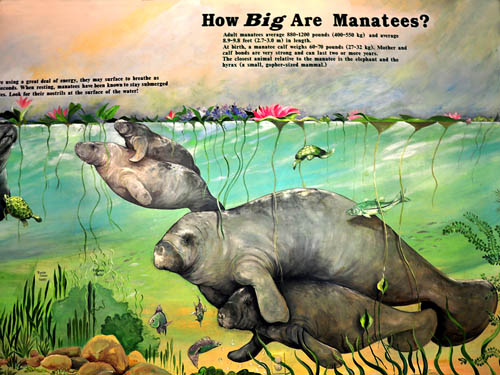
How Big Are Manatees? Photo by Ferrell Jenkins.

How Big Are Manatees? Photo by Ferrell Jenkins.

How Big Are Manatees? The poster says that adult manatees average 880-1220 pounds and are 8-9 feet long. The last statement under the question is this:

“The closest animal relative to the manatee is the elephant and the hydrax (a small gopher-size mammal.”

You may have wondered how I could relate this visit to traveling in the Bible lands. Well, here it is.

The hydrax is identified with the shaphan of the Hebrew Bible. English translations use some of the following terms:

  • hydrax (CSB)
  • shephan (NAU)
  • rock badgers (NET; ESV; NKJ). The NET notes say this is the Syrian Hydrax.
  • badgers (RSV)
  • conies (KJV; ASV); coneys (NIV)

Fauna and Flora of the Bible identifies this animal as the Syrian Coney (Procavia syriacus).

The rock badger lives among rocks from the Dead Sea valley to Mt. Hermon.

One of the best places to see the rock badgers is at En Gedi on the west shore of the Dead Sea.

Rock Badger at EnGedi. Photo by Ferrell Jenkins.

Rock Badger at EnGedi. Photo by Ferrell Jenkins.

The Rock Badger is mentioned in the book of Proverbs among things that are small, but exceedingly wise. There is a great lesson here. Even though they are not mighty, they build their homes in secure places. This is similar to the teaching of Jesus in Matthew 7:24-25. Notice the reading of  Proverbs 30:26 in a few of the English translations:

The shephanim are not mighty people, Yet they make their houses in the rocks; (NAU)

rock badgers are creatures with little power, but they make their homes in the crags; (NET)

the rock badgers are a people not mighty, yet they make their homes in the cliffs; (ESV)

hyraxes are not a mighty people, yet they make their homes in the cliffs; (CSB)