Category Archives: Israel

Ancient Yarkon fortress with Greek and Assyrian connections?

The American Friends of Tel Aviv University have announced that Tel Aviv University researchers have connected Tel Qadadi, at the mouth of the Yarkon River in Tel Aviv, with the Greek island of Lesbos.

Tel Qudadi, an ancient fortress located in the heart of Tel Aviv at the mouth of the Yarkon River, was first excavated more than 70 years ago — but the final results of neither the excavations nor the finds were ever published. Now, research on Tel Qudadi by archaeologists at Tel Aviv University has unpeeled a new layer of history, indicating that there is much more to learn from the site, including evidence that links ancient Israel to the Greek island of Lesbos.

“The secrets of this ancient fortress are only beginning to be revealed,” Dr. Alexander Fantalkin and Dr. Oren Tal of Tel Aviv University’s Department of Archaeology say. Their new research was recently published in the Palestine Exploration Quarterly and BABESH: Annual Papers on Mediterranean Archaeology.

The release points out that it was thought in the past that the Tel Qadadi fortress was established in the 10th century B.C. by King Solomon.

The establishment of the fortress at Tel Qudadi was understood later as evidence of the existence of a developed maritime policy in the days of the United Monarchy in ancient Israel.

Another view was that the fortress belonged to the 9th century B.C. and should be attributed to the Kingdom of Israel. An amphora from the Greek island of Lesbos in the Aegean is said to provide evidence that the site should now be dated to the late 8th/early 7th century fortress “serving the Assyrian interests in the Levantine coast rather than part of the Israelite Kingdom.”

One could not possibly have anything dating to the time of Solomon within a potsherd’s throw of Tel Aviv University!

Read the entire news release here.

The AFTAU release included a small photo by my friend and co-traveler Leon Mauldin.  Leon has given me permission to post his photo here. It shows the mouth of the Yarkon River as it flows into the Mediterranean Sea. The river begins a few miles inland at the Old Testament site of Aphek (1 Samuel 4:1), known in Roman times as Antipatris (Acts 23:31). Click on the photo for a larger image.
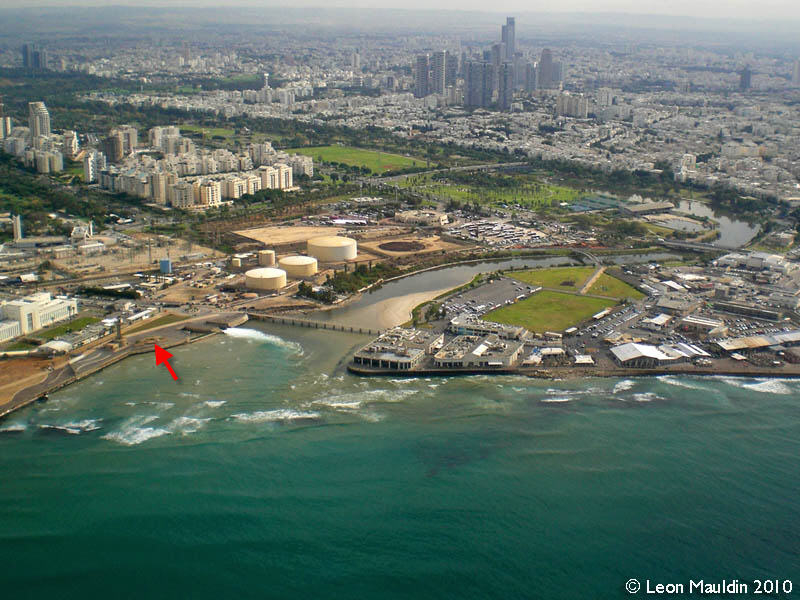
Aerial view of mouth of the Yarkon River at Tel Aviv. Photo by Leon Mauldin.

Aerial view of mouth of the Yarkon River at Tel Aviv. Photo by Leon Mauldin.

The arrow points to the little tel on the north bank of the Yarkon.

There is another lesson in this press release. Scholars, including archaeologist, do not agree and they often change their minds. It is a mistake for one to build an “infallible” case on a fallible premise. We must work with the evidence we have at any given time.

You may see more of Leon’s photos at Leon’s Message Board.

HT: Joseph I. Lauer

Bethlehem — home of David and Jesus

A little more than two years ago we wrote about Bethlehem as the birthplace of Jesus here. We will follow the example of Paul, Peter and Jude to remind our readers of some things we already know (Romans 15;15; 1 Corinthians 4:17; 2 Timothy 2:14; 2 Peter 1:12; Jude 1:5; et al.).

  • During the Patriarchal period the town we know as Bethlehem was called Ephrath (Genesis 48:7; 35:9-27).
  • Later, as part of the territory allotted to the tribe of Judah, it was the home of Ruth and Boaz and became the birthplace and early home of David (1 Samuel 17:12, 15).
  • The town was sometimes called the “city of David” (Luke 2:4, 11), but is most famous as the birthplace of Jesus (Micah 5:2; Luke 2:4-15; Matthew 2:1-16).

When one visits the Bible lands today he must realize that 2,000 years of history, involving both repeated building and the destruction of what has been built, has left nothing to remind one of the original place where Jesus was born. Justin Martyr (ca. A.D. 160) said Joseph “took up his quarters in a certain cave near the village.” Origen (mid-third century) said the cave where Jesus was born was being shown and even the enemies of the faith were talking of it. Jerome, a resident of Bethlehem (A.D. 386-420), tells how the birthplace of Jesus and other places associated with the ministry of Jesus were defiled from the time of Hadrian to the reign of Constantine. The Church of the Nativity now stands at this spot.

This photo shows the exterior of the Church of the Nativity.

Exterior of the Church of the Nativity, Bethlehem. Photo by Ferrell Jenkins.

Exterior of the Church of the Nativity, Bethlehem. Photo by Ferrell Jenkins.

My wife saved a portion of our local paper for me last Sunday. The headline says, “Peace swells Bethlehem tourism.” All of the town’s hotel rooms are booked solid for Christmas. Last year 70,000 visited Bethlehem for Christmas, but the number is expected to be “up strongly” this year.

If you have more interest in learning about the origin of the celebration of Christ, take a look here. A more detailed study of the historical aspects of the celebration is available in PDF here.

Time for family and manatees

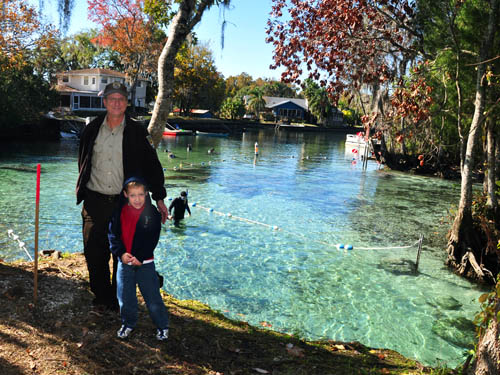
Monday and Tuesday we spent the time with our grandson. Last February we took him to the Manatee Viewing Center on Tampa Bay. Monday we went north of Tampa to Crystal River and the Chassahowitzka National Wildlife Refuge. My former student and friend, Michael Lusk, is the Refuge Manager. He took us into some areas not normally accessible to the public.

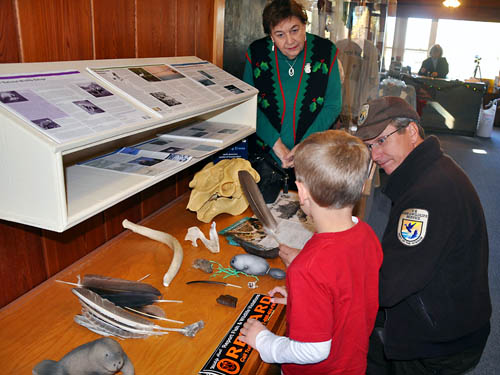
We started our visit at the Visitor’s Center, where we learned about the manatees and others animals that visit the refuge center or make it their home.

Visitors Center Chassahowitzka National Wildlife Refuge

Visitors Center at Chassahowitzka National Wildlife Refuge.

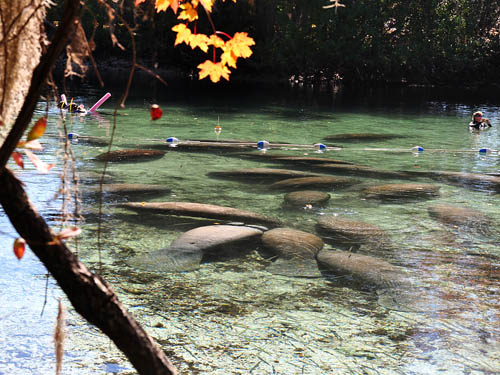
Because the water was at low tide it appears that the manatees are resting on the bottom of the inlet. People are allowed to swim with the manatees, but not in the roped off area.

Manatees at Chassahowitzka National Wildlife Refuge. Photo by Ferrell Jenkins.

Manatees at Chassahowitzka National Wildlife Refuge. Photo by Ferrell Jenkins

From another point we have a clearer view of the manatees.

Manatees at Chassahowitzka National Wildlife Refuge

Manatees at Chassahowitzka National Wildlife Refuge. Photo by Ferrell Jenkins.

We wrote about the manatees here, and called attention to the claim that they are related to the elephant and the hydrax.

“The closest animal relative to the manatee is the elephant and the hydrax (a small gopher-size mammal).”

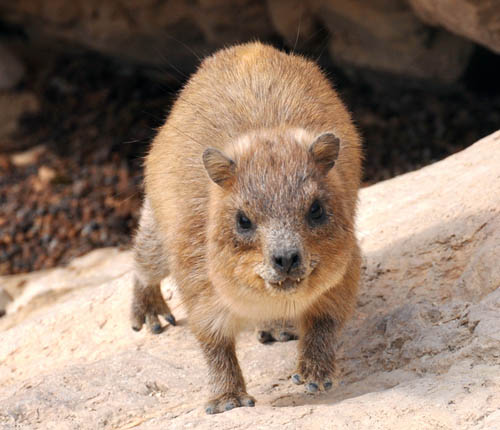
The hydrax or Rock Badger is mentioned in the book of Proverbs among things that are small, but exceedingly wise. There is a great lesson here. Even though they are not mighty, they build their homes in secure places. This is similar to the teaching of Jesus in Matthew 7:24-25. Notice the reading of  Proverbs 30:26 in a few of the English translations:

The shephanim are not mighty people, Yet they make their houses in the rocks; (NAU)

rock badgers are creatures with little power, but they make their homes in the crags; (NET)

the rock badgers are a people not mighty, yet they make their homes in the cliffs; (ESV)

hyraxes are not a mighty people, yet they make their homes in the cliffs; (CSB)

Rock Badger at En Gedi. Photo by Ferrell Jenkins.

Rock Badger at En Gedi. Photo by Ferrell Jenkins.

Another shipwreck in the Mediterranean

We see more reports of bad weather in the Mediterranean and the effect it is having on shipping. Note today’s report in Hürriyet, Turkey’s English Daily here.

Stormy weather in Antalya caused a cargo ship to run aground Thursday, leaving one person missing, and may also have contributed to the death of a woman whose body was found in the area.

The vessel, named “Seabright,” had been en route from the Tarsus Port in Adana province to Egypt with a crew of 18 people when it crashed into the rocks in a central part of the Mediterranean province of Antalya, the Anatolia news agency reported Friday.

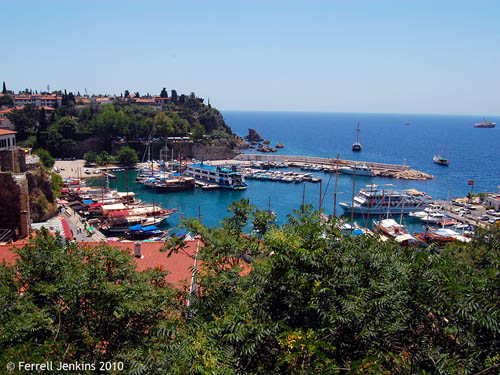
Did you notice the references to Tarsus and Antalya? This brings to mind the work of the Apostle Paul. Tarsus in Cilicia was the home of Paul (Acts 9:11; 21:39; 22:3). Antalya is identified with Attalia, a coastal city a short distance west of Tarsus (Acts 14:25). Perga, mentioned in the same verse, is nearby.

Pleasure harbor at Antalya, Turkey. Photo by Ferrell Jenkins.

Pleasure harbor at Antalya, Turkey. Photo by Ferrell Jenkins.

Mark Wilson writes of Antalya,

The modern city covers the ancient site so few ancient ruins are visible. Those remaining are around the harbor in the old city called Kaleiçi. (Biblical Turkey, 81).

When Paul sailed from Caesarea to Rome his ship went along the southern coast of Asia Minor, modern Turkey. Imagine the effect of this type of storm on a ship dependent on sails for its navigation.

Earlier in the week we noted the effect of dangerous storms in the Eastern Mediterranean. Scroll down for posts about Caesarea, Ashkelon, and Alexandria.

Caesarea National Park closed due to storm damage

The recent storm in the eastern Mediterranean caused damage to the breakwater at Caesarea and led Israeli authorities to temporarily close the Caesarea National Park. Haaretz reports here.

The head of the Israel Antiquities Authority, Shuka Dorfman, yesterday toured Caesarea National Park to take stock of the damage to the antiquities by last weekend’s storm.

Calling the damage “a national disaster,” Dorfman noted that the breakwater, which was broken in three areas by high waves during the storm, now leaves the antiquities exposed to damage from any future high waves.

Dorfman expressed concern that the storm expected this weekend could further damage the antiquities.

“The damage from the storm is huge all along the coast, from Ashkelon in the south the Acre in the north,” Dorfman said adding that if the situation is not remedied immediately through extensive conservation efforts, erosion of the cliff along the beach would continue until it collapses, leading to “the destruction of many ancient cultural treasures of Israel.”

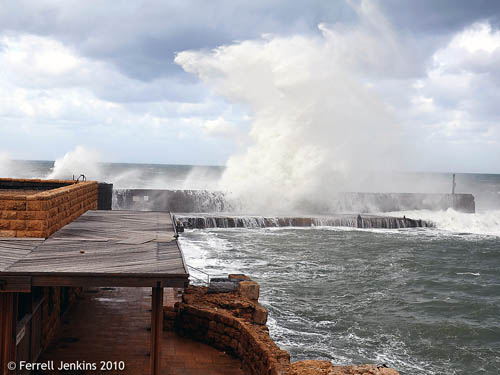
A year ago I wrote about a stormy day at Caesarea Maritima here. I think you might enjoy the photos there. Here is a new one.

High waves at Caesarea Maritima - 12/12/09 - Photo by Ferrell Jenkins.

High waves at Caesarea Maritima - December 12, 2009 - Photo by Ferrell Jenkins.

Caesarea Maritima was a first century Roman capital and seaport. The gospel was first preached to the Gentiles here when Peter came from Joppa to Caesarea to tell Cornelius words by which he could be saved (Acts 10, 11).

Herod the Great built a city on the site of Strato’s Tower and named it Caesarea in honor of Caesar Augustus. It became a center of Roman provincial government in Judea. The city had a harbor and was located on the main caravan route between Tyre and Egypt. This city is called Caesarea Maritima (on the sea) to distinguish it from Caesarea Philippi.

The Apostle Paul used the harbor at Caesarea several times. He was imprisoned here for two years before departing for Rome (Acts 24:27; 27:1).

Storm uncovers beautiful sculpture

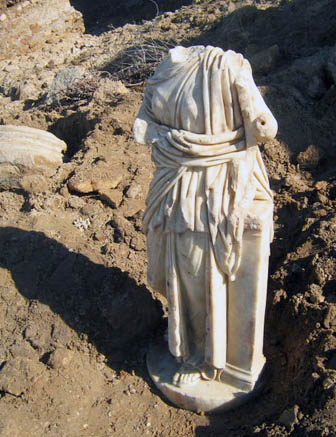
The recent storms in the eastern Mediterranean have caused considerable damage along the coast. At Ashkelon, located on Israel’s southern Mediterranean coast, the high waves uncovered a Roman-era statue.

Roman-era statue uncovered by storm at Ashkelon. Photo: IAA.

Roman-era statue uncovered by storm at Ashkelon. Photo courtesy of Israel Antiquities Authority.

France 24 International News reports here,

A massive storm that battered the eastern Mediterranean caused the collapse of a cliff in the southern Israeli city of Ashkelon, revealing a rare Roman-era marble statue, officials said on Tuesday.

“The big storm earlier this week caused the cliff to collapse and a statue from Roman times was found by a passer-by,” said Yoli Schwartz, spokeswoman for the Israel Antiquities Authority.

The white marble statue of a woman, which weighs about 200 kilogrammes (440 pounds) and stands 1.2 metres (nearly four feet) tall, has been removed from the site by the authority, which is studying it, she said.

The statue was missing its head and arms, apparently from earlier damage, but had “delicately carved sandals,” Schwartz told AFP.

The storm that hit the eastern Mediterranean earlier in the week with winds of over more than 100 kilometres per hour (62 miles per hour) whipped up enormous waves, some as high as 12 metres (40 feet), that caused widespread damage.

While the collapse of the cliff in Ashkelon led to the discovery of the statue, the storm also endangered other important archaeological sites along the coast.

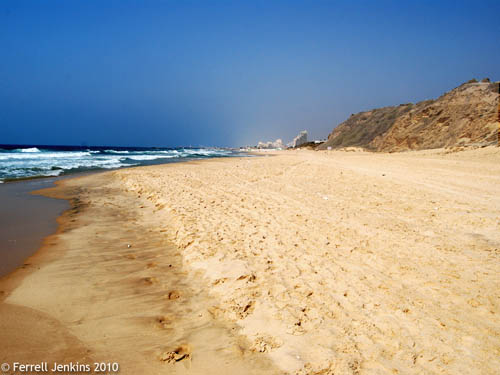
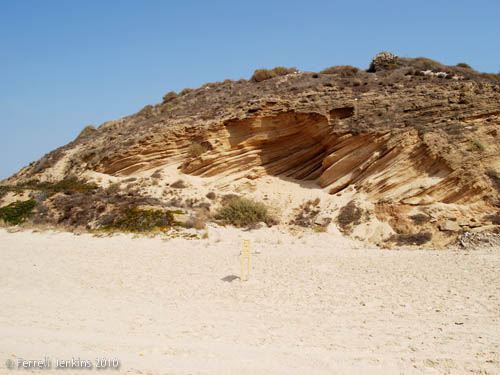
The reports I have read do not make it clear if this discovery was made at Tel Ashkelon. The port is mentioned. Damage to archaeological sites, both natural and man-made, are not uncommon. In fact Tel Ashkelon has been severely eroded by the wind and the waves over the years. This photo shows the location of the tel as we look north. Some of the buildings of modern Ashkelon may be seen in the distance.

Tel Ashkelon and the Mediterranean Sea. Photo by Ferrell Jenkins.

Ashkelon and the Mediterranean Sea. Photo by Ferrell Jenkins.

Take a look at the erosion in the west side of the tel. Shards of pottery may be seen in the exposed portion of the tel and along the beach. Some shards show evidence of having been repeatedly washed out and in.

Erosion visible in Tel Ashkelon. Photo by Ferrell Jenkins.

Erosion visible in Ashkelon. Photo by Ferrell Jenkins.

Ashkelon was one of the main cities of the Philistines. The LORD spoke against the Philistine cities through the prophet Jeremiah (ch. 47). These verses caught my attention.

How long will you cry out, ‘Oh, sword of the LORD, how long will it be before you stop killing? Go back into your sheath! Stay there and rest!’ But how can it rest when I, the LORD, have given it orders? I have ordered it to attack the people of Ashkelon and the seacoast. (Jeremiah 47:6-7 NET)

HT: Joseph I. Lauer

Palestine Exploration Fund’s photostream

The Palestine Exploration Fund has posted some fascinating historical photos from the nineteenth and early twentieth-century that will be of interest to students of historical geography and archaeology. The link is here.

Once you get there scroll down to the second line of photos where you will see a photo made sometime between 1930 and 1936 of John Garstang working at Jericho. He is making photos of the abundance of pottery found at that spot.

Working through this collection is going to be fun.

The photos are marked “© All rights reserved.” Those who wish to use them for educational purposes should be able to do so under the copyright Fair Use provision.

HT: Paleojudaica and Biblical Paths.

Extreme weather in the Middle East

Most parts of the United States have severely cold weather tonight. Even here in Florida we are expecting record cold tonight and tomorrow night. One of the cruise ships was unable to enter the Tampa port today due to strong winds.

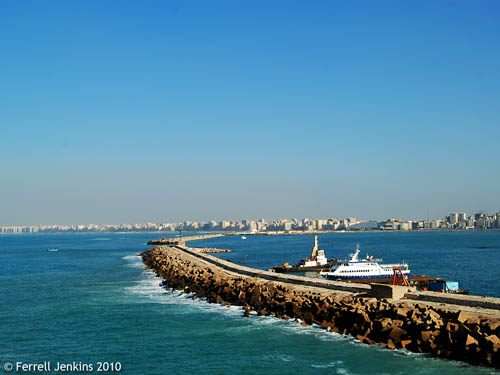
All of that reminded me about the extreme weather in the eastern Mediterranean and various parts of the Middle East. The network news showed conditions on the cruise ship that was unable to enter the harbor at Alexandria. The photo below show the breakwater at the entrance to the Alexandria harbor. The flat looking building to the right on the shore is the famous new library of Alexandria.

Breakwater at entrance to Alexandria harbor. Photo by Ferrell Jenkins.

Breakwater at entrance to Alexandria harbor. Photo by Ferrell Jenkins.

RFIenglish has the following summary:

Twenty-six ships were barred from entering the Suez Canal and 29 vessels delayed for three hours. The waterway was hit by poor visibility and winds of up to 40 knots an hour, said an official at the canal, which is Egypt’s third-largest source of foreign revenue after tourism and remittances from expatriate workers.

Red Sea and Mediterranean ports were closed for a second day on Sunday, while an Italian container ship, Jolly Amaranto, was stranded off the north-western coast after its engines broke down.

Visibility at Cairo airport was reduced to 300 metres.

As a long drought that affected the region came to an end, temperatures plummeted and storms hit Lebanon, Syria, Jordan, the Palestinian territories and Israel:

* In Lebanon seaside roads and ports have been closed after a 45-year-old woman was killed by a falling tree hitting her car – the year’s first snowstorm hit the country’s mountains;
* Off Israel a Moldovan freighter went down near the port of Ashdod but its crew of 11 Ukrainians was rescued.
* Syria’s capital Damascus was hit by snowstorms;
* Jordan suffered sandstorms and was braced for heavy rain and snow, which could lead to flooding.

Forecasters expect the bad weather to continue on Monday and have advised people to stay indoors due to a sandstorm that has blanketed the Egyptian capital.

Read also the BBC report here, or the Breitbart coverage which Todd Bolen mentioned here.

The Israel National News reports on snow in the Jerusalem area. Haaretz says the precipitation is a boon to the Sea of Galilee which has been extremely low in recent months.

Vessels of honor and dishonor

In explaining to Timothy the importance of right living, Paul says,

Now in a great house there are not only vessels of gold and silver but also of wood and clay, some for honorable use, some for dishonorable. Therefore, if anyone cleanses himself from what is dishonorable, he will be a vessel for honorable use, set apart as holy, useful to the master of the house, ready for every good work. (2 Timothy 2:20-21 ESV)

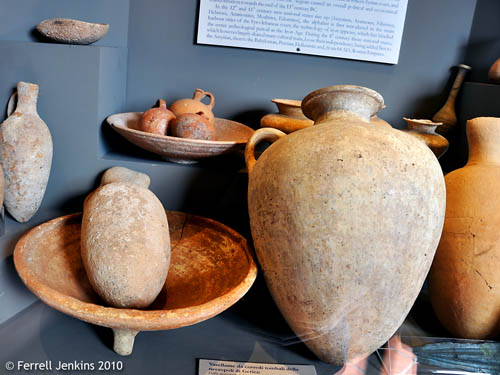
The term vessel (Greek, skeuos) is used of literal vessels made of clay, gold, silver, or wood. It is also used by analogy of individuals as a vessel. I have chosen two photos to illustrate vessels of different value. The first shows vessels from Middle Bronze II Jericho made of clay. Vessels of this type were used throughout Bible times.

Middle Bronze II pottery from Jericho. Vatican Museum. Photo by Ferrell Jenkins.

Middle Bronze II pottery from Jericho. Vatican Museum. Photo by Ferrell Jenkins.

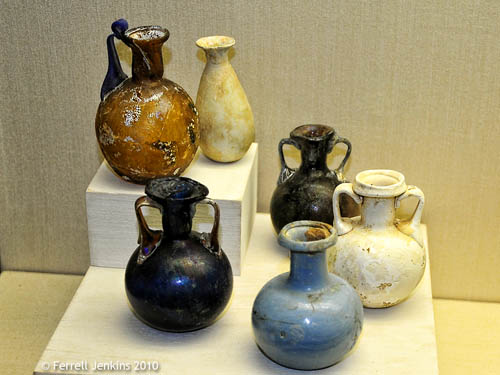
The next photo shows several pieces of “mold-blown perfume vessels decorated with stylized motifs” on display at the Eretz Israel Museum, Tel Aviv, Israel. These vessels are obviously more delicate and require more care than the ordinary clay vessels. For our time we might compare Melmac (if you are too young  to know, look it up!) and fine china.

Mold-blown perfume vessels. Erezt Israel Museum. Photo by Ferrell Jenkins.

Mold-blown perfume vessels. Erezt Israel Museum. Photo by Ferrell Jenkins.

Paul says to Timothy, and to us, “be a vessel for honorable use, set apart as holy, useful to the master of the house.”

Peter uses a similar analogy in speaking of the husband’s responsibility to his wife.

Likewise, husbands, live with your wives in an understanding way, showing honor to the woman as the weaker vessel, since they are heirs with you of the grace of life, so that your prayers may not be hindered. (1 Peter 3:7 ESV)

Another jumping off place — the pinnacle of the temple

A couple of days ago we wrote about the pinnacle of the temple (Mark 11:11; Luke 4:9). We followed the common suggestion that the reference was to the southeast corner of the temple mount precinct.

We mentioned that the late Benjamin Mazar, The Mountain of the Lord (page 149), shows a photo of the southeast corner of the wall with the comment that this “is known as the ‘pinnacle of the Temple’ (Mark 11:11; Luke 4:9).”

Leen Ritmeyer left us a comment to say that “Mazar actually had a different idea,” and called attention to his own post at ritmeyer.com.

Dr. Ritmeyer, author of The Quest: Revealing the Temple Mount in Jerusalem, provided some insight into the subject that is helpful and appreciated. He says,

Although this statement does appear in the book, I remember discussing this problem with him and he said that he actually saw the  southwest corner of the Temple Mount as a more likely candidate for the pinnacle of the Temple. One needs to determine what was the most important element in the temptation of Jesus to throw himself down from the pinnacle. Was it the height of the corner above what lay below or did the temptation lie in impressing as many people as possible with that jump?

As the southwest corner was a busy junction between the major north-south street running through Jerusalem and the Plaza in front of the Southern Wall of the Temple Mount, there would have been many more people to impress here than on the much quieter southeast corner.

It is in a setting such as this that we can visualise the dramatic scene that would have taken place had not Jesus challenged the temptation with the power of God’s Word.

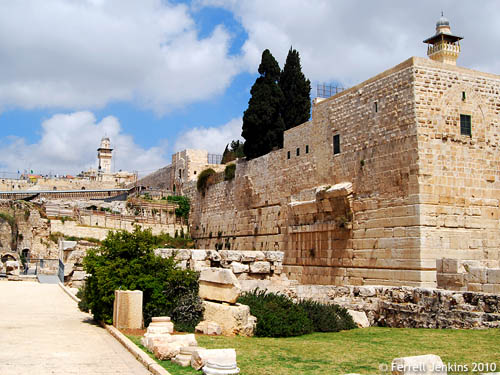
The Temple Mount Southwest Corner. Photo by Ferrell Jenkins.
The Southwest Corner of the Temple Mount. Photo by Ferrell Jenkins.

The western side of the Temple Mount enclosure ran along the Tyrophean Valley from north to south. A few years ago archaeologists found the first century street level at the southwest corner. The stones you see protruding from the wall are known as “Robinson’s Arch”, named for 19th century explorer Edward Robinson. When I first visited Jerusalem in 1967 it was commonly thought that the arch was the beginning of a bridge across the Tyrophean Valley, similar to Wilson’s Arch which is north of the Western Wall plaza. Now we know that the arch was the beginning of a winding staircase that allowed access to the Royal Stoa on the temple platform. (You will see a nice drawing of this staircase in Ritmeyer’s post.)

In my original post I said, “In a post to follow I will mention another view.” The other view I had in mind was the southwest corner.

Richard M. Mackowski, Jerusalem City of Jesus, says this corner “may be identified with the biblical Pinnacle of the Temple” (page 122). This is the comment I intended to use in today’s post. I am delighted that Dr. Ritmeyer calls attention to the discussion he had with Benjamin Mazar. We expect scholars to change their minds as they gain new information. It is also possible that an editor added the note in the book.

My bottom line is that we do not know for certain where the pinnacle of the temple is located. Either of these views suggest a good possibility.