Category Archives: Israel

Nahal Dan — strongest source of the Jordan

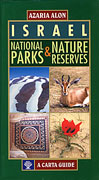
Israel National Parks and Nature Reserves, by Azaria Alon, is a must book for those who plan to visit more than the popular few of the parks and reserves in Israel.  It is published by Carta (Jerusalem), and distributed by Eisenbraun’s in the USA. Click on the link here to go directly to the description and order info.

Here is Alon’s description of the Nahal Dan (Nahr el-Leddan; River Dan):

Nahal Dan is situated in the heart of an area known as “the land of streams and rivers,” and indeed, in the Nahal and along its margins, water and vegetation are present in abundance. The Nahal has a single principal source but it is also fed by dozens of smaller springs. Walking in this environment one has the feeling of springs emerging everywhere. All this water has its origin from the winter snows on Mt. Hermon. The snow melts slowly, seeps into the sponge-like earth of the mountain, and emerges in the foothills. The water flows quietly from the springs, but it continues down an ever-increasing slope, turning into a torrent and generating standing waves and foam. When the stream emerges from the nature reserve, it splits into several rivulets which rejoin when it encounters Nahal Hermon to form the Jordan River.

Nahal Hermon is more commonly known as the Nahr Banias which begins at the site of Caesarea Philippi.

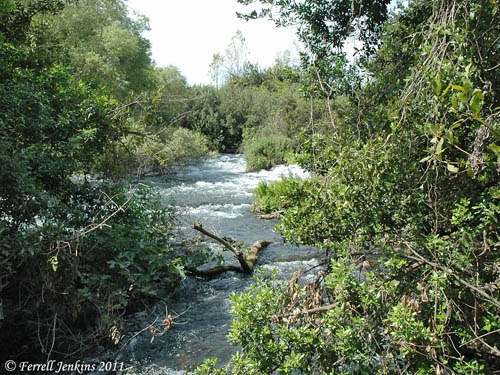
Here is a view of the Nahal Dan within the Tel Dan Nature Reserve.

Nahal Dan in the Tel Dan Nature Reserve. Photo by Ferrell Jenkins.

Nahal Dan in the Tel Dan Nature Reserve. Photo by Ferrell Jenkins.

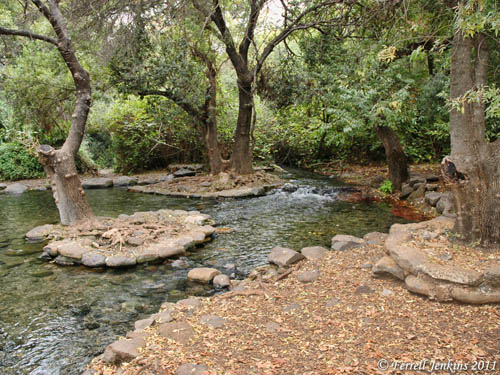
And here is one of the springs. This one is located immediately below the northwest corner of Tel Dan.

A spring in the Tel Dan Nature Reserve. Photo by Ferrell Jenkins.

A spring in the Tel Dan Nature Reserve. Photo by Ferrell Jenkins.

Dan is Israel’s northernmost city (Judges 18:29).

The flea river: Nahr Bareighit or Nahal Iyon

The least known of the sources of the Jordan River is the Nahr Bareighit (flea river) or Nahal Iyon (the name used in Israel). Like the Senir (Hasbani), this river begins in the Beka Valley of Lebanon. It is often overlooked when the sources of the Jordan are named.

Nelson Glueck, The River Jordan, describes the Nahr Bareighit.

The westernmost source of the Jordan is the small mountain stream, Nahr Bareighit. Through a rude gorge, it tumbles down southward from the hilly meadowland of Merj ‘Ayun, which retains in clear part its ancient Biblical name of Ijon (1 Kings 15:20), to add its waters to the formation of the fateful [Jordan] river. The Nahr Bareighit joins the Nahr Hasbani about three quarters of a mile above the point where the Hasbani joins the junction of the Leddan and Banias streams. These last two alone were anciently considered as the sole sources of the Jordan. All found help to form it, and lose their identity in it, as the Jordan starts it flow under its own name.

“Roll, Jordan, roll;
I want to go to heaven when I die
To hear sweet Jordan roll.”

Deni Baly, The Geography of the Bible, devotes a single sentence to this little stream.

The basin of Marj ‘Ayoun to the west is drained by the smaller Bareighit, which leaps over the threshold in a series of charming waterfalls near Metullah and postpones its junction with the Jordan until just before the Huleh marshes. (193)

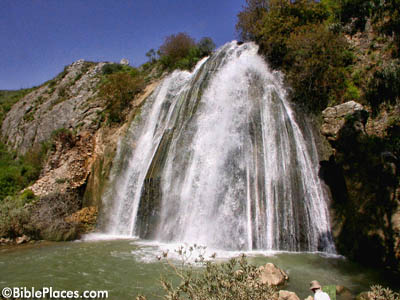
The photo below shows the Iyon Mill Falls. It is one of the beautiful photos of several falls on the river from the Pictorial Library of Bible Lands. Check BiblePlaces.com to purchase the complete set or the DVD of Galilee and the North.

Nahal Iyon Mill Falls. Photo: BiblePlaces.com.

Nahal Iyon Mill Falls. Photo courtesy of BiblePlaces.com.

The Senir, a source of the Jordan River

The longest source of the Jordan is the 24-mile-long Nahr Hasbani which begins in the Beka Valley of Lebanon and flows south to join the Jordan. Israel has replaced many of the Arabic names that were commonly used in earlier decades with Hebrew names. The Old Testament says that the Sidonians “call Hermon Sirion, and the Amorites call it Senir” (Deuteronomy 3:9). The river is now designated Senir in Israel.

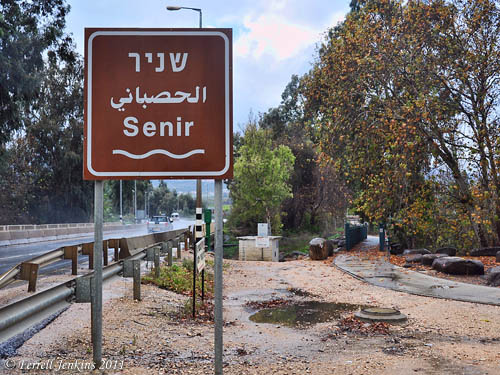
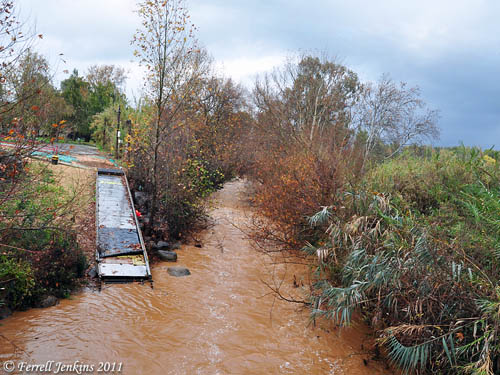
At the Senir (Hasbani) on Israel Highway 99. Photo by Ferrell Jenkins.

At the Senir (Hasbani) on Israel Highway 99. Photo by Ferrell Jenkins.

Other passages identifying Mount Hermon as Senir are 1 Chronicles 5:23, Song of Solomon 4:8, and Ezekiel 27:5. Nelson Glueck, The River Jordan, calls attention to Psalm 42:6, translating it this way:

O my God, my soul is cast down within me: Therefore am I mindful of thee from the land of the Jordan, and the Hermons” (Psalm 42:6)

The plural of the Hebrew word chermonim is bought out in the English translations by phrases like “peaks of Hermon” or “heights of Hermon.”

Israel Highway 99 runs north east from Kiryat Shmona to the Golan Heights past Tel Dan and Banias (Caesarea Philippi) and two other sources of the Jordan (the River Dan and the River Banias). Because this river begins in the vicinity near Mount Hermon, it is called the Senir.

The photo below is the view north from Highway 99.

The Senir River (Hasbani) view north from HWY 99.

The Senir River (Hasbani) view north from HWY 99. Photo by Ferrell Jenkins.

I think the slide on the west side of the river is used to launch kayaks into the river.

Here and there in biblical blogdom

Dr. Carl Rasmussen, the name back of those great photos at Holy Land Photos (now more than 3100) and author of the excellent Zondervan Atlas of the Bible (Revised edition), recently started a blog under the title HolyLandPhotos’ Blog. I think you will enjoy following it here. The blog discusses “Sites, Peoples, and Events Related to the Bible, Ancient Near East, and Classical Studies.” Click Zondervan Atlas of the Bible to buy this book at Amazon for $26.39 (post paid). That is a saving of 34%.

Wayne Stiles (blog is here) has an article about the “Historical marvels at Tel Dan” in a recent Jerusalem Post here.

Luke Chandler calls attention to a fascinating BBC 2010 article on the British Museum which says the 80,000 object on display amount to just 1% of the eight million artifacts in the Museum collection. See Luke’s comments and the link at Luke Chandler’s Blog here.

If you plan a trip to London, I suggest you take a copy of my seven page paper on Some Biblically Related Artifacts in the British Museum. Get it in PDF here.

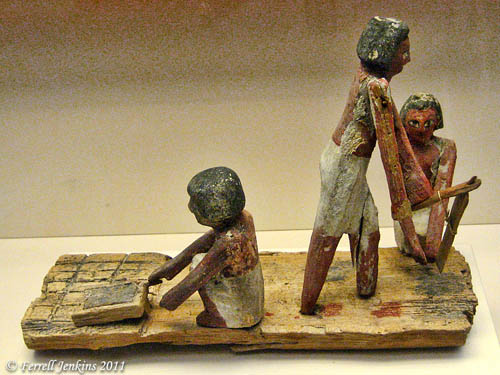
The photo below is of an Egyptian Brick Making Model. That leaves 79,999 more (+/-).

“Don’t continue to supply the people with straw for making bricks, as before. They must go and gather straw for themselves. (Exodus 5:7 CSB)

Egyptian Brick Making Model. British Museum. Photo by Ferrell Jenkins.

Egyptian Brick Making Model. British Museum. Photo by Ferrell Jenkins.

Leon Mauldin is traveling in Israel. Read his reports at Leon’s Message Board here.

Prof. Aren Maeir reports on the availability for download of old reports on the excavations at Megiddo by the Oriental Institute of the University of Chicago.

The Oriental Institute of the University of Chicago announces the online publication of four older titles. Internet publication of these books was made possible through the generous support of Misty and Lewis Gruber.

  • OIC 9. New Light from Armageddon: Second Provisional Report (1927-29) on the Excavations at Megiddo in Palestine. By P. L. O. Guy. Oriental Institute Communications 9. Originally published in 1931.
  • OIP 26. Material Remains of the Megiddo Cult. By Herbert Gordon May. Oriental Institute Publications 26. Originally published in 1935.
  • OIP 32. The Megiddo Water System. By Robert S. Lamon. Oriental Institute Publications 32. Originally published in 1935.
  • SAOC 17. Notes on the Megiddo Pottery of Strata VI-XX. By Geoffrey M. Shipton. Studies in Ancient Oriental Civilization 17. Originally published in 1939.

Dr. Leen Ritmeyer writes about the Jordanian-financed restoration of the Dome of the Rock, including a video, here.

Races called off at Caesarea Maritima hippodrome

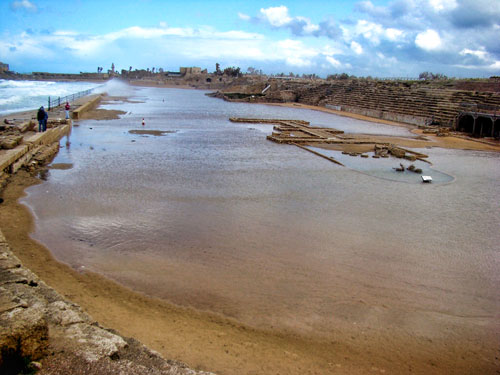
Friend Leon Mauldin is traveling in Israel for a few days. He reports “a mixture of wind, rain, and sunshine” today. He shared a nice photo of the hippodrome at Caesarea Maritima flooded. Note the heavy clouds and the water crashing in from the sea.

Caesarea Maritima Hippodrome standing in water. Photo by Leon Mauldin.

Caesarea Maritima Hippodrome standing in water. Photo by Leon Mauldin.

Our thanks to Leon for sharing this photo with out readers. You may follow the progress of his tour at Leon’s Message Board here.

We know that Israel needs the rain after several years of drought conditions. The archaeological park was closed due to storm damage in mid-December, 2010. See here.

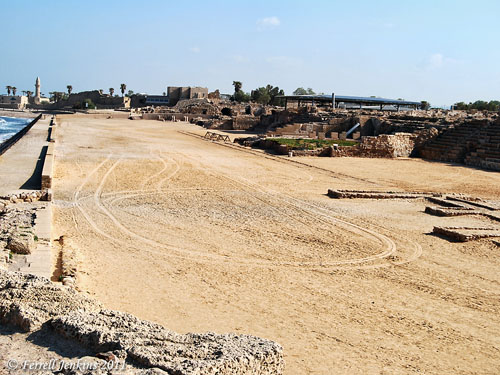
Here is a photo of the same area made during a dry period.

Caesarea Maritima Hippodrome. Photo by Ferrell Jenkins.

Caesarea Maritima Hippodrome Dry. Photo by Ferrell Jenkins.

Herod the Great built a hippodrome along the coast at Caesarea Maritima in 10 B.C. to celebrate the opening of the city. Read more here.

Peter preached to Cornelius at Caesarea (Acts 10,11).

Paul was imprisoned in the city for two years before departing for Rome (Acts 24:27; 27:1).

Pharaoh’s chariot wheels and other things that won’t float — Examining the claims of the late Ron Wyatt

The late Ron Wyatt is noted for his fabulous claims to have located just about every secret thing there is, including Noah’s Ark, the location of Sodom and Gomorrah and the other cities of the plain, Mount Sinai, the location of the crossing of the Red Sea, wheels from Pharaoh’s chariots, the ashes of the red heifer, the ark of the covenant, etc., etc., etc.

Standish and Standish, two Seventh Day Adventist researchers, wrote a response to Wyatt, who was also a Seventh Day Adventist. In Holy Relics or Revelation, they give a list of 92 things Wyatt claimed to have found. This book is available at Amazon, and is partially available online at Google Books.

Ron Wyatt (1933-1999) was a nurse-anesthetist with no training in archaeology. We might more correctly call him an explorer. Few famous, recognized archaeologists have more than one or two fabulous finds to their credit, but Wyatt found almost everything that was missing!

Typically I receive several Emails each year asking about some of the claims of Wyatt, though they do not always mention his name. Recently I received a PowerPoint presentation attached to the Email. The presentation is entitled “Moses & the Red Sea Crossing Truth or Fiction?” Of course, I believe Moses led the developing nation of Israel through the sea. No one takes credit for producing the presentation. There is no documentation other than Scripture references. Looking at the “Properties” of the presentation that someone borrowed a template from some other presentation.

The Claim

The presentation includes a map showing Succoth immediately north of the Gulf of Suez. That is the wrong position. Israel then traveled across the Sinai peninsula through a wadi running east toward Eilat/Aqaba, then southerly to Nuweiba on the Gulf of Aqaba (Eilat). This, according to Wyatt, is exactly where the Israelites crossed the Red Sea out of Egypt (he considered the Sinai peninsula as Egypt) into the wilderness on the east of the Gulf of Aqaba. This is necessary to place Mount Sinai in Saudi Arabia. Wyatt did some scuba diving and found Pharaoh’s chariot wheels, chariot bodies, human and horse bones.

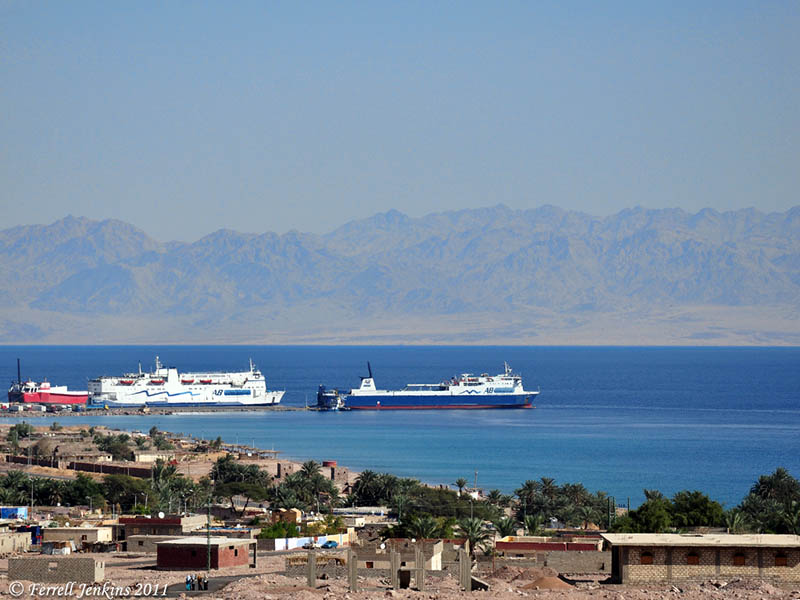
The photo below is one I took in the vicinity of Nuweiba January 26, 2011. The view is east from the Sinai Peninsula to Saudi Arabia. This point is about 160 miles on a straight line from where the presentation map shows Israel leaving Succoth. It is about 45 miles south of Eilat/Aqaba. Eilat is in Israel; Aqaba is in Jordan. Even the modern roads in the Sinai are not built on a straight line.

So he made his chariot ready and took his people with him; and he took six hundred select chariots, and all the other chariots of Egypt with officers over all of them. The LORD hardened the heart of Pharaoh, king of Egypt, and he chased after the sons of Israel as the sons of Israel were going out boldly. Then the Egyptians chased after them with all the horses and chariots of Pharaoh, his horsemen and his army, and they overtook them camping by the sea, beside Pi-hahiroth, in front of Baal-zephon. (Exo 14:6-9 NAU)

Think about it. A large, powerful, professional Egyptian army had to chase “about six hundred thousand men on foot, aside from children” (Exodus 12:37-38). The Israelites also had their “flocks and herds” and “a very large number of livestock” with them. Yet, the Egyptians could not catch them for more than 160 miles!
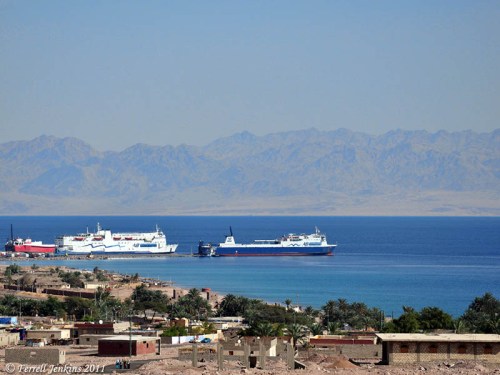
Peninsula east to Saudi Arabia. Photo by Ferrell Jenkins.

View from Sinai Peninsula east to Saudi Arabia. Photo by Ferrell Jenkins.

I don’t have the time now to do more, but I have located some articles that raise serious questions about Wyatt’s claims. Wyatt was never taken seriously by archaeologists (whether conservative or liberal).

Being Certain About What is Uncertain

Carl Rasmussen comments on the scholarly divide concerning landmarks like the Red Sea and Mount Sinai:

Indeed there are at least ten different proposals for the location of the Red Sea or Reed Sea — including three lakes near the Mediterranean Sea, five lakes along the line of the present-day Suez Canal, as well as the Gulf of Suez and the Gulf of Elath. In addition, there are at least twelve different candidates for Mount Sinai: five in the southern part of the peninsula, four in the north, one in the center, one in Midian (Saudi Arabia), and another in Edom (southern Transjordan). (Zondervan Atlas of the Bible, Rev. Ed., 103).

Responses to Wyatt

Wyatt was a Seventh Day Adventist, but when he was actively making his claims several Seventh Day Adventists scholars took up pen to respond to him. We have already mentioned the book by Standish and Standish.
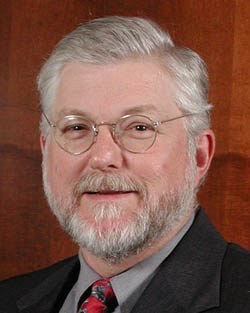
Dr. David Merling

Dr. David Merling

Dr. David Merling is currently Research Associate in Near Eastern Archaeology at Andrews University, Institute of Archaeology, Berrien Springs, MI. For a number of years he served as Curator of the Horn Archaeological Museum. During the 1990s Merling wrote a number of short articles responding to the claims of Ron Wyatt. These have been archived on the Andrews University web site. Merling discusses the following questions:

  • Who am I and why have I opened this Web site? He explains something about his credentials and states that he has been asked these questions “over and over again.” His comments were last updated in 2006.
  • Has Noah’s ark been found?
  • Ark of the Covenant, has it been found?
  • Did the Israelites cross the Red Sea or the Gulf of Aqaba? This is the specific question that we are now discussing.

You may find Dr. Merling’s material here.

The page dealing with the question of the Red Sea crossing includes maps showing the difference between what the Bible says and what Wyatt claimed. There is also a photo of the column that Wyatt claims is from the time of Solomon. Merling shows that it is from the time of Jesus [Roman], and unlike columns from the time of Solomon.

In another post we will mention more material responding to Wyatt and other pseudo-archaeologists.

A rooster can wake you up

Having been brought up in the country, I learned early about the annoyance of the rooster as well as his usefulness. His crowing awakened those who wanted to get up early and those who would have preferred sleeping. Without the rooster there would be no more chicks. Bantam roosters were especially known for their strutting. The writer of Proverbs mentioned this attribute:

Three things are stately in their stride, even four are stately in their walk: a lion, which is mightiest among beasts and doesn’t retreat before anything, a strutting rooster, a goat, and a king at the head of his army. If you have been foolish by exalting yourself or if you’ve been scheming, put your hand over your mouth. For the churning of milk produces butter, and twisting a nose draws blood, and stirring up anger produces strife. (Proverbs 30:29-33 CSB)

The rooster strutted as if he owned the yard. Our backyard was barren. Chicken scratch was scattered across the yard and the chickens scurried to get their share.

The photo below was made recently at the Jordan River Park north of the Sea of Galilee.

Rooster at Jordan River Park. Photo by Ferrell Jenkins.

Rooster at Jordan River Park. Photo by Ferrell Jenkins.

We especially remember the rooster in connection with Peter’s denial of the Lord. Note first the Lord’s prediction:

“I assure you,” Jesus said to him, “tonight, before the rooster crows, you will deny Me three times!” “Even if I have to die with You,” Peter told Him, “I will never deny You!” And all the disciples said the same thing. (Matthew 26:34-35 CSB)

Matthew records what happened after the denial:

Then he started to curse and to swear with an oath, “I do not know the man!” Immediately a rooster crowed, and Peter remembered the words Jesus had spoken, “Before the rooster crows, you will deny Me three times.” And he went outside and wept bitterly. (Matthew 26:74-75 CSB)

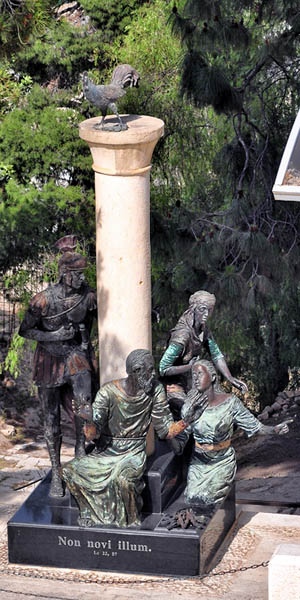
If you have visited St. Peter in Galicantu (St. Peter of the Cock Crowing) in Jerusalem recently, you have seen this sculpture showing Peter saying “I do not know Him.” Note the rooster on the top of the column.

Sculpture at St. Peter in Galicantu. Photo by Ferrell Jenkins.

Sculpture at St. Peter in Galicantu. Photo by Ferrell Jenkins.

Then the Lord turned and looked at Peter. So Peter remembered the word of the Lord, how He had said to him, “Before the rooster crows today, you will deny Me three times.” And he went outside and wept bitterly. (Luke 22:61-62 CSB)

Grass on the roof

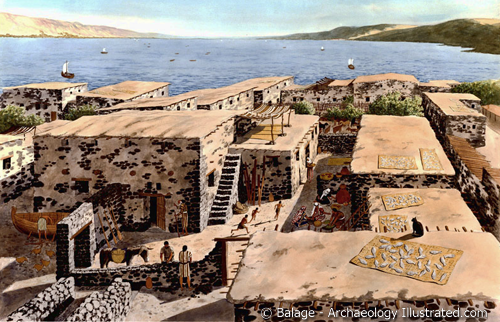
In the previous post we wrote about the account of some men putting a hole in the roof of the house where Jesus was teaching in Capernaum. Our photos illustrated the way roofs were constructed at the time. This art by Balage Balogh of Archaeology Illustrated shows clearly the roofs. You can see the flat dirt roof with the poles (we might say rafters) showing under the surface.

The houses of Capernaum in the time of Jesus.

The houses of Capernaum in the time of Jesus. Art by Balage Balogh, ArchaeologyIllustrated.com

Other biblical passages become clear when we understand the nature of house construction during Bible times.

Take a look at Proverbs27:15. Think of what the winter rains might do to one of the roofs of the day.

A continual dripping on a rainy day and a contentious wife are alike. (Proverbs 27:15 NET)

One of the Psalms of Ascent calls for the overthrow of  those who hate Zion.

May they be like the grass on the rooftops which withers before one can even pull it up, (Psalm 129:6 NET)

In another text we are told that King Hezekiah of Judah prayed to the Lord during the days of the Assyrian threat to Judah. The prophet Isaiah informs the Assyrian king Sennacherib that the Lord has overthrown His enemies in the past and will do so again. Notice the illustration:

Their residents are powerless, they are terrified and ashamed. They are as short-lived as plants in the field, or green vegetation. They are as short-lived as grass on the rooftops when it is scorched by the east wind. (2 Kings 19:26 NET = Isaiah 37:27).

They removed the roof above Jesus

The following paragraph by M. J. Selman in the New Bible Dictionary, 3rd ed., provides a good summary about houses in Bible times.

Many houses had two storeys, though, since no building in ancient Israel has yet been preserved with a complete roofed ground floor or ceiling, the original height of a building is not always certain. Upper rooms were reached by stairs or ladders. These rooms provided the main living and sleeping accommodation (cf. 2 Ki. 9:13, 17), and guests could also be looked after there (1 Ki. 17:19; 2 Ki. 4:10-11).

Roofs were constructed from beams covered with branches and a thick layer of mud plaster, though the rafters were sometimes supported by a row of pillars along the middle of the room. Cylindrical stone rollers about 60 cm. [23.6 inches] long were used to keep the roofs flat and waterproof, though roofs needed to be re-plastered annually prior to the rainy season to seal cracks which had developed during the summer heat.

The family would often sleep on the roof in summer or use it to dry raisins, figs, flax, etc., in the sun. A parapet was to be built as a safety precaution according to Dt. 22:8. Vaulted roofs were certainly in use in Palestine by the Persian period, while the tiled roof also appeared before NT times. The rooftop was also a place of worship, either for Baal and especially the host of heaven (Je. 19:13; Zp. 1:5), or for the true God (Acts 10:9).

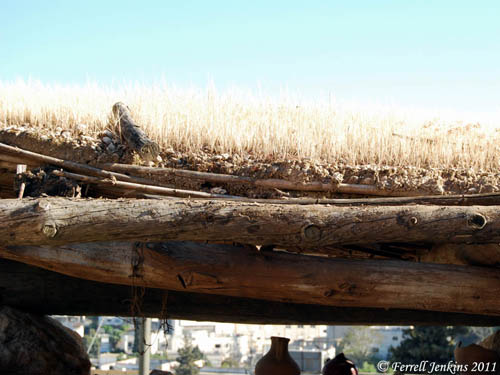
The first photo shows a portion of a roof made from wood and mud. You will also notice a roof roller on the roof. After the winter rains it was necessary to roll the roof.

Typical roof from NT times with roof roller. Nazareth Village. Photo by Ferrell Jenkins.

Typical roof from NT times with roof roller. Nazareth Village. Photo by Ferrell Jenkins.

The next photo shows the roof a little later in the year after grass has grown on the roof and died under the summer heat.

Typical of a roof from NT times with grass growing on it. Nazareth Village. Photo by Ferrell Jenkins.

Typical of a roof from NT times with grass growing on it. Nazareth Village. Photo by Ferrell Jenkins.

From the inside of the house the ceiling might look something like this.

Ceiling of roof made of timber and reeds. Nazareth Village. Photo by F. Jenkins.

Ceiling of roof made of timber and reeds. Nazareth Village. Photo by F. Jenkins.

Notice the New Testament texts implying such a roof.

When they were not able to bring him in because of the crowd, they removed the roof above Jesus. Then, after tearing it out, they lowered the stretcher the paralytic was lying on. (Mark 2:4 NET)

The account of Luke, a gentile physician, adds an interesting point that creates a small problem in interpretation.

But since they found no way to carry him in because of the crowd, they went up on the roof and let him down on the stretcher through the roof tiles right in front of Jesus. (Luke 5:19 NET)

Did you notice the reference to roof tiles? One of the Translator’s Notes in the NET Bible discusses this problem.

There is a translational problem at this point in the text. The term Luke uses is keramos. It can in certain contexts mean “clay,” but usually this is in reference to pottery (see BDAG 540 s.v. 1). The most natural definition in this instance is “roof tile” (used in the translation above). However, tiles were generally not found in Galilee. Recent archaeological research has suggested that this house, which would have probably been typical for the area, could not have supported “a second story, nor could the original roof have been masonry; no doubt it was made from beams and branches of trees covered with a mixture of earth and straw” (J. F. Strange and H. Shanks, “Has the House Where Jesus Stayed in Capernaum Been Found?” BAR 8, no. 6 [Nov/Dec 1982]: 34). Luke may simply have spoken of building materials that would be familiar to his readers.

There are other possible interpretations, but I hope this information with the photos will help you better understand the biblical text.

Prof. Anson F. Rainey — 1930-2011

Word comes today of the passing of Prof. Anson F. Rainey. He was Emeritus Professor of Ancient Near Eastern Cultures and Semitic Linguistics, Tel Aviv University. He taught in some of the most prestigious programs both in Israel and the United States.

One might disagree with his conclusions, but you never went away wondering about his position.

A list of his publications and teaching positions may be found at the website of the Department of Archaeology at Tel Aviv University here.

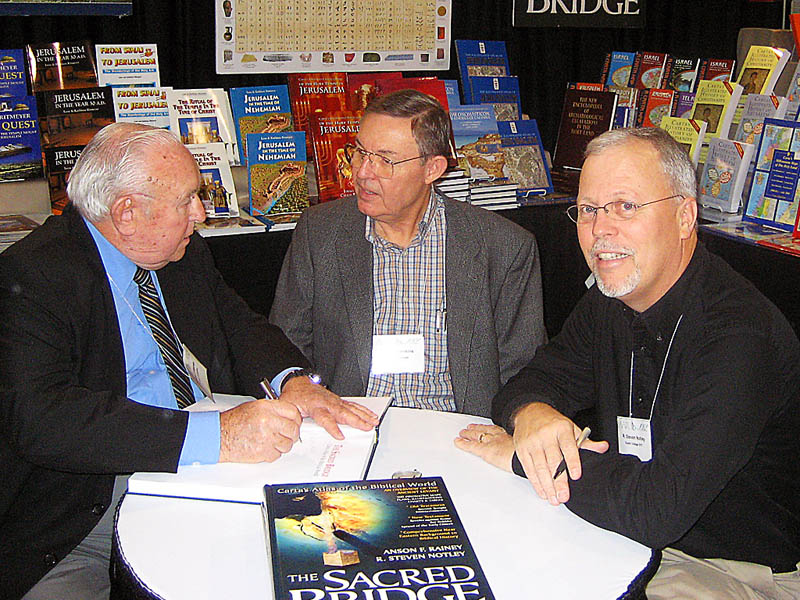
I am delighted to have an autographed copy of The Sacred Bridge. In the general category of Bible Atlases it stands in a field by itself as the most thorough and comprehensive. Todd Bolen said the book is “probably the most important work of historical geography ever written” while admitting that it is over the head of most students, and sometimes his own. See here and here.

Anson Rainey, Ferrell Jenkins, and Stephen Notley at SBL, 2006.

Anson Rainey, Ferrell Jenkins, and Stephen Notley at SBL, 2006.

HT: Joseph I. Lauer