Category Archives: Israel

The early rain damages Hai-Bar Yotvata Nature Reserve

According to The Jerusalem Post’s Sharon Udasin, heavy rains caused damage to the Hai-Bar Yotvata Nature Reserve located in the Arabah (Arava) north of Eilat.

The heavy rains that drenched the Eilat mountains and southern Arava region on Sunday night led to the flooding of the Hai-Bar Yotvata Nature Reserve, the Israel Nature and Parks Authority (INPA) said on Monday.

Over the course of the night, park workers evacuated animals that were in danger of drowning, and others worked all night to rebuild fences that had collapsed during the flood.

By Tuesday, the nature reserve will be open as usual to visitors, an INPA statement said.

Despite the damage caused to the nature reserve, the rains brought with them “many blessings” as they watered the acacia trees – which are “a source of life in the desert” – and created a “rare, breathtaking site,” according to the INPA.

“The desert is now beautiful and gleaming, and this is the best time to hike in it and to enjoy the rich and spectacular landscape it has to offer,” said Doron Nissim, the Eilat district manager at the INPA.

More information about the weather expectations for this year is available here.

The photo below shows the Arabian Oryx, thought to be the reem of the Hebrew Bible. English versions typically translate this word with “wild ox” (Numbers 23:22; 24:8; Deuteronomy 33:17, et al. The King James Version uses the word unicorn.
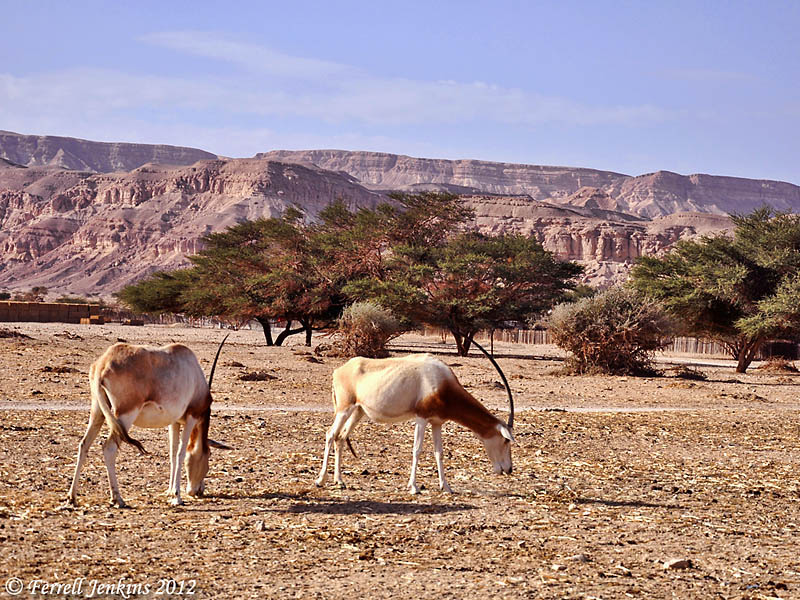
Arabian Oryx at Hai-Bar Nature Reserve. Photo by Ferrell Jenkins.

Arabian Oryx at Hai-Bar Nature Reserve. Photo by Ferrell Jenkins.

If one travels in the desert during the summer months he will see a dry, desolate bad land with only an isolated acacia or tamarisk tree or a shrub where the last water of the winter rain flowed. In the winter it can be different. Israel has two dominant seasons: winter and summer. The summer is dry and the winter is wet. The early rains begin about mid-October and continue till the late rains of early April. See Deuteronomy 11:14; Psalm 84:6; Joel 2:23; James 5:7.

 “And if you will indeed obey my commandments that I command you today, to love the LORD your God, and to serve him with all your heart and with all your soul,  he will give the rain for your land in its season, the early rain and the later rain, that you may gather in your grain and your wine and your oil.  And he will give grass in your fields for your livestock, and you shall eat and be full. (Deuteronomy 11:13-15 ESV)

You might enjoy reading our earlier post about “Rivers in the Desert” here.

HT: Todd Bolen, Bible Places Blog. This Wednesday Roundup is especially full of helpful information.
“You could feel the wheels turning”

Obituaries for Frank Moore Cross (1921–2012) are beginning to appear in various sources. William Yardley writes in The New York Times about Cross:

Dr. Cross studied culture, religion and politics of the period in which the Hebrew Bible, or Old Testament, was written and revised, and he traced the ways different nations and cultures had translated its early texts. He also traced the evolution of ancient script and developed expertise in dating documents by the slightest shifts in writing style.

“That we know that a particular scroll comes from 100 B.C. and not 50 A.D. is almost entirely due to the study of the scripts and their development that he worked out,” Mr. Machinist said. “That may seem like a trivial point, but if you don’t have a sense of when these texts are dated, you have no sense of their historical importance.”

Once, several colleagues said, after carbon dating confirmed dates that he had established through script analysis, Dr. Cross joked that he was happy to hear that his script studies had validated the practice of carbon dating.

The article mentions the study habits of Dr. Cross.

Dr. Cross often sequestered himself in his study at home until late into the night.

“He was very intense, and we would just kind of tiptoe by the study,” Ms. Gindele [one of his daughters] recalled. “My mother liked to say you could feel the wheels turning and not to bother him.”

The full article may be read here.

Hershel Shanks, editor of Biblical Archaeology Review, writes here about the life and influence of Cross under the title, “The End of an Era.”

Jim Davila, who wrote a dissertation under Cross, offers some interesting reminiscences here.

HT: Jack Sasson and Joseph Lauer

Visiting the Lynn H. Wood Archaeological Museum

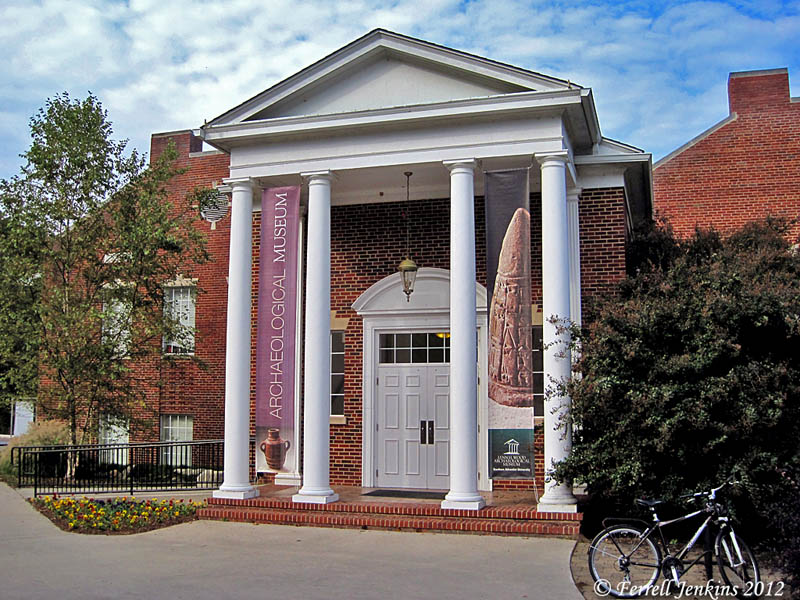
You might never expect to find an excellent archaeological museum nearly hidden in the woods of eastern Tennessee. But that is what you will find at the Lynn H. Wood Archaeological Museum on the campus of  Southern Adventist University in Collegedale, Tennessee.

When we arrived on campus we asked a student the location of the Museum. After walking up a long series of steps that some students were skipping up (ah, youth!), we asked two other students. Each of them offered to show us. And, neither had been to the Museum. Everyone on campus that we spoke with was friendly and helpful.

Inside Hackman Hall is housed a wonderful educational exhibit.

The Lynn H. Wood Archaeological Museum is located in this building.

The Lynn H. Wood Archaeological Museum is located in this building.

A few years ago William G. Dever gave his research library of nearly 3000 volumes and a large collection of archaeological artifacts to Southern. The artifacts are built into an award-winning exhibition under the title Vessels in Time: A Journey Into the Biblical World. Archaeology Professor Dr. Michael G. Hasel serves as curator of the Museum.

Iron Age IIA (1000-900 B.C.) Pottery in the Lynn H. Wood Museum.

Iron Age IIA (1000-900 B.C.) Pottery in the Lynn H. Wood Museum.

The exhibits follow a chronological order from the early days in Mesopotamia to New Testament times.  Each display has a good timeline which coordinates the archaeological periods with the Biblical record. The photo above shows some pottery from the Iron Age IIA (1000-900 B.C.). This is the period of the United Kingdom (or Monarchy). The bowl on the left has been slipped and shinned. The accompanying information explains that during this period vessels were sometimes dipped “into red watery clay” to create the colored slip. The bowl was then hand burnished with a stone like the one shown above it.

Three examples of dipper juglets from the period are shown:

  1. A Phoenician import.
  2. A simple local juglet.
  3. A black-slipped, burnished juglet.

There is a nice model of Solomon’s Temple in the same room.

If your travels take you anywhere near Chattanooga, Tennessee, I suggest you take time to drive a few miles east to Collegedale and visit the Lynn H. Wood Archaeological Museum.

Full information about the Museum including visiting hours may be found here.

6 year old palm from 2000 year old seed

A few date palm seed were uncovered by Professor Yigael Yadin during his excavation of Masada. Six years ago one of these seed was planted at the Arava Institute in Israel. The seed sprouted, and has grown into a nice little six year old palm.

Yishai Fleisher of EyeOnZionTV interviews Dr. Elaine Solowey at the Arava Institue about this seed and plant. In addition to the information about the palm, I especially like the way Dr. Solowey refuses to fall for some of the speculative journalistic questions.

The photo below shows one of the modern date palms on the southwestern shore of the Sea of Galilee.

Date Palm growing near the Sea of Galilee. Photo by Ferrell Jenkins.

Date Palm growing near the Sea of Galilee. Photo by Ferrell Jenkins.

Jericho is mentioned as “the city of palm trees” in Deuteronomy 34:3.

The righteous are compared to the palm tree.

The righteous flourish like the palm tree and grow like a cedar in Lebanon. (Psalm 92:12 ESV)

HT: Jack Sasson

Acts 15 — Photo Illustrations

James, the Lord’s brother, is one of the prominent characters in Acts 15. In fact, Paul later refers to the events of Acts 15, and speaks of James, Cephas,and John.

and when James, Cephas, and John, who had a reputation as pillars, recognized the grace that had been given to me, they gave to Barnabas and me the right hand of fellowship, agreeing that we would go to the Gentiles and they to the circumcised.  (Galatians 2:9 NET)

In the Armenian Quarter of the Old City of Jerusalem we find the Cathedral of St. James. Murphy-O’Connor says,

Facts and legend are juxtaposed as casually as are artistic creations of different talents and periods. The church is dedicated to St. James the Great, son of Zebedee, who was executed by king Herod Agrippa I in 44 (Acts 12:1-3).

But the building also claims to hold the “patriarchal throne of St James the Less, the brother of the Lord…” (Murphy-O’Connor). This is the James of Acts 15. (It is sometimes difficult for readers to keep all of those named James, John, and Mary, separate when reading the New Testament — not to mention Herod.)

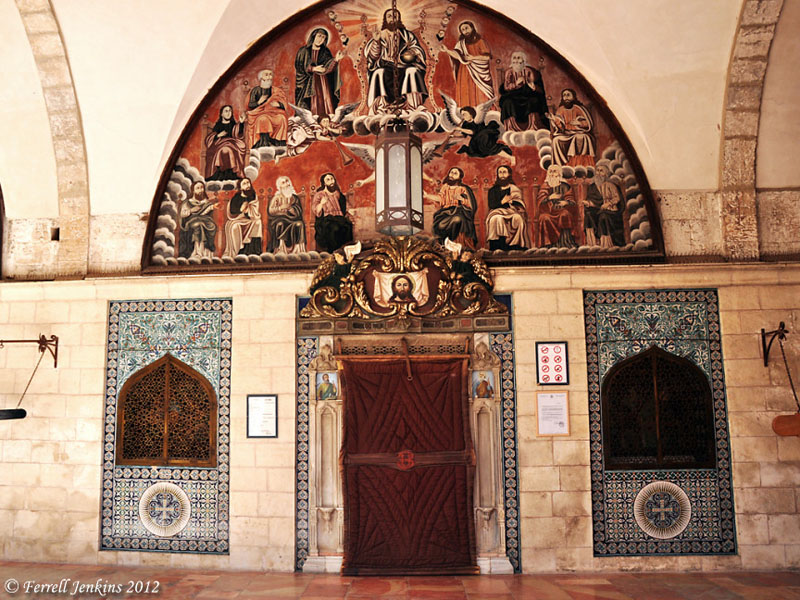
Photos were not allowed inside the building when I was there to observe a service. This photo shows the entrance to the Cathedral.

Entrance to St. James Cathedral in the Armenian Quarter of Jerusalem. Photo by Ferrell Jenkins.

Entrance to St. James Cathedral in the Armenian Quarter. Photo by Ferrell Jenkins.

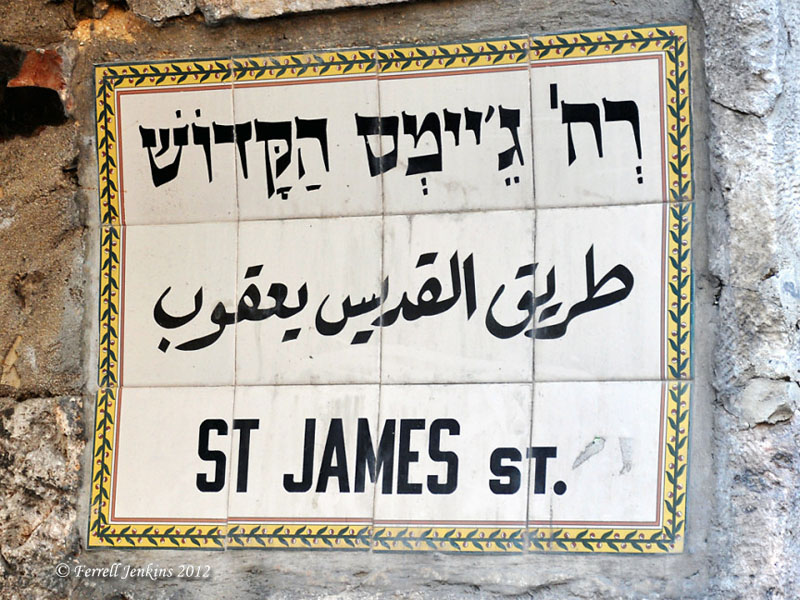
In one of the quietest places in the Old City one comes upon St. James Street.

St. James Street in the Armenian Quarter. Photo by Ferrell Jenkins.

St. James Street in the Armenian Quarter. Photo by Ferrell Jenkins.

Other names of interest in the Armenian Quarter include St. Mark’s Street and Ararat Street. A century ago the Armenians had a large presence in eastern Turkey, where the Mountains of Ararat are located.

“From the Land of Black Tents”

In his book The Apostle: A Life of Paul, noted biographer John Pollock begins his book with information about Paul’s background at Tarsus. He calls the first chapter, “From the Land of Black Tents.”

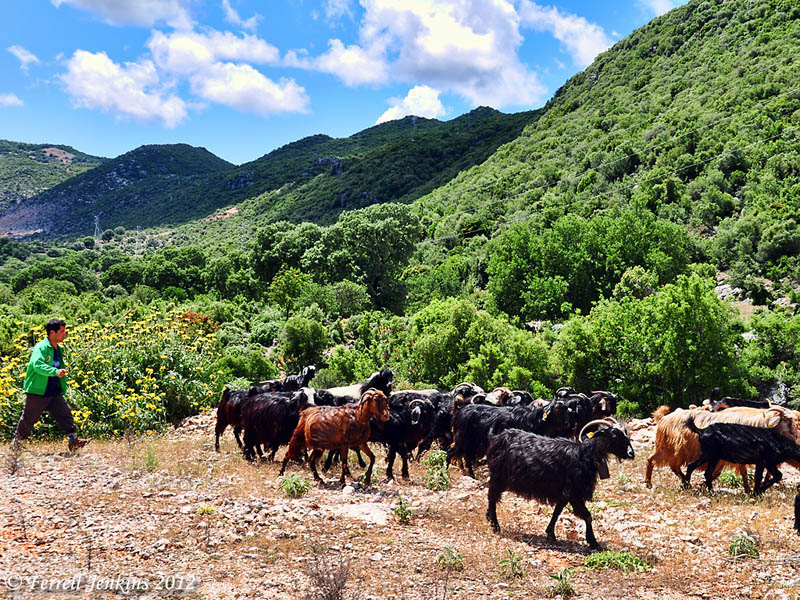
His father most likely was a master tentmaker, whose craftsmen worked in leather and in cilicium, a cloth woven from the hair of the large long-haired black goats that grazed (as they still do) on the slopes of the Taurus. The black tents of Tarsus were used by caravans, nomads, and armies all over Asia Minor and Syria.

We still see these herds of long-haired black goats in many parts of Turkey. The photo below was made east of Myra near the Mediterranean coast of Turkey.

Goats with long black hair, east of Myra, Turkey. Photo by Ferrell Jenkins.

Goats with long black hair east of Myra, Turkey. Photo by Ferrell Jenkins.

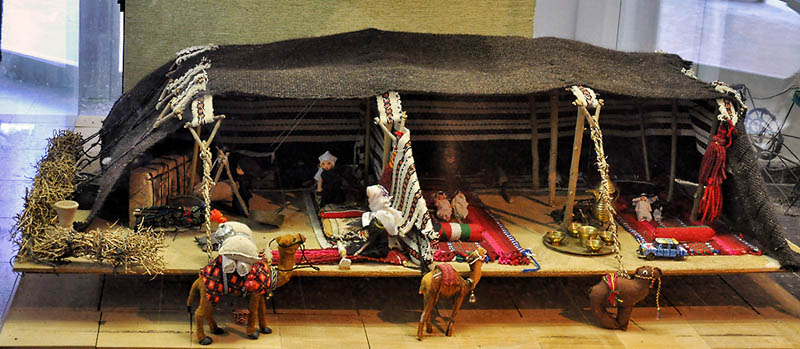
The Museum for Beduin Culture at Kibbutz Halav in the Negev of Israel displays a small model of a beduin (bedouin) tent. This museum intends to preserve the memory of the original bedouin life that is quickly being replaced by a permanent life and housing.

Bedouin Tent Model displayed at the Museum for Beduin Culture. Photo by Ferrell Jenkins.

Tent Model displayed at the Museum for Beduin Culture. Photo by Ferrell Jenkins.

Paul said,

But Paul said, “I am a Jew of Tarsus in Cilicia, a citizen of no insignificant city; and I beg you, allow me to speak to the people.” (Acts 21:39 NAU)

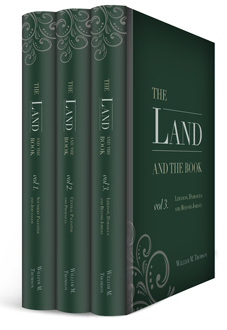
Thomson’s “The Land and the Book” on Logos community pricing

William Thomson’s 3-volume set, The Land and the Book, is now on community pricing at Logos.

http://www.logos.com/product/26753/the-land-and-the-book

Thomson - The Land and the Book

The Land and the Book

This set of books was published by Harper & Brothers between 1880 and 1886.

Thomson spend many years living in Beirut and traveling throughout the region. This is one of the excellent books telling of travel in those days, and of the then-current understanding of the location of various sites.

I am delighted that this book is now on community pricing for $18. If enough people place a bid the price could be lower. Place your bid today.

HT: Brooks Cochran

More about Magdala

Yesterday we called attention to the Magdala synagogue and table. We noted that it was impossible to get any good photos at the site. I didn’t even try.

We visited the site on the most recent tour, but everything is covered in a way that make it difficult or impossible to make sense of it.

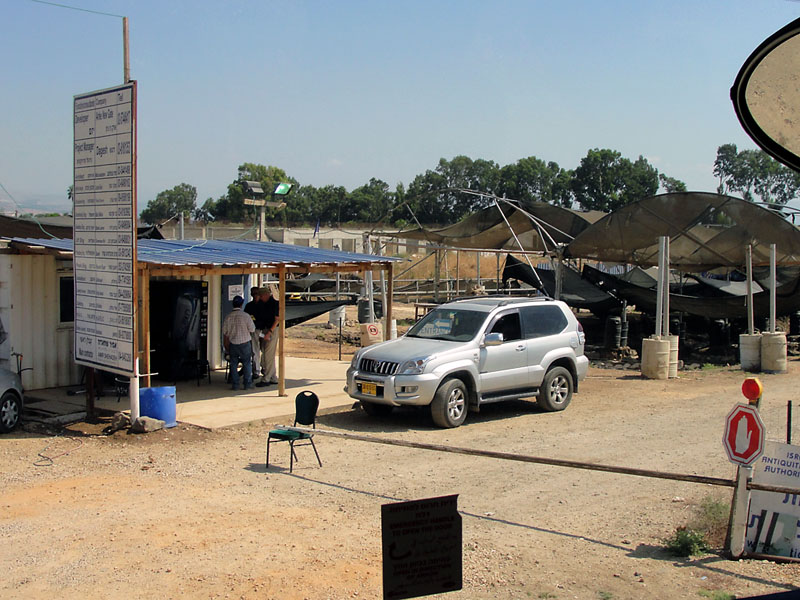
Overnight I received a photo from Steven Braman who was with us on the tour. He shared a photo he made from the bus window while our guide was negotiating a visit. I had been turned away on two previous attempts to see the site.

Site of the Magdala synagogue. Photo by Steven Braman.

Site of the Magdala synagogue. Photo by Steven Braman.

This looks like a construction site. It is. Notice the new buildings in the background of the photo. The Franciscians, under the name Galilee Project, are building a hotel, media center, cathedral, et al. In fact, the synagogue might not have been found for decades had it not been for the construction project. Hundreds of emergency excavations are conducted each year in Israel as a result of construction projects, the widening of roads, laying of pipe lines, and improving sewer systems.

The Magdala synagogue and table

Several times in the past few years we have called attention to the site of Magdala (Migdal). In September, 2009, we noted the announcement by the Israel Antiquities Authority of the discovery of a synagogue from the Second Temple period (50 BCE—100 CE).

A synagogue from the Second Temple period (50 BCE—100 CE) was exposed in archaeological excavations the Israel Antiquities Authority is conducting at a site slated for the construction of a hotel on Migdal [Magdala] beach, in an area owned by the Ark New Gate Company. In the middle of the synagogue is a stone that is engraved with a seven-branched menorah (candelabrum), the likes of which have never been seen. The excavations were directed by archaeologists Dina Avshalom-Gorni and Arfan Najar of the Israel Antiquities Authority.

The town of Magdala is not mentioned in the Bible, but Mary Magdalene is mentioned a total of 12 times in the four gospels. This place may have been her birthplace or her home. A few late manuscripts mention Magdala (Matthew 15:39 KJV), but earlier manuscripts read Magadan. Magdala is located about 4 miles north of Tiberias on the western shore of the Sea of Galilee.

The Hebrew word Magdala means tower. In New Testament times the city had become Hellenized and bore the Greek name Tarichea because of the importance of the salted-fish industry there. Mendel Nun located a harbor at the site. He says,

“In ancient times, pickled sardines were an important element of diet throughout the country–especially for those who lived near the lake” (BAR, Nov/Dec 1993).

Josephus had his headquarters at Magdala during the first Jewish Revolt against Rome (A.D. 66-70). He was able to get a group of at least 230 boats to go from Magdala to Tiberias (Jewish Wars 2.635-637). Vespasian attacked the town from the sea and destroyed it.

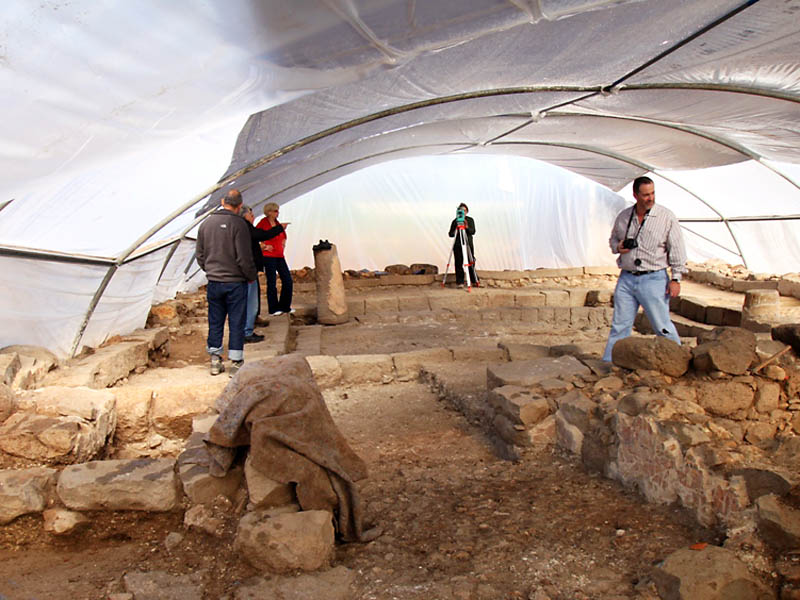
We visited the site on the most recent tour, but everything is covered in a way that make it difficult or impossible to make sense of it. We are fortunate to have a photo made by Jim Joyner a few years ago.

The Magdala/Migdal Synagogue. Photo by Jim Joyner.

The Magdala/Migdal Synagogue. Photo by Jim Joyner.

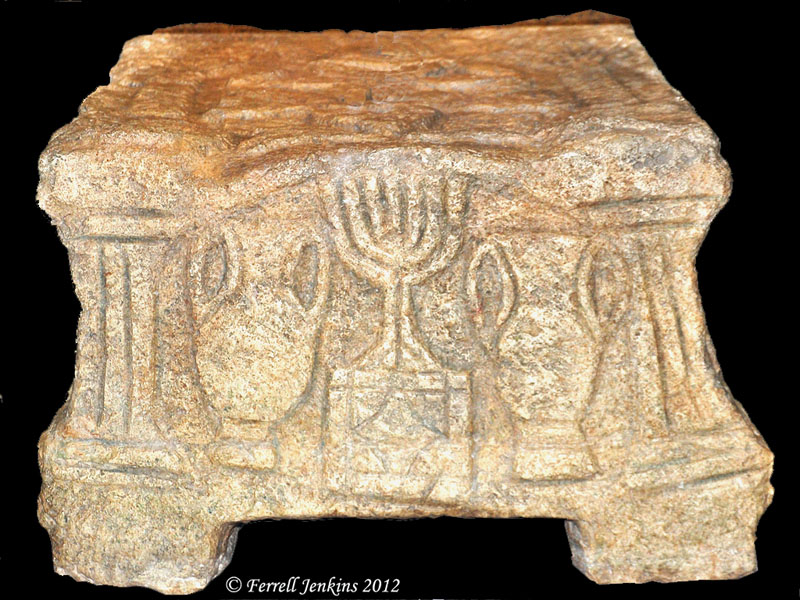
There is a replica of the “table” that was found in the synagogue at the site. The glare on the case was bad, but I followed the tip of Dr. Carl Rasmussen (Holy Land Photo’s Blog), I went to the Notre Dame Hotel and made a photo of the replica there. Since his photo, the table has been put in a case. Notice the menorah.

Magdale Synagogue Table - Notre Dame Hotel, Jerusalem.

Magdala Synagogue Table – Notre Dame Hotel, Jerusalem. Photo by Ferrell Jenkins.

We were told at the site that the original is now in the Rockefeller Museum. Whether on display or being examined by the IAA, I do not know.

Understanding the Land

Charles Savelle, over at Bible X calls attention to a Wall Street Journal article on the importance of geography in understanding world affairs. Read the article here. It might help you to understand better some of the situations going on in Russia, China, Iran, and Syria.

Later, Charles quotes from a new book on Joshua about the same subject and adds his comments about the importance of geography here. I want to share the paragraph he cites from Coleson’s commentary on Joshua in the Joshua, Judges, Ruth (Cornerstone Biblical Commentary)

“Because humans live on the surface of the earth, geography is always important. Because every ancient Israelite, humble or great, lived in close and intimate relationship with the land, if we wish to understand ancient Israel, we need to learn ancient Israel’s geography. Canaan was the Land of Promise God gave to Israel through the events recorded in Joshua; if we want to understand the message of Joshua, we need to study both the physical and the human geography of ancient Israel God’s grand plan of redemption for the human race may transcend both time and space, but God has so far worked it out in a very definite, limited place through a sequence of events in history. To understand God’s plan and its fulfillment, it helps to understand the timeline and the map” (Joshua, Judges, Ruth, p. 33).

I could not agree more.