Category Archives: Israel

Ashkelon excavation underway

‘Tis the season for archaeological digs. At Ashkelon, the Leon Levy Expedition runs from June 8 – July 19 this year. It is sponsored by Harvard’s Semitic Museum, Boston College, Wheaton College, and Troy University.

I have two young friends, Trent and Rebekah, who are working in the dig. They will not be writing up any marvelous new discoveries that might be made. This is always reserved for the directors of a dig to announce, and then later to publish. My friends are sharing some general information about their participation in the dig as time permits. They are there as part of Dr. Daniel Master’s team from Wheaton College.

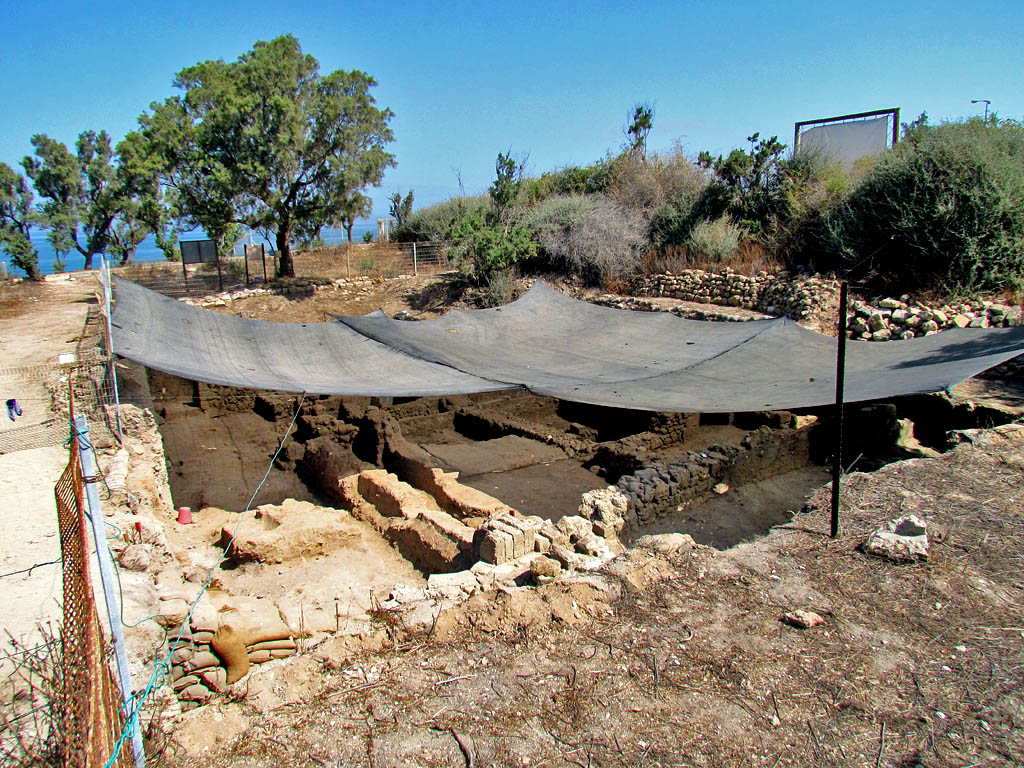
Trent has allowed me to use one of his photos of Grid 51. This is the Grid he has been working in during the past week. He informs me that this is about 1/4 mile southwest of the Canaanite Gate, and belongs to the Persian period. At the time Ashkelon was an important port aligned with Tyre and occupied by Phoenicians.

Grid 51 of the current Ashkelon excavation. Photo by Trent Dutton.

Grid 51 of the current Ashkelon excavation. Photo by Trent Dutton.

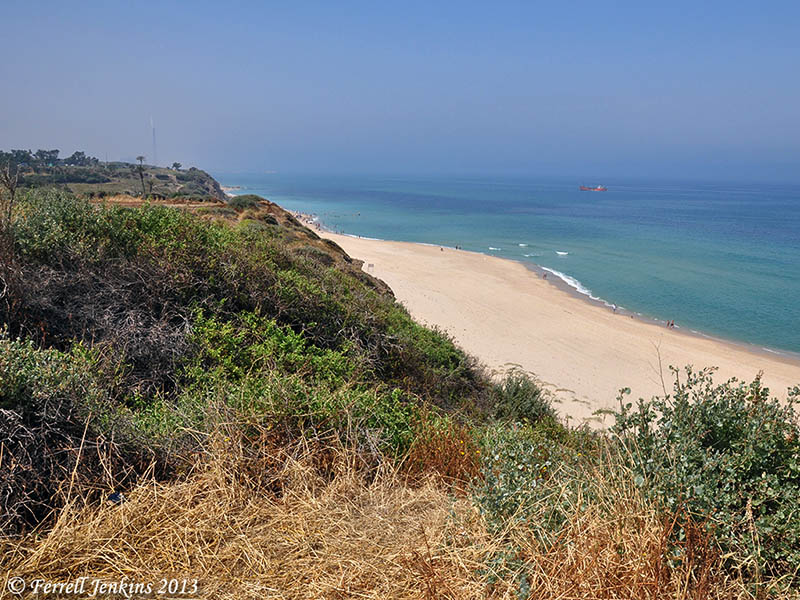
Notice that the Mediterranean Sea is visible to the west. The photo below shows the view south toward Gaza and Egypt and may include Grid 51.

View south along the beach at Ashkelon. Photo by Ferrell Jenkins.

View south along the beach at Ashkelon. Photo by Ferrell Jenkins.

According to 1 Samuel 6:17 there were five important Philistine cities: Ashdod, Gaza, Ashkelon, Gath, and Ekron. Ashkelon had a long history including occupation by Canaanites, Egyptians, Philistines, Phoenicians, Greeks, Romans, Byzantines, Muslims, Crusaders, and finally by Mamelukes.

If you would like to follow what Trent and Rebekah are able to share, see their blog here.

Overview of Jerusalem from the Haas Promenade

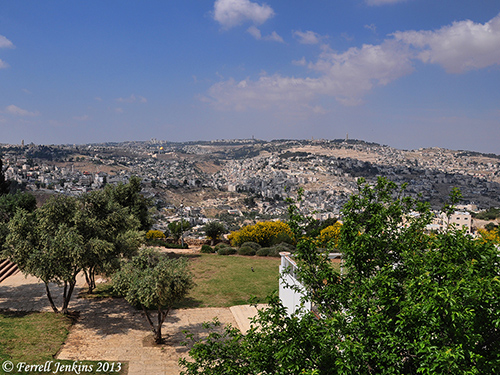
The Haas Promenade is fairly easy to reach from the Hebron Road (Derech Hevron) on the south side of Jerusalem. From there one has a beautiful view of the Old City of Jerusalem and the surrounding area. Those who know the city will enjoy this photo more than those who do not.

View of Jerusalem from the Haas Promenade. Photo by Ferrell Jenkins.

View of Jerusalem from the Haas Promenade. Photo by Ferrell Jenkins.

In this photo you can see the entirety of the southern wall of the Old City. From left to right notice the Church of the Dormition, the Dome of the Rock, the depression of the Kidron Valey, Mount Scopus, and the Mount of Olives. You can see the three towers of Olivet.

Because I have not been posting very much lately, and to show my appreciation for those of you who subscribe and continue to visit the blog, I have linked the image above to one large enough to use in PowerPoint presentations. I hope you and your viewers will enjoy.

As the mountains surround Jerusalem, so the LORD surrounds his people, from this time forth and forevermore. (Psalm 125:2 ESV)

“Extinct” frog alive and well in Hula Valley

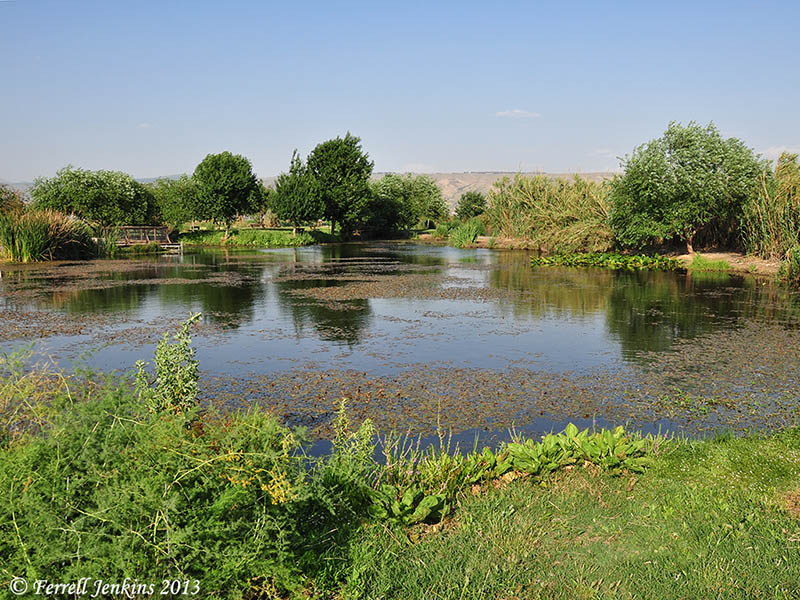
The Hula painted frog was declared extinct in 1996. But, an Israeli park ranger recently found one. Researchers have caught a total of 14 of these frogs since then. Read the story in the Smithsonian’s Smart News here.

There is no word whether this might have been the frog mentioned  in the account of the plagues the LORD sent on Egypt (Exodus 8). 🙂

He sent swarms of biting insects against them, as well as frogs that overran their land. (Psalm 78:45 NET)

A portion of the Hula Lake/Agamon Lake restoration project. Photo by Ferrell Jenkins.

A portion of the Hula Lake/Agamon Lake restoration project. Photo by Ferrell Jenkins.

See here for more info on the Lake Hula restoration project.

HT: Alan Cornett

A synagogue on the island of Delos

In the previous post we mentioned that there were numerous synagogues used by Jews of the Diaspora. Paul visited synagogues in many of the cities where he preached.

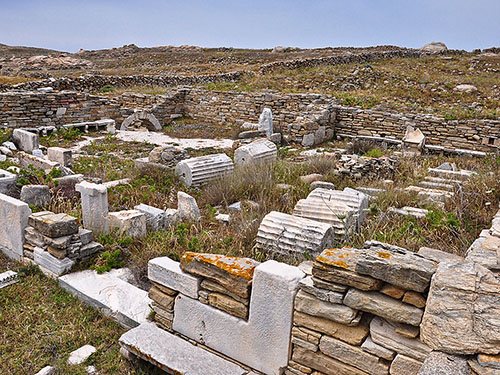
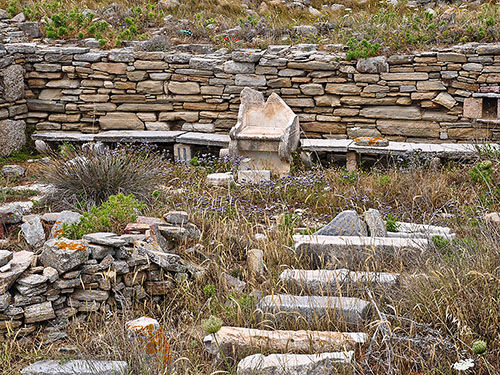
During his Spring travels, Dr. Carl Rasmussen visited the Greek island of Delos. Delos is one of those places that can only be reached with much effort. Carl has graciously granted permission for me to use a couple of his photos here. The first one shows a view to the west, southwest, showing various rooms of the synagogue. Note the “Moses Seat” in the upper right of the photo. The entrance is visible in the lower left.

Delos synagogue. Photo by HolyLandPhotos.

Delos synagogue. Photo by Carl Rasmussen, HolyLandPhotos.

The second photo shows a close up of the “Moses Seat” and the marble seats on each side. You may click on the photos for larger images provided by Dr. Rasmussen at the HolyLandPhotos’ Blog.

Delos synagogue. Photo by Carl Rasmussen, HolyLandPhotos.

Delos synagogue. Photo by Carl Rasmussen, HolyLandPhotos.

This large synagogue dates to the mid-second century B.C. Two inscriptions found in 1979-80 indicate that the worshipers here (Israelites) were likely Samaritans who revered Argarizein (Mount Gerizim). (See Kraabel, “New Evidence of the Samaritan Diaspora has been Found on Delos.” BA 47:1; 1984).

The Moses Seat. We commonly identify a special seat like the one in this synagogue as the Seat of Moses. Jesus may have made reference to such a seat (Matthew 23:2-3). For more information about the “Moses Seat” see here. Michael White suggests at least the possibility that this seat may be a “Proedrion, either for the major donor (or patron) or for the leader of the group” (HTR 80:2 (1987). I don’t see that this changes the fact that a reader and teacher of the Law might sit here.

If you have any interest in the synagogues scattered over the Mediterranean world, you will want to visit the HolyLandPhotos’ Blog here.

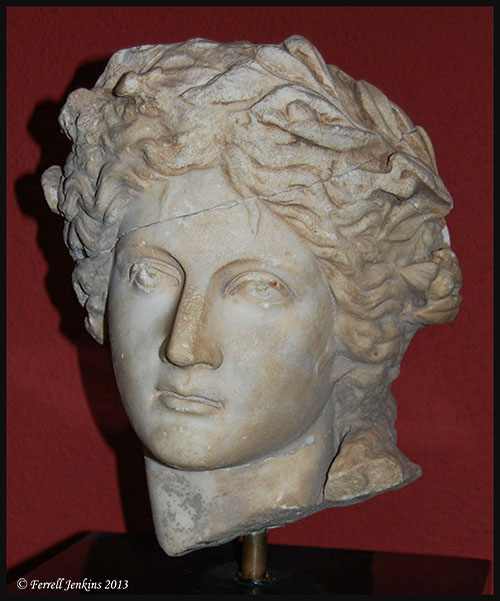
Tradition has it that Delos is the birthplace of Apollo, the son of Zeus, and his twin sister Artemis.

Marble head of Apolls from Perga. Second century A.D. Photo by Ferrell Jenkins.

Marble head of Apolls from Perga. Second century A.D. Photo by Ferrell Jenkins in the Antalya Archaeological Museum.

An article by Gordon Franz a few years ago piqued my interest in Delos. He wrote on “The Synagogue On The Island Of Delos And The Epistle Of James” in Bible and Spade (18:3; 2005). Franz provides the history and geography of the island. He includes a photo of the “Samaritan inscription,” and then proceeds to use the synagogue of Delos to illustrate two passages from the Epistle of James. He discusses James 2:2-4 and selected verses from James 3.

For those who have an interest in visiting Delos, Prof. Rasmussen explains exactly how to reach the synagogue from the Delos Museum. Rasmussen is author of the Zondervan Atlas of the Bible, and provides nearly 4000 thousand photos at the Holy Land Photos archive.

The synagogue — a place of study and discussion

The origin of the synagogue is difficult to determine, but it is generally held that it arose during the time of the Babylonian exile. Synagogues did not become common until the intertestamental period. The term intertestamental is used by many writers to describe the period between the close of the Old Testament (about 425 B.C.) and the coming of John the Baptist in the early first century A.D. Others use the term interbiblical, or the longer phrase, between the testaments.

With the destruction of the Temple (586 B.C.), sacrifices ceased. Prayer and the study of the sacred Scriptures, however knew no geographical limitations. The Book of Ezekiel describes the elders of Israel gathering in the prophet’s house (8:1; 20:1-3) (Charles Pfeiffer, Between the Testaments, 59).

In the sixth year, in the sixth month, on the fifth day of the month, as I sat in my house, with the elders of Judah sitting before me, the hand of the Lord GOD fell upon me there. (Ezekiel 8:1 ESV)

In the seventh year, in the fifth month, on the tenth day of the month, certain of the elders of Israel came to inquire of the LORD, and sat before me. And the word of the LORD came to me: “Son of man, speak to the elders of Israel, and say to them, Thus says the Lord GOD, Is it to inquire of me that you come? As I live, declares the Lord GOD, I will not be inquired of by you. (Ezekiel 20:1-3 ESV)

The word synagogue is of Greek origin. It simply refers to a gathering of the people, or a congregation. “The Hebrew word for such a gathering is keneseth, the name used for the parliament in the modern state of Israel” (Pfeiffer, 59).
After the rebuilding of the Temple (520–516 B.C.), the synagogue continued to fill the spiritual needs of the Jews of the Diaspora. There were synagogues in many of the cities visited by Paul: Damascus (Acts 9:2); Salamis (13:5); Antioch of Pisidia (13:14); Thessalonica (17:1); Corinth (18:4); Ephesus (19:8), and others. Only ten families were needed to compose a synagogue.

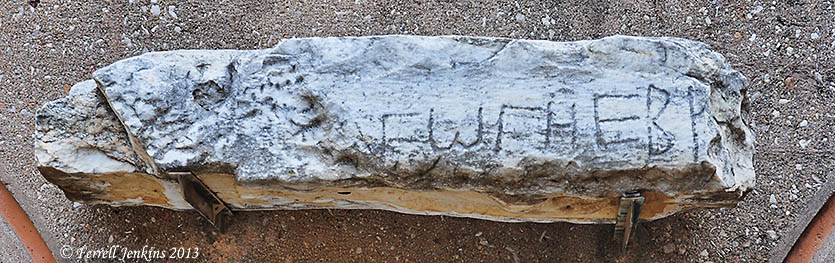
In 1898 a partial inscription mentioning a “synagogue of the Hebrews” was found at Corinth. It was published by Benjamin Powell in 1903 and identified as having come from the synagogue where Paul preached. McRay says that further study showed that it should be dated considerably later than the time of Paul. (Archaeology and the New Testament, p. 319).

Synagogue Inscription displayed in Corinth Museum. Photo by Ferrell Jenkins.

Synagogue Inscription displayed in Corinth Museum. Photo by Ferrell Jenkins.

A small plaque mounted underneath the inscription at the Corinth Museum reads, “Inscription from a late Roman synagogue.”

One rabbinic tradition has it that there were 480 synagogues in Jerusalem alone. Even the small villages of Galilee had synagogues at the time of Jesus (Mt. 4:23; 9:35).

More about Ephraim

In the previous post we pointed out that Ephraim, where Jesus went a short time before His death (John 11:54), is identified with Taybeh on the edge of the wilderness.

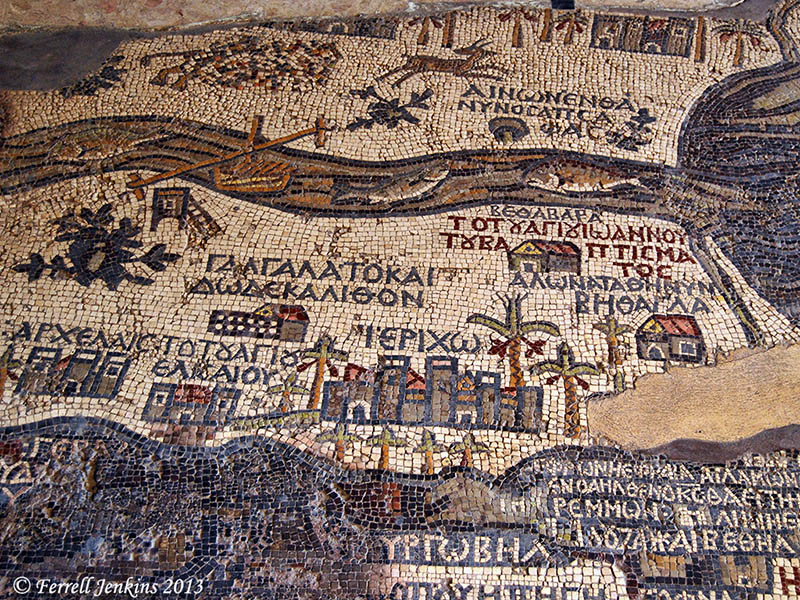
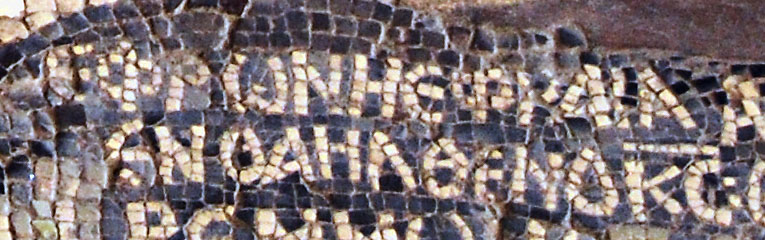
Ephraim is included on the Madaba Map dating to about 560-565 A.D. Below is a photo of a portion of the Madaba Map. The large town with palm trees around it represents Jericho. Below Jericho the land color changes to black. The entry closest to Jericho, but a little to the right, is Ephraim.

According to the website dealing with The Madaba Map, provided by the Studium Biblicum Franciscanum – Jerusalem, the two lines of white lettering read,

Ephron also Ephraia, where went the Lord

Portion of the Madaba Map mentioning Ephron. Photo by Ferrell Jenkins.

Portion of the Madaba Map mentioning Ephron. Photo by Ferrell Jenkins.

Here is a larger cropped portion of the map identifying Ephron. If your Byzantine Greek is up to date, you can make out all of the words.

Closeup of Ephron reference in Madaba Map. Photo by Ferrell Jenkins.

Closeup of the Ephron reference in Madaba Map. Photo by Ferrell Jenkins.

The inscription is located close to the wilderness, but is too far south. Other similar mistakes are made on the map. One such example would be the location of Ebal and Gerizim (See Victor R. Gold. “The Mosaic Map of Madaba.” Biblical Archaeologist, Sept. 1958: 50-71).

Ruins of a Byzantine church remain at Taybeh. There are also Crusader ruins. The Madaba Map from Jordan reflects the traditions of the 6th century A.D. Add this to the biblical evidence we mentioned equating Ephron, Ophrah, and Ephraim, and we have strong evidence that Taybeh marks the site of Ephraim.

Barry Britnell pointed out that Google Maps spell the name of Taybeh as Taibe.

You may read more about the Madaba Map section on Ephron here. Click on Ancient Sources for quotations from Eusebius and Josephus. Also check the Discussion section for more explanation.

William F. Albright suggested, as early as 1924, that Ephraim was to be identified with En Samye (Ein Samiyeh), a few miles northeast of Taybeh. Well, that gives me another place to visit in the future.

Jesus withdrew to Ephraim

The raising of Lazarus of Bethany brought much attention to Jesus and His ministry (John 11). According to John’s account, beginning in verse 45, many who saw the sign believed on Him. This caused the chief priests and Pharisees to convene a council. They were concerned about what the Romans might do if Jesus continued His work. Caiaphas, the high priest that year, told the council that it would be better for one man to die than for the whole nation to perish. In fact, John says this was a prophecy that Jesus was going to die for the nation. The text says,

So from that day on they made plans to put him to death. (John 11:53 ESV)

Jesus had other plans. Jesus carefully orchestrated His death. From the beginning of His ministry He spoke of His hour. After the raising of Lazarus he withdrew to a place northwest of Jerusalem on the edge of the wilderness at Ephraim.

Jesus therefore no longer walked openly among the Jews, but went from there to the region near the wilderness, to a town called Ephraim, and there he stayed with the disciples. (John 11:54 ESV)

Jesus would offer Himself as the sacrificial lamb at the time of the Passover. This took intricate planning.

Where is this place called Ephraim?

The identity of this place is complicated, partly because of the obscurity of the place and because of the change of names in the various languages that have prevailed in the territory over the centuries. Let’s try to work through some of the details.

Baal-hazor, where Absalom had sheep shearers, is said to be near Ephraim (2 Samuel 13:23).

The Ephron of 2 Chronicles 13:19 is often identified with Ephraim and the Ophrah of Joshua 18:23. Ophrah was in the tribal territory of Benjamin and near Bethel. Ophrah, which we are equating with Taybeh (tie-BAY), is only 4 miles north-east of Bethel and about 15 miles from Jerusalem.

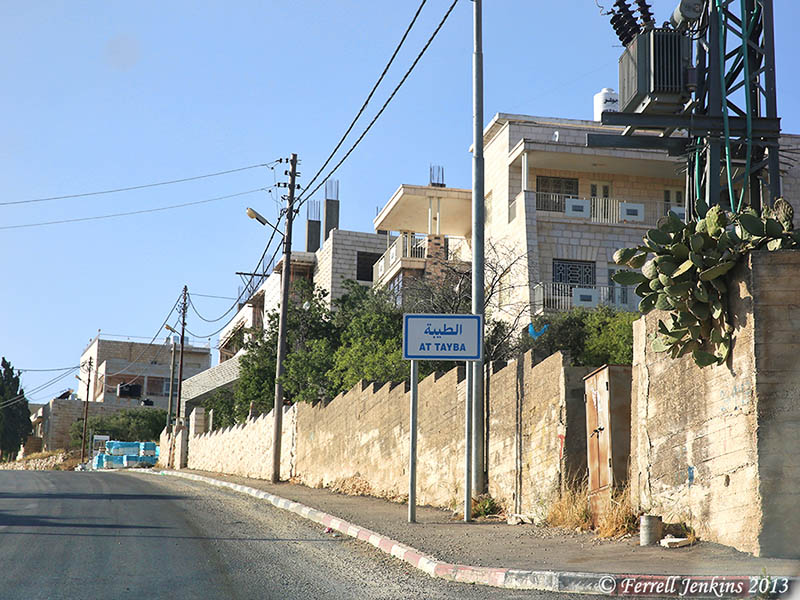
What is the name of Ephraim today? Ephraim is often identified with a Christian Arab town in the West Bank Palestinian territory known as At-Taybe. On Highway 60 a sign points to Taybeh, the spelling I am using. Carta’s Israel Touring Atlas spells it Et-Tayibeh.

Checking the Maps. Taybeh should be reached easily from Highway 60 by taking Highway 449 east at Ofra, and then a smaller road to the village. This is not possible. Ofra is an Israeli settlement, and the road is blocked for those wishing to go to Taybeh. Instead, it is necessary to take Highway 457 east, then 458 north. At the intersection with 449 (east), take the small road to the left to reach Taybeh. Highway 449 leads to the Jordan Valley and Jericho. The paved road is only wide enough for one vehicle at places and is in bad repair.
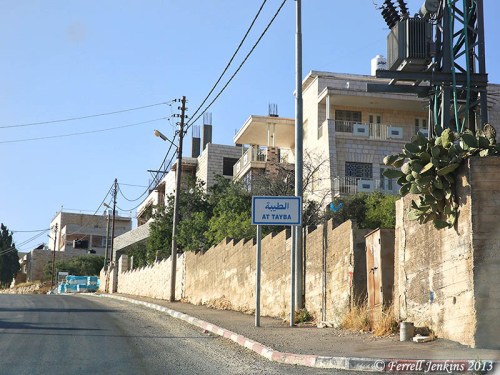
Entering the Christian village of At Taybe. Photo by Dan Kingsley.

Entering the Christian village of At Tayba. Photo by Dan Kingsley.

Gustaf Dalman says,

This et-Tayibeh, whose ancient name was, according to the villagers’ own recollections, ‘Afra’… (Sacred Sites and Ways, 1935, page 217).

Yoel Elitzur, says there is a surviving tradition that Taybeh was known in the past as Afra. He cites the work of Lydia Einsler from 1893, and then says that he,

…personally heard myself in the village, from speakers of various ages and levels of education. (Ancient Places Names in the Holy Land, 2004, page 268).

Note the similarity in the pronunciation of Oprah, Ephron, Afra, and Ephraim.

A book I have enjoyed for several decades is Eugene Hoade’s Guide to the Holy Land, published by the Franciscan Printing Press in Jerusalem. There is no date in the book, but I have owned it for several decades. Google books lists this book of 823 pages as having been published in 1984.

Hoade says that Taybeh is 869 meters in elevation. This equates to 2851 feet, about 400 feet higher than Jerusalem. He says that Taybeh is,

a Christian village, those inhabitants claim that they have been Christian from the very beginning. There is a flourishing Latin parish (1860): the Rosary Sisters have the Girl’ School since 1908: there is a Greek Orthodox Church, under which is a mosaic. The Greek Catholics built the new church of St. George in 1964, and the Latins are in the process of building a new church, which has a beautiful mosaic in the apse, representing the people meeting Jesus. (page 545)

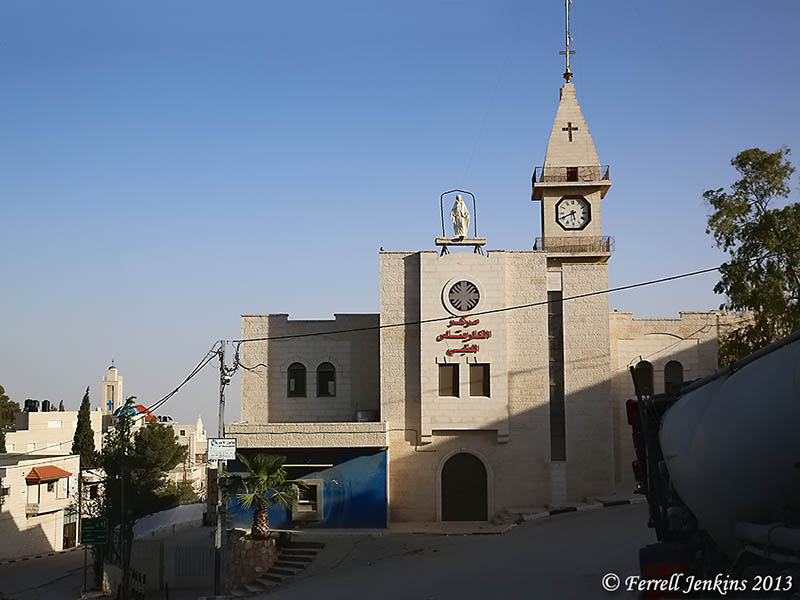
We drove to the top of the hill and the end of the village, turned around, and made a photo of what I think may be the Latin church and school.
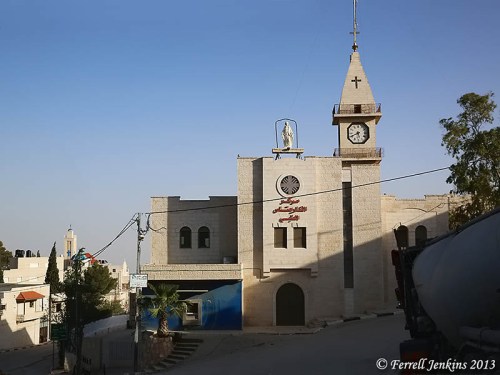
The Latin Church at Taybeh. Photo by Dan Kingsley.

The Latin Church at Taybeh. Photo by Dan Kingsley.

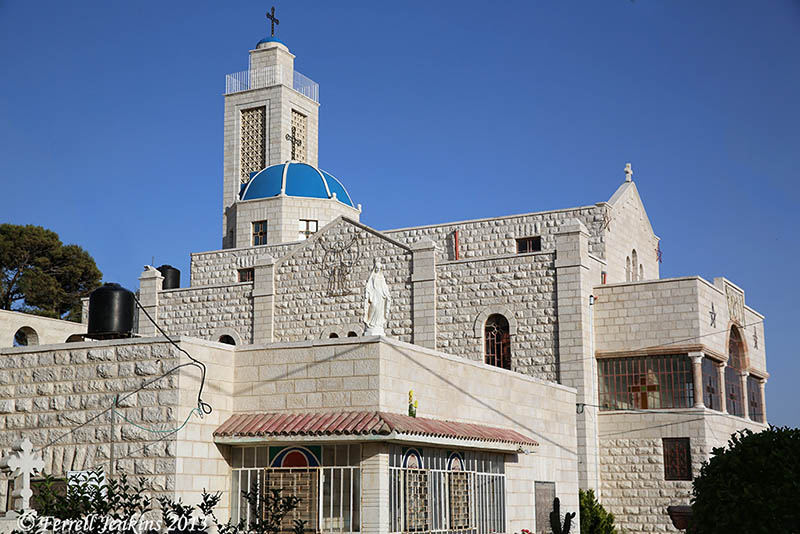
The Greek Catholic (Melkite) church of St. George was built in 1964. On the hill behind this church may be found the ruins of a Byzantine church.
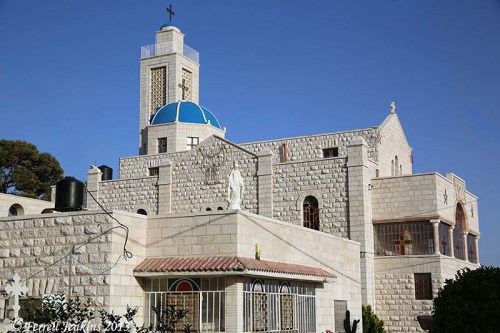
Greek Orthodox church at Taybeh. Photo by Dan Kingsley.

Greek-Melkite church at Taybeh. Photo by Dan Kingsley.

From the ridge on which Taybeh is built, the wilderness can be seen to the east. This is similar to the view that many of you have seen from the Mount of Olives, or from the Herodium, when you look to the east. The photo below shows the view east of Taybeh.
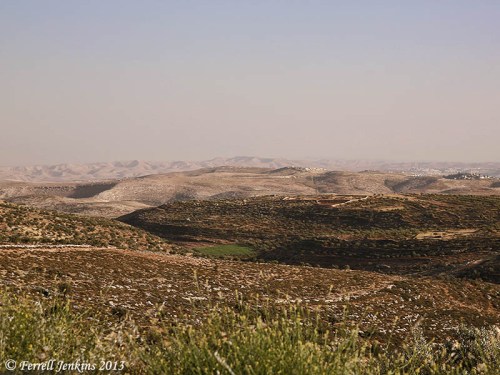
Wilderness to the east of Taybeh. Photo by Dan Kingsley.

Wilderness to the east of Taybeh. Photo by Dan Kingsley.

In reading about Taybeh, I have learned that all of the churches keep the Western Christmas and the Eastern Easter.

I have credited all of the photos to my traveling companion Dan Kingsley. Because we had little time to linger, we agreed that Dan would make the photos, sometimes from the car window, and we would share them. I have cropped and enhanced them as needed.

Why did Moses have a staff in his hand?

Recently during a mid-week Bible study, a brother presented a short talk on the question the LORD asked Moses.

The LORD said to him, “What is that in your hand?” He said, “A staff.” (Exodus 4:2 ESV)

We are not surprised to find a staff in the hand of Moses. Earlier in the same context we have learn that Moses was shepherding the flock of his father-in-law Jethro.

Now Moses was keeping the flock of his father-in-law, Jethro, the priest of Midian, and he led his flock to the west side of the wilderness and came to Horeb, the mountain of God. (Exodus 3:1 ESV)

Shepherd with his sheep at Nazareth Village. Photo by Ferrell Jenkins.

Shepherd with his sheep at Nazareth Village. Photo by Ferrell Jenkins.

The staff and the rod (Psalm 23:4) were the tools of the shepherd of Bible times. Here is a brief comment about the rod and staff from the Florida College Annual Lectures of 1993.

“Thy rod and Thy staff, they comfort me” (vs. 4). Shepherding was a dangerous profession. There were wild animals, thieves and robbers, and some means for defense was needed. The shepherd would carry the rod and staff for the protection of his flock. The rod (Hebrew, shēbet) was a short club about 30 inches long made from an oak sapling. The bulging head was shaped out of the stem at the beginning of the root. It was especially used as a weapon against men and animals who might threaten the flock. The staff (Hebrew, mish’eneth) was a straight pole about six feet long. Mackie says,

“Its service was for mountain climbing, for striking troublesome goats and sheep, beating leaves from branches beyond the reach of his flock, and especially for leaning upon. As he stood clasping the top of his stick with both hands, and leaning his head against it, his conspicuous and well-known figure gave confidence to the sheep grazing around him among the rocks and bushes of the wilderness.” (Mackie 291)

Most of the shepherds that I have seen throughout the Middle East carry a short staff – one that comes about waist high.

Excavation of the Ophel continues

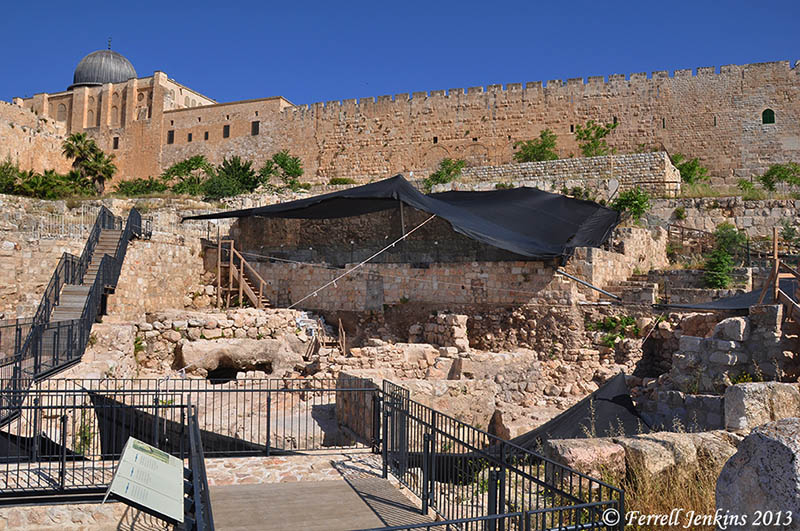
April 27 I was looking at the Ophel Excavations that are under the direction of Dr. Eilat Mazar. When I saw the tarp, I decided I would make a photo in hopes of learning something new in the future. The future is now.

According to The Key to David’s City, a web site devoted to the work of Herbert W. Armstrong College in Jerusalem, Dr. Mazar officially reopened the excavations on April 22.

In this continuation of the second phase Dr. Mazar will continue uncovering what she believes is a royal complex belonging to King Solomon, dated to the 10th century B.C.E., located at the foot of the Temple Mount in Jerusalem. As she works to expose more of this massive structure, the excavation will continue “to follow the remains of the First Temple Period along the line of the City Wall,” she told us.

The Key to David’s City web site has posted several nice videos explaining some aspects of the archaeological work at the site. The Gallery includes some excellent photos.

My photo below shows the area of the new excavation.

New Ophel excavations. Photo by Ferrell Jenkins.

Area of new Ophel excavations. Photo by Ferrell Jenkins.

We called attention to the Ophel Excavations 2012 here.

Jothan, king of Judah (740-732 B.C.), is said to have built extensively in the area known as Ophel.

He built the Upper Gate to the LORD’s temple and did a lot of work on the wall in the area known as Ophel. (2 Chronicles 27:3 NET)

Churning to make butter

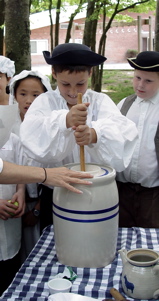
Churning Butter

Churning Butter

When I was a kid in the rural south, churning was done in a heavy duty ceramic pot. Butter was made by moving the stick (which had a sort of paddle attached) up and down.  I did not live in Colonial times, but the churn we used looked very much like the one shown in the picture to the left. Ours was a bit taller, I think.

The practice of churning to make butter has been around for thousands of years. It is mentioned in the Wisdom Literature of the Bible.

For the churning of milk produces butter, And pressing the nose brings forth blood; So the churning of anger produces strife. (Proverbs 30:33 NAU)

The ESV consistently uses the word pressing, from the Hebrew mits, three times in that verse.

For pressing milk produces curds, pressing the nose produces blood, and pressing anger produces strife. (Proverbs 30:33 ESV)

The NET Bible probably best conveys the meaning of the text by the use of churning, punching, and stirring up.

For as the churning of milk produces butter and as punching the nose produces blood, so stirring up anger produces strife. (Proverbs 30:33 NET)

The photo below shows a pottery churn from Beersheba, now displayed in the Israel Museum. The sign associated with the churn says,

The churn, used for making butter from milk, first appeared in the Chalcolithic Period [6,500–5,500 years ago] and became an important symbol of the time. To speed up the churning process, a rope was tied to the handles, and the churn was rocked back and forth.

Chalcolithic pottery churn from Beersheba. Israel Museum. Photo by Ferrell Jenkins.

Chalcolithic pottery churn from Beersheba. Israel Museum. Photo by Ferrell Jenkins.

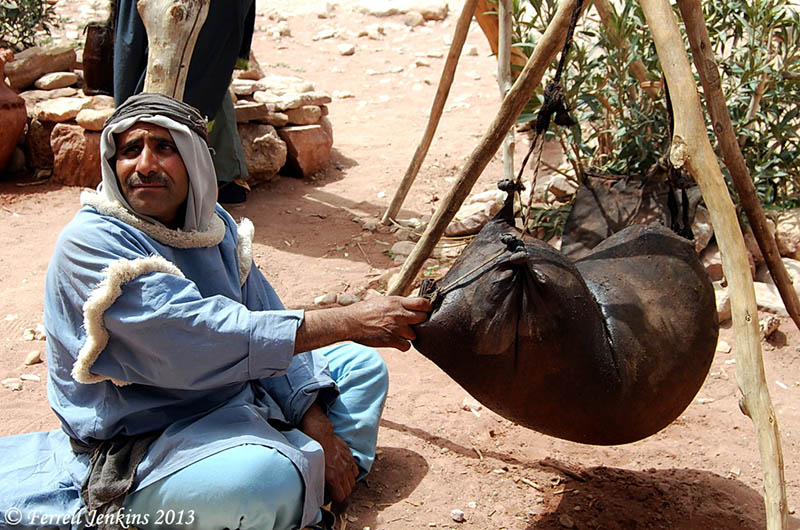
During a visit to Petra, Jordan, in 2008, a group of people were portraying the costumes and activity of earlier Bedouin. Many of the customs portrayed are the same as those we read about in the Bible.

In the photo below the man is rocking a churn made from an animal skin.

Bedouin churning in an animal skin at Petra. Photo by Ferrell Jenkins.

Bedouin churning butter in an animal skin at Petra. Photo by Ferrell Jenkins.

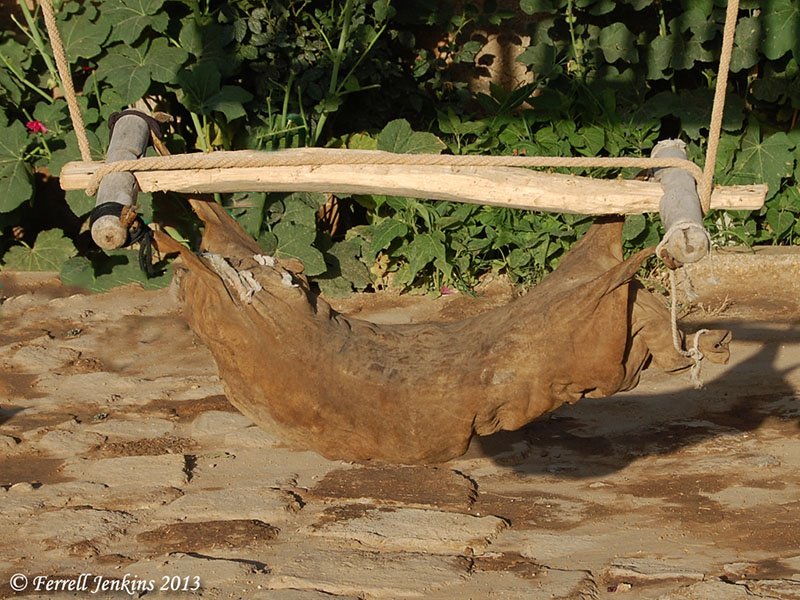
Finally, here is a photo that I made at Haran in southeastern Turkey, once the home of Abraham (Genesis 11:31 – 12:4), showing a churn made from an animal skin.

Churn made from animal skin at Haran. Photo by Ferrell Jenkins.

Churn made from animal skin at Haran. Photo by Ferrell Jenkins.