Category Archives: Greece

Keeping informed

Egyptian Antiquities. Keep up with breaking news about Egyptian antiquities at Andie Byrnes’ the Egyptology News.

Tomb of the Prophet Zechariah at the Madras Ruins. See the report of the Israel Ministry of Foreign Affairs here. James Davila raises lots of questions about this report. See his Feb. 3, 2011, post here.

HT: Paleojudaica

Photos of Turkey and Greece. Mark Hoffman is making available some nice photos of his recent trip in Turkey and Greece. Read, and find the link to the photos here. The photos are geotagged so you may spot the location in Google Earth.

Birdwatching in Israel.

“There were some 25,000 cranes crowded around us this evening,” reports Judith Schwartz, a Kibbutz Ginosar resident. “One night last week there were 42,000. Your eyes can’t quite believe what you’re seeing. They stand in the lake all night, safe from the bobcats in the area. And here they rest, and lift off in their masses at dawn, blackening the sky like a swarm of gigantic locusts, to continue their 5,000 mile trip to their winter home in Africa.”

At least 500 million birds of 200 different species fly across Israel each spring and fall on their way to and from Africa, Europe and Asia, says Dr. Reuven Yosef, director of Eilat’s International Birding and Research Center. And more than 70 native Israeli species head to warmer Africa in winter, such as the cuckoo, Egyptian vulture, short-toed eagle, hobby and lesser kestrel.

See the full article here.

HT: BiblePlaces Blog
Ancient Yarkon fortress with Greek and Assyrian connections?

The American Friends of Tel Aviv University have announced that Tel Aviv University researchers have connected Tel Qadadi, at the mouth of the Yarkon River in Tel Aviv, with the Greek island of Lesbos.

Tel Qudadi, an ancient fortress located in the heart of Tel Aviv at the mouth of the Yarkon River, was first excavated more than 70 years ago — but the final results of neither the excavations nor the finds were ever published. Now, research on Tel Qudadi by archaeologists at Tel Aviv University has unpeeled a new layer of history, indicating that there is much more to learn from the site, including evidence that links ancient Israel to the Greek island of Lesbos.

“The secrets of this ancient fortress are only beginning to be revealed,” Dr. Alexander Fantalkin and Dr. Oren Tal of Tel Aviv University’s Department of Archaeology say. Their new research was recently published in the Palestine Exploration Quarterly and BABESH: Annual Papers on Mediterranean Archaeology.

The release points out that it was thought in the past that the Tel Qadadi fortress was established in the 10th century B.C. by King Solomon.

The establishment of the fortress at Tel Qudadi was understood later as evidence of the existence of a developed maritime policy in the days of the United Monarchy in ancient Israel.

Another view was that the fortress belonged to the 9th century B.C. and should be attributed to the Kingdom of Israel. An amphora from the Greek island of Lesbos in the Aegean is said to provide evidence that the site should now be dated to the late 8th/early 7th century fortress “serving the Assyrian interests in the Levantine coast rather than part of the Israelite Kingdom.”

One could not possibly have anything dating to the time of Solomon within a potsherd’s throw of Tel Aviv University!

Read the entire news release here.

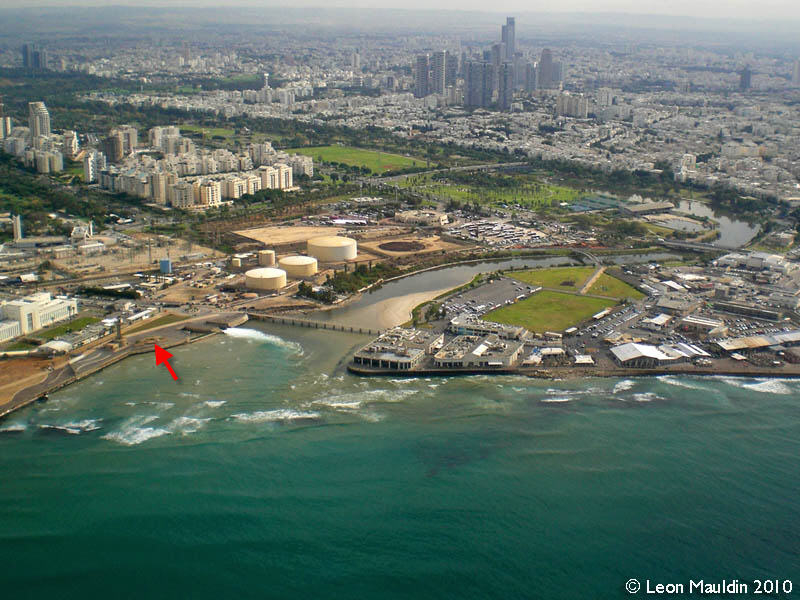
The AFTAU release included a small photo by my friend and co-traveler Leon Mauldin.  Leon has given me permission to post his photo here. It shows the mouth of the Yarkon River as it flows into the Mediterranean Sea. The river begins a few miles inland at the Old Testament site of Aphek (1 Samuel 4:1), known in Roman times as Antipatris (Acts 23:31). Click on the photo for a larger image.

Aerial view of mouth of the Yarkon River at Tel Aviv. Photo by Leon Mauldin.

Aerial view of mouth of the Yarkon River at Tel Aviv. Photo by Leon Mauldin.

The arrow points to the little tel on the north bank of the Yarkon.

There is another lesson in this press release. Scholars, including archaeologist, do not agree and they often change their minds. It is a mistake for one to build an “infallible” case on a fallible premise. We must work with the evidence we have at any given time.

You may see more of Leon’s photos at Leon’s Message Board.

HT: Joseph I. Lauer

Cenchrea — a port used by Paul and Phoebe

Cenchrea is located a few miles east of Corinth on the Saronic Gulf, an arm of the Aegean Sea. In the time of the Apostle Paul Cenchrea was considered the eastern port of Corinth. It was here that Paul had his hair cut before sailing for Syria.

Paul, having remained many days longer, took leave of the brethren and put out to sea for Syria, and with him were Priscilla and Aquila. In Cenchrea he had his hair cut, for he was keeping a vow. (Acts 18:18 NAU)

Our photo provides a view of the port and the northern breakwater.

The port of Cenchrea with view toward the northern breakwater. Photo by Ferrell Jenkins.

Port of Cenchrea with view toward the northern breakwater. Photo by Ferrell Jenkins.

Cenchrea was the home of Phoebe, who was a servant of the church there. Cenchrea would have been one of the unnamed churches “in the whole of Achaia” (2 Corinthians 1:1).

I commend to you our sister Phoebe, who is a servant of the church which is at Cenchrea; that you receive her in the Lord in a manner worthy of the saints, and that you help her in whatever matter she may have need of you; for she herself has also been a helper of many, and of myself as well. (Romans 16:1-2 NAU)

I think we may safely conclude that Phoebe sailed from this port to Rome with the epistle Paul write to the saints at Rome about A.D. 57.

Except for the port, little is to be seen of ancient Cenchrea. Some underwater excavations have taken place. Perhaps at a later time we will call attention to some of the discoveries.

Click on the image if you would like to have a copy of the photo suitable for use in teaching Acts, Romans, or the life and ministry of Paul.

Temple of Olympian Zeus in Athens

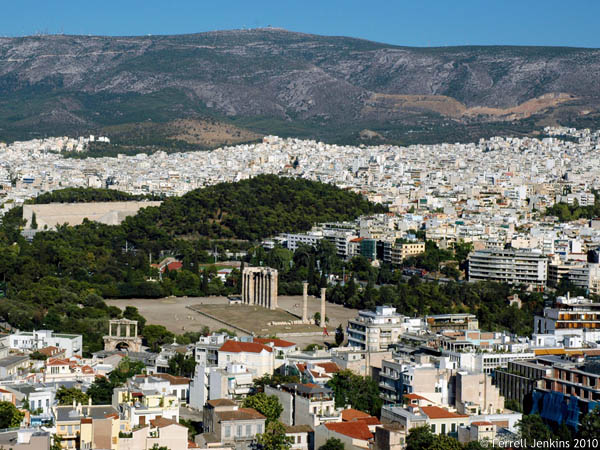
A reader asks about the location of the Arch of Hadrian that we wrote about in the previous post. The Arch is on the busy Leoforos Amalias. If you approach the arch and go through it, it leads to a park where the  Temple of Olympian Zeus, or Olympieion, stands. This is the area east of the Acropolis. The first photo shows the view from the Acropolis. The Temple is clearly visible. On the left you may also see the Olympic Stadium. The Arch of Hadrian is visible near the lower left corner.

The Temple of Olympian Zeus from the Acropolis. Photo by Ferrell Jenkins.

The Temple of Olympian Zeus from the Acropolis. Photo by Ferrell Jenkins.

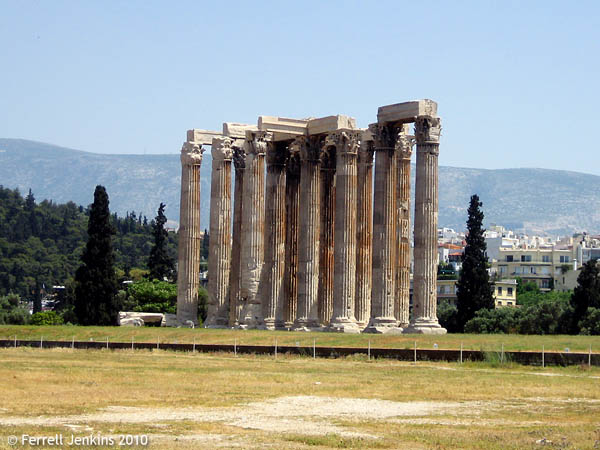
If you enter the park through the Arch of Hadrian you will have a nice view of the what remains of the Temple.

The Temple of Olympian Zeus in Athens. Photo by Ferrell Jenkins.

The Temple of Olympian Zeus in Athens. Photo by Ferrell Jenkins.

The Blue Guide on Athens and Environs says this is “the largest temple in Greece. It took 700 years to complete.” A temple was begun here as early as 550 B.C., but was not completed until the time of Hadrian.

Perhaps Paul saw this temple as he visited the sites of the city while awaiting the coming of Silas and Timothy from Macedonia.

For as I passed along and observed the objects of your worship, I found also an altar with this inscription, ‘To the unknown god.’ What therefore you worship as unknown, this I proclaim to you. (Act 17:23 ESV)

A map of Athens showing the central area, including the Arch of Hadrian, is available here.

Hadrian’s arch in Athens

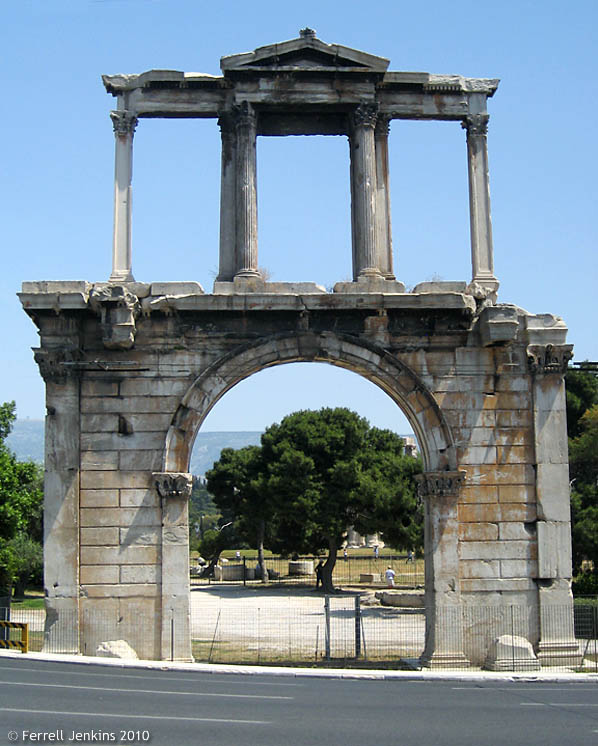
The Roman emperor Hadrian (A.D. 117-138) left arches in many cities he visited. The arch in Athens marks the entry to the Temple of Zeus. Rant and Reddish describe the arch:

The imposing Arch of Hadrian was constructed in honor of the emperor following the completion of the temple [to Zeus], and Hadrian himself walked through it to attend the dedication of the temple in 131 C.E. The western side of the arch (toward the old city) carries the inscription “This is Athens, the city of Theseus.” The inscription on the eastern side of the arch facing the temple (and toward a section of Athens that had been newly renovated by Hadrian) states, “This is the city of Harrian and not of Theseus. (A Guide to Biblical Sites in Greece and Turkey, 33)

To get a photo like this one requires some good footwork. The arch faces one of the busiest streets in Athens, but one must move out into the street between cars to get an unobstructed view.

Arch of Hadrian in Athens. Photo by Ferrell Jenkins.

Arch of Hadrian in Athens. Photo by Ferrell Jenkins.

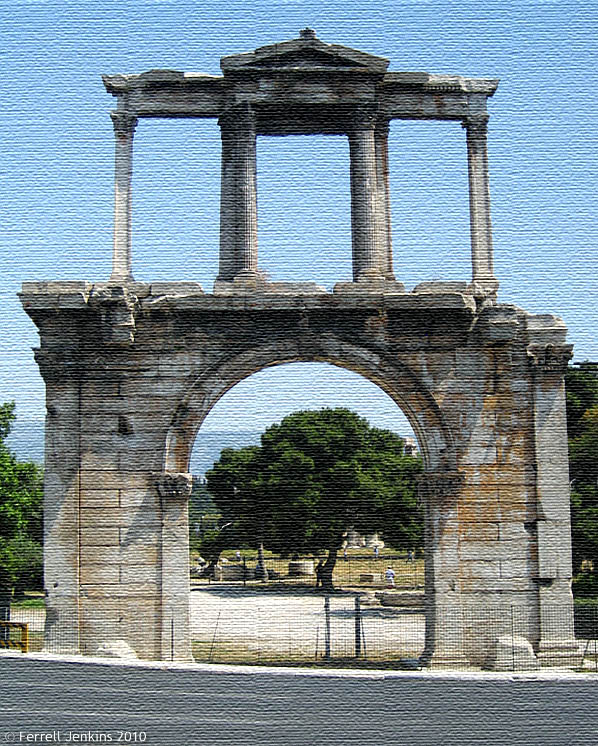
Photoshop, and some other photo editing programs, provide the opportunity to manipulate photos in unusual ways. Here is the same photo textured as if it were painted on canvas.

Arch of Hardrian on canvas. Photo by Ferrell Jenkins.

Arch of Hadrian on canvas. Photo by Ferrell Jenkins.

The fourth major persecution of the church by the Roman Empire came in the days of Hadrian.

Friday variety

Israel Photos. J P vd Giessen has been posting photos from a trip to Israel over the past few weeks at his Aantekeningen bij de Bijbel [Notes on the Bible] blog. You will find photos of Megiddo, Caesarea Maritima, Capernaum, Gamla and other places. Start here. I know, the blog is in Dutch. I follow the blog regularly. When I see something that is of special interest I go to Google Translate and paste in the article for a translation. It is not ideal, but it helps.

Turkey Photos. Ben Witherington III is posting photos of a recent trip to Greece and Turkey at his Bible and Culture blog. You will find photos of Corinth (Acts 18), Sagalassos, Assos (Acts 20:13-14), Alexandria Troas (Acts 16:8), Patara (Acts 21:1), Myra in Lycia (Acts 27:5), Cappadocia (Acts 2:9; 1 Pet. 1:1), and others. The site is not very user friendly, but you may find something of interest. Start here and then use the search box.

Tell es-Safi/Gath. Prof. Aren Maeir has posted several aerial photos of Tell es-Safi/Gath made at the end of the 2010 archaeological excavation season. If you look soon you may just scroll back through the photos here.

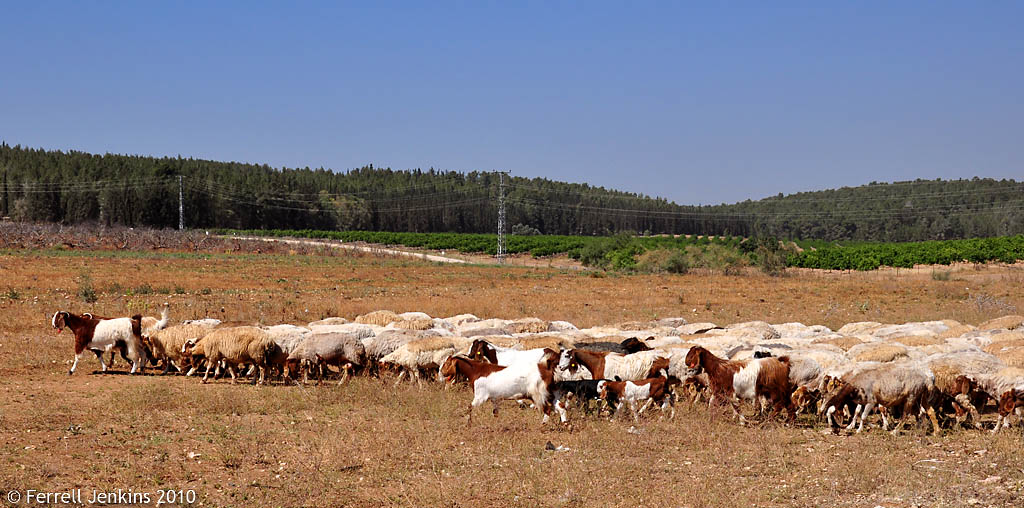
Our photo was made just below Tell es-Safi/Gath just after crossing the Elah brook. This shows the beginning of the coastal plain.

Sheep and goats at Tell es-Safi/Gath. Photo by Ferrell Jenkins.

Sheep and goats at Tell es-Safi/Gath. Photo by Ferrell Jenkins.

Greek, anyone? Rod Decker, a professor of Greek and New Testament, calls attention to some classic essays on using Greek in ministry. Perhaps some readers might find this helpful. Click here.

Temples made by man

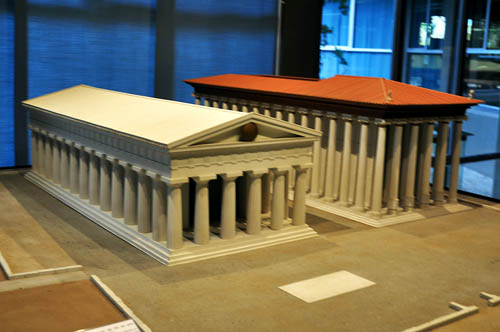
Any Greek or Roman city we visit is surely to have ruins of a theater and a temple. Both Greek and Roman theaters remain at Syracuse (Acts 28:12).The Paoli Orsi Regional Archaeological Museum displays a model of the Temple of Athena (left; 480 B.C.) and the Temple of Artemis (right; 520 B.C.).

Temple models at Syracuse, Sicily, archaeological museum.

Model of Temple Athena and Temple of Artemis. Syracuse. Photo by Ferrell Jenkins.

The Apostle Paul had to contend with this in every Roman city he visited. At Athens he said,

The God who made the world and everything in it, being Lord of heaven and earth, does not live in temples made by man, nor is he served by human hands, as though he needed anything, since he himself gives to all mankind life and breath and everything. (Acts 17:24-25 ESV)

He reminded the Corinthians, who lived in a city filled with temples,

For although there may be so-called gods in heaven or on earth–as indeed there are many “gods” and many “lords”– yet for us there is one God, the Father, from whom are all things and for whom we exist, and one Lord, Jesus Christ, through whom are all things and through whom we exist. (1 Corinthians 8:5-6 ESV)

Solomon’s temple in Jerusalem, as well as the later temples built by Zerubbabel and Herod, were made with hands. Paul certainly knows this. But he also knows what Solomon said about the same subject:

“But will God indeed dwell on the earth? Behold, heaven and the highest heaven cannot contain you; how much less this house that I have built! (1 Kings 8:27 ESV)

Read the full account of the building and dedication of the temple in 1 Kings 6-8. The temple was a place of worship, but it was not to be the object of worship.

Jesus taught His disciples to pray like this: “Our Father in heaven, hallowed be your name” (Matthew 6:9).

The Fountain of Peirene at Corinth

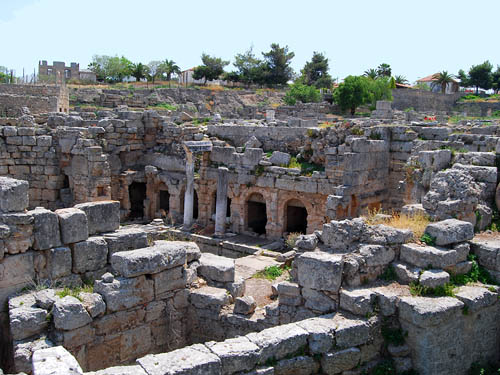
Food, Water, and the ability to defend, were the most important features in ancient cities. Corinth’s most important reservoir, the Fountain of Peirene, was fed from subterranean springs. It had a capacity of over 81,000 gallons.

Take a look at the horizon in the photo below. That was the level of the earth more than a century ago before archaeological excavations began at Ancient Corinth. The entire structure that we know as the Fountain of Peirene was covered with debris. This structure was built along the Lechaion Road which led from the Agora (Marketplace) to the Gulf of Corinth on the west side of the city.

The fountain is no longer in use, but if you walk close to the arches you can hear water flowing underneath the city.

Fountain of Peirene at Ancient Corinth. Photo by Ferrell Jenkins.

The Fountain of Peirene at Ancient Corinth. Photo by Ferrell Jenkins.

Paul visited Corinth on his second journey (A.D. 50-53). In spite of obstacles that brought fear to the heart of Paul, the Lord assured him that He had many people in the city (Acts 18:10).

And he stayed a year and six months, teaching the word of God among them. (Act 18:11 ESV)

The Greek side of Istanbul

Today’s Zaman has an interesting article about Greeks in Istanbul. The article discusses mainly a few Greek remains to be seen in the city and some information about remaining Greek Orthodox churches.The article is interesting because of the historical developments and conflicts between Greek and Turks. The note about the Serpentine Column caught my attention.

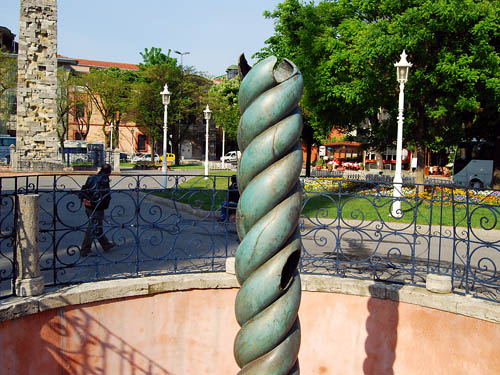
Being approximately 2,500 years old, the Serpentine Column is said to be İstanbul’s oldest remaining Greek monument. Erected to honor the triumph of the Greeks over the Persians at Plataea, it originally stood at Delphi (both ancient cities on Greek ground) and was moved to İstanbul in 324 B.C. by Constantine the Great to mark the declaration of the new capital city of the then-founded Roman Empire under the name of Constantinople. The originally eight-meter-high piece was made up of three intertwined serpents which supported a golden bowl. The bowl is believed to have been lost or stolen when the city was sacked during the Fourth Crusade. Some say the heads were hit and cut off by a drunken nobleman in the 17th century but one of them can still be seen in the İstanbul Archaeology Museum. The rest of the column can be found today at the Hippodrome in the Sultanahmet quarter.

There is a serious mistake in the article. The Serpentine Column was originally erected at Delphi in 479 B.C., but it was placed in the hippodrome of Constantinople by Constantine in 324 A.D.

Here is a photo of the bronze Serpentine Column as it stands in the hippodrome.

Serpentine Column in Istanbul. Photo by Ferrell Jenkins.

Bronze Serpentine Column in Istanbul. Photo by Ferrell Jenkins.

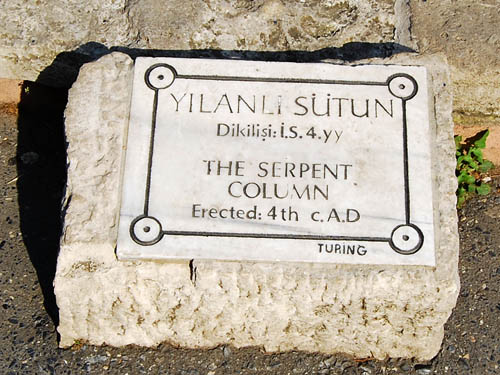
A sign marking the Serpentine Column indicates that the column was erected in the 4th century A.D. That is the date when Constantine had it erected in the hippodrome, but the column dates to the 5th century B.C.

Sign marking the Serpentine Column. Photo by Ferrell Jenkins.

Read the full  Today’s Zaman article here.

HT: Biblical Paths.

Miniature carving of Alexander the Great

Israel National News reports the discover of a rare miniature carving of Alexander the Great. The article by Nissan Ratzlav-Katz says,

Excavations in Tel Dor have turned up a rare and unexpected work of Hellenistic art: a precious stone bearing the miniature carved likeness of Alexander the Great. Archaeologists are calling it an important find, indicating the great skill of the artist.

The Tel Dor dig, under the guidance and direction of Dr. Ayelet Gilboa of Haifa University and Dr. Ilan Sharon of Jerusalem’s Hebrew University, has just ended its summer excavation season. For more than 30 years, scientists have been excavating in Tel Dor, identified as the site of the Biblical town of Dor. The town’s location, on Israel’s Mediterranean Sea coast some 30 kilometers south of Haifa, made it an important international port in ancient times.

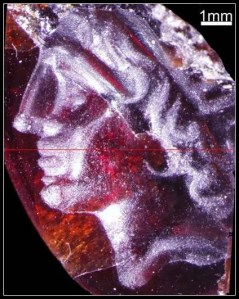
“Despite the tiny proportions – the length of the gemstone (gemma) is less than a centimeter and its width less than half a centimeter – the artist was able to carve the image of Alexander of Macedon with all of his features,” Dr. Gilboa said. “The king appears as young and energetic, with a sharp chin and straight nose, and with long, curly hair held in a crown.”

According to the archaeologists involved in the Tel Dor excavations, the discovery of the miniature Alexander gemstone carving in Israel is fairly surprising. The Land of Israel was not, for the Greek Empire, a central or major holding.

The article concludes,

Historically, Alexander himself passed through Dor in 332 BCE, during his voyage to Egypt. It appears that the city fell to him without resistance. Since that time until its conquest by the Hasmonean Jewish King Alexander Yannai around 100 BCE, Dor served as a stronghold of non-Jewish Hellenists in the Land of Israel.

The full article may be read here.

Miniature carving of Alexander from Tel Dor.

Carving of Alexander from Tel Dor.

Dor is mentioned in several Old Testament references including Joshua 17:10-11.

HT: Joseph I. Lauer