Category Archives: Egypt

James Leslie Starkey, excavator of Lachish

James Leslie Starkey was born in London January 3, 1895. He became interested in ancient history by reading books such as Layard’s Nineveh and Its Remains. He took a course in Egyptology and came in contact with Flinders Petrie. Later he worked with Petrie in Egypt.

Starkey joined Petrie in the excavation at Tell Jemmeh, then at Tell el Far’ah (South) in southern Palestine, where he directed the dig during the final season.

In 1932 Starkey began his own dig at Tell ed-Duwer, identified as biblical Lachish. During his six years at the site, one of the more significant finds was the Lachish Letters which date to the period of the end of the Babylonian conquest of Judah, during the time of the prophet Jeremiah.

While on his way to Jerusalem in January 1938, for the opening of the new Palestine Archaeological (Rockefeller) Museum, Starkey was shot in an ambush.

Starkey was buried in the Protestant Cemetery on Mount Zion. Four years later the body of his former mentor, Flinders Petrie, was laid to rest a few yards away.
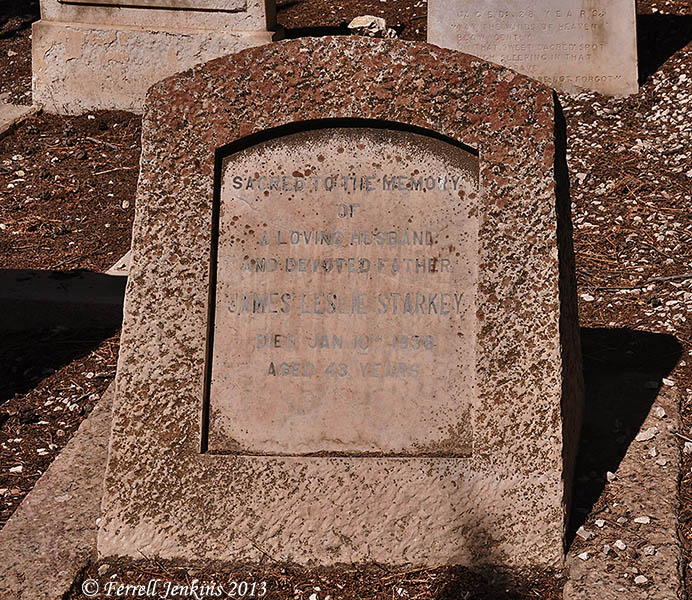
Tomb of James Leslie Starkey, excavator of Lachish. Photo by Ferrell Jenkins.

Tomb of James Leslie Starkey, excavator of Lachish. Photo by Ferrell Jenkins.

I found that information about Starkey is somewhat limited. Much of the info here has been gleaned from a page about Starkey on The Palestine Exploration Fund web site here. There you will see a photograph of Starkey with Petrie, and Olga Tufnell who spent twenty years to complete the four volumes of the Lachish Excavation Reports.

Like a cluster of henna…

Henna is mentioned only twice in the Bible, both in the Song of Solomon (or Canticles). The Shulammite girl describes her beloved.

My beloved is to me a cluster of henna blossoms in the vineyards of Engedi. (Song of Solomon [Canticles] 1:14 ESV; see also 4:13)

Scholars are divided about the meaning of the Hebrew term used here. Is this woman named Shulamith? Is she from the Jezreel Valley town of Shunem? Is she described as “the Perfect One” (NET Bible)? Or, is there some other plausible explanation?

Tristram mentions finding the “camphire of Engedi” at the site (cf. KJV transliteration of the Hebrew kopher).

The camphire of Engedi, mentioned in the Book of Canticles, we identified in a pretty shrub, with bunches of graceful pink-white blossoms, which was already in flower in some sheltered nooks, and called El-Henna by the Arabs, from which they procure the Henna dye—the Lawsonia alba of botanists. (The Land of Israel: A Journal of Travels in Palestine, Undertaken With Special Reference to Its Physical Character, 294-95).

Some small plants identified as henna can be seen at Neot Kedumim in the low hill country between Modi’in and Tel Aviv. Both they and the Fauna and Flora of the Bible identify it with the Lawsonia inermis. I don’t know how to sort out this name and the Lawsonia alba that Tristram mentions.

Henna growing at Neot Kedumim. Photo by Ferrell Jenkins.

Henna growing at Neot Kedumim. Photo by Ferrell Jenkins.

Henna is used by women of many societies on their hands, and other parts of the body. In several places I have seen local women painting designs on those who wished to try it.

One of the young ladies of my tour got henna tatoos from the Nubians in southern Egypt. Photo by Ferrell Jenkins.

Stacy got henna tattoos from a Nubian lady in southern Egypt near Aswan. She says it lasted about three weeks. Photo by Ferrell Jenkins.

Stacy tells me that the henna caused quite a stir when she returned to work. She says,

I talked with my hands. I gestured during a meeting and it stopped the meeting cold. Everyone stared. I said, “not to worry … it will disappear in 3 weeks” and continued on with the point I was making. 🙂

Life is fun.

The significance of Gaza

After my first tour to the Bible Lands, including Rome, Greece (Athens and Corinth), Egypt, Lebanon, Syria (Damascus), Jordan, and Israel, in April/May, 1967, I decided to make a second tour the following year. For many years, I always added some new places on each tour. In 1968 I added Beersheba and Gaza. The Gaza Strip (named such because of the long, narrow size of the small entity) had been under Egyptian control for several decades until June, 1967.

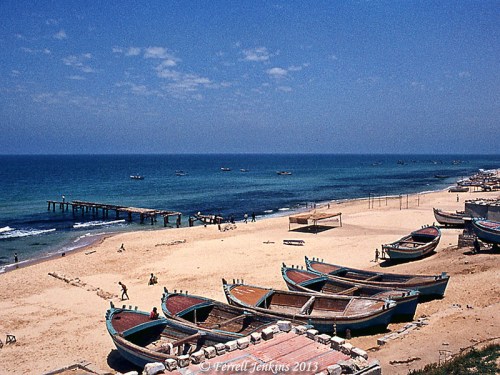
There was not much to see at Gaza. By the time we visited in 1968, Gaza was under Israeli control. We drove to the coast where there were only a few houses and some small fishing boats. This is one of the few slides that I have to illustrate the visit to Gaza.

Gaza on the Mediterranean Sea in May, 1968. Photo by Ferrell Jenkins.

Gaza on the Mediterranean Sea in May, 1968. Photo by Ferrell Jenkins.

Gaza is mentioned several times in the Old Testament. Here is a summary of these references.

  • Gaza was the southwestern boundary of the Canaanites in the table of Nations (Genesis 10:19).
  • The original inhabitants of Gaza were replaced by the Caphtorim, likely the ancestors of the Philistines (Deuteronomy 2:23).
  • Joshua defeated Canaanites “even as far as Gaza” (Joshua 10:41).
  • Joshua eliminated the Anakites except in Gaza, Gath, and Ashdod (Joshua 11:21-22). We recognized these cities as later belonging to the Philistines.
  • Gaza is listed as belonging to the tribe of Judah (Joshua 15:47; Judges 1:18).
  • The Midianites oppressed Israel, “as far as Gaza”, for seven years (Judges 6:4).
  • Samson had contact with the inhabitants of Gaza (Judges 16).
  • Gaza is listed as one of the five Philistine cities in the time of the Israelite Judges (1 Samuel 6:17).
  • Solomon controlled territory as far southwest as Gaza (1 Kings 4:24).
  • Hezekiah defeated the Philistines as far as Gaza and its territory (2 Kings 18:8).
  • Jeremiah makes reference to Gaza being conquered by Pharaoh (Jeremiah 47:1).
  • The prophets of Judah pronounced judgments upon Gaza (Amos 1:6-7; Zephaniah 2:4; Zechariah 9:5).

The only New Testament reference to Gaza is in Acts 8:26. Philip the evangelist was instructed to go south on the road that descends from Jerusalem to Gaza. English translators struggle with the issue of whether the city was desert, or the road leading to the city ran through a desert area. (I will leave that for some other time.)

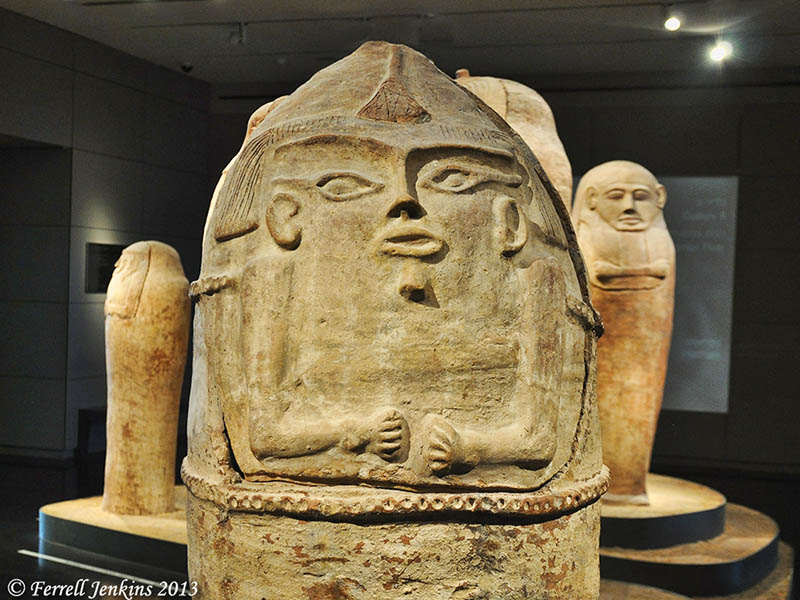
The first display one sees as he enters the archaeology wing of the Israel Museum is that of the anthropoid coffins from Deir el-Balah, a site south of Gaza city. The coffins, excavated by Trude Dothan in 1972, bear evidence of Egyptian influence. They date to the 13th century B.C.
Anthropoid Coffins from Deir el-Balah in the Israel Museum. Photo by Ferrell Jenkins.

Anthropoid Coffins from Deir el-Balah in the Israel Museum. Photo by Ferrell Jenkins.

Acts 10 — Photo Illustrations

Joppa (Yafo, Jaffa) is about 35 miles northwest of Jerusalem on the coast of the Mediterranean Sea. Yafo is on the south side of Tel Aviv.

Joppa has a history dating back to the 15th century B.C. when it is mentioned in the town lists of Pharaoh Thutmose III.

In this post I will limit my comments to some of the significant events of the Book of Acts related to Joppa.

  • Tabitha (Dorcas) lived in Joppa. When she died the disciples sent for Peter who was a Lydda. He came to Joppa and raised Dorcas (Acts 9:36-42). (Acts 10:6).
  • Peter stayed many days in Joppa with Simon the tanner (Acts 9:43). His house was by the sea (Acts 10:6). A house near the port is shown as the house of Simon, but there is no way to know this with certainty.
  • Peter received the housetop vision and learned that he was to go to Caesarea to preach the gospel to the Gentiles at the house of the Roman centurion Cornelius (Acts 10:23).

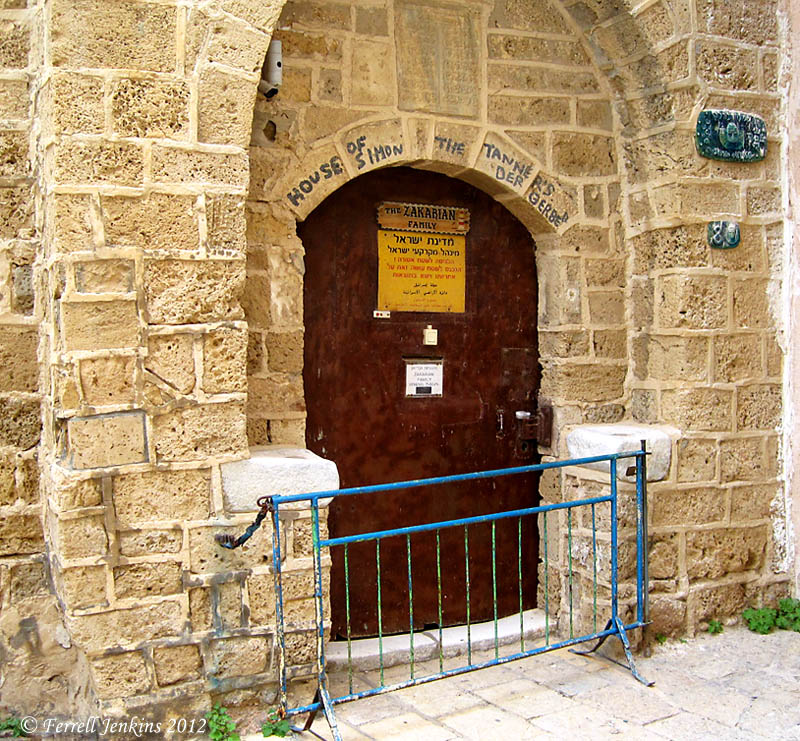
On one of the narrow streets of Joppa is a fairly modern house identified as the House of Simon the Tanner. Directly behind the house stands the lighthouse standing watch over the harbor. We take claims like this one with a grain of salt. But I often tell members of my tour groups, “It may not have been here, but it was not far from here.”

The traditional house of Simon the Tanner at Joppa. Photo by Ferrell Jenkins.

The traditional house of Simon the Tanner at Joppa. Photo by Ferrell Jenkins.

At least some houses during Bible times were build with a flat roof which could serve some practical uses. In the case of Peter it provided a good place to pray and to fall into a trance.

Felucas on the Nile

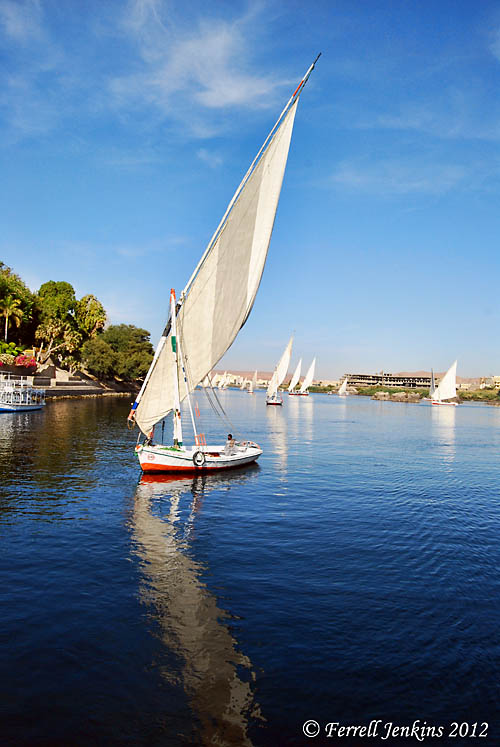
Felucas are common on the Nile in Egypt. The wooden sailing boat is moved by the wind. It seems to take two men to control the sail and the rudder. Many Nubians find work running these boats. See here. The photo below was made at Aswan, Egypt. Aswan is known as Syene in Ezekial 29:10 and 30:6.

Kitchener’s Island is visible on the left, and Elephantine Island is on the right.

A feluca on the Nile at Aswan. Photo by Ferrell Jenkins.

Felucas on the Nile at Aswan. Photo by Ferrell Jenkins.

Whether at Aswan or Cairo, an afternoon ride aboard a feluca is a pleasant and relaxing experience.

The Rosetta Stone

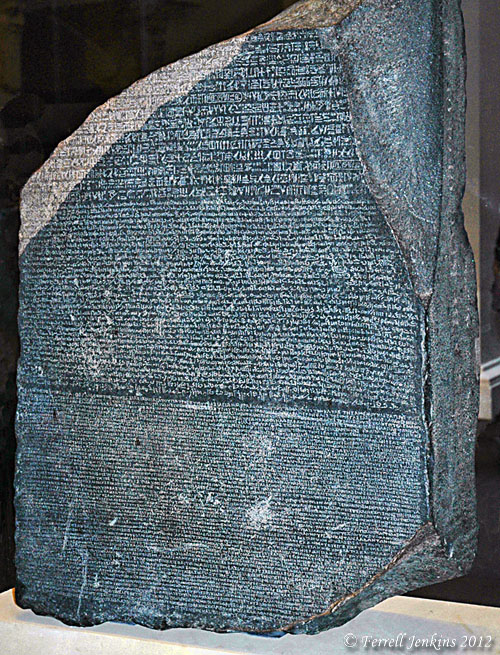
The Rosetta Stone was found by Napoleon’s soldiers in Egypt in 1799. It was read by Jean-François Champollion in 1822, and thus became the key to unlock Egyptian hieroglyphics. The Rosetta Stone is now displayed in the British Museum in London, where it has been since 1802.

The Rosetta Stone in the British Museum. Photo by Ferrell Jenkins.

The Rosetta Stone in the British Museum. Photo by Ferrell Jenkins.

Candace Keener writes the story of the Rosetta Stone in HowStuffWorks here.

HT: Jack Sasson

Acts 8 — An Ethiopian

So he [Philip] got up and went; and there was an Ethiopian eunuch, a court official of Candace, queen of the Ethiopians, who was in charge of all her treasure; and he had come to Jerusalem to worship, (Acts 8:27 NAU)

Where was Ethiopia in the first century? One might immediately think of the modern country of Ethiopia. And, I am certain that many modern Ethiopians might think so.

Nubia Today. Wikipedia Commons.

Nubia Today. Wikipedia Commons.

By checking numerous reliable sources, it becomes obvious that the terms Ethiopia in Acts 8 describes the ancient kingdom of Meroë. It was also known as Cush and Nubia in ancient times.

The ETHIOPIA referred to here is not the modern country of the same name but the ancient kingdom of Meroë, which lay along the upper Nile S of Aswan to Khartoum in the Sudan. (The International Standard Bible Encyclopedia, Rev. Vol. 2).

The map of the region of Nubia also shows the 6 cataracts of the Nile from Aswan in Egypt to Khartoum in Sudan.

One of the older sources says that the country we now call Ethiopia took rise about the middle of the first century A.D.

Another kingdom, that of Axum in the mountain region of Abyssinia proper, seems to have taken its rise about the middle of the 1st cent. A.D., but that does not come into view in our present inquiry. (Feltoe, (Hastings) Dictionary of the Apostolic Church).

R. H. Smith, in The Anchor Yale Bible Dictionary, says,

The place name “Ethiopia” (possibly meaning “land of the people of burnt faces,” i.e., dark skin; cf. Jer 13:23) appears, as such, only once in the Bible (Acts 8:27), but in the LXX it usually translates the Heb kūš (Cush), a name which appears several dozen times in the OT.

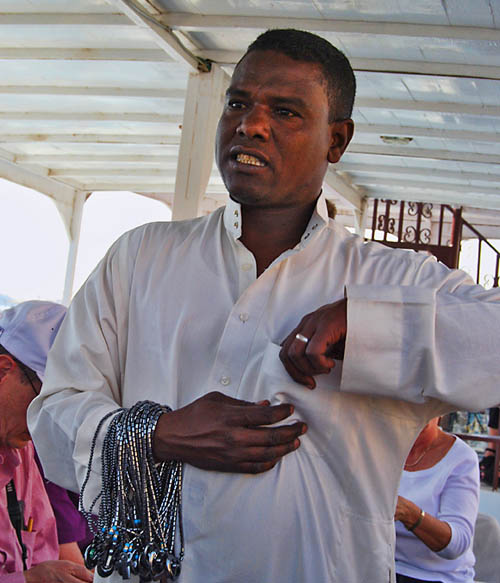
Nubian man at Philae Island near Aswan. Photo by Ferrell Jenkins.

Nubian man at Philae Island near Aswan. Photo by Ferrell Jenkins.

The building of the new Aswan dam by modern Egypt formed Lake Nasser, stretching south from Aswan for about 340 miles into northern Sudan. This made it necessary for the Nubians to be resettled around Aswan. Some of the famous monuments of Abu Simbel were covered by the lake. The Nubians are easily distinguished from the Egyptians because of their dark skin. They (and the Cushites) were distinct in the ancient Egyptian paintings and statuary.

Many of the Nubians have been employed in the tourism business. I wonder how they are surviving since the recent revolution.

Can the Ethiopian change his skin Or the leopard his spots? Then you also can do good Who are accustomed to doing evil. (Jeremiah 13:23 NAU)

The distance from Jerusalem to Ethiopia could be as much as 1500 miles. Quite a trip in a chariot.

Check the posts about Aswan here, and one about the Nubians here.

Another PLBL Giveaway

Todd Bolen, over at the Bible Places Blog, is giving away another five volumes of the Pictorial Library of the Bible Lands. Any five you choose. The entry period ends Friday. Check details here.

Major revision of the Pictorial Library of the Bible Lands

Todd Bolen announces the release of a total revision of the Pictorial Library of Bible Lands. This revised and expanded edition is the culmination of 9 years of work. The previous version contained 6000 photographs in 10 volumes. According to the announcement,

This new edition consists of 18 volumes with nearly 18,000 photographs, adding hundreds of new sites and re-visiting the old favorites.

Here are just a few features of the new edition of the Pictorial Library of Bible Lands.

  • Eight new volumes: (Lebanon, Eastern and Central Turkey, The Greek Islands, and more. New subjects include Cultural Images, Signs, and Trees, Plants, and Flowers.
  • New Photos: For example, more than 1000 new photos have been added to the Jerusalem volume.
  • New Photographers. In addition to the photos by Todd Bolen, the work of more than 40 photographers are included in this new set.
  • New Maps. New, original maps have been created to identify the sites.
  • New Indexes. Every photograph is indexed in a list of more than 400 pages.
  • You get the hi-res photos and the photos already in PowerPoint. You can use the presentation as it is or include individual slides in your own lesson.
  • And more…
Pictorial Library Complete Collection. BiblePlaces.Com.

Front cover of the new Pictorial Library Complete Collection.

For those who already own the previous collection, Bible Places is offering the new 18-volume set for the upgrade price of $179. The entire set for new purchasers is $389.

Would you prefer to make your own photos? Try buying a good digital SLR camera starting at about $1500, flying to Israel (not to mention Lebanon, Egypt, Turkey, Greece, the Greek Islands, Italy, et al.), renting a car for a few weeks, buying the gas. Oh, and don’t forget to hire a private plane for a few hours so you can get some good aerial photos. That might cost at least $389. 🙂 And what if the lighting conditions were not right for a good photos the day you were at a site? What if you don’t have time to get your photos organized and write a description of each one? Need I go on to make a point? Did I mention that living and teaching in Israel for a decade helps?

Every church should have a set of this material for the teachers to use in their teaching. Over the years I have found that some short-sighted groups (churches) will not make such an expenditure. The other choice is to buy the set for yourself.

I hear several lessons a week, and every one of them could be improved by the use of photos from this wonderful collection.

Learn more about the new Pictorial Library of Bible Lands in the following places:

Charles Savelle has a good interview with Todd Bolen at the BibleX blog here.

I have profited much from the work of Todd Bolen and am delighted to count him as a friend and to recommend this collection of photographs to every teacher of the Bible.

Follow the BiblePlaces.com Blog here.

Mummies of the World at MOSI in Tampa

Mummies of the World Exhibition opens at MOSI in Tampa, Florida, today. Details here. The exhibition includes mummified humans and animals from several places around the world in addition to those from Egypt.

According to local television reports, the exhibit runs through September 9, 2012.

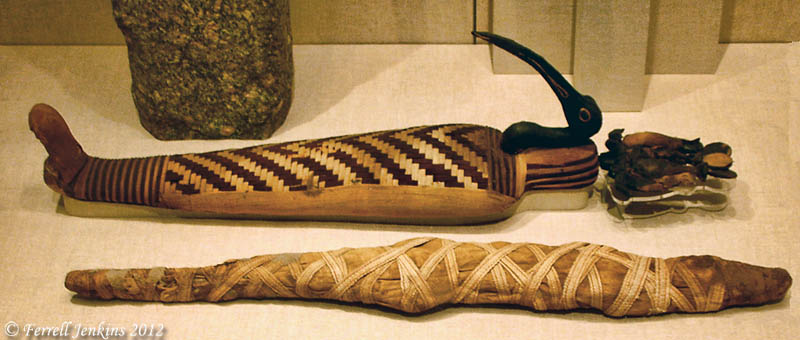
In the photo below we see a mummified Ibis and a mummified Crocodile from the Roman period of Ancient Egypt. The Egyptians considered various animals as gods and mummified them when they died.

Mummiried Ibis and Crocodile from Egypt. Roman Period. Brooklyn Museum.

Mummified Ibis and Crocodile from Egypt. Roman Period. Brooklyn Museum.

The Apostle Paul describes the condition of the Gentiles in the Greco-Roman world in these words:

Claiming to be wise, they became fools,  and exchanged the glory of the immortal God for images resembling mortal man and birds and animals and creeping things. (Romans 1:22-23 ESV)

Two Biblical characters  from the Patriarchal period were mummified in Egypt.

Then Joseph fell on his father’s face and wept over him and kissed him. And Joseph commanded his servants the physicians to embalm his father [Jacob]. So the physicians embalmed Israel. Forty days were required for it, for that is how many are required for embalming. And the Egyptians wept for him seventy days.  (Genesis 50:1-3 ESV)

So Joseph died, being 110 years old. They embalmed him, and he was put in a coffin in Egypt. (Genesis 50:26 ESV)