Category Archives: Egypt

Archaeological Conferences in Houston

The Dunham Bible Museum at Houston Baptist University will host an Archaeological Conference devoted to Khirbet el-Maqatir, proposed site for Biblical Ai, Saturday, February 8, 2014. Speakers include Dr. Bryant Wood, Dr. Eugene Merrill, Dr. Scott Stripling, and Dr. Leen Ritmeyer.

Information about the conference and registration details may be found here.

From January 21 – December 19, 2014, the Dunham Bible Museum will display a special exhibit, Khirbet el-Maqatir – History of a Biblical Site. This is in cooperation with the Associates for Biblical Research. Details here.

A scene in the eastern Sinai wilderness. Photo by Ferrell Jenkins.

A scene in the eastern Sinai wilderness. Photo by Ferrell Jenkins.

The Lanier Theological Library announces a lecture by James Hoffmeier and Stephen Moshier dealing with the exodus and the location of Mount Sinai. The titles for the January 18th lecture are,

  • Moses Did Not Sleep Here!
  • A Critical Look at Some Sensational Exodus and Mt. Sinai Theories

Registration information is here. (HT: Bible Places Blog).

The lectures by Hoffmeier and Moshier are the climax of a two day Consultation on the Historicity and Authenticity of the Exodus and Wilderness Traditions in a Post Modern Age. Details here.

Speakers include Richard Hess, Steven Ortiz, Alan Millard, Richard Averbeck, Lawson Youngers, Jr., and others.

Hiking Abraham’s footsteps

The full title of this Haaretz article is “Hiking in Abraham’s footsteps, from Turkey to the Holy Land.” Sounds incredible at the moment. To hike this complete trail from Haran (Genesis 12:4) to Beersheba (Genesis 21:31) (not to mention the trip to Egypt) requires travel in Turkey, Syria, Jordan, Israel, and the Palestinian Authority (West Bank).

Among the leaders back of the concept is David Landis and his wife Anna Dintaman, developers of the Jesus Trail from Nazareth to the Sea of Galilee. Their book, Hiking the Jesus Trail and Other Biblical Walks in the Galilee, is worthwhile even for those who do not plan to walk the trail.

Larry Haverstock walked the Jesus Trail in 2011. I see that Larry’s posts about the experience is still available on his blog. See the 3rd Journey. You will find some fascinating stories along with beautiful photos you may never see from a bus or car.

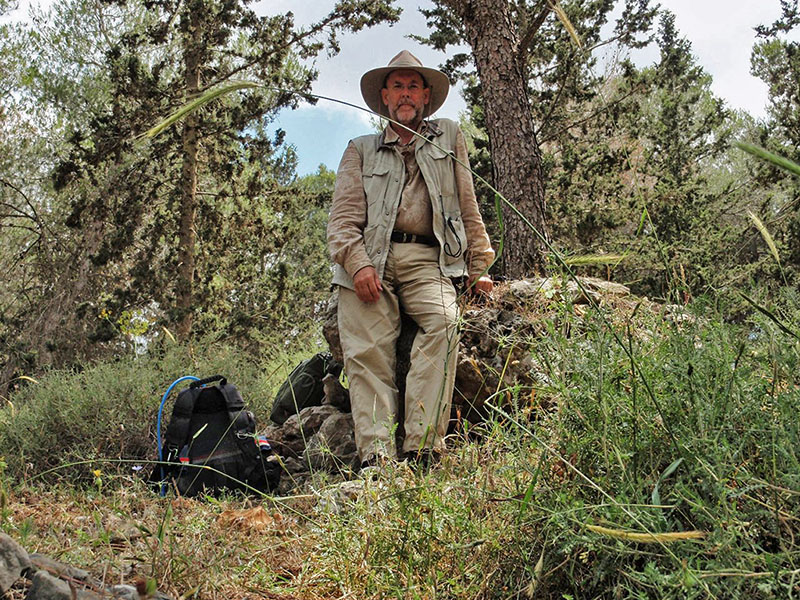
Larry Haverstock in the Zippori Forest north of Nazareth.

Larry Haverstock in the Zippori Forest north of Nazareth.

The link to the Haaretz article may be accessed here. In order to read the full article you must register for free access to 10 articles a month.

Don’t expect to walk the Abraham Path from Haran (in Turkey) to Beersheva [Beersheba], but you might be able to walk small portions of the trail everywhere except the part going through Syria.

There are many hiking trails in Israel, but most of these avoid contact with the Palestinian Authority. The new plan seeks to involve the local people in the development of facilities useful to hikers.

If you like hiking, or if you appreciate the geography of the Bible lands you will probably enjoy the article. Abraham Path has a nice web site with maps and photos here.

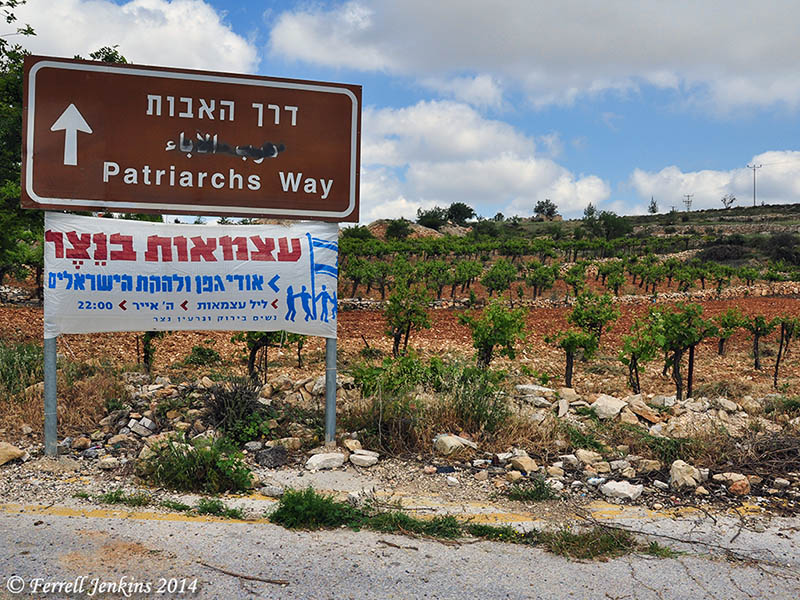
I don’t know what, if any, relationship there is between the Abraham  Path and the Patriarchs Way, a trail that is said to run from Beersheba to Nazareth. The defacing of the sign to eradicate the Arabic indicates one of the problems either trail might face. One often sees this sort of thing on signs pointing to Christian sites.

Sign pointing to Patriarchs Way off Hebron Road (Hwy. 60) south of Bethlehem . Photo by Ferrell Jenkins.

Sign pointing to Patriarchs Way off Hebron Road (Hwy. 60) south of Bethlehem . Photo by Ferrell Jenkins.

Walk the Land : A Journey on Foot through Israel, by Judith Galblum Pex, is a fascinating account of a couple who walked the Israel Trail from Eilat to Dan.

Zondervan Essential Atlas of the Bible

Frequently we have mentioned and recommended the Zondervan Atlas of the Bible by Carl G. Rasmussen. Every Bible student needs at least one or two good atlases to assist them in their study of the Scriptures.

Last month I attended some annual professional meetings in Baltimore and was pleased to see that Zondervan already had copies of the new Zondervan Essential Atlas of the Bible. One of the sales reps gave me a copy for review here.

At first appearance, the ZEAB has a beautiful cover of stiff, durable paper. It is a convenient 9 1/8″ x 7 3/8″ in size. The content is basically the same as the larger hard back edition. There has been some editing of the text to condense the book from 303 pages to 159 pages.

There are two major sections to the book: Geographical Section and Historical Section. The Geographical Section includes an Introduction to the Middle East as a Whole, and discusses the geography of Israel and Jordan, Egypt, Syria and Lebanon, and Mesopotamia.

The Historical Section covers the entire Bible from the Pre-Patriarchal Period to the Seven Churches of Revelation, with an additional chapter on Jerusalem, in 17 chapters.

The maps are superbly drawn and easy to read. A timeline accompanies each chapter. Rasmussen is noted for his Holy Land Photos web site. The photos are beautiful and helpful in illustrating the content.

This book has been prepared by a teacher, and I consider that a plus. In addition to his work at Bethel University, Carl continues to serve as an adjunct professor at Jerusalem University College. He has spent 16 years of his adult life in the Bible lands. His  Holy Land Photos’ Blog provides helpful, up-to-date, information about both familiar and unfamiliar places mentioned in the Bible. He has also led numerous tours through Bible lands.

This Atlas sells for $16.99. I see that Amazon has the Zondervan Essential Atlas of the Bible for $12.97. A Kindle version is about $3 less.

Either version is ideal for a person to take with them to Bible class, or on a tour of Bible lands.

The larger Zondervan Atlas of the Bible still remains indispensable for the serious student. I am trying to say you should have both books.

Carl has assisted me on several occasions in locating some of those hidden, out-of-the-way, places that most visitors to the Bible lands never see. I am pleased to commend this new edition of his book.

Excitement at Carchemish

It must have been exciting to be at Carchemish in 605 B.C. when Pharaoh Neco came all the way from Egypt to this city now on the border between Syria and Turkey. On an earlier excursion from Egypt to Carchemish in 609 B.C., Neco killed Josiah, king of Judah, at Megiddo.

Pharaoh Neco came to assist the Assyrians as they fought the Babylonians. But the emerging world power from the southern Euphrates city of Babylon overpowered the Assyrians and the Egyptians and sent Neco running back to Egypt. Nebuchadnezzar, king of Babylon, chased Neco to the border of Egypt.

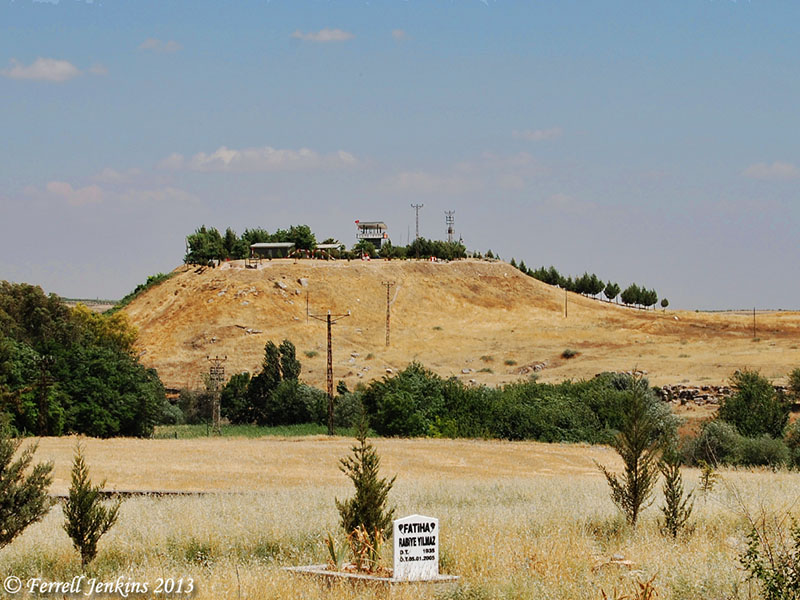
It is still exciting at Carchemish. I have been within sight of Carchemish once. The military installations were clearly visible on top of the tell. The tour operator handling my tour in Turkey a previous time advised me not to go to Carchemish (Karkamis) because it is “zero on the border” of Turkey and Syria.

Carchemish with a Turkish military base on top. Photo by Ferrell Jenkins 2007.

Carchemish with a Turkish military base on top. Photo by Ferrell Jenkins 2007.

We were excited to learn that new excavations had begun at Carchemish. That was before the recent “uncivil war” in Syria. Now, two reports give a little glimpse into the archaeological work there.

The first report from the WorldBulletin reports:

What could be the largest discovered inscribed tablet (stele), dating to the reign of Babylonian king Nebuchadnezzar II between 605-562 BC, has been discovered in the Turkish city of Karkamis on the military zone along the Turkey-Syria border.

Noting that the excavations sites are untroubled despite their proximity to the Syrian civil war, Dr. Nicola Marchetti said the Karkamis archeological museum is scheduled to open next year.

“Excavations are right on a military zone with 55 hectares in Turkey and 35 in Syria,” said Marchetti, the head of the Turkish and Italian excavation teams, at a press conference held in the Assembly Hall of the Metropolitan Municipality.

Excavations this year also unearthed a cuneiform tablet at the palace of Carchemish king Katuwa dating to 800 BC, as well as over 300 sculptures, a Luwian hieroglyphic inscription and a mosaic.

Read the full report here. I assume the work described in this report is somewhere other than the top of the high mound.

A report from ANSAmed used a few more words about the stele dating to the reign of Nebuchadnezzar.

Marchetti is proudest of a stele, or commemorative slab, carved with the face of Babylonian King Nebuchadnezzar, the conqueror of Karkemish. He destroyed Jerusalem and the Temple of Salomon in 587 BC, and built the Hanging Gardens of Babylon, which were the seventh wonder of the ancient world.

”It’s a beautiful, compact piece of limestone”, Marchetti enthuses of this unique, historic find.

This report may be read here. It continues to tell about some recent al-Qaeda activity near the border in Syria affected by the excavation.

While it’s an almost peaceful cohabitation, it is also true that the dig is within a Turkish military base. This offers the Italians a relative sense of safety – except on September 3, when al-Qaeda attacked the Syrian town of Jarabulus, eventually wresting it from the ”official” anti-Assad Free Syrian Army (FSA) insurgents. ”It was hell on earth. Bullets were flying everywhere”, says Marchetti, who teaches Near Eastern archeology at Bologna University.

”Luckily, archeologists dig holes. We dove in. We kept digging inside the deeper ones. The Turkish military kept telling us, stay down”. Calm was restored once the FSA fighters gave themselves up to the Turks in order to flee al-Qaeda. An armed truce has held since, allowing the Italian team to unearth new treasures.

Now we know why archaeologists dig trenches and holes.

I look forward to seeing that new archaeological museum at Karkamis. Karkamis is a small town of less than 5000 population.

HT: Jack Sasson

Copper production in the time of Solomon

The “promised land” was described to the Israelites as “a land whose stones are iron, and out of whose hills you can dig copper” (Deuteronomy 8:9). Copper was mined in the Arabah of Israel as far back as the 13th-12th century B.C. Copper is still mined at Timna about 25 miles north of Eilat (close to Ezion-geber). Belgian engineers made a survey proving the presence of 100,000 tons of metallic copper. Iron ore has been found in the Negev and in eastern Upper Galilee (Vilnay, The Israel Guide, 17).

The Bible does not say that Solomon had copper mines at Ezion-geber, but the presence of mining facilities dating to the 10th century B.C. indicates that this may have been one of the reasons why the King built a port and had a navy stationed there (1 Kings 9:26-28). Ezion-geber was more than 220 miles from Jerusalem. The copper provided a good medium of exchange for gold, spices, and other items that Israel needed.
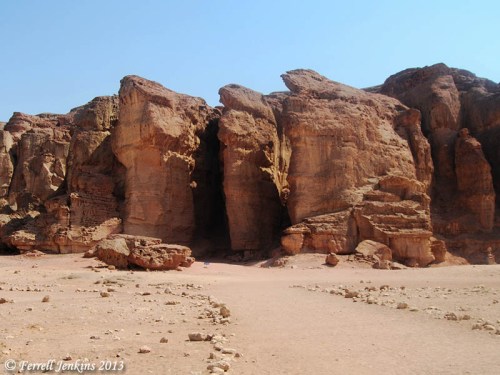
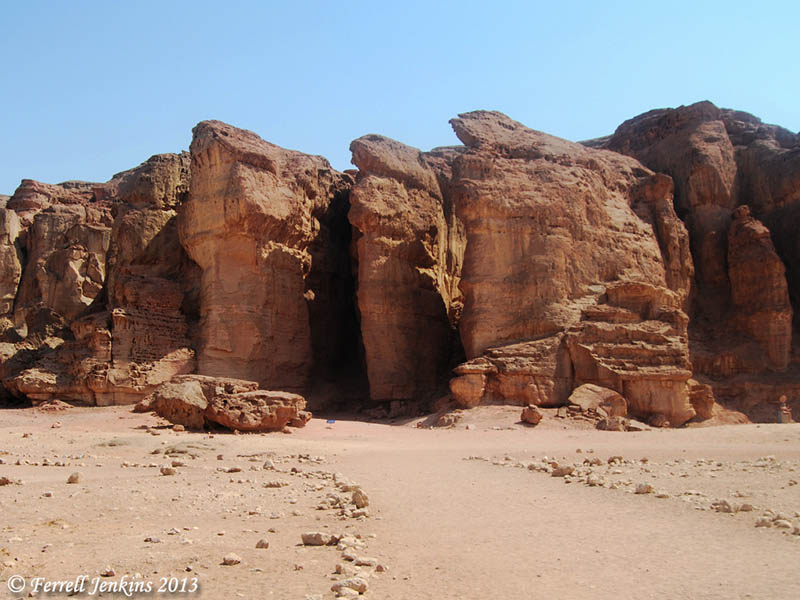
These massive pillars at Timna have been associated with Solomon for a long time. Photo by Ferrell Jenkins.

The Pillars of Solomon. These massive pillars at Timna have been associated with Solomon for a long time. Photo by Ferrell Jenkins.

In 1938, Nelson Glueck, reported that he had found a copper-refining plant at Tell el-Kheleifeh, which he identified as Ezion-geber, on the north shore of the Gulf of Aqabah (the Israelis call it the Gulf of Eilat). This site is now within Jordanian territory. Glueck identified the copper-refining plant as King Solomon’s copper mines, and explained that the apertures in the buildings served as flueholes. Through them, he thought, “the strong winds from the north-northwest entered into the furnace rooms of this structure,” which he called a “smelter, to furnish a natural draft to fan the flames.”

It is true that copper smelting was done in the Arabah in the time of Solomon, but Glueck later changed his mind about the building he had formerly identified as the refining plant. In 1962 Beno Rothenberg demonstrated that the installation at Tell el-Kheleifeh could not have been for copper smelting.

Glueck was convinced by the findings of Rothenberg that the apertures in the building “resulted from the decay and or burning of wooden beams laid across the width of the walls for bonding or anchoring purposes.” This does not affect any statement of the Bible, but it does mean that the old argument about the copper refining plant found in the Arabah is no longer valid. Glueck’s identification of Tell el-Kheleifeh with Ezion-geber is no longer accepted. We plan to follow this post with one on Solomon’s seaport.

A recent excavation and study, including archaeometric dating (of Site 30 of the southern Arabah) conducted by Erez Ben-Yosef, et al. has provided a new chronological framework for Iron Age copper production at Timna (Israel). Ben-Yosef says the study,

resulted in a new chronological framework for Iron Age copper production in this region. The main period of copper smelting in the southern Arabah was during the 10th century B.C.E., and the extent of New Kingdom Egyptian control over copper production in Timna was more limited than previously believed. (“A New Chronological Framework for Iron Age Copper Production at Timna (Israel).” BASOR 367 (2012), p. 65.

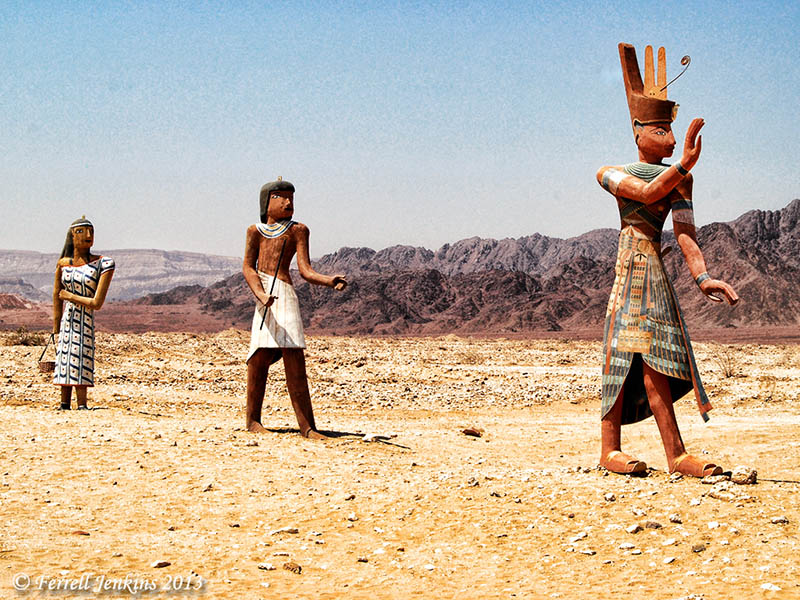
Egyptians welcome visitors to Timna Park. It is true that Egyptians worked in the area during the 13th-12th centuries B.C., but Ben-Yosef says their control over the copper production “was more limited than previously believed.”
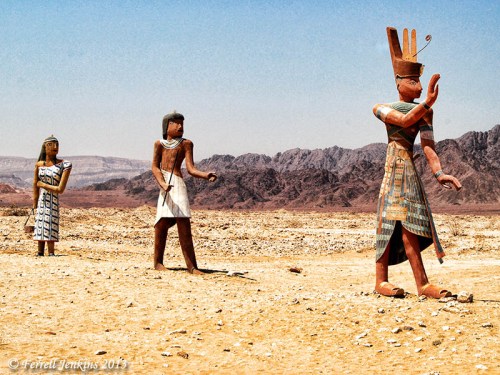
Entrance to the Timna Park. Photo by Ferrell Jenkins.

Egyptians welcome visitors to the Timna Park. Perhaps some Israelites should be added. Photo by Ferrell Jenkins.

Other post having to do with copper may be read here, here, and here.

This paragraph provides documentation for some of the material mentioned above. For more information one may check the following books or articles by Nelson Glueck: “The First Campaign at Tell el-Kheleifeh,” Bulletin of the American Schools of Oriental Research, Oct., 1938; The Other Side of the Jordan, 1940; Rivers in the Desert, 1949; the change was announced in “Ezion-geber,” The Biblical Archaeologist, Sept., 1965.

Egypt was a broken staff of reed

Last week, in preparation for a lesson I was presenting, I studied Ezekiel’s proclamation against Egypt. He says that Egypt has been a “staff of reed” to the house of Israel. Notice these verses from chapter 29.

Then all the inhabitants of Egypt shall know that I am the LORD. “Because you have been a staff of reed to the house of Israel,  when they grasped you with the hand, you broke and tore all their shoulders; and when they leaned on you, you broke and made all their loins to shake.  (Ezekiel 29:6-7 ESV)

The prophet Isaiah spoke directly to Israel with the same lesson.

Behold, you are trusting in Egypt, that broken reed of a staff, which will pierce the hand of any man who leans on it. Such is Pharaoh king of Egypt to all who trust in him. (Isaiah 36:6 ESV)

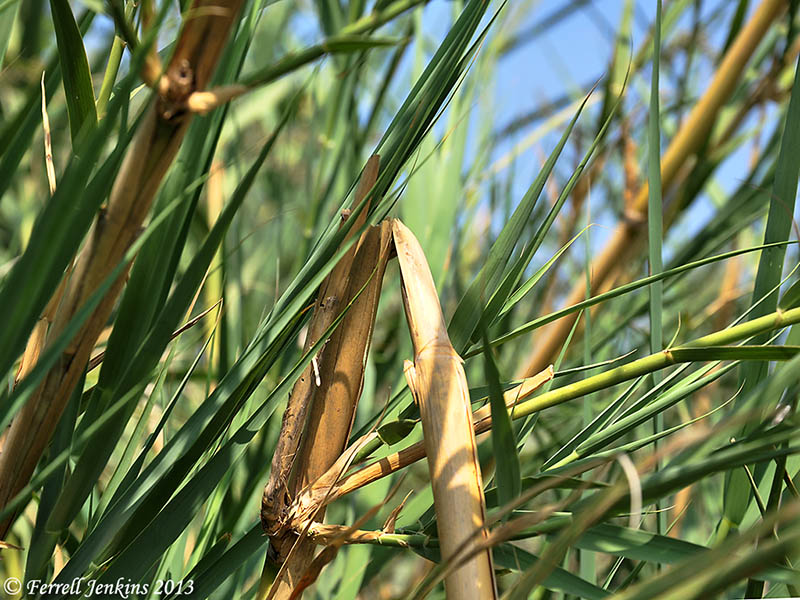
Reeds are common along the banks of the Nile and the canals that take water to the fields needing it. The photo below shows a broken reed.

A broken reed does not make a good walking stick. Photo by Ferrell Jenkins.

A broken reed does not make a good walking stick. Photo by Ferrell Jenkins.

There is a great lesson in this for each of us to avoid leaning on promises and systems of thought that will not hold us up in time of need.

Trust in the LORD with all your heart, and do not lean on your own understanding.  In all your ways acknowledge him, and he will make straight your paths.  (Proverbs 3:5-6 ESV)

On taking yourself too seriously

On the way from Luxor to the Valley of the Kings on the West Bank of the Nile one passes two huge statues known as the Colossi of Memnon. The statues are nearly 60 feet tall, and once stood at the entrance to the funerary temple of Amenhotep III (also known as Amenophis III). With their crowns, each statue would have been about 66 feet tall. Amenhotep III ruled Egypt during the 18th Dynasty (14th century B.C.).

During the time of the Roman Empire the statues were mistakenly associated with “Memnon, son of Eos and Tithonus, who was killed by Achilles during the Trojan War” (Baedeker’s Egypt).

The last time I was in the Valley of the Kings I noticed the head and chest of the statue had become a resting place for birds. Just an interesting picture, I thought.

Statue of Amenhotet III (or Amenophis III) on West Bank of Nile at Thebes (Luxor). Photo by Ferrell Jenkins.

Statue of Amenhotep III (or Amenophis III) on West Bank of Nile at Thebes (Luxor). Photo by Ferrell Jenkins.

Whether covered by sand or birds, this illustrates how the “mighty” are esteemed by many who follow. Don’t take yourself too seriously!

Paul: For by the grace given to me I say to everyone among you not to think of himself more highly than he ought to think, but to think with sober judgment, each according to the measure of faith that God has assigned. (Romans 12:3 ESV)

The Acacia in the Sinai Wilderness

Most travelers to Israel have probably seen acacia trees growing along the shore of the Dead Sea. Fewer travelers have visited the Sinai Peninsula, now part of Egypt. The term acacia is used in most English versions of the Bible, but the King James version (1611) simply transliterated the Hebrew word shittim.

The Fauna and Flora of the Bible comments on the acacia:

The acacia is a member of the Mimosa family. Four different species are found in Palestine, the most common being the A. raddiana, which grows in the valleys around the Dead Sea. It is an evergreen tree, 3 to 5.5 m high, with spiny branches carrying yellow flowers; its wood is very useful for building purposes.

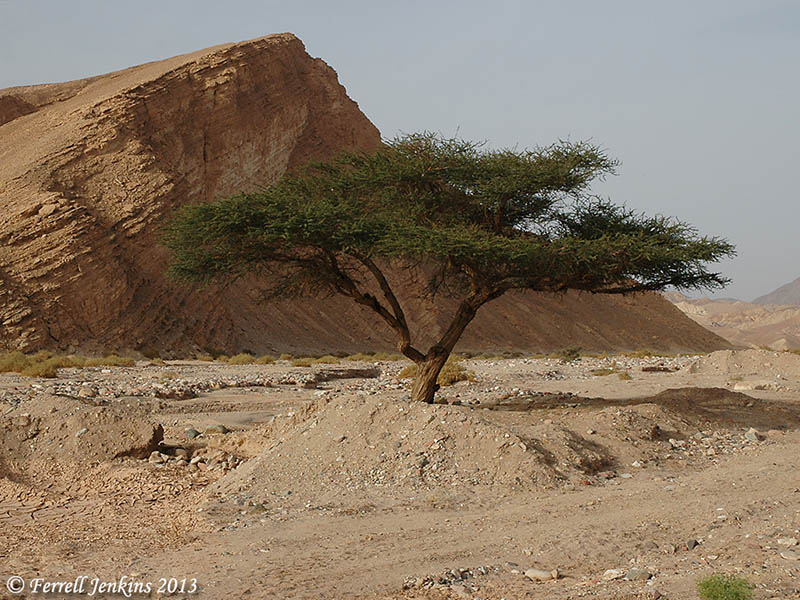
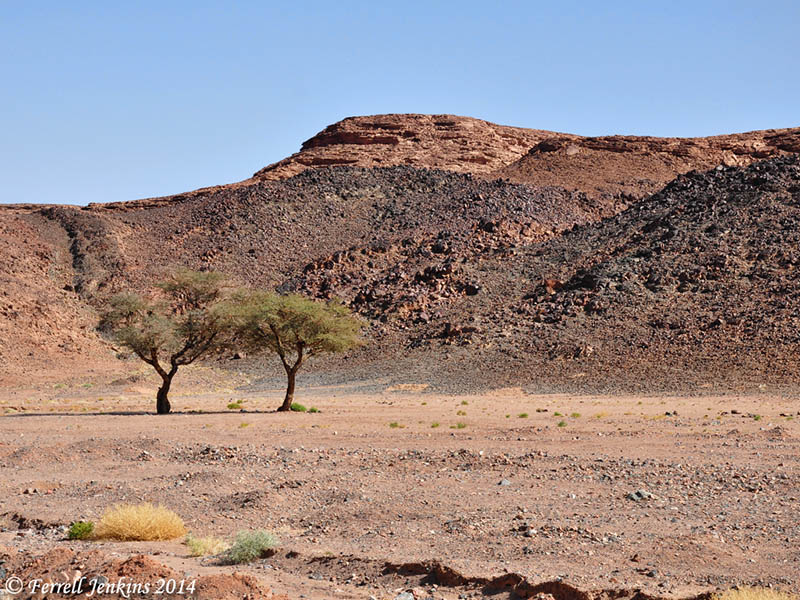
The acacia below is in the Wadi el-Tor in the Sinai Peninsula between the Gulf of Suez and Mount Sinai.

Acacia growing in Wadi el-Tor in the Sinai Peninsula. Photo by Ferrell Jenkins.

Acacia growing in Wadi el-Tor in the Sinai Peninsula. Photo by Ferrell Jenkins.

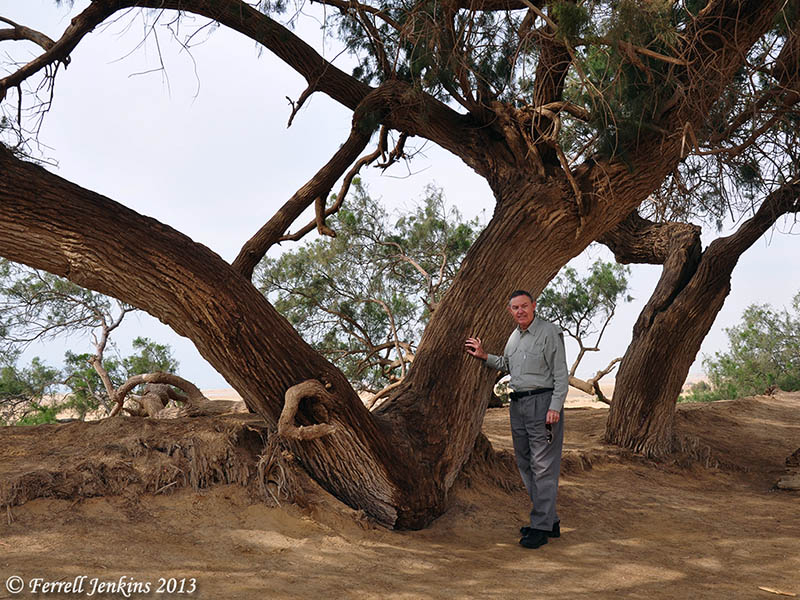
In the description of the construction of the tabernacle, the book of Exodus uses the word acacia 26 times from chapter 25 to chapter 38. When we see the smaller trees today we may wonder about finding enough wood for the tabernacle. At Ain Musa (Spring of Moses), the traditional place of Marah (Exodus 15:23), there are a few older large Acacia growing. Could it be possible that 3500 years ago there were many this size?

Large acacia at Ain Musa (Spring of Moses) on the east shore of the Gulf of Suez. Photo by Ferrell Jenkins.

Large acacia at Ain Musa (Spring of Moses) on the east shore of the Gulf of Suez.

Water gushed from the rock

This photo of granite rocks was made at Jebel Musa (traditional Mount Sinai) in the Sinai Peninsula. It reminded me of several Old Testament references to the rock from which the Lord provided water for the Israelites in the wilderness.

Granite rock on Mount Sinai (Jebel Musa). Photo by Ferrell Jenkins.

Granite rock on Mount Sinai (Jebel Musa). Photo by Ferrell Jenkins.

He opened the rock, and water gushed out; it flowed through the desert like a river. (Psalm 105:41 ESV)

He struck the rock so that water gushed out and streams overflowed. Can he also give bread or provide meat for his people?” (Psalm 78:20 ESV)

You may be able to use this photo as an illustration in one of your Bible class lessons or sermons. Click on the photo for a larger image.

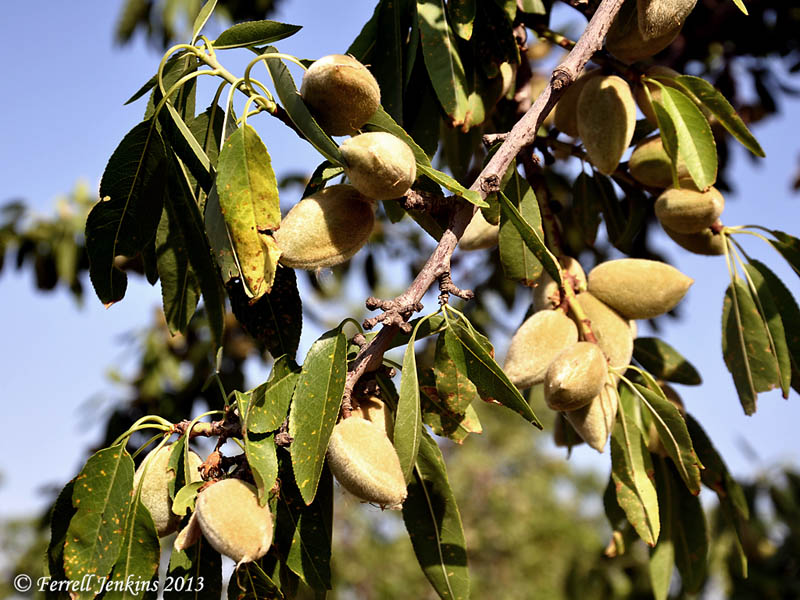
Almonds growing in the Jezreel Valley

The photo below shows almonds growing in the Jezreel Valley in late April.

Almonds growing in the Jezreel Valley. Photo by Ferrell Jenkins.

Almonds growing in the Jezreel Valley. Photo by Ferrell Jenkins.

During the days of a severe famine in the land of Canaan, Israel (Jacob) agreed to allow his youngest son Benjamin to go to Egypt at the request of the man who was in charge of dispensing food. That man was Joseph, the son of Israel. Jacob agreed to allow Benjamin to go with his older brothers. He also told the boys to take some of “the best products of the land” including almonds.

Then their father Israel said to them, “If it must be so, then do this: take some of the choice fruits of the land in your bags, and carry a present down to the man, a little balm and a little honey, gum, myrrh, pistachio nuts, and almonds. (Genesis 43:11 ESV)