Category Archives: Egypt

Codex Sinaiticus now online

According to a BBC report, the 4th century Codex Sinaiticus is now available online. More information about the project is available in this report by Reuthers. The link to Codex Sinaiticus is here.

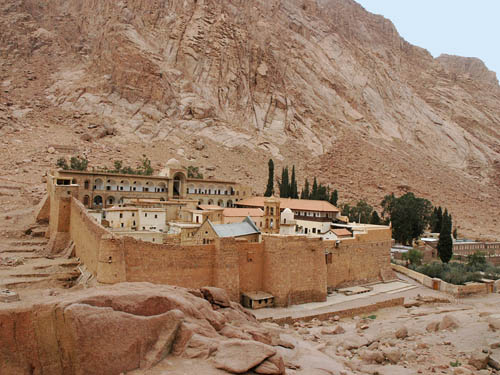
Here is a photo of Saint Catherine’s monastery, at the foot of Jebel Musa, the traditional Mount Sinai, where the manuscript was discovered in the 19th century.

St. Catherine's Monastery at Jebel Musa. Photo by Ferrell Jenkins.

St. Catherine's Monastery at Jebel Musa. Photo by Ferrell Jenkins.

HT: Paleojudaica; Frank Walton

Pistachio nuts among best products of the land

During the days of a severe famine in the land of Canaan, Israel (Jacob) agreed to allow his youngest son Benjamin to go to Egypt at the request of the man who was in charge of dispensing food. That man was Joseph, the son of Israel. Jacob agreed to allow Benjamin to go with his older brothers. He also told the boys to take some of “the best products of the land” including pistachio nuts.

Then their father Israel said to them, “If it must be so, then do this: take some of the best products of the land in your bags, and carry down to the man as a present, a little balm and a little honey, aromatic gum and myrrh, pistachio nuts and almonds. (Genesis 43:11 NAU)

I began thinking about this post while studying John 12.

Mary then took a pound of very costly perfume of pure nard, and anointed the feet of Jesus and wiped His feet with her hair; and the house was filled with the fragrance of the perfume. (John 12:3 NAU)

There are several significant words in this text: perfume (muron), pure (pistikos), and nard (vardos). The Greek word for pure (pistikos)  is difficult to define. Bauer-Danker says it is “variously interpreted, but evidently suggesting exceptional quality.” A comment by William Barclay caught my attention.

Oddly enough, no one really knows what that word means. There are four possibilities. It may come from the adjective pistos which means faithful or reliable, and so may mean genuine. It may come from the verb pinein which means to drink, and so may mean liquid. It may be a kind of trade name, and may have to be translated simply pistic nard. It may come from a word meaning the pistachio nut, and be a special kind of essence extracted from it. In any event it was a specially valuable kind of perfume.

Then I noticed the comments by Keil and Delitzsch on pictachio nuts (sic) in Genesis 43:11.

which are not mentioned anywhere else, are, according to the Samar. vers., the fruit of the pistacia vera, a tree resembling the terebinth, – long angular nuts of the size of hazel-nuts, with an oily kernel of a pleasant flavour; it does not thrive in Palestine now [1875], but the nuts are imported from Aleppo.

Well, that led me to think of photos I made in a pistachio orchard near Carchemish on the Euphrates (Jeremiah 46:2). This is about 65 miles from Aleppo.
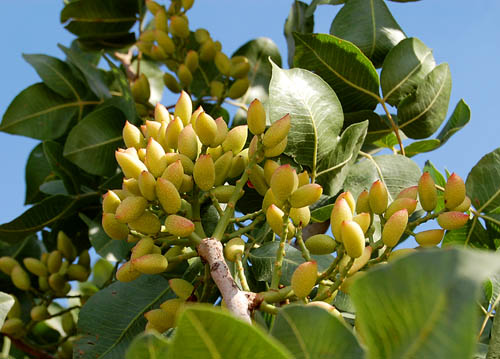
Pistachio's growing near Carchemish on the Euphrates. Photo by Ferrell Jenkins.

Pistachio's growing near Carchemish on the Euphrates. Photo by Ferrell Jenkins.

I think this is the only place I have seen pistachio’s growing on a tree. The practical comment by Matthew Henry is worth meditating on for a while.

Note, (1.) Providence dispenses its gifts variously. Some countries produce one commodity, others another, that commerce may be preserved. (2.) Honey and spice will never make up the want of bread-corn. The famine was sore in Canaan, and yet they had balm and myrrh, etc. We may live well enough upon plain food without dainties; but we cannot live upon dainties without plain food. Let us thank God that that which is most needful and useful is generally most cheap and common.

That sort of outlines the rambling of the mind back of this post. It is amazing what one may learn once he begins to track down leads. I still don’t know if pure (pistikos) has anything to do with pistachio nuts! Meditate.

Leeks in the land of Goshen

Israel’s experience in the Sinai wilderness might be summarized by the two words complained and murmured. One such account is given in Numbers 11.

We remember the fish we ate in Egypt that cost nothing, the cucumbers, the melons, the leeks, the onions, and the garlic. But now our strength is dried up, and there is nothing at all but this manna to look at.” (Numbers 11:5-6 ESV)

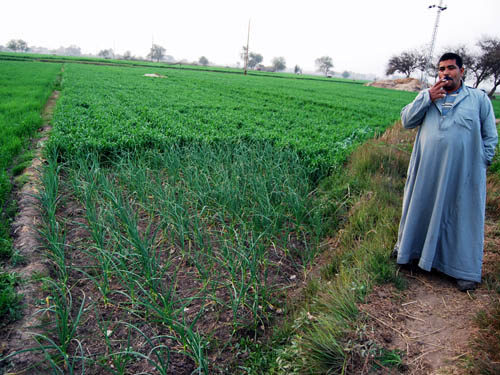
The Land of Goshen, where the Israelites lived, was located in the eastern Nile Delta along the Pelusiac Branch of the Nile. The land is flat and fertile, and their are canals with water. Because water is rare in the wilderness (or desert) crops are also rare.

From the wilderness, the great meals of fish and vegetables in Egypt looked good to the Israelites. The hard days of oppression were overlooked. (A lot like the bondage of sin!) I had an opportunity to be in some of the fields in Goshen. The farmers grow crops for the cattle, but they use the corners of the fields to grow vegetables for their own use. I saw leeks and cabbage.

Field in the land of Goshen. Photo by Ferrell Jenkins.

Field in the land of Goshen. Photo by Ferrell Jenkins.

The white object in the field is one of the pieces of the colossal statue of Rameses that we mentioned in an earlier post. Smoking is widespread in Egypt.

“A new beginning” in the Muslim world

United States President Obama calls for “a new beginning” in the Muslim world in Cairo today.

We watched the presidential inauguration on Al Jazeera in Egypt last January. The Egyptian men were all excited about this change in America. For a day or two afterward we would be greeted with big smiles and chants of  “Obama, Obama.” One camel driver told a member of our group, “I like Obama; he’s my color.”

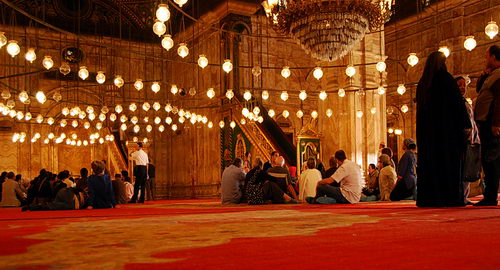
The Obama party is making visits to the pyramids and the Mohammed Ali Mosque. Typical tourist things to do. See our comments about the Mosque and a photo of the exterior of the building here. Below is a photo I made inside the mosque using a tiny tripod (about 6 inches high) on the floor of the mosque. Tourist groups are sitting on the floor listening to the history of the mosque.

Interior of Mohammed Ali Mosque in Cairo. Photo by Ferrell Jenkins.

Interior of Mohammed Ali Mosque in Cairo. Photo by Ferrell Jenkins.

Understanding is good. Let’s hope that this “new beginning” allows freedom for those in the Muslim world who profess Christ.

The full text of President Obama’s speech is available from The Guardian.

New discoveries in the land of Goshen

The storage city of Rameses was identified with Tanis in the past, but it is now identified with Tell el Daba in the eastern Nile Delta. Here is what the Bible says about Rameses in the land of Goshen:

  • It is called the land of Rameses (Genesis 47:11).
  • The Israelites built the storage cities of Pithom and Rameses (Exodus 1:11).
  • Rameses was the starting point of Israel’s exodus from Egypt (Exodus 12:37; Numbers 33:3, 5).

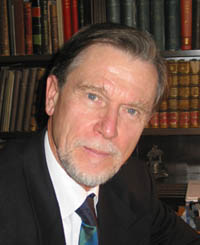
Prof. Dr. Manfred Bietak.

Prof. Dr. Manfred Bietak

Austrian archaeologists, under the direction of Professor Dr. Manfred Bietak and Irene Forstner-Mueller, have been working at Tell el Daba for several years. The history of this area may be divided into three periods:

  • Pre-Hyksos, when the city was named Rowaty (the door of the two roads).
  • Hyksos (about 1663-1555 B.C.), when the city was named Avaris.
  • Post-Hyksos, when the city was named Peru-nefer (happy journey).

The excavators recently uncovered a cuneiform letter written in southern Mesopotamian style. It is thought to date to the time of the Old Babylonian Kingdom of Hammurabi. The news release indicates a date of about 1600-1550 B.C. This illustrates a significant contact between Egypt and Mesopotamia.

Cuneiform Tablet from Tell el Daba.

Babylonian Cuneiform Tablet from Tell el Daba in the land of Goshen.

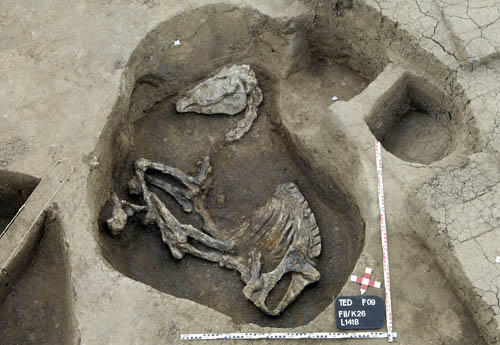
A second discovery was the burial of a horse, a mare likely used for breeding. Horses were introduced into Egypt by the Hyksos. The location of the burial near the palace of the Hyksos king Khayan suggests that this mare was a pet of the king.

Hyksos horse skeleton discovered at Tell el Daba.

Hyksos horse skeleton discovered at Tell el Daba.

The complete news release may be read in German here. Photos Copyright: Österreichisches Archäologisches Institut (ÖAI) Kairo. I had the pleasure of visiting Tell el Daba in January, 2009.

HT: Joseph I. Lauer

The Nile canals

The prophet Ezekiel  foretold the fall of Egypt at the hand of Nebuchadnezzar, king of Babylon (Ezekiel 30:10). Nebuchadnezzar defeated Pharaoh Neco at the battle of Carchemish in 605 B.C.

The prophet said,

“Moreover, I will make the Nile canals dry And sell the land into the hands of evil men. And I will make the land desolate And all that is in it, By the hand of strangers; I the LORD have spoken.” (Ezekiel 30:12 NAS)

Over a period of time the branches of the Nile in Lower Egypt (the Nile Delta) dried up. The course of the Pelusiac branch is known, but much of it is replaced by a canal running northeast from the area of Cairo to the Suez Canal.

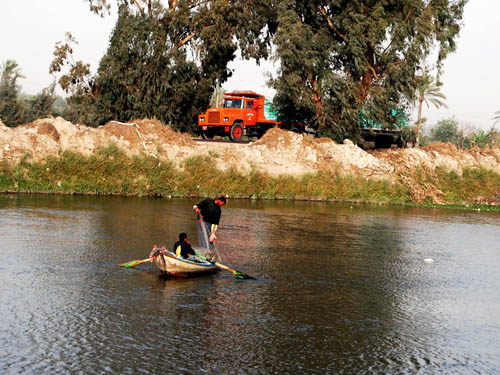
This photo shows a man fishing with a net in the Pelusiac branch which runs through the biblical land of Goshen (Genesis 45:10).

Fishing in the Pelusiac Branch of the Nile. Photo by Ferrell Jenkins.

Fishing in the Pelusiac Branch of the Nile. Photo by Ferrell Jenkins.

Happy Birthday to the WWW

The World Wide Web is now 20 years old. There are still a lot of people who are at least 20 years behind. Read the full account and links to related topics here.

In March 1989, Sir Tim Berners-Lee, then a scientist at CERN, the European Organisation for Nuclear Research, published a paper, entitled Information Management: A Proposal, which aimed to provide a framework for academic institutions to organise and share electronic documents across the internet, and were crucial in the creation of the world wide web.

“Tim pulled together ideas of a markup language, getting files on the internet and hypertext,” said Wendy Hall, a professor in the computer science department at the University of Southampton. “The things that made it work were open standards and protocols so anyone could set up their own web server and HTML documents, the fact that it was completely distributed and scalable, and that it worked over the network.”

Sir Tim will mark the occasion with a speech to scientists and technologists in Geneva, exploring the history of the web, and future applications of internet technology.

Earlier this week, Sir Tim warned a parliamentary round-table that allowing advertisers to target internet users by tracking their browsing habits was akin to putting a “spy camera” in people’s homes.

When I first began to use the WWW I would go to the CERN site, long before Google, to search for links to information. I remember telling my students in the 1990s that if they started reading all the pages on the WWW they would never finish. How much more today! Of course, most of the pages are probably not worth reading.

My first web page of biblical information, established May 14, 1996, later became the domain BiblicalStudies.info. BibleWord.com went online September 26, 1998.

On our recent trip to Alexandria, Egypt, we visited the famous new library. One of the guides showed us the computers that store about 85  —  web pages archived since 1998. Try it here. You can see what Bible World looked like in 1999.

Wayback computers in the library at Alexandria, Egypt. Photo by F. Jenkins.

Wayback computers in the library at Alexandria, Egypt. Photo by Ferrell Jenkins.

BTW, Al Gore was Vice President of the United States from 1993 to 2001.

HT: Paleojudaica

Pigeons

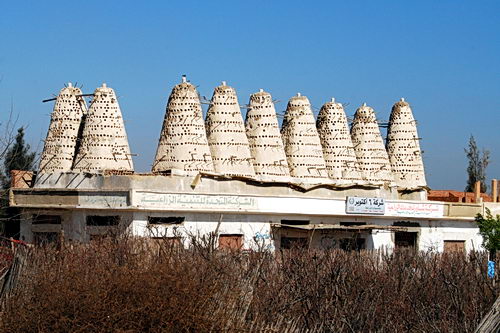
While traveling in Egypt we noticed pigeon roosts several places, but especially in the eastern Delta region (the biblical land of Goshen). The photo below was made along the desert road between Cairo and Alexandria.

Pigeons may serve many purposes: food, eggs, making fertilizer, message carriers, etc. Our guide explained that many people thought of the pigeon as an aphrodisiac.

Pigeon roosts near Alexandria, Egypt. Photo by Ferrell Jenkins.

Pigeon roosts near Alexandria, Egypt. Photo by Ferrell Jenkins.

Every reference to pigeons in the Bible is related to sacrifices. Most of the references are in Leviticus (1:14; 5:7, 11; 12:6, 8; 14:22, 30; 15:14, 29). Note two other references:

  • When the LORD made the land covenant with Abram at Shechem, He asked Abram to bring “a three year old heifer, and a three year old female goat, and a three year old ram, and a turtledove, and a young pigeon” (Genesis 15:9). The Hebrew word here is different. Fox, in The Five Books of Moses, uses the term fledgling.
  • Mary’s offering of purification in Jerusalem was “a pair of turtledoves or two young pigeons” (Luke 2:24).

Nefertiti smuggled from Egypt?

The title tells a lot. “Secret note reveals how Germany smuggled Queen Nefertiti bust from Egypt.” Here are a few excerpts:

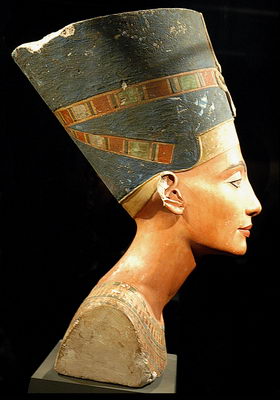
Nefertiti bus in Berlin. Photo by Ferrell Jenkins.

Nefertiti bust in Berlin. Photo by Ferrell Jenkins.

German archaeologists cheated Egyptian customs officers in order to smuggle the 3,400-year-old bust of Queen Nefertiti to Berlin, according to a secret document unearthed in archives….

The document is sure to stoke the row between German and Egypt over the removal of antiquities at the beginning of the 20th century.

The document, discovered in the German Oriental Institute, shows that the archaeologist Ludwig Borchardt deliberately hid the true value of the Nefertiti bust when he submitted the inventory of his finds to the Egyptian authorities in 1913….

The agreement was that Germany and Egypt would divide the spoils equally between them. But, says the witness, Borchardt “wanted to save the bust for us”. So it was tightly wrapped up and placed deep in a box in a poorly lit chamber to fool the chief antiquities inspector, Gustave Lefebvre….

It was enough to get Nefertiti out of the country into Germany. Now her long swan-like neck and exquisite features have come to symbolise the join between ancient and modern ideas of feminine beauty. Over half a million visitors a year are drawn to see her at Berlin’s Egyptian Museum.

But Egypt wants Nefertiti back and a document showing that the bust only left the country because of skulduggery could well strengthen Cairo’s case. Zahi Hawass, secretary-general of the Supreme Council of Antiquities in Egypt, has already threatened trouble. “We will make the lives of these (German) museums miserable,” he said.

At the very least Cairo wants Nefertiti back on loan to mark the opening of a new Grand Egyptian Museum, near the pyramid at Giza, in 2012.

For the full print story read here.

Nefertiti was the wife (Queen) of Pharaoh Akhenaten in 14th century B.C. Egypt.

HT: J. T. Lauer

Travel to Egypt

Because of a severe famine in Canaan, Abraham traveled to Egypt and sojourned there (Genesis 12:10). Joseph was sold by his brothers and eventually became a slave in Egypt (Genesis 37:28). Jacob and his family, at least 70 persons, went into Egypt and settled in the land of Goshen (the eastern Delta) during a time of famine in Canaan (Genesis 46; Acts 7:11-16).

What do we know outside the Bible about travel to Egypt during the Patriarchal age (the Middle Bronze age)? It is clear that foreigners traveled to Egypt. In the tomb of Khnum-hotep III at Beni Hasan, about 169 miles south of Cairo, there is a painting showing 37 Asiatics of the desert bringing gifts to Egypt and desiring trade. This tomb painting is dated to about 1890 B.C.

Here is a description of the painting given by J. A. Thompson in The New International Dictionary of Biblical Archaeology:

One picture shows thirty-seven seminomadic tribesmen from Palestine, from the land of Shutu (central Trans-Jordan), led by Absha, their chief. The men were beared, and the women used bands to hold their long hair in place. Their clothes were multicolored, the men wearing short skirts and sandals and the women having calf-length dresses, which they fastened at the shoulder by means of a clasp. Instead of sandals, the women had shoes on their feet. One of the men carried a lyre, and on one of the donkeys were two bellows, indicating that at least some members of the group were traveling metalworkers.

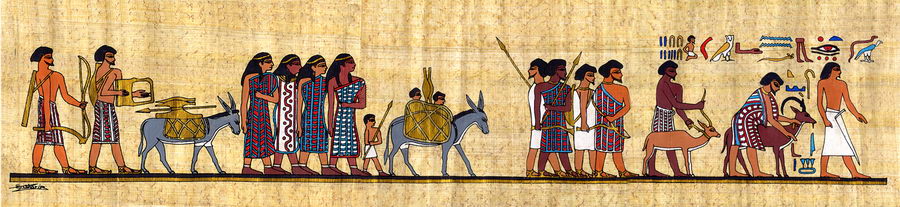
Egypt has many shops selling papyrus sheets. Some have tomb paintings. I am told that the Abu Simbel Papyrus store in Giza is the only one that has permission to sell a painting of the Asiatics arriving in Egypt. This looks better than any tomb painting one might see today while visiting a tomb. This papyrus painting shows only a portion of the 37 travelers making their way into Egypt. The Asiatics are wearing multicolored clothing. The person to the right in white is an Egyptian.

A portion of the Beni Hasan painting showing Asiatics arriving in Egypt.

A portion of the Beni Hasan painting showing Asiatics arriving in Egypt.

Click on the art for a larger image that might be suitable for use in a PowerPoint presentation.