Category Archives: Egypt

Tirhakah of Sudan (or Ethiopia, or Cush)?

Our post yesterday reported the discovery of a large statue of Taharqa  (English Bible: Tirhakah) deep in Sudan. Some English versions associate Tirhakah with Ethiopia (NET, NKJV). Other associate him with Cush (NAU, ESV, CSB). The Hebrew word here is Kush (or Cush).

Kenneth A. Kitchen clarifies the terminology:

The region S of Egypt, i.e. Nubia or N Sudan, the ‘Ethiopia’ of classical writers (not modern Abyssinia [Ethiopia]). The name Cush in both Hebrew and Assyrian derives from Egyptian Kš (earlier K’s, K’š), ‘Kush’. Originally the name of a district somewhere between the second and third cataracts of the Nile c. 2000 bc, ‘Kush’ became also a general term for Nubia among the Egyptians, which wider use Hebrews, Assyrians and others took over (G. Posener, in Kush 6, 1958, pp. 39–68). (New Bible Dictionary, 3rd Ed.)

The Theological Wordbook of the Old Testament comments on the term Cush (Ethiopia) as it is used in several Old Testament prophecies.

In several cases, especially in the prophets, Ethiopia is used in parallel construction as a synonym of Egypt (Isa 20:3-5; Ezek 30:4; Nah 3:9). This probably represents the dominance of Ethiopia (or, more precisely, Nubia) over Egypt between 750 and 663 B.C. Terhakah was a notable Nubian pharaoh who tried, unsuccessfully, to block Sennacherib’s westward expansion (2Kings 19:9 ; Isa 37:9). After 663 B. C. Egypt was independent of Nubia (Jer 46:9; Ezek 25:4, 5, 9).

About a year ago I visited a Nubian Village on the banks of the Nile River at the first cataract of the Nile at Aswan. The Nubians at the village originally lived south of Aswan in the ancient territory of Cush. When the new High Dam was built on the Nile the Nubians were moved to other settlements.

One of the interesting things I observed at the village was a shop of some sort called House of Kush (Cush). A sign on top of the building added “Welcome to Taharka Kingdom.” My point is to show the association between southern Egypt, Cush, and Tirhakah.
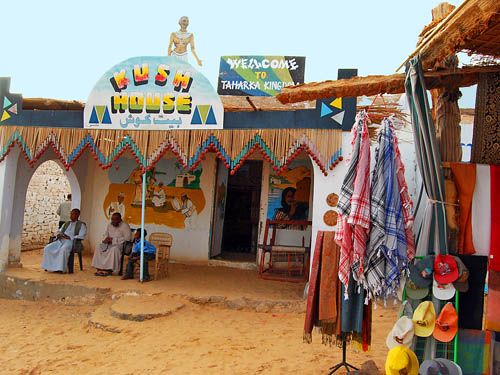
House of Kush (Cush) in Nubian Village at Aswan, Egypt. Photo by F. Jenkins.

House of Kush (Cush) in Nubian Village, Aswan, Egypt. Photo by F. Jenkins.
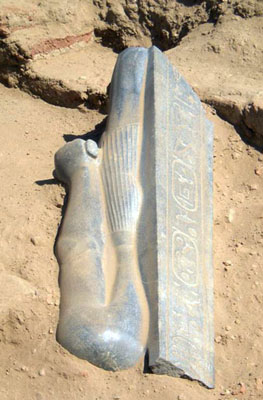
Statue of Tirhakah discovered in Sudan

Owen Jarus reports in The Independent the discovery of a massive statue of Pharaoh Taharqa [English Bible: Tirhakah] deep in Sudan.

No statue of a pharaoh has ever been found further south of Egypt than this one. At the height of his reign, King Taharqa controlled an empire stretching from Sudan to the Levant.

A massive, one ton, statue of Taharqa that was found deep in Sudan. Taharqa was a pharaoh of the 25th dynasty of Egypt and came to power ca. 690 BC, controlling an empire stretching from Sudan to the Levant. The pharaohs of this dynasty were from Nubia – a territory located in modern day Sudan and southern Egypt.

Taharqa statue. Photo: Berber-Abidiya Archaeological Project.

Taharqa statue. Photo: Berber-Abidiya Archaeological Project.

The Nubian pharaohs tried to incorporate Egyptian culture into their own. They built pyramids in Sudan – even though pyramid building in Egypt hadn’t been practised in nearly 800 years. Taharqa’s rule was a high water mark for the 25th dynasty. By the end of his reign a conflict with the Assyrians had forced him to retreat south, back into Nubia – where he died in 664 BC. Egypt became an Assyrian vassal – eventually gaining independence during the 26th dynasty. Taharqa’s successors were never able to retake Egypt.

In addition to Taharqa’s statue, those of two of his successors – Senkamanisken and Aspelta – were found alongside. These two rulers controlled territory in Sudan, but not Egypt.

. . .

While this is the furthest south that a pharaoh’s statue has been found, it doesn’t necessarily mean that Dangeil is the southern border of Taharqa’s empire. It’s possible that he controlled territory further up the Nile.

The statue of Taharqa is truly monumental. “It’s a symbol of royal power,” said Dr. Anderson, an indicator that Dangeil was an “important royal city.”

It’s made of granite and weighs more than one ton. It stood about 2.6 meters (8.5 feet) when it had its head. In ancient times it was smashed into several pieces on purpose. This was also done to the two other statues. It’s not known who did this or why. It happened “a long time after Taharqa,” said Anderson.

. . .

The largest piece of Taharqa’s statue is the torso and base. This part of the statue is so heavy that the archaeological team had to use 18 men to move it onto a truck.

“We had trouble moving him a couple hundred meters,” said Anderson. The move was “extremely well planned,” with the team spending eight to nine days figuring out how to accomplish it without the statue (or the movers) getting damaged.

The full account from The Independent may be read here. A longer article by Jarus, with several photos, may be found in Heritage Key.

After the Assyrian king Sennacherib captured Lachish, he headed for Jerusalem. On the way he heard that King Tirhakah of Ethiopia (Cush) had come out to fight against him.

The king heard that King Tirhakah of Ethiopia was marching out to fight him. He again sent messengers to Hezekiah, ordering them: “Tell King Hezekiah of Judah this: ‘Don’t let your God in whom you trust mislead you when he says, “Jerusalem will not be handed over to the king of Assyria.” Certainly you have heard how the kings of Assyria have annihilated all lands. Do you really think you will be rescued? (2 Kings 19:9-11 NET; cf. Isaiah 37:9)

Hezekiah was king of Judah from 716/15 – 687/86 B.C. (Thiele). The events recorded in the Bible took place shortly before 700 B.C. Tirhakah evidently came to power before 690 B.C., was already a leading commander of the army, or there may be another solution to the problem.

HT: Biblical Paths.

Don’t try this on your first trip

Some adventuresome souls who have been reading the posts about the recent trip to Israel may have in mind doing the same. After all, you have some friends who went to Europe on their own, bought an Eurail pass and saw everything in two weeks.

Not that I think that is the best way to see Europe in a limited amount of time, but I definitely warn against this for the first trip or two to Israel, Turkey, Jordan, or Egypt. When you read about a trip like the one I just completed the first two weeks of December, keep in mind that I have been traveling to Israel almost annually since 1967.

Your best choice for a first or second trip to the Bible Lands (or Holy Lands) is to travel with someone who has experience in this area. Look at a lot of itineraries before you make a decision. Look at the qualifications of the person leading the tour. Examine carefully the details such as class of hotels, number of meals, etc.

The most important thing you can do is to study about the places you will visit for several months in advance of the trip. A few weeks ago we presented a list of books that we suggest for this purpose here. Your most important study will come during the first year after you return from your trip. Because then you will have a better understanding of what you are reading about.

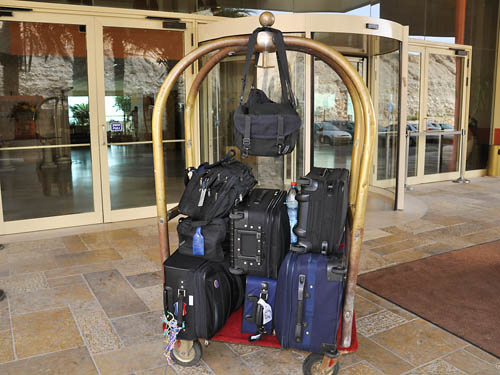
And don’t take too much luggage. It can spoil a good trip. I caught this photo of two tourists coming out of a hotel near the Dead Sea. Perhaps they had packed for a group.

Overloaded at the Dead Sea.

Overloaded at the Dead Sea. Photo by Ferrell Jenkins.

BU archaeologist discovers evidence of ancient Egyptian shipping

BU Today has an update here on the work of Professor Kathryn Bard in Egypt. This new article reports on a discovery first made by Bard five years ago. A video of some of the artifacts soon to go on display in the Egyptian Museum is included.

The team discovered seven caves at Wadi Gawasis containing relics dating back 4,000 years. The first pieces ever recovered from Egyptian seagoing vessels, they offer a tantalizing glimpse into an elaborate network of Red Sea trade.

Best known for its exports of gold, incense, ebony, elephant ivory, and exotic animals, the exact location of the port city Punt remains a mystery; Bard believes it was in present-day eastern Sudan. Inscriptions discovered more than a century ago indicate that Egyptian pharaohs mounted naval expeditions to Punt as far back as the Old Kingdom (2686 –2125 B.C.), and Bard’s findings give credibility to the legend in the form of stelae, limestone slabs installed in niches outside of the second cave.

King Solomon of Israel sought to make use of the Red Sea for shipping, but his plan does not appear to have been successful.

King Solomon also built a fleet of ships in Ezion-geber, which is near Eloth on the shore of the Red Sea, in the land of Edom. And Hiram sent his servants with the fleet, sailors who knew the sea, along with the servants of Solomon. They went to Ophir and took four hundred and twenty talents of gold from there, and brought it to King Solomon. (1 Kings 9:26-28 NAU)

Here is a photo I made at Eilat in the Red Sea (Gulf of Eilat/Aqaba).

Fish and coral in the Red Sea at Eilat. Photo by Ferrell Jenkins.

Fish and coral in the Red Sea at Eilat. Photo by Ferrell Jenkins.

HT: Joseph Lauer

Fisherman in Egypt

A fisherman brings in a large catch of fish in a lake on the outskirts of Alexandria, Egypt.

Fisherman Near Alexandria, Egypt. Photo by Ferrell Jenkins.

Fisherman Near Alexandria, Egypt. Photo by Ferrell Jenkins.

The wise writer of Ecclesiastes likened the unfortunate things that happen in life to fish being caught in a net.

Surely, no one knows his appointed time! Like fish that are caught in a deadly net, and like birds that are caught in a snare– just like them, all people are ensnared at an unfortunate time that falls upon them suddenly. (Ecclesiastes 9:12 NET)

This photo was made in the street fish market along the pier in Alexandria.

The Fish Market at Alexandria, Egypt. Photo by Ferrell Jenkins.

The Fish Market at Alexandria, Egypt. Photo by Ferrell Jenkins.

The prophet Isaiah (about 725 B.C.) spoke of a time that was coming upon Egypt in these words.

The fishermen will mourn and lament, all those who cast a fishhook into the river, and those who spread out a net on the water’s surface will grieve. (Isaiah 19:8 NET)

Move evidence of Babylonian-Egyptian contacts

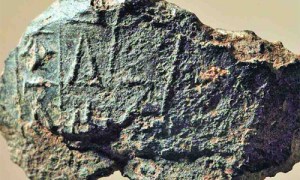
Austrian Times reports here on the discovery of a Babylonian seal impression at Tell el-Dab’a in Egypt.

Austrian archaeologists have found a Babylonian seal in Egypt that confirms contact between the Babylonians and the Hyksos during the second millennium B.C.

Irene Forstner-Müller, the head of the Austrian Archaeological Institute’s (ÖAI) branch office in Cairo, said today (Thurs) the find had occurred at the site of the ancient town of Avaris near what is today the city of Tell el-Dab’a in the eastern Nile delta.

The Hyksos conquered Egypt and reigned there from 1640 to 1530 B.C.

She said a recently-discovered cuneiform tablet had led archaeologists to suspect there had been contact between the Babylonians and the Hyksos.

Forstner-Müller added that Manfred Bietak had begun archaeological research on the period of Hyksos dominance at the remains of a Hyksos palace at Avaris in 1966.

Babylonian seal impression.

Babylonian seal impression.

Earlier in the year we reported on the discovery of a Babylonian tablet at Tell el-Dab’a here.

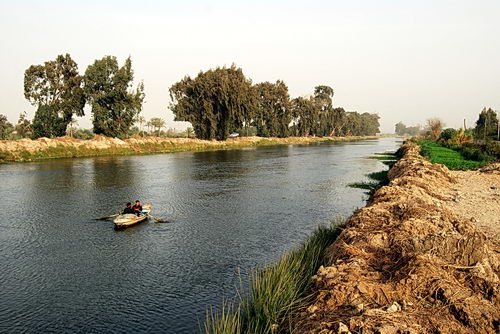
The report  says the Austrian plan to build a museum in the area. A more complete report in Die Presse says they also have plans to restore the river. The Pelusiac branch of the Nile once flowed by this ancient site. Below is a photo of the canal which often follows the course of the Pelusiac.

A canal where the Pelusiac branch of the Nile once flowed. Photo by F. Jenkins.Canal along the Pelusiac Branch of the Nile near Tell el-Dab’a. Photo by FJ.

Tell el-Dab’a is in the eastern Nile Delta. In Biblical times it was known as the Land of Goshen, and served as the home of the Israelites.

“Hurry and go up to my father, and say to him, ‘Thus says your son Joseph, “God has made me lord of all Egypt; come down to me, do not delay. “You shall live in the land of Goshen, and you shall be near me, you and your children and your children’s children and your flocks and your herds and all that you have. “There I will also provide for you, for there are still five years of famine to come, and you and your household and all that you have would be impoverished.” (Genesis 45:9-11 NAU)

These new findings might shed some light on the plausibility of Achan finding a garment from Shinar (Babylon) at Jericho (Joshua 7).

HT: Biblical Paths

What is in the basement of the Cairo Museum?

Tourists who visit the Egyptian Museum in Cairo are overwhelmed at the large collection of Egyptian artifacts. In fact, most folks just see a few of the displayed items. Have you ever thought about the basement. Take a look at this video featuring Dr. Zahi Hawass, the flamboyant director of antiquities in Egypt.


Now, if they would only allow the taking of photos in the galleries!
HT: Biblical Paths

Thebes in Bible Prophecy

Luxor was known as Thebes in Old Testament times. Both Jeremiah and Ezekiel prophesied the Lord’s judgment of the city. Jeremiah says,

“The LORD of hosts, the God of Israel, says, ‘Behold, I am going to punish Amon of Thebes, and Pharaoh, and Egypt along with her gods and her kings, even Pharaoh and those who trust in him’” (Jeremiah 46:25; see also Ezekiel 30:14-16)

A visit to the ruined and unoccupied temples of Karnak and Luxor, where Amon (or Amun) was worshiped as a great god, illustrates the fulfillment of this prophecy. Shortly after the time of Jeremiah (c. 586 BC), Egypt and Thebes began to decline as a world power.

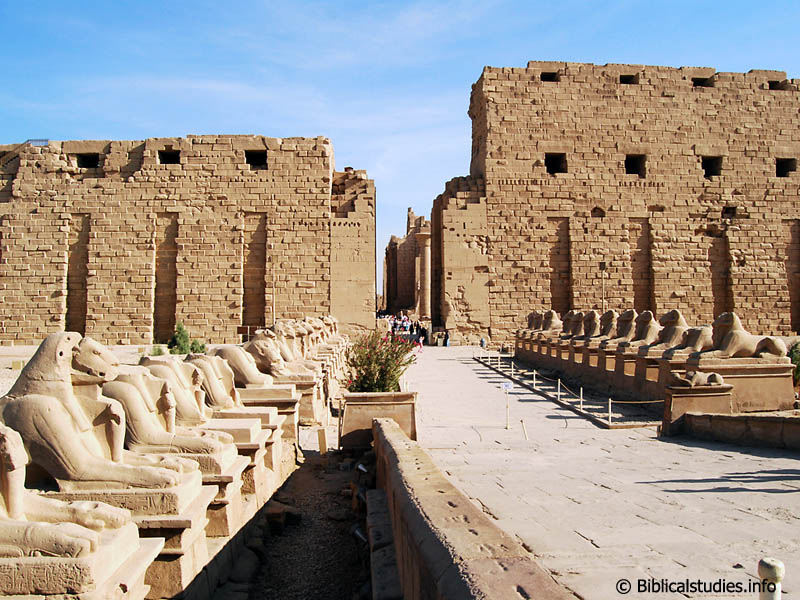
This photo of the avenue of the ram-headed sphinxes leads to the first pylon of the great temple of the god Amon (or Amun). The first pylon was the last part of the temple constructed (about 700 BC) and remains unfinished. This photo is large enough to be used in teaching presentations. Click on the photo for a larger image. I hope you will enjoy using it.

The avenue of ram-headed sphinxes and the first pylon at Karnak. Photo by Ferrell Jenkins.

The avenue of ram-headed sphinxes and the first pylon of the great temple of Amun at Karnak. Photo by Ferrell Jenkins.

In 663 BC the Assyrian king Ashurbanipal had already conquered Thebes (Hebrew, No Amon). The prophet Nahum, in prophesying the fall of Nineveh, calls attention to this event (3:8ff.).

Egyptian and Anatolian contacts with Galilee

Tel Aviv University reports on the discover of a rare Egyptian artifact dating to around 3000 BC from Tel Bet Yerah on the shore of the Sea of Galilee. The link to the report is here. The brief report from the Jerusalem Post is probably adequate here.

Although Egyptian-Israeli relations have been frosty in recent years, ties between the two lands were vibrant around 3,000 BCE during the Early Bronze Age – at least according to Tel Aviv University and University College London archeologists who discovered a rare, four-centimeter-long stone fragment at the point where the Jordan River exits Lake Kinneret.

The piece, part of a carved stone plaque bearing archaic Egyptian signs, was the highlight of the second season of excavations at Tel Bet Yerah (Khirbet el-Kerak). The site lies along an ancient highway that connected Egypt to the wider world of the ancient Near East.

Fragment of Egyptian plaque - c. 3000 BC - from Tel Bet Yerah.

Fragment of Egyptian plaque - c. 3000 BC - from Tel Bet Yerah.

. . . . . .

Earlier discoveries, both in Egypt and at Bet Yerah, have indicated that there was direct interaction between the site – then one of the largest in the Jordan Valley – and the Egyptian royal court. The new discovery suggests that these contacts were of far greater local significance than had been suspected.

The archeologists noted that the fragment – which depicts an arm and hand grasping a scepter and an early form of the ankh sign – was the first artifact of its type ever found in an archaeological site outside Egypt. It has been attributed to the period of Egypt’s First Dynasty, at around 3000 BCE.

. . . . . .

This year’s excavations also provided new insights into contacts between the early town and the distant north, when large quantities of “Khirbet Kerak Ware” (a distinctive kind of red/black burnished pottery first found at Tel Bet Yerah) were found in association with portable ceramic hearths, some of them bearing decorations in the form of human features.

One end of a decorated portable hearth - Khirbet Kerak Culture (c. 2700 BC)

One end of a decorated portable hearth - Khirbet Kerak Culture (c. 2700 BC)

“The hearths are very similar to objects found in Anatolia and the southern Caucasus,” noted Greenberg, “and most were found in open spaces where there was other evidence for fire-related activities.

“The people using this pottery appear to have been migrants or descendants of migrants, and its distribution on the site, as well as the study of other cultural aspects, such as what they ate and the way they organized their households, could tell us about their interaction with local people and their adaptation to new surroundings.”

. . . . . .

The tel was once described by influential American biblical archeologist William F. Albright as “perhaps the most remarkable Bronze Age site in all Palestine.” It presents the most complete sequence of the transition from village to city life in ancient Canaan.

Built on a raised peninsula near an important crossroads and a fertile valley, Tel Bet Yerah became a major regional center, and its fortification systems, city gate, streets and houses reveal elements of advanced urban planning.

Modern archeological research on the mound began in the early 1920s, when E.L. Sukenik (father of the late archeologist and politician Prof. Yigael Yadin) examined finds from the section of the old Samak (Tzemah)-Tiberias road that traversed the mound along its entire length.

At about the same time, Albright conducted his own investigation of the site; he was the first to identify and define the pottery known as Khirbet Kerak Ware.

The first archeological excavation was conducted in 1933, when the modern Tzemah -Tiberias highway was constructed. Over the next 70 years, about 20 excavation licenses were issued for Tel Bet Yerah and some 15,000 square meters were excavated, most of them in Early Bronze Age strata.

I think this type of information illustrates why the Lord placed His people on this land bridge between the great powers of the ancient world. It would continue to remain that way through the days of the Assyrians, Babylonians, Persians, Greeks, and Romans. And beyond.

HT: Joe Lauer

The Land of Rameses

Note: Over the past nine years I have contributed nearly 100 articles on Bible places to a magazine published by some of my friends. Normally I do not repeat the material here for several years.  The typesetter made a mistake in the July, 2009, issue of Biblical Insights using the title from the previous issue. Because of this I decided to run the article here with the correct title.

-o-o-o-o-o-o-

For many years scholars identified Rameses with Tanis (San el Hagar). Tanis is often identified with the Zoan which was built seven years after Hebron (Numbers 13:22). As a result of recent excavations in the eastern Nile Delta by Austrian archaeologists under the direction of Manfred Bietak, Rameses is now identified with Tell el-Daba. Tell el-Daba is situated on the eastern side of the ancient Pelusiac branch of the Nile River in the biblical land of Goshen (Gen. 45:10) which is also called the land of Rameses (Genesis 47:11). Rameses was the starting point of the exodus (Ex. 12:37; Num. 33:3,5).

Scholars posit four main proposals for the date of the exodus. (1) Before 2000 B.C. (Anati); (2) 1477 B.C. (Goedicke); (3) about 1450 B.C. (Bimson); (4) 1280 B.C. (popular view). If we believe that 1 Kings 6:1 should be taken seriously, as I do, the date of the exodus would have been about 1446 B.C. Conservative scholars disagree over whether there was a long bondage (430 years), or a short bondage (215 years).

The history of this area should be divided into three periods: pre-Hyksos, Hyksos, and post-Hyksos. The Hyksos were foreign (Canaanite or Asiatic) rulers who lived in the eastern Nile Delta and eventually ruled northern Egypt for some 108 years (c. 1663-1555 B.C.; 15th dynasty). In the pre-Hyksos period the town was known as Rowaty (“the door of the two roads”). During the 15th Dynasty the name was changed to Avaris. The Hyksos made their capital there and retained the name. When the Egyptians ran the Hyksos out of Egypt the name was likely changed to Peru-nefer (“happy journey”). Pharaoh Rameses built a new city at the same location and named it Rameses.

During their stay in the land of Egypt the Israelites built the storage cities of Pithom and Rameses (Exodus 1:11). Pharaoh Rameses II ruled Egypt about 1304 to 1227 B.C. How could the Israelites have built the city of Rameses prior to 1446 B.C. if Pharaoh Rameses was not the ruler of Egypt until nearly 200 years later? Some have suggested that the name Rameses was given to the city by the Hyksos in the 17th century B.C. Perhaps the city was named for a private individual by that name. The most common explanation is that Rameses is the modernization of an obsolete place name. We might say that Caesar crossed the English Channel though it was not known by that name at the time. We say St. Nicholas of Myra was a Turkish bishop, but Turkey did not exist at the time.

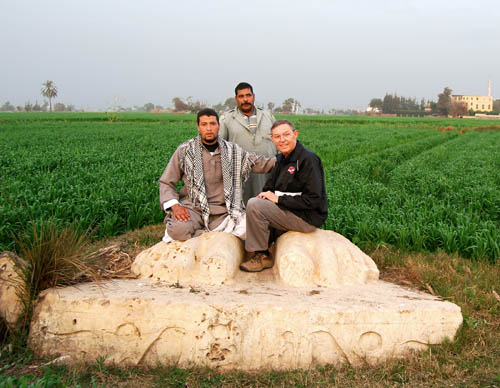
Earlier this year I spent two days in the land of Goshen. My guide gained access to a field in the Tell el-Daba area where we saw remnants of a colossal statue of Pharaoh Rameses II estimated to have been more than 30 feet high. The royal precinct of the city at the time of Moses has also been uncovered at Ezbet Helmi on the bank of the Pelusiac branch of the Nile.

Remnant of a colossal statue of Rameses II at Tell el-Daba in the land of Goshen.

Remnant of a colossal statue of Rameses II at Tell el-Daba in the land of Goshen.

It is incorrect to say that there was no Egyptian building in the delta during the time of Rameses II. The storage city constructed by the Israelites was not known as Rameses when they built it, but by one of the earlier names.