In the gospels one may find several references or allusions to events of the wilderness wandering. This indicates the significance of the event and suggests that it should be studied carefully by Christians as well as Jews.
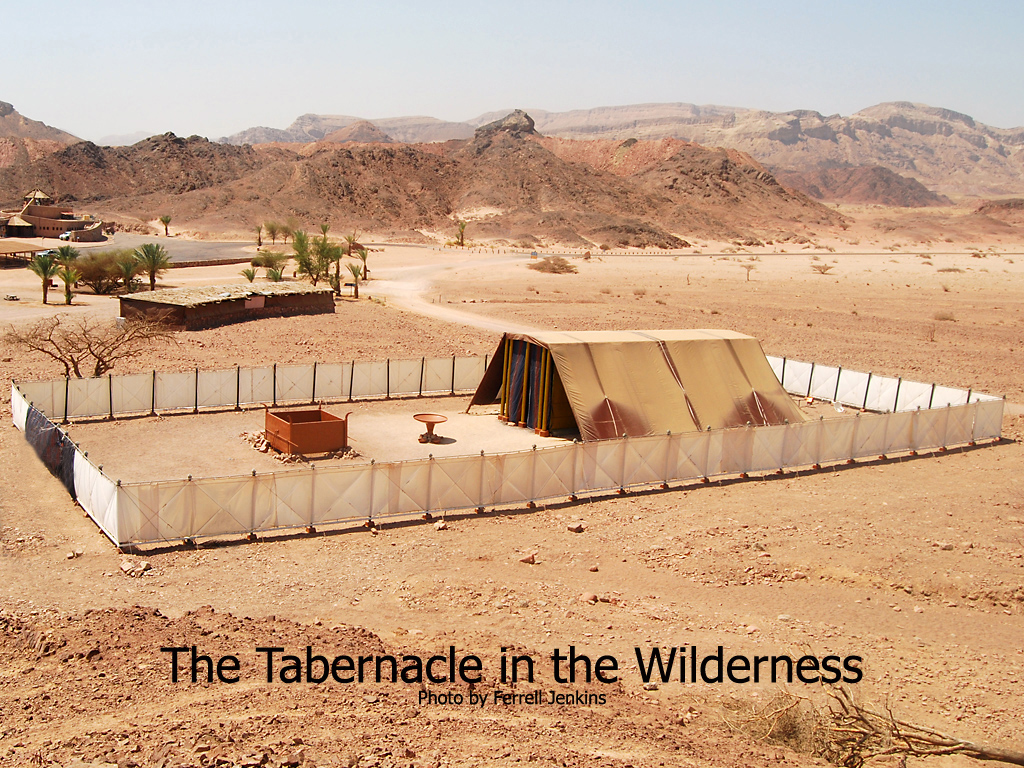
“The Word became flesh and dwelt [tented, tabernacled] among us…” (Jn. 1:14). The Lord made His presence known to the Israelites in the “tent of meeting” (the tabernacle; Ex. 29:45-46).
The Law was given through Moses [in the wilderness] (Jn. 1:17).
The serpent in the wilderness (Jn. 3:14ff.; cf. 8:28; 12:32).
The manna (Jn. 6:31ff.; notice the “grumbling” over the bread, vs. 41).
The water (Jn. 7:37-38).
Jesus was tempted in the wilderness by the devil. (Mt. 4:1-11).
Jesus fasted for 40 days and 40 nights (cf. Israel’s 40 years).
Jesus was tempted but did not succumb.
In response to the temptations of the devil Jesus quoted from the book of Deuteronomy (Mt. 4:4;
Dt. 8:3; Mt. 4:7; Dt. 6:16; Mt. 4:10; Dt. 6:13).
Stephen made several references to the events of the wilderness in his sermon (Acts
7:30-44).
Paul calls attention to the exodus and events of the wilderness wandering (Acts 13:18; Gal. 4:21-31). Notice his use of the phrase, “Remove the wicked man from among yourselves” (1 Cor. 5:13; cf. Dt. 13:5, the false prophet; 17:7, the one who served other gods; 17:12, one who acts presumptuously; 21:21, the rebellious son; 22:21, a girl not found a virgin).
Israel was baptized, ate spiritual food and drank spiritual drink, but practiced idolatry and immorality and fell (1 Cor. 10:1-13). Compare the situation at Corinth: Christians who had been baptized, ate and drank the Lord’s supper, were tempted by the idolatry (meat sacrificed to idols) and immorality of their city.
The Writer of Hebrews speaks of events of the wilderness wandering.
The events at Mount Sinai (Heb. 12:18-29). The word spoken through angels (2:2; cf. Gal. 3:19).
The unfaithfulness of Israel in the wilderness (Heb. 3–4).
In the book of Revelation.
“See…that you make all things according to the pattern which was shown you on the mountain” (Heb. 8:5; Ex. 25:40, the building of the tabernacle).
The woman who gave birth to the man child fled into the wilderness where she was nourished (Rev. 12:6). This symbol makes the wilderness a place of protection and nourishing. The figure seems to be based on the experience of the nation of Israel and of Elijah (1 Kings 19:1-18) as they were cared for by the Lord.
Some of the trumpets of chapters 8-10 are drawn from the plagues of Egypt. The one like a son of man came on a white cloud (cf. Isa. 19:1, judgment of Egypt) and judged the enemy (Rev. 14:14-20). The saints sing the song of Moses and the Lamb beside the sea (Rev. 15; cf. Ex. 14:31; 15:1-19).
At the top of our home page, we have a link to INDEXES (INDICES). There, occasionally I have included a collection of posts on a specific subject. If you have not used this feature of the blog, I suggest you take a look.
Specifically, I am calling attention to the INDEX: Route of the Exodus and the Location of Mount Sinai. Click on the link below to visit that page which includes many photos pertaining to the exodus and Mount Sinai.
Recently I observed on a social media site a discussion conducted by several young preachers. One was asking others what they thought about the location of Mount Sinai. A few days ago I received a note from an older former student about a column that some are calling Solomon’s Post or Pillar. I have learned enough about archaeology to know that an artifact must have a context. One random stone is not enough to build a legitimate conclusion. What archaeological excavation has determined the origin and provenance of the stone post? What ancient document has mentioned the post? What evidence do we have that it is in any way associated with Israelite King Solomon?
One respondent in the exchange on social media did call attention to the articles on my blog, but mostly they each were giving their opinion. The thing that really got my attention what that not one of them referenced a Bible dictionary or Bible encyclopedia. No one called attention to a Bible Atlas. When I was in college and several students gathered in a room to pool our ignorance we called it Shooting the Bull.
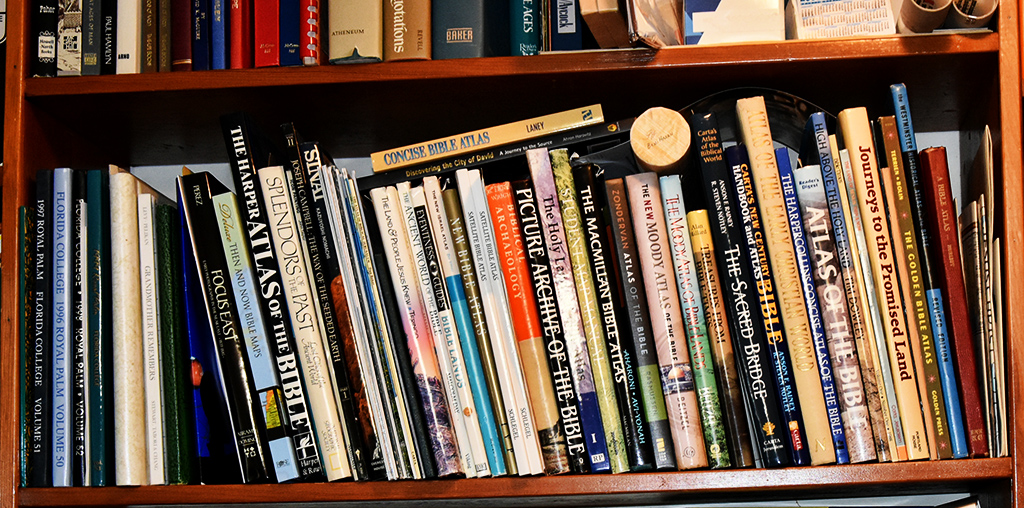
Most of my Bible Atlases.
Most of my Bible Atlases can be seen in this photo, but I have some others in digital format, and I do have several other smaller atlases on different shelves. Over half a century of travel to the Bible lands might explain why I have collected so many atlases as well as numerous road atlases and maps. Every preacher/teacher needs a few good Bible Atlases.
Gordon Franz at ETS annual conference.
Some scholars concentrate on certain areas of study and produce good material. Here I call attention to the work of Gordon Franz. He has written several essays under the category of Cracked Pot Archaeology at https://www.lifeandland.org/category/cracked-pot-archaeology/
His article on “Where is Mount Sinai in Arabia (Galatians 4:25)? Is especially helpful. Franz documents the view that the region commonly called Sinai was known as Arabia in Roman times:
Also check the article, MT. SINAI IS NOT AT JEBEL EL-LAWZ IN SAUDI ARABIA.
When you arrive at the Life and Land page search for Saudi Arabia. The site will return links for several articles.
Many of the articles written by Gordon Franz are available on the ABR (Associates for Biblical Research) web site. Go there and search for Mount Sinai. Use the link below to visit this site.
Franz exposes the claims of the late Ron Wyatt and Robert Cornuke pertaining to several biblical events.
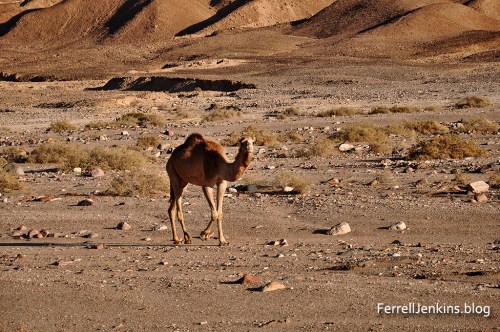
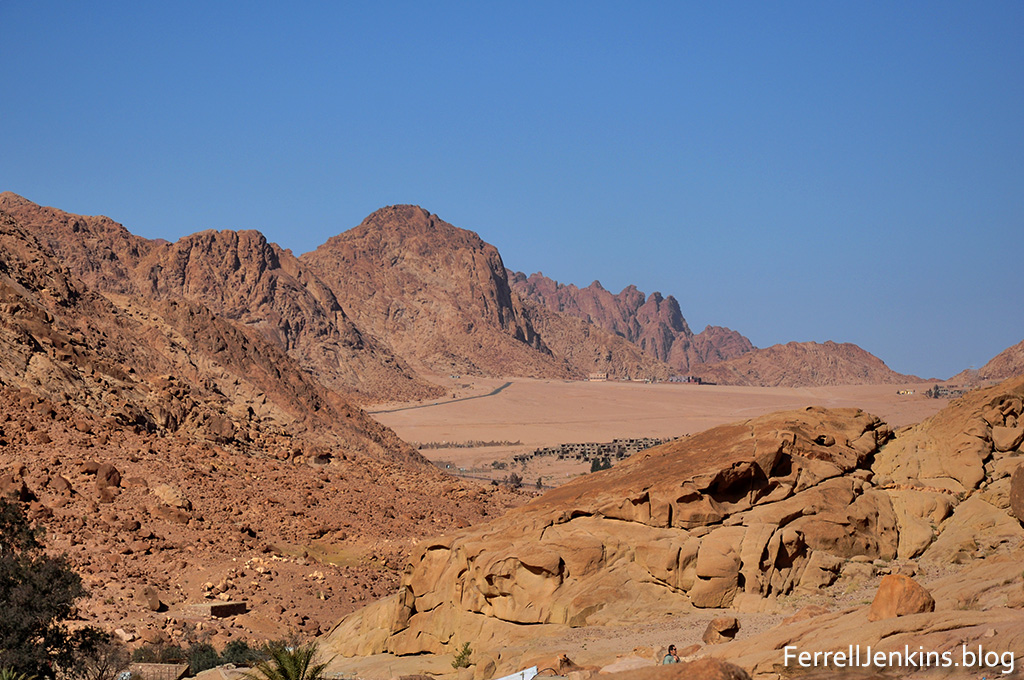
This is on the way to Mount Sinai which is still a distance to the east (left), Photo by Ferrell Jenkins
Carl Rasmussen says there are at “at least ten different proposals for the location of the Red Sea or Reed Sea including three lakes near the Mediterranean Sea, five lakes along the line of the present-day Suez Canal, as well as the Gulf of Suez and the Gulf of Elath. In addition, there are at least twelve different candidates for Mount Sinai: five in the southern part of the peninsula, four in the north, one in the center, one in Midian (Saudi Arabia), and another in Edom (southern Transjordan). (Zondervan Atlas of the Bible Revised Edition. 105).
The following map is part of a collection by David at BibleMapper now numbering 165. You may access this wonderful resource here.
BibleMapper shows no less than 10 candidates for the location of the Biblical Mount Sinai.
Anson F. Rainey was considered one of the top scholars on matters of Old Testament geography. I am pleased to have an autographed copy of The Sacred Bridge which was written by Anson Rainey (OT) and Steven Notley (NT).
Rainey’s comment on this matter is on page 120 of The Sacred Bridge. “Mount Sinai = Horeb = Mount Paran. The wilderness itinerary (Num 33:1–49) seems to point to a location for Mount Sinai in the southern Sinai Peninsula. Mount Sinai (סִינַי) is mentioned fifteen times in the books of Exodus, Leviticus, and Numbers as the place where the people of Israel received the revelation of the Torah. Poetic passages (e.g. Judg 5:5; Ps 68:9 [Eng. 8; note also v. 18 = Eng. 17]) depict it as the dwelling place of YHWH. Two call it Mount Paran (הַר פָּארָן; Deut 33:2; Hab 3:3). The steppe land (wilderness) of Paran (מִדְבַּר פָּארָן; e.g. Num 10:12; 12:16; 13:3) seems to be the generic name for the main Sinai expanses of which there are various subdivisions. Its name may be preserved in that of the oasis of Feirân known as Φαραν in Byzantine sources (Aharoni 1979:199). In Numbers 10:33 Sinai is called “the mountain of YHWH.” Seventeen times in the Hebrew Bible, especially throughout Deuteronomy and three passages in Exodus (3:1; 17:6; 33:6) and elsewhere (1 Kgs 8:9; 19:8; 2 Chr 5:10; Ps 106:9; Mal 3:22), the name Horeb (חֹרֵב) is used, evidently for the same place.” He also reminds us that several passages mention the mountain of God.
The Rest. This is suggested as the large expanse near Sinai where the Israelites camped before receiving the ten commandments.
In conclusion, I am writing this post in an effort to encourage all preachers and teachers to study more widely and deeper. I am aware that books are extremely expensive these days and many churches do not take into account this peculiar expense that ministers have. Perhaps this word to the sufficient is wise.
King Tut was opened and the treasures from the 14th century B.C. were The popular press reminds us here that 100 years ago today the tomb of revealed.
In the early years of leading tours, beginning in 1967, we visited Egypt on every tour. The treasures of the young king were displayed in the Cairo Museum. I, and those traveling with me, were always amazed by the large number of treasures displayed. Much gold and other materials of value are on display.
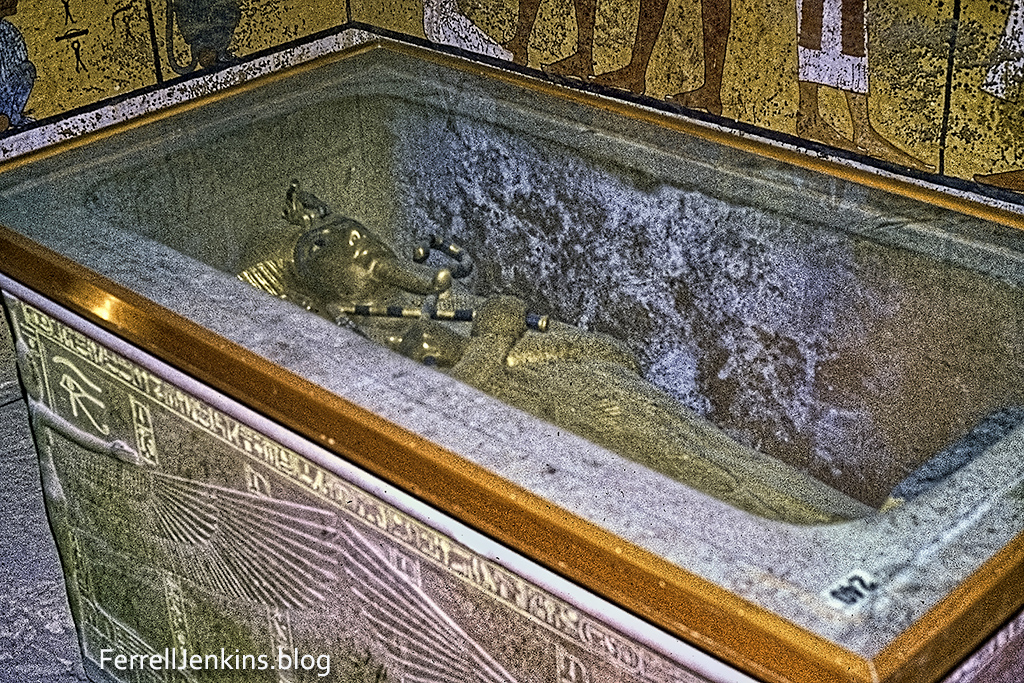
I don’t recall the first visit to Luxor and the Valley of the Kings where so many of the ancient Egyptian kings are buried. The photo that I am sharing with you today was made about 1978. Whatever the year the tomb was open to visitors. Later the tomb was closed to visitors in order to protect the ancient sarcophagus and the gold coffin of the king.
My slide was scanned by Imagers in Atlanta sometime between 1999 and 2004. I think it would be closer to the beginning date.
The granite sarcophagus of King Tut in the Valley of the Kings near Luxor. This scan made by Imagers between 1999 and 2004. Photo slide made by Ferrell Jenkins, probably about 1978.
Here is the largest wall painting showing servants of the king serving him in the afterlife. This motif is prominent in many of the tombs.
Slide converted by Imagers between 1999 and 2004/ Photo made by Ferrell Jenkins about 1978.
Bible students recall that Abraham, and later the family of Jacob, spent time in Egypt. This brings us to Moses. He lived more than a century before King Tut and could have become the son of a Pharaoh. Here is the way the writer of Hebrews describes his refusal to be called the son of Pharaoh’s daughter.
By faith Moses, when he was grown up, refused to be called the son of Pharaoh’s daughter, choosing rather to be mistreated with the people of God than to enjoy the fleeting pleasures of sin. He considered the reproach of Christ greater wealth than the treasures of Egypt, for he was looking to the reward. (Heb. 11:24-26 ESV)
The gold face mask of King Tut has been on display in the Cairo Museum every time I have visited.
The Face Mask of King Tut displayed in Cairo Museum. Photo by Ferrell Jenkins.
This is a re-post from USA Inauguration Day in 2009 and 2013.
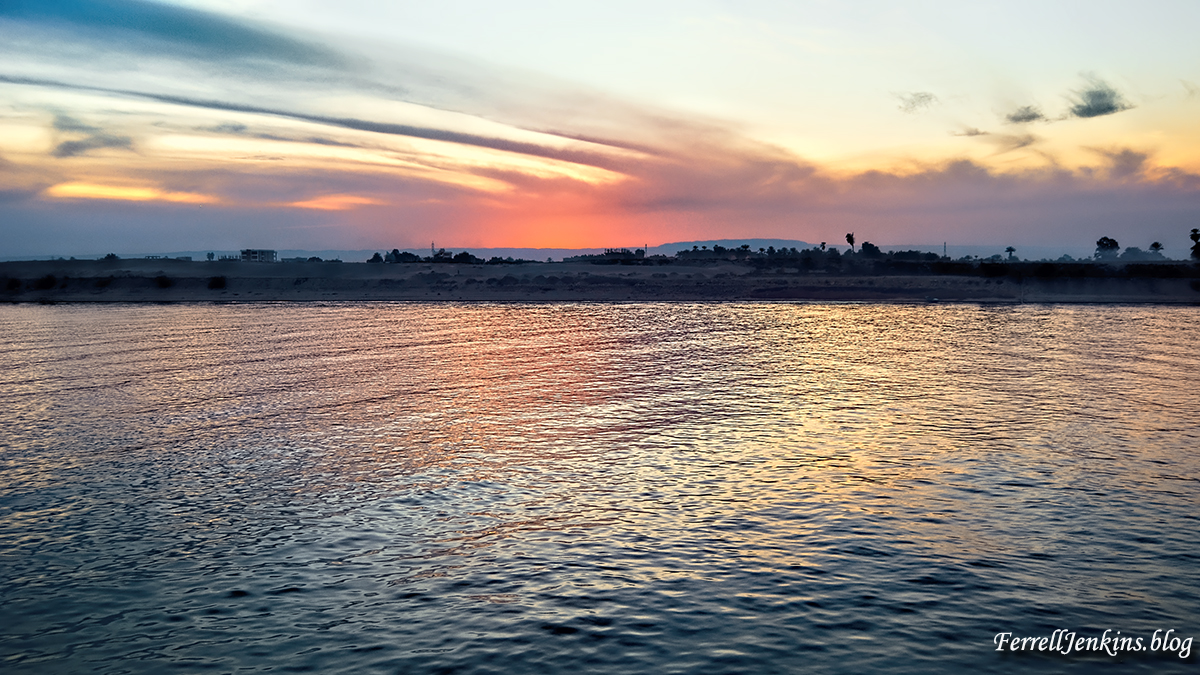
Shortly before sunset, January 20, 2009, I made a few photos of the Nile River looking toward the west bank of the river. I thought I would share this one with you.
Sunset during a Nile River cruise January 20, 2009. Photo by Ferrell Jenkins.
We are anchored on the Nile a few miles south of Luxor. From my cabin on the Tu Ya cruise boat I am watching the Al Jazeera Network live coverage of the inauguration ceremonies in Washington. The choice of the majority of voters on November 2 was not my choice, but I must say that I am proud at this moment to be an American.
The American ideal of freedom and justice for all is a noble one. Surely there are times when this ideal is not met, but it remains the dream that holds us together, many as one. The diversity of our nation is a testimony to the vitality of that dream.
The inaugural ceremony is the same whether watching it live in Washington, on Al Jezeera in Egypt, or on CBS, NBC, CNN, Fox, or one of the other networks in the United States. Well, maybe. The thing that makes the difference is the commentary afterwards and the news chosen to run underneath the live event.
Added Note: I wish to call attention to a fine article by David Diestelkamp in the recent issue of Think under the title @notmyCaesar.
Promised posts on the book of Revelation have not been forgotten but other more pressing things have consumed my time.
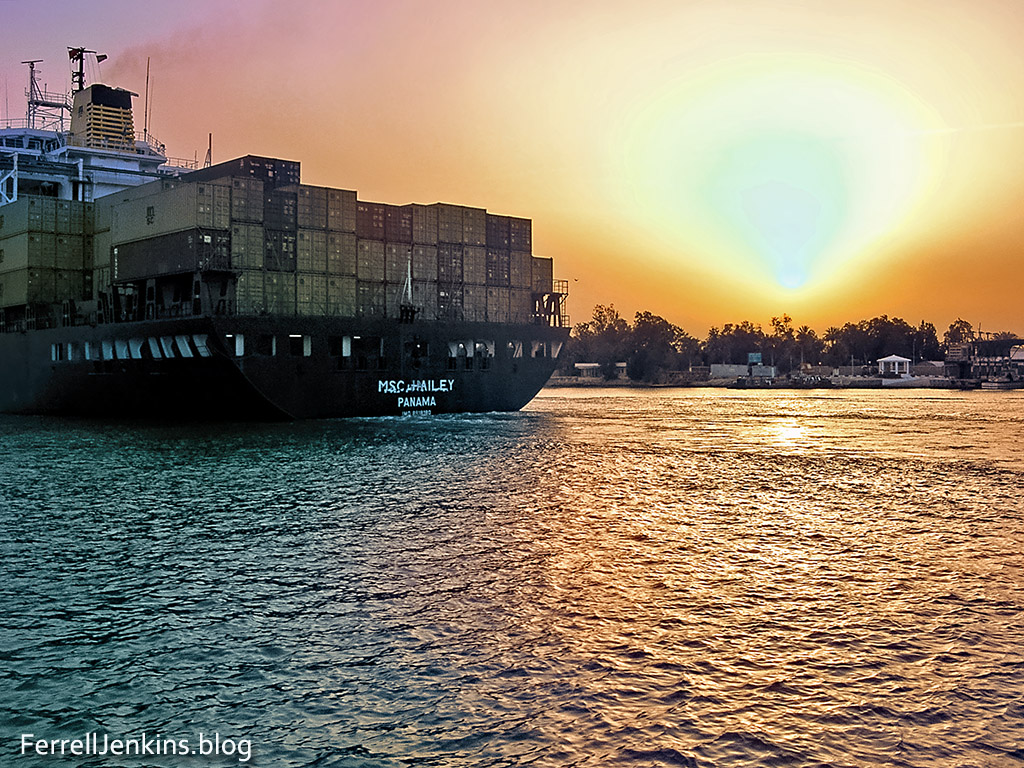
This morning I ran across some photos I made of the Suez Canal and thought I would post one of them. This photo was made from the Asia side of the Suez Canal. The view is west toward Africa. At this point the Suez Canal cuts through Lake Timsah.
Ship passing through the Suez Canal where it crosses Lake Timsah at sunset. Photo by Ferrell Jenkins.
The Suez canal connects the Mediterranean Sea with the Red Sea. After ten years of work the canal was completed in 1869.
Some scholars have suggested that the crossing by the Israelites as they left Egypt may have been in the area around Lake Timsah (through, south or north of it). Other suggestions include a site in the vicinity of Lake Ballah or the Great Bitter Lake for the crossing. We have several posts dealing with this subject. Search for Suez Canal, Great Bitter Lake, or the Exodus.
It was a day of high excitement at Carchemish in 605 B.C. when Pharaoh Neco came all the way from Egypt to this city now on the border between Syria and Turkey. On an earlier excursion from Egypt to Carchemish in 609 B.C., Neco killed Josiah, king of Judah, at Megiddo.
The map illustrating Pharaoh Neco’s trip to Carchemish is included in Bible Mapper v. 5. Click on the map to see a larger, more easily read, map.
Pharaoh Neco came to assist the Assyrians as they fought the Babylonians. But the emerging world power from the southern Euphrates city of Babylon overpowered the Assyrians and the Egyptians and sent Neco running back to Egypt. Nebuchadnezzar, king of Babylon, chased Neco to the border of Egypt.
It is still exciting at Carchemish. I have been within sight of Carchemish a few times. Military installations are clearly visible on top of the tell. The first time I was near Carchemish was in 1995. The tour operator handling my tour in Turkey advised me not to go to Carchemish (Karkamis) because it is “zero on the border” of Turkey and Syria. You may see other photos of Carchemish by using the search box with that word.
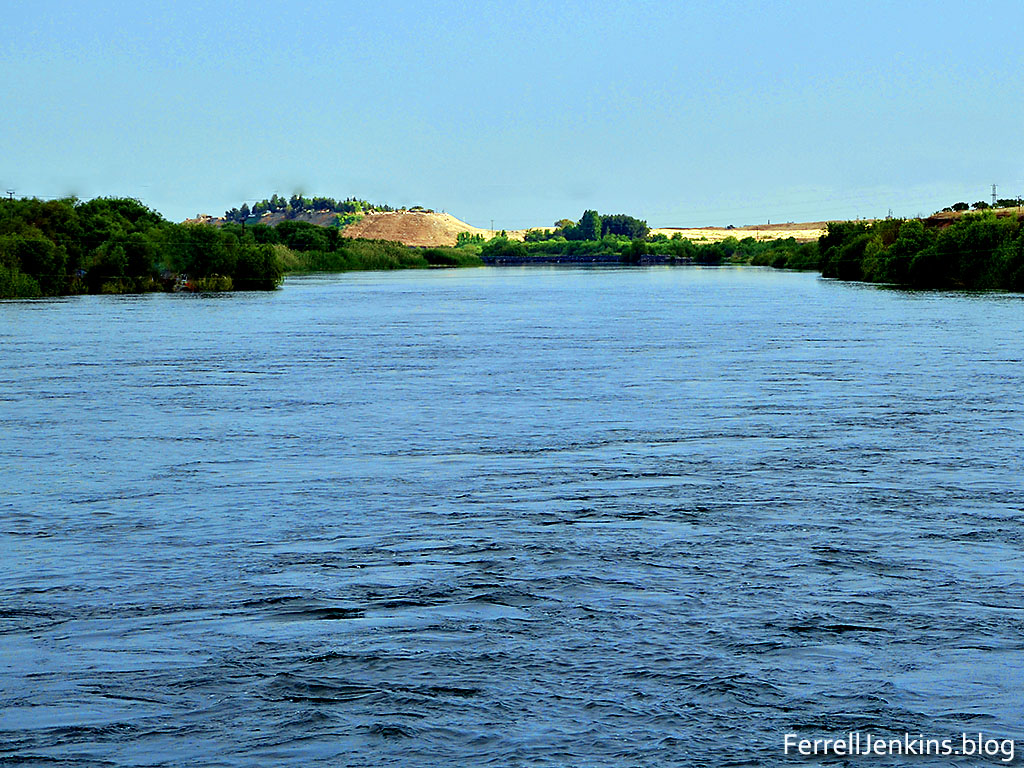
This photo was made in Turkey. The site of ancient Carchemish can be seen in the distance to the left of center. The River Euphrates makes a left turn before the mound and continues to flow into Syria and Iraq before flowing into the Persian Gulf. Photo by Ferrell Jenkins.
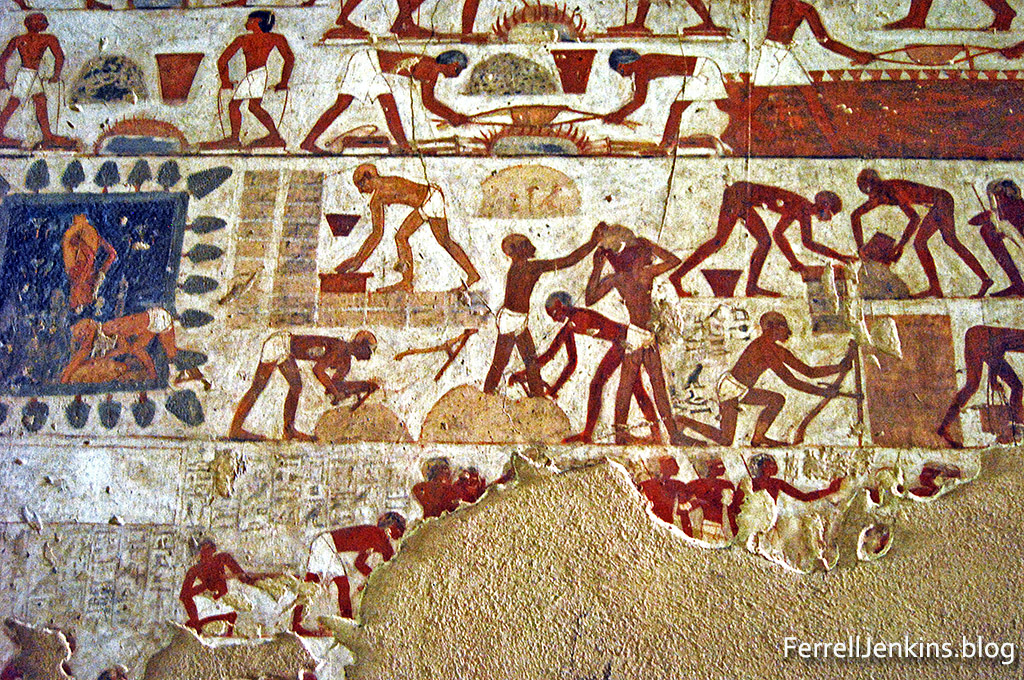
Normally I make multiple photos of any scene when possible, especially if there is a good chance I will not get a second opportunity. Our photo today is literally one of a kind. It is from the tomb of Rekhmire in the Valley of the Nobles in Egypt. While my group visited the Valley of the Kings our guide arranged transportation for me to visit this unique tomb which shows the process of brick-making in ancient Egypt.
A guard at the tomb allowed me to enter and make ONE photo. I gave him a tip of $5.00. I asked to make another photo, but he showed no interest in a second payment. This is my only photo and I was pleased with it.
Brick-making scene in the tomb of Rekhmire, Valley of the Nobles in lower Egypt..
In preparation for my tour I had enjoyed studying the Fall 2004 issue of Bible and Spade (Vol. 17 No. 4). Gary A. Byers wrote an article titled “The Bible According to Karnak.” I had become acquainted with Gary at the annual Near East Archaeological Society meetings and appreciated his work. Notice this paragraph which includes a mention of the scene above.
Also on the Nile’s west bank were the tombs of the nobles. Not being royally. they could not be buried within the Valley of Kings, the resting place of the Pharaohs they served. Within these tombs are colorful paintings of significant events in their lives. From Mena’s tomb (ca. 1385 RC) was a grain harvest scene that helps us imagine the seven years of plenty from Joseph’s time (Gn 41:47-49). The Tomb of Userhat (ca. 1280 BC) shows barbers cutting hair, also reminiscent of the Joseph story (Gn 4 1:14). From the Tomb of the Vizier Rekhmire (ca. 1470- 1445 BC) is a brickmaking and building scene depicting Asiatics from the actual period of the Israelites bondage (Ex 1:11 – 14; 5:7- 19).
We are not saying that these are Israelites, but that they are Asiatics from the same period that, according to the Bible, made brick and did other slave labor in Egypt.
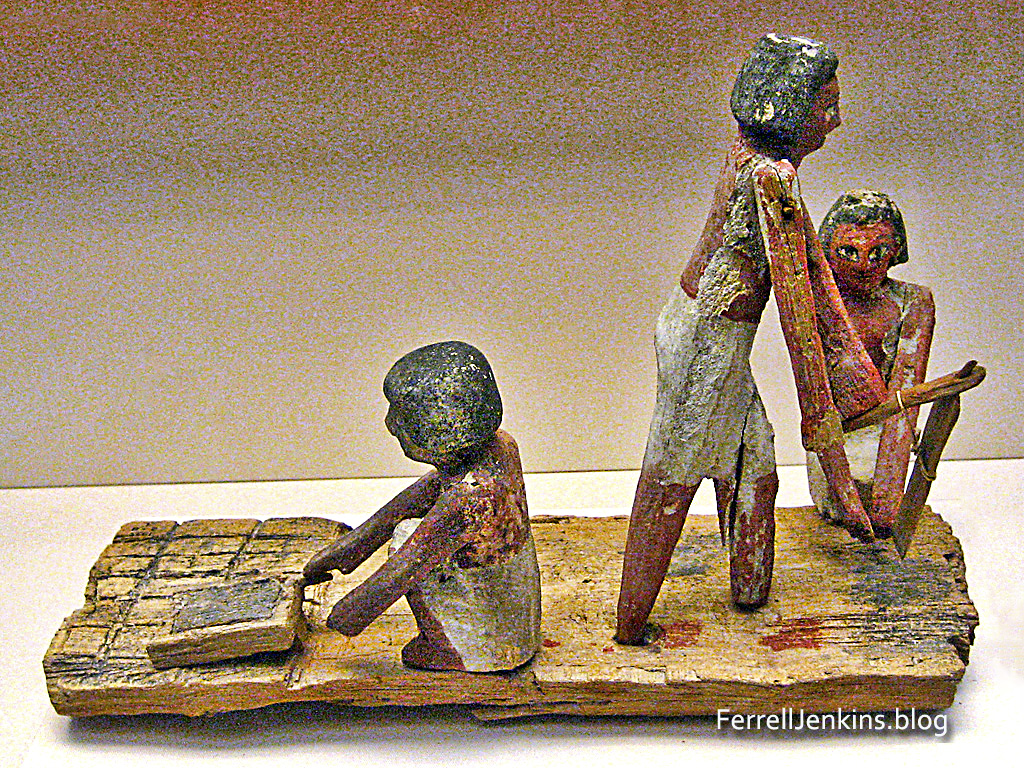
These additional photos show more examples of brick making in Egypt.
Model of brick making in ancient Egypt now displayed in the British Museum. Photo by Ferrell Jenkins.
The text mentioned in Byers’ article says,
11 Therefore they set taskmasters over them to afflict them with heavy burdens. They built for Pharaoh store cities, Pithom and Raamses.
12 But the more they were oppressed, the more they multiplied and the more they spread abroad. And the Egyptians were in dread of the people of Israel.
13 So they ruthlessly made the people of Israel work as slaves
14 and made their lives bitter with hard service, in mortar and brick, and in all kinds of work in the field. In all their work they ruthlessly made them work as slaves. (Exodus 1:11-14 ESV)
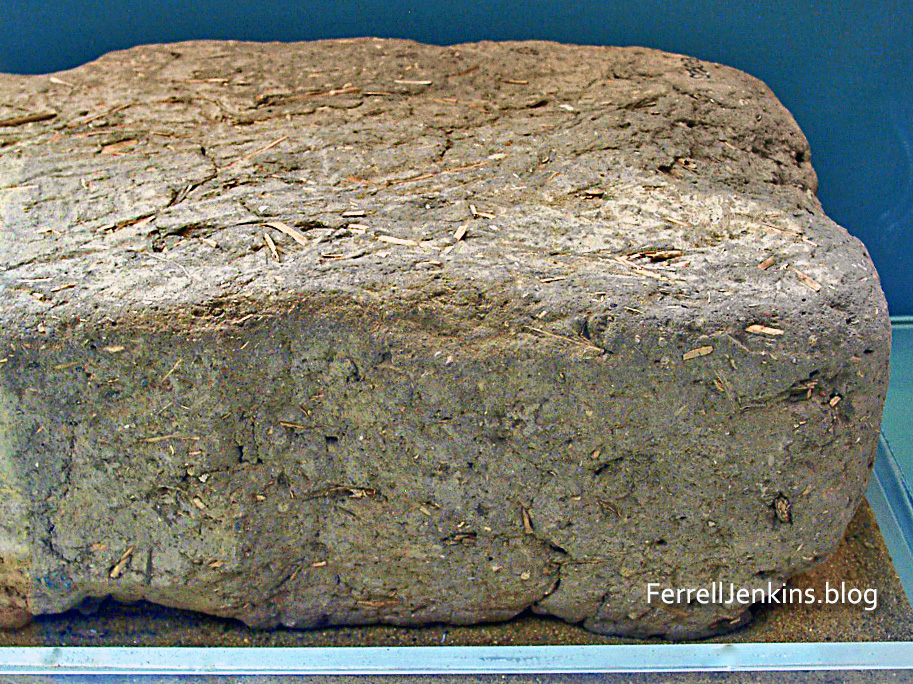
Exodus 5:7-19 specifically says that the Israelites were using straw to make brick. Our photo below, also from the British Museum, shows a brick with straw in it.
This brick from ancient Egypt was made with straw. Displayed in the British Museum. Photo by Ferrell Jenkins.
The Bible and Spade article may be located online here. There you will find a drawing showing the brick making scene as well as other types of labor.
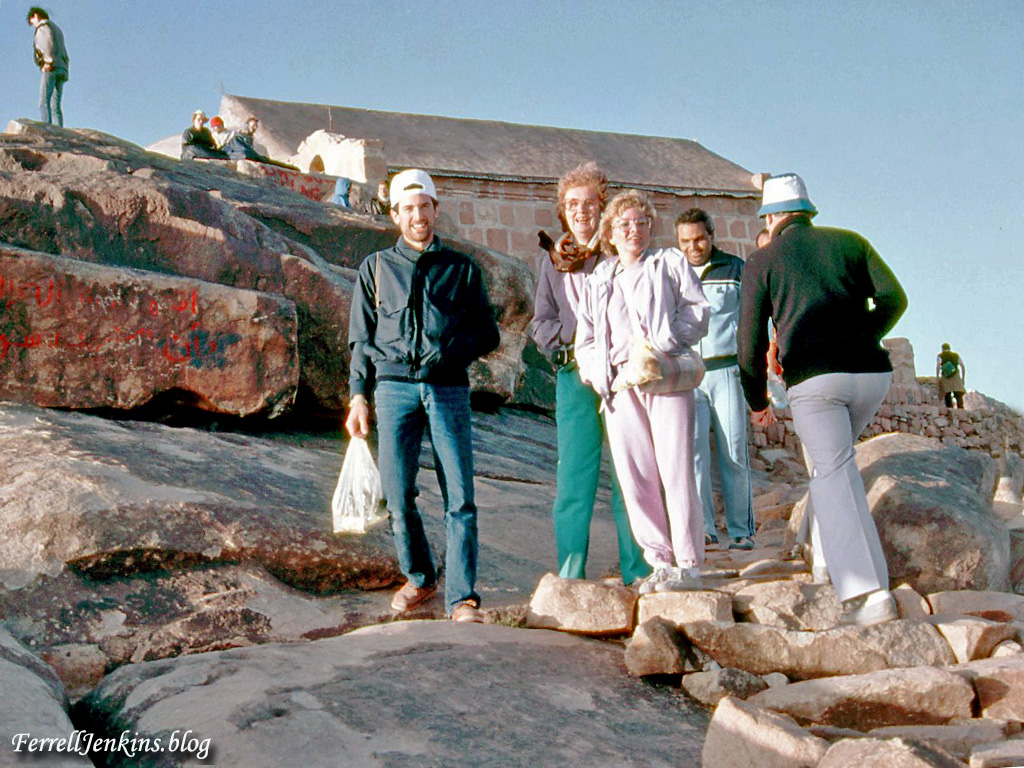
In April, 1986, arrangements were made for my travel group to leave Israel from Eilat and travel to Mount Sinai for an overnight stay. Opportunity was given for those who wished to climb the traditional mountain where Moses was given the Law (Exodus 20-24). Only four of the group chose to do so.
The peak known as Jebel Musa (Mount Moses) is thought by many to be the Mount Sinai of the Bible. Beginning at Saint Catherine’s monastery it takes about two hours and thirty minutes to climb to the top where the elevation is more than 7,500 feet. We began at 3:05 a.m. and made it to the top in time to see the sunrise. After thirty minutes of rest and meditation we made it back to the monastery in about two hours.
Three tour members who climbed the traditional Mount Sinai with me April 10, 1986. Tour members left to right: Mark Dunagan (Oregon), Lillian Price (Indiana), Gloria Spurgeon [Land] (Texas). Samir Kamel (in gray behind Gloria) is the Egyptian escort for the Nawas Travel Company who came from Cairo to meet us, climbed the mountain with us.He was later appointed the general manager of the Cairo office. Slide photo by Ferrell Jenkins.
On the summit is an Orthodox Chapel of the Holy Trinity, built in 1934 on ruins of a 4th-century Byzantine church. It is said to have been built over the rock from which God took the tablets of stone and its interior is decorated with frescoes of the life of Moses.
For more information about Mount Sinai see our Index: Route of the Exodus and the Location of Mount Sinaihere.
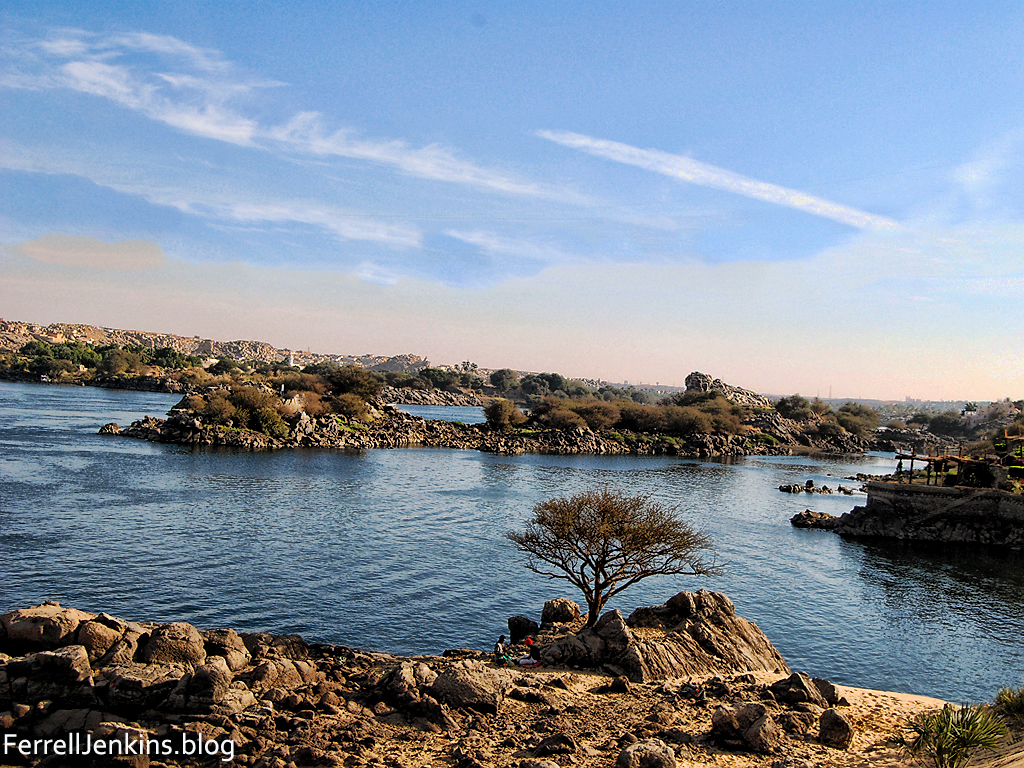
The first cataract of the Nile River is at Aswan, Egypt. Aswan is identified with Syene in Ezekiel 29:10, and with the Sinim of Isaiah 49:12. This cataract provided a natural boundary between Egypt to the north and Cush to the south. It was impossible for large boats to traverse this region of the Nile.
The first cataract of the Nile River at Aswan, Egypt. Photo by Ferrell Jenkins.
The Bible records that King David provided materials for a proposed temple in Jerusalem before his death.
…and cedar timbers without number, for the Sidonians and Tyrians brought great quantities of cedar to David. (1 Chronicles 22:4 ESV; see verses 1-5)
The cedars were floated from Lebanon to Joppa for Solomon’s Temple (2 Chronicles 2:16).
Hiram, king of Tyre, built a cedar house for David (2 Samuel 5:11; 7:2).
Solomon requested that Hiram have cedars of Lebanon cut for him (1 Chronicles 22:7).
Cedars from Lebanon again were floated to Joppa for the rebuilding of the temple (520-516 B.C.; Ezra 3:7).
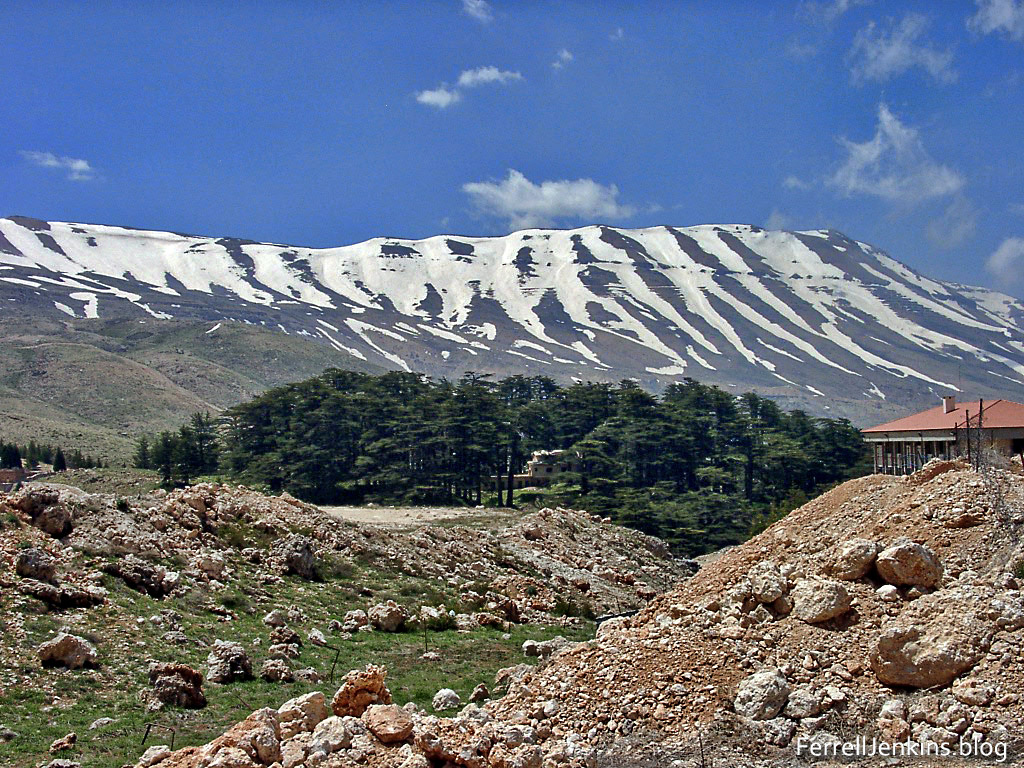
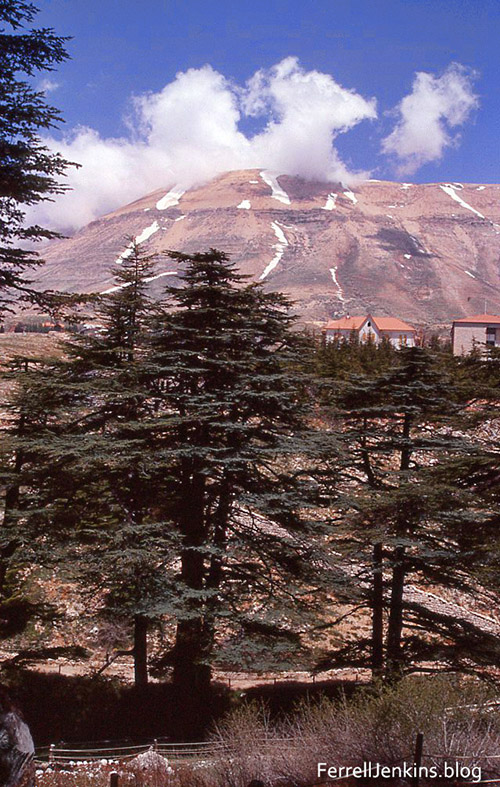
Only a few of the fabled cedars remain in Lebanon. One cluster of trees grow at Besharre in the north of Lebanon at an elevation of about 5000 feet or more above sea level. Our photo below was made in May, 2002, when there was some snow still on the surrounding mountains.
A view of the clump of cedars at Besharre, Lebanon. Photo by Ferrell Jenkins.
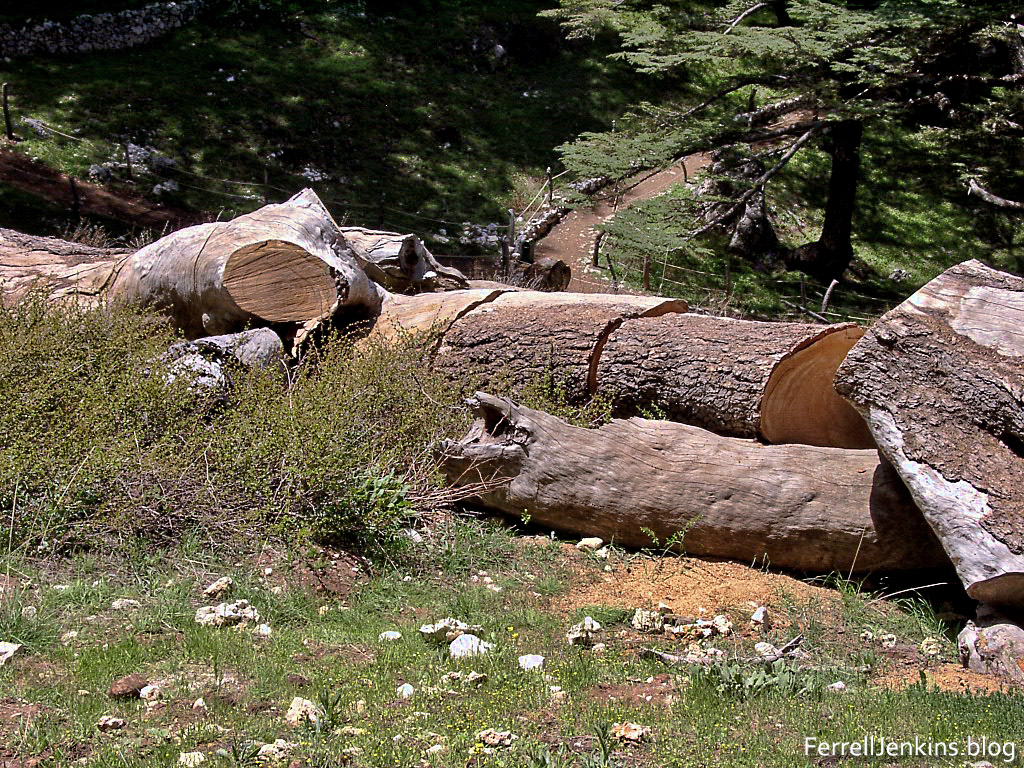
The cedars in Lebanon are now protected and may be cut for the wood only when a tree has fallen.
A fallen cedar at Besharre in northern Lebanon. Photo by Ferrell Jenkins.
The Cedrus libani is described in Fauna and Flora of the Bible.
The enthusiasm with which the OT writings praise the cedar of Lebanon is understandable. It is a majestic tree of great beauty, reaching 27 m [88 ft.] in height and 12 m [39 ft.] in girth. Its long branches spread out horizontally from the trunk, and the leaves are dark and evergreen, glittering like silver in the sun. The cones take three years to mature. The fragrant wood is much sought after for building purposes, as it does not easily rot. Its great value as timber is often mentioned, especially in the history of King Solomon. (p. 108)
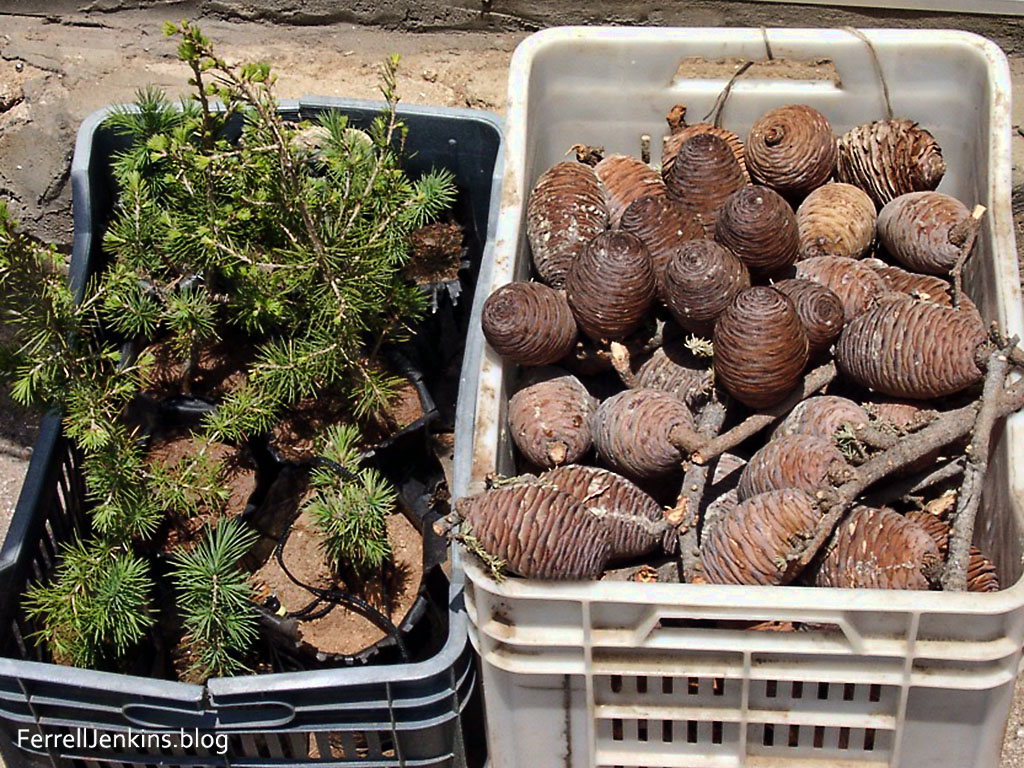
Small potted plants and cones from the cedars of Lebanon. Photo by Ferrell Jenkins.
The next photo illustrates how the branches “spread out horizontally from the trunk.” This tree is different from the cedars so many of us have enjoyed for Christmas trees.
A few of the Cedars of Lebanon at Besherre. Photo by Ferrell Jenkins.
Not so many of the cedars remain because various nations have used them in buildings projects.
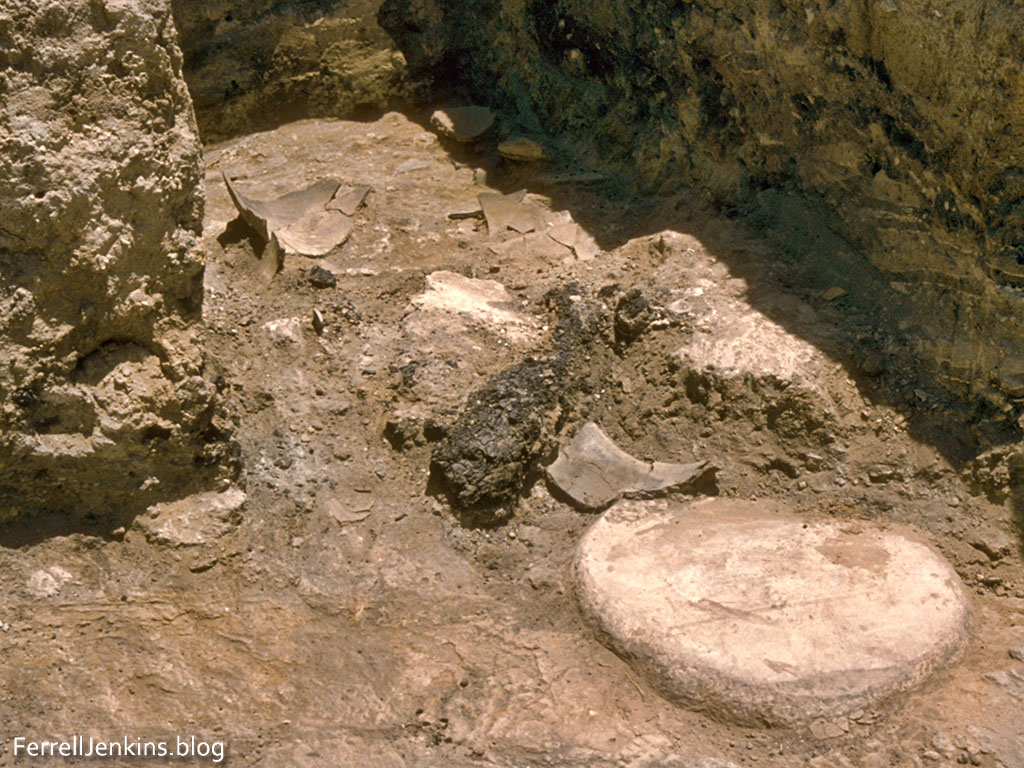
We have an example in a temple from the Late Bronze Age, a period of Egyptian control at Lachish. The description of the temple by David Ussishkin is fascinating, but I must concentrate on two things. Several charred beams were found on the floor of the building. Ussishkin says,
The roof was spanned by long wooden beams laid parallel to one another across the main hall. Their charred remains, identified as cedar of Lebanon, were found lying on the floor; altogether, remains of about ten beams could be detected along the southern part of the hall… (Ussishkin, David. “Excavations at Tel Lachish – 1973-1977.” Tel Aviv 5:1-2 (1978): 1-97: 13.
This temple is also designated as the Acropolis Temple. Information about it, including a plan and reconstruction drawings are found in Ussishkin, Biblical Lachish, pp. 140-164.
In our photo below that I made in 1980 only one piece of wood remains (in the center of our photo).
Charred beam made of Cedar of Lebanon in the Egyptian-period temple at Lachish. Photo by Ferrell Jenkins, 1980.
Notice the column base. Two of these were found in the temple. The scholars who analyzed the carbonized beams with a diameter of about 30 cm [12 inches]. Cedar trunks of that diameter could have been 14 metres [45 feet] or longer, and thus easily capable of spanning the ceiling across the main hall without additional support (Usshishkin, Excavations).
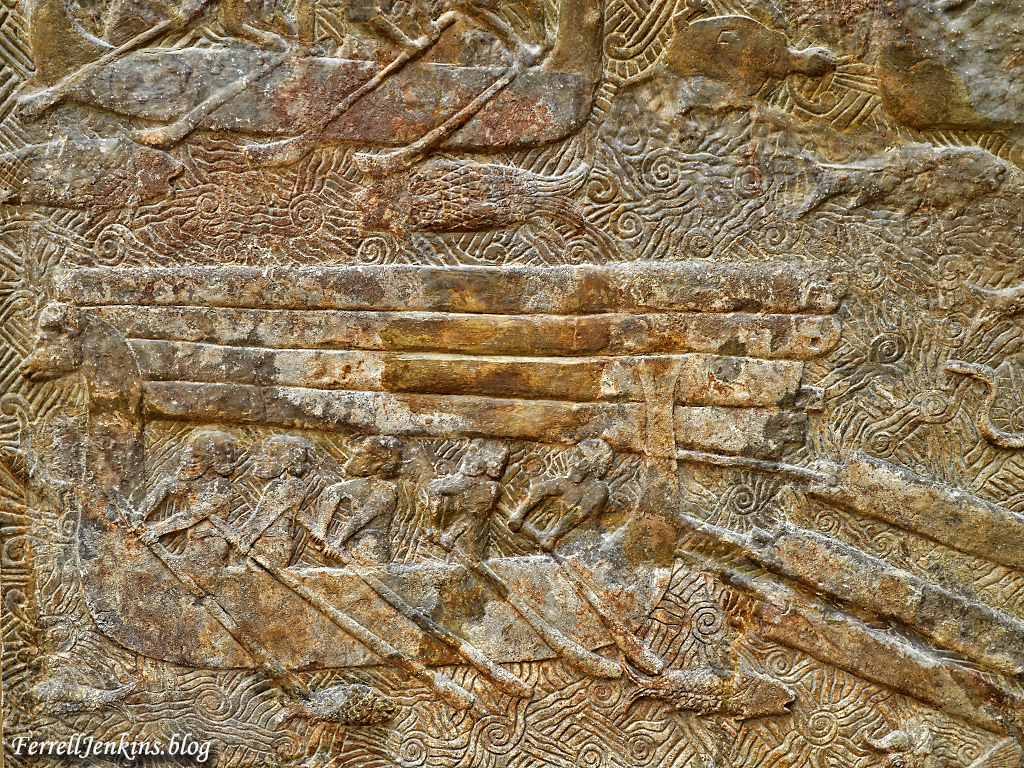
Ancient nations used the cedar of Lebanon for their boats and buildings. Several panels are displayed in the Louvre showing boats transporting logs of cedars of Lebanon for use in the palace of Sargon. Our photo shows a small portion of one panel.
Assyrians transporting cedar of Lebanon for their buildings. Period of Sargon II (721-705 BC). Louvre. Photo by Ferrell Jenkins.






 Ferrell's Travel Blog
You must be logged in to post a comment.