Category Archives: Culture

Memphis in Egypt

This morning, after a period of worship, we visited the ruins of ancient Memphis. The prophet Ezekiel has this to say about Memphis.

This is what the sovereign LORD says: I will destroy the idols, and put an end to the gods of Memphis. There will no longer be a prince from the land of Egypt; so I will make the land of Egypt fearful.  (Ezekiel 30:13)

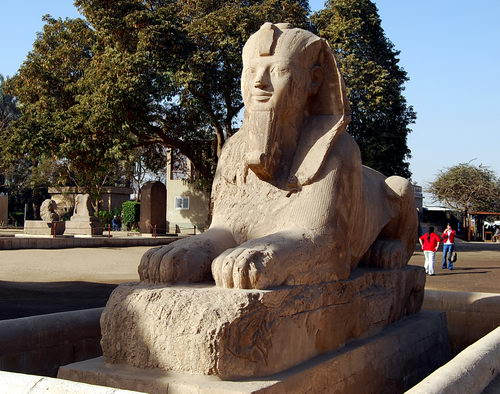
The alabaster sphinx of Rameses II  (13th century B.C.) is one of the nicest pieces on display at the site. It is also one of the few artifacts to be seen. The prophecy has surely come to pass.

Alabaster sphinx of Rameses II at Memphis. Photo by Ferrell Jenkins.

Alabaster sphinx of Rameses II at Memphis. Photo by Ferrell Jenkins.

Next we moved to the edge of the desert to visit the tomb of a Nobleman dating to about 2400 B.C., and the Step Pyramid of Zoser.

After lunch we returned to Old Cairo to spend some time in the Coptic Museum and the Abu Sarga church. This is the church associated with the visit of Mary, Jopseph, and Jesus to Egypt (Matthew 2).

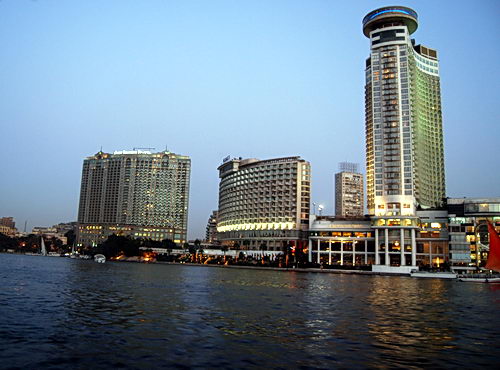
The last event of the day, and of the tour, was a felucca ride on the Nile River. The large buildings of down town Cairo are beautiful after sunset.

Cairo on the Nile at Night. Photo by Ferrell Jenkins.

Cairo on the Nile at Night. Photo by Ferrell Jenkins.

Visiting the Valley of the Kings

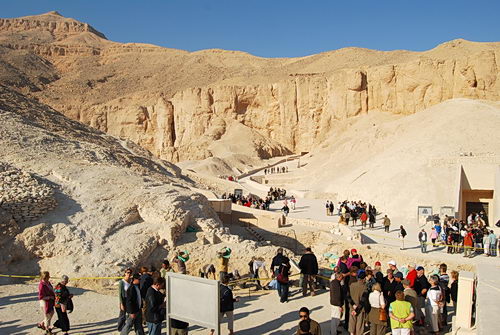
While at Luxor we visited the Valley of the Kings. This is where the Pharaoh’s of the New Kingdom Period of Egyptian history are buried. There are no pyramids during this periods, but at least sixty four tombs are known in the Valley of the Kings. Our group visited two or three.

The Valley of the Kings is located on the West Bank of the Nile River a short distance from the Nile valley.

The Valley of the Kings. Photo by Ferrell Jenkins.

The Valley of the Kings. Photo by Ferrell Jenkins.

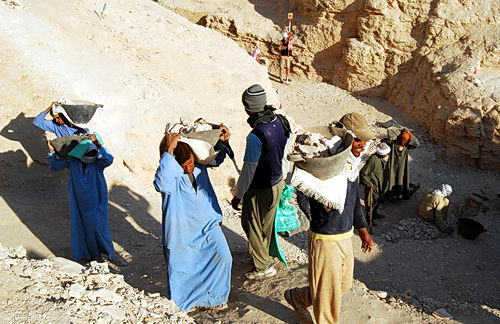
New archaeological excavations continue in the Valley of the Kings. It was fascinating to see workers carrying buckets filled with debris. This is reminiscent of old photos of workers in Mesopotamia or Palestine in the early nineteenth century. Beginning with the excavation of Masada by Yigal Yadin, volunteers are used. Students often pay their own transportation, room and board, to work on a dig. It is a form of educational slavery, one might say.

Workers at archaeologicaly site in the Valley of the Kings. Photo by Ferrell Jenkins.

Workers at archaeological site in the Valley of the Kings. Photo by Ferrell Jenkins.

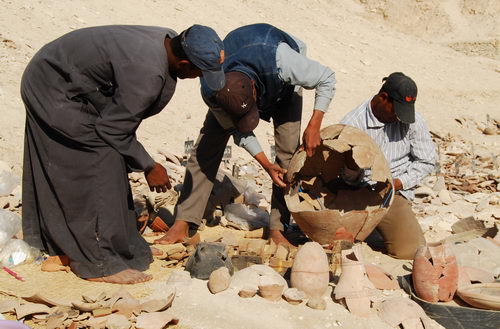
Some archaeologists were busy surveying. Others were photographing small items. I saw four individuals washing and restoring broken pottery.

Pottery reconstruction in the Valley of the Kings. Photo by Ferrell Jenkins.

Pottery reconstruction in the Valley of the Kings. Photo by Ferrell Jenkins.

Travel can be exciting and educational.

Thoughts on the Nile during the Inauguration

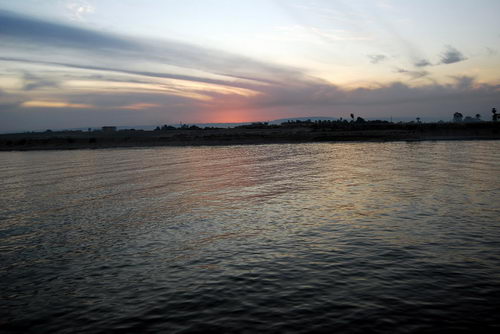
Shortly before sunset I made a few photos of the Nile River looking toward the west bank of the river. I thought I would share this one with you.

Sunset on the Nile. Photo by Ferrell Jenkins.

Sunset on the Nile. Photo by Ferrell Jenkins.

We are anchored on the Nile a few miles south of Luxor. From my cabin on the Tu Ya cruise boat I am watching the Al Jazeera Network live coverage of the inauguration ceremonies in Washington. The choice of the majority of voters on November 2 was not my choice, but I must say that I am proud at this moment to be an American.

The American ideal of freedom and justice for all is a noble one. Surely there are times when this ideal is not met, but it remains the dream that holds us together, many as one. The diversity of our nation is a testimony to the vitality of that dream.

The inaugural ceremony is the same whether watching it live in Washington, on Al Jezeera in Egypt, or on NBC, CNN, Fox, or one of the other networks in the United States. Well, maybe. The thing that makes the difference is the commentary afterwards and the news chosen to run underneath the live event.

More illustrations of apocalyptic imagery

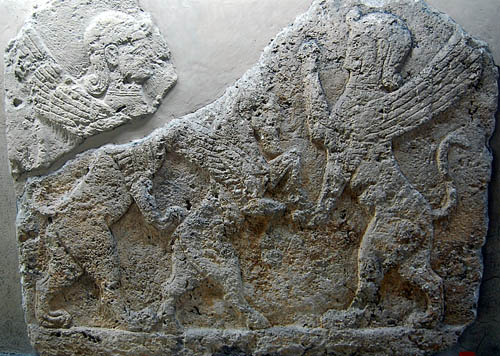
We mentioned in earlier posts on apocalyptic literature that composite images were common among the Assyrians, Babylonians, and Persians. This was also true of the Hittites who lived in the upper Euphrates area. The Anatolian Civilization Museum at Ankara contains many of the reliefs from Carchemish on the Euphrates. The one below shows two human-headed sphinx standing. There is also a winged horse standing between them. They appear to be dancing.

Human-headed sphinxs standing; winged horse standing. Photo by F. Jenkins.

Human-headed sphinx standing; winged horse standing. Photo by F. Jenkins.

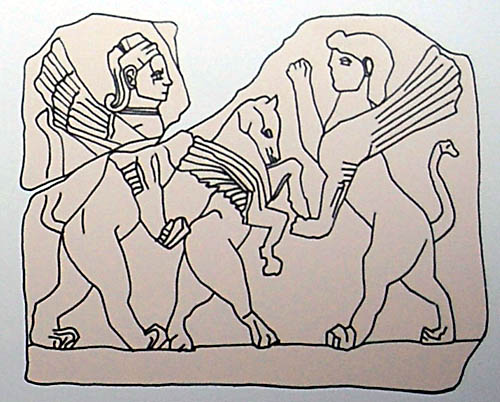
This drawing from the Museum may show the image more clearly. Notice the bird head on the tail of the sphinx on the right.

Drawing of the human-headed sphinx and standing horse.

Drawing of the human-headed sphinx and standing horse.

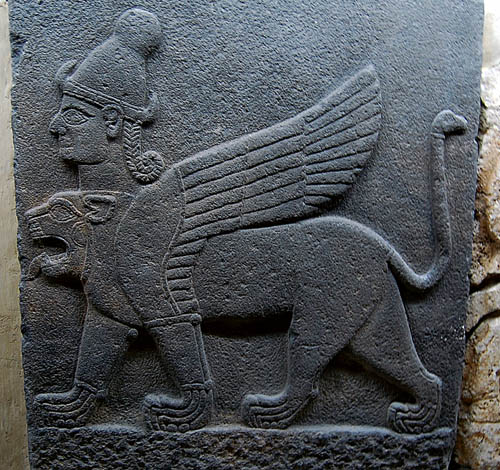
This one is of special interest. It shows a lion with wings and a human head.  The tail shows the head of a bird. There are four images in composite form. This basalt orthostat also comes from Carchemish.

Three-headed sphinx.

Three-headed sphinx.

Judeans who were taken captive to Babylon traveled in this region on their way to their place on the Chebar (Kebar) River in southern Mesopotamia. We know that Nebuchadnezzar made his headquarters at Riblah in the land of Hamath. Because this region was part of the Fertile Crescent we can be sure that the Judeans traveled in the area on their long trip from Judea to Babylon. See 2 Kings 25:6-7.

We are not saying that Ezekiel borrowed his composite creatures from the culture around him. We are saying that such was common and that it would not have been unusual or strange to Ezekiel or his hearers/readers.

Notice, again, Ezekiel’s description of the creatures he saw:

These are the living beings that I saw beneath the God of Israel by the river Chebar;  so I knew that they were cherubim.  Each one had four faces and each one four wings, and beneath their wings was the form of human hands.  As for the likeness of their faces, they were the same faces whose appearance I had seen by the river Chebar. Each one went straight ahead. (Ezekiel 10:20-22 NASB)

For the images in the book of Daniel we could show numerous composite creatures from Babylon.

A New Year’s poem by my favorite author

The New Leaf

He came to my desk with quivering lip —
The lesson was done.
“Dear Teacher. I want a new leaf he said,
“I have spoiled this one.”
I took the old leaf, stained and blotted
And gave him a new one, all unspotted,
And into his sad eyes smiled;
“Do better now, my child!”

I went to the Throne with a quivering soul —
The old year was gone.
“Dear Father, hast Thou a new leaf for me?”
“I have spoiled this one.”
He took the old leaf, stained and blotted
And into my sad heart smiled:
“Do better now, my child!”

This poem has been among my sermon notes for many years. It is one of those numerous good illustrations that have come down to us from Anonymous or Author Unknown.

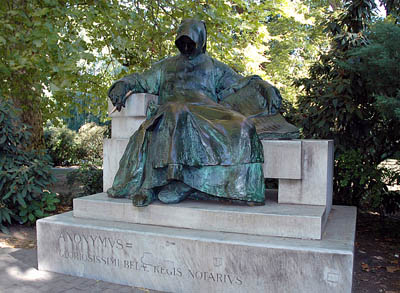
In Budapest, Hungary, near the entrance of Vajdahunyad Castle, there stands a statue of Anonymous by Miklos Legeti. The statue commemorates a 12th or 13th century unknown chronicler of one of the several rulers named King Bela.

Statue of Anonymous in Budapest. Photo by Ferrell Jenkins.

Statue of Anonymous in Budapest. Photo by Ferrell Jenkins.

The next time you quote him you will do so with knowledge of what he looked like.

Satellite imagery reveals Egyptian ruins

CNN has a report on the use of satellites to help unearth ancient Egyptian ruins. Read the full article here. The report features the work of Sarah Parcak, an archaeologist at the University of Alabama at Birmingham.

In our society we tear down anything that is a decade or more old in order to build a new structure. Except, of course, for our historical districts. It wasn’t that way in the ancient world. If a structure was destroyed or ravaged, the conquerors might build a new one in the same place. They would build over and utilize any walls still standing.

Building in ancient Egypt was along the Nile River and in the Delta. Much of what shows as Egypt on a modern map is not currently habitable. Eighty two million people live in this small space, according to the CNN report. When I took my first group to Egypt in 1967 we were told that the population was 40 million. Even then it seemed crowded; now it is terrible.

Here are a few comments about Parcak’s work:

In this field, Parcak is a pioneer. Her work in Egypt has yielded hundreds of finds in regions of the Middle Egypt and the eastern Nile River Delta.

Parcak conducted surveys and expeditions in the eastern Nile Delta and Middle Egypt in 2003 and 2004 that confirmed 132 sites that were initially suggested by satellite images. Eighty-three of those sites had never been visited or recorded.

In the past two years, she has found hundreds more, she said, leading her to amend an earlier conclusion that Egyptologists have found only the tip of the iceberg.

“My estimate of 1/100th of 1 percent of all sites found is on the high side,” Parcak said.

And here are some comments made by Parcak about the value of the satellite images:

“We can see patterns in settlements that correspond to the [historical] texts,” Parcak said, “such as if foreign invasions affected the occupation of ancient sites.

“We can see where the Romans built over what the Egyptians had built, and where the Coptic Christians built over what the Romans had built.

“It’s an incredible continuity of occupation and reuse.”

The flooding and meanders of the Nile over the millennia dictated where and how ancient Egyptians lived, and the profusion of new data has built a more precise picture of how that worked.

“Surveys give us information about broader ancient settlement patterns, such as patterns of city growth and collapse over time, that excavations do not,” said Parcak, author of a forthcoming book titled “Satellite Remote Sensing and Archaeology.”

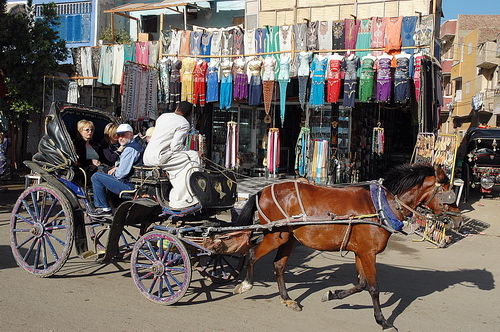
In every town along the Nile in Upper Egypt (the south) buildings crowd the river. This scene is from Edfu.

Shops at Edfu in Upper Egypt. Photo by Ferrell Jenkins.

Shops at Edfu in Upper Egypt. Photo by Ferrell Jenkins.

McGarvey’s Land of the Bible

J. W. McGarvey was one of the best scholars of the 19th century Restoration Movement. He was president of the College of the Bible in Lexington, KY. One of my first books was his practical New Commentary on Acts of Apostles (1892). He had earlier (1868) written A Commentary on Acts of Apostles dealing with some of the critical issues of the book. McGarvey addressed some of the critical questions of the day in The Authorship of Deuteronomy, Jesus and Jonah, and Biblical Criticism.

McGarvey visited Palestine in 1879. His former students paid for the trip [I like that!], with the understanding that he would write a book. They would get their money back from the sale of the book. His book, Lands of the Bible, was published by J. B. Lippincott & Co., London and Philadelphia, in 1881. The title page indicates that 15,000 copies were printed. Impressive for a book on that subject.

J. W. McGarvey’s Lands of the Bible is available at the Restoration Movement pages here. For other works by McGarvey and other Restoration leaders begin with the home page here.

When I led my first group to the Bible Lands in 1967, one friend in the group had studied McGarvey’s book carefully. He took a tape measure with him. When we came to certain sites he took out the tape to take measurements. He wanted to be sure he was at the same place McGarvey visited.

Chapter IX in McGarvey’s book is titled “Argument from the Agreement of the Land and Book.” I have an outline of this material in my Introduction to Christian Evidences [OP], and use some of this material in my Daily Life in Bible Times series. One would be mistaken not to move beyond McGarvey, Thompson, Robertson, and the other early explorers. On the other hand, it would be amiss to dismiss what these scholars wrote.

What prompted all of this? Todd Bolen recently wrote a post on The Acoustics of Mounts Gerizim and Ebal in which he quotes from one of McGarvey’s letters here. I urge you read his post now. Also follow the link to the Biblical Studies and Technology Tools post showing the valley between Ebal and Gerizim using digital mapping tools.

I wanted to contribute something to this study by including here a scan of the plate from my original edition of Lands of the Bible (opposite page 288).
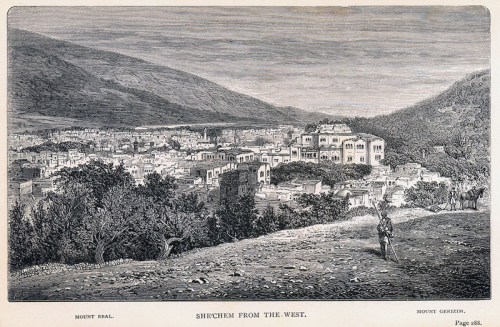
Shechem from the West. McGarvey, Land of the Bible.

Shechem from the West. McGarvey, Land of the Bible.

Todd Bolen has a great photo of Mount Ebal from Mount Gerizim. I would like to add the other side of the valley. Here is a photo showing Mount Gerizim from above Mount Ebal. It is an aerial shot made for me by the well known photographer Zev Radovan.
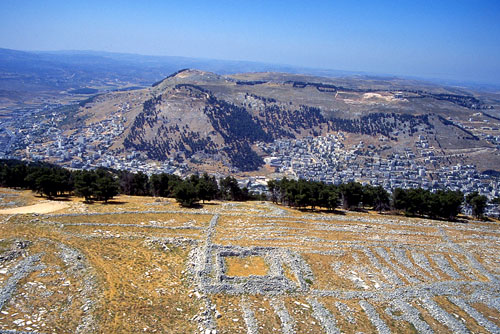
View of Mount Gerizim from above Mount Ebal.

View of Mount Gerizim from above Mount Ebal.

Maybe later we will discuss some of the important biblical events that took place in this area. For not let us note that this is where the blessings and curses of the law were read after the children of Israel entered the promised land (Deuteronomy 11:19). Here is the account of that event:

All Israel with their elders and officers and their judges were standing on both sides of the ark before the Levitical priests who carried the ark of the covenant of the LORD, the stranger as well as the native. Half of them stood in front of Mount Gerizim and half of them in front of Mount Ebal, just as Moses the servant of the LORD had given command at first to bless the people of Israel. Then afterward he read all the words of the law, the blessing and the curse, according to all that is written in the book of the law.  There was not a word of all that Moses had commanded which Joshua did not read before all the assembly of Israel with the women and the little ones and the strangers who were living among them. (Joshua 8:33-35 NASB)

Museum exhibitions

Babylon: Myth and Reality runs until March 15, 2009, at the British Museum in London. Details, along with videos and photos available here. This exhibition brings together artifacts from the British Museum, Berlin, the Louvre, and other museums. If you have an opportunity to go, be sure to download our brief list of Some Biblically Related Artifacts in the British Museum here.

Tutankhamun and the Golden Age of the Pharaohs runs through May 17 at the Dallas [Texas] Museum of Art. Details here.

Tutankhamun: The Golden King and the Great Pharaohs runs through May 22 at the Civic Center in Atlanta, Georgia. Details here.

The Michael C. Carlos Museum at Emory in Atlanta has an exhibition called Wonderful Things: The Harry Burton Photographs and the Discovery of the Tomb of Tutankhamun. It runs through May 25. Details here.

Excavating Egypt is a major exhibition from the Petrie Museum of Egyptian Archaeology. This exhibition runs at the University of Kentucky, Lexington, from March 14 through June 14, 2009. Details here.

We wrote of a King Tut exhibition in Vienna, with a nice photo, here.

Pompeii and the Roman Villa (Art and Culture Around the Bay of Naples) continues at the National Gallery of Art in Washington, D.C. through March 22. Details here. Videos, audios, and other material online.

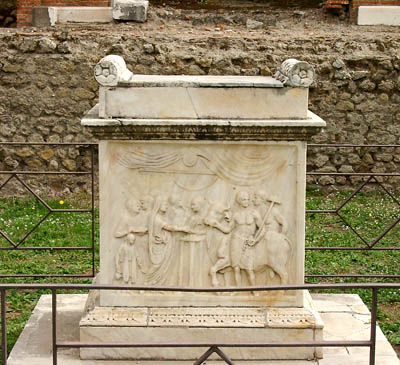
The photo below is one I made in 2001 of the altar at the Temple of Vespasian at Pompeii. Vespasian was the Roman general who led the attack on the Jewish rebels beginning in A.D. 66. Upon learning of the death of Nero he headed back to Rome. Later he became Emperor. Pompeii was covered with volcanic ash in A.D. 79. This altar shows a sacrificial scene.

Sacrificial altar, Temple of Vespasian, Pompeii. Photo by Ferrell Jenkins.

Sacrificial altar, Temple of Vespasian, Pompeii. Photo by Ferrell Jenkins.

Art and Empire: Treasures From Assyria in the British Museum continues through January 4 at the Museum of Fine Art in Boston. Details here. We wrote about visiting this exhibition here.

Most of these exhibition are listed in the Nov./Dec. 2008 issue of Saudi Aramco World.

It’s snowing

I see that WordPress has it snowing across my page this morning. Guess the computer didn’t take into account that I live in Florida. Enjoy the snow.

Travel is fun

One of the perils of travel is dealing with the hawkers. There is the guy who approaches a person with a Nikon Digital SLR trying to sell him postcards of the monument he just photographed. I remember a boy in Damascus in 1967 hawking those little inlaid boxes for “Just one lousy American dollar.” We were on a boat taking the canal tour in Bangkok when suddenly a boy comes up out of the dirty water into the moving boat.

Egypt is probably the worst place for hawkers. One thing is for sure. If you ever take an item in your hand it will be difficult to get rid of it. You may say, “I don’t need that.” He say, “Why you no need this?”

I like this refreshing sign in a shop at Ephesus. No doubt here!

Genuine fake watches in a shot at Ephesus. Photo by Ferrell Jenkins.

Genuine fake watches in a shop at Ephesus. Photo by Ferrell Jenkins.