Category Archives: Culture

The shepherd and his sheep

Scenes typical of biblical times are common Jordan, Turkey, and portions of the West Bank of Palestine today. There are some differences, of course.

We were traveling between Diyarbakir and Sanliurfa, Turkey, in early June. Several farmers were harvesting their grain using modern combines.
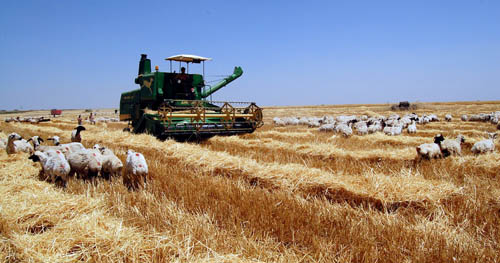
Harvesting grain in Eastern Turkey. Photo by Ferrell Jenkins.

Harvesting grain in Eastern Turkey. Photo by Ferrell Jenkins.

As quickly as the combine passed by, the shepherds brought in the sheep to feed.

The sheep/shepherd analogy was used by Jesus to describe His relationship to His disciples.

I am the good shepherd. The good shepherd lays down his life for the sheep. (John 10:11 ESV)

When Paul spoke to the elders of the Ephesian church he instructed them “to shepherd the church of God” (Acts 20:28 NAS). I note that the ESV uses the term care instead of shepherd to translate the Greek poimaino. That certainly conveys the right idea.
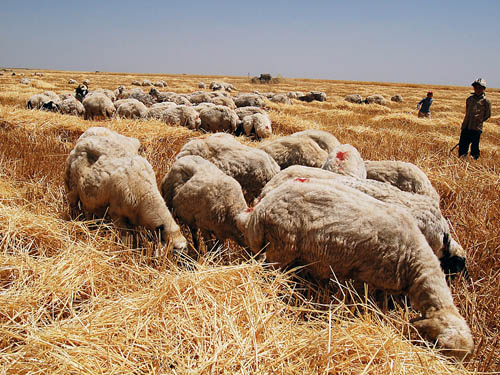
Shepherds care for their sheep in Eastern Turkey. Photo by Ferrell Jenkins.

Shepherds care for their sheep in Eastern Turkey. Photo by Ferrell Jenkins.

Peter instructed elders to “shepherd the flock of God among you” (1 Peter 5:2). The NET Bible says, “Give a shepherd’s care to God’s flock among you.” Lest these men who have been appointed to this work be elevated in their own importance, Peter added,

And do not lord it over those entrusted to you, but be examples to the flock. (1 Peter 5:3 NET)

not domineering over those in your charge, but being examples to the flock. (1 Peter 5:3 ESV)

J. B. Phillips, in his translation of this text, used a vivid phrase to illustrate the overreaching of some elders:

You should aim not at being “little tin gods” but as examples of Christian living in the eyes of the flock committed to your charge. And then, when the chief shepherd reveals himself, you will receive that crown of glory which cannot fade.

Ireland and St. Patrick

Thoughts turn toward the Emerald Isle on St. Patrick’s Day, especially for those with Irish roots. The truth about St. Patrick is shrouded in Irish mist. He is said to have brought Christianity to Ireland, perhaps in the latter part of the fifth century.

I do not celebrate St. Patrick’s day, but for whatever good he may have done I am thankful. I thought this would be a good opportunity to share a photo from Ireland with you.

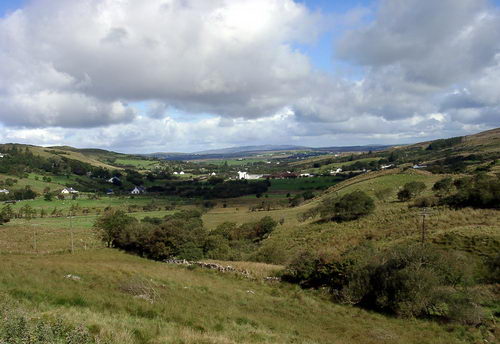
Ireland is a beautiful place to visit. The photo below of Finn Valley was made near Donegal Bay. The area is noted for beautiful hills, a magnificent coastline, majestic mountains, deep glens, and shimmering lakes.

Ireland's Finn Valley. Photo by Ferrell Jenkins.

Ireland's Finn Valley. Photo by Ferrell Jenkins.

One branch of my family came from County Wicklow on the south eastern side of the island.

Happy Birthday to the WWW

The World Wide Web is now 20 years old. There are still a lot of people who are at least 20 years behind. Read the full account and links to related topics here.

In March 1989, Sir Tim Berners-Lee, then a scientist at CERN, the European Organisation for Nuclear Research, published a paper, entitled Information Management: A Proposal, which aimed to provide a framework for academic institutions to organise and share electronic documents across the internet, and were crucial in the creation of the world wide web.

“Tim pulled together ideas of a markup language, getting files on the internet and hypertext,” said Wendy Hall, a professor in the computer science department at the University of Southampton. “The things that made it work were open standards and protocols so anyone could set up their own web server and HTML documents, the fact that it was completely distributed and scalable, and that it worked over the network.”

Sir Tim will mark the occasion with a speech to scientists and technologists in Geneva, exploring the history of the web, and future applications of internet technology.

Earlier this week, Sir Tim warned a parliamentary round-table that allowing advertisers to target internet users by tracking their browsing habits was akin to putting a “spy camera” in people’s homes.

When I first began to use the WWW I would go to the CERN site, long before Google, to search for links to information. I remember telling my students in the 1990s that if they started reading all the pages on the WWW they would never finish. How much more today! Of course, most of the pages are probably not worth reading.

My first web page of biblical information, established May 14, 1996, later became the domain BiblicalStudies.info. BibleWord.com went online September 26, 1998.

On our recent trip to Alexandria, Egypt, we visited the famous new library. One of the guides showed us the computers that store about 85  —  web pages archived since 1998. Try it here. You can see what Bible World looked like in 1999.

Wayback computers in the library at Alexandria, Egypt. Photo by F. Jenkins.

Wayback computers in the library at Alexandria, Egypt. Photo by Ferrell Jenkins.

BTW, Al Gore was Vice President of the United States from 1993 to 2001.

HT: Paleojudaica

Pigeons

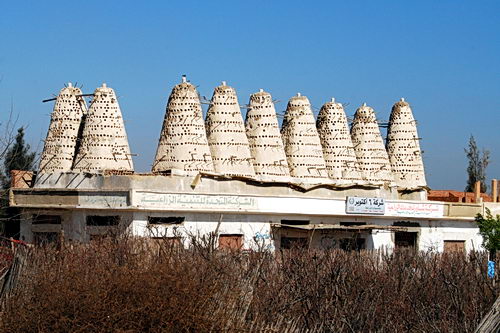
While traveling in Egypt we noticed pigeon roosts several places, but especially in the eastern Delta region (the biblical land of Goshen). The photo below was made along the desert road between Cairo and Alexandria.

Pigeons may serve many purposes: food, eggs, making fertilizer, message carriers, etc. Our guide explained that many people thought of the pigeon as an aphrodisiac.

Pigeon roosts near Alexandria, Egypt. Photo by Ferrell Jenkins.

Pigeon roosts near Alexandria, Egypt. Photo by Ferrell Jenkins.

Every reference to pigeons in the Bible is related to sacrifices. Most of the references are in Leviticus (1:14; 5:7, 11; 12:6, 8; 14:22, 30; 15:14, 29). Note two other references:

  • When the LORD made the land covenant with Abram at Shechem, He asked Abram to bring “a three year old heifer, and a three year old female goat, and a three year old ram, and a turtledove, and a young pigeon” (Genesis 15:9). The Hebrew word here is different. Fox, in The Five Books of Moses, uses the term fledgling.
  • Mary’s offering of purification in Jerusalem was “a pair of turtledoves or two young pigeons” (Luke 2:24).

Another Byzantine church uncovered

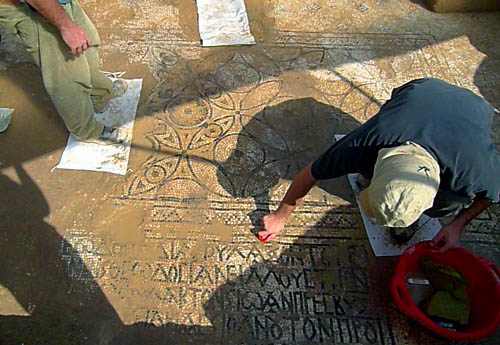
The Israel Antiquities Authority announced today the discovery of a church building dating to the Byzantine period. This one is located near Moshav Nes-Harim, about 3.11 miles east of Beth Shemesh. The full press release may be read here. The Byzantine period in Israel may be dated from about A.D. 325 to the early part of the 7th century.

Christianity grew out of the soil of Judaism. In the early part of the first century Jesus said, “for salvation is from the Jews” (John 4:22).

Max Miller says,

The population of the Holy Land became almost entirely Christian, except for Jewish enclaves primarily in Galilee. moreover, Christian pilgrims flocked to the Holy Land from all over the Roman-Byzantium world and Christian churches were built over virtually every spot which could be imagined to have any connection with a biblical event. (Introducing the Holy Land, 130-131).

He continues to say,

By 640 most of Egypt, the Holy Land and Syria were under Islamic control.

Mosaic dedicatory inscription in Greek. Photo by Daniel Ein Mor, IAA.

Mosaic dedicatory inscription in Greek. Photo by Daniel Ein Mor, IAA.

Evidence for the existence of Jewish and Christian buildings and settlements continues to become known rapidly. It has become common among some Muslim sources to deny the existence of Jews in the land of Palestine before the 20th century. The evidence of archaeology says otherwise. The Old Testament scriptures say otherwise. The New Testament, and the existence of the church in those early centuries, say otherwise.

The sad thing is that buildings are found, not churches composed of Christians. The church had so departed from the New Testament order that it was not able to effectively survive the pressures of  the Muslim invasion. The church of our day appears very weak as it faces the cultural pressures of the postmodern world.

HT: Joseph I. Lauer

Reminders of Patriarchal Life

The Bible paints a clear picture of the life of the patriarchs, especially Abraham, Isaac, and Jacob. Just type the words tent and tents in your computer Bible search engine. Here are a few things said about the biblical patriarchs. (You need to remove the hits referring to the “tent of meeting” or tabernacle.)

  • Lot and Abraham had flocks and herds and tents (Genesis 13:5).
  • Numerous references mention moving the tent (see Genesis 13:18).
  • Jacob was a peaceful man, living in tents (Genesis 25:27).
  • Even as late as the time of David many were living in tents (2 Samuel 18:17).

The writer of Hebrews describes the faith of Abraham this way:

By faith he lived as a foreigner in the promised land as though it were a foreign country, living in tents with Isaac and Jacob, who were fellow heirs of the same promise. (Hebrews 11:9)

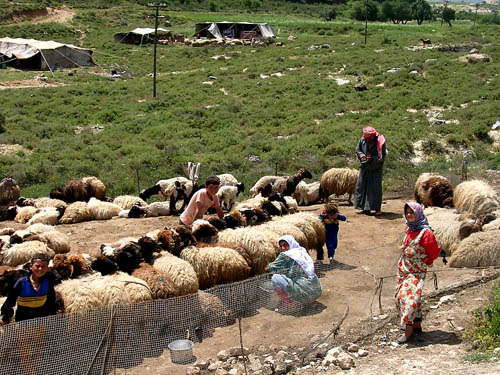
One of the values of travel to the lands of the Bible is to see many customs reminiscent of Bible times. In 2002 I spent nearly a week in Syria with a colleague visiting biblical and historical sites. North of Latakia, almost to the border with Turkey, we saw a settlement of what appeared to be at least three families living in tents. One man was clearly the “patriarch” of the group. Several women were busy working. One was milking the sheep. The tents were spread out over about an acre or more of land.

Shepherd settlement in northeastern Syria. Photo by Ferrell Jenkins.

Shepherd settlement in northeastern Syria. Photo by Ferrell Jenkins.

I think one could envision Abraham and his family in much the same way.

A meditation for Sunday

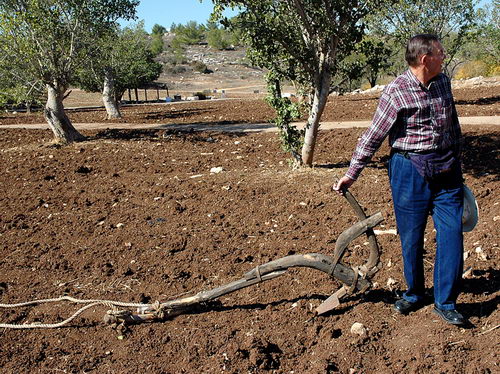
As they were going along the road, someone said to him, “I will follow you wherever you go.” And Jesus said to him, “Foxes have holes, and birds of the air have nests, but the Son of Man has nowhere to lay his head.” To another he said, “Follow me.” But he said, “Lord, let me first go and bury my father.” And Jesus said to him, “Leave the dead to bury their own dead. But as for you, go and proclaim the kingdom of God.” Yet another said, “I will follow you, Lord, but let me first say farewell to those at my home.” Jesus said to him, “No one who puts his hand to the plow and looks back is fit for the kingdom of God.” (Luke 9:57-62)

Illustrating a parable at Neot Kedumim in Israel. Photo by Leon Mauldin.

Illustrating a parable at Neot Kedumim in Israel. Photo by Leon Mauldin.

The last time I saw “Tilley”

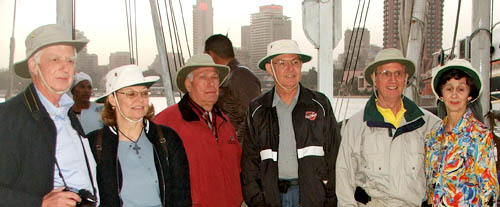
Our group prepared for a late afternoon felucca ride on the Nile River at Cairo. I had on my Tilley Endurable. I bought it at the Queen’s Quay Terminal in Toronto in November, 2002. Too far back to be covered by the Tilley insurance. On the last few tours I noted that other tour members were wearing a Tilley. We began making a “Tilley Group” photo.

Thanks to Katherine of Alabama I have a way to remember my Tilley Endurable. I still had it at the end of the felucca ride, but the next morning I realized that it was not in my room. Had I left it on the bus? The driver said no. Had I left it in the hotel lobby after talking with our tour guide? The hotel staff said it was not among their lost and found items.

I hope my kids will give me a new Tilley for Father’s Day. Till then, here is my final memory.

Tilley Group in Egypt. Photo by Katherine.

Tilley Group in Egypt. Photo by Katherine.

My only consolation came the next day when I went with my guide and one of his local friends to the Eastern Delta, biblical Goshen, in a private car. I lamented my lost hat. Osman said, it is better that you don’t have it today. Egyptians don’t wear hats. You blend in better without one. The few times we stopped at police checkpoints, the officer never said, “Who is the foreigner?”

Oh, and by the way, if you see an Egyptian wearing a Tilley hat ask him where he found it.

From Egypt to New York in 12 hours

We arrived in the USA yesterday afternoon, and got a good night of rest. Typically it takes about a day for every hour in time change to get over jet-lag. We look forward t0 making our way to Florida this afternoon.

Delta now has a non-stop New York/Cairo flight. The service was good in both directions, and the flights were on time. We felt fortunate yesterday to have quite a few empty seats that allowed passengers to spread out over the plane. We know that other members of the tour group arrived in the USA last Monday. We have heard from most of them after arrival at their homes. For this we are thankful.

Our tour members repeatedly said that the trip was a real adventure,  just as we had advertised. It was fun, but primarily it was a real educational and spiritual experience. We not only learned about ancient and modern Egypt, but we related this to the biblical characters who called Egypt home for a while.

Elizabeth and I went to Alexandria on Tuesday. We traveled along the high desert road from Giza to Alexandria. The area is filled with new housing, factories, and agricultural area made possible by modern irrigation.

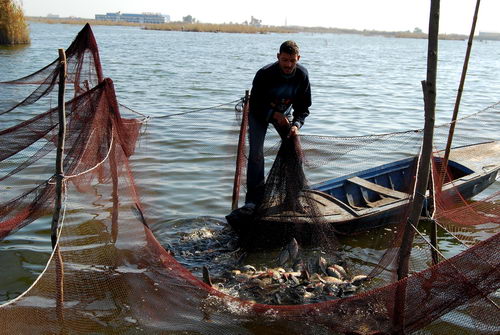
Shortly before we reached Alexandria we passed an area filled with bulrushes. We stopped to watch some fishermen pull in their nets. We were told that these fish are farm fish.

An Egyptian fisherman working the nets. Photo by Ferrell Jenkins.

An Egyptian fisherman working the nets. Photo by Ferrell Jenkins.

I also made some similar photos along the Nile and the canals of Egypt. As we think of ancient Egypt we recall the oracle against Egypt in Isaiah 19. I suggest you read the entire chapter. For now, note these verses.

The bulrushes by the Nile, by the edge of the Nile And all the sown fields by the Nile Will become dry, be driven away, and be no more. And the fishermen will lament, And all those who cast a line into the Nile will mourn, And those who spread nets on the waters will pine away. (Isaiah 19:7-8 NAS)

References like these from the Old Testament prophets were fulfilled in the centuries before the coming of Christ. Remember that the ancient Hamitic Egyptian disappeared long ago. The modern Semitic Egyptians are caretakers of an antiquity they had nothing to do with.

Group headed for home

Our group, all healthly and happy, left the hotel a short time ago for the Cairo International Airport.  The flight isn’t until 12:30 p.m. (Cairo time), but we have been staying near the Giza Pyramids. With nearly 20 million people in Cairo one never knows how long the normally 1 hour trip to the airport will take.

Elizabeth and I are remaining for a few days to visit some other sites we have not seen or been able to photograph.

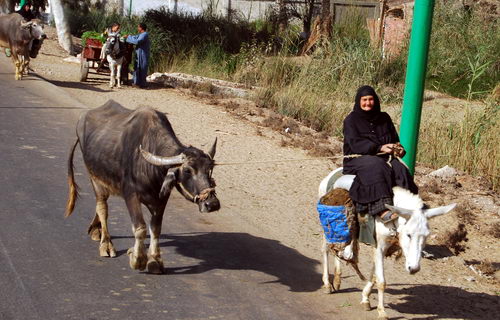
Yesterday I had a photo ready that I wanted to share. It was made at Memphis and is typical of so much of what we see in Egypt. Don’t get the wrong impression. There are many affulent people in this country, but the vast majority seem to eek out a living day by day.

Moving the "herd" near ancient Memphis. Photo by Ferrell Jenkins.

Moving the "herd" near ancient Memphis. Photo by Ferrell Jenkins.

Yesterday our group used a long day to visit the Eastern Delta of
Egypt. Biblically we know that land as Goshen. Few travelers are able to go into this area of Egypt. Over the next few weeks I will try to share a few photos and thoughts about the area.

You might enjoy reading a first person account of the tour written by one of our tour members. This would be especially true if you know some of the folks who have been traveling with us. Click on Picture This.