Category Archives: Culture

C. S. Lewis – Beyond Narnia

If you are interested in C. S. Lewis and his writings, you might enjoy a recent one hour documentary about him. The trailer may be seen here. The complete video is available here. A DVD is available for purchase.

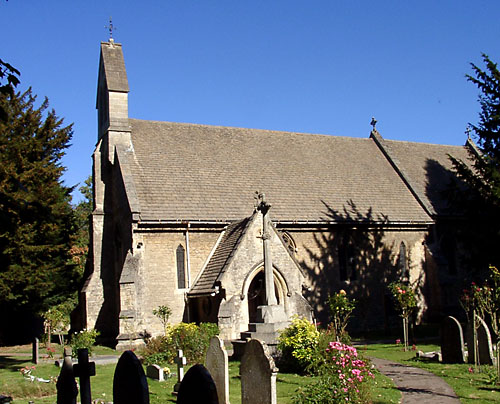
The photo below is of Holy Trinity Church, Headington Quarry, Oxford. This is the church Lewis and his brother Warnie attended. Both are buried in the church graveyard.

Holy Trinity Church, Headington Quarry. Photo by Ferrell Jenkins.

Holy Trinity Church, Headington Quarry. Photo by Ferrell Jenkins.

More information, including photos, about sites associated with Lewis is available here.

HT:  N.T. Resources Blog and Between Two World.

The Greek side of Istanbul

Today’s Zaman has an interesting article about Greeks in Istanbul. The article discusses mainly a few Greek remains to be seen in the city and some information about remaining Greek Orthodox churches.The article is interesting because of the historical developments and conflicts between Greek and Turks. The note about the Serpentine Column caught my attention.

Being approximately 2,500 years old, the Serpentine Column is said to be İstanbul’s oldest remaining Greek monument. Erected to honor the triumph of the Greeks over the Persians at Plataea, it originally stood at Delphi (both ancient cities on Greek ground) and was moved to İstanbul in 324 B.C. by Constantine the Great to mark the declaration of the new capital city of the then-founded Roman Empire under the name of Constantinople. The originally eight-meter-high piece was made up of three intertwined serpents which supported a golden bowl. The bowl is believed to have been lost or stolen when the city was sacked during the Fourth Crusade. Some say the heads were hit and cut off by a drunken nobleman in the 17th century but one of them can still be seen in the İstanbul Archaeology Museum. The rest of the column can be found today at the Hippodrome in the Sultanahmet quarter.

There is a serious mistake in the article. The Serpentine Column was originally erected at Delphi in 479 B.C., but it was placed in the hippodrome of Constantinople by Constantine in 324 A.D.

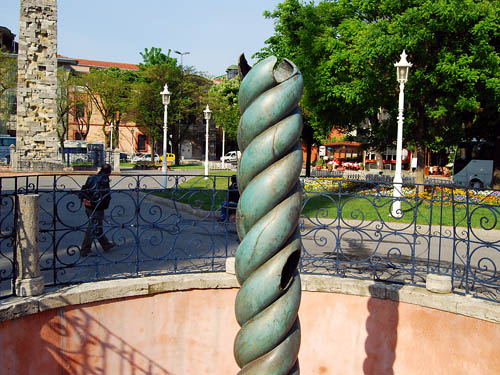
Here is a photo of the bronze Serpentine Column as it stands in the hippodrome.

Serpentine Column in Istanbul. Photo by Ferrell Jenkins.

Bronze Serpentine Column in Istanbul. Photo by Ferrell Jenkins.

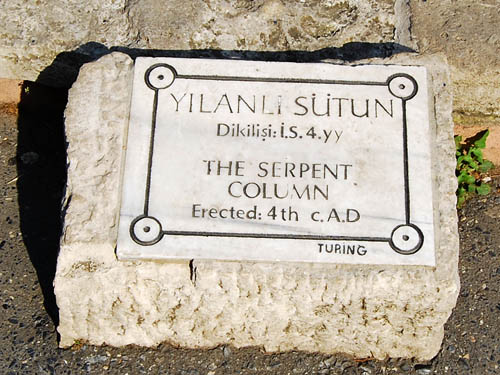
A sign marking the Serpentine Column indicates that the column was erected in the 4th century A.D. That is the date when Constantine had it erected in the hippodrome, but the column dates to the 5th century B.C.

Sign marking the Serpentine Column. Photo by Ferrell Jenkins.

Read the full  Today’s Zaman article here.

HT: Biblical Paths.

Egyptian and Anatolian contacts with Galilee

Tel Aviv University reports on the discover of a rare Egyptian artifact dating to around 3000 BC from Tel Bet Yerah on the shore of the Sea of Galilee. The link to the report is here. The brief report from the Jerusalem Post is probably adequate here.

Although Egyptian-Israeli relations have been frosty in recent years, ties between the two lands were vibrant around 3,000 BCE during the Early Bronze Age – at least according to Tel Aviv University and University College London archeologists who discovered a rare, four-centimeter-long stone fragment at the point where the Jordan River exits Lake Kinneret.

The piece, part of a carved stone plaque bearing archaic Egyptian signs, was the highlight of the second season of excavations at Tel Bet Yerah (Khirbet el-Kerak). The site lies along an ancient highway that connected Egypt to the wider world of the ancient Near East.

Fragment of Egyptian plaque - c. 3000 BC - from Tel Bet Yerah.

Fragment of Egyptian plaque - c. 3000 BC - from Tel Bet Yerah.

. . . . . .

Earlier discoveries, both in Egypt and at Bet Yerah, have indicated that there was direct interaction between the site – then one of the largest in the Jordan Valley – and the Egyptian royal court. The new discovery suggests that these contacts were of far greater local significance than had been suspected.

The archeologists noted that the fragment – which depicts an arm and hand grasping a scepter and an early form of the ankh sign – was the first artifact of its type ever found in an archaeological site outside Egypt. It has been attributed to the period of Egypt’s First Dynasty, at around 3000 BCE.

. . . . . .

This year’s excavations also provided new insights into contacts between the early town and the distant north, when large quantities of “Khirbet Kerak Ware” (a distinctive kind of red/black burnished pottery first found at Tel Bet Yerah) were found in association with portable ceramic hearths, some of them bearing decorations in the form of human features.

One end of a decorated portable hearth - Khirbet Kerak Culture (c. 2700 BC)

One end of a decorated portable hearth - Khirbet Kerak Culture (c. 2700 BC)

“The hearths are very similar to objects found in Anatolia and the southern Caucasus,” noted Greenberg, “and most were found in open spaces where there was other evidence for fire-related activities.

“The people using this pottery appear to have been migrants or descendants of migrants, and its distribution on the site, as well as the study of other cultural aspects, such as what they ate and the way they organized their households, could tell us about their interaction with local people and their adaptation to new surroundings.”

. . . . . .

The tel was once described by influential American biblical archeologist William F. Albright as “perhaps the most remarkable Bronze Age site in all Palestine.” It presents the most complete sequence of the transition from village to city life in ancient Canaan.

Built on a raised peninsula near an important crossroads and a fertile valley, Tel Bet Yerah became a major regional center, and its fortification systems, city gate, streets and houses reveal elements of advanced urban planning.

Modern archeological research on the mound began in the early 1920s, when E.L. Sukenik (father of the late archeologist and politician Prof. Yigael Yadin) examined finds from the section of the old Samak (Tzemah)-Tiberias road that traversed the mound along its entire length.

At about the same time, Albright conducted his own investigation of the site; he was the first to identify and define the pottery known as Khirbet Kerak Ware.

The first archeological excavation was conducted in 1933, when the modern Tzemah -Tiberias highway was constructed. Over the next 70 years, about 20 excavation licenses were issued for Tel Bet Yerah and some 15,000 square meters were excavated, most of them in Early Bronze Age strata.

I think this type of information illustrates why the Lord placed His people on this land bridge between the great powers of the ancient world. It would continue to remain that way through the days of the Assyrians, Babylonians, Persians, Greeks, and Romans. And beyond.

HT: Joe Lauer

Miniature carving of Alexander the Great

Israel National News reports the discover of a rare miniature carving of Alexander the Great. The article by Nissan Ratzlav-Katz says,

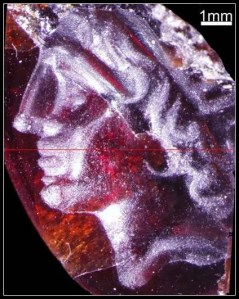
Excavations in Tel Dor have turned up a rare and unexpected work of Hellenistic art: a precious stone bearing the miniature carved likeness of Alexander the Great. Archaeologists are calling it an important find, indicating the great skill of the artist.

The Tel Dor dig, under the guidance and direction of Dr. Ayelet Gilboa of Haifa University and Dr. Ilan Sharon of Jerusalem’s Hebrew University, has just ended its summer excavation season. For more than 30 years, scientists have been excavating in Tel Dor, identified as the site of the Biblical town of Dor. The town’s location, on Israel’s Mediterranean Sea coast some 30 kilometers south of Haifa, made it an important international port in ancient times.

“Despite the tiny proportions – the length of the gemstone (gemma) is less than a centimeter and its width less than half a centimeter – the artist was able to carve the image of Alexander of Macedon with all of his features,” Dr. Gilboa said. “The king appears as young and energetic, with a sharp chin and straight nose, and with long, curly hair held in a crown.”

According to the archaeologists involved in the Tel Dor excavations, the discovery of the miniature Alexander gemstone carving in Israel is fairly surprising. The Land of Israel was not, for the Greek Empire, a central or major holding.

The article concludes,

Historically, Alexander himself passed through Dor in 332 BCE, during his voyage to Egypt. It appears that the city fell to him without resistance. Since that time until its conquest by the Hasmonean Jewish King Alexander Yannai around 100 BCE, Dor served as a stronghold of non-Jewish Hellenists in the Land of Israel.

The full article may be read here.

Miniature carving of Alexander from Tel Dor.

Carving of Alexander from Tel Dor.

Dor is mentioned in several Old Testament references including Joshua 17:10-11.

HT: Joseph I. Lauer

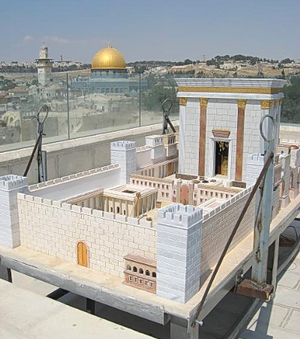
World’s largest temple model

Arutz Sheva, Israel National News.com, reported the inauguration of the world’s largest model of the Second Temple (they mean Herod’s temple; not the one built by Zerubbabel in the days of the prophet Haggai).

The model, built at a scale of 1:60, was built by Michael Osanis for the Aish HaTorah Yeshiva in Jerusalem’s old city, and is displayed on the roof of its new museum, which at seven stories above the Western Wall plaza has a breathtaking view of the Temple Mount.

The photo of the model in place on the roof of Aish HaTorah’s new Exploration museum is impressive.

Largest temple model ignaurated August 5, 2009. Photo: Arutz Sheva.

Largest temple model inaugurated August 5, 2009. Photo: Arutz Sheva.

Read the full story here. There is a video showing the model being put into place.

Arutz Sheva reported July 30th on the building of the altar of the temple at Mitzpe Yericho. See article and photos here.

The Temple Institute has already built several of the Temple vessels such as the Ark and the menorah, and has now embarked on an ambitious project to build the altar, which will ultimately measure 3 meters wide by 3 meters long and 2 meters tall.

During Thursday’s ceremony, which took place in Mitzpe Yericho just east of Jerusalem, the Temple Institute laid the cornerstone for the altar and demonstrated how tar will be used to cement the stones together. The Institute plans on bringing the altar to its proper place on the Temple Mount when the Temple is rebuilt.

Mitzpe Yericho is in the wilderness of Judea near the Monastery of St. George.

There is some discussion between the Jews and Jesus about the building of Herod’s temple in the Gospel of John.

The Jews then said to Him, “What sign do You show us as your authority for doing these things?” Jesus answered them, “Destroy this temple, and in three days I will raise it up.” The Jews then said, “It took forty-six years to build this temple, and will You raise it up in three days?” But He was speaking of the temple of His body. So when He was raised from the dead, His disciples remembered that He said this; and they believed the Scripture and the word which Jesus had spoken. (John 2:18-22 NAU)

HT: Joseph I. Lauer.

Taking the family to the Explorations in Antiquity Center

We recently ran three posts about the Explorations in Antiquity Center, LaGrange, GA, here, here, and here. A couple of friends in Alabama were encouraged by the posts to take 9 of their grandchildren to visit the center. Olen and Jane have visited Israel and Jordan with me twice, and I think they have been in Turkey twice. So, they know what to look for, and they understood the value of such an experience as that provided by the Explorations in Antiquity Center for their grandchildren.

You may remember Jane from her Journeys With Jane blog. She described the experience in Georgia this way:

The experience was much more than we had even hoped for! It was a long (4 ½ hour) drive over there, included an overnight stay, and long drive back, but worth all the time involved. The exhibit itself is a bargain, and extremely educational for both adults and children. We are ready to go back whenever we have the opportunity. We are thankful for the safety during our travels on this brief “journey” and highly recommend it to anyone who is interested in the Bible or history of that era.

What was the best part?

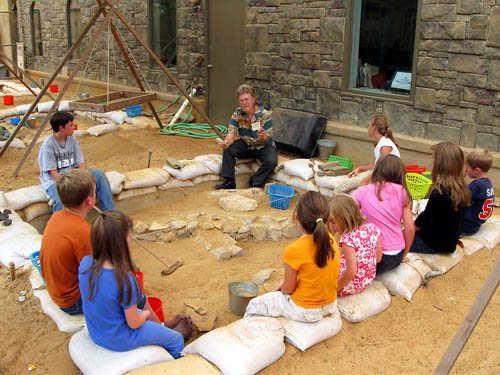
The best part was the archaeological dig. We went to prepared areas and were instructed on archaeological techniques. Then we dug and sifted through our diggings to locate artifacts (some real and some replicas) which we would learn about later

She says they were honored to have Dr. James Fleming, the founder of the Center, explain about the artifacts they discovered on the dig, and relate them to different periods of history. Here, the kids listen intently as Dr. Fleming talks with them.

Dr. Fleming explains the archaeological artifacts to the kids.

Dr. Fleming explains the archaeological artifacts to the kids at the Explorations in Antiquity Center. Photo courtesy Journeys With Jane.

You might enjoy seeing the other photos Jane has posted on her blog here.

I have no connection with, or financial interest in, the Explorations in Antiquity Center, but I am delighted to promote such a wonderful teaching center. The link to the Center website is here.

David Padfield visits the Explorations In Antiquity Center at LaGrange, Georgia

If you have a desire to visit the lands of the Bible, but can’t afford the trip, I would suggest you visit the Explorations In Antiquity Center in LaGrange, Georgia. Recently my wife and I visited the Center for the first time and were amazed at the quality of the displays.

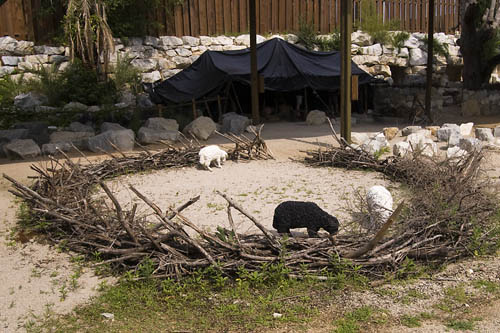
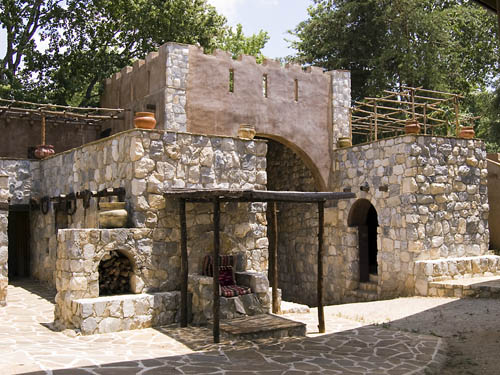
The Explorations In Antiquity Center is a living museum of life in Bible times. As you walk through the outdoor exhibits you will see realistic replicas of scenes from the Ancient Near East, such as water wells, vineyards, olive presses, mangers, and a sheepfold, watchtower and a threshing floor.

Sheepfold at Explorations in Antiquity Center. Photo by David Padfield.

Sheepfold at Explorations in Antiquity Center. Photo by David Padfield.

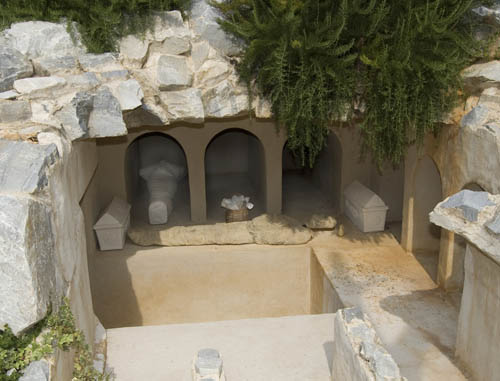
The tomb exhibit is especially worthy of notice. They have a replica of a typical Israelite tomb from around 700 to 500 BC, and a wonderful Herodian Period tomb like the one in which our Lord was probably buried. The replica was designed to show a cross section of the tomb (i.e., one of the walls is missing) and this makes it easier to explain the burial process in our Lord’s time upon this earth.

Cut-away replica of Herodian Period niche-type tomb. Photo by David Padfield.

Cut-away replica of Herodian Period niche-type tomb. Photo by David Padfield.

My favorite exhibit is the one that depicts life in an ancient village. They have built a typical four room Israelite house that will help you to understand the importance of a courtyard, the place of domestic animals in village life, how household storage was managed and the way the sleeping quarters were divided.

The center is open Tuesday through Saturday, from 10:00 AM to 6:00 PM. You can walk through the displays at your leisure, or call in advance for a guided tour that includes a Biblical meal (more about that in our second post).

-o-o-o-o-o-o-

David Padfield has visited the Bible Lands several times and is well qualified to evaluate the Explorations In Antiquity Center. Many of you have used his photographs and other materials that are made available through his web site (padfield.com).

The Explorations In Antiquity Center web site is available here.

The Exploration in Antiquity Center

The Explorations in Antiquity Center at LaGrange, Georgia, is the brainchild of Dr. James Fleming. Fleming has lived and worked in Israel since 1973. Numerous tour groups have visited his Biblical Resources center there. I first met Jim many years ago in the home of Richard Cleave in Jerusalem. Cleave is the author/photographer/publisher of The Holy Land Satellite Atlas and other photographic and geographic materials. In that meeting I saw that the three of us shared a common passion in wanting to use what we had learned about the Bible lands in teaching others.

The Explorations in Antiquity Center web page says,

Dr. Fleming established Biblical Resources in 1975, for the purpose of producing educational materials and aids for teaching the historical, geographical, and archaeological background of the Bible.

It was wonderful to have these resources together at one place in Israel, but it is beneficial to many more to have the resources available in the Southeastern United States.

David Padfield recently visited the Center in LaGrange. At my request he has written a brief review for Ferrell’s Travel Blog. We plan to run the review with photographs during the next few days.

The city gate at Exploration in Antiquities Center. Photo by David Padfield.

The city gate at Exploration in Antiquities Center. Photo by David Padfield.

You may access the Center’s web site here.

David Padfield is well known for his helpful web site, Padfield.com.

Where were you 40 years ago?

Even if we did not remember the exact day, all of us have heard that today is the 40th anniversary of the Apollo 11 mission to the moon. Our family had moved to Florida the previous December. School was not in session. What a great opportunity to take the boys to Cape Canaveral to see the “moon shot.”

Still in awe after the launch of Apollo 11. Photo by Ferrell Jenkins.

Still in awe after the launch of Apollo 11. Photo by Ferrell Jenkins.

You may notice what appears to be a scratch on the slide running from the ground up into the water. That is the antenna to an little battery-operated TV. Afterwards we had a great picnic lunch mom had prepared.

Flag faux pas

We have been flying our flag since a few days before Memorial Day.

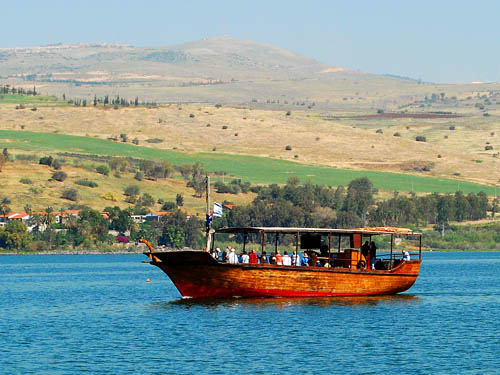
When traveling outside the United States it is fairly common to see the flag of the USA displayed in front of hotels that cater to citizens of the USA. Dozens of boats carry tourists across the Sea of Galilee from one port to another. This is an important part of our tours to give the travelers some sense of the elevation of the sea, and of the quietness of its water.

Tourist boat on Sea of Galilee. View to East. Photo by Ferrell Jenkins.

Tourist boat on Sea of Galilee. View to East. Photo by Ferrell Jenkins.

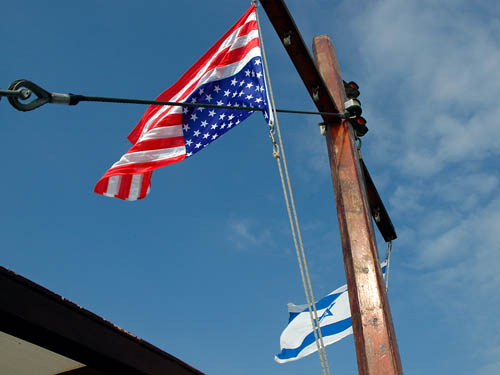
It is fairly typical of these boats to hoist a flag of the country from which its passengers come. In 2006 the boat we were on had inadvertently hoisted the USA flag upside down. The rules of etiquette for the display of the flag say that the flag should be flown upside down only as a distress signal. Fortunately we did not have a storm like the one mentioned in the gospels. Such storms still occur when the strong winds come down upon the sea from the surrounding mountains. In that case I suppose a distress signal might have been helpful.

But as they were sailing along He fell asleep; and a fierce gale of wind descended on the lake, and they began to be swamped and to be in danger. They came to Jesus and woke Him up, saying, “Master, Master, we are perishing!” And He got up and rebuked the wind and the surging waves, and they stopped, and it became calm. (Luke 8:23-24 NAU)

United States flag upside down on Israeli boat. Photo by Ferrell Jenkins.

United States flag upside down on Israeli boat. Photo by Ferrell Jenkins.

Happy fourth of July to my USA friends. Fly your flag proudly, but don’t turn it upside down!