Category Archives: Culture

Where will you travel in 2011?

Many people never travel because they put it off. Some people plan to see a lot of the places in the United States before they travel to a foreign destination. And most of these people never travel anywhere much. I don’t know how many times I have told someone that there is no way to drive to Israel and the other Bible lands. Young couples spend money to take skiing trips and other vacations, but they never think about saving to travel to the Holy Land. Usually they do not go.
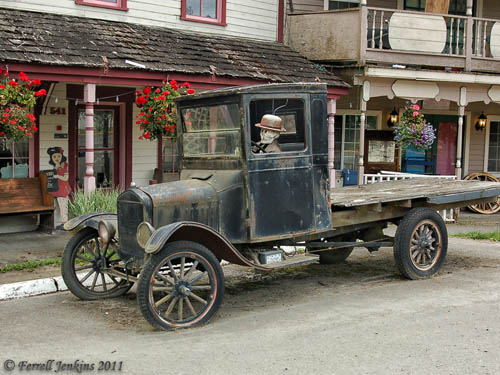
An old truck at Wilkeson, Washington. Photo by Ferrell Jenkins.

An old truck at Wilkeson, Washington. Photo by Ferrell Jenkins.

The Northern Pacific Railroad opened a sandstone quarry in Wilkeson, Washington, in the last quarter of the 19th century. The little town with a population of about 400 is now practically a ghost town and one of the entries near Mount Rainier. There are several old buildings and vehicles left from the last century or earlier.

Wilkeson shows us what can happen to a town, a church, a school, or other organization, or even an individual when we allow the life to ebb away. The guy in the old truck isn’t going anywhere.

Where are you going this year? I hope you will understand this in a spiritual way, as well as thinking about literal travel.

8 Owe no one anything, except to love each other, for the one who loves another has fulfilled the law.
9 For the commandments, “You shall not commit adultery, You shall not murder, You shall not steal, You shall not covet,” and any other commandment, are summed up in this word: “You shall love your neighbor as yourself.”
10 Love does no wrong to a neighbor; therefore love is the fulfilling of the law.
11 Besides this you know the time, that the hour has come for you to wake from sleep. For salvation is nearer to us now than when we first believed. (Romans 13:8-11 ESV)

Wishing you a fruitful and pleasant New Year

The beginning of a New Year gives us an opportunity to correct the mistakes we made in the previous year and try more diligently to do better in the future.

I trust that your New Year will be one of fruitfulness and pleasantness as you seek to honor the Creator of the universe and all men.

A fruit kiosk at the port of Akko (Roman Ptolemais). Photo by Ferrell Jenkins.

A fruit kiosk at the port of Akko (Roman Ptolemais). Photo by Ferrell Jenkins.

1 How blessed is the man who does not walk in the counsel of the wicked, Nor stand in the path of sinners, Nor sit in the seat of scoffers!
2 But his delight is in the law of the LORD, And in His law he meditates day and night.
3 He will be like a tree firmly planted by streams of water, Which yields its fruit in its season And its leaf does not wither; And in whatever he does, he prospers.
4 The wicked are not so, But they are like chaff which the wind drives away.
5 Therefore the wicked will not stand in the judgment, Nor sinners in the assembly of the righteous.
6 For the LORD knows the way of the righteous, But the way of the wicked will perish. (Psalm 1:1-6 NAU)

Ancient Yarkon fortress with Greek and Assyrian connections?

The American Friends of Tel Aviv University have announced that Tel Aviv University researchers have connected Tel Qadadi, at the mouth of the Yarkon River in Tel Aviv, with the Greek island of Lesbos.

Tel Qudadi, an ancient fortress located in the heart of Tel Aviv at the mouth of the Yarkon River, was first excavated more than 70 years ago — but the final results of neither the excavations nor the finds were ever published. Now, research on Tel Qudadi by archaeologists at Tel Aviv University has unpeeled a new layer of history, indicating that there is much more to learn from the site, including evidence that links ancient Israel to the Greek island of Lesbos.

“The secrets of this ancient fortress are only beginning to be revealed,” Dr. Alexander Fantalkin and Dr. Oren Tal of Tel Aviv University’s Department of Archaeology say. Their new research was recently published in the Palestine Exploration Quarterly and BABESH: Annual Papers on Mediterranean Archaeology.

The release points out that it was thought in the past that the Tel Qadadi fortress was established in the 10th century B.C. by King Solomon.

The establishment of the fortress at Tel Qudadi was understood later as evidence of the existence of a developed maritime policy in the days of the United Monarchy in ancient Israel.

Another view was that the fortress belonged to the 9th century B.C. and should be attributed to the Kingdom of Israel. An amphora from the Greek island of Lesbos in the Aegean is said to provide evidence that the site should now be dated to the late 8th/early 7th century fortress “serving the Assyrian interests in the Levantine coast rather than part of the Israelite Kingdom.”

One could not possibly have anything dating to the time of Solomon within a potsherd’s throw of Tel Aviv University!

Read the entire news release here.

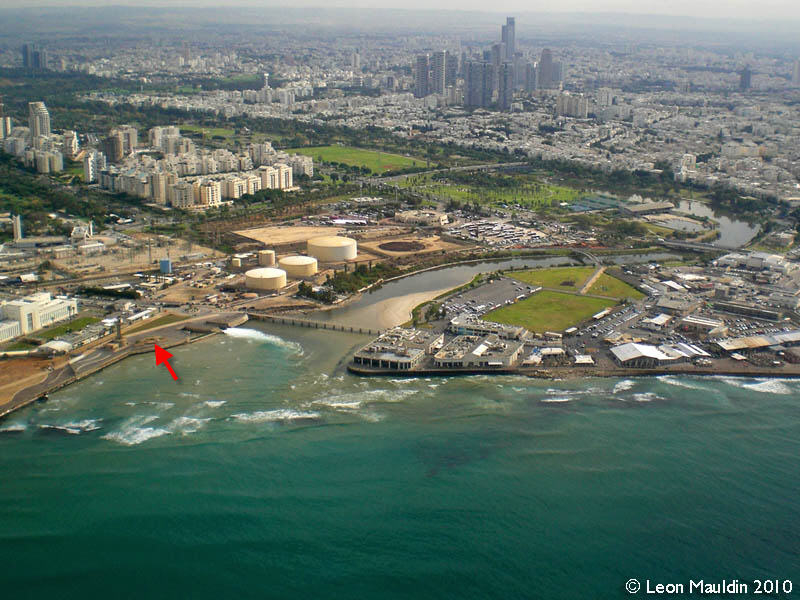
The AFTAU release included a small photo by my friend and co-traveler Leon Mauldin.  Leon has given me permission to post his photo here. It shows the mouth of the Yarkon River as it flows into the Mediterranean Sea. The river begins a few miles inland at the Old Testament site of Aphek (1 Samuel 4:1), known in Roman times as Antipatris (Acts 23:31). Click on the photo for a larger image.

Aerial view of mouth of the Yarkon River at Tel Aviv. Photo by Leon Mauldin.

Aerial view of mouth of the Yarkon River at Tel Aviv. Photo by Leon Mauldin.

The arrow points to the little tel on the north bank of the Yarkon.

There is another lesson in this press release. Scholars, including archaeologist, do not agree and they often change their minds. It is a mistake for one to build an “infallible” case on a fallible premise. We must work with the evidence we have at any given time.

You may see more of Leon’s photos at Leon’s Message Board.

HT: Joseph I. Lauer

Elaborate hairstyles in New Testament times

The apostle Peter wrote much, by comparison to the size of his first epistle, about the Christian and submission. I wish to call attention to something he said about the relation of wives to their husbands. Notice the reading in four English versions.

Your beauty should not consist of outward things like elaborate hairstyles and the wearing of gold ornaments or fine clothes; (1 Peter 3:3 CSB)

Do not let your adorning be external–the braiding of hair and the putting on of gold jewelry, or the clothing you wear– (1 Peter 3:3 ESV)

Let your beauty not be external– the braiding of hair and wearing of gold jewelry or fine clothes– (1 Peter 3:3 NET)

Your beauty should not come from outward adornment, such as braided hair and the wearing of gold jewelry and fine clothes. (1 Peter 3:3 NIV)

Years ago I was impressed with the comments by William Barclay about the elaborate dressing habits of the upper class women of the Greco-Roman world.

In the world of the Greeks and the Romans it is interesting to collect the references to personal adornments. There were as many ways of dressing the hair as there were bees in Hybca. Hair was waved and dyed, sometimes black, more often auburn. Wigs were worn, especially blonde wigs, which are found even in the Christian catacombs; and hair to manufacture them was imported from Germany, and even from as far away as India. Hairbands, pins and combs were made of ivory, and boxwood, and tortoiseshell; and sometimes of gold, studded with gems. (Barclay, Daily Study Bible Series: The Letters of James and Peter)

He gives other illustrations of the expensive clothing and jewelry of some of the women of the Imperial household. He says,

Christianity came into a world of luxury and decadence combined.

In face of all this Peter pleads for the graces which adorn the heart, which are precious in the sight of God. These were the jewels which adorned the holy women of old. Isaiah had called Sara the mother of God’s faithful people (Isaiah 51:2); and if Christian wives are adorned with the same graces of modesty, humility and chastity, they too will be her daughters and will be within the family of the faithful people of God.

Kistemaker calls attention to a comment by J.N.D. Kelly,

The elaboration in hair-styles, make-up, dress and personal jewelery in the [first] and [second] cent[urie]s is eloquently attested by the literature and art of the period.

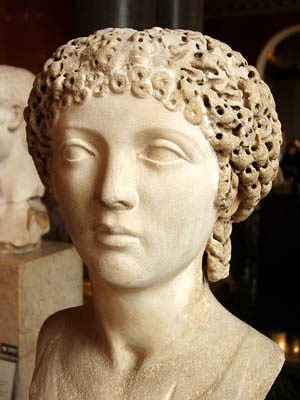
With that in mind I decided to show a few examples of statuary of some of the women of the royal households. The first is a woman from the time of Nero (A.D. 54-68). Peter’s letters were written during that period.

Woman from the time of Nero. The Louvre. Photo by Ferrell Jenkins.

Woman from the time of Nero. The Louvre. Photo by Ferrell Jenkins.

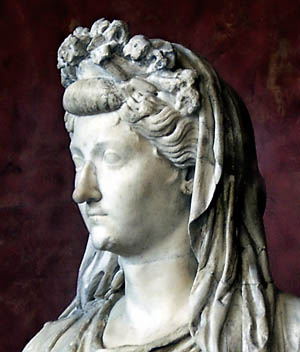
The next example is of Livia, the wife of Augustus and the mother of Tiberius.

Livia, wife of Augustus, mother of Tiberius. The Louvre. Photo by Ferrell Jenkins.

Livia, wife of Augustus, mother of Tiberius. The Louvre. Photo by Ferrell Jenkins.

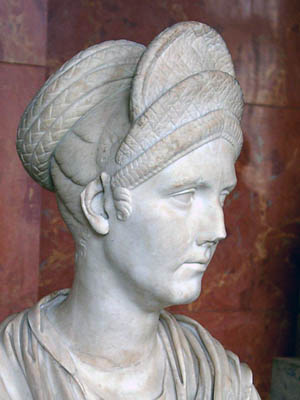
And finally, here is a bust of a neice of Trajan (A.D. 98-117).

Trajan's neice. The Louvre. Photo by Ferrell Jenkins.

Trajan's neice. The Louvre. Photo by Ferrell Jenkins.

Can you imagine the women of that time watching the TV award shows or reading the latest glamor magazines and not wanting to have their hair fixed the same way?

There is a lesson here for everyone, both female and male, who seeks to imitate Christ.

Astronaut photo of Egypt, Israel and Jordan at night

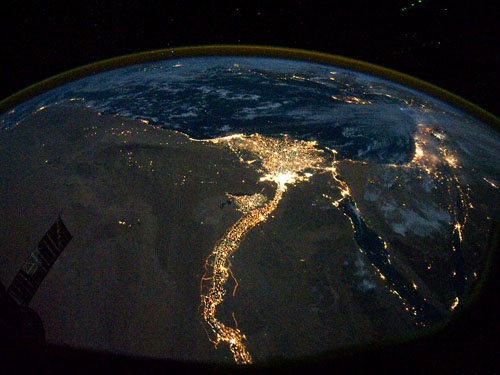
The satellite photo below is one of the fabulous photos made by NASA astronauts from space. The emphasis in this photo is the Nile Delta at night. You are able to see the portion of Egypt where most of the people live. The Sinai, Israel and Jordan are also visible. To the north, the island of Cyprus and the south shore of Turkey can be seen.

NASA Astronaut Photography of the Egypt and Israel by night.Astronaut photo of Egypt, Israel and Jordan at night.

NASA provides a helpful explanation of the photo.

One of the fascinating aspects of viewing Earth at night is how well the lights show the distribution of people. In this view of Egypt, we see a population almost completely concentrated along the Nile Valley, just a small percentage of the country’s land area.

The Nile River and its delta look like a brilliant, long-stemmed flower in this astronaut photograph of the southeastern Mediterranean Sea, as seen from the International Space Station. The Cairo metropolitan area forms a particularly bright base of the flower. The smaller cities and towns within the Nile Delta tend to be hard to see amidst the dense agricultural vegetation during the day. However, these settled areas and the connecting roads between them become clearly visible at night. Likewise, urbanized regions and infrastructure along the Nile River becomes apparent (see also The Great Bend of Nile, Day & Night.)

Another brightly lit region is visible along the eastern coastline of the Mediterranean—the Tel-Aviv metropolitan area in Israel (image right). To the east of Tel-Aviv lies Amman, Jordan. The two major water bodies that define the western and eastern coastlines of the Sinai Peninsula—the Gulf of Suez and the Gulf of Aqaba—are outlined by lights along their coastlines (image lower right). The city lights of Paphos, Limassol, Larnaca, and Nicosia are visible on the island of Cyprus (image top).

Scattered blue-grey clouds cover the Mediterranean Sea and the Sinai, while much of northeastern Africa is cloud-free. A thin yellow-brown band tracing the Earth’s curvature at image top is airglow, a faint band of light emission that results from the interaction of atmospheric atoms and molecules with solar radiation at approximately 100 kilometers (60 miles) altitude.

The image is used courtesy of the Image Science & Analysis Laboratory, NASA Johnson Space Center. You may access various images at their website here. An annotated photo is available there.

HT: Aantekeningen bij de Bijbel

Fascinating article on “Tyre and the Poets”

Joseph P. Duggan writes a fascinating article on “Tyre and the Poets” in The American Spectator. Notice a few excepts. I have added some of the pertinent Scripture references within the article in brackets.

For $50 a family can take a safe, radio-call taxi from the congested heart of Beirut to the uncluttered ancient waterfront of Tyre, a few miles north of the border with Israel. Lush banana plantations line the coastal route.…

The Western literary imagination is attracted to Tyre because it swirls amid the turbulent confluence of Biblical history and prophecy, Homeric and Virgilian epic, Ovidian mythology, and imperial extravagances of luxury and vindictive warfare. Tyre is the birthplace of real or fabulous personages including Cadmus, Europa, and Dido, the latter of whom colonized Carthage as others were to plant the Tyrian standard in Mediterranean ports as far west as Cádiz. The men who sailed with Columbus and colonized the Americas were descendants of long-ago colonists from Tyre.

With its expensive purple dye made from a local mollusk, the murex, Tyre was the center for the Versaces and Givenchys of the ancient world. Paris took Helen of Troy here on a shopping expedition to drape in sumptuous fabric the frame and face that launched a thousand ships.

King Hiram of Tyre was an ally and trading partner of Jerusalem’s King Solomon. Hiram sold Solomon the cedar timber for the great Temple. [1 Kings 9:11]

The Jerusalem-Tyre relationship was rocky then as now. The old Hebrew prophets inveighed against the wealthy city and its neighbor, Sidon, as hotbeds of heathenism and vice. Jezebel, a Tyrian princess (and Dido’s great-aunt) who married Israel’s King Ahab, came to an unhappy end. [Jezebel was the daughter of Ethbaal, king of the Sidonians. 1 Kings 16:31]

Egypt’s pharaohs many times made war against Tyre. Babylon under Nebuchadnezzar battered Tyre in the 6th century B.C. [Ezekiel 26:7; 29:18] Some 250 years later, Alexander the Great already had established effective mastery over the entire Levant when he demanded to offer sacrifice at Tyre to its principal god, Melqart. Alexander maintained that he himself was divine because, he said, he was a descendant of divine Herakles, of whom Melqart was only an avatar. The Tyrians didn’t cotton to that.

When diplomacy failed, Alexander mounted a costly siege whose success resulted in the slaughter of thousands of Tyrians, deportation into slavery for the survivors, and ruin of the splendid city. Modern historians say there was no strategic rationale for Alexander’s destruction of Tyre and its people. The impulse for the genocide was something like the rage of a deranged, spurned lover. Is “education” the answer to war and the world’s other problems? Consider that the Macedonian sociopath had for his personal tutor the serene and rational Stagirite who wrote the Nicomachean Ethics.

When Jesus walked up the short road from Galilee to Tyre, [Matthew 15:21] preaching to the people and driving a demon out of a local woman’s daughter, [Mark 7:26] he saw what Nebuchadnezzar and Alexander had done to the place, fulfilling the prophecies of, inter alia, Amos, Ezekiel [26-28], Zechariah and Jeremiah. He instructed his disciples to say to Galilean towns that rejected them and their preaching: “It shall be more tolerable for Tyre and Sidon at the judgment, than for thee.” [Matthew 11:21-22]

The entire article may be read here.

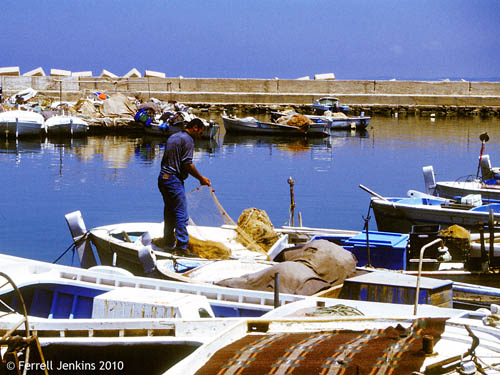
Our photo was made in the harbor of the island city of Tyre in 2002.

Fisherman working with nets at Tyre. Photo by Ferrell Jenkins.

Fisherman working with nets at Tyre. Photo by Ferrell Jenkins.

I will make you a bare rock. You shall be a place for the spreading of nets. You shall never be rebuilt, for I am the LORD; I have spoken, declares the Lord GOD. (Ezekiel 26:14 ESV)

HT: PaleoJudaica

A look at copyright basics

The other day, on some source I look at, someone said something like this, “I don’t know anything about copyright.” Earlier this year I had a problem with a blogger who copied my articles and photos, even replacing my copyright notice with his own. Read here, if interested.

WordPress features some of their more successful blogs each day under the title “Freshly Pressed.” One of them caught my eye this morning. It has to do with misconceptions about copyright at it applies to blog posts.

I suggest that everyone who writes a blog, edits a bulletin, prepares presentations, wants to copy a handout, or posts info on a social network take a look at this article on Blogger Basics: Copyright by Deirdre Reid. She also explains Creative Commons.

Some think the solution to the copyright problem is just to label everything as “anonymous.” Not so.

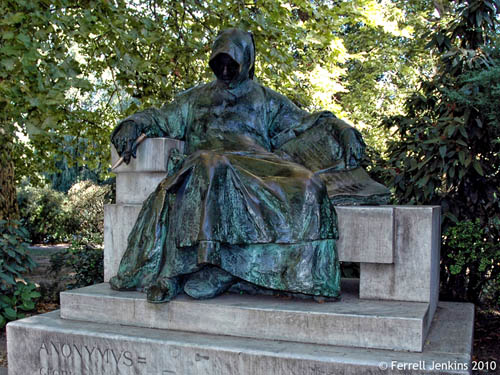
Statue of Anonymous in Budapest. Photo by Ferrell Jenkins.

In Budapest, Hungary, near the entrance of Vajdahunyad Castle, there stands a statue of Anonymous by Miklos Legeti. The statue commemorates a 12th or 13th century unknown chronicler of one of the several rulers named King Bela.

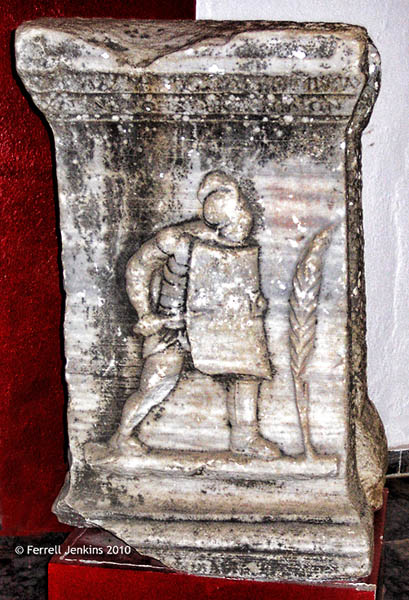
The apostles as gladiators

The apostle Paul compared the work of the apostles to that of gladiators in the arena. In writing to the Corinthians he says,

For I think that God has exhibited us apostles as last of all, like men sentenced to death, because we have become a spectacle to the world, to angels, and to men. (1 Corinthians 4:9 ESV)

As the last event of the day, the gladiator’s who were condemned to death were brought into the arena as a spectacle for the excited crowd. The word spectacle translates the Greek theatron, easy enough for everyone to understand the reference.

Leon Morris (Tyndale New Testament Commentary) calls attention to James Moffatt’s translation of this text.

The imagery is derived from the arena, as Moffatt’s rendering brings out, ‘God means us apostles to come in at the very end, like doomed gladiators in the arena!’

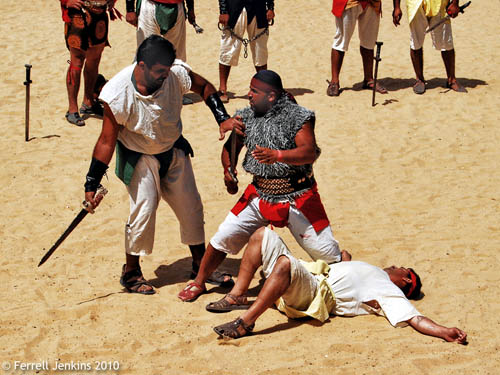
The photo below shows gladiators in the Roman hippodrome at the RACE (Roman Army and Chariot Experience)  show at Jerash, Jordan.

Gladiators in the Roman hippodrome at Jerash, Jordan. Photo by Ferrell Jenkins.

Gladiators in the Roman hippodrome at Jerash, Jordan. Photo by Ferrell Jenkins.

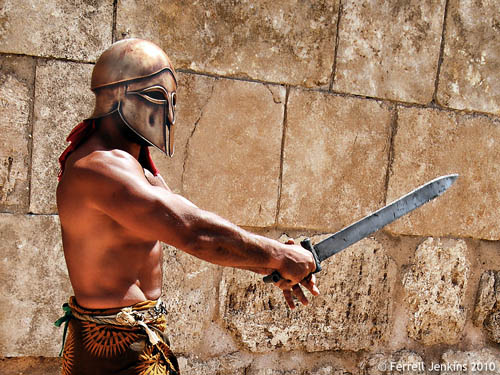
Here is a close up of one of the gladiators.

Gladiator in the RACE show, Jerash, Jordan. Photo by Ferrell Jenkins.

Gladiator in the RACE show, Jerash, Jordan. Photo by Ferrell Jenkins.

Both photos are available in a larger size suitable for use in teaching. Just click on the images.

David Padfield has several photos of gladiators here.

Scientific study of “headless” gladiators

Discovery News reports here on a new study about the “headless” gladiators found in a cemetery at York, England, a few years ago.

Britain’s enigmatic “headless Romans” lost their heads far away from home, according to a multi-isotopic analysis of the 1,800-year-old skeletal remains.

Unearthed between 2004 and 2005 in a cemetery in York, England, the remains belong to 80 individuals, almost all males, who died violently at ages ranging between 19 and 45.

At least 46 of them had been carefully decapitated, with their heads placed by or between their legs or pelvis.

Believed by some to be gladiators, losing their heads after their last fight, the heavily built men were buried in one of the most prestigious cemeteries of York during the 2nd and 3rd century A.D.

A new scientific “multi-isotopic analysis of the skeletal remains” has shown that many of the men were from other parts of Britain and the Roman Empire. It is a fascinating technical study.

Gladiator at Ephesus. Photo by Ferrell Jenkins.

Gladiator at Ephesus. Photo by Ferrell Jenkins.

The Science Channel web site has a nice video in which Dr. Karl Großschmidt, Medical University of Vienna, discusses the discovery at Ephesus of skeletons belonging to 70 gladiators. Click here to view the video and a second one discussing the weapons used by the gladiators.  Großschmidt thinks that most of the men died in combat before the age of 35.

HT: David Padfield

In a post to follow I will discuss Paul’s use of the gladiator in one of his epistles.

A report today says that Pompeii’s house of gladiators collapsed Saturday morning. Check CNN.

Murex is not the only source of purple

Royal purple dye was made from the secretion of the Murex snail, typically found along the eastern Mediterranean coast, especially near Tyre.

In New Testament times (the first century A.D.), several cities in Asia Minor were noted as producers of dye. Colossae and Thyatira were located inland, far away from the Sea. These, and other cities of the region, made purple from the madder root.

Madder root, a source of purple in Turkey. Photo by Ferrell Jenkins.

Madder root, a source of purple in Turkey. Photo by Ferrell Jenkins.

The three colors shown in the yarn below come from the madder root. The darker color on the right might more closely resemble royal purple.

Yarn dyed with madder root. Photo by Ferrell Jenkins.

Yarn dyed with madder root. Photo by Ferrell Jenkins.

Thyatira was noted as a great center for the wool trade and for its dyeing industry. Lydia, the first convert of the gospel in Europe, was a native of Thyatira (in Asia). She seems to have represented this industry in Philippi. One inscription, found at Philippi in 1872, honored from among the purple dyers a man named Antiochus who was a “native of Thyatira” (Meinardus, St. John, 93).

The purple dye used around Thyatira was evidently a vegetable dye from the madder root which grew in abundance in the region. Hemer says that the madder root “was still cultivated in the district at least until the end of the last century.” The pigment is commonly called Turkey red. In addition to the colors shown in the yarn above, I am told by the Turkish carpet sellers that the “red” in this beautiful Turkish carpet comes from the madder root.

Carpet made from yarn made from the madder root. Photo by Ferrell Jenkins.

Carpet using yarn made from the madder root. Photo by Ferrell Jenkins.

Now when you read about Lydia as a seller of purpose you should think of the dye made from the madder root, or from the dyed products.

A woman named Lydia, a dealer in purple cloth from the city of Thyatira, who worshiped God, was listening. The Lord opened her heart to pay attention to what was spoken by Paul. (Acts 16:14 CSB)