Category Archives: Culture

The Parthenon — in Athens, Greece, and in Athens of the South

The Parthenon in Athens, Greece, is one of the most famous architectural landmarks on earth. The building was erected on the Acropolis in the fifth century B.C. According to Fant and Reddish, “the cult statue of Athena stood in the east cella, surrounded by a colonnade of twenty-three columns and an entrance portico with six columns.”

Completed in 438 B.C.E. the statue of Athena was designed and constructed by Phidias himself. On its base it stood nearly 40 feet tall, supported by a massive post. The face and hands were of ivory. According to Thucydides, more than 40 talents of gold (approximately 250 lbs.) were used to plate the remainder of the enormous statue. These plates were removable so that the weight of the gold could be checked periodically. The goddess stood upon a large platform upon which the Pandora myth was depicted. Her left hand rested upon her shield, her spear leaned against her left shoulder, and in her right hand she held a small image of Nike. The statue eventually was carried off to Constantinople and destroyed there in 1203 C.E. (Fant and Reddish, A Guide to Biblical Sites in Greece and Turkey, Oxford, 30-31)

Nashville, Tennessee, had nicknamed itself the Athens of the South by the mid 19th century. In 1897 a replica of the Greek Parthenon was built in Nashville’s Centennial Park. After yesterday’s post about the original Parthenon, my friend Ken Green, who lives in Nashville, wrote that he was sure I had seen the Parthenon, but wondered if I had seen the 42-foot statue of Athena which was unveiled to the public in 1990. In earlier years I have lived in Alabama and Kentucky, with frequent trips through Nashville, but I have not seen the Athena statue. Fortunately, my friend David Padfield visited Nashville last year and made some nice photos (as usual). He has graciously allowed me to share a couple of these photos with our readers.

The first photo shows the exterior of the Nashville Parthenon.
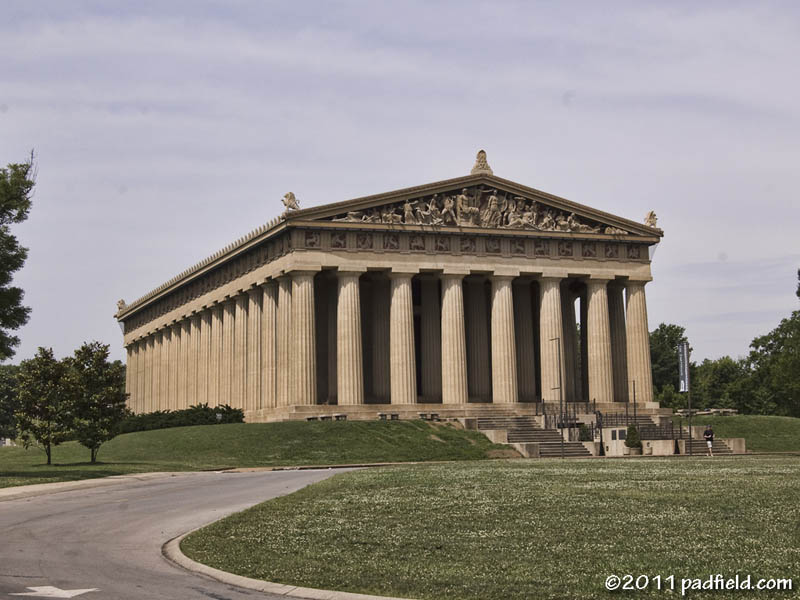
The Parthenon in Nashville, Tennessee. Photo by David Padfield.

The Parthenon in Nashville, Tennessee. Photo by David Padfield.

The next photo shows the statue of Athena as it is displayed in the Parthenon.

Athena in the Parthenon in Nashville, Tennessee. Photo by David Padfield.

Athena in the Parthenon in Nashville, Tennessee. Photo by David Padfield.

Think of the glory of the original Parthenon and the statue of Athena on the Acropolis in Athens. Paul certainly saw the building and may have seen the statue of Athena that was then inside the building.

Now while Paul was waiting for them at Athens, his spirit was being provoked within him as he was observing the city full of idols. (Acts 17:16 NAU)

“Being then the children of God, we ought not to think that the Divine Nature is like gold or silver or stone, an image formed by the art and thought of man. (Acts 17:29 NAU)

You may read more about the Nashville Parthenon at the official city website here.
Lystra — Barnabas is Zeus and Paul is Hermes

G. Walter Hansen comments on the religious life of Galatia and the importance of Zeus and Hermes to the people who lived there.

Zeus was the most widely worshipped god in Galatia; temples to Zeus were ubiquitous. Zeus was often linked with other gods. In the territory of Lystra there are carvings and inscriptions which show Zeus accompanied by Hermes. An inscription found near Lake Sugla is a dedication to Zeus of a sundial and a statue of Hermes. The names of the dedicators are Lycaonian. A stone altar near Lystra is dedicated to “the Hearer of Prayer [presumably Zeus] and Hermes.” A relief near Lystra depicts Hermes with the eagle of Zeus. In Lystra a stone carving shows Hermes with two other gods, G and Zeus. (Gill and Gempf, The Book of Acts in its First Century Setting, Vol. 2: Graeco-Roman Setting, 393)

This evidence, says Hansen, provides the setting for the events of Paul and Barnabas at Lystra. Luke describes the reaction of the Lystrans when they saw Paul heal a lame man.

When the crowds saw what Paul had done, they raised their voice, saying in the Lycaonian language, “The gods have become like men and have come down to us.”  And they began calling Barnabas, Zeus, and Paul, Hermes, because he was the chief speaker.  The priest of Zeus, whose temple was just outside the city, brought oxen and garlands to the gates, and wanted to offer sacrifice with the crowds.  (Acts 14:11-13 NAU)

Bruce reminds us that “Zeus was the chief god in the Greek pantheon; Hermes, the son of Zeus by Maia, was the herald of the gods” (The Book of the Acts, NICNT, 292).

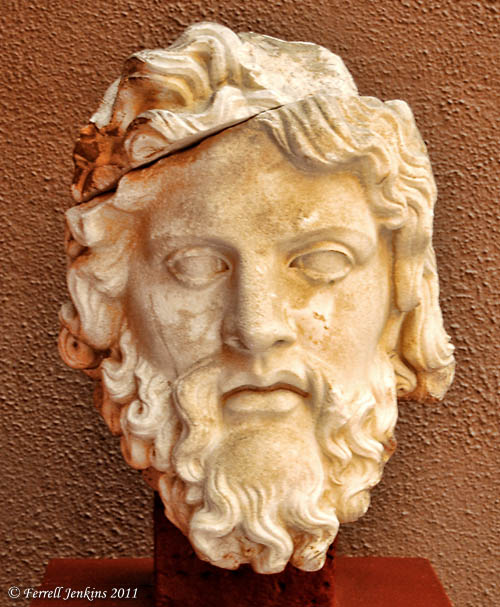
Our photo of Zeus is of a bust displayed in the archaeological museum at Ephesus.

Bust of Zeus in the Ephesus Museum. Photo by Ferrell Jenkins.

Bust of Zeus in the Ephesus Museum. Photo by Ferrell Jenkins.

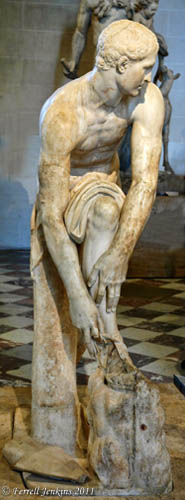
Paul was called Hermes because he was the chief speaker. Hermes was the messenger of the gods. How appropriate that our word hermeneutics, coming from the name Hermes, is used to describe the important work of interpreting the Scriptures. I have heard some speakers make fun of the word and then proceed to say that a certain phrase in the Scripture means … ! The photo below shows Hermes tying on his sandal in preparation for delivering a message. Some may recognize Hermes as the Latin Mercury, who is used as the symbol for the floral industry.

Hermes Putting on Sandal. Louvre. Photo by Ferrell Jenkins.

Hermes Putting on Sandal. Displayed in the Louvre. Photo by Ferrell Jenkins.

The King James Version used the Latin terms Jupiter and Mercurius in Acts 14:12. Bruce says this is “due to an old and foolish fashion of replacing Greek proper names by their Latin equivalents in English translations from the Greek.”

Illustrations from Lystra

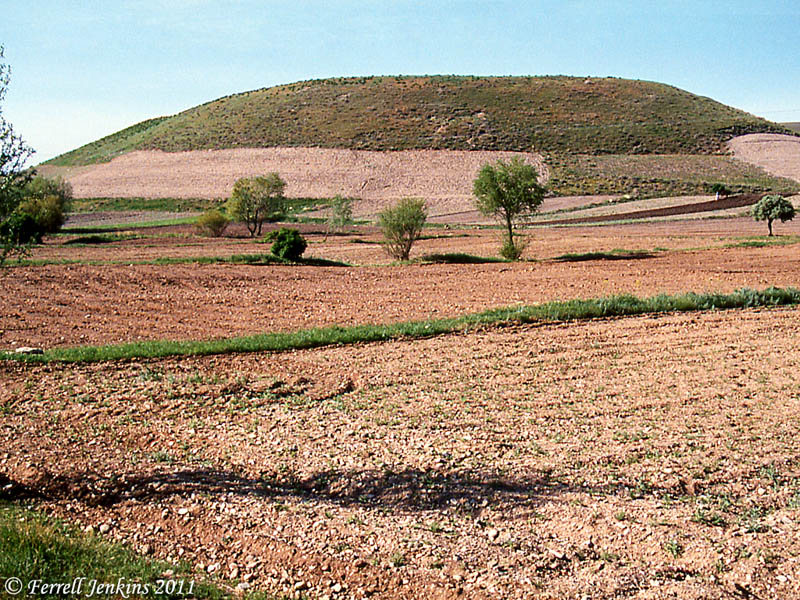
Looking through some slides, I found a nice photo of Lystra. In this photo from 1987 you will see that farmers have plowed the slopping side of the tell as far as practical. Often we see crops growing on the top of a tell, especially one that has not been excavated.

Lystra. 1987 Photo by Ferrell Jenkins.

Lystra. 1987 Photo by Ferrell Jenkins.

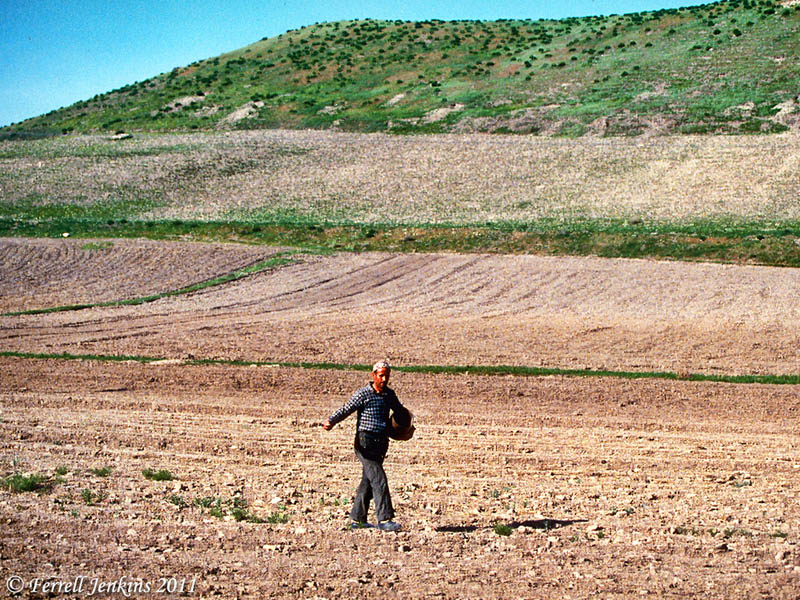
From another year, likely in the 80s, the sower is broadcasting seed. This is a practice that I saw frequently while growing up in the rural South. We rarely see this practice in the modern days of mechanization either in the USA or in the Bible World.

Sower at Lystra. Photo by Ferrell Jenkins.

Sower scattering seed at Lystra. Photo by Ferrell Jenkins.

The practice of the sower scattering seed is mentioned several times in the Bible. Notice Isaiah 55:10-11.

For as the rain and the snow come down from heaven, And do not return there without watering the earth And making it bear and sprout, And furnishing seed to the sower and bread to the eater;  So will My word be which goes forth from My mouth; It will not return to Me empty, Without accomplishing what I desire, And without succeeding in the matter for which I sent it.  (Isaiah 55:10-11 NAU)

Notice Paul’s use of the Isaiah text in 2 Corinthians 9:10.

We think also of the parables of Jesus.

3 And He spoke many things to them in parables, saying, “Behold, the sower went out to sow;  4 and as he sowed, some seeds fell beside the road, and the birds came and ate them up.  5 “Others fell on the rocky places, where they did not have much soil; and immediately they sprang up, because they had no depth of soil.  6 “But when the sun had risen, they were scorched; and because they had no root, they withered away. 7 “Others fell among the thorns, and the thorns came up and choked them out. 8 “And others fell on the good soil and yielded a crop, some a hundredfold, some sixty, and some thirty.  9 “He who has ears, let him hear.” (Matthew 13:3-9 NAU)

Thanksgiving — 2011

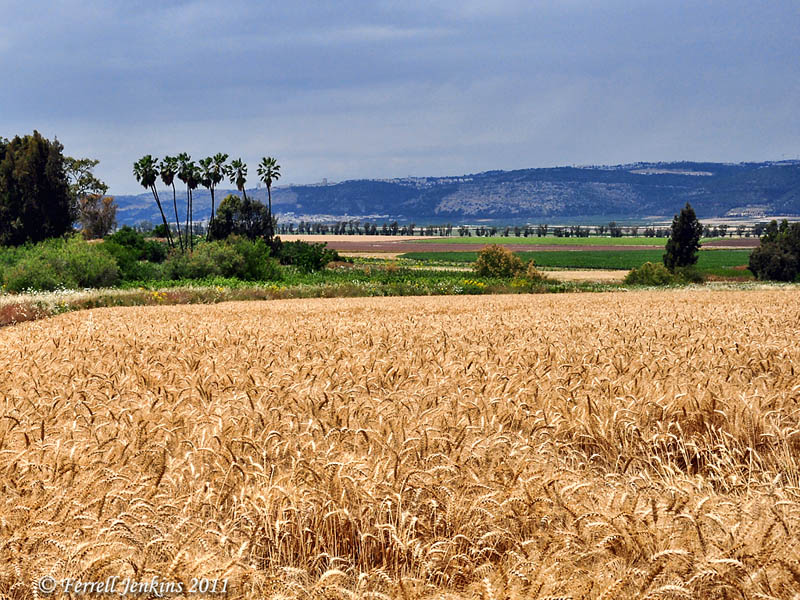
Abundant wheat fields near biblical Endor. Photo by Ferrell Jenkins.

Abundant wheat fields near biblical Endor. Photo by Ferrell Jenkins.

I will give thanks to the LORD with all my heart; I will tell of all Your wonders. (Psalm 9:1 NAU)

Enter His gates with thanksgiving And His courts with praise. Give thanks to Him, bless His name. (Psalm 100:4 NAU)

Let us come before His presence with thanksgiving, Let us shout joyfully to Him with psalms. (Psalm 95:2 NAU)

I will praise the name of God with song And magnify Him with thanksgiving. (Psalm 69:30 NAU)

Be anxious for nothing, but in everything by prayer and supplication with thanksgiving let your requests be made known to God. (Philippians 4:6 NAU)

New insights into the clothing of the Qumran inhabitants

The recent edition of Dead Sea Discoveries has an article by Orit Shamir and Naama Sukenik on “Qumran Textiles and the Garments of Qumran’s Inhabitants.” The article costs $35 from Brill. To order click here. Here is the abstract.

Among the Qumran textiles that were kept at the Rockefeller Museum was a group of textiles that were unusual for Qumran. Most of them were made of wool, and some were dyed or decorated. Their marking QCC—Qumran Christmas Cave indicates their origin. In 2007 the cave was investigated by Porat, Eshel, and Frumkin. The cave is located in the bottom section of Kidron valley and doesn’t belong to Qumran caves. It can now be determined that all of the textiles from Qumran are made solely of linen. They were free of any colored decoration, except for scroll wrappers that decorated in blue. This, and the simplicity and whiteness of the textiles from Qumran, is compatible with the literary sources. It appears that the people of Qumran wished to differentiate themselves from the rest of the population also on the basis of their style of garments.

A popular article based on the technical paper appears in LiveScience here. Some speculation about the writers of the scrolls is based on the cloths found with the scrolls. Look also for an Image Album of 8 captioned photos including the textiles from Qumran and the Christmas Cave.

Most of the cloth wrappings found at Qumran were white and made of linen. The wrappings found at Christmas Cave were colorful and made of wool. The Mosaic law was clear about the clothing to be worn by the Israelites.

Do not wear clothes made of both wool and linen. (Deuteronomy 22:11 CSB)

Jodi Magness cites the War Scroll to illustrate that the “Qumran sectarian clothing must be made entirely of linen” (Stone and Dung, Oil and Spit, 116).

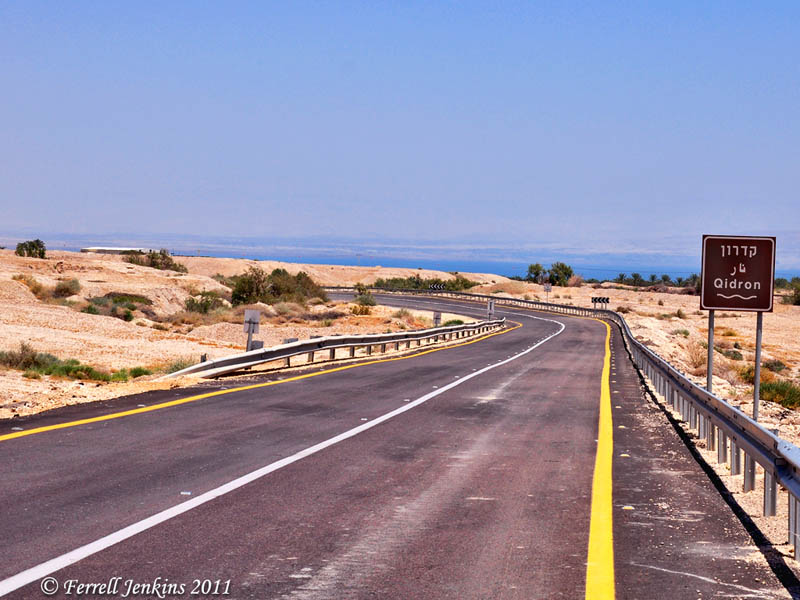
Most Bible students probably think of the Kidron valley running north to south between Jerusalem and the Mount of Olives. That is correct, except that the brook joins with the Hinnom valley and continues east to the Dead Sea.

The photo below was made about 4.25 miles south of Qumran along the Dead Sea Road (Hwy. 90) as it crosses the brook Kidron (Qidron). The Christmas Cave mentioned in the article is to the west (left) of the highway as the brook comes down from Jerusalem. (Click on the photo for a larger image.)

Location of the Brook Kidron on Dead Sea Road (view north). Photo by Ferrell Jenkins.

Crossing Brook Kidron on Dead Sea Road (view northeast). Photo by Ferrell Jenkins.

When David fled from Jerusalem at the time of Absalom’s rebellion, he crossed the Kidron “toward the way of the wilderness.”

Everyone in the countryside was weeping loudly while all the people were marching past. As the king was crossing the Kidron Valley, all the people were marching past on the road that leads to the desert. (2 Samuel 15:23 CSB)

HT: Joseph I. Lauer

The Patriarchs lived in the Negev

English Bibles translate the Hebrew word negev in a variety of ways.

  • South — KJV; NKJV
  • “the South [country]” is the Translator’s Note in the NET Bible. A study note says, “Negev is the name for the southern desert region in the land of Canaan.”
  • Negeb — ESV
  • Negev — most modern English versions.
  • eremos — the word for desert or wilderness is used in the LXX. This word does not describe the Negev precisely enough.

I am away from home and most of my resources, but I recall hearing the late Anson Rainey describe the Negev like the figure 8. Turn the 8 horizontal with Beersheba in the center. The area is one that is often subject to drought and famine.

The Patriarchs, Abraham, Isaac, and Jacob spent much time in the Negev (Genesis 12:9; 13:1,3; 20:1; 24:62).

The Israelite spies were sent by Moses from the Sinai to investigate Canaan. The text makes it clear that they had to go through the Negev to get to the hill country and Hebron. Hebron is only about 25 miles north of Beersheba. Once we head south from Hebron we begin to notice a change from the hill country to a more dry clime.

When Moses sent them to investigate the land of Canaan, he told them, “Go up through the Negev, and then go up into the hill country (Numbers 13:17 NET)

When they went up through the Negev, they came to Hebron… (Numbers 13:22 NET)

The Canaanite king of Arad lived in the Negev (Numbers 21:1). Arad is located east of Beersheba as the land slopes down to the Dead Sea.

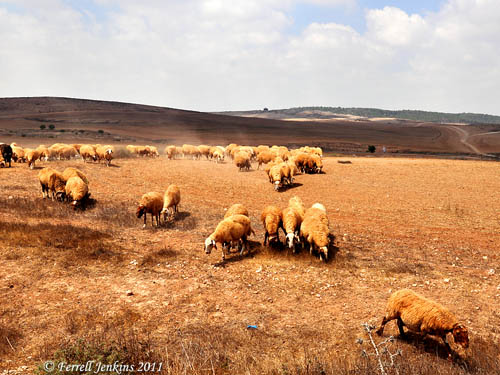
Our photo today was made a few miles north of Beersheba. I think it illustrates the typical dryness of the region.

Sheep in the Negev. Photo by Ferrell Jenkins.

Sheep in the Negev. Photo by Ferrell Jenkins.

Keep your lamps burning

Light is necessary for life and growth. We are introduced to light in the biblical account of creation.

And God said, “Let there be light,” and there was light.  And God saw that the light was good. And God separated the light from the darkness.  God called the light Day, and the darkness he called Night. And there was evening and there was morning, the first day.  (Genesis 1:3-5 ESV)

Of Jesus, the Gospel of John says, “In him was life, and the life was the light of men” (John 1:4 ESV).

David spoke of meditating on God during the watches of the night (Psalm 63:6). He watched his sheep by night, but most work was not done in the night prior to the introduction of electric power. We used one Aladdin lamp and a few kerosene lamps in our home in the rural South until I was about 8 or 10 years old. Then we began to use a single electric bulb in a room when we needed to be in the room.

Jesus said,

We must work the works of of him who sent me while it is day; night is coming, when no one can work.  As long as I am in the world, I am the light of the world” (John 9:4-5 ESV).

Herodian period lamp burning. Photo by Ferrell Jenkins.

Herodian period lamp from the time of Jesus. Photo by Ferrell Jenkins.

The photo above is one of the Herodian period lamps I have purchased in the Bible lands over the past 44 years. Two or three times I have used some olive oil (or Wesson oil, or a small piece of a candle) to show how much light the lamp gives.

In the parable of the watchful slaves Jesus said,

“Stay dressed for action and keep your lamps burning,  and be like men who are waiting for their master to come home from the wedding feast, so that they may open the door to him at once when he comes and knocks. (Luke 12:35-36 ESV)

The Apostle Paul commanded the saints at Philippi to shine as lights in the world.

Do all things without grumbling or questioning,  that you may be blameless and innocent, children of God without blemish in the midst of a crooked and twisted generation, among whom you shine as lights in the world, (Philippians 2:14-15 ESV)

Finally got the photo uploaded

I was unable to upload one of the photos about goats in the Sinai peninsula earlier. Finally got it uploaded. If you missed seeing the photo of the nanny goat caring for the newborn kid, please take a look now.

Goats in the Bible world

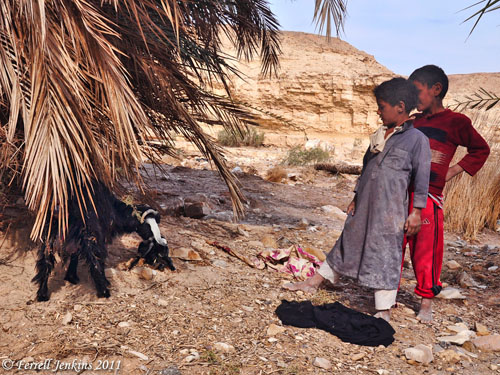
Travel in the Middle East provides many illustration similar to life in Bible times. We are more likely to see these illustrations where we have less modernization. The photos I wish to share today come from the Sinai peninsula. Last January we stopped at a Bedouin settlement on the way from the Suez Canal to Mount Sinai. Our timing was good. A goat had just given birth to a kid. While the nanny was keeping the kid moving around, two of the Bedouin boys were standing by keeping watch. Remembering my own childhood on a farm, I am sure the boys could hardly contain themselves from helping the kid. They had probably been told many times that it would be a big mistake to do so.

Bedouin boys keeping watch over a goat and newborn kid. Photo by Ferrell Jenkins.

Bedouin boys keeping watch over a goat and newborn kid. Photo by Ferrell Jenkins.

The earliest biblical reference to the goat is in Genesis 15:9, the account of Abraham’s sacrifice after the giving of the land covenant. A three year old female goat was among the animals offered. The LORD later commanded Israel to offer goats in their sacrifices.

This photo shows the nanny’s care for the still-wet newborn.

Mother goat cares for newborn kid in the Sinai Peninsula. Photo by Ferrell Jenkins.

Mother goat cares for newborn kid in the Sinai Peninsula. Photo by Ferrell Jenkins.

Goats were used for food. In Rachel’s attempt to have Isaac bless Jacob she prepared “delicious food” for Isaac.

Now therefore, my son, obey my voice as I command you. Go to the flock and bring me two good young goats, so that I may prepare from them delicious food for your father, such as he loves. And you shall bring it to your father to eat, so that he may bless you before he dies. (Genesis 27:8-10 ESV)

Goats’ hair and goatskins were used In the construction of the Tabernacle (Exodus 25:4-5 et al.).

The goat was among the clean animals that could be eaten (Deuteronomy 14:4).

One of the wise sayings of Solomon mentions goats’ milk for food.

There will be enough goats’ milk for your food, for the food of your household and maintenance for your girls. (Proverbs 27:27 ESV).

Making your enemies your footstool

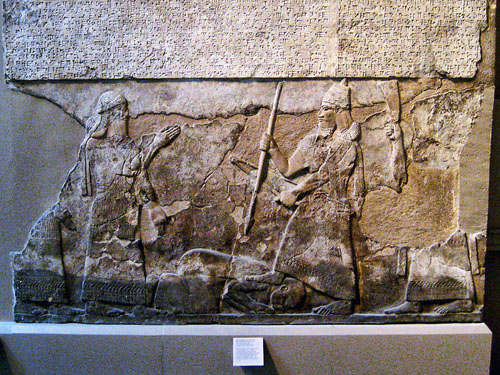
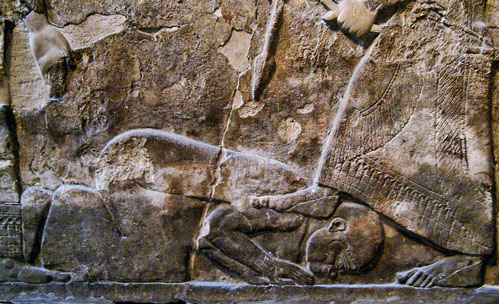
A common motif found in Ancient Near East reliefs shows a monarch placing his foot on his enemy. One illustration of this is the large relief showing the Assyrian King Tiglath-Pileser III (reigned 745-727 B.C.) with his foot on the neck of an enemy. Tiglath-Pileser III is known as Pul in the Bible.

Pul king of Assyria invaded the land, and Menahem paid him a thousand talents of silver to gain his support and to solidify his control of the kingdom. (2 Kings 15:19 NET)

So the God of Israel stirred up King Pul of Assyria (that is, King Tiglath-pileser of Assyria), and he carried away the Reubenites, Gadites, and half-tribe of Manasseh and took them to Halah, Habor, Hara, and the river of Gozan, where they remain to this very day. (1 Chronicles 5:26 NET)

The Assyrian relief below is displayed in the British Museum.

Tiglath-Pileser III Subjugates an Enemy. British Museum. Photo by Ferrell Jenkins.

Tiglath-Pileser III Subjugates an Enemy. British Museum. Photo by Ferrell Jenkins.

Here is a closeup of what we are seeking to illustrate.

Tiglath-Pileser III Puts His Foot on Neck of Enemy. British Museum. Photo by Ferrell Jenkins.

Tiglath-Pileser III Puts His Foot on the Neck of an Enemy. BM. Photo by Ferrell Jenkins.

Several biblical passages come to mind in this connection.

When they brought the kings out to Joshua, he summoned all the men of Israel and said to the commanders of the troops who accompanied him, “Come here and put your feet on the necks of these kings.” So they came up and put their feet on their necks. (Joshua 10:24 NET)

Here is the LORD’s proclamation to my lord: “Sit down at my right hand until I make your enemies your footstool!” (Psalm 110:1 NET)

Peter quotes Psalm 110:1 to show that Jesus is now seated on the throne of David at the right hand of God (Acts 2:35).

And Paul says,

For he must reign until he has put all his enemies under his feet. (1 Corinthians 15:25 NET)

The last enemy is death (1 Corinthians 15:26).