Category Archives: Culture

Elephantine Island

There are numerous ways to describe the location of Elephantine Island. It is an island in the Nile River at Aswan (= Syene in Ezekiel 29:10 and 30:6). Or we might say that the island is located at the first cataract of the Nile.

According to Budge, the earlier name for Elephantine was Abu. One way of writing the name of the island included the drawing of an elephant (E. A. Wallis Budge, The Gods of the Egyptians, II:51).

Various suggestions have been made regarding the origin of the name Elephantine. Some say the smooth rocks of the first cataract remind one of an elephant back. Others say, the island is shaped like an elephant tusk. Or, the island was the center of ivory trading in the past.

A small granite statue of an elephant has been uncovered on the extreme south end of the island. Aswan, you likely recall, was noted for its granite.

Granite Elephant on Elephantine Island, Aswan, Egypt. Photo by Ferrell Jenkins.

Granite Elephant on Elephantine Island, Aswan, Egypt. Photo by Ferrell Jenkins.

In the Septuagint Old Testament and in the New Testament the word elephantinos is translated ivory. You can think of Samaria’s famous beds of ivory, made from the tusks of elephants (Amos 6:4), or the unsold cargoes of the merchants who could no longer trade with the fallen Babylon [Roman Empire] (Revelation 18:12).

Monday Meandering — March 19

Greatest Finds. The Israel Ministry of Foreign Affairs has compiled a list of the “Greatest archeological finds in Israel” here with links. Places include Masada, Megiddo, Beit Guvrin-Maresha, Ashkelon, the City of David, Hazor, Dan, Herodion, Khirbet Qeiyafa, and Tel es-Safi (Gath), and others.

The Scale of the Universe 2 here. Fascinating. Requires Flash. Reminds me of two Biblical references.

 When I look at your heavens, the work of your fingers, the moon and the stars, which you have set in place,  4 what is man that you are mindful of him, and the son of man that you care for him? (Psalm 8:3-4 ESV)

For by him all things were created, in heaven and on earth, visible and invisible, whether thrones or dominions or rulers or authorities– all things were created through him and for him.  And he is before all things, and in him all things hold together.  (Colossians 1:16-17 ESV)

Marine Life in the Corinthian Gulf here. Beautiful photos.

The Acrocorinth. Wonderful, clear view of the mountain above ancient Corinth here. Carl Rasmussen has posted several other nice photos of Corinth recently.

A history of the Roman Empire in 75 seconds here.

The Burnt House. The headline in the Jerusalem Post read “House in Old City as Titus left it.” Leen Ritmeyer includes this and another news article, along with his reconstruction of the Burnt House here.

Geopolitics of Israel. Every student of Bible geography will enjoy the analysis of the geopolitics of Israel by the Stratfor Global Intelligence here.

2,000-year-old Israeli date palm. Has it been trumped by a 32,000-year-old Russian flower? Tom Powers provides some links about the palm which is now about 8 feet tall, here.

HT: Aren Maeir; NT Resources Blog; Corinthian Matters; Luke Chandler’s Blog; Bible Places Blog.

“Beware the ides of March”

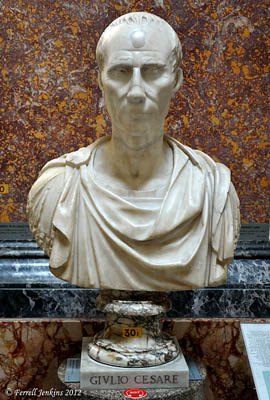
Bust of Julius Caesar in Vatican Museum. Photo by Ferrell Jenkins.

Bust of Julius Caesar in the Vatican Museum. Photo by Ferrell Jenkins.

Shakespeare has the Sootsayer warn Caesar, “Beware the ides of March.” The ides of March was used to describe the 15th of March in the Roman calendar. It was on that day that Julius Caesar was assassinated in 44 B.C. As a result, the expression has come to have a sense of foreboding — a sense that something bad is about to happen.

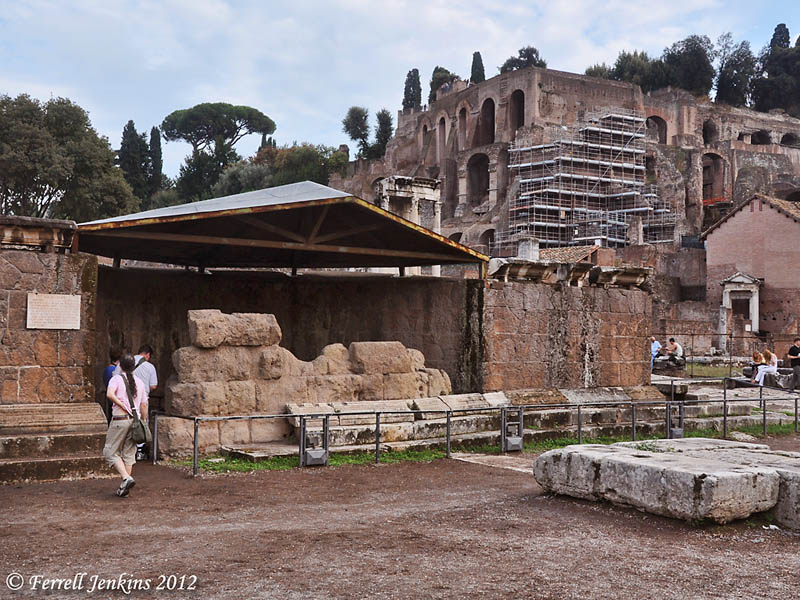
Our photo below shows the place in the Roman Forum where a temple was built to honor Julius Caesar by Augustus in 29 B.C. The deification of rulers was already common in the eastern part of the Empire. This practice would become a serious problem for the Christians of the Roman Empire before the end of the first century A.D., especially those living in Asia Minor. This is one of the issues addressed in the Book of Revelation.

Ruins of the temple erected to Caesar in the Roman Forum. Photo by Ferrell Jenkins.

Ruins of the Temple erected to Caesar in the Roman Forum. Photo by Ferrell Jenkins.

The Jerusalem Syndrome

Each year about 50 visitors to Jerusalem have to be taken to a psychiatric ward because they are overcome with what they experience in the Holy City. In the worst cases individuals have come to believe that they are the Messiah, or that they are preparing the way for Him. Psychiatrists call this phenomenon the “Jerusalem Syndrome.”

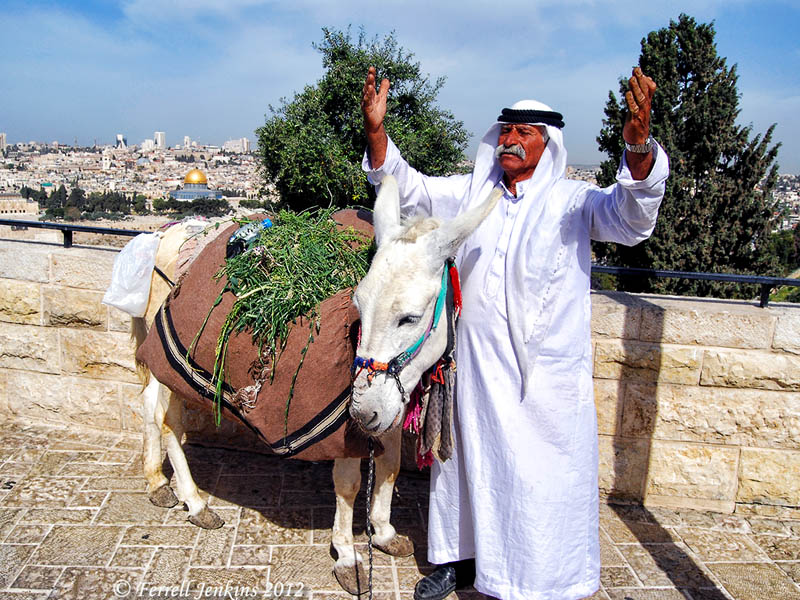
I have no idea who the fellow below thinks he is imitating, but I have dubbed him an “actor” — not someone who has been overcome with the Jerusalem Syndrome. Some might say that he is “John the Baptist, others say Elijah, and others Jeremiah or one of the prophets.” (Matthew 16:14 ESV)

An "actor" on the Mount of Olives. Photo by Ferrell Jenkins.

An "actor" on the Mount of Olives poses as a biblical character. Photo: Ferrell Jenkins.

Wired Magazine recently ran a fascinating article by Chris Nashawaty dealing with the Jerusalem Syndrome. He interviews Dr. Pesach Lichtenberg, head of the men’s division of psychiatry at Herzog Hospital in Jerusalem. Lichtenberg and Nashawaty visit the Old City of Jerusalem in search of a likely prospect for Jerusalem Syndrome. Read the article in its entirety here.

I had been unaware that visitors to Florence, Italy, experience a similar phenomenon when they “are overwhelmed by powerful works of art.” There, it is called Stendhal syndrome after the writer who described it in the early 19th century. Japanese tourists are especially subject to Paris syndrome while visiting the City of Light.

The sights of Jerusalem are truly impressive, and some tourists who tend to be emotional are often brought to tears by what they see and hear.

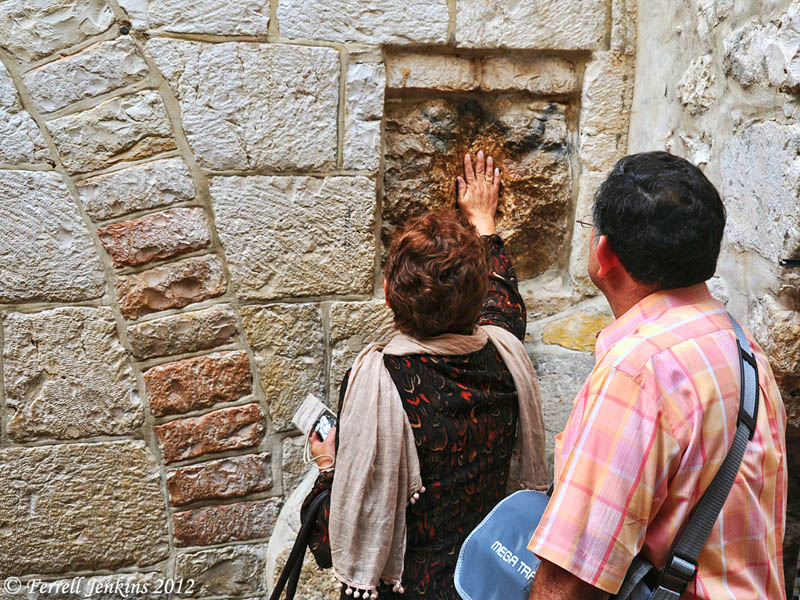
A woman places her hand on a stone at the fifth station of the cross. Photo by Ferrell Jenkins.

A woman places her hand on a stone at the fifth station of the cross. Some say this is a stone touched by Jesus on His way to the crucifixion. Photo by Ferrell Jenkins.

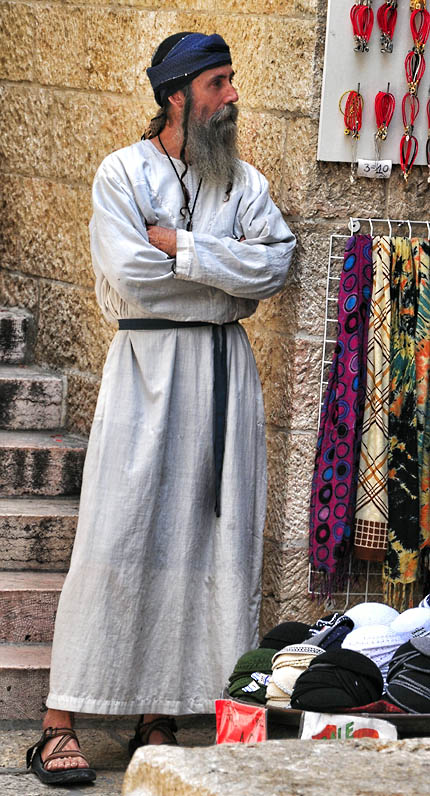
It is not every day that you see someone like this selling jewelery and souvenirs.

Vendor in the Jewish Quarter of Jerusalem. Photo by Ferrell Jenkins.

Vendor in the Jewish Quarter of Jerusalem. Photo by Ferrell Jenkins.

We ran a brief note about the Jerusalem Syndrome about four years ago here.

HT: Either Jack Sasson or Joseph Lauer (perhaps both), but I have misplaced the Email.

Discovery of 20 mummies & wooden sarcophagus at Aswan, Egypt

Euro Weekly announces,

ARCHAEOLOGISTS from [the Spanish] Jaen University found some 20 mummies and a wooden sarcophagus at a site in Aswan, Egypt.

The report says,

The main find is a tomb built for a provincial governor from the XII dynasty (1830BC) and a wooden sarcophagus in which a high-ranking person was buried.

The brief article may be read here.

Aswan is famous for its granite quarries. An unfinished obelisk, which would have been 137 feet long and weighing 1152 tons, remains in the quarry lying on its side. Holes were drilled into the stone at intervals of about 2 ½ feet and wooden pegs were placed in them. As water was poured over the pegs they expanded to separate the obelisk from the surrounding stone.

Aswan Quarry with the unfinished obelisk. Photo by Ferrell Jenkins.

Aswan Quarry with the unfinished obelisk. Photo by Ferrell Jenkins.

Aswan is known as Syene in Ezekiel 29:10 and 30:6. The expression, “from Migdol to Syene and even to the border of Ethiopia” is similar to the familiar “from Dan to Beersheba.” Migdol was in the far northeast of the country, and Syene was near the southern border. The writer means the entire country.

HT: Jack Sasson

Visual illustrations for Daniel 8

In Daniel’s vision of a ram and a male goat we are given a glimpse of the two world empires following Babylon — the Medo-Persian Empire and the Alexandrian (or Hellenistic/Grecian) Empire.

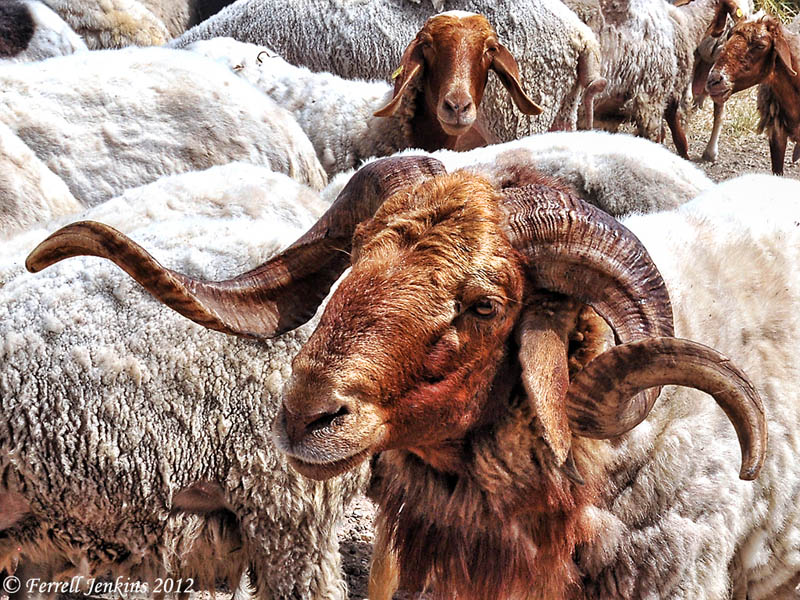
Daniel sees a ram.

I raised my eyes and saw, and behold, a ram standing on the bank of the canal. It had two horns, and both horns were high, but one was higher than the other, and the higher one came up last. (Daniel 8:3 ESV)

Ram at Socoh. Photo by Ferrell Jenkins.

A ram. With horns like that it is easy to see who is boss. Photo by Ferrell Jenkins.

In apocalyptic literature the visions take liberty with reality. It would require an artist to draw the ram and the male goat exactly as Daniel saw them.

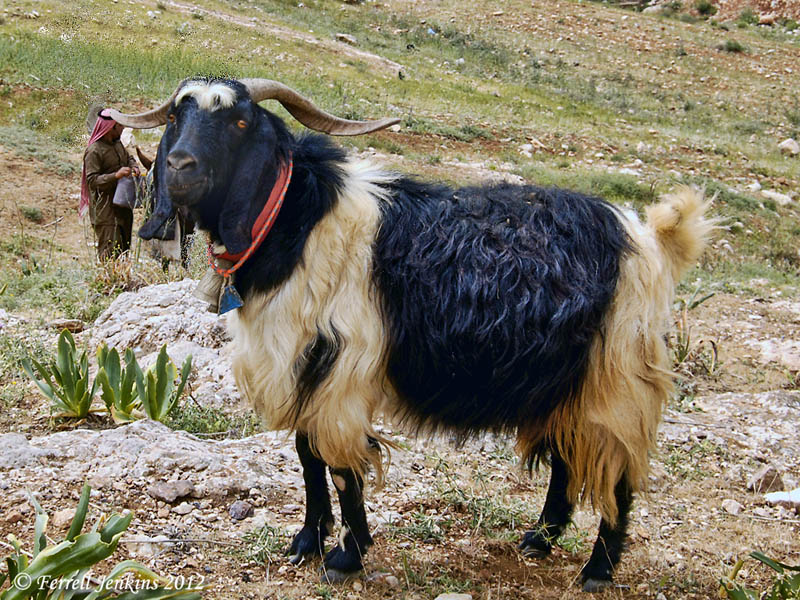
Then Daniel sees a male goat.

As I was considering, behold, a male goat came from the west across the face of the whole earth, without touching the ground. And the goat had a conspicuous horn between his eyes. (Daniel 8:5 ESV)

A male goat in Gilead (modern Jordan). Photo by Ferrell Jenkins.

A male goat in Gilead (modern Jordan). Photo by Ferrell Jenkins.

The interpretation is easier for us than it was for Daniel before Gabriel gave him an understanding of the vision (vs. 15-16).

As for the ram that you saw with the two horns, these are the kings of Media and Persia.  And the goat is the king of Greece. And the great horn between his eyes is the first king.  (Daniel 8:20-21 ESV)

It will not be difficult to find other uses for photos of the ram and the male goat in Bible lessons (e.g., Genesis 15:9; Leviticus 23:19; 16:5)

Cooking at 4th century Qatzrin

Golan in Bashan is first mentioned in the Bible in connection with the priestly cities of refuge that were appointed to Israel east of the Jordan (Deuteronomy 4:43; cf. Joshua 20:8; 1 Chronicles 6:71).

After modern Israel captured the Golan Heights from Syria in 1967, considerable efforts was made to identify Jewish villages that may have existed in the area. One such village was Qatzrin (pronounced kats-REEN). Archaeologist Anne Killebrew spent a decade or more working at the site and directing the reconstruction of the site which included a synagogue and several houses.

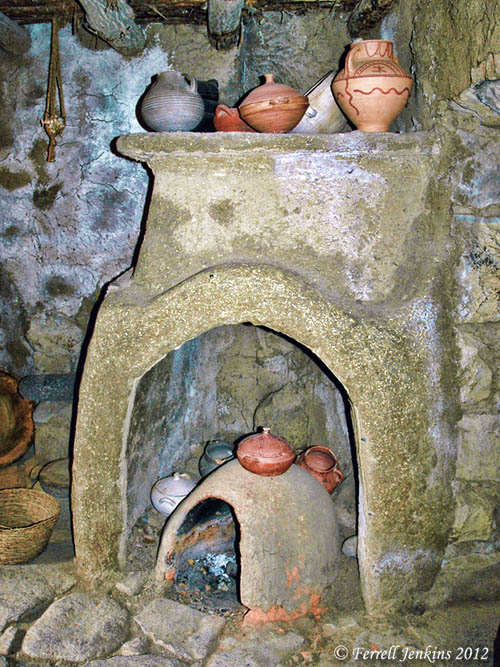
Qatzrin was originally built in the 4th century A.D. and remained in use till the mid-8th century. I wanted to show you the oven that we have from that village. The photo below shows a small clay oven placed within a mud-brick chimney. The chimney took the smoke out of the house and provided heat for the second floor bed room as well as for the kitchen. Not quite a microwave, but it wasn’t terribly different from the wood-burning stoves I knew as a child. (No, not in the 4th century!)

An oven inside a chimney at Qatzrin. Photo by Ferrell Jenkins.

An oven inside a mud-brick chimney at Qatzrin. Photo by Ferrell Jenkins.

Killebrew and Steven Fine wrote about “Qatzrin—Reconstructing Village Life in Talmudic Times” in Biblical Archaeology Review 17:03 (May/June 1991). The reconstruction of the oven and chimney are explained in a sidebar to the article.

The kitchen of the House of Rabbi Abun, seen on our cover, can be understood as a microcosm of the painstaking effort that went into the reconstruction of the whole house. The small domed oven at center stands within a mudbrick chimney. Excavated remains of this indoor oven—employed both for heating the house and for cooking in bad weather, when outdoor cooking was difficult—indicated the size and shape of the oven, a type still used by the Druze (a Moslem sect residing in the area). A portion of the chimney exits the roof in the corner, behind the period pottery on the chimney’s mantle, and rises high enough above the roof to create a draw that effectively pulls smoke out of the house. No remains of the original chimney were found, but the reconstruction was built, as was the rest the house, by Druze workmen using traditional styles and methods. Experiments have shown that this chimney works well.

Both Matthew and Luke record the statement of Jesus,

But if God so clothes the grass of the field, which today is alive and tomorrow is thrown into the oven, will he not much more clothe you, O you of little faith? (Matthew 6:30; cf. Luke 12:28 ESV)

The Greek word for oven or furnace (in a few English versions) is klibanos. According to BDAG it is used of “an oven (made of pottery),” exactly what you see in the photo.

Louw-Nida explains further:

a dome-like structure made of clay, in which wood and dried grass were burned, and then after being heated, was used for baking bread – ‘oven.’… ‘the grass of the field which is alive today and tomorrow is cast into the oven’ Mt 6.30. The function of klibanos may be described as ‘a place heated for baking bread,’…

After one gets the fire going with grass or other kindling, it was often kept going with dung cakes. See Ezekiel 4:15 for a biblical example.

Baking bread in Bible times

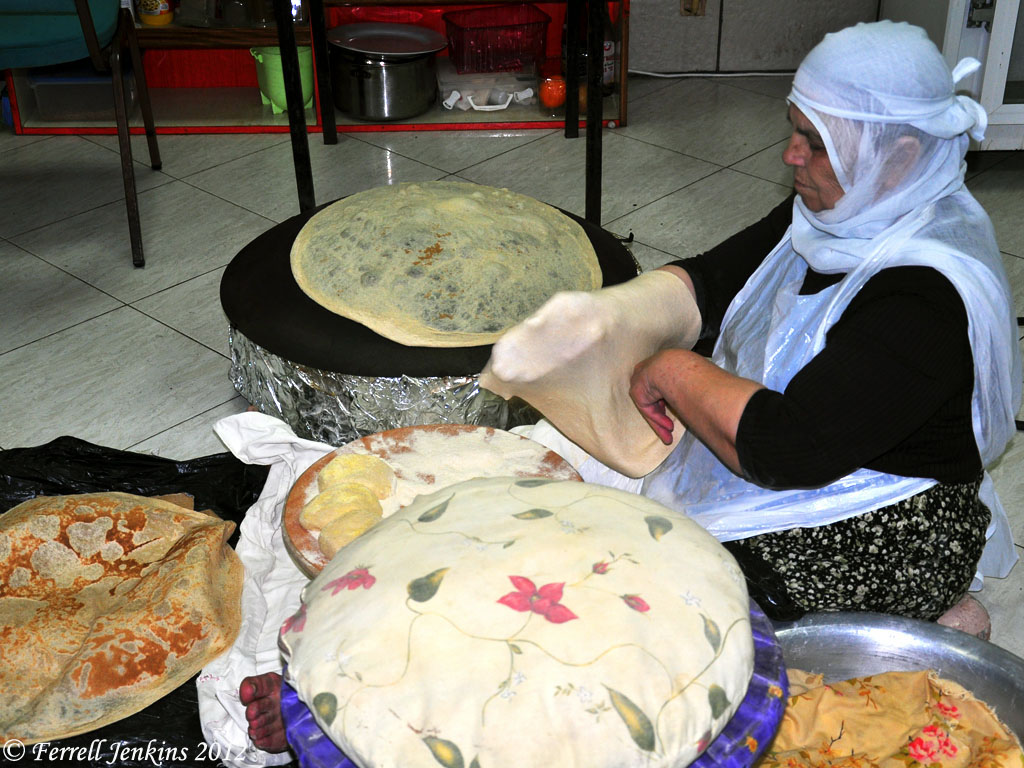
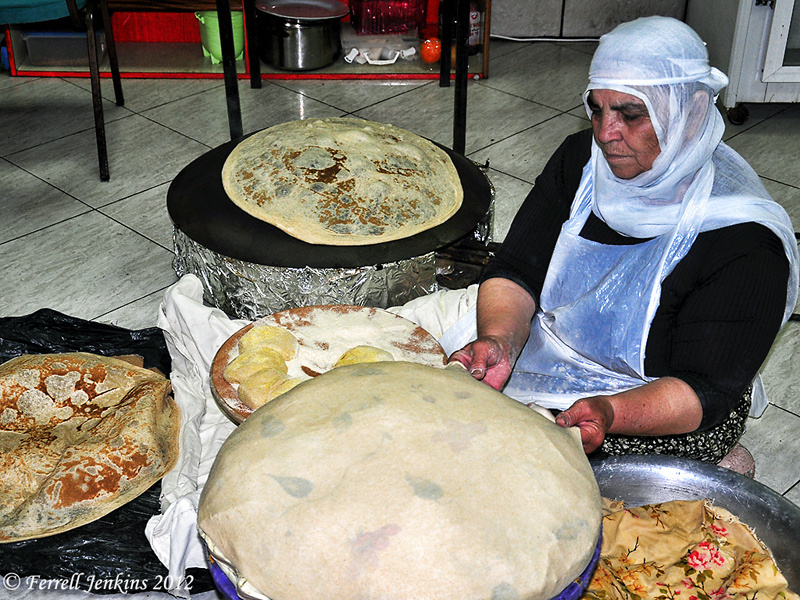
The Druze are especially noted in Israel for baking bread on a convex griddle. There are Druze villages on Mount Carmel and in the Golan Heights where the border with Israel and Syria come together. The photo below slows a woman preparing the dough for baking at a restaurant in the north of the Golan Heights at Birket Ram.

Druze woman preparing bread for baking at Birket Ram. Photo by Ferrell Jenkins.

Druze woman preparing bread for baking at Birket Ram. Photo by Ferrell Jenkins.

She will first place the dough on a rounded cushion which looks like a pillow (at the bottom of the photo).

After that she will turn it over on the griddle at the top of the photo. There you see bread cooking. To the left there is bread that has been taken from the griddle. Your chosen ingredients of meal and/or vegetables will be rolled in the thin bread.

Druze woman preparing bread for baking at Birket Ram. Photo by Ferrell Jenkins.

Druze woman preparing bread for baking at Birket Ram. Photo by Ferrell Jenkins.

I certainly am not an expert on cooking, nor even an expert on how this type of cooking might compare with some bread baking in Bible times. Ovens were often used by people of the Bible world, but some bread was cooked on a plate or griddle made of clay or iron.

King and Stager say,

“When a griddle (mahabat) of clay or iron (Ezek. 4:3) was used, it was set on stones over a pit in which a fire was kindled; then the dough was baked directly on the griddle” (Life in Biblical Israel, 66).

There are a few biblical references in which this type of griddle seems to be in mind.

And if your offering is a grain offering baked on a griddle, it shall be of fine flour unleavened, mixed with oil. (Leviticus 2:5; see also 6:21; 7:9 ESV)

For a visual aid, Ezekiel was told to take an iron griddle (plate, frying pan) and use it as an iron wall between himself and the city.

And you, take an iron griddle, and place it as an iron wall between you and the city; and set your face toward it, and let it be in a state of siege, and press the siege against it. This is a sign for the house of Israel. (Ezekiel 4:3 ESV)

Holladay’s Hebrew lexicon defines the Hebrew word for griddle as “(metal) plate, griddle for roasting & frying.”

I would write more, but I think I will go eat.

Jesus and the Moneychangers

We noted in a previous post that there are two accounts of Jesus cleansing the temple. By this we mean the temple precinct (the hieron), not the sanctuary where only priests were allowed (the naos). For the first account, early in his ministry, see John 2:13-25. The second account, toward the close of his ministry, is recorded in Matthew 21:12-13; Mark 11:15-18; and Luke 19:45-48.

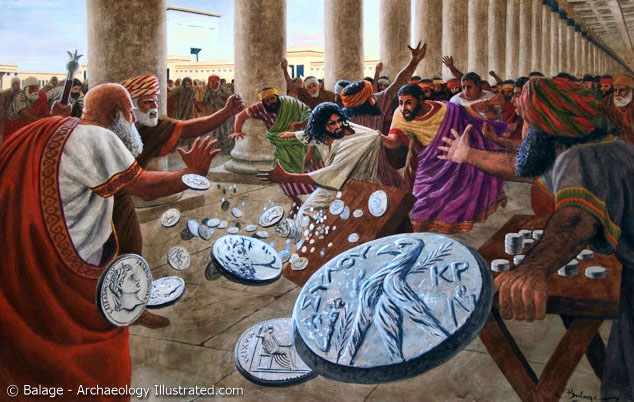
Artist Balage Balogh illustrates the scene of Jesus and the Money Changers. See more of his work at Archaeology Illustrated here.

Jesus and the Money Changers. Balage Balogh, Archaeology Illustrated.

Jesus and the Money Changers. Balage Balogh, ArchaeologyIllustrated.com.

The biblical account also mentions the animals and birds that were for sale to those coming to Jerusalem to worship (John 2:16; Matthew 21:12).

Money changers. (English versions use moneychagers, money-changers, and money changers.) The Jews normally would not bring the foreign money as an offering to the temple. The money had to be changed into the half-shekel of ancient Israel. This would necessitate money changers. Those who have traveled to foreign countries understand that money changers are common and necessary. Alfred Edersheim, who wrote a book on The Temple: Its Ministry and Services, pointed out that the total sum derived annually from the Temple tribute was large. The money changers were simply in the wrong place.

It is generally held that the coin used by the Jews for the temple tax was the Tyre shekel, which after 19 B.C. was most likely minted in Jerusalem (cf. Hendin, Guide to Biblical Coins, 175).

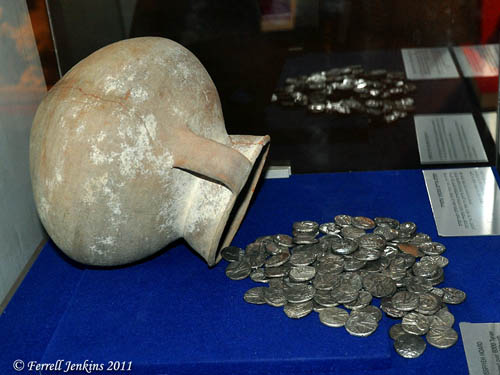
A hoard of coins including Tyrian Shekels, half shekels, and denarii bearing the image of  Roman Emperor Augustus (30 B.C.– A.D. 14) was found a few years ago at Ussifiyeh (Isfiya), a Druze village on Mount Carmel.

Ussifiyeh hoard of coins including Tyrian Shekels. Eretz Israel Museum.

Ussifiyeh hoard of coins including Tyrian Shekels. Photo by Ferrell Jenkins.

The information sign in the Eretz Israel Museum in Tel Aviv says,

The hoard probably represents a delivery of Temple tax intercepted and hidden away due to the events of the Jewish War which broke out in 66 C.E.

Click on the photo for an image large enough to use in classes and sermons.

The pollen is blowin’ in the wind

The unseasonably warm weather here in Florida has already begun to affect allergy sufferers, including yours truly. The pollen is not as high as it will be, but high enough to cause sniffling, sneezing and stuffiness. That’s nothing new. Keep reading.

The excavations at Ramat Rachel, between Jerusalem and Bethlehem, reveal evidence of etrogs and myrtle from the ancient royal garden. A word of explanation might be appropriate for some readers. English readers know Sukkot as the Feast of Booths, Tabernacles, or Temporary Shelters – Leviticus 23:34).

Ha’aretz reports here today:

The earliest evidence of local cultivation of three of the Sukkot [commonly know to English readers as the Feast of Booths or Tabernacles,  holiday’s traditional “four species” has been found at the most ancient royal garden ever discovered in Israel.

The garden, at Kibbutz Ramat Rachel in Jerusalem, gave up its secrets through remnants of pollen found in the plaster of its walls.

The garden was part of an Israelite palace at Ramat Rachel that has been excavated for many years, most recently in a joint dig by Prof. Oded Lipschits and Dr. Yuval Gadot of Tel Aviv University and Prof. Manfred Oeming of Heidelberg University. The palace existed from the time of King Hezekiah until the Hasmonean period in the second century B.C.E.

The excavations revealed that the garden must have had a beautiful – and strategic – view, but it lacked its own water source. Thus the ancient landscape architects had to build channels and pools to collect rainwater for irrigation.

The archaeologists discovered that the garden’s designers had removed the original hard soil and replaced it with suitable garden soil. But until recently, they had no idea what was grown there.

Then, Lipschits said, he and his colleagues had a “wild thought”: If plasterers had worked on the garden walls in springtime, when flowers were blooming, breezes would have carried the pollen to the walls, where it would have become embedded in the plaster.

Enlisting the aid of Tel Aviv University archaeobotanist Dr. Daphne Langot, they carefully peeled away layers of the plaster, revealing pollen from a number of plant species.
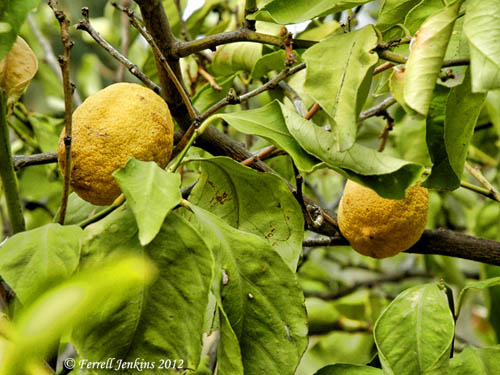
Etrog late in the season at Qatzrin. Photo by Ferrell Jenkins.

Etrog late in the season at Qatzrin. Photo by Ferrell Jenkins.

The article continues,

Most of the plants were wild, but in one layer of plaster, apparently from the Persian period (the era of the Jewish return from the Babylonian exile in 538 B.C.E. ) they found pollen from ornamental species and fruit trees, some of which came from distant lands.

The find that most excited the scholars was pollen from etrogs, or citrons, a fruit that originated in India. This is the earliest botanical evidence of citrons in the country.

Scholars believe the citron came here via Persia, and that its Hebrew name, etrog, preserves the Persian name for the fruit – turung. They also say royal cultivation of the exotic newcomer was a means of advertising the king’s power and capabilities.

The garden at Ramat Rachel is also the first place in the country to yield evidence of the cultivation of myrtle and willow – two more of the four species used in Sukkot rituals.
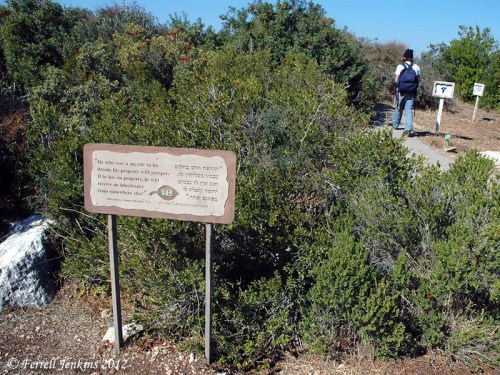
Myrtle growing at Neot Kedumim in Judean Hills. Photo by Ferrell Jenkins.

Myrtle growing at Neot Kedumim in Judean Hills. Photo by Ferrell Jenkins.

For an earlier post on the royal garden at Ramat Rachel, read here.

HT: Joseph Lauer