Category Archives: Books

Florida College Lectures on Logos Pre-pub

Yesterday I explained a little about Logos Bible Software and their Community Pricing and Pre-publication Specials. Today I want to tell you about a set of Pre-pub books that are of special interest to me.

Florida College is an accredited (by the Southern Association) private liberal arts college that for decades has offered four years of Bible studies. The college does not accept funds from churches, but the board, administration and faculty are members of Churches of Christ that are often designated as non-instiutional.

Accreditation as a junior college was granted to Florida College in the mid-1950s, but the college continued to offer four years of Bible studies. Biblical Studies was the first accredited Bachelor’s degree to be offered in 1997.

Since its beginning in 1946, Florida College (earlier named Florida Christian College) conducted an annual Bible lecture program. Beginning in 1974 the main lessons in these lectureships were published in book form from the manuscripts of invited speakers. The speakers were teachers and ministers associated with Churches of Christ.

Melvin Curry followed Homer Hailey as chair of the Bible department after Hailey’s retirement in 1973. Nineteen of the volumes were edited by Curry. After that, it came my turn to edit ten volumes while I served as chair of Biblical Studies. Since my retirement in 2001, Daniel Petty has served as department chair and edited the annual lecture book.
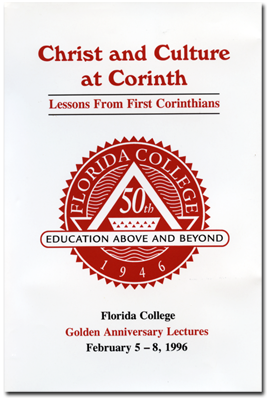
FC Lectures 1996

There are a total of 38 volumes (1974–2011) in the series. Some of these volumes have been out of print for several years.

The Logos web site offers the following overview of the lecture books:

The Florida College Annual Lectures (1974–2011) brings you thirty-eight years of the college’s annual lectures series in complete written form. Prior to the first published lecture series in 1974, only content outlines were available.

Each volume includes fifteen or more lectures from contributors from various biblical fields, and focus on a specific theme. These themes deal with modern issues and are supported by recent scholarship. Learn what true worship entails. Discover how God can restore your life. Challenge yourself to share the gospel message. The Florida College Annual Lectures (1974–2011) (38 vols.) contains both informative and stimulating topics that allow you to apply the biblical principles found in its lectures to your daily walk with Christ.

With Logos, every word is essentially a link! Scripture references are linked directly to the Bibles in your library—both the original language texts and English translations. Logos Bible Software allows you to quickly move from the table of contents to your desired content and search entire volumes and collections by topic, title, or Scripture reference, making Logos the perfect software to expand your understanding of the Word.

How Pre-publication works. Books on Pre-pub will not be produced until Logos sees that there are enough orders to make the publication feasible. Interested customers lock in the pre-pub price. You must set up an account with Logos, but your card is not charged until the book or set is ready to deliver. You will be notified when the book is ready. At that time you have a choice to continue or cancel. You may have to wait 6 months or more until the work is ready.

The deal is great. This 38 volume set of Florida College Lectures is available on Pre-pub for $74.95. This set is scheduled to sell for $174 when it is published. Even that is a bargain.

In order for this great resource to become a reality, Logos need a few more people to agree to buy the completed work. Help yourself, and others, in this worthy effort.

Think about these 38 volumes for $75. There are more than 600 lectures. That’s about 12 cents per lecture. Even mine are worth that. The entire collection is searchable, along with all other works you have in your Logos collection. When a Scripture reference appears, simply mouse over it and the Scripture is visible in your preferred version of the Bible.

In a previous post here I have explained that you must have a Logos base package, or already have Logos on your computer.

Logos Bible Software is the premier digital publishing format for books dealing with Biblical Studies. If you are serious about Bible study, you need to investigate Logos.

Meanwhile. Go to the Logos web site and place your Pre-pub order NOW. The sooner Logos publishes, the sooner we can begin to utilize the search features in this entire set. You can always get to the information by going to Logos.com. Look under Products for the Pre-publication Specials. The direct link to info about the Florida College Annual Lectures, with a list of every lecture, is here.
Logos Community Pricing

Logos Bible Software has a feature called Community Pricing. It works like this. A book (or set) is chosen for publication. Interested persons are asked to place a bid on the completed digital publication. When there are enough bids to pay for publication the book is published. After the initial publication, the price goes up. I have purchased many Logos publications using Community Pricing and Pre-Publication Specials.

To use the Community Pricing or Pre-Pub specials you must already have Logos (or the older Libronix) on your computer. You may purchase a base package from Logos (here), or buy a relatively inexpensive set of books from someone like Rejoice Christian Software. I suggestion you buy something like the  Baker New Testament Commentary ($79.95 here), the Norman Geisler Apologetics CD-Rom Library ($29.95 here), or one of the other great specials they offer.

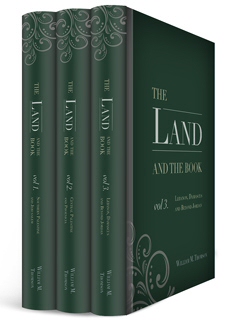
thompson_land-and-the-bookHere is a Community Pricing special too good to miss for anyone interested in the land of the Bible: The Land and the Book by William M. Thomson. This is an old work that is rich in information about the land and the culture of the Bible land.

Rich with scriptural landmarks and filled with hundreds of beautiful pen-and-ink illustrations, Thomson’s The Land and the Book has been a popular classic for over 100 years. Learn more about the people, places, and historical events behind the text you’re studying. Incorporate pictures, illustrations, and graphics into sermons, school papers, or Sunday school lesson plans. Whether you are a student, pastor, scholar, or layperson, the 3-volume Land and the Book is a must-have resource for Bible study or reading.

A work like this does not replace current studies, but it supplements them. Just go to Logos (here) and bid $18 on this work. If it sells for less you will pay less.
In the next post I will share another special pre-pub bargain.

Clarence Stanley Fisher — Armageddon

Clarence Stanley Fisher was trained as an architect at the University of Pennsylvania in his hometown of Philadelphia. He became involved in archaeology at Nippur, Iraq (the region of ancient Sumer). Later he worked with George Andrew Reisner at Giza, Egypt, and then at Samaria from 1908 to 1910. This expedition, sponsored by Harvard, was the first American excavation in Palestine. After a short time back at Giza, he excavated at Beth Shan (Beit She’an), a dig sponsored by the University of Pennsylvania.

Fisher received an invitation from the University of Chicago to work at Megiddo, a work funded by the Rockefeller family. This excavation continued from 1933 to 1939, but fisher stopped working at the site after two years because of bad health.

The Megiddo excavations were recounted by Fisher under the title The Excavation of Armageddon, a work published by the University of Chicago Press with a foreword written by James Henry Breasted. This work is available at Google Books.

From 1936 to the time of his unexpected death in 1941, Fisher served as Professor of Archaeology at the American Schools of Oriental Research in Jerusalem (now the Albright Institute).

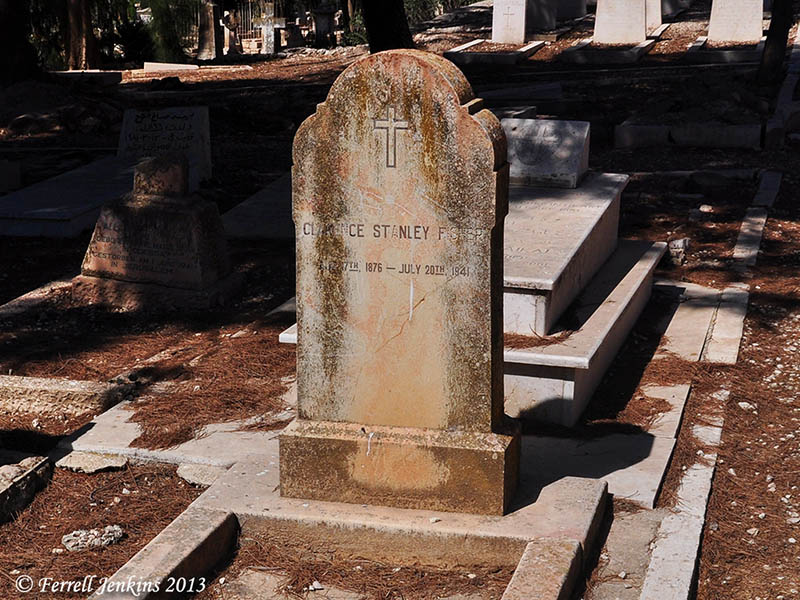
Fisher is buried at the Protestant Cemetery on Mount Zion in Jerusalem.

Grave marker for Clarence Stanley Fisher. Photo by Ferrell Jenkins.

Grave marker for Clarence Stanley Fisher. Photo by Ferrell Jenkins.

The brief information I have included here is summarized from a brief article by Milton C. Fisher in Bible and Spade 6:2 (Spring 1993). I get the impression that Milton is not related to Clarence. Milton Fisher cites two comments about C. S. Fisher that I wish to quote here.

W. F. Albright described Fisher as “an archaeological genius of no mean quality.”

Nelson Glueck wrote the following at the time of his death:

“The company of his friends misses him sorely. The host of those who loved him for his goodness of heart and humility of spirit will cherish the memory of this gentle man, whose last pilgrimage was to Nazareth, and whose final resting place is in Jerusalem.”

I find it fascinating to see so many well-known names associated with Fisher when Americans and American institutions were actively working in the Middle East.

The Spafford grave in the Protestant Cemetery

How the Spaffords came to make Jerusalem their home is an interesting story, but I will leave it for you to read in Bertha Spafford Vester, Our Jerusalem: An American Family in the Holy City 1881–1949. It may be difficult to locate a copy of the book for a reasonable price, but it is available in Kindle format for $8.39. Click here: Our Jerusalem.

The members of the American Colony lived under a series of governments — the Turks, British, Jordanians, and Israelis. Horatio died in 1888 during the Turkish rule. The American Colony had secured a place for burials on the south eastern slope of the traditional Mount Zion overlooking the Hinnom Valley.

Before I can show you the grave marker of Horatio Spafford I should tell you about the desecration of his original grave. Toward the end of the 19th century, when the members of the American Colony needed a grave site, they learned that earlier burials had been removed and the remains placed “temporarily” in a large pit. After much effort, permission was granted by various ruling authorities for the bones to be gathered, and a small plot was granted for the burial of the American Colony members.

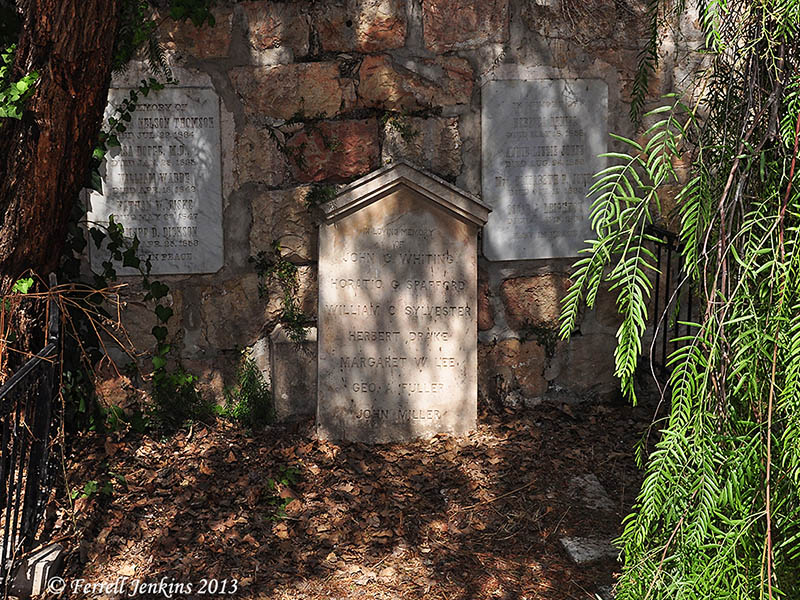
That small plot is pictured below. It is immediately inside the gate to the cemetery. The large marker identifies seven members of the American Colony whose remains were recovered: John C. Whiting; Horatio G. Spafford; William C. Sylvester; Herbert Drake; Margaret W. Lee; Geo. A. Fuller; John Miller. I have noticed at least four of these names in Vester’s Our Jerusalem. Whiting was also from Chicago. He and his family came to Jerusalem with the Spaffords, as did Margaret Lee.

Grave stone for Spafford and other members of the American Colony in the Protestant Cemetery on Mount Zion. Photo by Ferrell Jenkins.

Grave stone for Spafford and other members of the American Colony in the Protestant Cemetery on Mount Zion. Photo by Ferrell Jenkins.

The two smaller markers in the wall identify others whose bones were recovered and buried in the common grave.

In 1896 a group of 37 Swedish farmers left Nås, Sweden, and made their way to Jerusalem. They took up residence at the American Colony. (Vester says there were 38, including 17 children, and a babe in arms. Perhaps the infant was born after leaving Sweden.) The Swedes mostly engaged in farming in the nearby Kidron Valley. I think you would enjoy reading the comment to the last post written by reader Erik Wold. You may see his photographs of Nås and read his Norwegian comments here (use Google Translate if you do not read Norwegian). The Swedish writer Selma Lagerlöf won a Nobel prize for her novel called Jerusalem, which was based on the American Colony. Bertha Vester says that her mother, Anna Spafford, “is the heroine in her book and is called Mrs. Gordon.”

Something else that has fascinated me is the fact that Eric Matson and the American Colony photographers worked from this location. About 40 years ago I edited a series of Bible Class literature called Truth in Life. We used some of Eric Matson’s wonderful Bible land photographs in the series. For more information about the work of Matson and the other photographers see Life in the Holy Land. I think Matson was the heir of one of the settlers from Sweden.

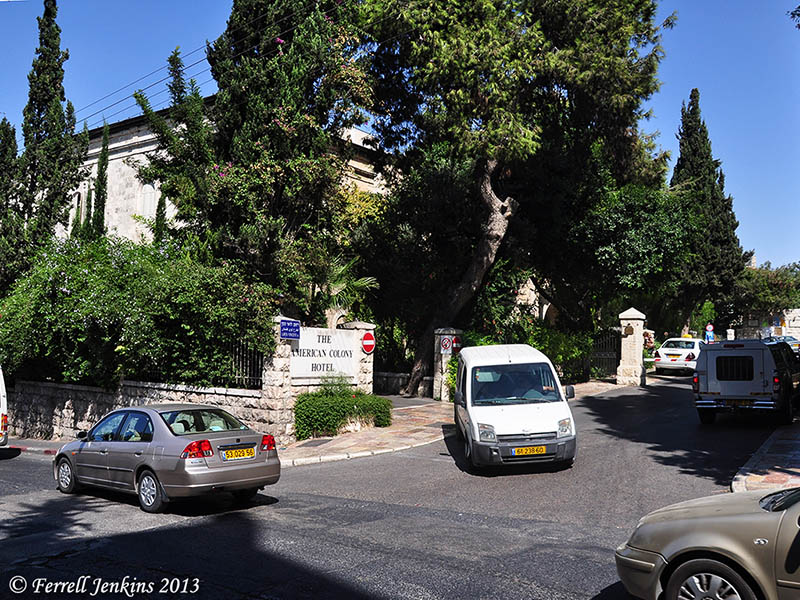
I do not know anything about the present ownership of the American Colony Hotel, but it is a prestigious 5-star luxury hotel.

Entrance to the American Colony Hotel, Jerusalem. Photo by Ferrell Jenkins.

Entrance to the American Colony Hotel, Jerusalem. Photo by Ferrell Jenkins.

Would you like to see more photographs from the Protestant Cemetery?

The new Satellite Bible Atlas

Todd Bolen announced Monday the publication of the Satellite Bible Atlas. This new work is by Bill Schlegel, Associate Professor of the Bible at IBEX in Israel. Bill has lived and taught in Israel since 1984. He taught at the Jerusalem University College (formerly the Institute of Holy Land Studies) before joining The Master’s College IBEX program in 1995.

According to Bolen,

This resource is ready for personal use, classroom use, and field trip use. The author, Bill Schlegel, has been teaching college and seminary students in Israel for 25 years. Everything in the Satellite Bible Atlas is field-tested by a professor who knows God’s land and loves God’s Word.

He continues to give 7 additional reasons why he loves the Satellite Bible Atlas. I will leave it for you to read more details at the Bible Places Blog here.

sba2000c-t

I have had the opportunity for several days to see the various materials associated with the Satellite Bible Atlas, but late Monday I received my beautiful copy and have found it to be an amazing production.

After 17 pages of beautiful satellite maps, the additional maps are printed on one page with a brief, numbered, commentary on the opposite page. For example, looking at map 5-1, Samuel’s Ministry, we see a marked map of the portion of the land where Samson was born, and the places of his activity. Map 9-4 shows Jesus’ Move from Nazareth to Capernaum. Map 10-1 shows Acts of the Apostles in Israel. While the emphasis is on the Promised Land and the history of Israel, Jesus and the Early Church, there are maps showing the Journeys of Paul, The First Revolt Against Rome (c. 66-73 AD), the Bar Kochva Revolt, Jerusalem, the modern Middle East, etc. Eighty-five maps in all.

This beautiful book is published in Israel. I am surprised that the book is available for $30 plus tax and $3 shipping (in the U.S.). You will also be granted access to download the maps.

More information and ordering instructions are available here. Sample Maps, Commentary, Study Questions, and an Index to Sites, are available for download. There are also some Teaching Videos, and more are expected from time to time.

New biography of C. S. Lewis by Allister McGrath

Allister McGrath, a native of Belfast, Ireland, and currently a professor of theology and apologetics at Kings College, London, announces that his  biography of C. S. Lewis is to be published this year.

In this video, McGrath speaks about the biography from the study of C. S. Lewis at the Kilns.

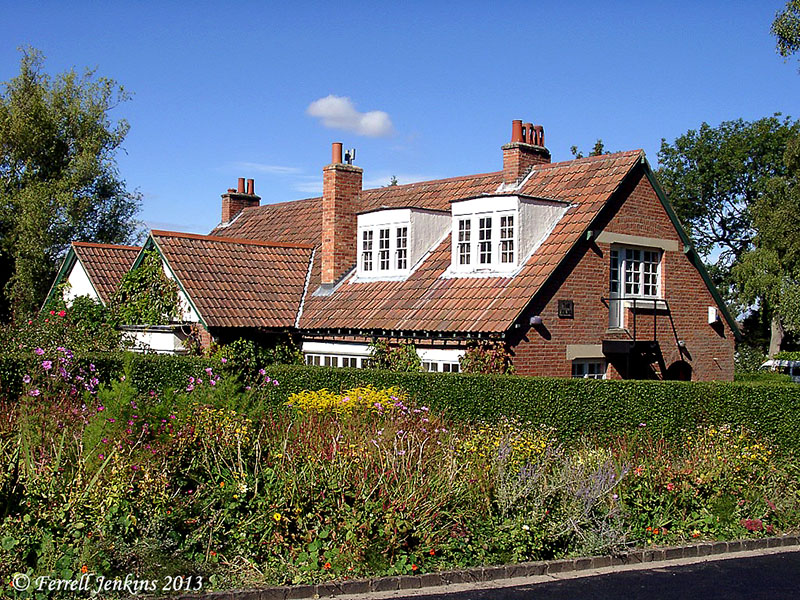
Several years ago I had the opportunity to visit Lewis sites in and around Oxford, England. The photo below shows the Kilns, former home of C. S. Lewis and his older brother Warnie. The house was not open for visitors at that time, but I understand it is now open at certain times.

The Kilns, Oxford, home of C. S. Lewis. Photo by Ferrell Jenkins.

The Kilns, former home of C. S. Lewis. Photo by Ferrell Jenkins.

If you have an interest in Lewis and his writing, you will probably enjoy looking at some of the other photos I made. Click here.

A new study guide for those who wish to understand the overall picture of the Bible

How do we deal with the problem of the person who does not know very much about the Bible and gets lost in some of our classes? I recall one time teaching Romans in a church class. I think we were already in chapter 11. A visitor came to the class. Toward the end of the class when I was entertaining questions, the visitor spoke up saying, “I don’t have any idea what you are talking about.” I sympathized with him and mentioned that we had set the stage for the current class over a period of months.

Marc Hinds, a former student of mine at Florida College, understands that many students need a general survey of the Bible. He has provided a solution for this problem in his newly published book by 21st Century Christian. The full name, The Big Picture: A Guide to Learning the Bible’s Story, explains what he is trying to do with this book. The book is suitable for classes of beginners or more advanced learners who haven’t yet understood the overall picture of the Bible.
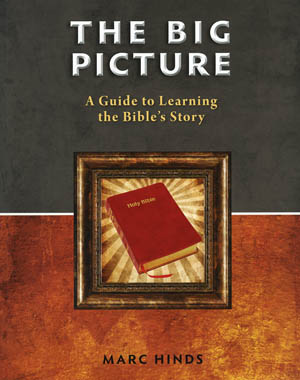
The Big Picture, by Marc Hinds.

The Big Picture, by Marc Hinds.

In this book of 15 lessons, you will find a brief survey of both the Old Testament and the New Testament. The book is printed in full color with many illustrations, photographs, and maps drawn (by Marc) specifically to illustrate the lesson. This book will be suitable for church classes, or individual home study.

The book may be ordered from 21st Century Christian, other bookstores, or Amazon here: The Big Picture: A Guide to Learning the Bible’s Story.

Limited time bargain on a great Bible atlas

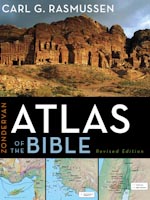
Christianbook.com is offering Carl Rasmussen’s Zondervan Atlas of the Bible for a limited time at the unusual price of $14.99. Click here.

zondervanatlascover01

I can’t promise that it will still be available by the time I get this posted, but you can try.

Update Noon  12-04-12:  I see the price is now $19.99. If you have a a Prime account with Amazon (postage free), or wish to add another item, the price may be better at $22.73 for Zondervan Atlas of the Bible.

This Atlas is an extremely good one. It is well written, accurate, colorful, filled with great photos and helpful maps. Earlier this evening I emailed a notice to folks who have traveled with me recently, or who plan to, with this note:

This is an excellent book for anyone planning a tour to Israel, or anyone who has been. It should be one of your most helpful Bible study tools.

One of the ladies who traveled to Israel earlier this year replied with this note:

That is a great price. I got one before we went. I use it daily as I read and it sure brings the scriptures alive. It is much more so now that we have seen the country.

The Annual Meetings # 1

Each year in November professional meetings pertaining to the field of biblical studies are held in a major U.S. city. The largest meeting is the SBL/AAR meeting. That is the Society of Biblical Literature and the American Academy of Religion. Together these organizations attract maybe eight thousand persons who are involved in teaching and researching in the fields of Biblical Studies and Religious Studies.

ASOR, the American Schools of Oriental Research, meets separately a few days ahead of the other meeting. This organization attracts those who are teaching and active in the field of Near Eastern archaeology.

The Evangelical Theological Society (ETS) currently meets at the same time as ASOR. I think in some recent years as many as 2000 members attend ETS. This organization attracts scholars who are admittedly conservative in their approach toward the Scriptures. Most of them teach in seminaries or religious schools.

Some international scholars attend each of these meetings.

From time to time I have someone ask me why I attend. I will suggest a couple of reasons based on the current ETS meeting, and these reasons will be true of both meetings.

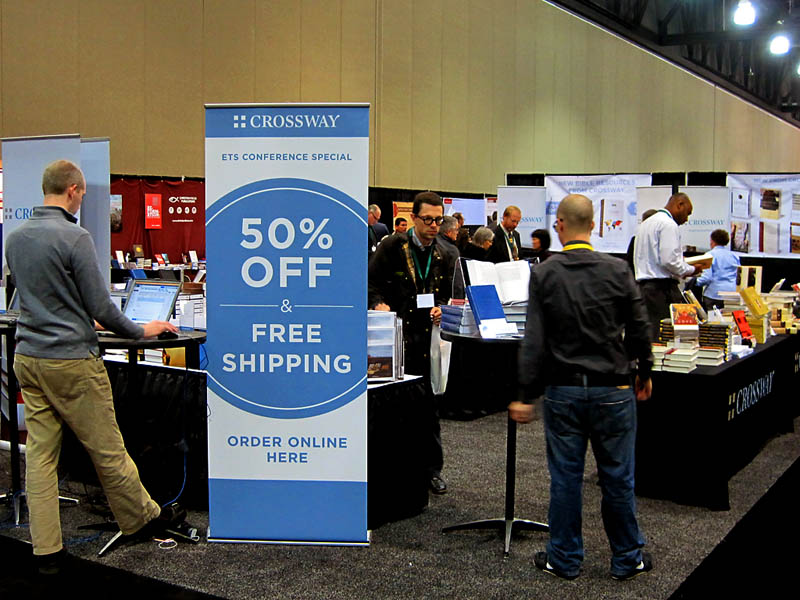
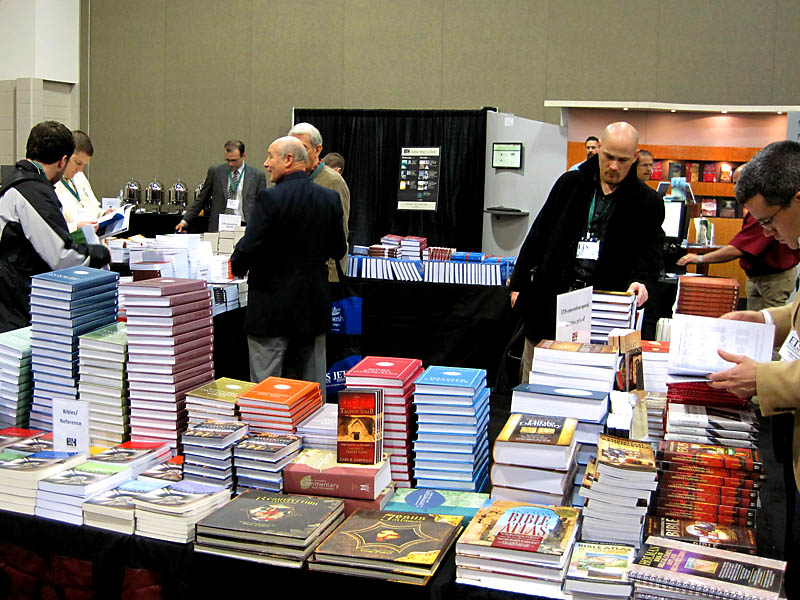
Books, Books, Books. I do not buy as many books as I once did, but I still like to see what is being published. The ETS book exhibit has grown from a few tables several years back to a large exhibit hall this year. Many of the major religious publishers offer deep discounts to the members. They know that these teachers may use their books, or at least recommend them, in their classes. Only members with the proper ID are allowed in the exhibit hall.

The Crossway display. Crossway is the publisher of the ESV bible.

The Crossway display. Crossway is the publisher of the ESV bible.

The books on display are mainly the current publications along with a few of the previous best sellers.

A portion of the B&H display.

A small portion of the B&H display.

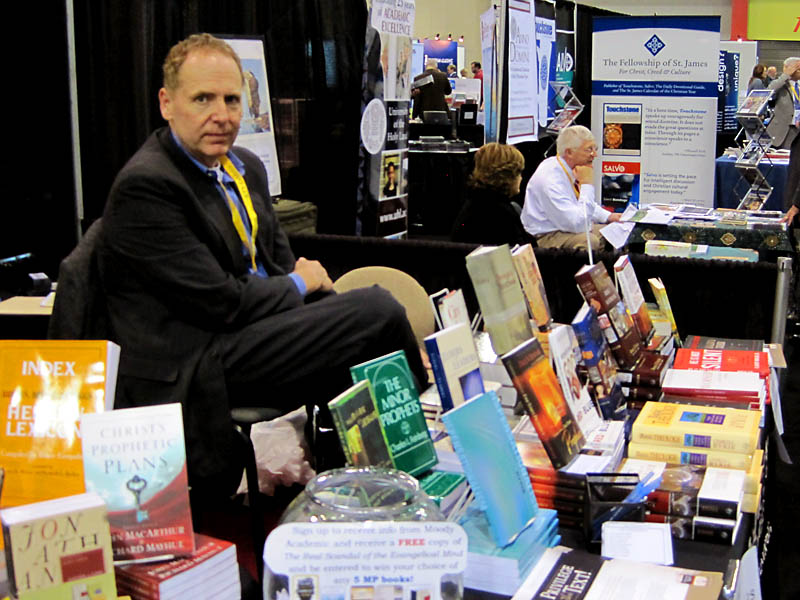
Friends. Another reason I attend the meetings to to see old friends and make new ones. Jack is now a freelance representative. This week he was working for Moody Press.

Promoting Moody Press books at the ETS meeting.

Promoting Moody Press books at the ETS meeting.

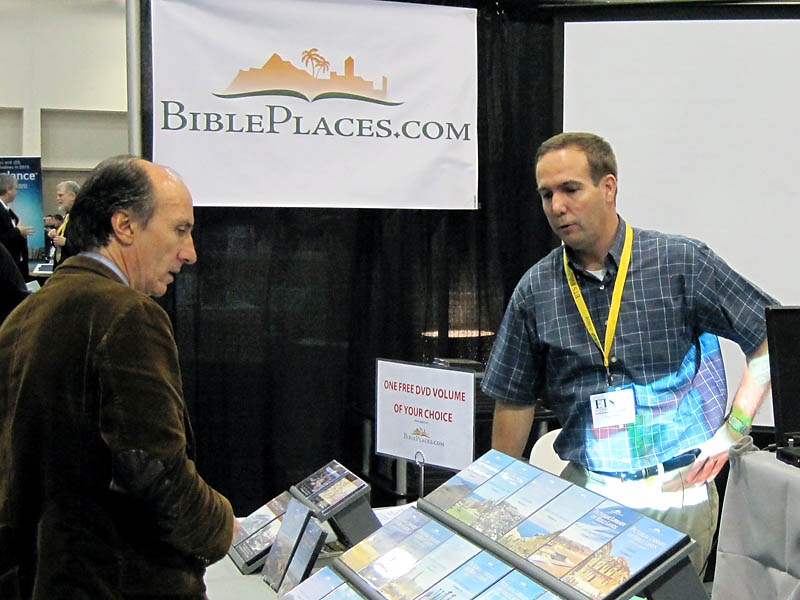
For the first time, Todd Bolen had a display of his Pictorial Library of the Bible Lands. We have written about this series here.

Todd Bolen, Bible Places.com, talks with a customer.

Todd Bolen (right), Bible Places.com, talks with a customer.

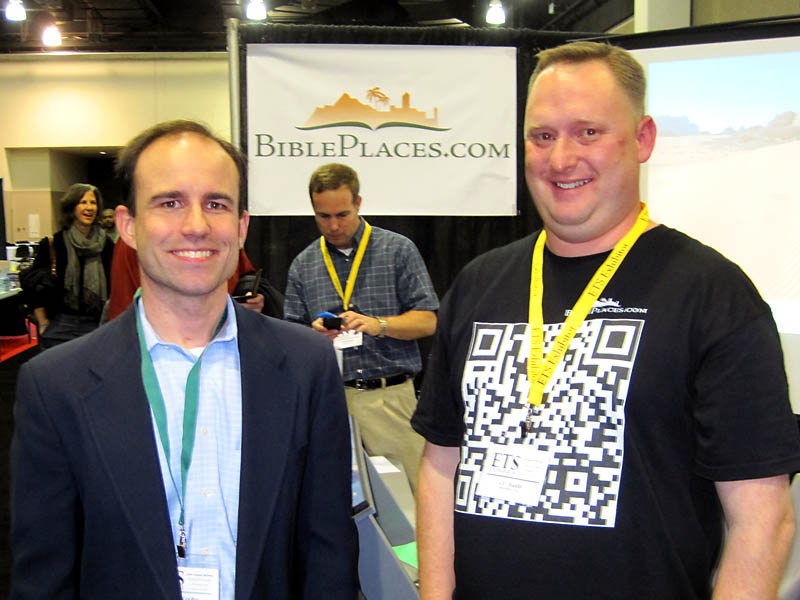
A. D. Riddle made new maps for the revised PLBL. He was helping at the booth. A customer is on the right. Bolen is in the background. This was my first time to meet A. D., he has been helpful to me several times via correspondence.

A.D. Riddle, who supplied new maps for the revised series.

A.D. Riddle (right), who supplied new maps for the revised series, takes a break from talking with an ETS member about the PLBL series.

I ran across Mark Wilson, author of Biblical Turkey: A Guide to the Jewish and Christian Sites of Asia Minor. Mark lives in Turkey part of each year, and has spoken to one of my groups. Everyone who plans a trip to Turkey, or who just wants to know more about the Biblical places in Turkey, should have this book.
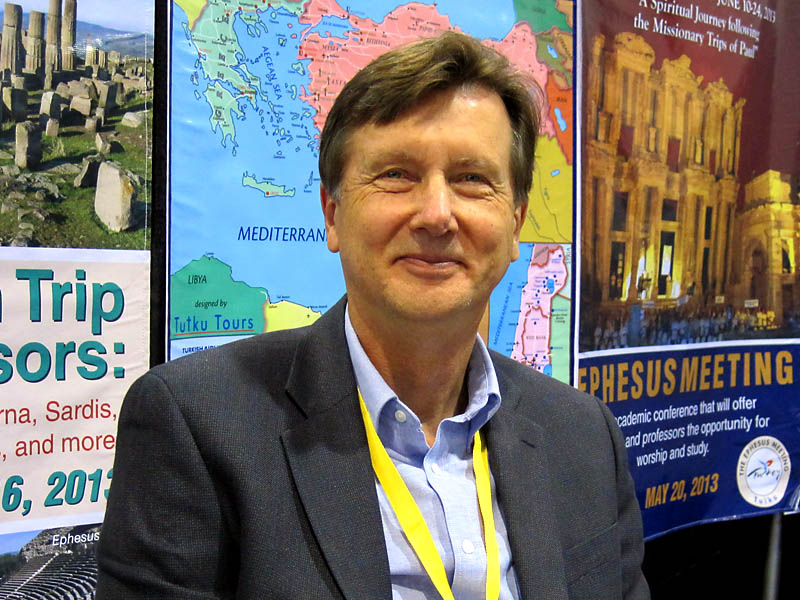
Mark Wilson mans the Tutku Travel booth.

Mark Wilson mans the Tutku Travel booth.

Other friends I saw included Steve Wolfgang, former students Rusty Taylor and Randy Murphy.

In another post I will mention some of the papers I heard.

Reformation Day

October 31 is known as Reformation Day because it was on this day in 1517 that Martin Luther posted Ninety-Five Theses on the door of the Castle Church in Wittenberg, Germany. The Ninety-Five Theses were issues that Luther thought should be debated by the theologians. These questions were brought about due to the sale of indulgences and general corruption within the Roman Catholic Church.

The term Protestant was not used to describe those who aligned themselves with Luther for another 12 years, but the Protestant movement can be dated the the event at Wittenberg.

There are many issues on which I would differ with Luther, but I admit that I admire the man and the stand that he took against practices of his day which were departures from the Apostolic doctrine.

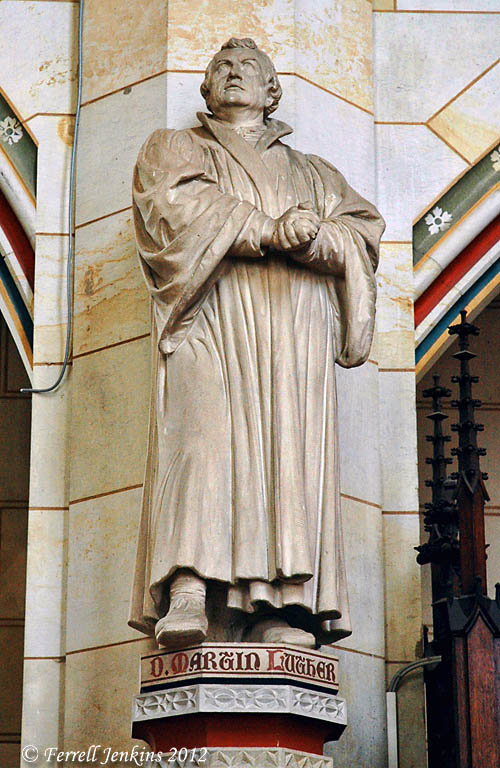
This statue of Luther stands in the Castle Church in Wittenberg, Germany. The official name of the town is Lutherstadt Wittenberg.

Statue of Martin Luther in the Wittenberg Castle Church. Photo by Ferrell Jenkins.

Statue of Martin Luther in the Wittenberg Castle Church. Photo by Ferrell Jenkins.

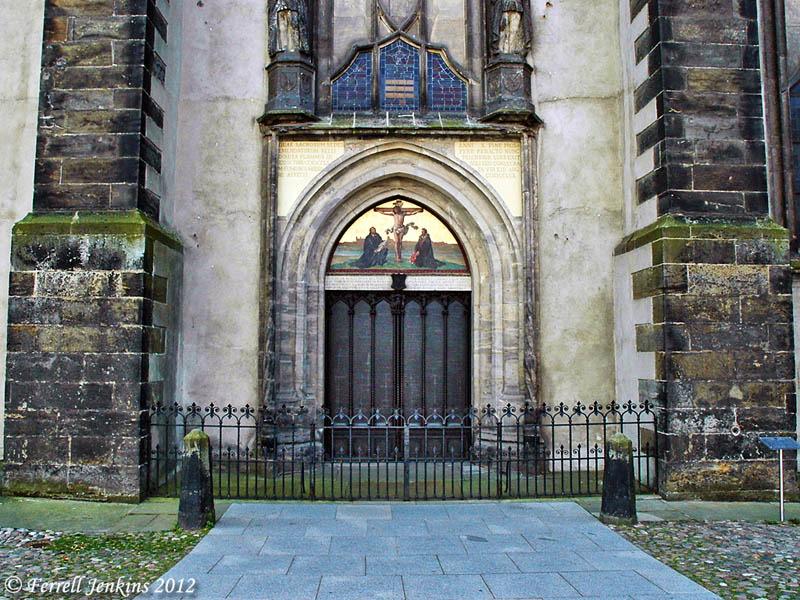
The original door of the church was destroyed by fire in 1760. Doors covered with bronze plaques with the Ninety-Five Theses on them were installed in 1858. The door of the church is pictured below.

Door of the Castle Church in Wittenberg. Photo by Ferrell Jenkins.

Door of the Castle Church in Wittenberg. Photo by Ferrell Jenkins.

Free Book. Those who use Logos Bible Software may download a copy of the Ninety-Five Theses under the title Disputation of Doctor Martin Luther on the Power and Efficacy of Indulgences. For information click here.

Interested in the Reformation? If you have interest in Church History and the place of the Reformation within it, you might enjoy this post on “The background of the Protestant Reformation,” or posts on Zwingli, Tyndale and Knox (and here), Heinrich Bullinger, St. Andrews, and Savonarola.

HT: HMcK