Category Archives: Books

Eric Cline – 1177 BC – Live Stream

The Explorers Club — New York City
Public Lecture Series featuring Eric Cline

Event open to: Public — Date: November 03, 2014
Time: 6:00 pm Reception, 7:00 pm Lecture
Location: NYC Headquarters, 46 E 70th Street, New York, NY, 10021

1177 BC: The Year Civilization Collapsed

This event will be streamed live. Please visit our Live Stream page here at 7pm on the evening of the event to view the lecture for free.

Here is a brief summary of the lecture provided by The Explorers Club.

For more than three hundred years during the Late Bronze Age, from about 1500 BC to 1200 BC, the Mediterranean region played host to a complex international world in which Egyptians, Mycenaeans, Minoans, Hittites, Assyrians, Babylonians, Cypriots, and Canaanites all interacted, creating a cosmopolitan and globalized world-system such as has only rarely been seen before the current day. It may have been this very internationalism that contributed to the apocalyptic disaster that ended the Bronze Age. When the end came, as it did after centuries of cultural and technological evolution, the civilized and international world of the Mediterranean regions came to a dramatic halt in a vast area stretching from Greece and Italy in the west to Egypt, Canaan, and Mesopotamia in the east. Large empires and small kingdoms, that had taken centuries to evolve, collapsed rapidly. With their end came the world’s first recorded Dark Ages.

It was not until centuries later that a new cultural renaissance emerged in Greece and the other affected areas, setting the stage for the evolution of Western society as we know it today. Blame for the end of the Late Bronze Age is usually laid squarely at the feet of the so-called Sea Peoples, known to us from the records of the Egyptian pharaohs Merneptah and Ramses III. However, as was the case with the fall of the Roman Empire, the end of the Bronze Age empires in this region was not the result of a single invasion, but of multiple causes. The Sea Peoples may well have been responsible for some of the destruction that occurred at the end of the Late Bronze Age, but it is much more likely that a concatenation of events, both human and natural — including earthquake storms, droughts, rebellions, and systems collapse — coalesced to create a “perfect storm” that brought the age to an end.

For more information about Dr. Cline, see here.

HT: Joseph I. Lauer

Book on the origin of Israel available

Daniel I. Block’s book, Israel: Ancient Kingdom or Late Invention?, is available in Kindle format today for $2.99. The retail price of the hardback is $28.

The publisher (B&H) of the 2008 book describes it as

a collection of essays responding to the radical claims that Israel and its history actually began following the Babylonian exile, and that the history of Israel we read about in the Bible is a fictionalized account.

Contributors are leading Bible and archaeology scholars who bring extra-biblical evidence to bear for the historicity of the Old Testament and provide case studies of new work being done in the field of archaeology.

The book includes the following essays dealing with some of the current discussions in Biblical studies.

  • Israel – Ancient Kingdom or Late Invention? – Daniel I. Block
  • The Value and Limitations of the Bible and Archaeology – Alan R. Millard
  • Contextual Criticism as a Framework for Biblical Interpretation – John M. Monson
  • North-West Semitic Inscriptions and Biblical Interpretation – Joel Drinkard
  • From Joseph to David: Mari and Israelite Pastoral Traditions – Daniel E. Fleming
  • Major Geographical Issues in the Accounts of the Exodus – James K. Hoffmeier
  • Slavery and Slave Laws in Ancient Hatti and Israel – Harry A. Hoffner Jr.
  • Were the Israelites Really Canaanites? – Alan R. Millard
  • Syria and the Bible: The Luwian Connection – Richard S. Hess
  • David and Solomon’s Jemsalem: Do the Bible and Archaeology Disagree? – Alan R. Millard
  • Who Were Israel’s Transjordanian Neighbors and How Did They Differ? – Gerald L. Mattingly
  • Shalmaneser III and Israel – K. Lawson Younger Jr.
  • Did the Israelites Really Learn Their Monotheism in Babylon? Simon J. Shenvin
  • Did Persian Zoroastrianism Influence Judaism? – Edwin M. Yamauchi
  • Interpreting the Bible as an Ancient Near Eastern Document – John H. Walton

Following the Blogs

Available today only in Kindle format: How We Got the Bible by Neil Lightfoot. This is not the only book you need on this subject, but it is a good beginning source.
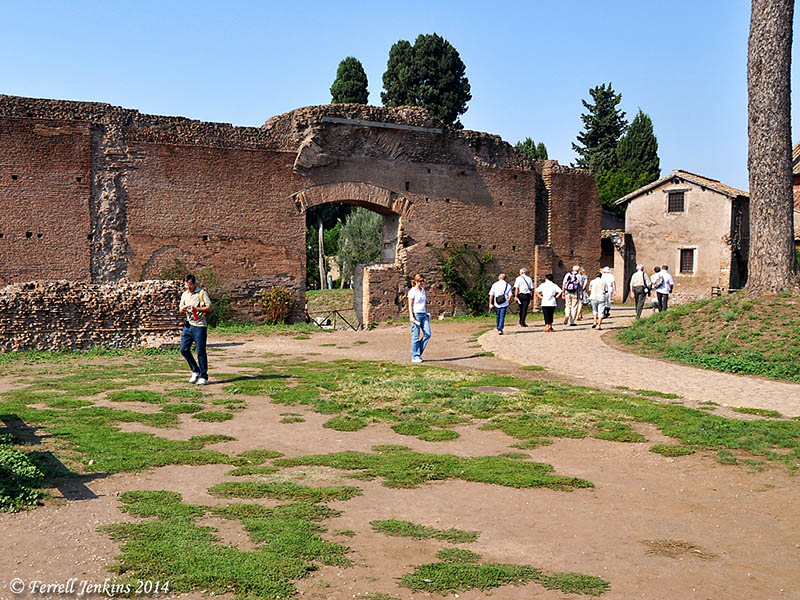
Todd Bolen’s Bible Places Blog is the best source for keeping up with news and recent materials related to Bible Places. I am a fan of the Weekend Roundup, with links to a variety of helpful materials. Today’s post reports that that rooms of Emperor Augustus on the Palatine Hill in Rome are now open to the public. Read here.

House of Augustus on the Palatine Hill, Rome. Photo by Ferrell Jenkins.

House of Augustus on the Palatine Hill, Rome. Photo by Ferrell Jenkins.

Charles Savelle provides a regular flow of links to helpful tools for serious Bible teachers and students at his BibleX (Bible Exposition). He recently pointed us to material on the Didache, The Dating of Deuteronomy and the Suzerain-Vassal Treaty Forms, and The Importance of Biblical Geography. I check this site regularly.

I enjoy following Bible Lands Explorer, the blog of Mark Ziese. Mark is a unique writer. His most recent post points us to a Brazilian newspaper for which he provided photos of the Jesus Trail. You may not be able to read the Portuguese newspaper, but there is a nice slide show of Mark’s photos.

Reading Acts. The blog by Phillip J. Long has some helpful articles for Bible students. Check some of these recent posts:

Ancient History Encyclopedia. This is a nice site including an encyclopedia that is primarily intended for high school level. Includes Index, Timeline, Maps, Photos, Videos, etc. Check the article on Roman Roads here.

ePlace. Research materials provided by Asbury Theological Seminary. Includes TREN collection of professional conference papers, dissertations, et al.

The Journal of Inductive Biblical Studies. This journal is built on the well-known work of Kuist, Traina, and others who wrote on Inductive Bible Study.

Daily Dose of Greek. Sign up for a 2-minute video Daily Dose of Greek by Rob Plumber, professor of Greek and New Testament at Southern Baptist Seminary.

Mark Hoffman, Biblical Studies and Technological Tools, recently posted two helpful lists of Greek lexical forms. Click here.

Resources to Help You Defend the Deity of Jesus. A list of resources by J. Warner Wallace, author of Cold Case Christianity.

HT: Brooks Cochran

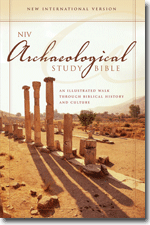
Archaeological Study Bible available for Kindle

Act quickly. The NIV Archaeological Study Bible is available in Kindle format for $4.99. The cheapest hard cover edition is available for $32.33 at Amazon. Use this link:
NIV Archaeological Study Bible: An Illustrated Walk Through Biblical History and Culture

NIV Archaeological Study Bible

NIV Archaeological Study Bible

This book was produced by conservative scholars and includes many valuable archaeological insights into the Bible.


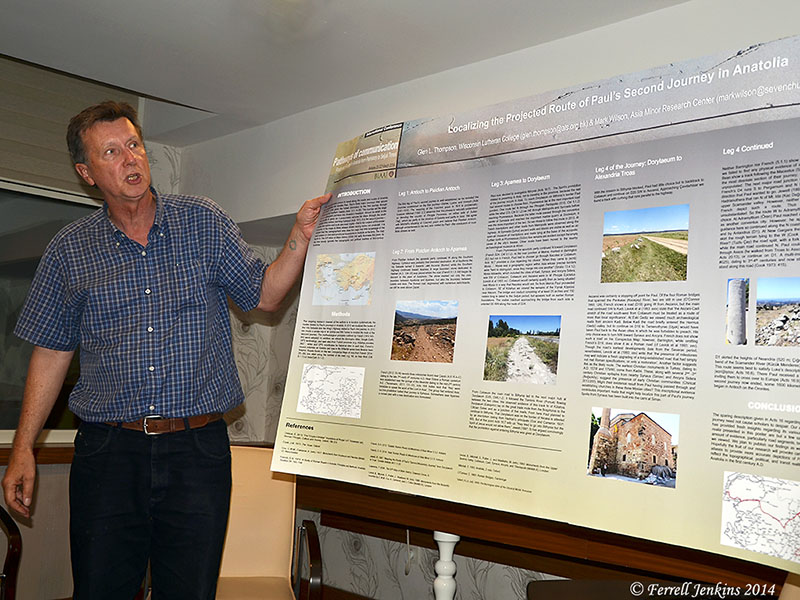
Mark Wilson speaks to group in Antalya

Dr. Mark Wilson shared a meal with us at the hotel one evening in Antalya, Turkey. After dinner Mark spoke to the group about his work in Turkey. He is the founder and director of the Asia Minor Research Center, and spends most of each year working and doing research in Turkey. He has updated several of the works of Sir William M. Ramsay, and written several helpful books on the book of Revelation. You will find much helpful material by Dr. Wilson on the Seven Church Network web site.

Our tour group heard a brief preview of the presentation Dr. Wilson plans for one of the upcoming annual professional biblical studies meetings in San Diego, California. He has been working on discovering the projected route of Paul’s Second Journey in Anatolia based on the biblical text, known roads, milestones, etc. from the first century. This was ideal for our group who had just completed a tour visiting all of the sites associated with Paul’s First Journey in Anatolia (modern Turkey).

Dr. Mark Wilson speaks about the route of Paul's second journey. Photo by Ferrell Jenkins.

Dr. Mark Wilson speaks about the route of Paul’s second journey in Anatolia to a tour group in Antalya, Turkey. Photo by Ferrell Jenkins.

We were pleased to see Dr. Wilson’s book, Biblical Turkey: A Guide to Jewish and Christian Sites of Asia Minor, available in many of the museum books stores including the Istanbul Archaeological Museum. Many of our tour members who did not already have a copy of the book got one from Mark after the presentation. You may purchase a copy from Amazon by clicking on the title above.
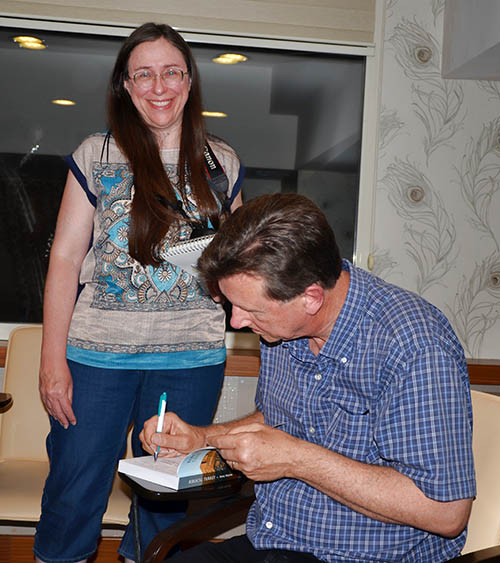
Tour members were delighted to have their book autographed by the author.

Dr. Wilson autographs a copy of Biblical Turkey for Stacy. Photo by Ferrell Jenkins.

Dr. Wilson autographs a copy of Biblical Turkey for Stacy. Photo by Ferrell Jenkins.

Free book: Did Jesus Rise From the Dead?

William Lane Craig’s short book, Did Jesus Rise From the Dead?, is available free today in Kindle format.

Book on the resurrection available free today

J. Warner Wallace is a cold-case homicide detective. As a former atheist he rejected the claims of the resurrection, but after examination of the evidence he came to believe.

This book is available free in Kindle format today. Click on the book image for the link to the book.

HT: Brooks Cochran

Good reading for the weekend

Noah

There has been much discussion in the past few weeks about the Noah movie. In last Saturday’s roundup, Todd Bolen called attention to the blog of Dr. Brian Mattson. In a post entitled “Sympathy for the Devil” Mattson comments about the movie. He reminds us of the following important point: The Bible is not the text for this movie. Several writers, and speakers, have pointed out that about the only things in common between the Noah movie and the Noah/Flood story of the Bible are a man named Noah, an ark, and water.

Mattson claims and documents the philosophical background of the director of the movie in Gnosticism and Kabbalah. I am certain that many people will see the movie and have no awareness of that, just as many ready Paul’s epistle to the Colossians, and John’s epistles without understanding how they are responding to early Gnostic doctrines.

Here is the link to Mattson’s articles:

The Wife of Jesus, again.

It is almost Easter, so we can expect a rerun on various strange views about Jesus. I first called attention to this speculation about the wife of Jesus back in September, 2012, here. Todd Bolen recently commented on the same material that is now getting new attention. Here, he provides links to the article in the New York Times, and the Harvard Theological Review article by Dr. Karen King (available for download). The Times of Israel article is available here.

Papyrus fragment possibly claiming that Jesus has a wife. Photo: Harvard University, Dr. Karen L. King.

The GJW (Gospel of Jesus Wife) papyrus fragment possibly claiming that Jesus had a wife. Photo: Harvard University, Dr. Karen L. King.

Bolen summarizes the pertinent material, showing that the document tells us nothing about 1st century events:

An initial radiocarbon analysis dated the fragment to 404–209 BC; a second analysis gave a mean date of AD 741. King concludes with a date in the 7th or 8th centuries AD. As far as being a reliable witness to 1st century events, it is not. The author notes that the fragment should be studied in light of the Muslim view that prophets were usually married.

In King’s reading, “The main point of the GJW (Gospel of Jesus Wife) fragment is simply to affirm that women who are wives and mothers can be Jesus’s disciples.”

Larry Hurtado has written three posts about the papyrus document. Begin here and then scroll back for the other two.

Wild Boar at Caesarea Philippi

Carl Rasmussen’s recent Israel student group encountered a herd of about 15 wild boar at Caesarea Philippi. He provides some nice photos to back up his claim, and discusses the various Biblical references about swine. Access the HolyLandPhotos’ Blog here.

Using Google Books

Rob Bradshaw is making many books and journals available in PDF format. I check his BiblicalStudies.org.uk site regularly for materials that might be helpful in my study. Recently he called attention to a short video by Tim Bulkeley on how to access Bible commentaries without a library. The helpful, brief video is here.


Cold-Case Christianity, free today

Cold-Case Christianity by J. Warner Wallace is available free in Kindle format March 10-11. The foreword is written by Lee Strobel. The publisher’s promo information says,


Written by an L. A. County homicide detective and former atheist, Cold-Case Christianity examines the claims of the New Testament using the skills and strategies of a hard-to-convince criminal.
Christianity could be defined as a “cold case”: it makes a claim about an event from the distant past for which there is little forensic evidence. In Cold-Case Christianity, J. Warner Wallace uses his nationally recognized skills as a homicide detective to look at the evidence and eyewitnesses behind Christian beliefs. Including gripping stories from his career and the visual techniques he developed in the courtroom, Wallace uses illustration to examine the powerful evidence that validates the claims of Christianity.
A unique apologetic that speaks to readers’ intense interest in detective stories, Cold-Case Christianity inspires readers to have confidence in Christ as it prepares them to articulate the case for Christianity.

Click on the book cover for more information, and to order.

HT: Brooks Cochran; Gospel eBooks.

Visualizing Isaiah 22: Shebna cut a tomb for himself

Shebna, the steward over the household of David, is to be replaced by Eliakim the son of Hilkiah. He will have the key of the house of David with power to open and shut. Consider the use of this text by Jesus in Revelation 3:8.

Thus says the Lord GOD of hosts, “Come, go to this steward, to Shebna, who is over the household, and say to him: What have you to do here, and whom have you here, that you have cut out here a tomb for yourself, you who cut out a tomb on the height and carve a dwelling for yourself in the rock? Behold, the LORD will hurl you away violently, O you strong man. He will seize firm hold on you and whirl you around and around, and throw you like a ball into a wide land. There you shall die, and there shall be your glorious chariots, you shame of your master’s house. I will thrust you from your office, and you will be pulled down from your station. In that day I will call my servant Eliakim the son of Hilkiah, and I will clothe him with your robe, and will bind your sash on him, and will commit your authority to his hand. And he shall be a father to the inhabitants of Jerusalem and to the house of Judah. And I will place on his shoulder the key of the house of David. He shall open, and none shall shut; and he shall shut, and none shall open. And I will fasten him like a peg in a secure place, and he will become a throne of honor to his father’s house. (Isaiah 22:15-23 ESV)

D. J. Wiseman comments on this text and a discovery possibly related to it.

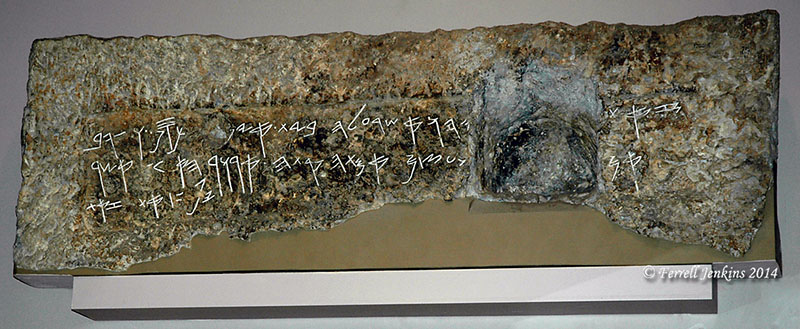
The historical background of the prophecies of Isaiah is provided by a number of contemporary records. One inscription, on a rock lintel from a tomb, was read by Avigad in 1953: ‘This is the (the sepulcher of Shebna) yahu who is over the house. There is no silver or gold here, but only (his bones) and the bones of his slave-wife with him. Cursed be the man who breaks this open.’ (Illustrations from Biblical Archaeology, 60)

Shebna inscription from a tomb. British Museum. Photo by Ferrell Jenkins.

Shebna inscription from a tomb in Silwan. British Museum. Photo by Ferrell Jenkins.

This tomb inscription was discovered in 1870 by Charles Clermont Ganneau in the village of Silwan. Following the 1967 war David Ussishkin and Gabriel Barkay examined numerous tombs in Silwan. For more information about the inscription, see Lost Treasures of the Bible by Fant and Reddish (154-157).