Category Archives: Books

Summary of the blogs

Over at the Biblical Studies Info Page, under Scholarly, then Blogs, I keep a list of several blogs that I regularly check. Here is a brief summary of some current items you might find of interest.

Todd Bolen calls attention to the continuation of the Western Wall excavations here. This excavation is on the extreme western side of the Western Wall plaza.

Aren Maer gives a wrap-up of the recent excavations at Gath (Tell es-Safi) here.

Ben Witherington includes a seminar paper by one of his doctoral students in review of Barth Ehrman’s Lost Christianities here. This has to do with the formation of the canon.

Mark Copeland has posted good photographs of 299 Sermon Charts pained by Steve Hudgins here. Steve pained a few charts for me, and some of my tour banners, years back. This shows the type of visual aids that some of us used. It was before flannel boards, opaque projections, overhead projections, and PowerPoint. The biggest problem is that the audience knew when we were only half finished! I doubt any of you will want to use a chart like this now, but you can get some great ideas for sermon starters, put them in PowerPoint, and see if they will gel.

Claude Mariottini has called attention to the problem of Fake Degrees, even among ministers and professors of biblical studies, here. Every now and then I see some preacher who wouldn’t know how to write a research paper advertising himself as Dr. So-and-so. Shameful.
The ESV Study Bible

Quite a bit of attention is being given to the forthcoming (October 15) English Standard Version Study Bible. Dr. Leen Ritmeyer has served as archaeological and architectural editor for the new study Bible. On his blog he calls attention to two interviews with Justin Taylor, Project Director and Managing Editor of the ESV Study Bible.

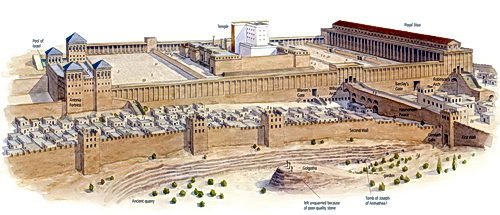
The first interview is “What Did Calvary Look Like?” Evidence for the Church of the Holy Sepulcher and the Garden Tomb is summarized. Golgotha on this drawing is now the site of the Church of the Holy Sepulcher.

Drawing showing Golgotha.

Drawing showing Golgotha.

The second interview is “What Did Jesus’ Tomb Look Like?”

If you teach the Bible you will want to download the large drawings associated with these interviews. Some sample pages in PDF (Introductions to Luke, Revelation, and Psalms) are available for download here.

Taylor explains the high quality of these drawings (“paintings”):

Using Dr. Ritmeyer’s extensive research and new drawings, we then turned to the illustration firm Maltings Partnership (in Derby, England) to produce the final, full-color paintings. We knew of Maltings’ superb work from their reconstruction drawings in the DK Travel Guides and the National Geographic Traveler guides. We could not be happier with the final results.

New study material online (including Español)

Over at BibleWorld I have posted the following items including Español el material de estudio de la Biblia.:

  • La Authoridad Biblica (under Foreign Language Materials). This book is for class or individual study.
  • Introduction to the Prophets. (This, and the other items below, are under Old Testament Studies.) Brief introductory outline showing the role of the prophets in Israel.
  • Analysis of the Book of Isaiah. This is the analysis by George L. Robinson.
  • Comparison of Kings of Israel, Judah, and Foreign Rulers. Helpful chart with dates for all rulers.

One you get to BibleWorld click on the Download Study Material in PDF link. Then scroll to the material you would like to take a look at and download if you wish.

Here is the link to BibleWorld.

A New, Smaller Bible Atlas

Carta's New Century Handbook and Atlas of the Bible

Carta’s New Century Handbook and Atlas of the Bible
Abridgment of The Sacred Bridge

by Anson F. Rainey and R. Steven Notley
Carta, Jerusalem, 2007
280 pages + full color illustrations and maps, English. Cloth, 9 x 12 inches
ISBN: 9789652207036
List Price: $50.00. Your Price: $45.00

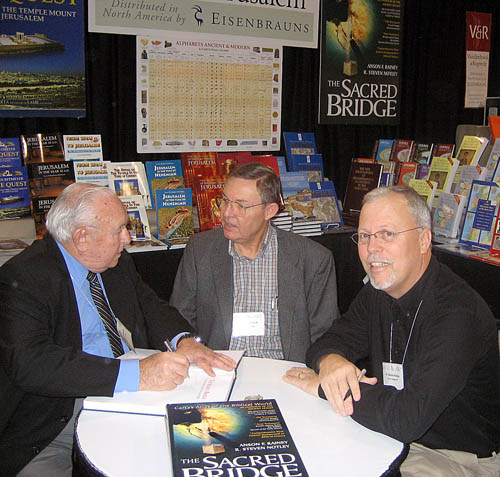
Several times we have mentioned the important of the Bible student having a good atlas. Check here. Two years ago Carta brought out The Sacred Bridge, by Rainey and Notley. The book is large, and the content is more than most students want or need. And the price was $100. In response to a request from many professors, the same authors have prepared Carta’s New Century Handbook and Atlas of the Bible. I have not seen this book, but I have been using the larger atlas, and I plan to get a copy of the abridged edition. Fortunately I was able to get The Sacred Bridge autographed by Rainey and Notley.

Eisenbrauns is the US distributor of Carta books and maps. A click on the title at the top will take you to their web page.

Man of Galilee now available

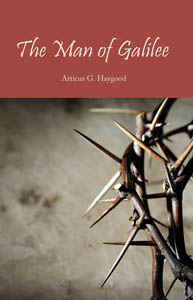
The Man of Galilee by Atticus G. Haygood is a small book that should be read by every person interested in the identity of Jesus of Galilee. The book was first published in 1889, and has been republished several times. I published it as part of Evidence Quarterly in 1963. It has been available at our Biblical Studies Info Page for a number of years. Now DeWard Publishing Company has published The Man of Galilee in an attractive paperback edition of 108 pages. This book will make an excellent gift to any young person who is of an age to be thinking about the Jesus of the New Testament.

Melvin Curry comments about this book:

Some big books need to die; this little one needs to live. Haygood’s Man of Galilee is a profound argument about the uniqueness of Jesus.

Dan Petty says,

Haygood discusses the truly unique and universal quality of the character of Jesus in a manner that is thoughtful, thorough, and logical. It is presented in terms that the student will find interesting, refreshing, and in the end, compelling.

Order The Man of Galilee.

I wish to commend DeWard Publishing Company for making this book available. Take a look at their web page.

Domitian, a hated emperor

One coin at a time is Brett Telford’s blog about coins. He has a marvelous photo of a silver Tetradrachm showing the image of Domitian. It was struck in Tarsus about A.D. 93-95. Please take a look.

Telford says,

The portrait reveals an emperor weary from insecurity and suspicion of conspiracy in the later years of his reign. His gaze bears witness to the demons that incited his paranoia. Domitian’s reign of terror began at around AD 93 and lasted until his death in AD 96… about the same time that this coin was struck.

After an interesting discussion of Ethelbert Stauffer’s theory that the titles of Domitian equal 666, Telford comments on the coincidence that this coin was minted at Tarsus, home of the apostle Paul.

This coin isn’t without its own Biblical reference. Tarsus, the city in which this coin was minted, was the birthplace of the Apostle Paul. Isn’t it ironic then, that a coin of the purported Biblical “Beast” was struck in the very city that brought us the most notable of early Christian missionaries.

Previously I have called attention to my books on Revelation. I failed to mention another brief publication about Domitian. Several years back Arthur M. Ogden and I wrote a series of exchanges. This publication, Did Domitian Persecute Christian? is available free in PDF at BibleWorld.

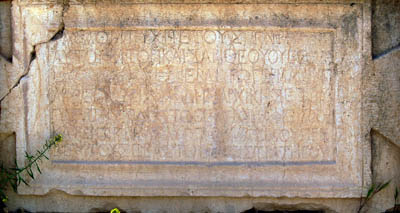
I have seen various inscriptions on which the name of Domitian has been scratched off. It means that he was a person of damnable memory. Recently on our trip to Jerash in Jordan we saw two inscription discovered when the theater was being restored. Here is a photo of one of them.

The inscription, which dates to the year A.D. 90/91, bears the title of the Emperor Domitian, but his name has been erased. The emperor is said to be the son of “divine (theou) Vespasian.” At the moment I can’t put my hands on it, but I recall that a translation of both inscriptions is included in the Newsletter of the American Schools of Oriental Research, Oct., 1974. Inscriptions like this definitely need to be in a controlled environment rather than outside in the weather.

On our upcoming Steps of Paul and John tour the name of Domitian will be used often.

HT: Georg S. Adamsen, Revelation Resources.

Some recommended books

The Holy Land: An Oxford Archaeological Guide by Jerome Murphy-O’Connor is now back in print. Be sure you get the fifth edition (2008). This is one of the finest, most authoritative guide of archaeological sites in Israel.

Todd Bolen has called attention to an interview with Jerome Murphy-O’Connor on the Radio Scribe radio program. The files are available in mp3. I suggest you listen to these. I will try to give you the links to the two interviews:

Book and Spade interview with Murphy-O’Connor # 2

Book and Spade interview with Murphy-O’Connor # 1

Something Murphy-O’Connor said in one of the interviews is that he is unable to judge regarding some claims made by various archaeologists. He said, “I write as a communicator.” I like that, and think of myself in the same way as I direct my tours.

Another good book to study along with your Bible is the Wycliffe Historical Geography of Bible Lands by Vos. Be sure you get the 2003 edition. The earlier edition was by Pfeiffer and Vos, but has now been updated by Vos.

Go to our Travel Book Store to order.

Logos has ANET on pre-pub

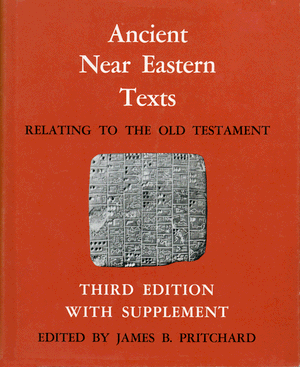
Logos is the premier source for good books available for use on the computer. Now they have Ancient Near Eastern Texts, edited by James Pritchard, on pre-pub. When Logos puts a book on the pre-pub list it means that they offer it for a lower price to those who will agree to buy it when it is ready for distribution. Over the years I have secured several good works this way.

Take a look at the pre-publication special information. The price will be $59.95. I have signed up, and I hope that you will do the same. Amazon offers the print version for $115.00.

Pritchard, Ancient Near Eastern Texts.

Everyone who studies the Bible and the historical association with countries like Egypt, Assyria, Babylon, and Persia, needs this work. The print edition costs about twice as much as the Logos digital version. The ability to search the Logos version will be a distinct advantage.

This edition of 735 pages was first published in 1969. Cyril J. Barber, The Minister’s Library, describes the original publication in these words:

Popularly referred to as ANET. An indispensable aid in understanding the background and culture of the peoples in the Ancient Near East.

HT: BiblePlaces Blog

Waterfalls of Israel

Tourists often fail to see the waterfalls in Israel because they are hidden in the hills off the main roads and require a hike to get to them. Several years ago I was browsing the books at a profession meeting (SBL) I attended. One of the new publications was The Holman Bible Dictionary (1991). I noticed a photo of the waterfall at Engedi (En Gedi) on page 419. The caption for the photo reads:

The only natural waterfall in Israel is located at Engedi on the west side of the Dead Sea.

I spoke to one of the representatives of the publisher that I had come to know and told him this was a mistake that should be corrected. He thanked me and gave me a copy of the dictionary for having pointed out this error. I assume that future editions of the dictionary have a corrected caption.

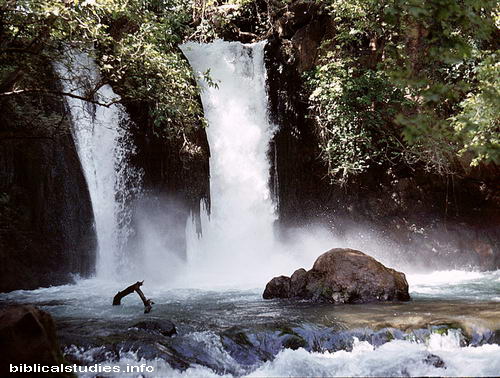
Here is a photo of the Jordan River Waterfall (sometimes called the Banias Falls) that I made in 1984. This waterfall is not far from the main road as you leave Banias (Caesarea Philippi) west toward Dan. A place like this would be most refreshing to a person like David as he was fleeing from Saul (1 Samuel 23:29-24:1). Of course, that was at Engedi, in the south.

Jordan River Falls (Banias Falls) Near Caesarea Philippi in Israel. Photo by Ferrell Jenkins 1984.

What really got me to thinking about this today is Todd Bolen’s BiblePlaces Newsletter which came today. In addition to links to news mentioned on the Bible Places Blog, the main feature includes the Waterfalls of Israel. There are five high-resolution photos and a PowerPoint presentation available for download. Todd also mentions other waterfalls in Israel.

Several times before I have recommended the BiblePlaces Newsletter and the Pictorial Library of Bible Lands. Click here to subscribe to the Newsletter. Click here to go to BiblePlaces for information about the Pictorial Library.

Theology Matters . . . It Always Matters

Dr. Albert Mohler, president of Southern Baptist Seminary, writes some excellent material relating to Christianity and modern culture; that is, the Christian Worldview as it relates to other Worldviews.

In his most recent blog, Mohler reviews a book by George Weigel, a prominent Catholic intellectual and commentator. Weigel’s book, Faith, Reason, and the War Against Jihadism, shows the importance of taking theology seriously in dealing with the threat of jihadism. I recommend that you read Dr. Mohler’s comments here.