Category Archives: Book of Acts

A visit to Nicaea in Bithynia.

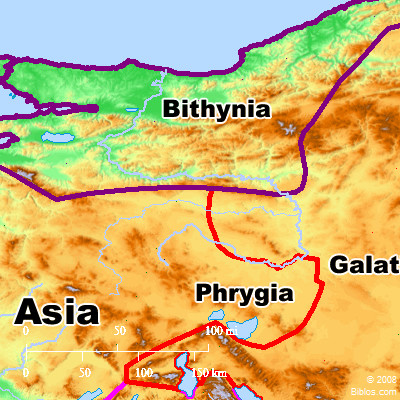
Today  my friend Leon and I made a 10 hour trip from Istanbul to Iznik, Turkey. Iznik is the name of ancient Nicaea (Nicea) in Bithynia. This is a region of Asia Minor into which Paul was not allowed by the Spirit to travel. Instead, he was directed to go down to Troas where he received the call to come over into Macedonia.

And when they had come up to Mysia, they attempted to go into Bithynia, but the Spirit of Jesus did not allow them. So, passing by Mysia, they went down to Troas. (Acts 16:7-8 ESV

Bithynia is across from Istanbul on the south side of the Sea of Marmara. It is a beautiful mountainous region with valleys filled with olive trees and fruit orchards.

The Epistles of Peter are addressed to saints living in Bithynia, but no specific towns are mentioned (1 Peter 1:1; 2 Peter 3:1).

The Roman province of Bithynia. BibleAtlas.org.

The Roman province of Bithynia. BibleAtlas.org.

The modern town of Iznik utilizes the layout of ancient Nicaea. Nicaea was the site of the first and seventh of the ecumenical councils held between 325 and 787 A.D. Hopefully I will be able to write more about these councils and their importance in the history of Christianity at a later time.

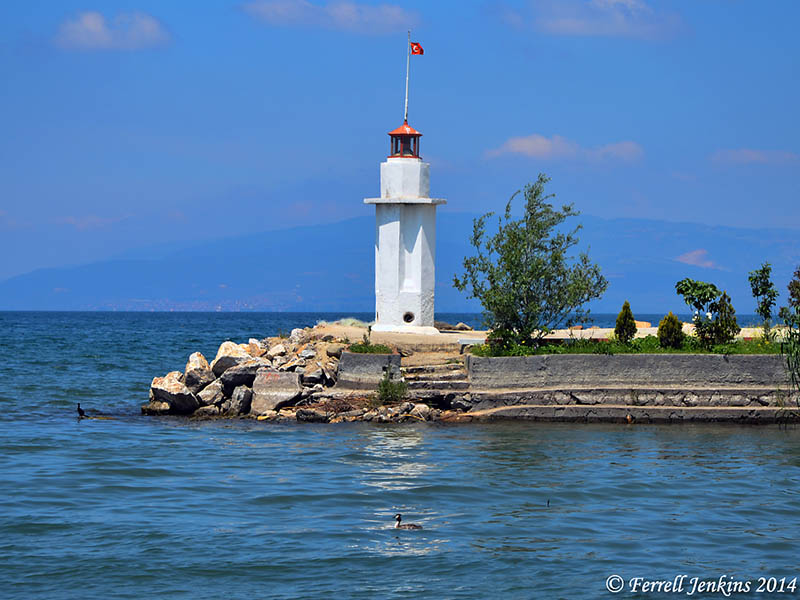
For today I wanted to share a photo I made of a little lighthouse in the fresh water Lake Iznik.

Lighthouse in Lake Iznik. Photo by Ferrell Jenkins.

Lighthouse in Lake Iznik. Photo by Ferrell Jenkins.

Some Museums in Turkey

My Ancient Crossroads Tour of Biblical and Historical Turkey is compete. Yesterday most of the tour members returned home. A few had other plans of travel before returning.

There are some wonderful museums in Turkey, but many of them are undergoing restoration at this time.

We missed seeing the main section of the Museum of Anatolian Civilizations in Ankara due to restoration. A nice,  small section containing mostly classical materials was open, but the great collection of Hittite materials (our reason for going there) was closed. According to an article in the Harriyet Daily News it reopened last Friday.

The Archaeological Museum in Antakya (Antioch of Syria, Acts 11, 13) was almost bare. Only a few of the lesser quality mosaics were on the walls. A new museum will open soon. I had told the group that we would see some good Hittite materials there, but they had already been moved. Incidentally, the Church of St. Peter and the Simon Stylites Monastery were also closed for renovation.

We did better at the fabulous museum in Antalya (Attalia of Acts 14:25). The Roman period statuary from Perga in Pamphylia (Acts 13:13-14; 14:25) is housed there.

In Istanbul we were able to visit the Ancient Orient section of the Archaeological Museum. The museum containing material from the classical world was closed. An excellent selection of materials was housed in a small area of the Museum.  The third floor, where artifacts from Palestine are housed was closed. Our appeal for entry failed.  There is where some very famous pieces are housed − the Siloam Tunnel inscription, the Gezer Calendar, the Herodian Temple inscription forbidding gentiles from entering the Temple, et al.

The Ancient Orient building houses a large number of bulls, dragons, and oxen from the procession street of ancient Babylon. I think it is second only to the Pergamum Museum in Berlin. There are excellent Hittite materials, including the oldest treaty between nations. It is the treaty between the Hittites and Pharaoh Ramses of Egypt after the battle of Kadesh on the Orontes. There are several pieces from the Assyrians, and a clay cylinder from the time of Nebuchadnezzar.

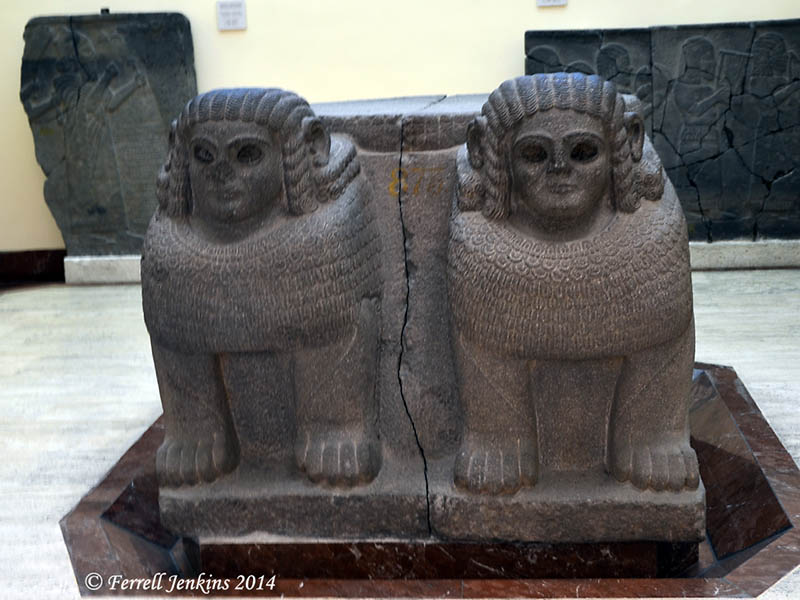
Here is a picture of one of the basalt Hittite column bases from Sinjerli. It is a double sphinx, dating to the 8th century B.C., that came from the entrance to Palace III.
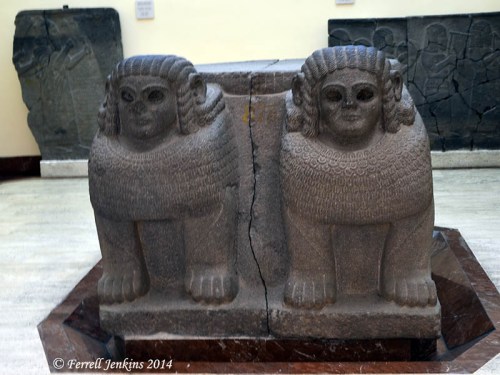
Hittite Column Base from Sinjerli. Photo by Ferrell Jenkins.

Front view of Hittite column base from Sinjerli. Photo by Ferrell Jenkins.

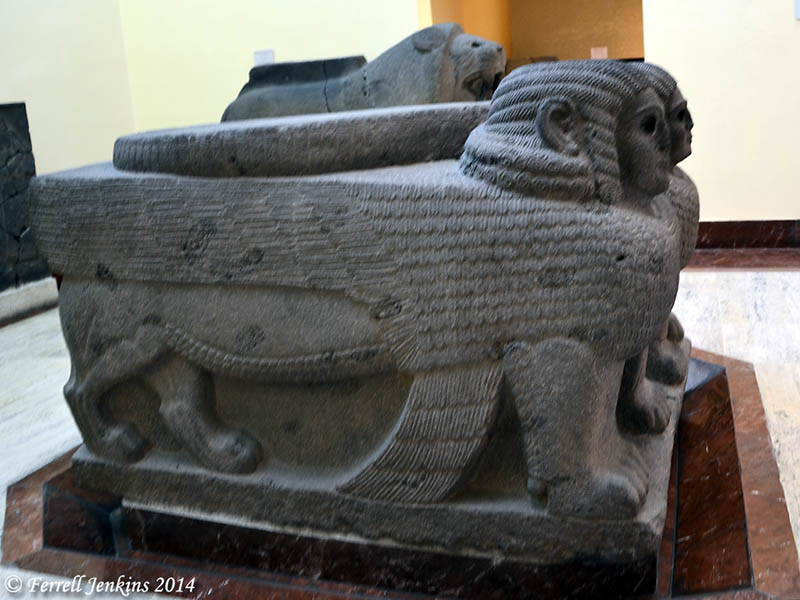
Below is the side view of this column base. Note that the figure of a lion shows a human head and wings of a bird. This provides a good illustration for the apocalyptic imagery in Daniel, Ezekiel, Zechariah, and Revelation.
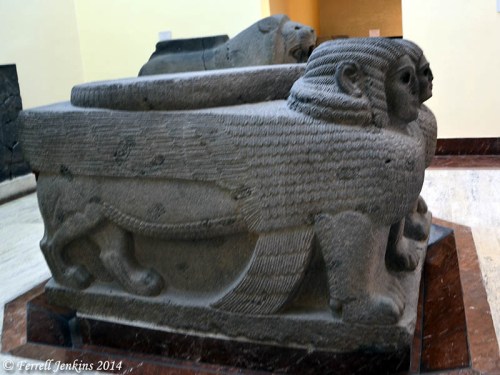
Side view of Hittite Column Base from Sinjerli. Photo by Ferrell Jenkins.

Side view of Hittite Column Base from Sinjerli. Photo by Ferrell Jenkins.

These are the Hittites with whom the ancient Israelites had dealings. Solomon imported horses and chariots from Egypt and Kue and exported them to the Hittites (1 Kings 10:29). See 2 Kings 7:6 for another reference to these people in the days of the prophet Elisha.

All things considered, maybe it didn’t turn out so bad after all.

Excavations at Derbe

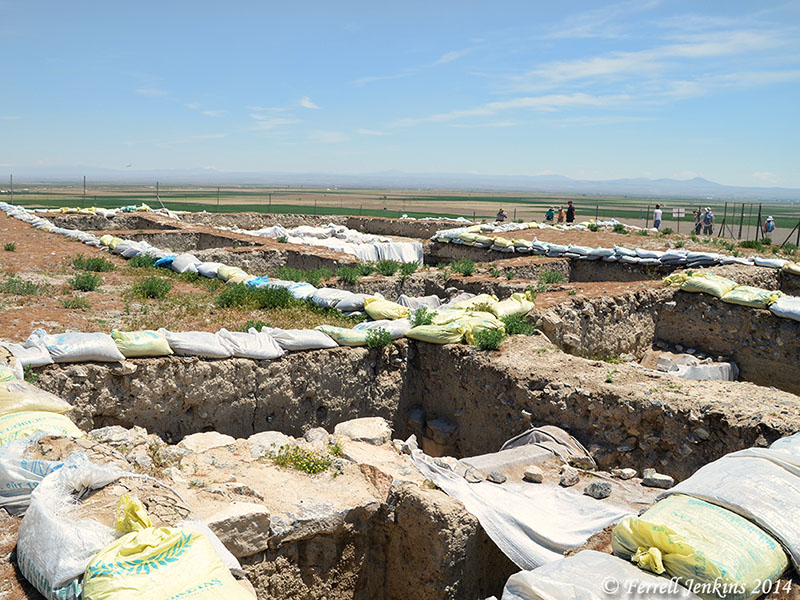
The first excavations ever have begun at the ancient city of Derbe. Derbe was visited by the Apostle Paul and Barnabas on the first preaching journey (Acts 14:20-21). Paul returned with Silas on the second journey (Acts 16:1).

Today our tour group visited Kerti Hüyuk, the site widely believed to be ancient Derbe. Several squares were opened on the top of the mound in 2013.

Recent excavation at Derbe. Photo by Ferrell Jenkins, May 14, 2014.

Recent excavation at Derbe. Photo by Ferrell Jenkins, May 14, 2014.

The report in a Turkish newspaper quotes Associate Professor Mehmet Tekocak of Selçuk University:

So far the excavations have unearthed ancient wall remains. “There are brick and stone walls. We found graves and skeletons inside the walls. Anthropologic works will reveal the ages and genders of these skeletons and how they died. Works show us that this place received a lot of damage, and most architectural materials were removed for use in other places. This place was seen as a kind of stone quarry. We found the remains of a church-like structure, and we believe that we will find new structures as excavations continue. Even these remains alone show us that a Christian society lived in this tumulus,” Tekocak said.

There is no hint as to the age of the church-like structure.

See the report in Hurriyet Daily News here. We look forward to future reports from Derbe.

HT: HolyLandPhotos Blog.

The tour photo

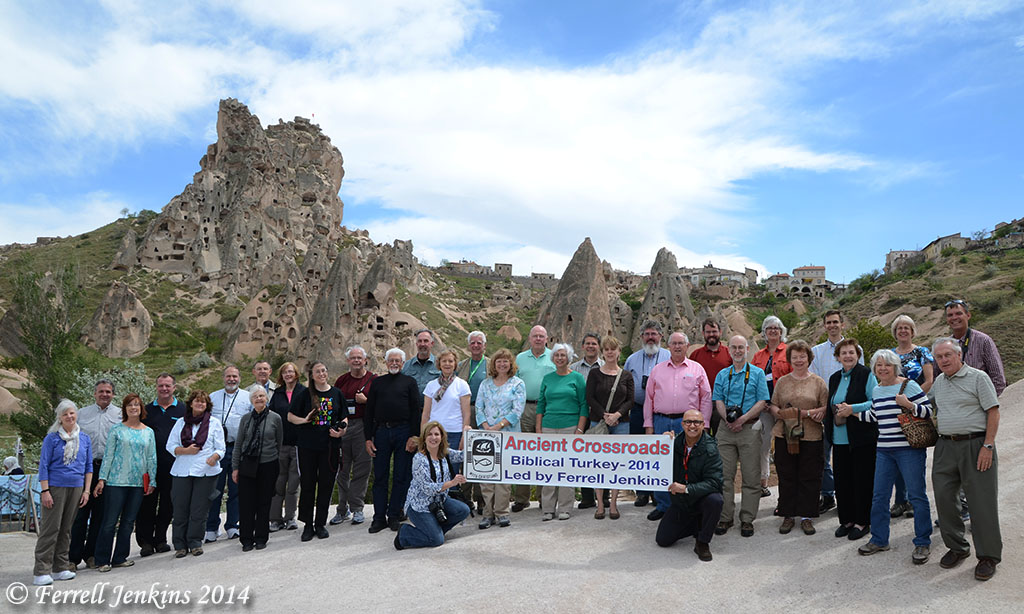
We spent the full day in Cappadocia. As usual with our tour, we have a local photographer to make a group photo at one of the interesting spots we visit. Our photo this time was made at Uchisar. Do you know anyone in our group?

Ancient Crossroads Tour of Biblical and Historical Turkey. Photo taken at Uchisar in Cappadocia. Photo by Ferrell Jenkins.

Ancient Crossroads Tour of Biblical and Historical Turkey. Photo taken at Uchisar in Cappadocia. Click on photo for a larger image.

The Bible tells us that Jews of Cappadocia were present in Jerusalem on the day of Pentecost (Acts 2:9). Peter wrote his epistles to saints scattered throughout Cappadocia and other places in Roman Asia Minor (modern Turkey).

Peter, an apostle of Jesus Christ, To those who are elect exiles of the dispersion in Pontus, Galatia, Cappadocia, Asia, and Bithynia,  2 according to the foreknowledge of God the Father, in the sanctification of the Spirit, for obedience to Jesus Christ and for sprinkling with his blood: May grace and peace be multiplied to you. (1 Peter 1:1-2)

John Freely describes Cappadocia in these words:

“Most of this part of Cappadocia is covered with a deep layer of tufa, a soft stone of solidified mud, ash and lava which once poured down from the now extinct volcanoes on Hasan Dagi and Ericiyes Dagi, the two great mountain peaks of Cappadocia. In the eons since then the rivers of the region have scoured canyons, gorges, valleys and gulleys through the soft and porous stone, and the elements have eroded it into fantastic crags, folds, turrets, pyramids, spires, needles, stalagmites, and cones, creating a vast outdoor display of stone sculptures in an incredible variety of shapes and colours” (The Companion Guide to Turkey, 238).

In the centuries after New Testament times many Christians settled in this volcanic region of perhaps 50,000 cones.

Regarding the Visualizing Isaiah series

The response to the Visualizing Isaiah series has been good by my estimation. Numerous readers have written that they enjoyed/profited by the series. Several bloggers have linked to the series and a few have re-blogged almost all of them to their readers.

This was an ambitious project. First, there was the responsibility to understand Isaiah well enough to make appropriate comments. Second, the selection of good photos was quite a task. I often looked through photos from various Bible sites and/or several museums with Ancient Near Eastern collections to locate what I thought was the right image. Some chapters offered numerous possibilities; others were a bit more difficult.

Hopefully I will be able to continue the series later. At this time I must take a break because I will be traveling in the Bible world most of May. I do plan to post something most days to indicate where I am traveling.

I trust that the Isaiah series has illustrated how you can enhance your study and teaching with visuals. You may say, “but I haven’t been to all of those places.” But you can search this blog for illustrations. Some time back we provided illustrations for the entire book of Acts. You can go to your Pictorial Library of Bible Lands collection and find the photos you need. Or, search the Bible Places Blog, or the Holy Land Photos’ Blog, or the vast collection at Holy Land Photos, or David Padfield’s collection here.

For my next series, I plan to select a shorter book such as Philemon or Jude.

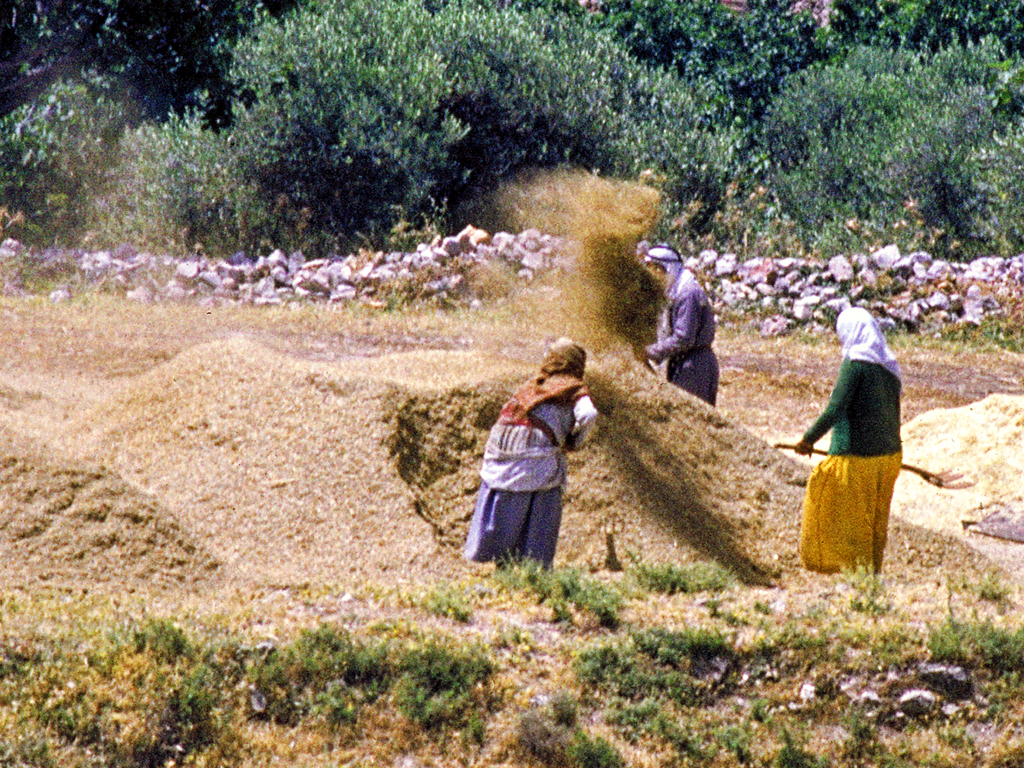
Just in case some of you are looking ahead to Isaiah 41, I will include an image to help with verses 15-16.

Behold, I make of you a threshing sledge, new, sharp, and having teeth; you shall thresh the mountains and crush them, and you shall make the hills like chaff; you shall winnow them, and the wind shall carry them away, and the tempest shall scatter them. And you shall rejoice in the LORD; in the Holy One of Israel you shall glory.  (Isaiah 41:15-16 ESV)

Winnowing at Shechem. Photo by Ferrell Jenkins.

Winnowing at Shechem. Photo by Ferrell Jenkins.

The Empty Tomb

The Gospel of Mark provides a brief account of the events of the first day of the week after the crucifixion of Jesus. The women went to the tomb of Jesus to anoint his body. The approach of the Sabbath did not allow this on Friday.

1 When the Sabbath was past, Mary Magdalene, Mary the mother of James, and Salome bought spices, so that they might go and anoint him.
2 And very early on the first day of the week, when the sun had risen, they went to the tomb.

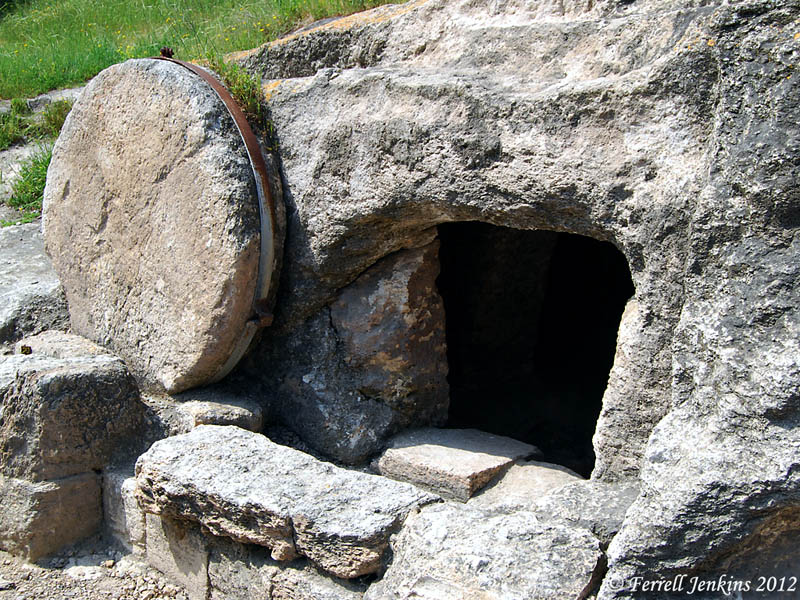
These grieving women were concerned about the removal of the large stone that had been rolled over the tomb opening and sealed by the Roman authorities. They were surprised when they discovered that the stone had already been removed.

3 And they were saying to one another, “Who will roll away the stone for us from the entrance of the tomb?”
4 And looking up, they saw that the stone had been rolled back–it was very large.

Perhaps they thought that some others, unknown to them, had come to provide the same service. They were alarmed to see the young man in a white robe.

5 And entering the tomb, they saw a young man sitting on the right side, dressed in a white robe, and they were alarmed.

The message was an unexpected one, but one that they were to share with his disciples and Peter and to tell them to update their appointment calendar to include a meeting with Jesus in Galilee.

6 And he said to them, “Do not be alarmed. You seek Jesus of Nazareth, who was crucified. He has risen; he is not here. See the place where they laid him.
7 But go, tell his disciples and Peter that he is going before you to Galilee. There you will see him, just as he told you.”
8 And they went out and fled from the tomb, for trembling and astonishment had seized them, and they said nothing to anyone, for they were afraid. (Mark 16:1-8 ESV)

The message that these women took with them was that the tomb was empty and that Jesus had risen from the grave. From this time forward He would be acknowledged by believers as Lord and Christ (Acts 2:36).

An empty Roman period tomb with a rolling stone. Photo by Ferrell Jenkins.

An empty Roman period tomb with a rolling stone. Photo by Ferrell Jenkins.

This is a rerun from April 8, 2012, but I think it is one that is still relevant.

Visualizing Isaiah 25: “on this mountain”

Isaiah continues the apocalyptic description of the judgment of the LORD and the return from captivity. The city that will be destroyed by the Babylonians will become a place of great feasting for all nations.

On this mountain the LORD of hosts will make for all peoples a feast of rich food, a feast of well-aged wine, of rich food full of marrow, of aged wine well refined.(Isaiah 25:6 ESV)

Early in the book Isaiah has informed us that “the mountain of the LORD” would become a place for blessing all men through the word which would go forth from Jerusalem.

It shall come to pass in the latter days that the mountain of the house of the LORD shall be established as the highest of the mountains, and shall be lifted up above the hills; and all the nations shall flow to it, and many peoples shall come, and say: “Come, let us go up to the mountain of the LORD, to the house of the God of Jacob, that he may teach us his ways and that we may walk in his paths.” For out of Zion shall go the law, and the word of the LORD from Jerusalem. (Isaiah 2:2-3 ESV)

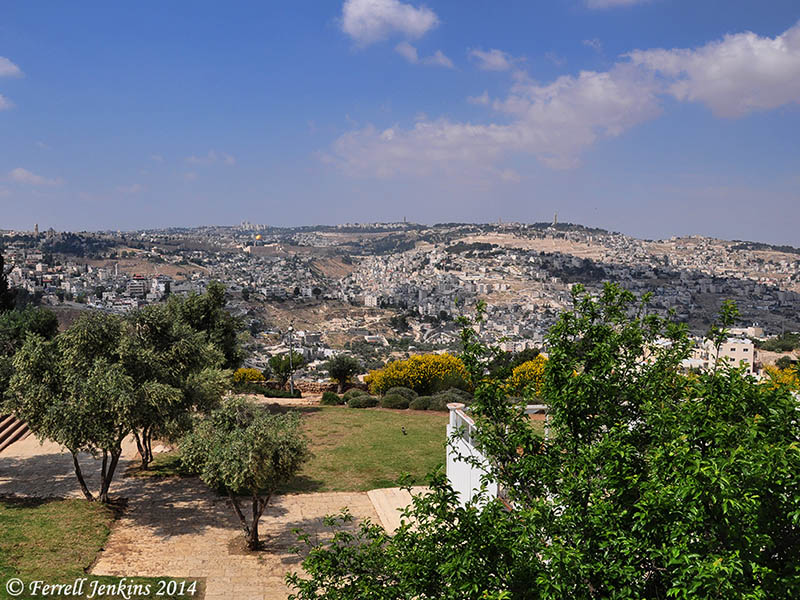
Jerusalem is not directly on the top of the central mountain range that runs from the north to the south in the land of Canaan/Israel. It is situated on the eastern slope of the mountain ridge. Even then there are mountains that are higher. In the photo below you see the Old City of Jerusalem, where the Temple of Solomon once stood. But you see that Mount Scopus and the Mount of Olives are higher than Jerusalem. In God’s plan Jerusalem would become the highest of all. We see the fulfillment of this in Acts 2.

Notice Jerusalem in the mountains. Photo by Ferrell Jenkins.

Notice Jerusalem in the mountains. Photo by Ferrell Jenkins.

The photo above was taken from the Haas Promenade south of Jerusalem. Click on the photo for a larger image and a better view of the city.

Purple fabric dyed from Murex found in Judean desert

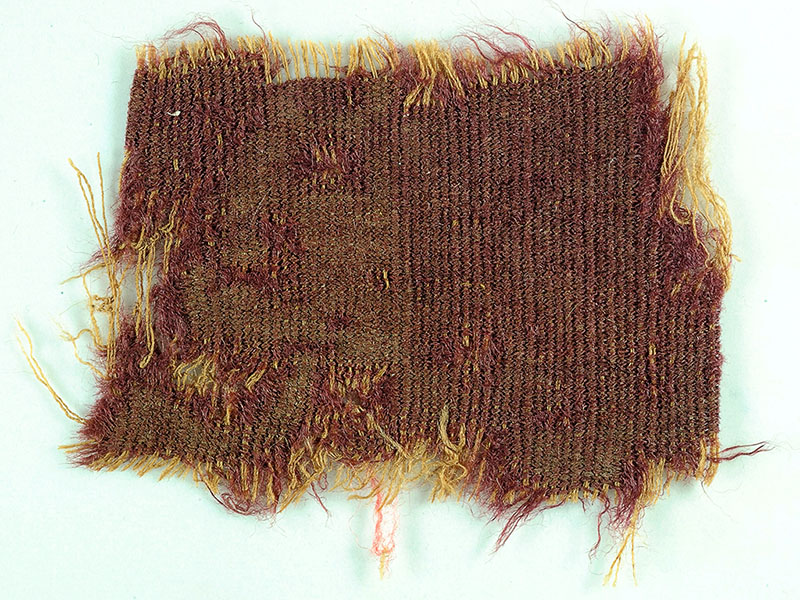
The Israel Antiquities Authority announced last week the discovery of two pieces of fabrics found at Wadi Murabba’at on the western shore of the Dead Sea.

Thousands of fabrics dating to the Roman period have been discovered in the Judean Desert and regions of the Negev and the ‘Arava. So far only two were colored with dye extracted from the murex snail. Now, within the framework of a study conducted by Dr. Na‘ama Sukenik of the Israel Antiquities Authority, three other rare fabrics belonging to pieces of prestigious textiles were exposed that might have been used as clothing in the Roman period. …

These prestigious textiles, from the Wadi Murabba‘at caves located south of Qumran, were revealed in a study that analysis the dye of 180 textiles specimens from the Judean Desert caves. Among the many textiles, most of which were dyed using substances derived from plants, were two purple-bordeaux colored textiles – parts of tunics that were double dyed utilizing two of the most expensive materials in antiquity: Murex trunculus (Hexaplex trunculus) and American Cochineal insect.

Purple fabric discovered at Wadi Murabba'at at caves south of Qumran. Photograph: Clara Amit, courtesy of the Israel Antiquities Authority.

Purple fabric discovered at Wadi Murabba’at at caves south of Qumran. Photograph: Clara Amit, courtesy of the Israel Antiquities Authority.

The valuation of the Murex purple in the ancient world is explained.

Of all of the dyes that were in use, purple is considered the most prestigious color of the earlier periods; however it seems the public’s fondness for this reached its peak in the Hellenistic-Roman period. The purple dyed fabrics attested to the prestige of the garment and the social status of its owner. There were times when the masses were forbidden from dressing in purple clothing, which was reserved for only the emperor and his family. These measures only served to increase the popularity of that color, the price of which soared and was equal to that of gold.

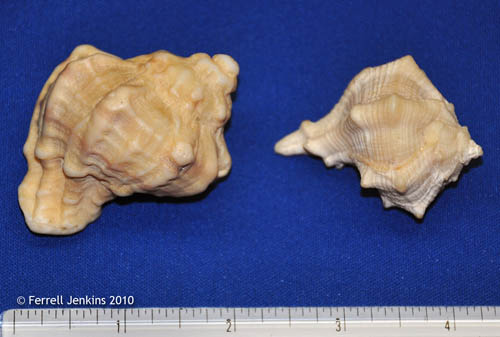
The photo below shows two Murex shells that I collected at the ruins of the ancient Phoenician site of Tyre.

Murex shells from Tyre. Photo by Ferrell Jenkins.

Murex shells from Tyre. Photo by Ferrell Jenkins.

Purple is mentioned in several New Testament texts. Notice these:

  • A rich man who habitually dressed in purple and fine linen (Luke 16:19).
  • Jesus was dressed in a purple garment to make him look like a king (Mark 15:17).
  • Purple was one of the products commonly traded and transported in the Roman Empire (Revelation 18:12).

If you are interested in more information about the Murex and the color Purple put the word Murex in the search box. You should locate six posts on this topic.

For the purple made from the madder root sold by Lydia (Acts 16:14), see here.

HT: Joseph Lauer

Caesarea Maritima – the Lower Palace

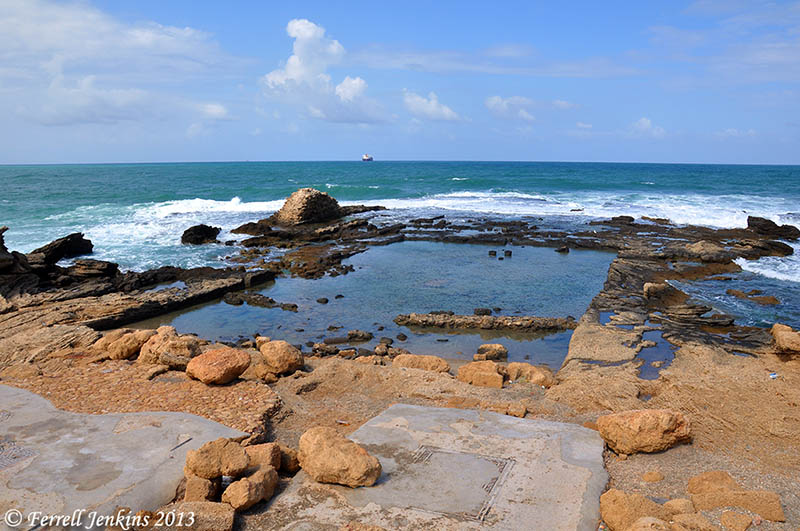
A few columns of the Palace of the Procurators have been restored at Caesarea. The late Jerome Murphy-O’Connor describes the lower level of the Palace.

From the west colonnade one can look down to the sea shore at a point where its dominant feature is a rectangular rock-cut pool (35 x 18). There are channels to the sea on both sides. A square statue base can be discerned in the middle. The colonnaded pool was originally the centerpiece of a two-storey building (83 x 51 m) which surrounded it on all sides. Presumably it was here that the Roman procurators lived. Wave action and the activities of stone robbers have ensured that virtually nothing remains. A staircase in the north-east corner gave access to the upper level. (The Holy Land, Fifth Edition, p. 243)

Our photo below shows this area. In the foreground you will see portions of some mosaics.

The lower level of the Place of the Procurators. Photo by Ferrell Jenkins.

The lower level of the Place of the Procurators. Photo by Ferrell Jenkins.

This was not a bad place for the Roman procurators to live a luxurious life while the Apostle Paul was held in custody nearby (Acts 23:23 – 26:32).

Procurators associated with Caesarea in the New Testament include…

  • Pilate (A.D. 26-26) – John 18, et al.
  • Felix (A.D. 52-59) – Acts 23-25
  • Festus (A.D. 59-61) – Acts 24-26

The Jewish rulers associated with Caesarea include…

  • Herod the king [Agrippa I] (A.D. 37-44) – Acts 12
  • Herod Agrippa II (lived A.D. 27-100) – Acts 25-26

The Hippodrome at Caesarea Maritima

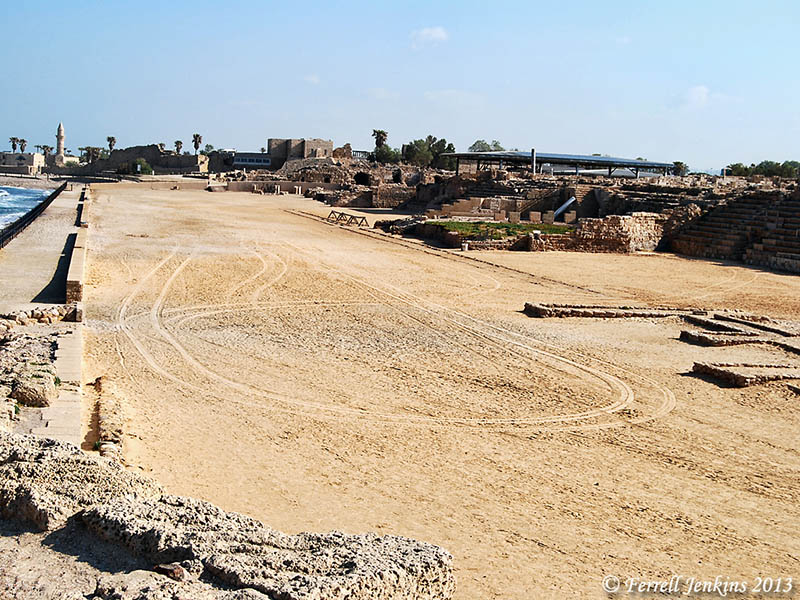
Herod the Great built a hippodrome along the Mediterranean coast at Caesarea Maritima in 10 B.C. to celebrate the opening of the city. In the second century A.D. the south end of the hippodrome was reconstructed as an amphitheater to be used for gladiatorial contests.

The seaside Hippodrome at Caesarea Maritima. Photo by Ferrell Jenkins.

The seaside Hippodrome at Caesarea Maritima. Photo by Ferrell Jenkins.

The apostle Paul was in prison at Caesarea for two years between A.D. 58 and 60 (Acts 23:23 – 26:32).

We discussed Paul’s possible use of the charioteer in Philippians 3:12-14 here.