Category Archives: blog

Identifying Lystra

Biblical sites are identified several ways. A few sites have been known for millennial. For example, Jerusalem (earlier Jebus, 1 Chronicles 11:4-5; and Salem, Genesis 14:18), Damascus, Athens, and Rome.

Some scholars have identified sites on linguistic grounds. For example, Edward Robinson identified biblical Bethel with Beitin in 1938. This proposal had been generally accepted until David Livingston suggested, in the last few decades, that Bethel should be identified with el- Bireh. Some names have remained virtually unchanged. Modern Anata is thought to be biblical Anathoth (Jeremiah 1:1). I note that the Syrian town of Ribleh is identified with biblical Riblah (2 Kings 25:6). After all these centuries only one letter is different.

Other sites are identified on the basis of inscriptions. Such is true of Gezer, Thyatira, and Lystra. This brings me to my topic today.

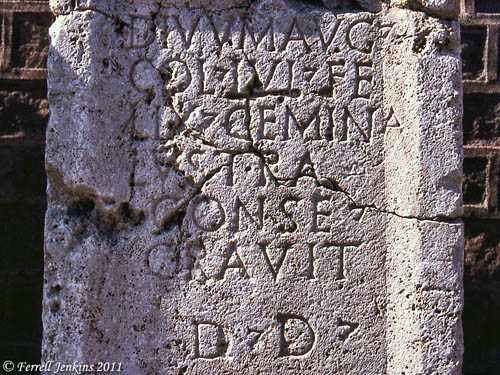
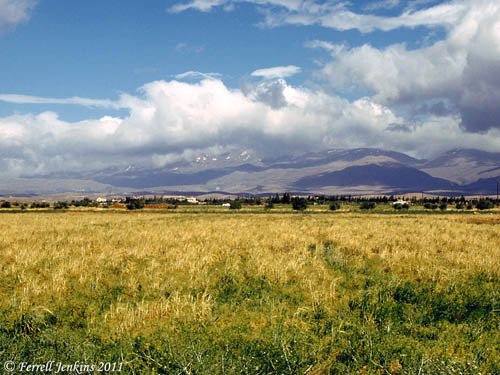
The identification of Lystra was made by J. R. S. Sterrett in 1855 on the basis of a Latin inscription found at the site. The inscription is now displayed at the archaeological museum in Konya (biblical Iconium).

Inscription with the name Lystra. Photo by Ferrell Jenkins.

Inscription with the name Lystra. Photo by Ferrell Jenkins.

The inscription includes the full Roman name Colonia Iulia Felix Gemina Lustra. See Mark Wilson, Biblical Turkey, 173. We called attention to this inscription, with a photo of the entire stone as it is displayed at Konya more than four years ago, during the first month of this blog, here.

The brethren of Lystra and Iconium spoke well of young Timothy at the time Paul chose him to join his preaching party.

Paul came also to Derbe and to Lystra. And a disciple was there, named Timothy, the son of a Jewish woman who was a believer, but his father was a Greek,  and he was well spoken of by the brethren who were in Lystra and Iconium. (Acts 16:1-2 NAU)

I have failed to say recently that archaeological mounds (tells) in Turkey are identified by the Turkish word höyük (pronounced who-youk).

Monday Meandering — October 10

More about Paul’s Shipwreck on Malta. Gordon Franz reviews Robert Cornuke’s recent video on the claimed evidence for the shipwreck.  The review is available at the Associates for Biblical Research site here, or Gordon’s Life and Land blog here.

Gordon also exposes the photos purporting to show giant human skeletons from Greece here.

Shiloh. Leon Mauldin wrote about our recent visit to Shiloh here, here, here. The tabernacle was located at Shiloh for many years after ancient Israel came into the promised land. See Joshus 18; 1 Samuel 1-4, et al.

Recent excavations at the base of Tel Shiloh. Photo by Ferrell Jenkins.

Recent excavations at the base of Tel Shiloh. Photo by Ferrell Jenkins.

Jezreel Excavation. A well-trained team of archaeologists, headed by Norma Franklin and Jennie Ebeling, announces renewal of excavations at Jezreel. Details here.

The new website describes the importance of the location of Jezreel.

We are returning to Jezreel because it is an amazing site with a long history that reflects the rich cultural heritage of the area

Perched on the foothills of the Gilboa mountain range it commands an unparelled view over the valley below. The famous sentry site of Megiddo, Biblical Armageddon, lies 15 kms to the west and to the east the renowned city of Bet Shean (Scythopolis).

Reliability of the New Testament Manuscripts. Barry Creamer comments on the “debate between Bart Ehrman and Daniel Wallace on whether the text of the New Testament is trustworthy. Both are world class scholars in textual criticism.” Some interesting comments on the different approach taken by the two textual critics to the problem of no original manuscripts. Read here.

HT:  Bible Place Blog; Bible X.

Bible Land Food display to teach children

During a recent series of lessons on Daily Life in Bible Times I presented some material on the foods of Bible times. I emphasized that the foods ancient Israel had were those suitable to the terrain in which they lived — predominantly the mountains. One of the major biblical references about the foods is Deuteronomy 8:7-9.

 For the LORD your God is bringing you into a good land, a land of brooks of water, of fountains and springs, flowing forth in valleys and hills; a land of wheat and barley, of vines and fig trees and pomegranates, a land of olive oil and honey; a land where you will eat food without scarcity, in which you will not lack anything; a land whose stones are iron, and out of whose hills you can dig copper.  (Deuteronomy 8:7-9 NAU)

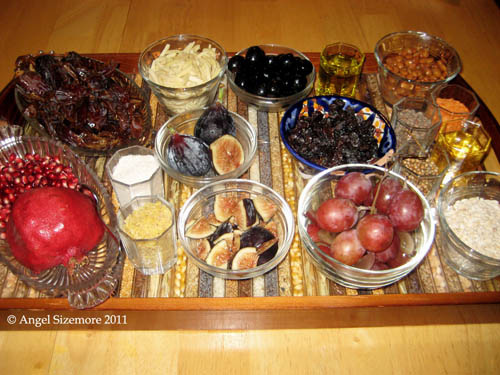
Later I learned that one of the ladies had prepared a Bible Land Food display to show the children during their Bible classes. I requested that Angel Sizemore allow me to use this material here. Here is her brief account.

— • —

After the September weekend lectures you presented at Centreville (Virginia) church of Christ, I had an idea for my class.  (I am teaching the 3rd & 4th graders this quarter). I thought that many of them may not have known what some of the food items you mentioned looked or tasted like. My family already eats most all of the items you mentioned, so I already had them in my kitchen. I had samples of several things cut up so they could taste them.

I showed the food to my own class first; then went over to the 5th & 6th grade class to show them; and finally to the little ones in the 1st & 2nd grade class. It was a HUGE hit with the children of all ages! I have heard from several of their parents that their kids really enjoyed it, and a couple of them had to scour the produce sections looking for their kid’s new favorite foods (like dates and pomegranates!).

Anyway, thank you for helping me to learn so much, and for inspiring me to teach more about it to our own little ones.

Bible Land Foods display by A. Sizemore. Ferrell's Travel Blog.

Bible Land Foods display by A. Sizemore.

Angel provided a list of the foods on the tray. (Click on the photo for a larger image.)

Foods included:
  • Dates — some whole and some cut up so they could taste it
  • Almonds — slivered
  • Black olives
  • Olive oil
  • Lentils — some dry brown and red lentils, and cooked brown lentils to taste
  • Coriander seed — threw that in because of the description of manna
  • Honey
  • Barley
  • Red grapes — some cut up so they could eat them
  • Raisins
  • Figs — some whole and some cut up so they could taste it
  • Cracked wheat [we also spoke of barley]
  • Whole wheat flour
  • Pomegranate — half of a fruit intact, some seeds so they could taste it
  • Cheese — not pictured but added to display — made with mix of goat/sheep milks
The kids enjoyed tasting everything, even stuff I didn’t intend for them to eat (like the raw lentils and olive oil)!
— • —
Note: Most of these foods have been discussed on the Travel Blog. Just use the search box to locate the posts. I have found that the search works best if you use only a single word. Try fig instead of figs. Try wheat instead of cracked. You will find coriander though I did not mention it in the lesson in Virginia.
Thanks to Angel for allowing us to share this wonderful teaching aid with our readers.

Pardon the absence

Since returning from Israel we have been trying to catch up, preparing for some lectures on Daily Life in Bible Times at the Church of Christ in Centreville, Virginia, and now trying to catch up from that and get ready for the next series.

I am still working on sorting the photos that have been made in Egypt and Israel this year.

Thanks for continuing to follow the blog.

A beautiful day in Galilee

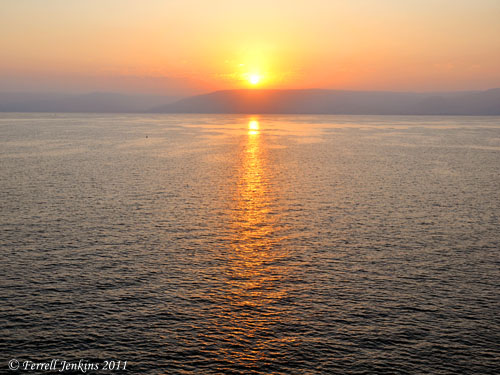
Sunrises on the Sea of Galilee can be extremely beautiful. I know that I have posted several photos of the sunrise, but I wanted to share another one from this morning.

Sunrise on the Sea of Galilee. Photo by Ferrell Jenkins - 09-04-11

Sunrise on the Sea of Galilee. Photo by Ferrell Jenkins - 09-04-11

Much of the ministry of Jesus was conducted on and around the Sea of Galilee. One of the important events recorded in Scripture is the calling of disciples.

Passing alongside the Sea of Galilee, he saw Simon and Andrew the brother of Simon casting a net into the sea, for they were fishermen. (Mark 1:16 ESV)

We went to Nazareth this morning to worship with the church there. Afterwards we spent a good bit of time in Mash’had, a small Arab town between Nazareth and the traditional site of Cana,  trying to locate the tell where the ancient city of Gath Hepher, the home of the prophet Jonah,  is thought to be located. Hopefully we will be able to tell you more about that experience later.

In May I wrote about locating and walking on a portion of the Roman Road near Golani Junction here. I wanted to share this experience with Leon, so we returned there.

There were some other things, but this will be enough for today.

It is hot at this time of the year, and especially when tramping around over hill and vale.

Monday meandering — August 29

Looking for a beautiful photo of the Cedars of Lebanon. Try one of these by Mark Connolly, posted by Carl Rasmussen on the HolyLandPhotos’Blog here. I understand that the oldest of the cedars are located at an elevation of about 6,500 feet above sea level at the village of Bchareé  in Mount Lebanon. The cedars are beautiful at any time of the year, but these snow photos are especially beautiful. I have seen them twice, but only with a little bit of snow. Note just two of the significant references to the cedars in the Bible.

  • Hiram of Tyre floated cedar from Lebanon to Joppa for Solomon’s Temple (966 B.C.; 2 Chronicles 2:16).
  • Cedars were floated to Joppa for the rebuilding of the temple (520-516 B.C.; Ezra 3:7).

Gordon Franz sent me an advance notice of an article you may read on his Life and Land blog. He is coining a new phrase be included in his Cracked Pot Archaeology category. It is a sub discipline of pseudo-archaeology called “Apostolic” Archaeology.

The practitioners of this discipline are usually adventurers, sometimes treasure hunters, and generally with neither field training in archaeological methodology nor academic credentials in Near East archaeology, but perhaps a superficial knowledge of the Bible. They claim to have discovered objects or places of great Biblical importance and declare it to be whatever they want it to be. They usually try to justify their pronouncements with a Bible verse. Their declarations are made as if they were speaking ex cathedra (i.e., with authority).

Read more here. We will be on the alert for more of Gordon’s exposés.

Dr. Claude Mariottini writes about what it is like to go back to teaching after the summer break. He comments on the plague of Email here.

In addition, with the advent of computers, we also had the birth of emails, that modern plague that invades one’s life day and night.  With the growth of technology, now one can check emails at the office or at home.  In addition, email follows you on your iPad and on your smart phone.  Emails are everywhere.

Last month my wife and I went on a vacation.  When I returned to the office, I had to process hundreds of emails.  I have an email at school, one at home, and another for the blog.  Just to process all the emails that had accumulated over a two-week period, it took me almost two days.  Maybe, some of us are luddites at heart, yearning for the good old days that never existed.

There is more good stuff there. I suggest you read it.

Which reminds me. I get more questions by Email, comments, and messages on FB, than I am able to answer. I want to answer most of them, but it is difficult to get to them. Hope you understand.

Logos Community Pricing — some great bargains

If you use Logos (or Libronix) Bible Software you probably already know about Community Pricing. Logos takes on some older works and produces them in the Logos format only when there is sufficient interest to pay. Some may take a year; other may never make it to production.

Todd Bolen is hoping that more people will make a bid on the 16-volume collection of William M. Ramsay before the deal closes on Friday. At this time you can get the entire collection for $20. More orders might even push the price down. Info here. Even Ramsay’s less valuable works are worth $1.25.

See earlier posts about Sir William Ramsay here and here.

While you are at the Logos web site take a look at Travels through Bible Lands Collection (15 volumes). It is expected to sell for $20, but is still gathering interest.

Also take a look at the following books or sets:

  • Cambridge Greek Testament for Schools and Colleges (21 vols.)
  • A Dictionary of Christ and the Gospels (2 vols.), Hastings.
  • A Dictionary of the Bible (5 vols.), Hastings.
  • Critical and Exegetical Commentary on the New Testament (21 vols.), including 16 volumes by Meyer.

I have bids on all of these. Every bid moves us closer to being able to use these works with our Libronix/Logos Bible Software. These books are all old and some material is  out of date, but there is much of value.

Don’t have any Logos software? You can buy from Logos, or you can get started with some really great bargains from Rejoice Christian Software. (I have no stock in either company.) You can buy the Essential IVP Reference Collection 3.0 for $89.95. Start here. This offer is good through Aug. 30. Check for other specials. The Baker New Testament Commentary is available for $80. That is the set by Hendriksen and Kistemaker.

Short video on Masada

The Israel Nature and Parks Authority has prepared a short video on Masada. The narrator presents a brief history of the fortress of Masada while beautiful scenes of the site are shown.

Arutz Sheva (Israel National News) provides a link to the video with an article about Masada here. (A direct link to the video on You Tube is here.) Elad Benari, author of the article, describes Masada in these words:

The top level had four bedrooms and a semicircular balcony, from which there was a spectacular view of the Dead Sea, Ein Gedi, and the Moab Mountains. A sophisticated and hidden staircase led to a middle level in which a large hall was built, surrounded by a veranda whose poles were placed at the edge of the cliff. The staircase went down to the bottom level, in which a large hall surrounded by vestibules was established. The walls of the hall were decorated with spectacular frescoes. A private bathhouse was built adjacent to the hall for the occupants of the northern palace.

At the peak were 29 large warehouses, each one 27 meters long. Excavations of the site found hundreds of pottery vessels in which huge amounts of food were stored. Thus, using a rare combination of natural conditions and human endeavors, Masada became a cliff that was almost impossible to conquer.

The great halls of the palaces were unsuitable for housing families, and thus became headquarters and public buildings.

The building near the north wall, which served as a stable in the days of Herod, was later turned into a synagogue. This is one of the Jewish people’s most ancient synagogues, known to be in use during the period of the second Holy Temple in Jerusalem, an unusual occurrence as synagogues became the accepted place to pray only after the destruction of the second Temple.

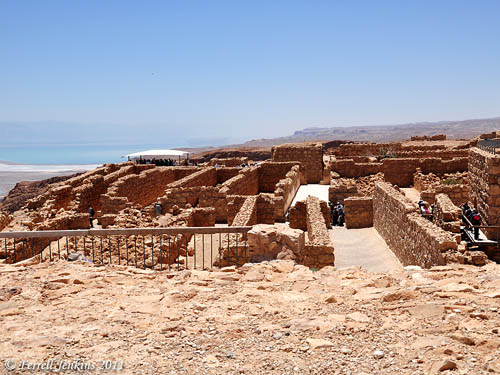
Our photo shows some of the large warehouses at the fortress. The Dead Sea and the mountains of Edom are visible in the left background.

Warehouses at Masada with the Dead Dea visible in the distance. Photo by Ferrell Jenkins.

Warehouses at Masada with the Dead Sea visible in the distance. Photo by Ferrell Jenkins.

It is possible that David visited the site of Masada long before it was turned into a fortress by King Herod. Gordon Franz has examined evidence for this suggestion at his Life and Land blog here.

One of the verses examined is Psalm 18:2 in which the term for fortress is the Hebrew metsudah (our English masada)

To the choirmaster. A Psalm of David, the servant of the LORD, who addressed the words of this song to the LORD on the day when the LORD rescued him from the hand of all his enemies, and from the hand of Saul. He said: I love you, O LORD, my strength.
2 The LORD is my rock and my fortress and my deliverer, my God, my rock, in whom I take refuge, my shield, and the horn of my salvation, my stronghold. (Psa 18:1-2 ESV)

HT: Joseph I. Lauer

Mount Hermon from the Damascus Road

Mount Hermon is the southern end of the Anti-Lebanon mountain range. The mountain is about 20 miles long and has three peaks. At 9,232 feet above sea level it is the highest mountain of Canaan, or Roman Syria, named in the Bible. The mountain now is shared by the countries of Lebanon, Syria, and Israel. The photo below shows mount Hermon from the east, a few miles south of Damascus toward Quneitra. This is roughly the route of the famous Damascus Road taken by Paul as he went from Jerusalem to Damascus. This photo was made the middle of May, 2002. There was more snow on the west side of the mountain in Lebanon than you see here.

View of Mount Hermon from the East. Photo by Ferrell Jenkins 2002.

View of Mount Hermon from the East. Photo by Ferrell Jenkins 2002.

The first biblical reference to Mount Hermon is found in Moses’ account of the Israelite conquest of transjordan (Deuteronomy 3:8). He says that Israel took the land from the hand of two Amorite kings “from the valley of Arnon to Mount Hermon.” The Sidonians, of ancient Phoenicia, called the mountain Sirion, and the Amorites called it Senir (Deuteronomy 3:9). The half-tribe of Manasseh lived in the area of Bashan which is south of Mount Hermon (1 Chronicles 5:23). The Mountain of Bashan is probably a reference to Mount Hermon (Psalm 68:15). Hermon is mentioned in four references in the poetic books of the Old Testament (Psalm 42:6; 89:12; 133:3; Song of Solomon 4:8).

The heavens are yours; the earth also is yours; the world and all that is in it, you have founded them. The north and the south, you have created them; Tabor and Hermon joyously praise your name. (Psalm 89:11-12 ESV)

This post is a slightly revised post from 2009, but the photo is a new one digitized from a slide made in 2002.

Roman sword & menorah engraving discovered

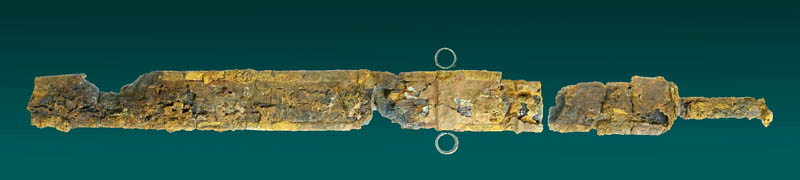
The Israel Antiquities Authority announced Monday the discovery of a Roman sword still in a scabbard and a stone with the engraving of the temple menorah.
Roman sword in scabbard. IAA photo by Clara Amit.

Roman sword in scabbard. IAA photo by Clara Amit.

During the course of work the Israel Antiquities Authority carried out in Jerusalem’s ancient drainage channel, which begins in the Siloam Pool and runs from the City of David to the archaeological garden (near the Western Wall), impressive finds were recently discovered that breathe new life into the story of the destruction of the Second Temple. The excavations are being conducted on behalf of the Israel Antiquities Authority, in cooperation with the Nature and Parks Authority and are underwritten by the City of David Foundation.

A 2,000 year old iron sword, still in its leather scabbard, was discovered in work the Israel Antiquities Authority is doing in the channel, which served as a hiding refuge for the residents of Jerusalem from the Romans at the time of the Second Temple’s destruction. In addition, parts of the belt that carried the sword were found. According to the excavation directors Eli Shukron of the Israel Antiquities Authority and Professor Ronny Reich of the University of Haifa, “It seems that the sword belonged to an infantryman of the Roman garrison stationed in Israel at the outbreak of the Great Revolt against the Romans in 66 CE. The sword’s fine state of preservation is surprising: not only its length (c. 60 cm), but also the preservation of the leather scabbard (a material that generally disintegrates quickly over time) and some of its decoration”.

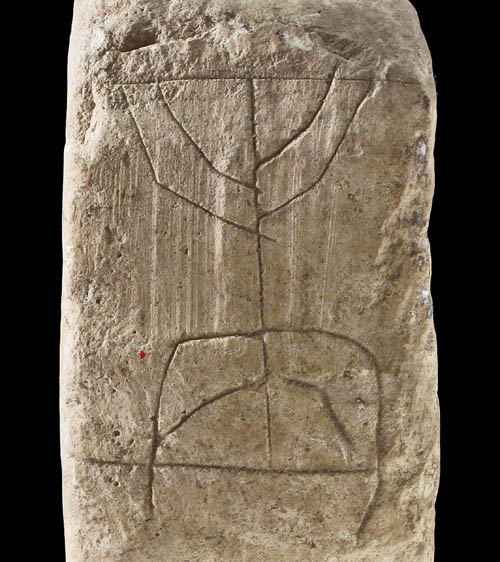
A stone object adorned with a rare engraving of a menorah was found in the soil beneath the street, on the side of the drainage channel. According to Shukron and Professor Reich, “Interestingly, even though we are dealing with a depiction of the seven-branched candelabrum, only five branches appear here. The portrayal of the menorah’s base is extremely important because it clarifies what the base of the original menorah looked like, which was apparently tripod shaped”. The fact that the stone object was found at the closest proximity to the Temple Mount to date is also important. The researchers suppose a passerby who saw the menorah with his own eyes and was amazed by its beauty incised his impressions on a stone and afterwards tossed his scrawling to the side of the road, without imagining that his creation would be found 2,000 years later.
Menorah found beneath 1st century street. IAA photo by Vladimir Naykhin.

Menorah found beneath 1st century street. IAA photo by Vladimir Naykhin.

An AP report with several enlargeable photos is available here.

I think this blog was the first one to report walking through the sewer more than 15 months ago. See here.

Two words are used for sword in the Greek New Testament. The more common word is machaira which describes a short, tongue-shaped sword or dagger. The term rhomphaia, which describes a long sword, is used only in Luke 2:35 outside the book of Revelation. It is used 6 times in Revelation. Probably all but one of these finds Christ as the bearer of the sword (1:16; 2:12; 2:16; 6:8; 19:15; 19:21). The book of Revelation has a setting in the Roman Empire outside of Palestine. The use of rhomphaia seems to be the appropriate term.

In one of the news reports about the recently found sword, archaeologist Elie Shukron is quoted as saying that the sword was the type used by Roman centurions, but that it was probably taken from the Roman garrison by one of the Jewish rebels (see here). This seems much more plausible to me.

G. K. Beale comments on the sword coming out of the mouth of Jesus:

The Christians in Asia are to understand that Jesus will do battle in this manner not only against the evil nations (19:15) but also against all those among the churches who compromise their faith (2:16). The consensus is that this sword alludes to that of the Roman soldier, used in battle, further enhancing this idea. (The Book of Revelation in NIGTC, 212)

This photo was made at the RACE show (Roman Army and Chariot Experience) in the hippodrome at Jerash, Jordan. It shows the centurion wearing both swords.
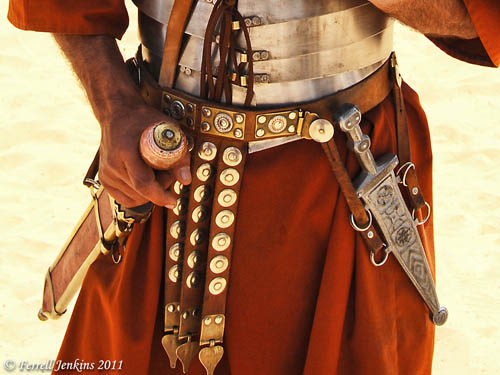
Roman Centurion at Jerash with two swords. Photo by Ferrell Jenkins.

Roman Centurion at Jerash with two different swords. Photo by Ferrell Jenkins.

HT: Bible Places Blog; Joseph Lauer.