Category Archives: blog

McGarvey’s Land of the Bible

J. W. McGarvey was one of the best scholars of the 19th century Restoration Movement. He was president of the College of the Bible in Lexington, KY. One of my first books was his practical New Commentary on Acts of Apostles (1892). He had earlier (1868) written A Commentary on Acts of Apostles dealing with some of the critical issues of the book. McGarvey addressed some of the critical questions of the day in The Authorship of Deuteronomy, Jesus and Jonah, and Biblical Criticism.

McGarvey visited Palestine in 1879. His former students paid for the trip [I like that!], with the understanding that he would write a book. They would get their money back from the sale of the book. His book, Lands of the Bible, was published by J. B. Lippincott & Co., London and Philadelphia, in 1881. The title page indicates that 15,000 copies were printed. Impressive for a book on that subject.

J. W. McGarvey’s Lands of the Bible is available at the Restoration Movement pages here. For other works by McGarvey and other Restoration leaders begin with the home page here.

When I led my first group to the Bible Lands in 1967, one friend in the group had studied McGarvey’s book carefully. He took a tape measure with him. When we came to certain sites he took out the tape to take measurements. He wanted to be sure he was at the same place McGarvey visited.

Chapter IX in McGarvey’s book is titled “Argument from the Agreement of the Land and Book.” I have an outline of this material in my Introduction to Christian Evidences [OP], and use some of this material in my Daily Life in Bible Times series. One would be mistaken not to move beyond McGarvey, Thompson, Robertson, and the other early explorers. On the other hand, it would be amiss to dismiss what these scholars wrote.

What prompted all of this? Todd Bolen recently wrote a post on The Acoustics of Mounts Gerizim and Ebal in which he quotes from one of McGarvey’s letters here. I urge you read his post now. Also follow the link to the Biblical Studies and Technology Tools post showing the valley between Ebal and Gerizim using digital mapping tools.

I wanted to contribute something to this study by including here a scan of the plate from my original edition of Lands of the Bible (opposite page 288).
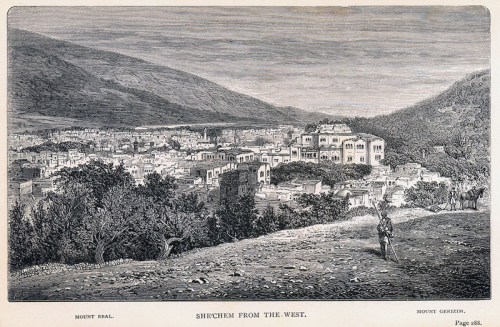
Shechem from the West. McGarvey, Land of the Bible.

Shechem from the West. McGarvey, Land of the Bible.

Todd Bolen has a great photo of Mount Ebal from Mount Gerizim. I would like to add the other side of the valley. Here is a photo showing Mount Gerizim from above Mount Ebal. It is an aerial shot made for me by the well known photographer Zev Radovan.
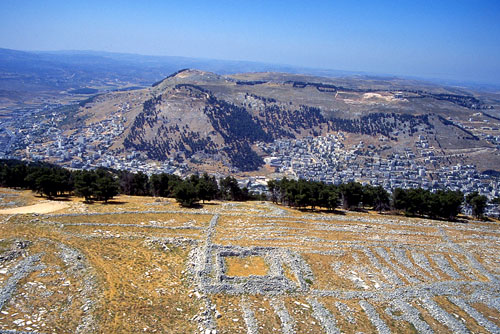
View of Mount Gerizim from above Mount Ebal.

View of Mount Gerizim from above Mount Ebal.

Maybe later we will discuss some of the important biblical events that took place in this area. For not let us note that this is where the blessings and curses of the law were read after the children of Israel entered the promised land (Deuteronomy 11:19). Here is the account of that event:

All Israel with their elders and officers and their judges were standing on both sides of the ark before the Levitical priests who carried the ark of the covenant of the LORD, the stranger as well as the native. Half of them stood in front of Mount Gerizim and half of them in front of Mount Ebal, just as Moses the servant of the LORD had given command at first to bless the people of Israel. Then afterward he read all the words of the law, the blessing and the curse, according to all that is written in the book of the law.  There was not a word of all that Moses had commanded which Joshua did not read before all the assembly of Israel with the women and the little ones and the strangers who were living among them. (Joshua 8:33-35 NASB)
An invitation from Issuu by mistake

A short time ago I received a notice that a newsletter I was interested in was available. When I followed the link I ended up at something called Issuu. When I registered I was able to get the newsletter. In the process of registering I allowed Issuu to begin issuing invitation to my Gmail mailing list. I have no way of knowing how many invitations when out.

Several of you have already joined.

Sorry about that. It may be a wonderful service, but I don’t like to receive unwanted Emails and I normally try to avoid sending them.

Please forgive!

It’s snowing

I see that WordPress has it snowing across my page this morning. Guess the computer didn’t take into account that I live in Florida. Enjoy the snow.

Celebrating 100,000 visitors; a gift for you

Thanks for visiting Ferrell’s Travel Blog. This afternoon our Blog Stats moved above 100,000. I think when we began the blog we only had in mind that families of some of our tour members could follow our route of travel. Then I began to write about other places I had visited. Well, here we are today.

As my wife and I looked at the stats I said, “Well, we have reached a millstone, if not a milestone.” She said, “Yes, it is a millstone.” I must admit it has become addictive. But when I realize that I am reaching a large number of people each day/week/month with something that may be beneficial in Bible study and teaching, I am delighted.

Ferrell Jenkins celebrating 100,000 visitors.

Ferrell Jenkins celebrating 100,000 visitors.

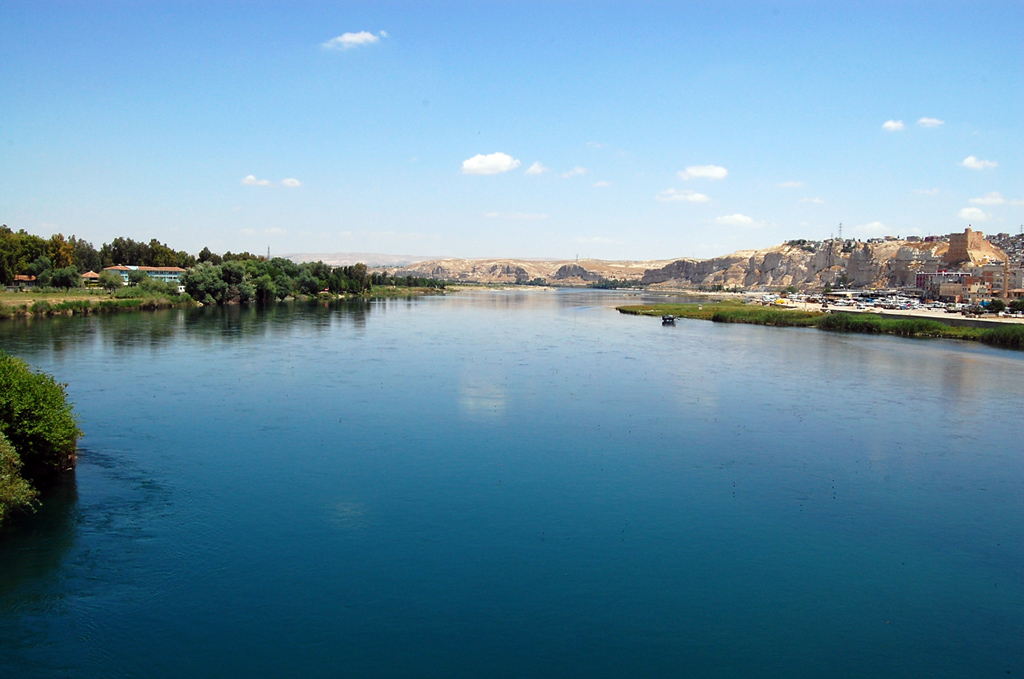
I want to share a gift that may be of benefit to those who use PowerPoint presentations in teaching. During the life of the blog, more people have visited our pages on the Euphrates River than any other. Here is a photo of the Euphrates at Birecik, Turkey. Click on the small photo below and it will take you to a high resolution photo that you may download and use. We request that you not publish the photo without permission. A digital copyright notice is embedded in the image.

The Euphrates River at Birecik, Turkey. Photo by Ferrell Jenkins.

The Euphrates River at Birecik, Turkey. Photo by Ferrell Jenkins.

The Euphrates is the largest, longest and most important river of Western Asia. It is nearly 1800 miles long and was the northeastern boundary of the land promised to Abraham (Gen. 15:18). The empires of Assyria and Babylon, the greatest enemies of Israel, were east of the Euphrates. The Old Testament prophets often put the Euphrates by metonomy for these countries to designate the place from which the punishment of God would come (Isa. 7:20; 8:7; Jer. 46:10). For more information on the Euphrates River read the article here.

Take our poll

Israel trip comments

Elizabeth and I returned last Thursday from a two week trip to Israel. We hosted our first tour in 1967. Since that time I have been to Israel nearly forty times. We have been privileged to show hundreds of Bible students the land of the Bible. Of course, there are also tours to Greece, Turkey, and Egypt, that also visited Bible sites.

We made the recent trip to visit some places we had not been, and also to make digital photographs at some places, both Old Testament and New Testament, we had not been able to visit with a good digital camera. We were able to get to a great percentage of the sites we intended to visit. A few eluded us, mostly due to a lack of time. There were also some surprises along the way that allowed us to visit a few sites that were not on our list.

August is not the ideal time to visit Israel due to the heat. If you followed our blog you know that we encountered temperatures of 113 degrees Fahrenheit some days. Of course, we had an air conditioned car and nice air conditioned hotels. We used Delta Reward Miles for our flights. Considering my schedule and the available Reward dates, it was the best we could do. Having visited Israel in March, April, May, June, July and November, it was good to add August to the list. In many cases I think the 2600+ high resolution photos we made were good. We made our overseas flight from Detroit on Air France via Paris. The return was on Delta’s non-stop flight from Tel Aviv to Atlanta (12 hours and 45 minutes). We had enough points to fly business. Getting back to coach will be difficult!

One advantage of traveling in the summer is that the days are longer for making photos. In the winter the daylight hours are much shorter, and you face the likelihood of rain and larger crowds.

Driving in Israel is little different from driving in the USA, but the cities are not laid out in the neat western way of avenues and streets. Parking is difficult in most of the cities. The day we visited the Old City of Jerusalem we took a taxi to the Dung Gate, and then another taxi at the end of the day from Jaffa Gate. We rented from Eldan, and also rented a GPS unit from the company that supplies the units for all car rental agencies. We received a defective unit that was a real pain for four days until we were back near the airport to replace it. We rented a cell phone from Travel Cell before leaving the USA that allowed free incoming calls.

Gasoline costs about $8 per gallon, and prices for food are about double what we would expect to pay in the USA. The water in Israel is good, but we bought bottled water for our daily travel. The hotels had small refrigerators for our use. Internet connections cost as high as $20 per day. Most were $12 a day. One hotel, the Ron Beach in Tiberias, charged only $2 per day. The $12 and $20 rates are really tough when we think of getting free Internet connections in most American hotels. By the way, the Ron Beach is an ideal hotel for individuals traveling. It is away from the the hustle and bustle of Tiberias and is situated on the shore of the Sea of Galilee.

Plastic water bottles and cigarette butts abound everywhere Israelis hike. The area around the Sea of Galilee is especially bad. If I could give the officials some advice it would be to declare a clean up day.

We do not advise the first or second time traveler to try it on your own. You need to be with a group and a competent guide.

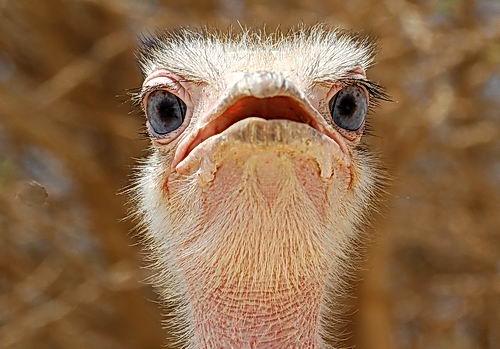
Perhaps the biggest danger we faced was at the Hai-Bar Nature Reserve. I let down the car window to make a photo of one of the ostriches and almost lost a lens. See for yourself.

Ostrich at the Hai-Bar Nature Reserve. Photo by Ferrell Jenkins.

Ostrich at the Hai-Bar Nature Reserve. Photo by Ferrell Jenkins.

The ostrich is listed among the unclean birds for the Israelites in Leviticus 11:16 and Deuteronomy 14:15.

We drove almost 1900 miles, traveled from Dan to Beersheba, even from the border of Egypt on the Gulf of Eilat (Aqaba) on the Red Sea to the border with Lebanon at Metulla. We drove along the Lebanon border in the mountains of Upper Galilee from Kedesh to Akko. We were close to the Gaza strip when we visited Ashkelon. We drove from the Mediterranean Sea on the West to the border with Jordan in the Arabah, and along the Jordan River valley. Some of the sites along the central mountain range (read West Bank) are not easily accessible.

Israel has a good National Parks system. When we travel with a group the guide buys an entry card for the sites we will visit. This was what we intended to do, but our first stop was at Bet Guvrin/Maresha. We bought a pass, good for a year, to visit all of the parks. This was a good purchase, and we still have time to get back and visit some other sites. 🙂 There were a few other places we visited that were not part of the national parks network (e.g., Timna Park, and the Tabernacle Model).

Both of us stayed healthy the entire tour and arrived home safely. Every flight was on time. We are thankful to the Lord for this wonderful opportunity and look forward to using what we learned and photographed in teaching others.

Did Zoroastrianism influence Christianity?

There are many subjects on which I would enjoy commenting, but I have determined to keep this Blog as a travel blog pertaining primarily to biblically related sites. And, I don’t have time to take care of another blog.

We had a comment on The Persian background of Iran that needs some comment. Our reader says,

And incidentally, there’s much more of Iran in the bible. The original “apple” was actually a pomegranate — which comes from Iran, for example. Mithraism, a Persian religion, was the basis for the celebtration of Christmass. The whole concept of hell and heaven and angles was introduced from Zoroastrianism into Judaism and then Christianity.

The Bible does not speak of an “apple” in the Garden of Eden. In Genesis 3:3 and 3:6 we are told that Adam and Eve had been told not to eat “from the fruit of the tree which is in the middle of the garden.” The fruit was good for food. Earlier, in Genesis 1:29 we are told that God gave man “every tree which has fruit yielding seed, it shall be food for you.” The Hebrew words are the same for fruit, tree, and food in both Genesis 1 and Genesis 2. We certainly do not know that the fruit was pomegranate.

The issue of whether Judaism and Christianity have borrowed some basic concept from Zoroastrianism is debatable. Notice the comment by Lewis and Travis in Religious Traditions of the World (Zondervan, 1991).

The relation between Zoroastrianism and the chief monotheistic religions, Judaism, Christianity, and Islam, is debated. Part of the problem is due to the fact that the collection of Zoroastrian teaching was not completed until the fourth century C.E. [A.D.], leaving in some doubt who may have influenced whom in such matters as angels, resurrection, and eschatology. (57)

If one takes the New Testament as the complete and final revelation of the will of God for man, as I do, any changes in doctrine after New Testament times must be considered as departures from the faith. The argument goes something like this:

  • The New Testament is the completed revelation of the mind of God to man (Ephesians 3:1-7; 1 Corinthians 2:6-13; Ephesians 4:5; Jude 1:3; Romans 1:16; I Corinthians 1:21, et al.). The Scripture is the inspired word of God (2 Timothy 3:16-17).
  • Jesus is God (John 1:1; Hebrews 1:8; Colossians 1:15-17). He became flesh (John 1:14). He died on the cross for the sins of mankind (1 Corinthians 1:23; 2:2, 8; 15:3-4; Hebrews 9:28; Acts 2:36; 4:10).
  • The Bible warns about going beyond this teaching (1 John 4:1; Galatians 1:6-8; 2 John 1:9-11).

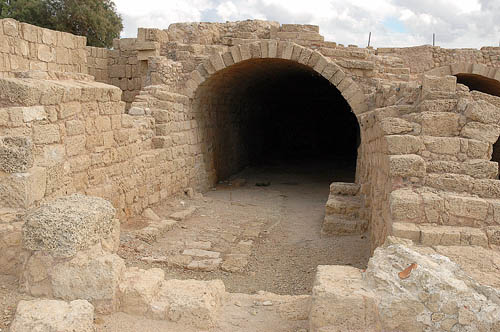
It is true that Mithraism was a significant competitor of Christianity in the second century Roman Empire. It was one of the favorite mystery religions of the Roman soldiers. At Caesarea Maritima on the Mediterranean coast, in one of the substructures of a public building, evidence has been found indicating that one of the vaults served as a Mithraeum in the early 2nd century A.D.

Building at Caesarea Maritima converted to a Mithraeum in the early 2nd century A.D. Photo by Ferrell Jenkins.

Building at Caesarea Maritima converted to a Mithraeum in the early 2nd century A.D. Photo by Ferrell Jenkins.

Christmas, as a religious holiday, is not known in the New Testament. In this case we must say that later Christianity borrowed aspects of it from pagan sources. See my article on The Truth About Christmas here for more details.

If you are interested in a complete study about the relation between Persia and the Bible, I suggest Edwin M. Yamauchi’s Persia and the Bible with foreword by Donald J. Wiseman) Baker, 1990.
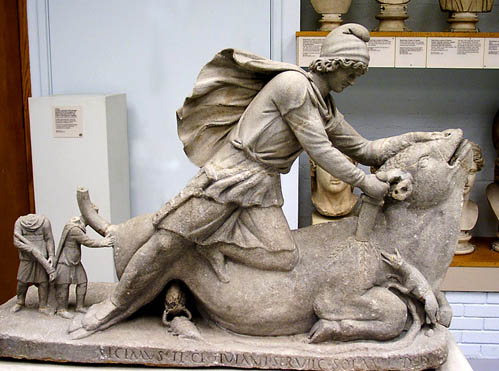
Yamauchi tells us that “the central cult image of Mithraism was the statue of the tauroctony or depiction of Mithras slaying the bull.” He says over 500 representations of this image have been found. Here is one I photographed in the Britism Museum.

The Sun-god Mithras slaying a bull. Photo by Ferrell Jenkins in the British Museum.

The Sun-god Mithras slaying a bull. Photo by Ferrell Jenkins in the British Museum.

Summary of the blogs

Over at the Biblical Studies Info Page, under Scholarly, then Blogs, I keep a list of several blogs that I regularly check. Here is a brief summary of some current items you might find of interest.

Todd Bolen calls attention to the continuation of the Western Wall excavations here. This excavation is on the extreme western side of the Western Wall plaza.

Aren Maer gives a wrap-up of the recent excavations at Gath (Tell es-Safi) here.

Ben Witherington includes a seminar paper by one of his doctoral students in review of Barth Ehrman’s Lost Christianities here. This has to do with the formation of the canon.

Mark Copeland has posted good photographs of 299 Sermon Charts pained by Steve Hudgins here. Steve pained a few charts for me, and some of my tour banners, years back. This shows the type of visual aids that some of us used. It was before flannel boards, opaque projections, overhead projections, and PowerPoint. The biggest problem is that the audience knew when we were only half finished! I doubt any of you will want to use a chart like this now, but you can get some great ideas for sermon starters, put them in PowerPoint, and see if they will gel.

Claude Mariottini has called attention to the problem of Fake Degrees, even among ministers and professors of biblical studies, here. Every now and then I see some preacher who wouldn’t know how to write a research paper advertising himself as Dr. So-and-so. Shameful.

We begin a cruise on the Aegean

After breakfast this morning we will be boarding M/V Aquamarine, a ship of the Louis Cruise Lines, for a four day/three night cruise of the Greek Islands. Our first stop this afternoon will be Patmos, a small island in the Dodecanes group (12 islands), where John was exiled prior to writing the book of Revelation.

I, John, your brother and fellow partaker in the tribulation and kingdom and perseverance which are in Jesus, was on the island called Patmos because of the word of God and the testimony of Jesus. (Revelation 1:9).

During the cruise portion of our tour my posts may be limited and/or brief. I understand that the ship has Internet service, but I am not sure of the arrangements.

Several others members of our tour group are blogging. If you would like to read a good blog of much more human interest, please take a look at journeyswithjane.

Norm teaches Bible at Athens Bible School. He is writing for this students, and is including some good photos of the places we are visiting. N.O.R.M. is the name of his blog. He says its means Not Out Roaming Mindlessly. I like that! Click here to visit his blog.

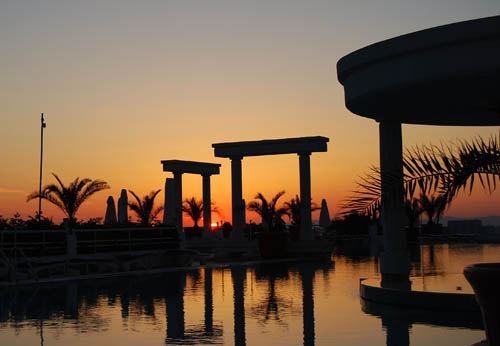
Our hotel at Kusadasi (near Ephesus), Turkey, is built on a cliff overlooking the Aegean Sea. Here is a sunset view if caught last evening from the hotel pool deck.

Sunset on the Aegean. Made a Kusadasi, Turkey, by Ferrell Jenkins.

A day in Galilee

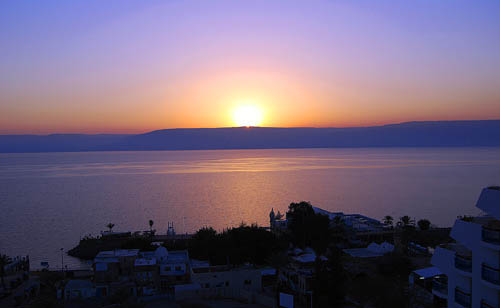
is is the way I began the day by viewing the sunrise over the Sea of Galilee from my hotel window at Tiberias. This is always a beautiful view. It brings to mind many of the teaching of Jesus in the Galilee area. Jesus met his disciples on the shores of Galilee after His resurrection. John 21:12 records that Jesus prepared breakfast for the disciples.

Sunrise on the Sea of Galilee. Photo made from Tiberias by Ferrell Jenkins. April 3, 2008.

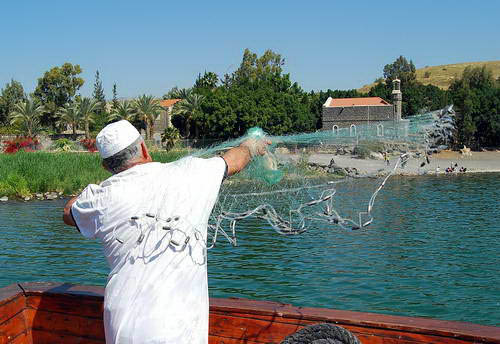
We always include a boat ride on the Sea of Galilee as part of ou tour. One of the men on our boat showed how nets were cast in bible times. This was in the area where Jesus appeared to the disciples. Here is the account in the Gospel of John:

But when the day was now breaking, Jesus stood on the beach; yet the disciples did not know that it was Jesus. 5 So Jesus said to them, “Children, you do not have any fish, do you?” They answered Him, “No.” 6 And He said to them, “Cast the net on the right-hand side of the boat and you will find a catch.” So they cast, and then they were not able to haul it in because of the great number of fish. (John 21:4-6).


Fisherman casting a net on the Sea of Galilee. Photo by Ferrell Jenkins.

We visited Capernaum, Tabgha, the Mount of Beatitudes, and Bethsaida. We drove along the eastern side of th Sea of Galilee and saw the area where the swine ran down the steep cliff into the sea.(Matthew 8:32). We stopped at En Gev and made a photo of the tell of Hippos. We made a few photos at the new excavations at Tiberias. In December excavations were renewed at Magdala. We stopped at the site, but the entire area is locked and it was practically impossible to make any decent photos of the site due to the fencing around the site. Perhaps in future years the site will be open to the public. Magdala was the home of Mary Magdalene.

Everyone in the group seems to be having a good time learning more about the land of Jesus.

Two of our ladies are publishing blogs that are very informative and are filled with human interest. We learned that the 3rd grade class at Athens Bible School is following our tour as one of their projects. There are four women on our tour who are grandmothers of children in the class. Here are the links to the other blogs.

gowithjo.blogspot.com