Category Archives: Bible Study

Satet — the female god of Elephantine

We noted earlier that there were three major gods worshiped on Elephantine Island and the nearby region — Khnum, Satet, and Anqet. Khnum was the river or water god and was considered the god of the Nile. Satet was his female counterpart.

Her most important role was as the goddess of the inundation (yearly flooding of the Nile). According to myth, on the “Night of the Teardrop” would shed a single tear, which was caught by Satet and poured into the Nile, causing the inundation. (Ancient Egypt Online)

Budge says that at one period,

she must have been regarded as the goddess of the inundation, who poured out and spread over the land the life-giving waters of the Nile, and as the goddess of fertility. (The Gods of Egypt, II:55)

The ruins shown below belong to the Temple of Satet from Egyptian Dynasty XVIII. This was the time of Thutmose III (roughly around 1500 B.C.), during what is designated the New Kingdom Period.
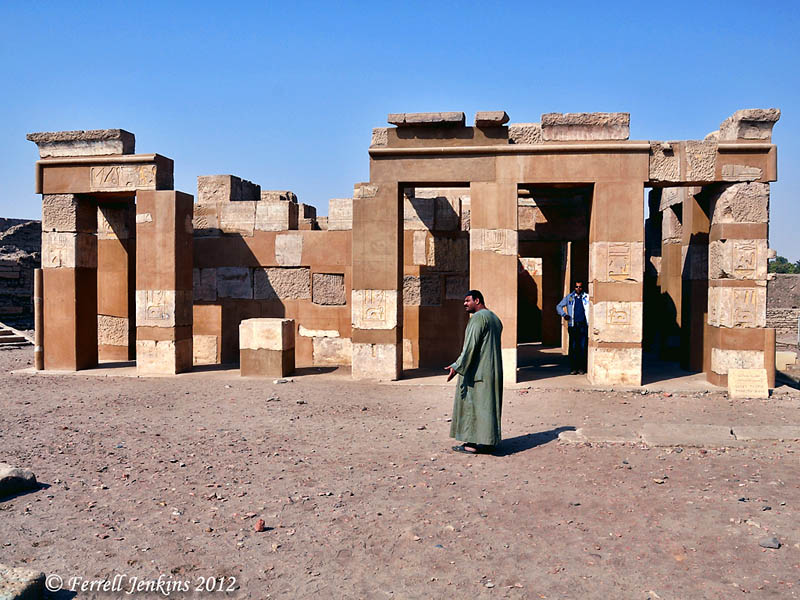
Satet Temple on Elephantine Island. Photo by Ferrell Jenkins.

Satet Temple on Elephantine Island. Photo by Ferrell Jenkins.

A broken relief of the head of Hathor may be seen in the ruins. Hathor portrayed herself with the head of a cow, with two horns, and a solar disc between the horns. Sometimes she was portrayed in the form of a cow.
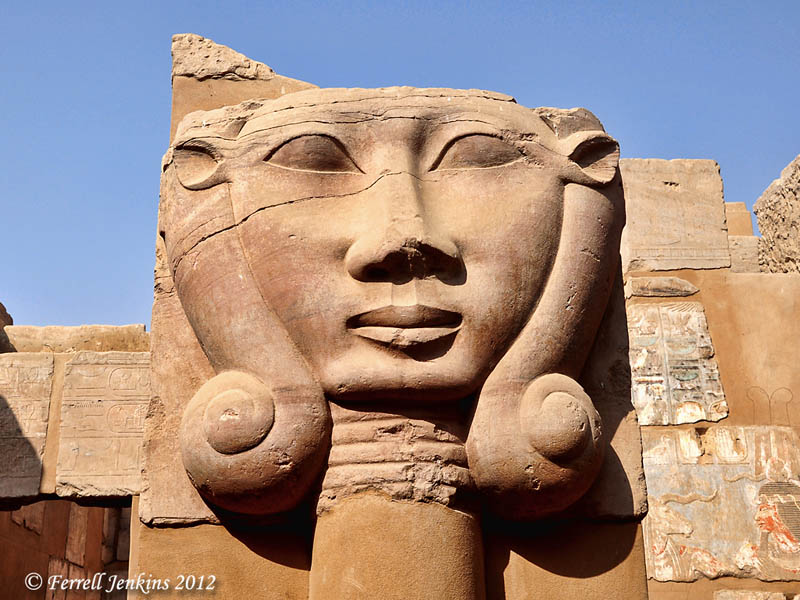
Hathor in the Ptolemaic Satet Temple on Elphantine Island. Photo by Ferrell Jenkins.

Hathor in the Satet Temple on Elephantine Island. Photo by Ferrell Jenkins.

Temples honoring Satet continued on the island into the Ptolemaic and Roman periods.

Israel had been warned at the time of the Exodus that they should not return to Egypt.

Only he must not acquire many horses for himself or cause the people to return to Egypt in order to acquire many horses, since the LORD has said to you, ‘You shall never return that way again.’ (Deuteronomy 17:16 ESV)

After the Exile of Judah to Babylon, some of the Judeans who remained in the land of Judah returned to Egypt taking the prophet Jeremiah with them. Jeremiah continued to warn of the dangers of serving the gods of Egypt. In fact, the women of Judah are accused of leading their husbands into worshiping the gods of Egypt (Jeremiah 44).

No Joke: free and nearly free

Todd Bolen, in his Weekend Roundup at the Bible Places Blog, calls attention to a couple of books that I wanted to mention while there is still time.

The first is a free Kindle ebook — Walk the Land: A Journey on Foot Through Israel. This couple in their early 50s followed the 600-mile Israel National Trail from the border of Egypt to the border of Lebanon. It was a 42 day trek. I don’t know how long the book will be available at this price. Act quickly.

The second is one of the Fabulous Friday Specials at Christianbook.com. Through Monday evening you can get the Zondervan Atlas of the Bible, by Carl Rasmussen, for $14.99 (with typical postage and handling, I suppose).

The gods of Elephantine Island

Khnum (also Khnoum and Khnemu) was the chief Egyptian god in a region stretching from Thebes (modern Luxor) to Philae. Philae is a short distance south of Aswan and Elephantine Island.

According to Budge,

… the principal sanctuaries of the god were at the two ends of the First Cataract, i.e., on Elephantine on the north and on Philae and the adjoining islands on the south. He [Khnum] was the god par excellence of the First Cataract, throughout which, with his female counterpart Satet and the local Nubian goddess Anqet, he was worshipped from the earliest dynasties … (The Gods of the Egyptians, II:50).

Recently I learned of Ancient Egypt Online. This well-constructed site describes Khnum:

Khnum was originally a water god who was thought to rule over all water, including the rivers and lakes of the underworld. He was associated with the source of the Nile, and ensured that the inundation deposited enough precious black silt onto the river banks to make them fertile. The silt also formed the clay, the raw material required to make pottery. As a result he was closely associated with the art of pottery. According to one creation myth, Khnum moulded everything on his potters wheel, including both the people and the other gods.

Budge sums up the essence of the god when he says that Khnum “was originally a water or river-god, and that in very early times he was regarded as the god of the Nile and of the annual Nile-flood…”

A courtyard and an impressive granite doorway mark the location of the Late Khnum Temple on Elephantine Island. This gate, belonging to Dynasty XXX,  was constructed in the reign of Nectanebo II (c. 350 B.C.). The Wikipedia entry says he was the last native ruler of ancient Egypt.

Ruins of the Khnoum Temple on Elephantine Island. Photo by Ferrell Jenkins.

Granite doorway of the Khnoum Temple on Elephantine Island. Photo by Ferrell Jenkins.

The Book of Exodus quotes the LORD saying that, in the plagues of Egypt, he would execute judgment on the gods of Egypt.

I will pass through the land of Egypt in the same night, and I will attack all the firstborn in the land of Egypt, both of humans and of animals, and on all the gods of Egypt I will execute judgment. I am the LORD. (Exodus 12:12 NET; cf. Numbers 33:4).

Khnum was the god of the Nile. Not much left today.

Elephantine Island

There are numerous ways to describe the location of Elephantine Island. It is an island in the Nile River at Aswan (= Syene in Ezekiel 29:10 and 30:6). Or we might say that the island is located at the first cataract of the Nile.

According to Budge, the earlier name for Elephantine was Abu. One way of writing the name of the island included the drawing of an elephant (E. A. Wallis Budge, The Gods of the Egyptians, II:51).

Various suggestions have been made regarding the origin of the name Elephantine. Some say the smooth rocks of the first cataract remind one of an elephant back. Others say, the island is shaped like an elephant tusk. Or, the island was the center of ivory trading in the past.

A small granite statue of an elephant has been uncovered on the extreme south end of the island. Aswan, you likely recall, was noted for its granite.

Granite Elephant on Elephantine Island, Aswan, Egypt. Photo by Ferrell Jenkins.

Granite Elephant on Elephantine Island, Aswan, Egypt. Photo by Ferrell Jenkins.

In the Septuagint Old Testament and in the New Testament the word elephantinos is translated ivory. You can think of Samaria’s famous beds of ivory, made from the tusks of elephants (Amos 6:4), or the unsold cargoes of the merchants who could no longer trade with the fallen Babylon [Roman Empire] (Revelation 18:12).

Paul spent a night at Cos (Kos)

Paul and his companions, including the physician Luke, made their way from Miletus to Cos (Kos).

And when we had parted from them and set sail, we came by a straight course to Cos, and the next day to Rhodes, and from there to Patara. (Acts 21:1 ESV)

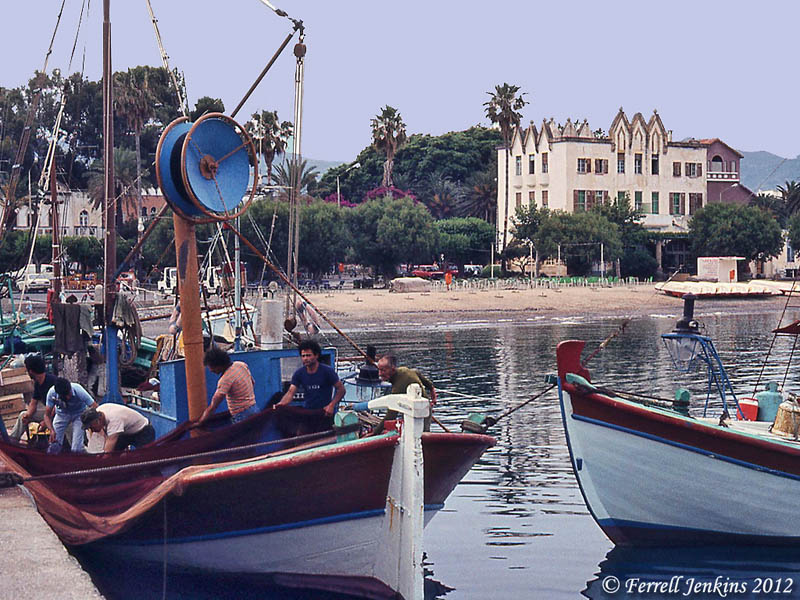
Cos is one of the islands belonging to a group of 12 called the Dodecanese. Patmos is also an island of this group. The Mycenaeans settled Cos in the 15th century B.C. In the centuries to follow the island came under the control of the Persians, the Greeks, and the Romans. In modern times the island has been under Turkish and Italian control, and German occupation. Since 1948 it has been part of Greece. My only visit to Cos was a brief stop en route from Patmos to Rhodes in 1984. Here is one of the photos I made.

The harbor on the Island of Cos in 1984. Photo by Ferrell Jenkins.

The harbor on the Island of Cos in 1984. Photo by Ferrell Jenkins.

In the time of Paul, Cos was noted as the birthplace of Hippocrates, the “father of medicine.” Hippocrates was associated with the Asclepium, ruins of which can still be seen. A Hellenistic gymnasium and some Roman ruins, including portions of a Roman road, may also be seen. There is also an archaeological museum.

Howard F. Vos describes the island with these words:

One of the most beautiful ports of the ancient world, Cos not doubt was most famous as a health resort. It was the site of the first school of scientific medicine and the sanctuary of Asclepius (Esculapius). The island had a healthful climate and hot ferrous and sulfurous springs, which the great Hippocrates (ca 460–377 b.c.), the father of medicine, first used to cure his patients. (The International Standard Bible Encyclopedia, revised.)

James Strahan, in the old Hasting’s Dictionary of the Apostolic Church, says,

It was renowned for its vines and looms, its literature and art, and above all for its temple of Æsculapius and school of medicine, which must have made it especially interesting to St. Luke.

According to Josephus, Herod the Great assisted the people of Cos with grain and other goods. (JW 1:424).

Two Other Good Sources:

Fant, C. E. and M. G. Reddish, A Guide to Biblical Sites in Greece and Turkey.

Wilson, Mark. Biblical Turkey: A Guide to Jewish and Christian Sites of Asia Minor. This book deals with Turkey, but devotes ½ page to Cos as a Sidetrip.

Dr. Bryant Wood’s Lectures on Archaeology and the Conquest

Dr. Bryant G. Wood recently presented three lectures on “Archaeology and the Conquest: New Evidence on an Old Problem” for the 2012 William R. Rice Lecture Series. The lectures, and a fourth lecture on Old Testament Archaeological Discoveries, are available in MP3 here.

The four topics available for listening are:

  • Background and Chronology of the Exodus and Conquest.
  • Digging Up the Truth at Jericho.
  • The Discovery of Joshua’s Ai.
  • Great Archaeological Discoveries Related to the old Testament.

Wood is Director of Research at the Associates for Biblical Research, editor of Bible and Spade, and director of the Excavations at Khirbet el-Maqatir (suggested as a possible site for Biblical Ai).

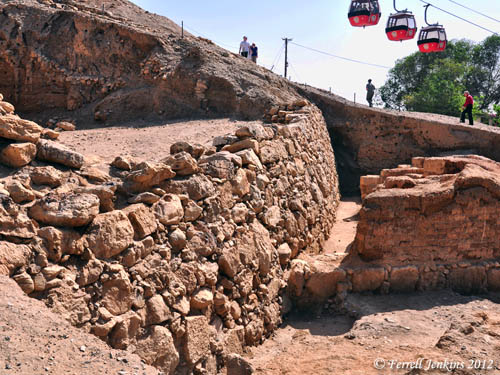
Jericho's Outer Revetment Wall on South End of Tel es-Sultan. Photo by Ferrell Jenkins.

Jericho's Outer Revetment Wall on the South End of Tel es-Sultan. Recent archaeological work at Jericho indicates that mud brick had fallen on houses built against this wall. Wood believes that this evidence fits perfectly with the biblical record in Joshua. Photo by Ferrell Jenkins.

HT: Bible-X

Alexander the Great and the Book of Daniel

Josephus, the late first century Jewish historian, records the visit of Alexander the Great to the city of Jerusalem in the 4th century B.C. He recounts how Alexander “went up into the temple” and “offered sacrifice to God.” He says that the Book of Daniel was shown to Alexander. Alexander assumed, as have many commentators since that time, that Daniel was prophesying of Alexander.

Bust of Alexander in the Istanbul Archaeological Museum. Photo by Ferrell Jenkins.

Bust of Alexander in the Istanbul Archaeological Museum. Photo by Ferrell Jenkins.

Here is a portion of the account from the Antiquities of the Jews. Notice especially section 337.

336 And when he had said this to Parmenion, and had given the high priest his right hand, the priests ran along by him, and he came into the city. And when he went up into the temple, he offered sacrifice to God, according to the high priest’s direction, and magnificently treated both the high priest and the priests.
337 And when the Book of Daniel was showed to him {a} wherein Daniel declared that one of the Greeks should destroy the empire of the Persians, he supposed that himself was the person intended; and as he was then glad, he dismissed the multitude for the present; but the next day he called them to him, and bade them ask what favours they pleased of him;
338 whereupon the high priest desired that they might enjoy the laws of their forefathers, and might pay no tribute on the seventh year. He granted all they desired; and when they entreated him that he would permit the Jews in Babylon and Media to enjoy their own laws also, he willingly promised to do hereafter what they desired:  (Ant 11:336-338)

Read Daniel 8 for more details of the conflict between Alexander, who is compared to a male goat, and the Persian king who is likened to a ram.

As I was considering, behold, a male goat came from the west across the face of the whole earth, without touching the ground. And the goat had a conspicuous horn between his eyes. (Daniel 8:5 ESV)

Monday Meandering — March 19

Greatest Finds. The Israel Ministry of Foreign Affairs has compiled a list of the “Greatest archeological finds in Israel” here with links. Places include Masada, Megiddo, Beit Guvrin-Maresha, Ashkelon, the City of David, Hazor, Dan, Herodion, Khirbet Qeiyafa, and Tel es-Safi (Gath), and others.

The Scale of the Universe 2 here. Fascinating. Requires Flash. Reminds me of two Biblical references.

 When I look at your heavens, the work of your fingers, the moon and the stars, which you have set in place,  4 what is man that you are mindful of him, and the son of man that you care for him? (Psalm 8:3-4 ESV)

For by him all things were created, in heaven and on earth, visible and invisible, whether thrones or dominions or rulers or authorities– all things were created through him and for him.  And he is before all things, and in him all things hold together.  (Colossians 1:16-17 ESV)

Marine Life in the Corinthian Gulf here. Beautiful photos.

The Acrocorinth. Wonderful, clear view of the mountain above ancient Corinth here. Carl Rasmussen has posted several other nice photos of Corinth recently.

A history of the Roman Empire in 75 seconds here.

The Burnt House. The headline in the Jerusalem Post read “House in Old City as Titus left it.” Leen Ritmeyer includes this and another news article, along with his reconstruction of the Burnt House here.

Geopolitics of Israel. Every student of Bible geography will enjoy the analysis of the geopolitics of Israel by the Stratfor Global Intelligence here.

2,000-year-old Israeli date palm. Has it been trumped by a 32,000-year-old Russian flower? Tom Powers provides some links about the palm which is now about 8 feet tall, here.

HT: Aren Maeir; NT Resources Blog; Corinthian Matters; Luke Chandler’s Blog; Bible Places Blog.

A touch of Ireland

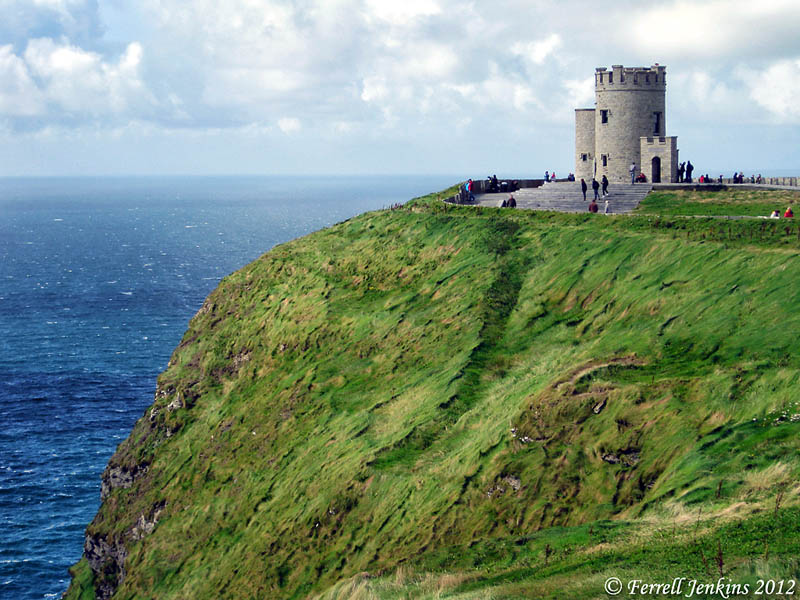
For today I wanted to share a little something from the Emerald Isle. The first photo was made at the Cliffs of Moher on the western coast of Ireland in County Clare.  It certainly illustrates why Ireland is referred to as the Emerald island. The tower is known as O’Briens Tower.

A nice web site about the Cliffs of Moher may be viewed here.

At the Cliffs of Moher, western coast of Ireland. Photo by Ferrell Jenkins.

The next photo comes from Wicklow County in the south eastern corner of Ireland. Glendalough served as a Christian monastic center for about 500 years from the sixth century A.D.

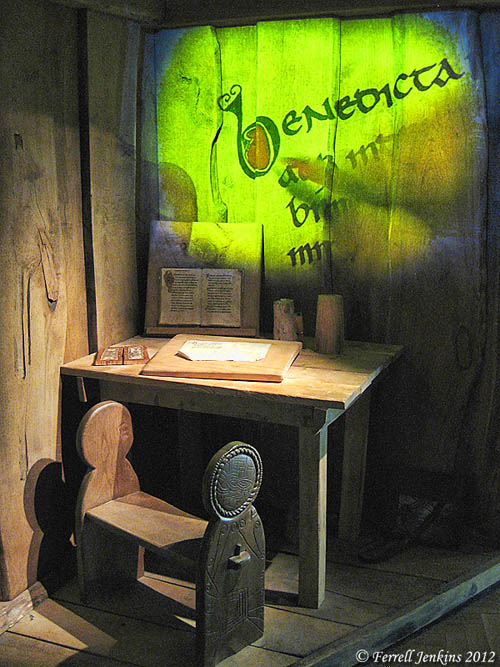
One of the educational exhibits at Glendalough involves the work of the scribe in copying the Scriptures and writing ecclesiastical works.

Scribe Exhibit at Glendalough, Ireland. Photo by Ferrell Jenkins.

Scribe Exhibit at Glendalough, Wicklow County, Ireland. Photo by Ferrell Jenkins.

Click on Monastic Chapters from a web site about Glendalough and Wicklow County here.

“Beware the ides of March”

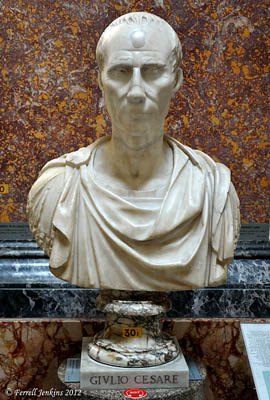
Bust of Julius Caesar in Vatican Museum. Photo by Ferrell Jenkins.

Bust of Julius Caesar in the Vatican Museum. Photo by Ferrell Jenkins.

Shakespeare has the Sootsayer warn Caesar, “Beware the ides of March.” The ides of March was used to describe the 15th of March in the Roman calendar. It was on that day that Julius Caesar was assassinated in 44 B.C. As a result, the expression has come to have a sense of foreboding — a sense that something bad is about to happen.

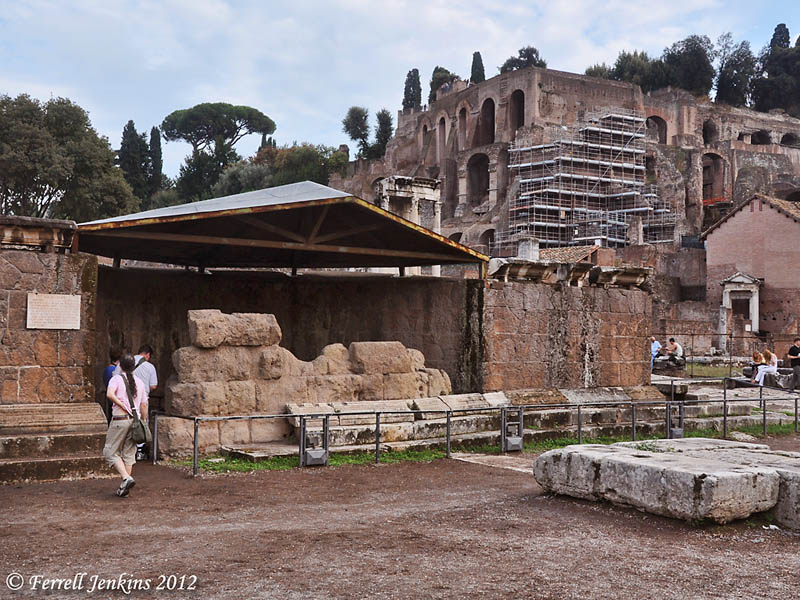
Our photo below shows the place in the Roman Forum where a temple was built to honor Julius Caesar by Augustus in 29 B.C. The deification of rulers was already common in the eastern part of the Empire. This practice would become a serious problem for the Christians of the Roman Empire before the end of the first century A.D., especially those living in Asia Minor. This is one of the issues addressed in the Book of Revelation.

Ruins of the temple erected to Caesar in the Roman Forum. Photo by Ferrell Jenkins.

Ruins of the Temple erected to Caesar in the Roman Forum. Photo by Ferrell Jenkins.