Category Archives: Bible Study

Landing amid snipper fire!

About the time we were ready for landing the pilot began what seemed link some diversionary tactics, first turning to the left, and then to the right. We knew that this was an area that had seen conflict for several millennial.

When the pilot had the plane safely on the tarmac we all jumped out and hunkered down to avoid the sniper fire from all sides. The greeting that had been planned for us had to be cancelled.

So much for April fool’s day! (I haven’t heard anything about the presidential campaigns since leaving the USA.)

We made the trip safely, but several pieces of luggage were missing. Once these reports had been filed we left the airport and went to Joppa.

Joppa is located on the Mediterranean Sea. Joppa is now part of Tel Aviv-Yaffo. The site is associated with several important evens from biblical times. Solomon traded wheat, barley, oil, and wine to Hiram of Tyre for the timber of Lebanon to be used in Solomon’s building projects, including the temple.

“Now then, let my lord send to his servants wheat and barley, oil and wine, of which he has spoken. We will cut whatever timber you need from Lebanon and bring it to you on rafts by sea to Joppa, so that you may carry it up to Jerusalem.” (2 Chroinicles 2:15-16).

Jonah took a ship from Joppa toward Tarshish in a feeble attempt disobey the Lord (Johan 1:3). Peter raised Dorcas (Tabitha) at Joppa (Acts 9:36-43). While in the city, Peter received messengers from Cornelius of Caesarea (Acts 10-11). Part of the account in Acts reads this way:

“And he reported to us how he had seen the angel standing in his house, and saying, ‘Send to Joppa and have Simon, who is also called Peter, brought here; and he will speak words to you by which you will be saved, you and all your household.” (Acts 11:13-14).

Our photo today is made from the site of Joppa, looking toward the modern city of Tel Aviv. We plan to see Caesarea tomorrow.

Tel Aviv from the site of ancient Joppa. The Mediterranean Sea. Photo by Ferrell Jenkins.

In the air and on the road again

We are off to Israel and Jordan.

Soon we will be leaving our hotel and heading for Lufthansa at the JKF International Airport to meet our group. There were at least eight of us at this hotel last night. We have an intermediate stop at Frankfurt, and then on to Tel Aviv. If we arrive on time we will be able to visit Joppa before sunset. Our overnight stay will be at Netanya, along the beautiful Mediterranean.

If possible we will connect to the Internet at Frankfurt. Otherwise, expect our first post from Netanya. We hope to give you a brief behind the lense look at the places we visit in Israel and Jordan. Our time in Israel and Jordan will be seven hours ahead of EDT.

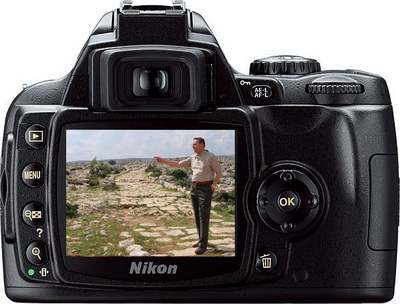
Nikon D40X and Ferrell Jenkins on Roman Road near Tarsus.

Greek NT Manuscripts Discovered in Albania

Daniel B. Wallace reports on the discovery of what is being called a “treasure trove” of Greek New Testament manuscripts. Wallace heads up the Center for the Study of New Testament Manuscripts (www.csntm.org). Last summer a team went to the National Archive in Tirana, Albania, to photograph some manuscripts.

According to Wallace, there are now 5752 New Testament manuscripts known and catalogued. These range from the small John Rylands fragment of the Gospel of John to complete manuscripts of the New Testament.

Seventeen formerly lost manuscripts were found to be in the Albanian archive. This was not the most exciting part of the discovery in Albania. Wallace explains,

This was not the only good news of the day, nor even the most momentous. The catalog revealed several other Greek New Testament manuscripts that had never been catalogued by western scholars. Simple arithmetic told us this: There were forty-seven Greek New Testament manuscripts listed in the National Archive catalog, while the K-Liste noted only thirty in Albania (thirteen plus the seventeen that had been presumed lost). Thus, Tirana was housing at least seventeen manuscripts unknown to western scholarship and as many as thirty-four! Since the dawn of the 21st century, an average of two or three Greek New Testament manuscripts is brought to light each year. A cache of 17 to 34 manuscripts is a remarkable find, regardless of the age and pedigree of the manuscripts.

Codex Beratinus from the 6th century was the oldest manuscript in the Archive.

The oldest manuscript in the collection is Codex Beratinus, a codex that had been dyed in purple, with silver and gold letters written on it. Containing only Matthew and Mark today, this codex, written in the sixth century, is very rare because it is a royal codex. Only a handful of purple biblical codices still exist.

You may read the complete account here.

Wallace mentions one of the manuscripts that does not contain the account of the woman taken in adultery (John 7:53-8:11). He gives us a good discussion of how textual critics deal with this question.

The Parchment and Pen blog has carried a series of articles on textual criticism. To find all of these worthwhile articles scroll down and look for Dan Wallace Contra Mundane in the left column. Click here and look for these good articles.

Back to travel. The whole issue of determining the original text of the New Testament comes down to some practical issues. A visit to Israel and Jordan might include the following places:

  • Bethany beyond the Jordan (John 1:28). Or should it be Bethabara?
  • The Pool of Betheda (John 5:2). Or should it be Bethzatha, Bethsaida, or Belzetha? And should that verse (4) about the stirring of the water even be in the text?
  • The country of the Gadarenes (Matthew 8:28). Or should it be Gergesenes or Gerasenes?

A news release about the Albanian manuscript discovery may be read here. A PDF copy is available here.

Added Note: Video report. WFAA, Dallas, aired a brief report about Dr. Wallace and the Albanian discovery. I could not get it to work in Firefox, but it is o.k. in Explorer. Click here. I wish TV and newspaper reporters could think of something better than “a modern Indiana Jones!”

The Corinth Canal

The city of Corinth is located about two miles south of the narrow isthmus which forms the land bridge, and controlled access, between the main land mass of Greece and the Peloponnesus.

The isthmus is less than five miles wide. In ancient times small ships were dragged across the isthmus on a paved road called the diolkos. Small portions of the diolkos may still be seen. Larger ships unloaded their cargo which was carried across and reloaded. This avoided the long 200 mile journey around the Peloponnesus. Nero abandoned his attempts to dig a canal across the isthmus (A. D. 67).

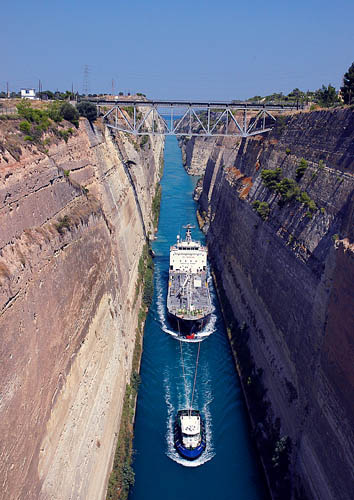
A canal was constructed between 1881 and 1893. Here is a photo of that canal with a tug boat pulling a ship through the canal.

Corinth Canal. Photo by Ferrell Jenkins.

The apostle Paul likely came to Corinth about A.D. 51, during the reign of the Roman Emperor Claudius, and remained there for eighteen months (Acts 18). The book of Acts records the success of that work:

Crispus, the leader of the synagogue, believed in the Lord with all his household, and many of the Corinthians when they heard were believing and being baptized. (Acts 18:8).

Archaeological excavations have been conducted at the ancient city of Corinth since 1896 by the American School of Classical Studies in Athens.

Is there a “third Jesus”?

If you have been impressed by seeing Deepak Chopra on TV telling about his new book, The Third Jesus (the Christ we cannot ignore), I suggest you read this post by Ben Witherington. Click here.

Postmodern man is unwilling to accept the Jesus of the Bible, but he still needs to believe, and wants to believe. This is what makes all of the cable TV programs about the mysteries of Jesus, the unknown years, and those dealing with the claims of the Gnostic literature so popular.

Here are a few Scriptures that might be helpful as you think of Jesus.

In the beginning was the Word, and the Word was with God, and the Word was God. (John 1:1)

And the Word became flesh, and dwelt among us, and we saw His glory, glory as of the only begotten from the Father, full of grace and truth. (John 1:14)

For many deceivers have gone out into the world, those who do not acknowledge Jesus Christ as coming in the flesh. This is the deceiver and the antichrist. (2 John 1:7)

… concerning His Son, who was born of a descendant of David according to the flesh, 4 who was declared the Son of God with power by the resurrection from the dead, according to the Spirit of holiness, Jesus Christ our Lord… (Romans 1:3-4)

“Therefore let all the house of Israel know for certain that God has made Him both Lord and Christ– this Jesus whom you crucified.” (Acts 2:36)

Peter’s great confession of Jesus took place at Caesarea Philippi.

Simon Peter answered, “You are the Christ, the Son of the living God.” (Matthew 16:16)

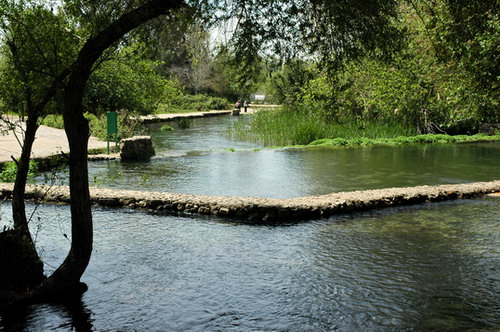
The photo below was made at Caesarea Philippi, one of the major sources of the Jordan River. This was the site of Peter’s great confession.

Source of the Jordan River at Caesarea Philippi. Photo by Ferrell Jenkins.

Senator McCain visits the Western Wall

USA Today reports that Senator John McCain visited the Western Wall during his visit in Israel. This is not uncommon for political figures. Travelers to Israel want to see the Western Wall, or as many of them call it, “The Wailing Wall.”

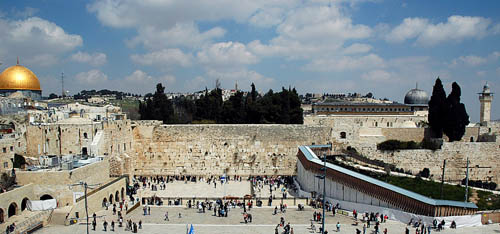
The Western Wall is the western side of the enclosure wall built around the temple mount by Herod the Great. Herod’s wall would have been seen by Jesus and His disciples on their many visits to Jerusalem. Since 1967, after Israel took control of the Old City of Jerusalem, a large portion of the Western Wall has been exposed. The portion we see in our photograph now serves as a place for prayer. It is divided into two portions, one for men, and one for women.

The temple platform is where Solomon’s temple (966-586 B.C.), the temple of Zerubbabel (built 520-516 B.C.), and Herod’s temple (building began about 19 B.C.), once stood. According to the Gospel of John, work continued on Herod’s temple for 46 years.

Then the Jewish leaders said to him, “This temple has been under construction for forty-six years, and are you going to raise it up in three days?” (John 2:20, NET Bible).

The Western Wall in Jerusalem. Photo by Ferrell Jenkins.
The temple platform, now the location of the Mosque of Omar (the Dome of the Rock with the gold dome), and the Al-Aqsa mosque with the silver dome, is now administered by a Muslim group called the Waqf. Currently it is not possible for tourists to visit the temple platform.

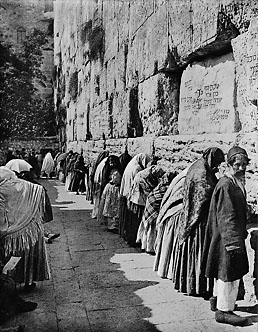
The Wailing Wall between 1900 and 1920. Matson Photograph Collection.

This old photo from the Matson Collection shows the Wailing Wall sometime between 1900 and 1920. This is the way the wall looked when I first saw it in May, 1967. At that time the area was under Jordanian control and no worshipers were present. Notice how small the area is, and how few rows of stone are visible.

Journeys with Jane

Recently I encouraged those who will be traveling with us on tour to the Bible lands this year to think about starting a blog. Jane has taken the plunge. She describes her blog this way:

I am neither an author nor a scholar…just a grandmother and a Bible class teacher, so my blog will be neither scholarly nor a great literary work. However, I hope to write entries in my blog while we are on this trip so family at home (grandchildren in particular…along with the students in my fifth grade Bible Class, and the group of teenage girls I lovingly refer to as the “Salt Shakers”) can keep up with where I am, and what I am seeing and learning.

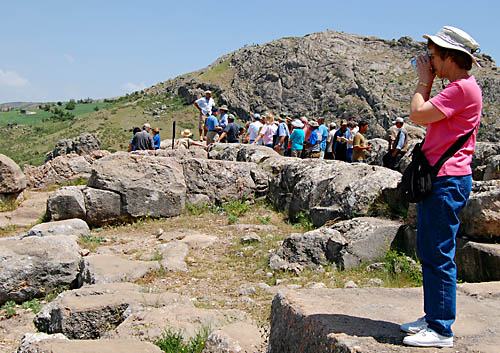
Jane and Olen have been on several of my tours, and she is always one of the best prepared to learn. Both of them are good photographers. Here is a photo of Jane among the Hittite ruins at ancient Hattusas in Turkey.

Jane at Hattusas, home of the Hittites. Photo by Ferrell Jenkins.

If you have children, grandchildren, or if you teach a class of young people, I am sure you will enjoy Jane’s posts. Click here to go to journeyswithjane.blogspot.com.

The Valley of Jezreel from Murakah

Every Bible class teacher has probably learned to sketch the coastline of Canaan (Palestine, Israel). Be sure to make that little jut out into the Mediterranean Sea to represent Mount Carmel. But Mount Carmel is much more; it is a range. Consisting largely of limestone, the mountain is almost 15 miles long by 5 miles wide. The elevation is about 1500 feet above sea level. From the western promontory one can overlook the city and port of Haifa. The Roman general Vespasian, who later became emperor, offered sacrifices on Mount Carmel before the war against the Jews (A.D. 66-70) (Hoade, Guide to the Holy Land, 665).

The location of Mount Carmel made it practical for travelers going north or south to travel around the mountain through the Jezreel Valley (or Valley of Megiddo). To the Greeks it was the Valley of Esdraelon.

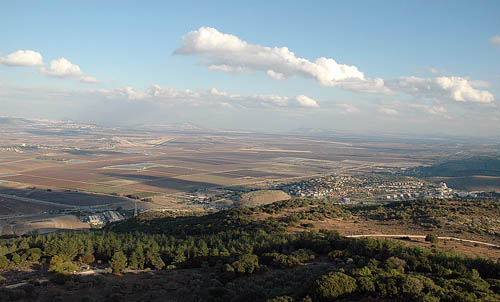
Carmel is best known as the place of the contest between Elijah and the prophets of Baal. Elijah had king Ahab to call all Israel and the 450 prophets of Baal to Mount Carmel (1 Kings 18:17-40). The traditional site for this event is shown at Muhrakah on the eastern end of Mount Carmel. Below the Carmelite monastery of St. Elijah can be seen the valley of Megiddo and the tell of Jokneam (Josh. 12:22). The brook Kishon, where the prophets of Baal were slain, is nearby (1 Kings 18:40).

The photo below of the Jezreel Valley was made from the roof of the monastery. The view is a little to the north, but mostly to the east. The tell in the center of the photo immediately below the mountain is Jokneam. The Bible mentions its “pasture lands” in Joshua 21:34. In the distant left you can see the mountains of lower Galilee, where Nazareth is located. Mediddo, not visible, is to the extreme right. The River Kishon is just a little to the left of this view.

View of the Valley of Megiddo from Muraka. Photo by Ferrell Jenkins.

The Valley of Megiddo was the scene of many significant historical battles and provides the background for the setting of Armageddon (or Har-Magedon) in Revelation 16.

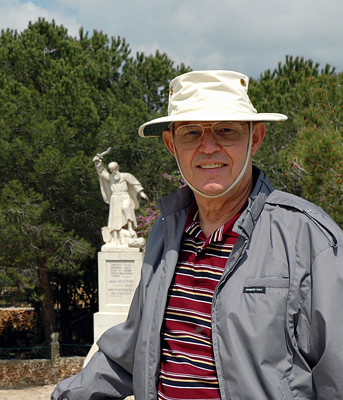
The photo below is intended to remind travelers to wear a hat and sunscreen when visiting Israel. It is much brighter than most Americans are accustomed to in the spring of the year.

Ferrell Jenkins and the Statue of Elijah at Murakah.

The Home of Elisha

Abel Meholah (or Abel-meholah), NAS, ESV is a tell in the Jordan Valley, about 10 miles south of Beth-shean. It is mentioned only three times in the Bible. The Midianites, who were fleeing from Gideon’s army of 300, fled as far as the border of Abel Meholah (Judges 7:22).

Solomon (reigned 970-931 B.C.) set up administrative officers over Israel. Baana, the son of Ahilud, was over the fifth district that included Abel Meholah.

Baana the son of Ahilud, in Taanach, Megiddo, and all Beth-shean that is beside Zarethan below Jezreel, and from Beth-shean to Abel-meholah, as far as the other side of Jokmeam (1 Kings 4:12, ESV).

Many of us likely would find Abel Meholah of interest as the home of Elisha the prophet. When Elijah met the LORD at Horeb, the mountain of God, he was told to do three things: (1) Anoint Hazael king over Aram [Syria]; (2) Anoint Jehu king over Israel; (3) Anoint Elisha from Abel Meholah to take his place as prophet. This took place around the middle of the 9th century B.C. See 1 Kings 19:11-16.

Elijah and Elisha were two of the more important oral prophets of Israel. Elijah was among the settlers of Gilead, on the east side of the Jordan (1 Kings 17:1).

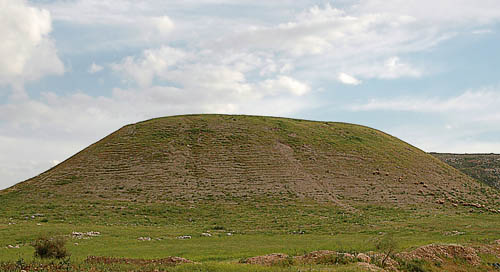
The identification of Abel Meholah is uncertain. Two sites east of the Jordan River have been suggested. The biblical statements seem to favor a site on the west side of the Jordan. Four sites have been suggested. Check the Anchor Bible Dictionary for details and a bibliography. Our photo is of Tell Abu Sus. Future excavations may help settle this question. This is a beautiful example of a tell. Who knows what might be buried within it?

Abel Meholah in the Jordan Valley. Possible home of the prophet Elisha. Photo by Ferrell Jenkins.

The popularity of inspirational religious tours

USA Today has an article about “Inspirational religious tours” about the variety of tours available to people who wish to follow the steps of this or that religious person. Here are some comments about Israel and Jordan that you might find interesting.

Kevin Wright says the volatile political situation in the Middle East can present challenges for religious-themed tour operations. “The perception of violence is always the number one challenge for tour operators and travel providers selling trips to the Holy Land,” he explains. “However, any violence that takes place in the Middle East is typically far removed from the traditional tourist sites. Hence, the biggest challenge for travel companies selling the Holy Land is overcoming the misperceptions of violence in tourist areas.”

Lately, that perception hasn’t slowed visitation to Israel and Jordan—both countries had record numbers of visitors last year. Israel hosted more than half a million Americans in 2007, an all-time high, (according to the country’s tourism commissioner), and Jordan’s Tourism Board said the country’s tourism revenues increased by more than 13% in 2007.

Is they have for millennia, the world’s holy sites continue to exert a powerful draw over the faithful and the curious. These days, with modern transportation and updated standards of travel, it’s getting easier to walk in the footsteps of the holy ones, with much less of that ancient travail.

Read the entire article here.

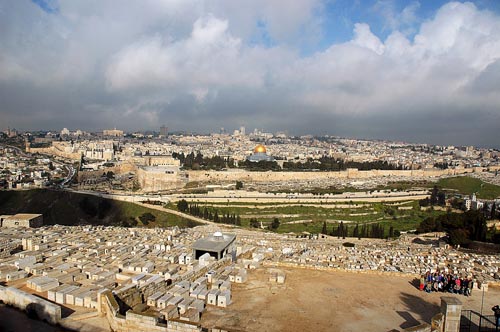
The tours I direct are study tours, but almost everyone who travels with us finds the tour inspirational. Most of those who travel with us do so in an effort to increase their understanding of the Bible. This view of Jerusalem from the Mount of Olives is inspirational to a lot of people.

Jerusalem From the Mount of Olives. Photo by Ferrell Jenkins.