Category Archives: Bible Study

Pressing on toward the goal

Paul’s admonition to the brethren at Philippi is often used in sermons.

Not that I have already obtained it or have already become perfect, but I press on so that I may lay hold of that for which also I was laid hold of by Christ Jesus. Brethren, I do not regard myself as having laid hold of it yet; but one thing I do: forgetting what lies behind and reaching forward to what lies ahead, I press on toward the goal for the prize of the upward call of God in Christ Jesus. (Philippians 3:12-14)

Most often we hear speakers compare what Paul said to the effort put forth by individuals running in a race. This is certainly not inappropriate. However, many years back I ran across a statement by E. M. Blaiklock that changed my thinking. Blaiklock was a noted classicist. This particular comment comes from Cities of the New Testament.

One mark of the Roman colony is perhaps to be detected in the letter which Paul wrote, over ten years later, to the Macedonian church which he had come to love. It is a hidden metaphor from the chariot race. Exhorting his Philippians to effort and single-minded endurance, Paul writes: ‘This one thing I do-forgetting the things behind, and stretching out to those before, I make for the mark, the prize of the upward calling’.

Commentators generally have not marked the fact that Paul appears to have in mind, not the athletic contests of the Greeks, from which he commonly drew illustration, but the chariot racing of Rome. He was writing to a Roman colony. He was writing also from Rome itself, and never was there such rivalry of racing colours, and circus fever than at that time. The common talk of the soldiers of the soldiers was of the chariot racing, and Paul would gain a vivid impression of this most perilous of sports.

Such a race as that which forms the substance of Paul’s figure is described well in Ben HUR. The charioteer stood on a tiny platform over sturdy wheels and axle. His knees were pressed against the curved rail, and his thighs flexed. He bent forward at the waist, stretching out hands and head over the horses’ backs. This is surely what he means by ’stretching out to the things before’. The reins were wound round the body, and braced on the reins the body formed a taut spring. It can easily be seen how completely the charioteer was at the mercy of his team’s sure feet and his own fine driving skill. Euripides, in his Hippolytus, tells how the hero fell and was killed in such conditions. Ovid describes the same disaster in Book XV of his Metamorphoses. In his intense preoccupation the driver dare not cast a glance at ‘the things behind’. The roaring crowd, crying praise or blame, the racing of his rivals, all else had perforce to be forgotten. One object only could fill the driver’s eye, the point to which he drove at the end of each lap.

Here is a photo that might help to illustrate what Blaiklock said. It was made at the RACE show (Romy Army and Chariot Experience) at Jerash, Jordan.
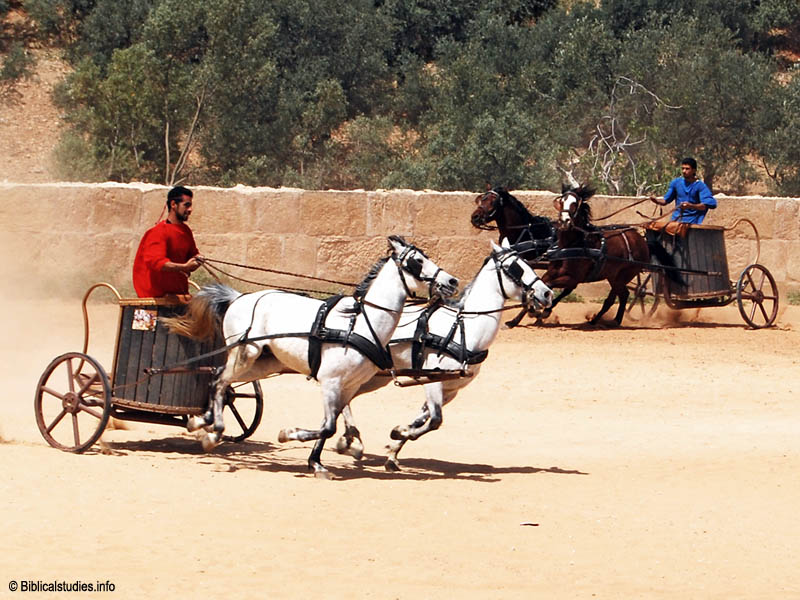
Chariot race at the RACE show in Jerash, Jordan. Photo by Ferrell Jenkins.

Chariot race at the RACE show in Jerash, Jordan. Photo by Ferrell Jenkins.

This is a reprint from April 30, 2008, but with a different photo suitable for use in presentations. Click on the image for the larger photo.
Paul’s burial in Rome

The apostle Peter gets the most attention in Rome, but Paul also has his share of shrines. Paul was taken to Rome in the custody of the Roman Empire (Acts 27-28).

I appeal to Caesar. (Act 25:11)

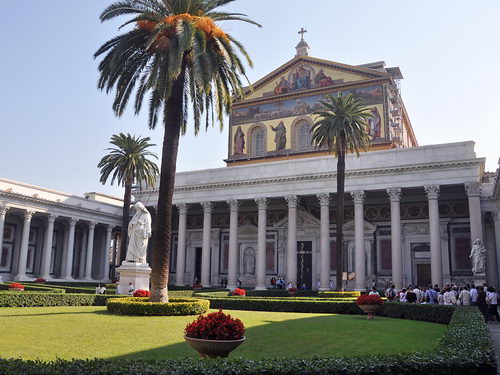
Tradition has it that Paul was buried outside the walls of Rome where we now find the Basilica of St. Paul Outside the Walls.

The basilica of St. Paul Outside the Walls in Rome. Photo by Ferrell Jenkins.

The basilica of St. Paul Outside the Walls in Rome. Photo by Ferrell Jenkins.

The statue in front of the church shows Paul with a drawn sword and a book. The inscription reads PREDICATORI VERITATIS and DOCTORI GENEIUM. Paul was a preacher of truth and a teacher of the Gentiles.

For this I was appointed a preacher and an apostle (I am telling the truth, I am not lying) as a teacher of the Gentiles in faith and truth. (1Timothy 2:7 NAU; see also 2 Timothy 1:11)

Visiting the Bible Lands with Mother

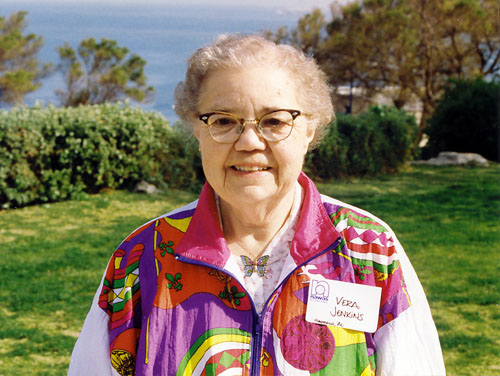
I regretted that my Father never was able to visit the Bible lands with me, but Mother made two trips. The first in 1980, a year after my father died, and the second in 1993. I enjoyed having her as part of the group. She could walk faster and longer than anyone in the group, I think.

Vera Jenkins at Joppa in 1993. Photo by Ferrell Jenkins.

Vera Jenkins at Joppa in 1993. Photo by Ferrell Jenkins.

This has been one of my favorite pictures of Mother. I made it at ancient Joppa in Israel, March 13, 1993, with the Great Sea in the background.

Charles Darwin – Galapagos Finches

HT: Defend the Word

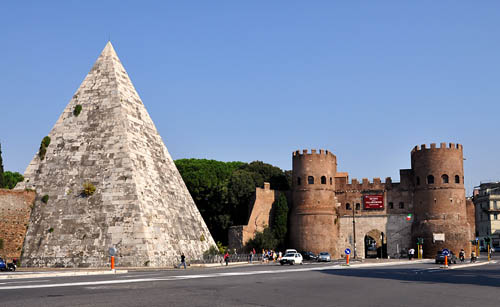
The Pyramid of Caius Cestius

The Pyramid of Caius Cestius, erected in 43 B.C., is located in the Aurelian wall near the Gate of St. Paul in Rome.

Pyramid of Caius Cestius and the Gate of St. Paul. Photo by Ferrell Jenkins.

Pyramid of Caius Cestius and the Gate of St. Paul. Photo by Ferrell Jenkins.

Caius Cestius was an insignificant first century B.C. magistrate, but it is possible that Paul saw his Pyramid.

How big is the Canon? Depends on who you ask.

Bible Study Magazine has made available a chart comparing various canons of Scripture. Those included are the SamWhat's in Your Bible? Find out at BibleStudyMagazine.comaritan Bible, Hebrew Bible, Greek Orthodox, Roman Catholic, Syriac, Ethiopian, and Protestant. By clicking on the small chart you will be taken to the complete large chart in Bible Study Magazine.

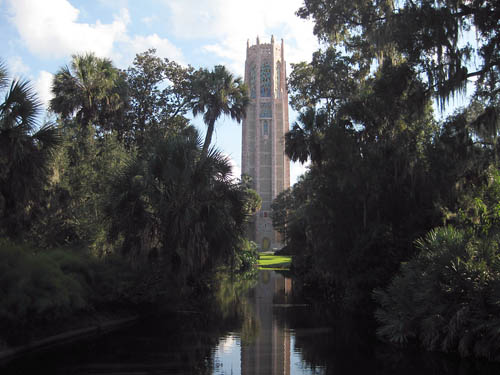
Bok Tower in Florida

This week, through Wednesday, I am presenting a series of lectures at the Lake Wales (Florida) Church of Christ. When I drove into the parking lot yesterday morning I looked to a distant hill and saw Bok Tower. I recall visiting Bok Tower one time as much as 5 decades ago. It is certainly a place to remember.

The tower and gardens were envisioned in the 1920s by Dutch immigrant and humanitarian Edward W. Bok. This site, set among orange groves, is one of the highest spots in Florida. The National Historic Landmark was dedicated by President Calvin Coolidge in 1929. In the afternoon we went by Tower so I could capture a photo.

Bok Tower Gardens, Lake Wales, FL. Photo by Ferrell Jenkins.

Bok Tower Gardens, Lake Wales, FL. Photo by Ferrell Jenkins.

According to the brochure available at the entry this tower houses one of the world’s finest carillons. Concerts are presented daily.

Buying the best Bible Software

Logos_iconAs time permits I am trying to catch up on some of the blogs that I follow. I see that C. Michael Patton has a post at Parchment and Pen (I love that title) on “The Other Best Bible Software.” He is talking about Logos Bible Software. The other one he reviewed earlier is BibleWorks 8. Michael says he uses both. So do I.

Every young preacher should stop buying junk, ready-mixed pabulum, and get some real tools. Another advantage is that you will have no books to loan! Read Patton’s review here.

You will find some comments about the free software that so many preachers and teachers use.

The earlier review about BibleWorks 8 is here.

David Instone-Brewer, Tyndale Tech, has also written recently about Logos Libronix 3 here.

Morris Proctor is an (the?) authorized trainer for Logos Bible Software. His Tips and Tricks are helpful. You might also find a helpful note at the Logos Blog.

You will also find notes about both of these programs at Biblical Studies and Technological Tools.

Recently I wrote here about the problem of having to use Pradis to have access to Zondervan publications. In recent weeks, Zondervan and Logos announced that Zondervan books will be available from Logos. Good news. Now we must wait to see have much (or little?) we will have to pay for the conversion of the programs we already have.

Do your best to present yourself to God as one approved, a worker who has no need to be ashamed, rightly handling the word of truth. (2 Timothy 2:15 ESV)

Make every effort to present yourself before God as a proven worker who does not need to be ashamed, teaching the message of truth accurately. (2 Timothy 2:15 NET)

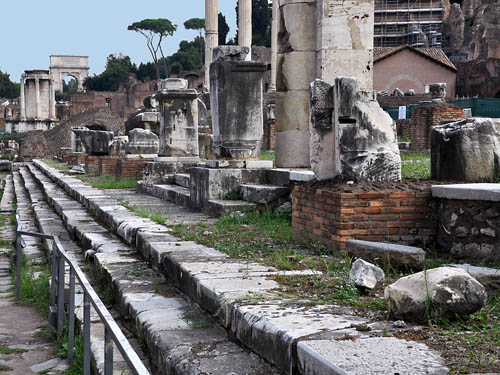
The Basilica Julia in the Roman Forum

Paul had come to Rome as a prisoner. While at Caesarea he exercised his right as a Roman citizen to appeal to Caesar (Acts 25:11; 28:19).

If then I am a wrongdoer and have committed anything for which I deserve to die, I do not seek to escape death. But if there is nothing to their charges against me, no one can give me up to them. I appeal to Caesar. (Act 25:11 ESV)

Only the large platform of the Basilica Julia remains in the Roman Forum. The building was not completed when it was dedicated by Julius Caesar in 46 B.C. The building burned and was reconstructed by Augustus in A.D. 12. Amanda Claridge, Rome: An Oxford Archaeological Guide, describes the Basilica Julia in the following words:

The basilica was the seat of the Court of the Hundred (the centumviri), a special civil court which generally dealt with matters of inheritance and actually numbered 180 judges when they all sat together at an important trial. Pliny the Younger describes the scene at one where he pleaded on behalf of a senatorial lady suing her 80-year-old father, who had disinherited her ten days after he took a new wife. In addition to the judges the place was packed with onlookers. Both parties had brought in large numbers of seats for their supporters, behind which were rows of people standing as far as the outer walls, and the crowd spilled upwards in the galleries, hanging over the rails in their efforts to hear the proceedings. (89-90)

Some scholars suggest that this is where Paul’s appeal before Caesar would have been heard (Wycliffe Historical Geography 545).

The steps leading to the Basilica Julia in Roman Forum. Photo by Ferrell Jenkins.

The steps leading to the Basilica Julia in Roman Forum. Photo by Ferrell Jenkins.

The information above describing the crowds that came to the court might provide some understanding of Paul’s statement to Timothy.

Do your best to come to me soon. For Demas, in love with this present world, has deserted me and gone to Thessalonica. Crescens has gone to Galatia, Titus to Dalmatia. Luke alone is with me. Get Mark and bring him with you, for he is very useful to me for ministry. Tychicus I have sent to Ephesus. When you come, bring the cloak that I left with Carpus at Troas, also the books, and above all the parchments. Alexander the coppersmith did me great harm; the Lord will repay him according to his deeds. Beware of him yourself, for he strongly opposed our message. At my first defense no one came to stand by me, but all deserted me. May it not be charged against them! But the Lord stood by me and strengthened me, so that through me the message might be fully proclaimed and all the Gentiles might hear it. So I was rescued from the lion’s mouth. The Lord will rescue me from every evil deed and bring me safely into his heavenly kingdom. To him be the glory forever and ever. Amen. (2 Timothy 4:9-18 ESV)

The Brethren, the Roman Forum and the Palatine Hill

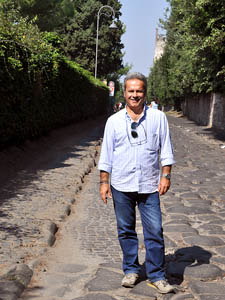
Stefano Corazza on the Appian Way

Stefano Corazza on the Appian Way

This morning I spoke again for La Chiesa di Christo in Rome. Stefano Corazzo translated my lesson on the subject “Can I trust my Bible?” I used PowerPoint slides with both English and Italian captions. Several of the brothers and sisters speak English at well as Italian.

Saturday and Sunday were beautiful sunny days in Rome. I tried to take advantage of the light to make some photos that would be helpful in teaching various New Testament subjects, especially pertaining to the book of Acts, the epistle to the Romans, the Prison Epistles (Ephessians, Colossians, Philemon, and Phillippians), and 2 Timothy, which seems to be the last prison epistle.

When I decided to return to the Roman Forum I did so at an entry with immediate access to the Palatine Hill. When I reached the ticket window I was told that tickets were free for Saturday and Sunday. Then I noticed that this included the Colosseum as well as the Palatine Hill and Forum. That was a saving of €12, about $18. My lucky day!

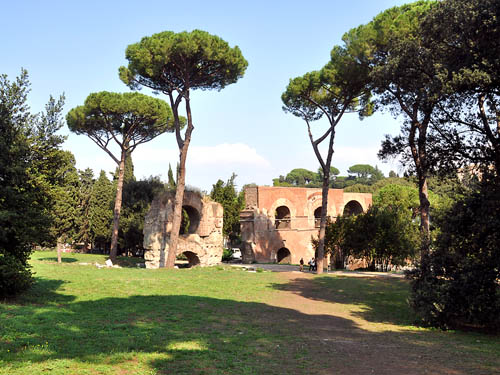
The Palatine Hill is a flat top hill of about 25 acres. Palatial residences of the emperors were built here during the Imperial period. Some of the structures date to a period after the time of Paul. Domitian (A.D. 81–96) modified the hill with new buildings. Two great complexes, called the House of Flavia and the House of Augustus grace the hill. A Stadium was used for minor games and entertainment.

The Palatine Hill in Rome. Photo by Ferrell Jenkins.

The Palatine Hill in Rome. Photo by Ferrell Jenkins.

The Roman Forum was the hub of Roman life — religious, political, economic, social. One structure of significance for the study of the life and work of Paul is the Julian Basilica — the seat of the tribunal of the centumiri, who judged civil cases. Here between the Palatine and Capitoline hills Paul probably stood trial before Caesar.