Category Archives: Bible Study

Preparing for a Trip to Israel

Occasionally I get a request from someone planning their first trip to Israel asking for suggestions on books to help them prepare for the trip.

There are some excellent books we suggest for your study before and during the tour. Below is a list of books which we recommend for your use. Begin with The Holy Land by Murphy- O’Connor. It will take you a while to read and mark the book. You will enjoy the book much more once you return home and begin to use it as a resource. Of course, this is true of many of the books listed here.

  • Baly, Denis. Basic Biblical Geography (Fortress) paperback. Brief introduction. Any books by Baly can be helpful.
  • Beitzel, Barry J. The Moody Atlas of Bible Lands (Moody). A complete atlas of Bible lands.
    Dyer, Charles H. and Gregory A. Hatteberg. The Christian Traveler’s Guide to the Holy Land. Broadman and Holman, 1998.
  • Eyewitness Travel Guides. Jerusalem & the Holy Land. DK Publishing. This book has beautiful plans of the buildings.
  • Frank, Harry Thomas (ed.). Atlas of the Bible Lands (Broadman). Concise atlas; good maps.
  • Hoppe, Leslie J. A Guide to the Lands of the Bible. Liturgical Press., 1999. Cover Israel, Jordan, and other areas.
  • Miller, Max. Introducing the Holy Land. This book is out of print, but you might be able to locate a used copy.
  • Murphy-O’Connor, Jerome. The Holy Land (Oxford), paperback. Excellent.
  • Page, Charles R. and Carl A. Volz, The Land and the Book (Abingdon).
  • Ullian, Robert, ed. Israel: Past and Present. A beautiful guide to the 16 top archaeological sites in Israel. Overlays illustrate how the sites might have looked in ancient times.
  • Vos, Howard F. The Wycliffe Historical Geography of Bible Lands (Hendrickson). This is the completely revised 2003 edition. The book was originally published in 1967, edited by Pfeiffer and Vos. Excellent.

The books we have listed above are not typical travel books, but accurate, scholarly books. Some are in a popular style. Travel books can be helpful, however. Many sites you visit will offer small booklets about those places.

If you can only buy three books, I suggest Murphy-O’Connor, Eyewitness Travel Guides and Hoppe.

Some of the popular travel guides that provide good info include: Let’s Go Israel, Fodor’s, Lonely Planet, and Rough Guides. The last two guides are intended primarily for individual travelers, but I find them helpful.

You may order any of these books from Amazon by going to our Biblical Studies Info Book Store here.

Internet Sites. What web pages would be helpful for the first time (or repeat) traveler? Obviously I suggest Ferrell’s Travel Blog and the BiblePlaces Blog by Todd Bolen. You will need to use the search box to search for posts dealing with places you plan to visit.

Go to the Biblical Studies Info Page here. Click on Bible Places. There you will find many links to specific places in Israel and other countries. I suggest you also go to the Scholarly Page and check the Archaeology section and the Blogs. Todd Bolen’s BiblePlaces is an excellent source. You will likely find good information and photos from the places you plan to visit.

The books may be ordered at a discount from Amazon at the Biblical Studies Info Bookstore. Perhaps some of our readers with experience in traveling to the Bible lands will add some additional suggestions in comments.
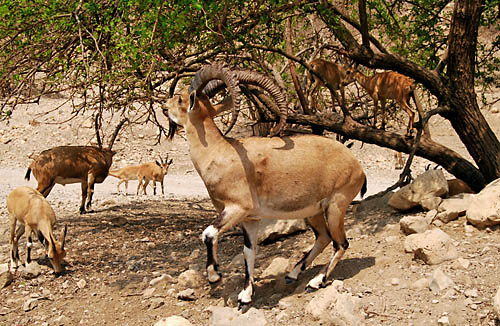
Ibex at En Gedi near the Dead Sea. Photo by Ferrell Jenkins.
Ibex at En Gedi near the Dead Sea. Photo by Ferrell Jenkins.
More on the Magdala Excavation Project

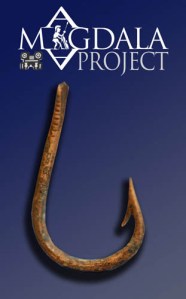
Fishhook from the 2008 Magdala Project dig.

Fish-hook from the 2008 Magdala Project dig.

The Magdala Project blog is giving some info on the current excavations at the site of Magdala on the west short of the Sea of Galilee. Reports include information on the first century synagogue, a 2006 preliminary report, and ship iconography as portrayed on mosaics of the first to third centuries AD.

Several nice photos are included on the blog including one of a fish-hook discovered  from the 2008 Magdala Project dig, and a stone anchor from the 2007 season.

The article by K. C. Hanson on “The Galilean Fishing Economy and the Jesus Tradition” is extremely helpful for those seeking to understand the role of the disciples of Jesus who were fishermen.

The photo of the fish-hook  provides a nice illustration of a text from Matthew 17:24-27.

When they came to Capernaum, the collectors of the two-drachma tax went up to Peter and said, “Does your teacher not pay the tax?” He said, “Yes.” And when he came into the house, Jesus spoke to him first, saying, “What do you think, Simon? From whom do kings of the earth take toll or tax? From their sons or from others?” And when he said, “From others,” Jesus said to him, “Then the sons are free. However, not to give offense to them, go to the sea and cast a hook and take the first fish that comes up, and when you open its mouth you will find a shekel. Take that and give it to them for me and for yourself.” (Matthew 17:24-27 ESV)

We have mentioned Magdala several times. Check here, and use the Search box for other references.

HT: Bible Places Blog

Fisherman in Egypt

A fisherman brings in a large catch of fish in a lake on the outskirts of Alexandria, Egypt.

Fisherman Near Alexandria, Egypt. Photo by Ferrell Jenkins.

Fisherman Near Alexandria, Egypt. Photo by Ferrell Jenkins.

The wise writer of Ecclesiastes likened the unfortunate things that happen in life to fish being caught in a net.

Surely, no one knows his appointed time! Like fish that are caught in a deadly net, and like birds that are caught in a snare– just like them, all people are ensnared at an unfortunate time that falls upon them suddenly. (Ecclesiastes 9:12 NET)

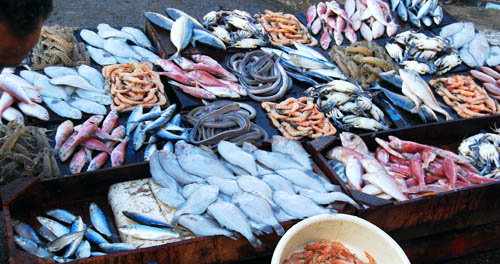
This photo was made in the street fish market along the pier in Alexandria.

The Fish Market at Alexandria, Egypt. Photo by Ferrell Jenkins.

The Fish Market at Alexandria, Egypt. Photo by Ferrell Jenkins.

The prophet Isaiah (about 725 B.C.) spoke of a time that was coming upon Egypt in these words.

The fishermen will mourn and lament, all those who cast a fishhook into the river, and those who spread out a net on the water’s surface will grieve. (Isaiah 19:8 NET)

The Ark at Kiriath-jearim

The first reference to Kiriath-jearim is in Joshua 9:17 where it is listed as one of the cities of the Hivites along with Gibeon, Chephirah, and Beeroth. These cities were located on the western side of the Judean hill country.

The name, Kiriath-jearim, means “city of forests” or wood, and is identified with Deir el-Azar. The Arab village at the site today is called Abu Ghosh and can be seen about nine miles west of Jerusalem to the right of the main highway to Tel Aviv. Several other names are given for the place. It is called Kiriath-baal (Joshua 15:60; 18:14), Baalah (Joshua 15:9), possibly Baalath (1 Kings 9:18), and Baale-judah (2 Samuel 6:2). Perhaps the simplest and correct explanation is that the Israelites changed the name from a place that honored Baal to a geographical one, the city of forests.

When the Danites moved from their allotted territory to the north they camped a little to the west of Kiriath-jearim at a place they called Mahaneh-dan (Camp of Dan; Judges 18:11-12).

Kiriath-jearim’s highest honor is in the association with the ark of the covenant. The Israelites took the ark from the tabernacle at Shiloh to the battle field at Ebenezer when they were fighting with the Philistines (1 Samuel 4). The ark was captured by the Philistines and taken to Ashdod, then to Gath, and finally to Ekron before they decided to get rid of it. The ark was returned to Beth-shemesh (1 Samuel 4-6).

The men of Beth-shemesh sent messengers to the residents of Kiriath-jearim asking them to come and take the ark to their town. The ark was brought into the house of Abinadad on the hill. His son, Eleazar, was consecrated by the men of the city to keep the ark of the LORD. The ark remained there for many years until David had it brought to Jerusalem (1 Samuel 6:21-7:2; 2 Samuel 6).

A prophet named Uriah, a contemporary with Jeremiah, lived at Kiriath-jearim. He preached a message similar to that of Jeremiah regarding Jerusalem in the days of the Babylonian threat. When he was threatened by King Jehoiakim he fled to Egypt, but was captured and brought back to Jerusalem and put to death (Jeremiah 26:20-24).

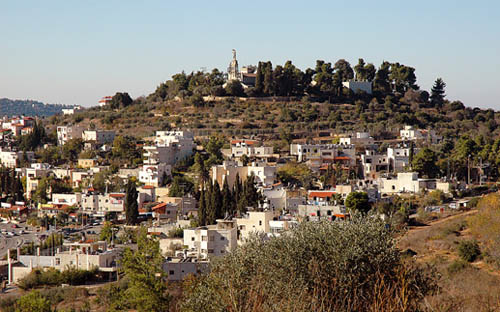
The ark of the covenant was here at Kiriath-jearim before David took it to Jerusalem. Photo by Ferrell Jenkins.

The ark of the covenant was here at Kiriath-jearim before David took it to Jerusalem. Photo by Ferrell Jenkins.

Our photograph shows the hill of Kiriath-jearim. Our Lady of the Ark of the Covenant Church was built in 1911 on the ruins of a fifth century Byzantine church.

This article was published in Biblical Insights, June, 2007.

Sunset at Hierapolis

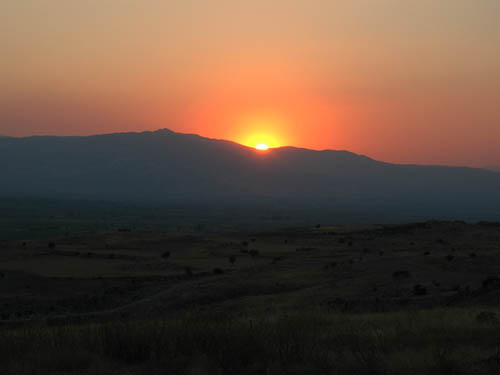
This is a sunset view I made at Pamukkale (biblical Hierapolis; Colossians 4:13). Hierapolis is famous for hot mineral springs and terraced travertine formations. It is now a World Heritage site.

For I bear him witness that he [Epaphras] has worked hard for you and for those in Laodicea and in Hierapolis. (Colossians 4:13 ESV)

Sunset at Hierapolis in the Lycus River Valley. Photo by Ferrell Jenkins.

Sunset at Hierapolis in the Lycus River Valley. Photo by Ferrell Jenkins.

German Archaeologist: Beneath every footstep in Syria is an ancient civilization

The Global Arab Network reports on a statement made by German archaeologist Markus Gschwind, head of the Syrian-German Archaeology Expedition, here. The report says,

Syria, the land of civilizations and history, is rife with ancient monuments that tell the stories of the many peoples and civilizations that lived in it, whose stories endured in the face of time to tell humanity about their greatness.

“Beneath every footstep in Syria is an ancient civilization,” says Archaeologist Markus Gschwind, head of the Syrian-German Archaeology Expedition working at al-Rafina in Hama. He notes that this saying is repeated around Germany, as most Germans consider Syria the most historically deep-rooted country in the Mediterranean.

In a statement to SANA, Gschwind said that he has been living and excavating in Syria for six years, each day discovering many secrets from the history of mankind.

Gschwind is working at the ancient city of al-Rafina in Hama. Hama is at the site of Biblical Hamath  (2 Kings 14:25; 2 Chronicles 8:4).

My limited visits to Syria have convinced me that the statement by Gschwind is correct. Of course, the same could be said of Israel, Jordan, Turkey, Iraq, et al.

The Assyrian Empire ruled the ancient near east from the battle of Qarqar (853 B.C.) till the battle of Carchemish (605 B.C.) when they were defeated by the Babylonians. Nineveh had fallen seven years earlier. This was the time of the Divided Kingdom period in Israelite history, and Assyria had contact with a numerous biblical kings. Ahab, for example, fought against the Assyrians at Qarqar. Qarqar is north of Hammath. Both are on the Orontes River.

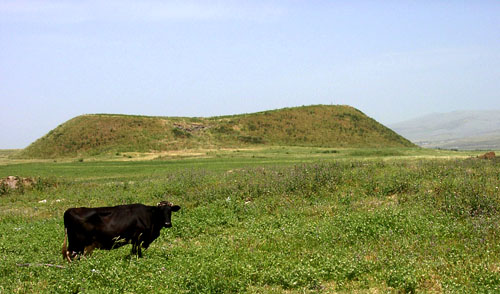
Qarqar on the Orontes. Photo by Ferrell Jenkins.The tell of Qarqar in northern Syria. Photo by Ferrell Jenkins.
HT: Biblical Paths

Move evidence of Babylonian-Egyptian contacts

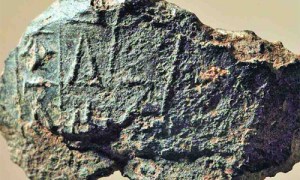
Austrian Times reports here on the discovery of a Babylonian seal impression at Tell el-Dab’a in Egypt.

Austrian archaeologists have found a Babylonian seal in Egypt that confirms contact between the Babylonians and the Hyksos during the second millennium B.C.

Irene Forstner-Müller, the head of the Austrian Archaeological Institute’s (ÖAI) branch office in Cairo, said today (Thurs) the find had occurred at the site of the ancient town of Avaris near what is today the city of Tell el-Dab’a in the eastern Nile delta.

The Hyksos conquered Egypt and reigned there from 1640 to 1530 B.C.

She said a recently-discovered cuneiform tablet had led archaeologists to suspect there had been contact between the Babylonians and the Hyksos.

Forstner-Müller added that Manfred Bietak had begun archaeological research on the period of Hyksos dominance at the remains of a Hyksos palace at Avaris in 1966.

Babylonian seal impression.

Babylonian seal impression.

Earlier in the year we reported on the discovery of a Babylonian tablet at Tell el-Dab’a here.

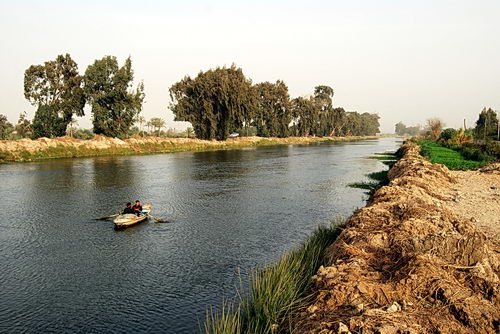
The report  says the Austrian plan to build a museum in the area. A more complete report in Die Presse says they also have plans to restore the river. The Pelusiac branch of the Nile once flowed by this ancient site. Below is a photo of the canal which often follows the course of the Pelusiac.

A canal where the Pelusiac branch of the Nile once flowed. Photo by F. Jenkins.Canal along the Pelusiac Branch of the Nile near Tell el-Dab’a. Photo by FJ.

Tell el-Dab’a is in the eastern Nile Delta. In Biblical times it was known as the Land of Goshen, and served as the home of the Israelites.

“Hurry and go up to my father, and say to him, ‘Thus says your son Joseph, “God has made me lord of all Egypt; come down to me, do not delay. “You shall live in the land of Goshen, and you shall be near me, you and your children and your children’s children and your flocks and your herds and all that you have. “There I will also provide for you, for there are still five years of famine to come, and you and your household and all that you have would be impoverished.” (Genesis 45:9-11 NAU)

These new findings might shed some light on the plausibility of Achan finding a garment from Shinar (Babylon) at Jericho (Joshua 7).

HT: Biblical Paths

Looking for Libnah

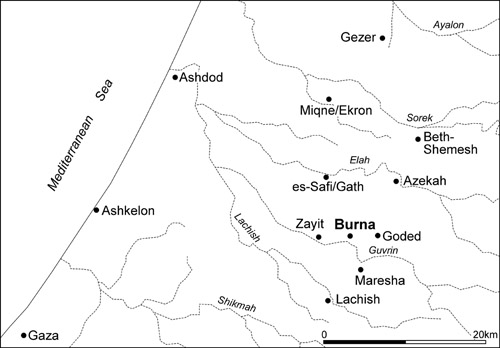
A new blog, called The Tel Burna Excavation Project, has been launched to report on the preliminary survey of Tel Burna. The tel is located in the Shephelah of Israel among such sites as es-Safi/Gath, Zayit, Goded, Mareshah, Azekah and Lachish.

The Shephelah. Map: Tel Burna Excavation Project.

The Shephelah. Map: Tel Burna Excavation Project.

In the case of Tel Burna, with no excavation material available, the problem is even more difficult. despite this, several scholars have suggested identifying the site with Biblical Libnah (although one should note that nearby Tel Zayit is a very likely candidate as well – as Ron Tappy, the excavator there, has recently published).

Libnah was a Canaanite town that was conquered by Joshua who allotted it to the tribe of Judah (Joshua 10:29-30; 15:42). The city was chosen as one of the Levitical cities (Joshua 21:13), which points to its role as a border site. According to 2 Kings 8:22 (and 2 Chronicles 21:10), the city of Libnah was involved in the rebellion against Jehoram the king of Judah (in 9th century BCE) and later, a woman from Libnah married King Josiah in the 7th century BCE (Kings 23:31-32;2 Kings 24:17-18; Jeremiah 22:11).

In any case, even if the site is not Libnah, it is clear for the survey results (which will be mentioned in an upcoming post) that the site was a very important site in the Iron Age, along the border between Judah and the Philistines.

HT: Luke Chandler’s Blog; Aren Maeir.

The Western Wall tunnel

Most first time visitors to the Western Wall in Jerusalem, whether in 1967 or 2009, probably think they are looking at a wall seen by Jesus and other first century characters prior to AD 70. In a sense they are. That is, they are seeing the same wall, but not at the first century level.

The Western Wall is the western side of the temple platform enclosure built by Herod the Great. Jesus drove money changers out of the temple precinct (hieron) (John 2:13-17). In their discussion with Jesus the Jews called attention to the length of time the temple (naos) had been under construction (John 2:19-21).

Jesus answered them, “Destroy this temple, and in three days I will raise it up.” The Jews then said, “It took forty-six years to build this temple, and will You raise it up in three days?” But He was speaking of the temple of His body. (John 2:19-21 NAU)

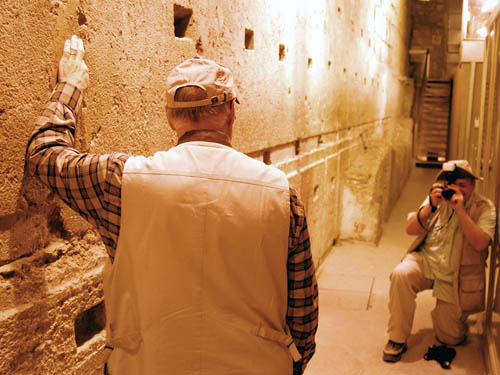
The photo below shows the largest visible stone in the western side of the Temple precinct. According to the Western Wall Tunnel web site, this stone is the largest one in the tunnel. It is 41 feet long, 11.5 feet high, and 15 feet deep. The web site says that this stone is 20 feet above the street level of the first century.

The largest visible stone in the Western Wall tunnel. Photo by Ferrell Jenkins.

The largest visible stone in the Western Wall tunnel. Photo by Ferrell Jenkins.

The Tunnel was dug in the years following 1967, but an exit was not cut on the north end until 1996.

Israel plans major excavation at Western Wall

Israel National News reports, in an article by Samuel Sokol, plans to conduct a archaeological dig under the Western Wall in Jerusalem.

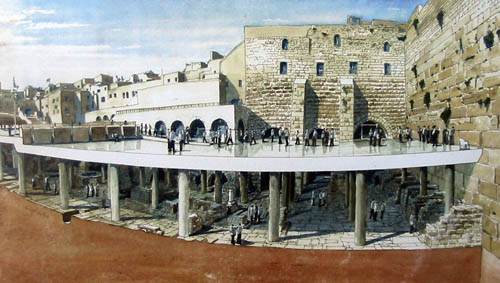
Israel is planning a major archaeological dig under the Western Wall (Kotel) plaza, opposite the Temple Mount, officials announced Thursday. The excavations will create an archaeological park directly underneath the area where worshippers currently stand while praying at the Kotel.

The current prayer area will remain open, supported by pillars, while a new area will be added underneath, at the level at which worshippers at the ancient Temple stood in the past.

The complete article may be read here, and another here from The Jerusalem Post.

This drawing shows the planned part underneath the present pavement at the Western Wall.

Proposed Western Wall archaeological park. Photo: Antiquities Authority.

Proposed Western Wall archaeological park. Photo: Antiquities Authority.

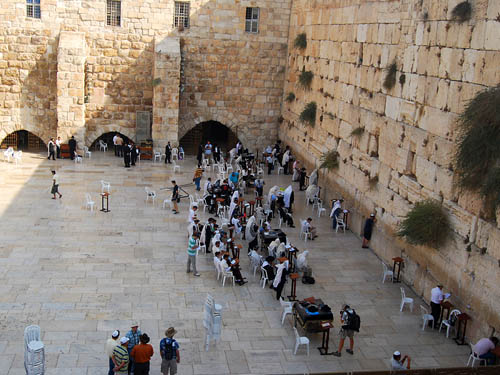
Here is the way this area looks at the present time.

The Western Wall platform. View to north toward Wilson's Arch. Photo by F. Jenkins.

The Western Wall platform. View to north toward Wilson's Arch. Photo by F. Jenkins.

HT: Joseph Lauer