Category Archives: Bible Study

Iron Age Hadad temple found in Jordan

Major news sources are reporting the discovery of a 3,000-year-old Iron Age temple from Khirbet ‘Ataroz near the town of Madaba (close to Mount Nebo and about 20 miles SW of Amman). The head of the Jordanian Antiquities Department said the find dates to the 8th century B.C. (a little shy of the 3,000 years mentioned by the news sources). Here are a few comments from the AP article.

He said the complex boasts a main room that measures 388 square feet (36 square meters), as well as two antechambers and an open courtyard.

The sanctuary and its artifacts — hewn from limestone and basalt or molded from clay and bronze — show the complex religious rituals of Jordan’s ancient biblical Moabite kingdom, according to al-Saad.”

Today we have the material evidence, the archaeological proof of the level of advancement of technology and civilization at that period of time,” he said.

The Moabites, whose kingdom ran along present-day Jordan’s mountainous eastern shore of the Dead Sea, were closely related to the Israelites, although the two were in frequent conflict. The Babylonians eventually conquered the Moabites in 582 B.C.

Archaeologists also unearthed some 300 pots, figurines of deities and sacred vessels used for worship at the site. Al-Saad said it was rare to discover so many Iron Age items in one place.

The article continues,

Among the items on display Wednesday, there was a four-legged animal god Hadad, as well as delicate circular clay vessels used in holy rites. Al-Saad said the objects indicate the Moabites worshipped many deities and had a highly organized ritual use of temples.

The AP report, with small photos of some of the artifacts, may be read here. The typical news reports fail to give adequate information about the discovery. In these cases, we wait for scholarly information.

Below I have a quotation from the revised ISBE giving a brief explanation about Hadad.

An alternative name for Baal, the head of the Canaanite pantheon, whose worship was expressed in fertility rites. The storm-god Hadad is mentioned in Assyrian inscriptions, and called on the monolith of Shalmaneser “the god of Aleppo.” In the Assyrian inscriptions he is identified with the air-god Rimmon. The union of the two names in Zec. 12:11 suggests this identity. (Hovey and Harrison, The International Standard Bible Encyclopedia, Revised (Eerdmans, 1988; 2002). 2:590-591.)

Several thing should be noted by the Bible student.

  • Hadad is the Baal of the Old Testament.
  • Hadad is called the “god of Aleppo.”
  • Hadad is identified with Baal from discoveries at Ras Shamra (Ugarit).
  • The Israelites were warned not to “inquire about” the gods of the nations of Canaan, saying “How did these nations serve their gods?–that I also may do the same” (Deuteronomy 12:30). If you are reading this post you probably know what happened.

A few years ago I visited the archaeological museum in Aleppo. The entrance is decorated with replicas of the god Hadad (think Baal) standing on a bull
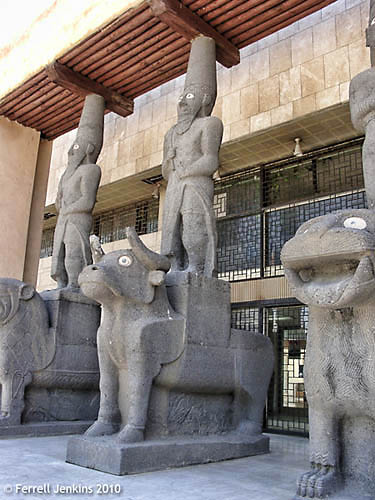
Hadad on a Bull. Aleppo Syria Museum. Photo by Ferrell Jenkins.

Hadad on a Bull. Aleppo Syria Museum. Photo by Ferrell Jenkins.

HT: Joseph Lauer
Cupid cameo found in Jerusalem

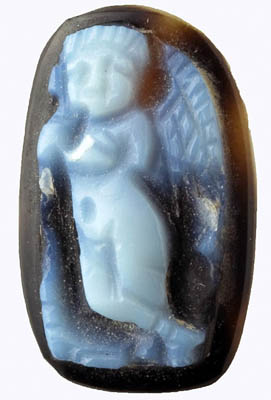
The 11th Annual City of David Archaeology Conference is scheduled for Wednesday, September 1. One item that will be discussed is the recently discovered 2,000 year old semi-precious cameo with an image of Cupid (the Eros of Greek mythology) on it.

Cupid Cameo found in Jerusalem.

Cupid Cameo found in Jerusalem. Photo IAA/Clara Amit.

This inlaid stone is of the “Eros in mourning” type, and is one of a group of visual motifs connected with the imagery of mourning practices. Jewelry bearing such motifs – earrings and rings, were not necessarily worn only in mourning rites, rather, they also served as memento mori, reminders of the fleeting nature of life.

The cameo, which is thought to have come from a piece of jewelry, is 0.39 in. long and 0.03 in. wide. It was discovered in the Givati Parking lot excavation under the direction of Dr. Doron Ben Ami and Yana Tchekhanovets.

We have noted other surprising discoveries in this area here and here. The area is not open to the public. Last May I made this photo through a hole which had been made (by someone else) in the metal fence surrounding the area. This site is immediately south of the old city wall, a few hundred feet east of Dung Gate. Needless to say, construction of the garage has been delayed. This is what happens when one begins to dig in Jerusalem.

Givati Garage Excavations. Photo by Ferrell Jenkins.

Givati Garage Excavations. Photo by Ferrell Jenkins.

Eros. William Barclay often mentions erōs when he comments on a text dealing with love. You recall the four words: agape, philia, storgé, and erōs. Barclay says,

There is the noun erōs and the accompanying verb eran. These words describe the love of a man for a maid; there is always passion in them; and there is always sexual love. Sophocles described erōs as “the terrible longing.” In these words there is nothing essentially bad; they simply describe the passion of human love; but as time went on they began to be tinged with the idea of lust rather than love, and they never occur in the New Testament at all. (The Gospel of Matthew at Matthew 5:43-48)

HT: Joseph I. Lauer

Paul’s illustration of the olive tree in Romans 11

The illustration used by Paul in Romans 11 to describe the relation between the Jews and the Gentiles is both memorable and instructive.

17 But if some of the branches were broken off, and you, although a wild olive shoot, were grafted in among the others and now share in the nourishing root of the olive tree,
18 do not be arrogant toward the branches. If you are, remember it is not you who support the root, but the root that supports you.
19 Then you will say, “Branches were broken off so that I might be grafted in.”
20 That is true. They were broken off because of their unbelief, but you stand fast through faith. So do not become proud, but fear.
21 For if God did not spare the natural branches, neither will he spare you.
22 Note then the kindness and the severity of God: severity toward those who have fallen, but God’s kindness to you, provided you continue in his kindness. Otherwise you too will be cut off.
23 And even they, if they do not continue in their unbelief, will be grafted in, for God has the power to graft them in again.
24 For if you were cut from what is by nature a wild olive tree, and grafted, contrary to nature, into a cultivated olive tree, how much more will these, the natural branches, be grafted back into their own olive tree. (Romans 11:17-24 ESV)

His point is simple. The Jews were cut off because of their unbelief. Gentiles were grafted in through their faith in Christ. The Jews may again be a part of the tree by accepting Christ. In the photo below we see that new branches have been grafted in the older, well-rooted stump.

Olive tree with grafts at Nazareth Village. Photo by Ferrell Jenkins.

Olive tree with grafts at Nazareth Village. Photo by Ferrell Jenkins.

In this close view one can see distinctly the grafting of the “wild olive shoot” into the old stump to be able to “now share the nourishing root of the olive tree.”

Grafts on an old olive stump. Photo by Ferrell Jenkins.

Grafts on an old olive stump. Photo by Ferrell Jenkins.

Paul addresses the problem of arrogance on the part of Gentile Christians. He reminds them that, as branches, they are dependent on the root.

do not be arrogant toward the branches. If you are, remember it is not you who support the root, but the root that supports you. (Romans 11:18 ESV)

Remember that Jesus is the root of David (Revelation 5:5; 22:16). He informed the woman of Samaria that “salvation is from the Jews” (John 4:22 ESV).

In directing tours I have encountered a few guides who think that a Christian group is interested only in “Christian sites.” This is far from true. In most of our churches the majority of the classes at any given time will be from the Old Testament.

For whatever was written in former days was written for our instruction, that through endurance and through the encouragement of the Scriptures we might have hope. (Romans 15:4 ESV)

Click on the photos for images large enough for use in your teaching.

More to come about the uses of the olive and oil production.

The Olive Tree

What is the first tree mentioned by name in the Bible? After a visit to the art museum one might say, “the apple.” But there is nothing about the apple in Genesis. I don’t mean the “tree of the knowledge of good and evil” either.

The first is the fig. Adam and Eve tried to cover their nakedness by sewing together fig leaves.

Then the eyes of both were opened, and they knew that they were naked. And they sewed fig leaves together and made themselves loincloths (Genesis 3:7 ESV)

I really want to write about the second tree named in Scripture. It is the 0live. After the flood, Noah sent out a dove to see if the water had receded.

And the dove came back to him in the evening, and behold, in her mouth was a freshly plucked olive leaf. So Noah knew that the waters had subsided from the earth. (Genesis 8:11 ESV)

The land of Canaan, promised by the LORD to Abraham and his descendants, was to be a land that included figs and olives.

a land of wheat and barley, of vines and fig trees and pomegranates, a land of olive trees and honey (Deuteronomy 8:8 ESV)

Olive trees flourish in the mountainous terrain of the land of Canaan/Israel/Palestine (this is not a political discussion). Here are some photos of olive trees. The first is one of the older trees in the traditional Garden of Gethsemane on the Mount of Olives. In fact, it appears that two trees grew together.

An older Olive trees in the traditional Garden of Gethsemane. Photo by Ferrell Jenkins.

An older Olive trees in the traditional Garden of Gethsemane. Photo by Ferrell Jenkins.

Here are a few trees at Sepphoris in Galilee.

Olive Trees at Sepphoris in Galilee. Photo by Ferrell Jenkins.

Olive Trees at Sepphoris in Galilee. Photo by Ferrell Jenkins.

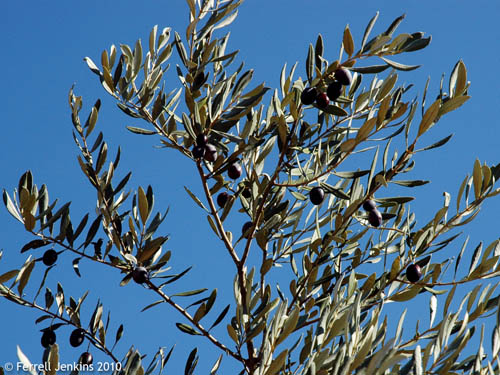
And this photo is a close up of a branch and some of the leaves. The photo was made at Neot Kedumim in the Shephelah of Israel.

Olive Branches at in the Shephelah of Israel. Photo by Ferrell Jenkins.

Olive Branches at in the Shephelah of Israel. Photo by Ferrell Jenkins.

Later we will follow up with more about the uses of the olive.

The Watchtower

Recently we wrote about the Valley of Beracah here. The biblical account says Judah came out to the watchtower or observation post to see the overnight progress of the armies of Ammon, Moab, and Edom.

When Judah came to the watchtower [lookout, NAU; observation post, NET] of the wilderness, they looked toward the horde, and behold, there were dead bodies lying on the ground; none had escaped. (2 Chronicles 20:24 ESV)

Watchtower at Nazareth Village. Photo by Ferrell Jenkins.

Watchtower at Nazareth Village. Photo by Ferrell Jenkins.

The prophet Isaiah speaks of a watchtower built in the midst of a vineyard.

Let me sing for my beloved my love song concerning his vineyard: My beloved had a vineyard on a very fertile hill. He dug it and cleared it of stones, and planted it with choice vines; he built a watchtower in the midst of it, and hewed out a wine vat in it; and he looked for it to yield grapes, but it yielded wild grapes. And now, O inhabitants of Jerusalem and men of Judah, judge between me and my vineyard. (Isaiah 5:1-3 ESV)

Our photo was made at Nazareth Village, a must stop on your next visit to Israel. (I note that the web site is temporarily offline.) Click on the photo for an image large enough to use in presentations.

Recent photos from Magdala

Several times in the past three years we have called attention to the site of Magdala (Migdal). Last September we noted announcement by the Israel Antiquities Authority of the discovery of a synagogue from the Second Temple period (50 BCE—100 CE).

A synagogue from the Second Temple period (50 BCE—100 CE) was exposed in archaeological excavations the Israel Antiquities Authority is conducting at a site slated for the construction of a hotel on Migdal [Magdala] beach, in an area owned by the Ark New Gate Company. In the middle of the synagogue is a stone that is engraved with a seven-branched menorah (candelabrum), the likes of which have never been seen. The excavations were directed by archaeologists Dina Avshalom-Gorni and Arfan Najar of the Israel Antiquities Authority.

The town of Magdala is not mentioned in the Bible, but Mary Magdalene is mentioned a total of 12 times in the four gospels. This place may have been her birthplace or her home. A few late manuscripts mention Magdala (Matthew 15:39 KJV), but earlier manuscripts read Magadan. Magdala is located about 4 miles north of Tiberias on the western shore of the Sea of Galilee.

The Hebrew word Magdala means tower. In New Testament times the city had become Hellenized and bore the Greek name Tarichea because of the importance of the salted-fish industry there. Mendel Nun located a harbor at the site. He says,

“In ancient times, pickled sardines were an important element of diet throughout the country–especially for those who lived near the lake” (BAR, Nov/Dec 1993).

Josephus had his headquarters at Magdala during the first Jewish Revolt against Rome (A.D. 66-70). He was able to get a group of at least 230 boats to go from Magdala to Tiberias (Jewish Wars 2.635-637). Vespasian attacked the town from the sea and destroyed it.

Magdala with Mount Arbel to the West. Photo by Jim Joyner.

Magdala with Mount Arbel to the West. Photo by Jim Joyner.

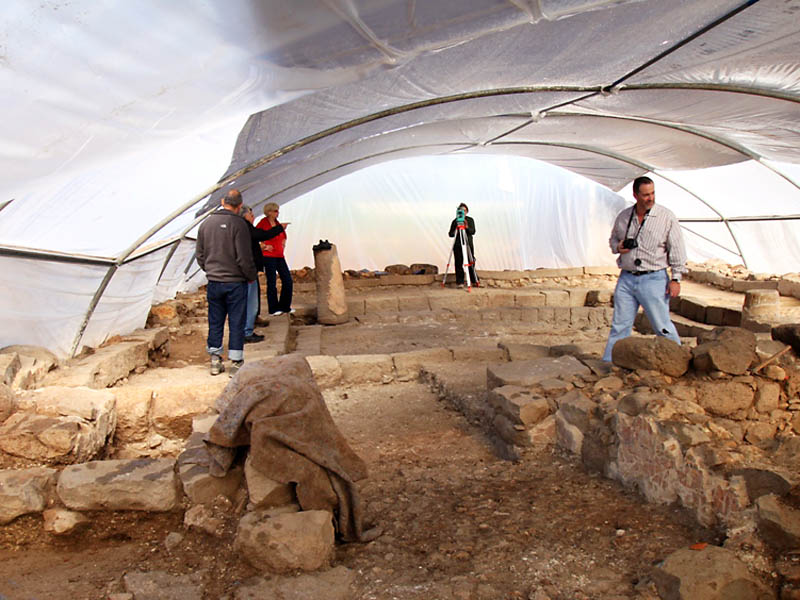
Recently Jim Joyner, one of our readers, offered to share a few of his photos made at Magdala earlier this year. The photo above shows part of the residential area of Magdala with Mount Arbel in the distance to the west. The synagogue excavation is under the tent in the distance. The Sea of Galilee would be to our back.

Jim explains,

The residences were first excavated. Eventually the remains of a synagogue were discovered. It was a magnificent discovery! The walls of the synagogue are clear, and the places where seats were located in the synagogue are obvious.  The walls were beautifully frescoed, and the remains of the colors are still obvious on the uncovered portions of the walls.

The Magdala/Migdal Synagogue. Photo by Jim Joyner.

The Magdala/Migdal Synagogue. Photo by Jim Joyner.

Thanks, Jim. We look forward to seeing more of these great photos.

We wrote about the Magdala Excavation Project here.

Glo – the Bible for a Digital World

Rejoice Christian Software announces that the Glo Digital Bible is available for $45.00 for one week. They already sell it for the discounted price of $52, but when you click on “Buy Now” the price shows as $45.

Glo - The Digital Bible

Take a look at the RCS page advertising Glo here. You will see a link to a video explaining some features of the product. This is a great product at a good price.

The Biblical Studies and Technological Tools blog has two extended reviews of Glo. Part 1 is here. Part 2 is here.

I have no financial interest in RCS, but I have found their prices and service to be as advertised.

Araunah’s threshing floor

After David’s sin in the the matter of taking a census of the people of Israel, and his acknowledgment of the sin, he was told by Gad to build an altar (2 Samuel 24:1-10). The instructions are specific.

And Gad came that day to David and said to him, “Go up, raise an altar to the LORD on the threshing floor of Araunah the Jebusite.” So David went up at Gad’s word, as the LORD commanded. (2 Samuel 24:18-19 ESV)

Araunah was gracious in his offer to allow David to take any of his property needed — the oxen, the threshing sledge, and the yokes of the oxen for the wood. He said, “All this, O king, Araunah gives to the king.”

David’s reply is one of those memorable statements of Scripture.

But the king said to Araunah, “No, but I will buy it from you for a price. I will not offer burnt offerings to the LORD my God that cost me nothing.” So David bought the threshing floor and the oxen for fifty shekels of silver. (2 Samuel 24:24 ESV)

Artist Balage Balogh has provided us a beautiful illustration of the threshing floor of Araunah on what we later know to be Mount Moriah. See more of his work at Archaeology Illustrated.

Araunah's Threshing Floor. Art by Balage, Archaeology Illustrated.

Araunah's Threshing Floor. Illustrated by Balage.

It is generally understood that this is the place where Abraham came to offer Isaac, in the mount of the LORD three days from Beersheba  (Genesis 22:4, 14). It is where Solomon began to build the temple in 966 B.C.

Then Solomon began to build the house of the LORD in Jerusalem on Mount Moriah, where the LORD had appeared to David his father, at the place that David had appointed, on the threshing floor of Ornan the Jebusite. (2 Chronicles 3:1 ESV)

The temple was destroyed by the Babylonians in 586 B.C., but rebuilt under the leadership of Joshua and Zerubbabel after the return from Babylonian exile (520-516 B.C.). Herod the Great basically built a new temple during his reign.

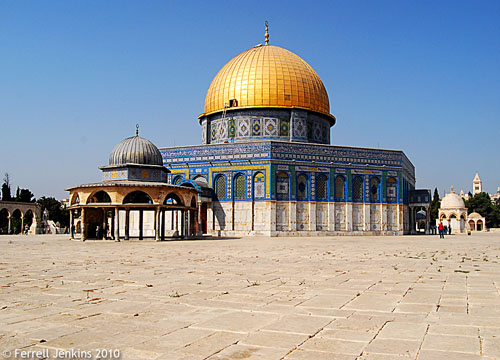
The Romans destroyed Jerusalem, including the temple, in A.D. 70. Centuries later, between 687 and 691, the Qubbet es Sakhra, (Dome of the Rock) was built on the orders of the Ommayad caliph, Abd el Malik. The building has been restored numerous times, but “the monument has preserved its original majestic proportions and harmonious design” (The Middle East, Hachette, 1966).

Dome of the Rock. Original site of Solomon's Temple. Photo by Ferrell Jenkins.

Dome of the Rock. Original site of Solomon's Temple. Photo by Ferrell Jenkins.

The association of this site with both Abraham and David ties together two of the great texts of the Old Testament (Genesis 12; 2 Samuel 7) and makes it especially significant for those who believe the Bible.

The chariot city of Megiddo

For years it has been pointed out that there is at least some evidence for stables at Megiddo. The biggest dispute has been over who built and used the stables.

On my last visit to Megiddo I noticed some new sculptures had been placed at the site. The view is to the north across the Jezreel Valley toward Lower Galilee. This sort of decoration has become common at parks in Israel.

Horse and chariot sculpture at Megiddo. Photo by Ferrell Jenkins.

Chariot and horses sculpture at Megiddo. Photo by Ferrell Jenkins.

There are several reference in the Bible connecting Megiddo with chariots. Because Megiddo was located on the main trunk road between Egypt and the empires of the north (Hittites and Syria) and those of the east (Assyria, Babylon, and Persia), we should not find this surprising.

Solomon is said to have built the house of the LORD, his own house, the Millo and the Wall of Jerusalem, and the cities of Hazor, Megiddo, and Gezer (1 Kings 9:15). The same context makes reference to chariot cities built by Solomon:

and all the store cities that Solomon had, and the cities for his chariots, and the cities for his horsemen, and whatever Solomon desired to build in Jerusalem, in Lebanon, and in all the land of his dominion. (1 Kings 9:19 ESV)

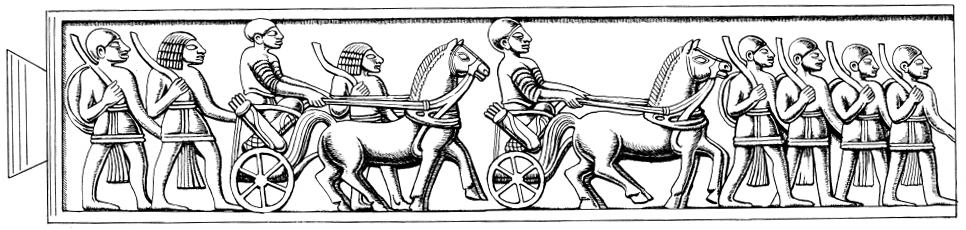
The drawing below comes from 1,000 Bible Images (Logos) with this note:

The picture shows two chariots and some foot soldiers, each carrying a curved ax, made of ivory (from Megiddo).
Read a little about this publication here. I do not recall having seen this piece in any museum. Does any reader know where it may be? There is a similar piece in the Oriental Institute.
Chariots and foot soldiers made of ivory. From Megiddo.

Chariots and foot soldiers made of ivory. 1,000 Bible Images.

Shalmaneser III (858-859 B.C.) informs us that Ahab, the Israelite, provided 2,000 chariots and 10,000 foot soldiers to the coalition that fought against the Assyrian king at Qarqar (Stone Monolith from Kurkh, now in the British Museum). Sounds as if Ahab had an impressive army.

Ptolemaic gold coin found at Tel Kedesh

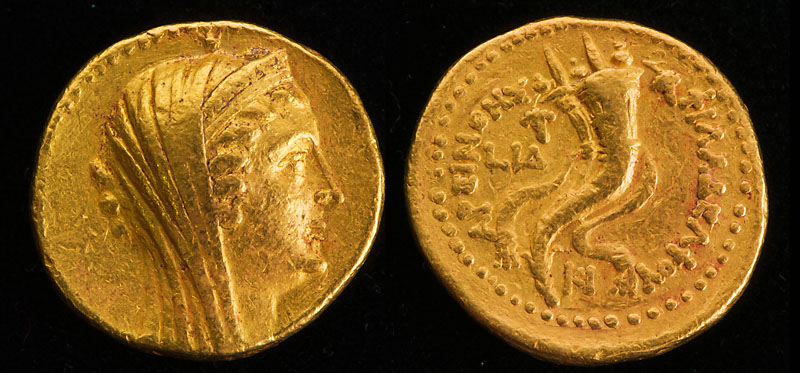
Announcement was made today that the excavation at Tel Kedesh has uncovered a gold coin dating to 191 B.C. The coin was minted in Alexandria by Ptolemy V and bears the name of the wife of Ptolemy II, Arsinoë Philadelphus (II).

According to Dr. Donald T. Ariel, head of the Coin Department of the Israel Antiquities Authority, “This is an amazing numismatic find. The coin is beautiful and in excellent preservation. It is the heaviest gold coin with the highest contemporary value of any coin ever found in an excavation in Israel. The coin weighs almost one ounce (27.71 grams), while most ancient gold coins weighed 4.5 grams. In Ariel’s words, “This extraordinary coin was apparently not in popular or commercial use, but had a symbolic function. The coin may have had a ceremonial function related to a festival in honor of Queen Arsinoë, who was deified in her lifetime. The denomination is called a mnaieion, meaning a one-mina coin, and is equivalent to 100 silver drachms, or a mina of silver.

The obverse (‘head’) of the coin depicts Arsinoë II Philadelphus. The reverse (‘tail’) depicts two overlapping cornucopias (horns-of-plenty) decorated with fillets. The meaning of the word Philadelphus is brotherly love. Arsinoë II, daughter of Ptolemy I Soter, was married at age 15 to one of Alexander the Great’s generals, Lysimachus, king of Thrace. After Lysimachus’ death she married her brother, Ptolemy II, who established a cult in her honor. This mnaieion from Tel Kedesh attests to the staying power of the cult, since the coin was minted a full 80 years after the queen’s death.

The Israel Antiquities Authority press release is currently available here.

Gold coin of Arsinoë Philadephus (II). Discovered at Tel Kedesh.

Gold coin of Arsinoë Philadelphus (II) discovered at Tel Kedesh. Photo by Sue Webb, courtesy IAA.

The Oriental Institute at the University of Chicago displays a statue base with the same name as that on the coin. The top of the statue has the name incised in hieroglyphs and the front shows the name in Greek.

Statue base showing name of Arsinoë Philadelphus. OIUC.

Statue base showing the name of Arsinoë Philadelphus. OIUC. Photo: Ferrell Jenkins.

Tel Kedesh, in Upper Galilee, is near the Lebanon border. This Kedesh was located in the territory of the Israelite tribe of Naphtali (Joshua 19:37). It is probably best known as one of the six cities of refuge assigned to the tribe of Levi (Joshua 20:7; 21:32).

So they set apart Kedesh in Galilee in the hill country of Naphtali, and Shechem in the hill country of Ephraim, and Kiriath-arba (that is, Hebron) in the hill country of Judah. (Joshua 20:7 ESV)

Deborah went with Barak to Kedesh, where he called out the men of Zebulun and Naphtali to go with him to fight Jabin’s army (Judges 4). The Assyrians captured Kedesh about 732 B.C. (2 Kings 15:29).

The excavations at Tel Kedesh are being conducted by the University of Michigan and the University of Minnesota. Some miscellaneous information about the excavation is available at the Kelsey Museum of Archaeology Dig Diaries here.

Tel Kedesh in northern Galilee. Photo by Ferrell Jenkins.

View to the NE of Tel Kedesh in northern Galilee. Photo by Ferrell Jenkins.

HT: Joseph I. Lauer