Category Archives: Bible Study

Royal theater box at the Herodium

Last week reports began to circulate about Herod’s royal theater box at the Herodium. Here are some excepts from the News Release published by the Hebrew University of Jerusalem.

Royal box uncovered at Herodium reveals further evidence of luxurious lifestyle of famed King of Judea

A “royal box” built at the upper level of King Herod’s private theater at Herodium (Herodion in Greek) has been fully exposed in recent excavations at the site, providing a further indication of the luxurious lifestyle favored by the famed Judean monarch.

The excavations, in the frame of Herodium’s National Park at the eastern edge of Gush Etzion, were conducted by Prof. Ehud Netzer under the auspices of the Hebrew University of Jerusalem Institute of Archaeology.

The theater, first revealed during the years 2008-2009, is located halfway up the hill close to Herod’s mausoleum, whose exposure in 2007 aroused worldwide attention. The highly decorated, relatively small theater was built in approximately 15 B.C.E., which was the year of the visit to Judea of Marcus Agrippa, second in the hierarchy of the Roman Empire, said Prof. Netzer, who has been assisted in the excavations by Yakov Kalman, Roi Porath and Rachel Chachy.

The royal box (measuring eight by seven meters and about six meters high) is the central space among a group of rooms attached to the upper part of the theater’s structure. This impressive room doubtlessly hosted the king, his close friends and family members during performances in the theater and was fully open towards the stage.

Its back and side walls are adorned with an elaborate scheme of wall paintings and plaster moldings in a style that has not been seen thus far in Israel; yet, this style is known to have existed in Rome and Campania in Italy during those years. This work, therefore, was no doubt executed by Italian artists, perhaps sent by Marcus Agrippa, who a year before his visit to Judea met Herod on the famous Greek island of Lesbos said Netzer.

On the upper parts of the walls are the room’s highlights: a series of unique “windows” painted with outfolded shutters on either side and various naturalistic landscapes within. They include scenes of the countryside, the Nile River and a nautical scene featuring a large boat with sails. One can identify features of trees, animals and human beings. Some of these windows have survived intact on the walls, whereas others were found in fragments on the floor and are undergoing restoration in the Israel Museum’s laboratory.

Painted windows with shutters appear in the late Second Pompeian Style in Italy, and mainly depict unrealistic views like theater settings and still-life. The closest parallels for the windows at Herodium are known from the “Villa Imperiale” at Pompeii, dated to the early Third Style, 15 to 10 B.C.E.

The News Release may be read in its entirety here.

Joseph I. Lauer secured the available photos and has been kind enough to share them.
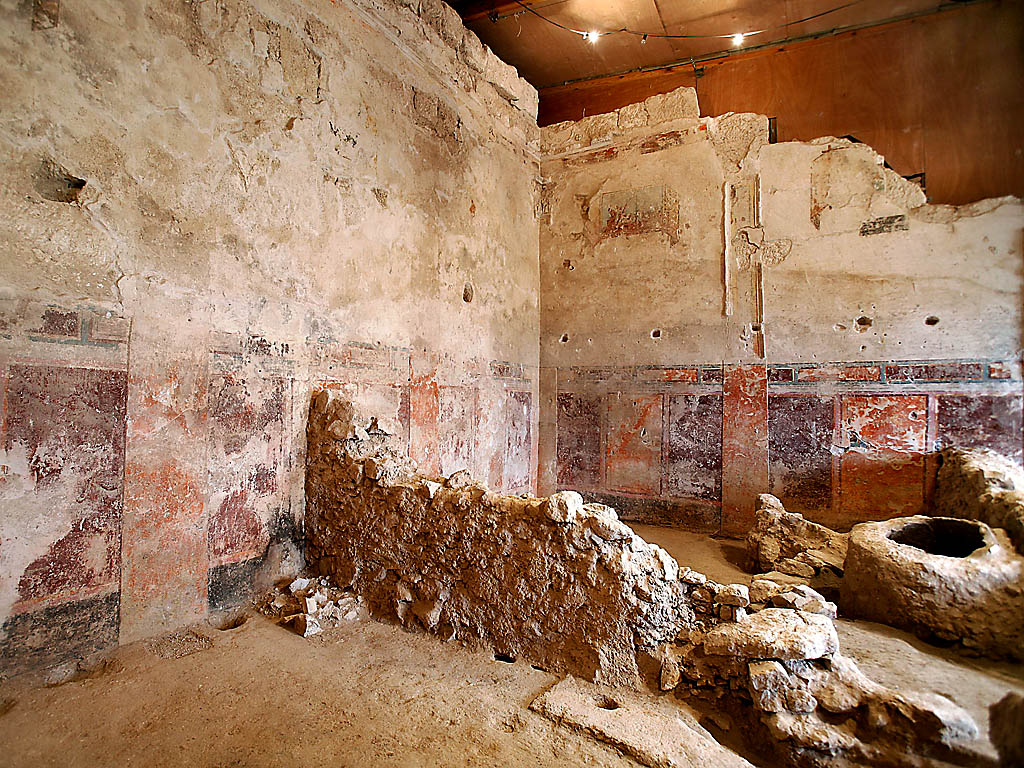
Herodium theater royal box. Photo by Gabi Laron, Hebrew University.

Herodium theater royal box. Photo by Gabi Laron, Hebrew University.

The Hebrew University report says,

The data accumulated during the excavation proves that the theater’s lifetime was very short, less than ten years. Slightly before Herod’s death, It was deliberately destroyed in order not to disrupt the conic shape of the artificial hill. During the construction of the artificial hill (as well as the famous monumental stairway which begins at the bottom of the hill), parts of the theater, including the “royal box,” were temporarily used by the builders, leaving their footsteps in the form of subdivision walls, cooking installations and graffiti.
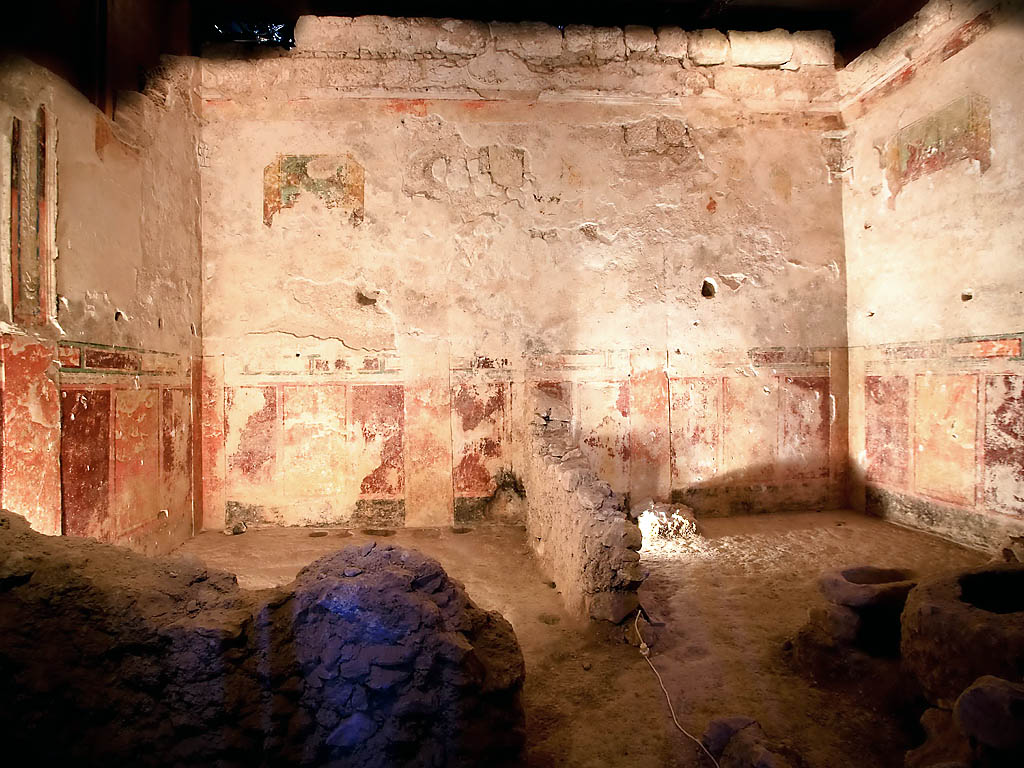
Herodium royal box. Photo by Tal Rogovski, Hebrew University.

Herodium theater royal box. Photo by Tal Rogovski, Hebrew University.

I had the opportunity to make some aerial photos of the Herodium December 15, 2009. Shadows were on the north side of the Herodium, but the massive area of the excavation can be seen. Note especially the theater. I feel certain that the royal box described above is under the blue roof. Click on the image to for a larger photo.
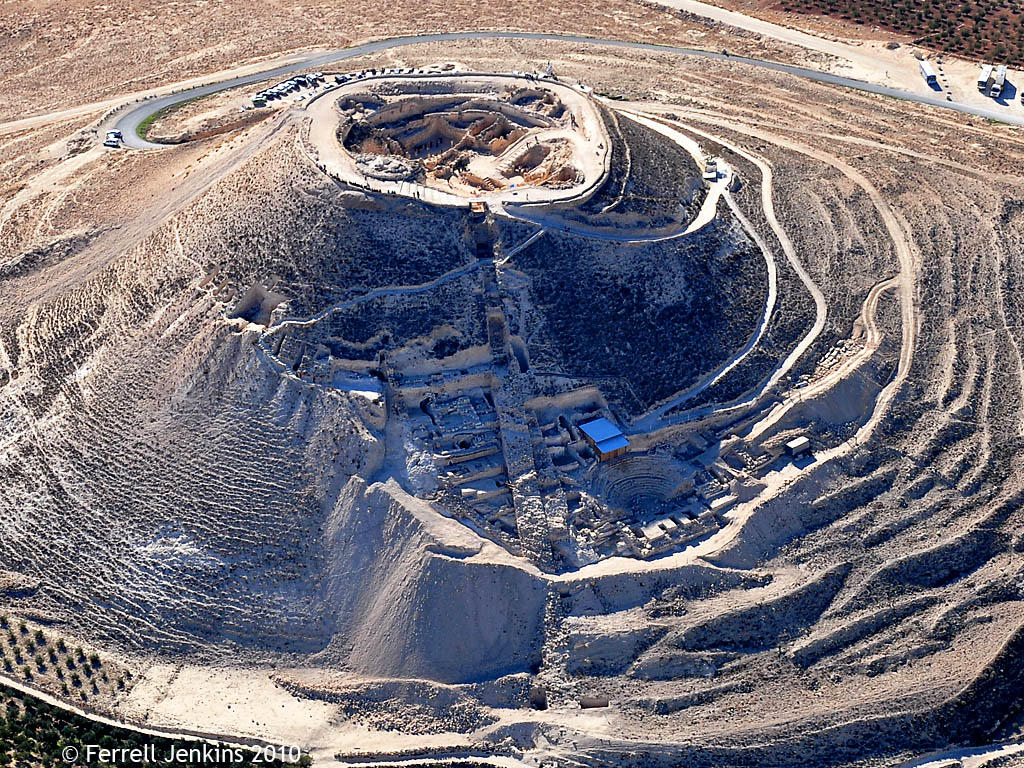
Aerial photo of the Herodium. Photo by Ferrell Jenkins.

Aerial photo of the Herodium. Photo by Ferrell Jenkins.

The Herodium is located about four miles southeast of Bethlehem. When we think of these two places together we recall Herod’s frantic attempt to kill Jesus.

Then Herod, when he saw that he had been tricked by the wise men, became furious, and he sent and killed all the male children in Bethlehem and in all that region who were two years old or under, according to the time that he had ascertained from the wise men. (Matthew 2:16 ESV)

All of the photos are suitable for use in teaching presentations.

Abel Beth Maacah — a mother in Israel

No sooner had King David put down the rebellion of his son Abaslom when a Benjamite by the name of Sheba led a rebellion against him. The men of Israel rebelled against David and followed Sheba, but the men of Judah remained loyal to the king.

Realizing that Sheba was a greater threat than Absalom had been, David called on Abishai to take servants (warriors) and capture Sheba. Joab’s men went out from Jerusalem to capture Sheba. This pursuit took Joab’s men all the way to the north of the Israelite territory, to a town named Abel-Beth-Maacah. Some English versions use Abel Beth Maacah, or a similar variant. In modern Israel this town is almost on the border with Lebanon between Kiryat Shmona and Metulla.

Sheba passed through all the tribes of Israel to Abel of Beth-maacah. All the Berites came together and followed him. Joab’s troops came and besieged Sheba in Abel of Beth-maacah. They built an assault ramp against the outer wall of the city. While all the troops with Joab were battering the wall to make it collapse, a wise woman called out from the city, “Listen! Listen! Please tell Joab to come here and let me speak with him.” (2 Samuel 20:14-16 CSB)

Abel Beth Maacah. Photo by Ferrell Jenkins.

Abel Beth Maacah - a mother in Israel. Photo by Ferrell Jenkins.

Our photo, looking east, shows the massive mound thought to be the site of Abel-Beth-Maacah. This photo was made in early May. The tell stands out distinctly from the surrounding apple orchards. The Beka Valley and the anti-Lebanon mountain range can be seen beyond the tel.

The wise woman reasons with Joab. She tells him that this town formerly was a place where people would ask for advice to end a dispute. She said,

I am a peaceful person, one of the faithful in Israel, but you’re trying to destroy a city that is like a mother in Israel. Why would you devour the LORD’s inheritance?” (2 Samuel 20:19 CSB)

Joab agreed that he would not destroy the city if she would hand over Sheba. She agreed to throw the head of Sheba over the wall. She did what she promised and the destruction was averted. Joab went back to the king in Jerusalem.

Abel-beth-Maacah is mentioned in at least two other passages.

  1. The city was conquered by Ben-hadad, king of Aram [Syria] (1 Kings 15:20).
  2. The city was captured by Tiglath-pileser, king of Assyria, in the days of Pekah of Israel.

Note. This is a revision of a post from December 19, 2008 with a more recent photo.

The ziggurat at Ur

The pyramids of Egypt are fairly well known to students in the Western world. Some study is made of them in the elementary grades. The ziggurats of Mesopotamia (mostly present day Iraq) are not as well known. In Egypt we have some pyramids, like the great pyramids of Giza, which are still standing to almost their original height. Having been made of stone, they have been fairly well preserved.

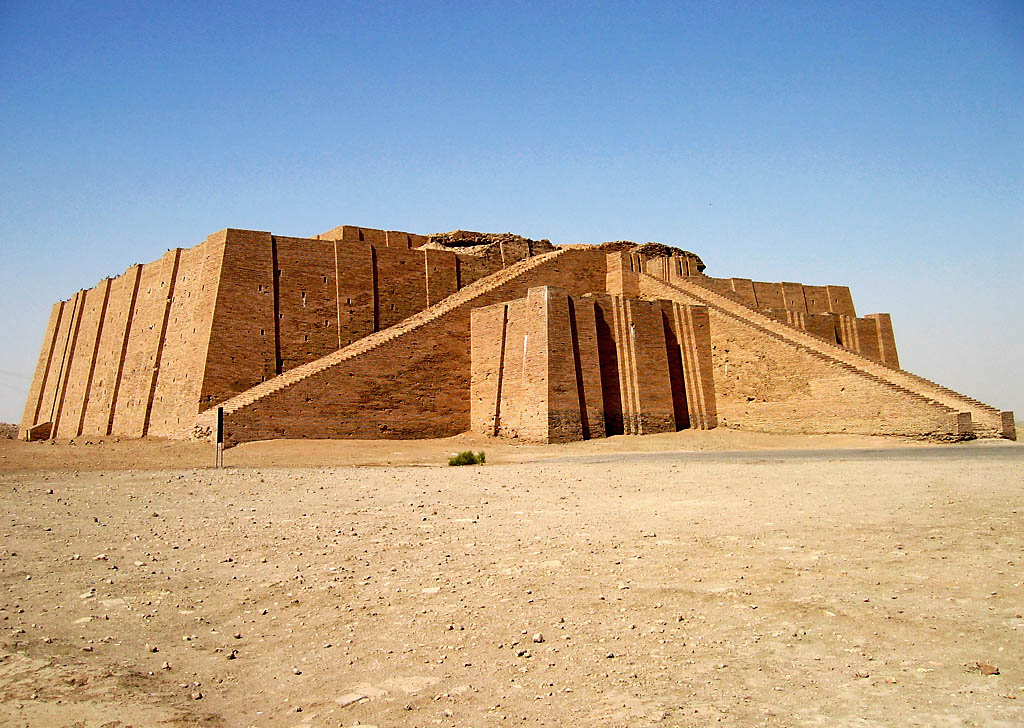
The ziggurats of Mesopotamia were made of baked bricks. Over the centuries they have tended to become piles of mud. The only one I saw during my only visit to Iraq in May, 1970, that had any semblance of a defined shape was the ziggurat at Ur. That was because it had been reconstructed up to about the fourth story.

The ziggurat was a staged temple tower. The temple at the top of the tower was considered the dwelling place of the particular god worshiped at a site. The kings of Ur are thought to have built the first ziggurat about the 27th century B.C., though some may have been erected on older structures going back to about 3100-2900 B.C. (The Middle East, Hachette World Guides, 1966). A model, like the one below from the Pergamum Museum in Berlin gives us a good impression of the original appearance of the ziggurats.

Ziggurat Model at the Pergamum Museum, Berlin. Photo by Ferrell Jenkins.

Ziggurat Model at the Pergamum Museum, Berlin. Photo by Ferrell Jenkins.

Every now and then I search the Internet for photos of Iraq. Sometimes I locate a nice photo made by a soldier who has been stationed there. One day I came across a really great photo on Flickr made by Josh McFall. It took a while to track down Josh and ask his permission to use the photo on the web site. He enthusiastically grated permission, only asking that I comply with the attached Creative Commons license. That, I was pleased to do. The Creative Commons license on this photo requires Attribution, Non-commercial Use, and No Derivative works. Josh, I am sure many of my readers thank you.

The ziggurat at Ur is attributed to the third dynasty of Ur (2124-2015 B.C.).

Ziggurat at Ur in Iraq. Photo by Josh McFall.

Reconstructed Ziggurat at Ur in Iraq. Photo by Josh McFall.

Perhaps we should think of something like the ziggurats when we study the account of the building of the tower of Babel in Genesis 11.

Then they said, “Come, let us build ourselves a city and a tower with its top in the heavens, and let us make a name for ourselves, lest we be dispersed over the face of the whole earth.” (Genesis 11:4 ESV)

And it might help with the understanding of what Jacob saw in his dream at Bethel.

And he dreamed, and behold, there was a ladder set up on the earth, and the top of it reached to heaven. And behold, the angels of God were ascending and descending on it! (Genesis 28:12 ESV)

When John calls attention to this scene he says the angels were ascending and descending on the “Son of Man” (John 1:51).

Both photos are available in presentation size for those who would like to use them. Just click on the image.

The Ostrich in Bible Times

The ostrich is listed among the unclean birds for the Israelites in Leviticus 11:16 and Deuteronomy 14:15. Job laments that he is “a companion of ostriches” (Job 30:29). The longest section of scripture mentioning the ostrich is in the the response by the LORD.

“The wings of the ostrich wave proudly, but are they the pinions and plumage of love? For she leaves her eggs to the earth and lets them be warmed on the ground, forgetting that a foot may crush them and that the wild beast may trample them. She deals cruelly with her young, as if they were not hers; though her labor be in vain, yet she has no fear, because God has made her forget wisdom and given her no share in understanding. When she rouses herself to flee, she laughs at the horse and his rider. (Job 39:13-18 ESV)

Ostrich at the Hai Bar Nature Reserve. Photo by Ferrell Jenkins.

Ostriches at the Hai Bar Nature Reserve. Photo by Ferrell Jenkins.

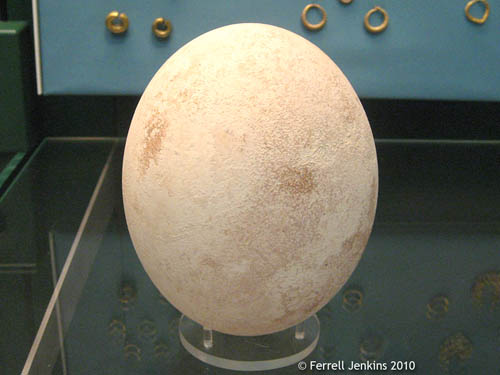
Archaeologists uncovered this ostrich egg pictured below from the MB II level (1750–1550 B.C.) at Lachish. The sign with the display at the British Museum says,

Ostriches were native to the Levant and their eggs, plain or decorated were often included in tomb deposits.

Ostrich Egg discovered at MB II Lachish. British Museum. Photo by Ferrell Jenkins.

Ostrich Egg discovered at MB II Lachish. British Museum. Photo by Ferrell Jenkins.

After the destruction of Jerusalem in 586 B.C., Jeremiah lamented that “the daughter of my people has become cruel, like the ostriches in the wilderness.” (Lamentations 4:3 ESV)

The potter’s right over the clay

In arguing that God has the right to do whatever He chooses, Paul uses the illustration of the potter and the clay.

But who are you, O man, to answer back to God? Will what is molded say to its molder, “Why have you made me like this?” Has the potter no right over the clay, to make out of the same lump one vessel for honorable use and another for dishonorable use? (Romans 9:20-21 ESV)

Potter molding a vessel at Avanos in Anatolia. Photo by Ferrell Jenkins.

Potter molding a vessel at Avanos in Anatolia. Photo by Ferrell Jenkins.

Our photo shows a potter molding a vessel, according to his own choosing, at Avanos in Turkey. Avanos, a town north of the region of Cappadocia, is famous for its potters. I am told that many homes have a potter’s wheel and the residents make some of the family income through pottery making.

The words of the LORD through the prophet Jeremiah are fitting:

Then the word of the LORD came to me: “O house of Israel, can I not do with you as this potter has done? declares the LORD. Behold, like the clay in the potter’s hand, so are you in my hand, O house of Israel. (Jeremiah 18:5-6 ESV)

We have included an image suitable for presentations for those who wish to use it in teaching.

Cyrus Cylinder loaned to Iran

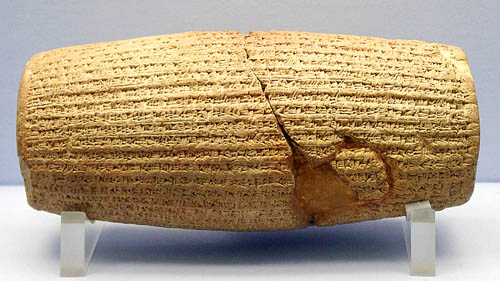
The Cyrus Cylinder came from ancient Persia. Now the British Museum, where it has been housed for many years, is loaning the artifact to the museum in Tehran, Iran.

Todd Bolen calls attention the the agreement, the historical significance of the Cyrus Cylinder, and the biblical reference (Ezra 1:1-4) to one of the events mentioned in the Cylinder.

The the account at the Bible Places Blog here, and be sure to follow the link to his list of the British Museum: Top 10, yeah 15.

If you plan to visit London, and you are interested in Bible study, be sure to download my short list of “Some Biblically Related Artifacts in the British Museum” here.

The Cyrus Cylinder in the British Museum. Photo by Ferrell Jenkins.

The Cyrus Cylinder in the British Museum. Photo by Ferrell Jenkins.

Have no fear of the authorities

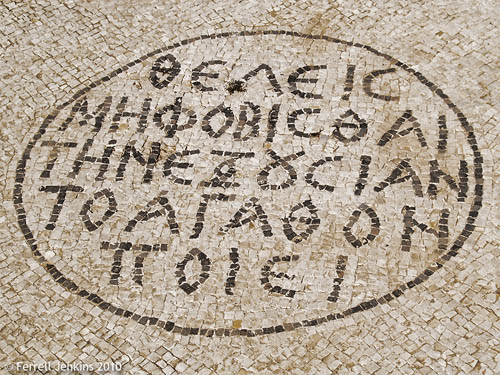
While reading Romans 13 I came to Paul’s admonition to the saints at Rome, ” Would you have no fear of the one who is in authority? Then do what is good.” My mind immediately turned to the mosaic which was discovered during the excavation of the Byzantine public area at Caesarea Maritima.

The context in Paul’s Epistle to the Romans reads this way.

For rulers are not a terror to good conduct, but to bad. Would you have no fear of the one who is in authority? Then do what is good, and you will receive his approval, for he is God’s servant for your good. But if you do wrong, be afraid, for he does not bear the sword in vain. For he is the servant of God, an avenger who carries out God’s wrath on the wrongdoer. (Romans 13:3-4 ESV)

The sign at the site describes the building where the mosaic was found as a Tax Archive. The original is said to be on display at the Kibbutz Sdot Yam Museum. The edifice is identified as “Byzantine government offices where clerks recorded tax revenues.”

Mosaic at Caesarea Maritima. Photo by Ferrell Jenkins.

Mosaic at Caesarea Maritima. Photo by Ferrell Jenkins.

I suppose they did not understand that this is politically incorrect!

Ties between Mesopotamia, the Mediterranean, and Egypt

Folks who study the Bible have understood that the people of the ancient near east traveled through Canaan as they made their way from Mesopotamia to Egypt, and back.

Several discoveries illustrating the contact between these ancient lands have recently been made. We commented on discoveries at Tell el-Da’ba in Egypt showing contacts between Babylon and Egypt here.

Word has come of a Syrian-German expedition “working in the Katana Kingdom ruins at Tel el-Mesherfeh archaeological site in Homs.”

Prof. Peter Pfalzner said the archeological finds in the site during the past two days indicate that Katana Kingdom enjoyed influence and important international and trade ties.

He added the finds reveal the existence of cultural relations between Katana Kingdom and the Pharaohs and Mesopotamia, in addition to trade relations with Mediterranean countries

The news report, which may be read here, continues,

Pfalzner underlined the importance of Katana kingdom during the Middle Bronze Age in the 2nd Millennium BC, adding that the royal palace in it was one of the greatest in Syria. He also noted that the archeological sites in Syria are filled with treasures waiting to be uncovered.

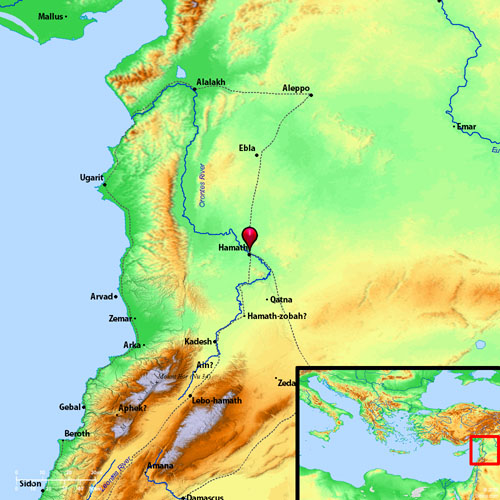
The Middle Bronze Age (about 2100 to 1550 B.C.) is the period of the biblical Patriarchs. Assume for a moment that Abraham and his family came from Ur in southern Mesopotamia (modern Iraq), rather than from northern Mesopotamia (Genesis 11:28 — 12:5). The map from Bible Atlas shows some of the places we will mention below.

Map showing Hamath and Kedesh. BibleAtlas.org.

Map showing Hamath and Kedesh. Courtesy of BibleAtlas.org.

The route taken by Abraham from Haran to Shechem in Canaan would most likely take him through the Syrian towns we know as Aleppo, Ebla, Hama and Homs. Homs would be at approximately the point referred to in the Bible as the entrance of Hamath (= modern Hama; 1 Kings 8:65). Several of these references indicate that Israel’s territory extended that far north during certain historical periods (2 Kings 14:25; Amos 6:14).

A few miles south of Homs are two significant sites illustrating the movement of ancient kingdoms. Tell Nebi Mend is the site of the battle of Kadesh where Rameses II and the Hittites fought. Another site nearby is Riblah where Nebuchadnezzar made his headquarters when he destroyed Jerusalem.

Then they captured the king and brought him up to the king of Babylon at Riblah, and they passed sentence on him. They slaughtered the sons of Zedekiah before his eyes, and put out the eyes of Zedekiah and bound him in chains and took him to Babylon. (2 Kings 25:6-7 ESV)

Here is a photo I made of Tell Nebi Bend. The Orontes River is to our back in this photo, and the valley of the battle of Kadesh is on the opposite side of the tell. There were a few houses of a modern village on the tell, but most of them were empty.

Kadesh - Tell Nebi Mend in Syria. Photo by Ferrell Jenkins.

Tell Nebi Mend (=Kadesh) in Syria. Photo by Ferrell Jenkins.

The Bible informs us that 4 kings of the east engaged the 5 kings of the region of Sodom and Gomorrah (Genesis 14).

And all these joined forces in the Valley of Siddim (that is, the Salt Sea). (Genesis 14:3 ESV)

The new information we are learning shows that such movement was not all that uncommon.

HT: Joseph Lauer

The olive shoots

The Bible is filled with illustrations from the agricultural practices and daily life activities of ancient Israel. We frequently pass over these images because we no longer understand the practices.

Here is an interesting one. In describing the happy home, one of the Psalms of Ascent says this,

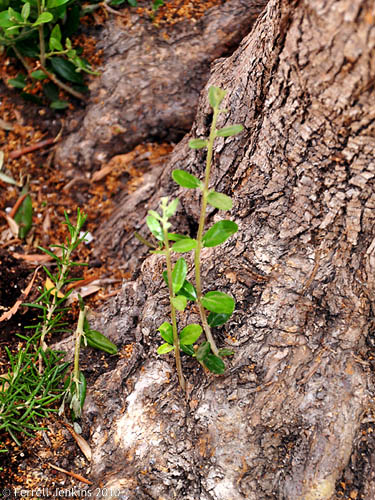
Your wife will be like a fruitful vine within your house; your children will be like olive shoots around your table. (Psalms 128:3 ESV)

I must have photographed a dozen different examples of what the writer is alluding to. Perhaps this one will help you to enjoy it a little better.

Olive shoots coming from an olive tree. Photo by Ferrell Jenkins.

Olive shoots coming from an olive tree. Photo by Ferrell Jenkins.

What happens after the olives are harvested?

Oded Borowski says the grape vines and the olive trees were the main fruit trees cultivated by Israelite farmers.

The main product of the vine was wine; olives were grown for oil. Both of these products were produced in special installations (winepress and olive press, respectively) as part of the harvesting season. The end products were stored in jars for local use, for barter, and for tax payments. The latter is well attested by the Samaria ostraca, which record the quantities of oil and wine received at the collection center in Samaria. Biblical and extrabiblical references indicate that there were different types and grades of wine and oil. (Daily Life in Biblical Times, 29)

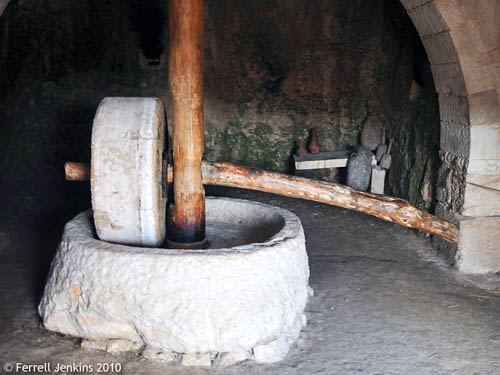
The fresh olives are placed on one stone and crushed by rolling another stone over them. The olive is really between a rock and a hard place. The large top stone (the crushing stone) is turned by a person or an animal causing the stone to roll over the olives that have been placed on a hewn stone installation. The photo below was made at the Nazareth Village.

Olive crusher at Nazareth Village. Photo by Ferrell Jenkins.

Olive crusher at Nazareth Village. Photo by Ferrell Jenkins.

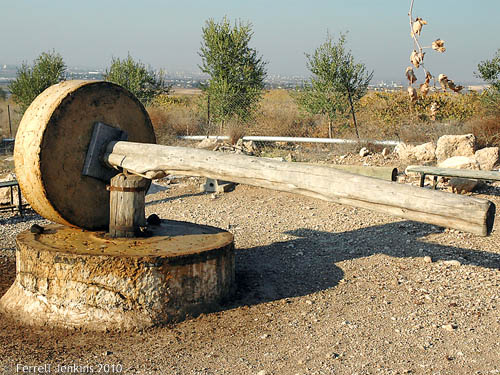
The olive crusher is most often seen outside near the olives. Here is a stone at Gezer. The view is toward the coastal plain.

Olive crusher at Gezer with view toward Coastal Plain. Photo by Ferrell Jenkins.

Olive crusher at Gezer with view toward Coastal Plain. Photo by Ferrell Jenkins.

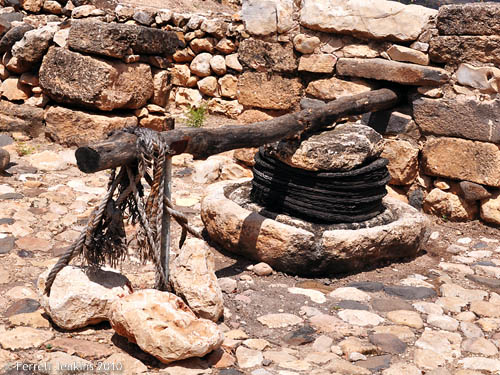
Once the olives are crushed the pulp is put into bags or baskets with holes in the side. Heavy weights are placed on the bags to squeeze out the oil. This photo shows a simple oil press set up at Hazor.

Simple Olive Press at Hazor. Photo by Ferrell Jenkins.

Simple Olive Press at Hazor. Photo by Ferrell Jenkins.

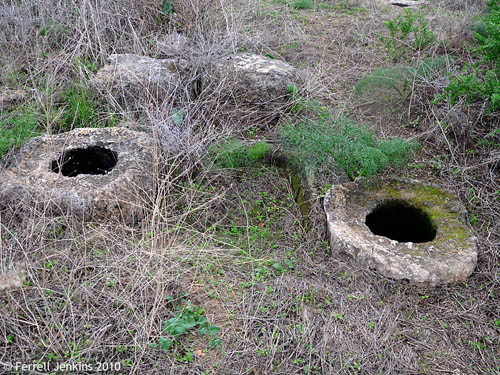
The archaeological excavations at Tel Mikne/Ekron revealed that the city was a large industrial oil production center. Only a few of these vats are visible at the site today. The tell is partially cultivated and the rest is overgrown. The small museum at the nearby kibbutz is closed and all of the artifacts have been moved to Ashdod. I was told that they are not on display at this time.

Crushing basin with a pressing vat on either side. Photo by Ferrell Jenkins.

Crushing basin with a pressing vat on either side. Photo by Ferrell Jenkins.

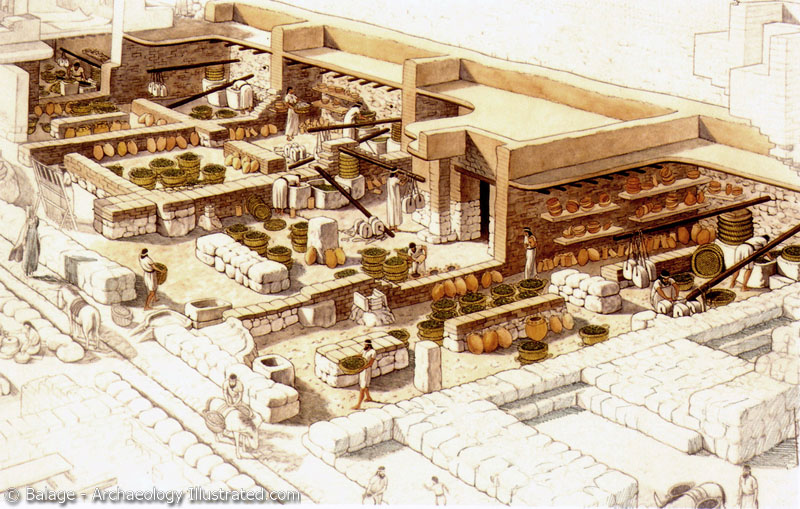
Based on the excavations, artist Balage has drawn the olive oil production center at Tel Mikne/Ekron.

Olive oil production at Ekron. Art by Balage, Archaeology Illustrated.

Olive oil production at Ekron. Art by Balage, Archaeology Illustrated.

Once the oil is retrieved it is stored in large ceramic jars. When Gedaliah became governor of Judah after the Babylonian destruction of Jerusalem he told the residents to “gather wine and summer fruits and oil, and store them in your vessels” (Jeremiah 40:9-10).