Category Archives: Bible Places

Palestine Exploration Fund’s photostream

The Palestine Exploration Fund has posted some fascinating historical photos from the nineteenth and early twentieth-century that will be of interest to students of historical geography and archaeology. The link is here.

Once you get there scroll down to the second line of photos where you will see a photo made sometime between 1930 and 1936 of John Garstang working at Jericho. He is making photos of the abundance of pottery found at that spot.

Working through this collection is going to be fun.

The photos are marked “© All rights reserved.” Those who wish to use them for educational purposes should be able to do so under the copyright Fair Use provision.

HT: Paleojudaica and Biblical Paths.

Extreme weather in the Middle East

Most parts of the United States have severely cold weather tonight. Even here in Florida we are expecting record cold tonight and tomorrow night. One of the cruise ships was unable to enter the Tampa port today due to strong winds.

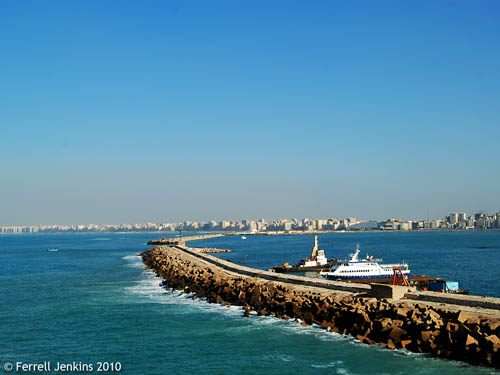
All of that reminded me about the extreme weather in the eastern Mediterranean and various parts of the Middle East. The network news showed conditions on the cruise ship that was unable to enter the harbor at Alexandria. The photo below show the breakwater at the entrance to the Alexandria harbor. The flat looking building to the right on the shore is the famous new library of Alexandria.

Breakwater at entrance to Alexandria harbor. Photo by Ferrell Jenkins.

Breakwater at entrance to Alexandria harbor. Photo by Ferrell Jenkins.

RFIenglish has the following summary:

Twenty-six ships were barred from entering the Suez Canal and 29 vessels delayed for three hours. The waterway was hit by poor visibility and winds of up to 40 knots an hour, said an official at the canal, which is Egypt’s third-largest source of foreign revenue after tourism and remittances from expatriate workers.

Red Sea and Mediterranean ports were closed for a second day on Sunday, while an Italian container ship, Jolly Amaranto, was stranded off the north-western coast after its engines broke down.

Visibility at Cairo airport was reduced to 300 metres.

As a long drought that affected the region came to an end, temperatures plummeted and storms hit Lebanon, Syria, Jordan, the Palestinian territories and Israel:

* In Lebanon seaside roads and ports have been closed after a 45-year-old woman was killed by a falling tree hitting her car – the year’s first snowstorm hit the country’s mountains;
* Off Israel a Moldovan freighter went down near the port of Ashdod but its crew of 11 Ukrainians was rescued.
* Syria’s capital Damascus was hit by snowstorms;
* Jordan suffered sandstorms and was braced for heavy rain and snow, which could lead to flooding.

Forecasters expect the bad weather to continue on Monday and have advised people to stay indoors due to a sandstorm that has blanketed the Egyptian capital.

Read also the BBC report here, or the Breitbart coverage which Todd Bolen mentioned here.

The Israel National News reports on snow in the Jerusalem area. Haaretz says the precipitation is a boon to the Sea of Galilee which has been extremely low in recent months.

Scholar claims evidence for Toi king of Hamath

King Toi of Hamath is mentioned in two Biblical texts.

Now when Toi king of Hamath heard that David had defeated all the army of Hadadezer, Toi sent Joram his son to King David to greet him and bless him, because he had fought against Hadadezer and defeated him; for Hadadezer had been at war with Toi. And Joram brought with him articles of silver, of gold and of bronze. (2 Samuel 8:9-10 NAU)

See also 1 Chronicles 18:9-10 where he is mentioned under the name Tou.

Prof. Aren Maeir reports on his Gath blog that Prof. Itamar Singer called his attention to an article by “C. Steitler (“The Biblical King Toi of Hamath and the Late Hittite State of ‘P/Walas(a)tin’”. Biblische Notizen 146 [2010]: 81-99) in which the author claims that one can identify the recently identified King Tatais, king of P/Walas(a)tin (from new inscriptions in Syria), with Toi, king of Hamath, mentioned in II Sam 8, 9-10; I Chr 18, 9-10.”

Maeir gives this brief summary of the article:

“David’s alliance with Toi, king of Hamath (2Sam 8,9-10) can be anchored in the historical context of Syria. Recent archaeological and philological studies have demonstrated the continuity between the Hittite Great Empire and the late Hittite kingdom, P/Walas(a)tin, to which Hamath belonged. Based on historical and onomastic analyses, the biblical Toi should be identified with a king of P/Walas(a)tin, Taitas.”

Take a look at Prof. Maeir’s observations here. This will be a great story to follow.

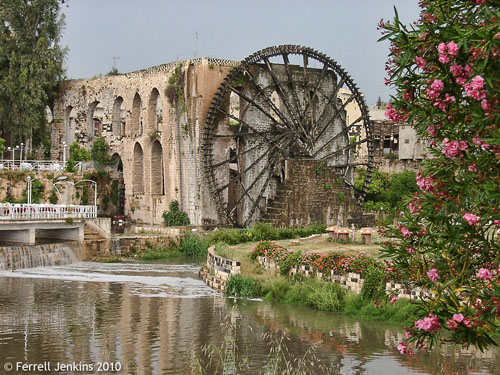
Hamath is associated with the modern city of Hama on the Orontes River in Syria. The city is noted for its norias. These waterwheels were used for several centuries to divert water from the river for agricultural purposes. Today those that remain are mostly decorative.

One of the Norias on the Orontes River at Hama, Syria. Photo by Ferrell Jenkins.

One of the norias on the Orontes River at Hama, Syria. Photo by Ferrell Jenkins.

Vessels of honor and dishonor

In explaining to Timothy the importance of right living, Paul says,

Now in a great house there are not only vessels of gold and silver but also of wood and clay, some for honorable use, some for dishonorable. Therefore, if anyone cleanses himself from what is dishonorable, he will be a vessel for honorable use, set apart as holy, useful to the master of the house, ready for every good work. (2 Timothy 2:20-21 ESV)

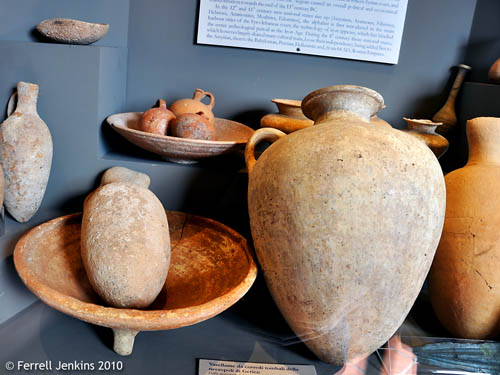
The term vessel (Greek, skeuos) is used of literal vessels made of clay, gold, silver, or wood. It is also used by analogy of individuals as a vessel. I have chosen two photos to illustrate vessels of different value. The first shows vessels from Middle Bronze II Jericho made of clay. Vessels of this type were used throughout Bible times.

Middle Bronze II pottery from Jericho. Vatican Museum. Photo by Ferrell Jenkins.

Middle Bronze II pottery from Jericho. Vatican Museum. Photo by Ferrell Jenkins.

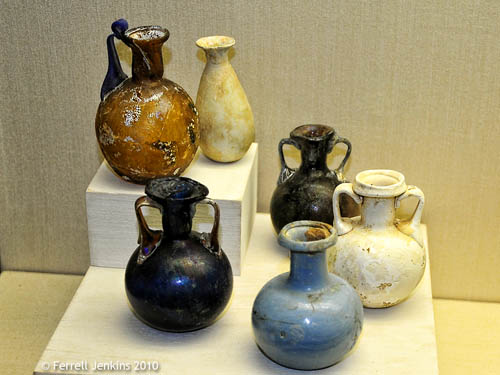
The next photo shows several pieces of “mold-blown perfume vessels decorated with stylized motifs” on display at the Eretz Israel Museum, Tel Aviv, Israel. These vessels are obviously more delicate and require more care than the ordinary clay vessels. For our time we might compare Melmac (if you are too young  to know, look it up!) and fine china.

Mold-blown perfume vessels. Erezt Israel Museum. Photo by Ferrell Jenkins.

Mold-blown perfume vessels. Erezt Israel Museum. Photo by Ferrell Jenkins.

Paul says to Timothy, and to us, “be a vessel for honorable use, set apart as holy, useful to the master of the house.”

Peter uses a similar analogy in speaking of the husband’s responsibility to his wife.

Likewise, husbands, live with your wives in an understanding way, showing honor to the woman as the weaker vessel, since they are heirs with you of the grace of life, so that your prayers may not be hindered. (1 Peter 3:7 ESV)

Another jumping off place — the pinnacle of the temple

A couple of days ago we wrote about the pinnacle of the temple (Mark 11:11; Luke 4:9). We followed the common suggestion that the reference was to the southeast corner of the temple mount precinct.

We mentioned that the late Benjamin Mazar, The Mountain of the Lord (page 149), shows a photo of the southeast corner of the wall with the comment that this “is known as the ‘pinnacle of the Temple’ (Mark 11:11; Luke 4:9).”

Leen Ritmeyer left us a comment to say that “Mazar actually had a different idea,” and called attention to his own post at ritmeyer.com.

Dr. Ritmeyer, author of The Quest: Revealing the Temple Mount in Jerusalem, provided some insight into the subject that is helpful and appreciated. He says,

Although this statement does appear in the book, I remember discussing this problem with him and he said that he actually saw the  southwest corner of the Temple Mount as a more likely candidate for the pinnacle of the Temple. One needs to determine what was the most important element in the temptation of Jesus to throw himself down from the pinnacle. Was it the height of the corner above what lay below or did the temptation lie in impressing as many people as possible with that jump?

As the southwest corner was a busy junction between the major north-south street running through Jerusalem and the Plaza in front of the Southern Wall of the Temple Mount, there would have been many more people to impress here than on the much quieter southeast corner.

It is in a setting such as this that we can visualise the dramatic scene that would have taken place had not Jesus challenged the temptation with the power of God’s Word.

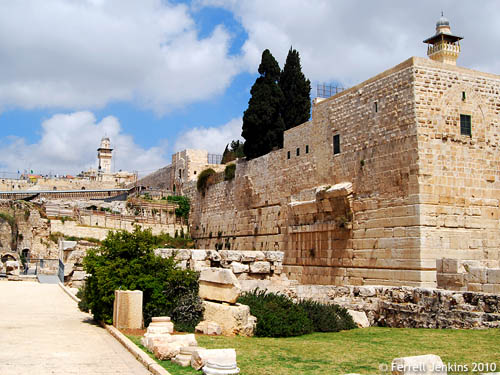
The Temple Mount Southwest Corner. Photo by Ferrell Jenkins.
The Southwest Corner of the Temple Mount. Photo by Ferrell Jenkins.

The western side of the Temple Mount enclosure ran along the Tyrophean Valley from north to south. A few years ago archaeologists found the first century street level at the southwest corner. The stones you see protruding from the wall are known as “Robinson’s Arch”, named for 19th century explorer Edward Robinson. When I first visited Jerusalem in 1967 it was commonly thought that the arch was the beginning of a bridge across the Tyrophean Valley, similar to Wilson’s Arch which is north of the Western Wall plaza. Now we know that the arch was the beginning of a winding staircase that allowed access to the Royal Stoa on the temple platform. (You will see a nice drawing of this staircase in Ritmeyer’s post.)

In my original post I said, “In a post to follow I will mention another view.” The other view I had in mind was the southwest corner.

Richard M. Mackowski, Jerusalem City of Jesus, says this corner “may be identified with the biblical Pinnacle of the Temple” (page 122). This is the comment I intended to use in today’s post. I am delighted that Dr. Ritmeyer calls attention to the discussion he had with Benjamin Mazar. We expect scholars to change their minds as they gain new information. It is also possible that an editor added the note in the book.

My bottom line is that we do not know for certain where the pinnacle of the temple is located. Either of these views suggest a good possibility.

Sharks at Sharm el-Sheikh in the Sinai

Even our local TV news is reporting on the shark attacks at Sharm el-Sheikh in Egypt. Sharm el-Sheikh is located  on the tip of the Sinai Peninsula. The Huffington Post includes numerous links for those who have an interest in this subject here.

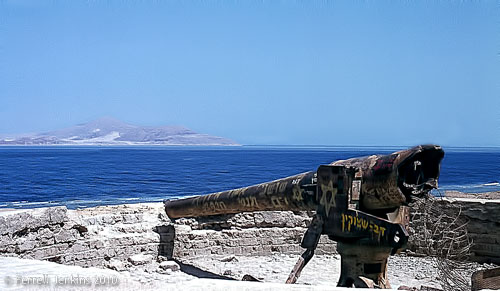
I have been in the Sinai peninsula several time, but have visited Sharm el-Sheikh only once in 1973. At that time the Sinai was under Israeli control. The site played an important role in the June War of 1967. The United Arab Republic closed the Straits of Tiran to Israeli shipping and blockaded all ships headed for Eilat. This narrow waterway and one of the Egyptian guns is seen in the old photo I made. Today Israel and Egypt share diplomatic relations and the Sinai is under Egyptian control. Sharm el-Sheikh is one of Egypt’s most popular resorts.

Egyptian gun taken by Israel at the Straits of Tiran in 1967. Photo by Ferrell Jenkins.

Egyptian gun taken by Israel at the Straits of Tiran in 1967. Photo by Ferrell Jenkins.

The Sinai is significant in biblical history because the traditional location of Mount Sinai is located there, equated with Jebel Musa.

The glory of the LORD settled on Mount Sinai, and the cloud covered it for six days. On the seventh day He called to Moses from the cloud. (Exodus 24:16 CSB)

Scholars are not in agreement on the location of Mount Sinai. In the beautiful revised edition of the Zondervan Atlas of the Bible, geographer Carl G. Rasmussen says,

… there are at least twelve different candidates for Mount Sinai: five in the southern part of the peninsula, four in the north, one in the center, one in Midian (Saudia Arabia), and another in Edom (southern Transjordan). — page 103

The pinnacle of the temple

A friend asks about the pinnacle of the temple.

Can you tell me where to find a diagram that shows the “pinnacle of the temple?” It looks as if the consensus is that it was Solomon’s porch. Anyone jumping off would land in the Kidron Valley.

In my reading the most common view is that the southeast corner of the Temple Mount is the place mentioned in Mark and Luke as  the pinnacle of the temple.

William Barclay says,

In the third temptation Jesus in imagination saw himself on the pinnacle of the Temple where Solomon’s Porch and the Royal Porch met. (The Gospel of Luke, in The Daily Study Bible Series, 44)

Benjamin Mazar, The Mountain of the Lord, shows a photo of the southeast corner of the wall with the comment that this “is known as the ‘pinnacle of the Temple’ (Mark 11:11; Luke 4:9),” page 149.

William Hendriksen says,

The present temptation, then, takes place in Jerusalem, to which the devil has led Jesus. Satan has set the Savior on the very pinnacle (literally wing) of the outer wall of the entire temple complex. The exact spot is not given. It may have been the roof-edge of Herod’s royal portico, overhanging the Kedron Valley, and looking down some four hundred fifty feet, a “dizzy height,” as Josephus points out (Antiq. XV.412). This spot was located southeast of the temple court, perhaps at or near the place from which, according to tradition, James, the Lord’s brother, was hurled down. See the very interesting account in Eusebius, EcclHist;, II.xxiii. ( New Testament Commentary : Exposition of the Gospel According to Luke, 237)

Here is the comment by Josephus,

… and this cloister deserves to be mentioned better than any other under the sun; for while the valley was very deep, and its bottom could not be seen, if you looked from above into the depth, this further vastly high elevation of the cloister stood upon that height, insomuch, that if anyone looked down from the top of the battlements, or down both those heights, he would be giddy, while his sight could not reach to such an immense depth. (Ant. 15:412)

The photo below shows the southeast corner of the temple enclosure built by Herod the Great in the Second Temple model now displayed on the grounds of the Israel Museum.
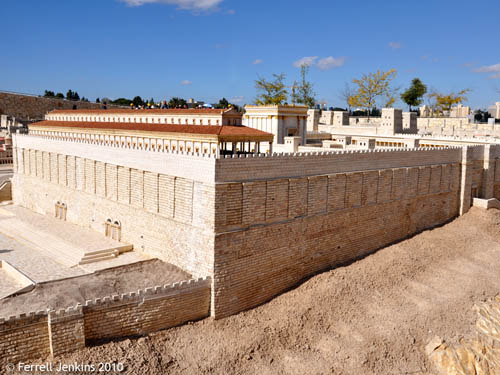
Second Temple Model, Jerusalem. Photo by Ferrell Jenkins.

Second Temple Model view from the southeast. Photo by Ferrell Jenkins.

In the photo below we see the southeast corner from the east. The stone work includes a conglomerate ranging from later Moslem (at the top) to Herodian (at the bottom). At the present time one certainly would not fall into the Kidron Valley if he jumped from the top of the wall. I do not know what it might have been in the time of Jesus. I think a jump from the present wall to the land below would be deadly enough.
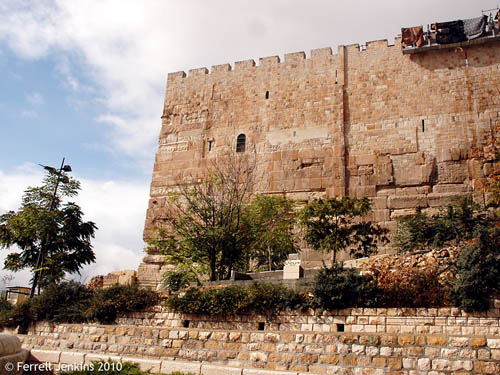
Southeast corner of Temple Mount enclosure. Photo by Ferrell Jenkins.

Southeast corner of Temple Mount enclosure. Photo by Ferrell Jenkins.

Here is a view of the Kidron Valley looking south. The “pinnacle of the temple” is visible in the upper right of the photo. The valley drops off rapidly near the point where you see the tomb on the left (Absalom’s Pillar).
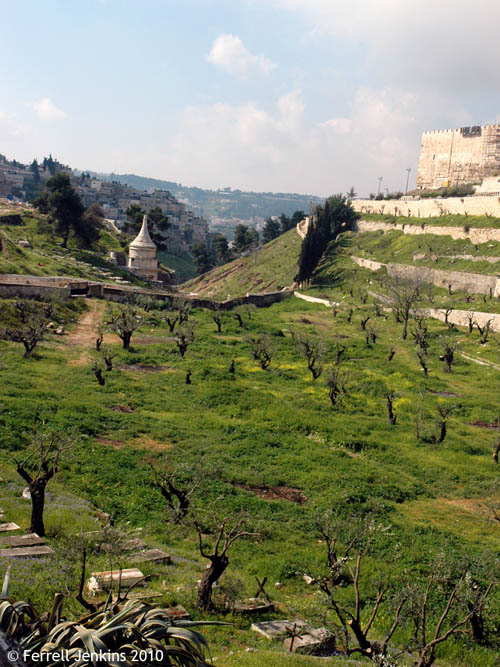
Kidron Valley looking South. Photo by Ferrell Jenkins.

Kidron Valley looking South. Note wall in upper right. Photo by Ferrell Jenkins.

In a post to follow I will mention another view.

My friend asked where to find a diagram of the pinnacle of the temple. One might check the Image Library at Ritmeyer Archaeological Design here.

The photos above might be all one needs to illustrate the point. I have posted these in sizes large enough for use in teaching presentations.

Fire rages in Carmel mountains

Haaretz reports here on a fire in the Carmel mountains.

Forty people were killed on Thursday as a huge brush fire continued to rage across the Carmel Mountains in northern Israel, killing and injuring dozens, among them prison guards and firemen.

Some 13,000 people were evacuated from their homes in the north and Israel called for international aid as the fire blazed out of control, fanned by easterly winds following a month of near record temperatures for the time of year.

This story developed throughout the day Thursday and it would be best to use Google to search for updates.

Mount Carmel is a range which runs southeast from the Mediterranean Sea for about 14½ miles. It is probably best known in the Bible as the place of the contest between the prophet Elijah and the prophets of Baal (1 Kings 18:17-40). The traditional site for this event is shown at Muhraka on the eastern end of the range.

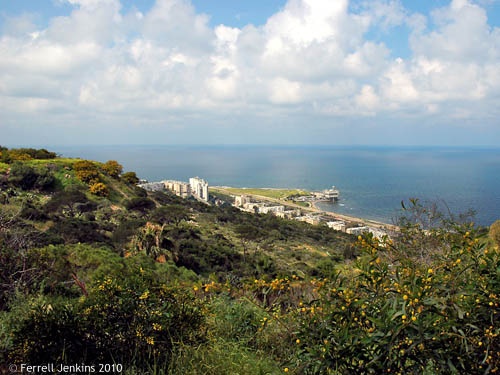
The photo below was made from an observation point on the western end of the Carmel range. Some of the buildings of greater Haifa can be seen along the Mediterranean. The photo shows some of the typical scrub brush seen many places on the mountain.

The Mediterranean Sea from Mount Carmel near Haifa. Photo by Ferrell Jenkins.

The Mediterranean Sea from Mount Carmel near Haifa. Photo by Ferrell Jenkins.

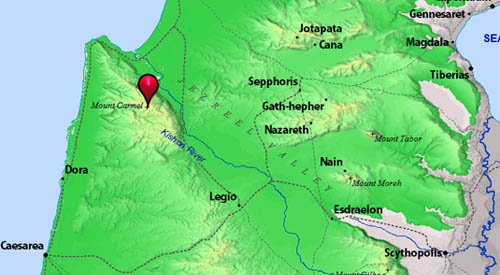
This map from BibleAtlas.org shows Mount Carmel in relation to sites in the Jezreel Valley and lower Galilee.

Map from BibleAtlas.org to show location of Mount Carmel.

Map from BibleAtlas.org showing the location of Mount Carmel.

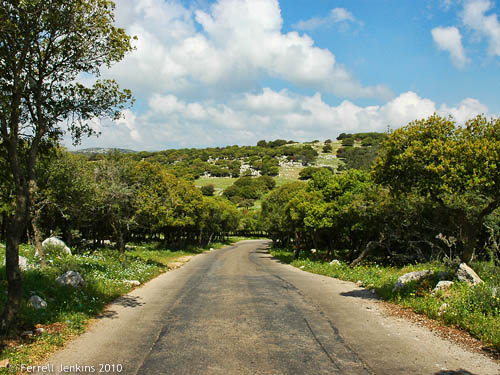
The next photo was made near Murakah on the southeastern end of the Carmel range.

Mount Carmel near Murakah. Photo by Ferrell Jenkins.

Mount Carmel near Murakah. Photo by Ferrell Jenkins.

Update: Todd Bolen, at the BiblePlaces Blog, calls attention to 35 powerful photos of the fire on Mount Carmel. Check boston.com.

Uriah’s trip from Jerusalem to Rabbah

Last evening I was looking at the biblical account of David’s battles against the Ammonites (2 Samuel 10-11).

In the spring of the year, at the time when kings normally conduct wars, David sent out Joab with his officers and the entire Israelite army. They defeated the Ammonites and besieged Rabbah. But David stayed behind in Jerusalem. (2 Samuel 11:1 NET)

You probably know the rest of the story. David is attracted to Bathsheba, commits adultery, learns Bathsheba is pregnant, calls Uriah home in hope that he will spend the night with Bathsheba. Uriah acted in the true warrior way by not enjoying the benefits of the marriage bed while his companions were camping in the open field. David sent Uriah back to the battle with a letter to Joab to put Uriah in the forefront of the battle.

Have you thought about the journey made by Uriah and the other Israelite soldiers as they traveled from Jerusalem to Rabbah and back? You know where Jerusalem is located. It is situated on the eastern side of the water parting ridge of Israel at an elevation of about 2400 feet above sea level. Numerous times we have discussed the journey from Jerusalem to the Jordan Valley. See here and here.

The distance from Jerusalem to the Dead Sea is not more than 20 miles. The elevation drops from about 2600 feet at the Mount of Olives to (currently) about 1384 feet below sea level at the surface of the Dead Sea. The point of crossing at the Jordan River would be a little higher. From there one must go up into the Transjordan Tableland to reach Rabbah. The general elevation of the Transjordan Tableland is about 3000 feet above sea level. Amman is about 2500 feet above sea level. That makes this a difficult route of travel.

Rabbah (Rabbath), the capital of ancient Ammon, is the site we now know as Amman, capital of Jordan. During the Hellenistic period the city was renamed Philadelphia.

The total distance from Jerusalem to Rabbah is about 40 miles as the crow flies. Men rarely travel like crows. The distance by road is longer and more difficult.

The photo I wish to share today was made in early April. It was made along a road a little east of the Jordan Valley and the Plains of Moab. From here you can see the terrain David’s men, including Joab and Uriah, had to travel on their way from Jerusalem to Rabbah. Modern Amman is located in the mountains we see on the horizon.

View looking east toward Amman. Photo by Ferrell Jenkins.

View looking east toward Amman. Photo by Ferrell Jenkins.

Learning routes of travel is one of the most important values in visiting the Bible lands. I hope this photo will help you with your study of the biblical account.

More about the first preaching on Pentecost

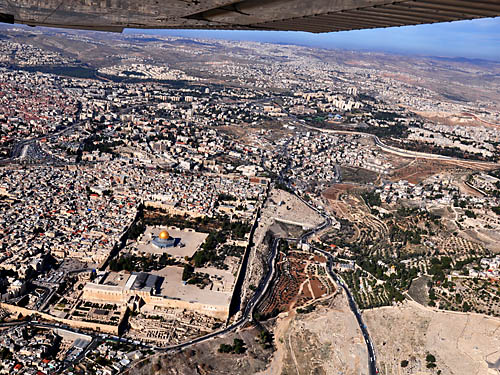
In this aerial view of Jerusalem you can see the Temple Mount enclosure and most of the Old City of Jerusalem. The Kidron Valley and the western slope of the Mount of Olives is visible on the right of the photo.

Aerial view of Jerusalem looking NE. Photo by Ferrell Jenkins.

Aerial view of Jerusalem looking NE. Photo by Ferrell Jenkins.

The photo below is a cropped portion of the image with emphasis on the Temple Mount.

The Temple Mount enclosure from the south. Photo by Ferrell Jenkins.

A closer view of the Temple Mount enclosure from the south. Photo by Ferrell Jenkins.

Herod the Great began to rebuild the existing postexilic temple on a grander scale about 20 B.C. Work had been going on for 46 years in the early days of the ministry of Jesus.

Then the Jewish leaders said to him, “This temple has been under construction for forty-six years, and are you going to raise it up in three days?” (John 2:20 NET)