Category Archives: Bible Places

Living springs of water

Today we traveled north from Tiberias on the Sea of Galilee to Hazor. About the time our bus stopped the rain began. We waited a while, but left the bus as soon as the rain let up. This gave an opportunity to visit the gate, the Canaanite palace, and a few other areas before the rain started again. Finally we left and went on to Dan. There we were able to visit the site with only sprinkles.

By this time of the year I had come to expect that major rains (the latter rains, Joel 2:23) would be over, but still delighted to see the rains coming to a land that has suffered drought for a few years.

From Dan we continued to Banias, the site of New Testament Caesarea Philippi. This is the area where Peter confessed Jesus to be the Christ, the Son of the Living God, and where Jesus made the promise to build His church.

Now when Jesus came into the district of Caesarea Philippi, He was asking His disciples, “Who do people say that the Son of Man is?” And they said, “Some say John the Baptist; and others, Elijah; but still others, Jeremiah, or one of the prophets.”  He said to them, “But who do you say that I am?”  Simon Peter answered, “You are the Christ, the Son of the living God.” And Jesus said to him, “Blessed are you, Simon Barjona, because flesh and blood did not reveal this to you, but My Father who is in heaven.  “I also say to you that you are Peter, and upon this rock I will build My church; and the gates of Hades will not overpower it.  “I will give you the keys of the kingdom of heaven; and whatever you bind on earth shall have been bound in heaven, and whatever you loose on earth shall have been loosed in heaven.”  Then He warned the disciples that they should tell no one that He was the Christ. (Matthew 16:13-20 NAU)

It was still raining some, but I was much impressed with the force of the water today. I have been here on probably every tour since the site has been under Israeli control. I don’t recall ever seeing so much water surging from the earth. This is a good sign, I think.

Here is a photo made looking north toward the source of the River Banias, the easternmost source of the Jordan River.
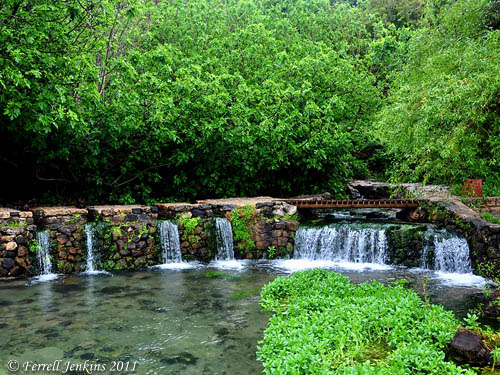
Looking to the source of the Banias River. Photo by Ferrell Jenkins.

Looking to the source of the Banias River. Photo by Ferrell Jenkins.

The photo below shows the same area from the north. Here we are immediately above the outlet of the powerful springs.
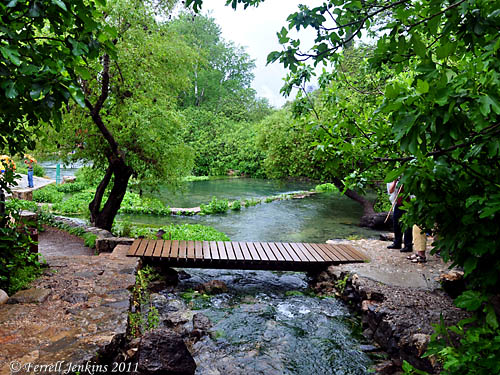
River Banias, a source of the Jordan, from the North. Photo by Ferrell Jenkins.

River Banias, a source of the Jordan, from the North. Photo by Ferrell Jenkins.

We got only an occasional glimpse of Mount Hermon to see the patches of snow on it.
A beautiful day in Galilee and at Megiddo

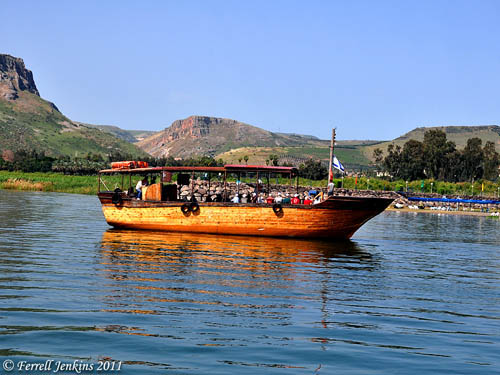
This morning we took our group on the usual boat ride across the Sea of Galilee. We left Tiberias and sailed to near the Cove of the Sower and then turn west to Nof Ginosaur on the western coast of the Sea. Ginosaur is the English Gennesaret.

Boat approaches the region of Genesaret. Photo by Ferrell Jenkins.

Boat approaches the region of Genesaret. Photo by Ferrell Jenkins.

After they had crossed over, they came to land at Gennesaret and anchored there.  As they got out of the boat, people immediately recognized Jesus.  They ran through that whole region and began to bring the sick on mats to wherever he was rumored to be. And wherever he would go– into villages, towns, or countryside– they would place the sick in the marketplaces, and would ask him if they could just touch the edge of his cloak, and all who touched it re healed.  (Mark 6:53-56 NET)

I noticed to significant things about the Sea of Galilee today.

  1. It appeared to be higher than the three or four previous times I saw it.
  2. Fishing boats were missing when I looked from my room to the Sea this morning. We have come to expect many fishing boats plying the quiet waters, but this has changed since the fishing ban was put into effect.

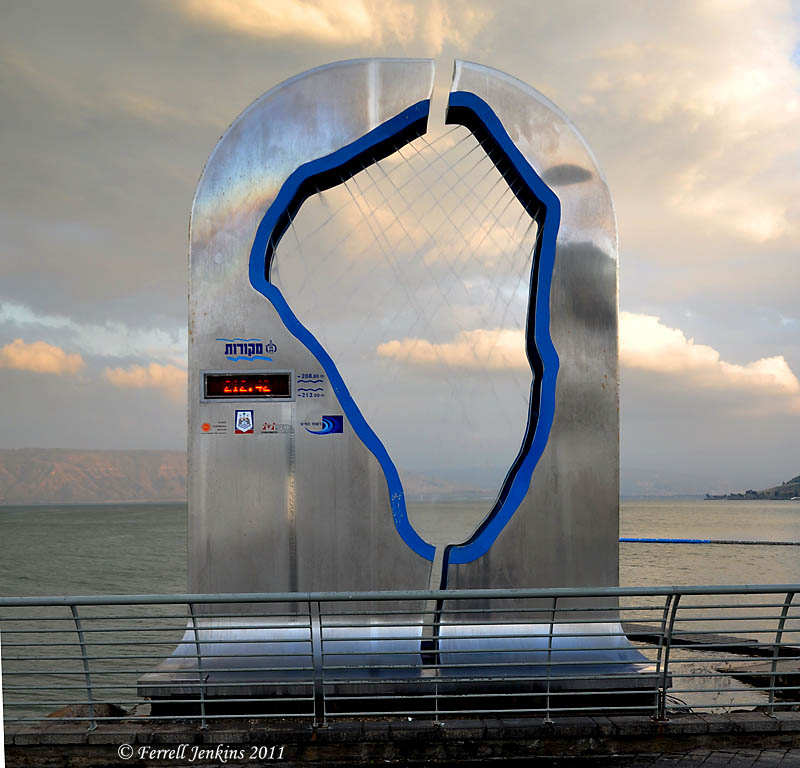
Indeed, the Sea level is higher. We reported December 11, 2009, that the level was 703,12 feet below Mediterranean sea level. In October , 2010, the level had risen to 701.71 feet below sea level.

Sea of Galilee guage, April 29, 2011. Photo by Ferrell Jenkins.

Sea of Galilee gauge, April 29, 2011 shows -212.42. Photo by Ferrell Jenkins.

After we returned to the hotel at Tiberias, I walked down to the pier to see the current measurement. The Sea was 212.42 meters below sea level (= 696.916 feet). The rise of the water is significant. The all time low is about 704 feet below sea level. The maximum former level is about 686 feet below sea level. Look carefully and you will see jets of water streaming through the Sea gauge.

Yesterday we stopped at Megiddo to look at the model of the city, but due to the rain we decided not to visit the tel. This afternoon we returned. The view of the Jezreel Valley was good.

And, there was more…

The missing luggage for our two wayward tour members was at the hotel when we returned.

We have several tour members from Alabama, Georgia, and Tennessee. Various ones were getting more reports of severe damage in their area back home, but none reported personal injury. For this we are thankful. The prayers of all spiritual persons is appreciated.

Jonah sailed from Joppa

Our group arrived in Israel today except for two persons who were delayed due to a bad weather connection in Detroit. Just learned a few minutes ago that they are on their way via Paris.

We had time to visit Joppa (Yafo) before proceeding to Netanya, along the Mediterranean coast, for overnight.

Joppa is located in the Plain of Sharon and served as the seaport for Jerusalem which is about 35 miles away. The city is now called Jaffa, or Yafo. Joppa was a walled town as early as the reign of Pharaoh Thutmose III (1490-1435 B.C.) who mentions Joppa in his town lists.

Here are a few of the biblical highlights for Joppa.

  • Joppa was assigned to the tribe of Dan, but was not controlled by the Israelites till the time of David (Joshua 19:46).
  • Hiram of Tyre floated cedar from Lebanon to Joppa for Solomon’s Temple (2 Chronicles 2:16).
  • Jonah sought a ship for Tarshish at Joppa to avoid going to Nineveh (Jonah 1:3).
  • Cedars from Lebanon again were floated to Joppa for the rebuilding of the temple (520-516 B.C.; Ezra 3:7). The port of the city is behind St. Peter’s Church.
  • Tabitha (Dorcas) lived in Joppa. When she died the disciples sent for Peter who was a Lydda. He came to Joppa and raised Dorcas (Acts 9:36-42). (Acts 10:6).
  • Peter stayed many days in Joppa with Simon the tanner (Acts 9:43). His house was by the sea (Acts 10:6). A house near the port is shown as the house of Simon, but there is no way to know this with certainty.
  • Peter received the housetop vision and learned that he was to go to Caesarea to preach the gospel to the Gentiles at the house of the Roman centurion Cornelius (Acts 10:23).

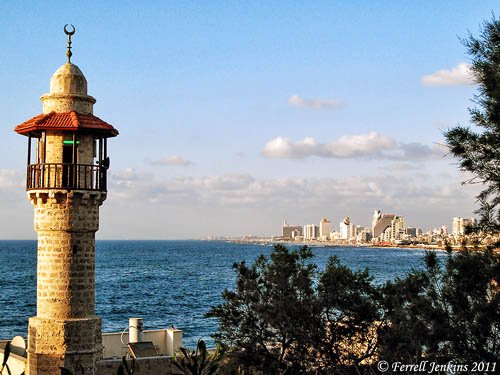
The photo below shows the view of modern Tel Aviv from Joppa. The minaret in the foreground dates to the Turkish period.

View of modern Tel Aviv from Joppa. Photg by Ferrell Jenkins.

View of modern Tel Aviv from Joppa. Photo by Ferrell Jenkins.

Jesus visited Bethany often

The crowds of pilgrims who had come to Jerusalem for Passover overloaded the system. Many of them likely slept in the open on the Mount of Olives and other places near the city. On Monday evening,

And he entered Jerusalem and went into the temple. And when he had looked around at everything, as it was already late, he went out to Bethany with the twelve. (Mark 11:11 ESV)

Luke tells us that it was His custom to do so.

And he came out and went, as was his custom, to the Mount of Olives, and the disciples followed him. (Luke 22:39 ESV)

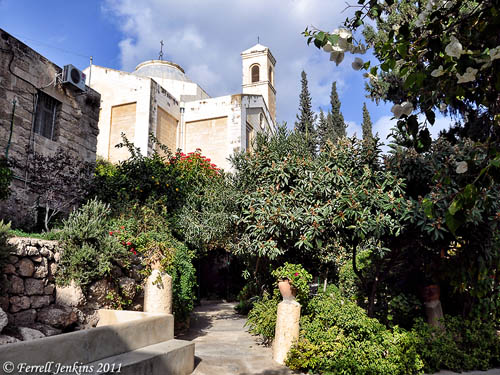
Bethany, the village of Mary, Martha and Lazarus (John 11:1), was located on the eastern slope of the Mount of Olives about two miles from Jerusalem (John 11:1, 18). The photo below shows the Church of St. Lazarus at Bethany. The walk from the main street goes through a pleasant garden. This was the Jerusalem-Jericho road before the building of the tunnel and the new highway.

Church at Bethany. Photo by Ferrell Jenkins.

Church at Bethany on eastern slope of Mount of Olives. Photo by Ferrell Jenkins.

Here on the eastern slope of Olivet we find the traditional tomb of Lazarus. In the time of Jesus the mountain was likely filled with olive trees.  Jerusalem may be seen only after one reaches the crest of the mountain.

Jesus also visited in the home of Simon the leper at Bethany, where a woman anointed his head with oil as He reclined at the table (Matthew 26:6-7).

Tradition places the ascension of Jesus on the top of the Mount of Olives, but Luke says it took place at Bethany (Luke 24:50-51).

Roman chariot races at Jerash

Several times in the past we have called attention to the RACE show at Jerash, Jordan. RACE stands for Roman Army Chariot Experience. The show is conducted in the Roman hippodrome at Jerash, one of the cities of the Decapolis in the time of Jesus.

Large crowds followed Him from Galilee, Decapolis, Jerusalem, Judea, and beyond the Jordan. (Matthew 4:25 CSB)

BBC News has posted a short video about the Roman chariot races and the Roman Army show. Click here to view.

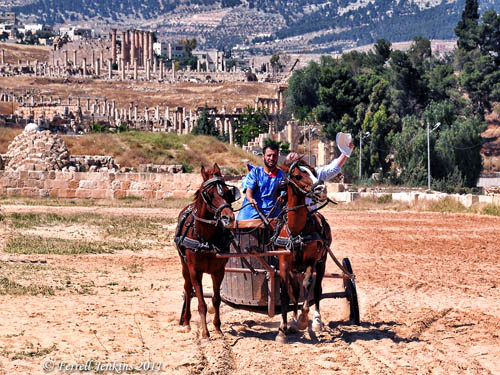
Our photo shows one of the tourists being taken for a wild ride after the show. It appears he may have lost his hair during the ride. Note the background of the ruins of Roman Jerash and the mountains of biblical Gilead.

Chariot Race in the Roman Hippodrome at Jerash. Photo by Ferrell Jenkins.

Chariot Race in the Roman Hippodrome at Jerash. Photo by Ferrell Jenkins.

Click on the photo for a larger image.

HT: Bible Places Blog.

Early morning view across the Sea of Galilee

The photo below shows an early morning scene across the Sea of Galilee from Tiberias. Perhaps we should say across “the Sea of Tiberias” as John does.

After these things Jesus went away to the other side of the Sea of Galilee (or Tiberias). (John 6:1 NAU)

After these things Jesus manifested Himself again to the disciples at the Sea of Tiberias, and He manifested Himself in this way. (John 21:1 NAU)

The view is from the Caesar hotel in Tiberias across the roof tops of some of the older buildings of Tiberias to the north east. The northern shore is clearly visible, as well as the area of biblical Bashan and of the Geshurites to the east (Joshua 12:5; 13:11).

NE view across the Sea of Galilee from Tiberias. Photo by Ferrell Jenkins.

NE view across the Sea of Galilee from Tiberias. Photo by Ferrell Jenkins.

The photo was made January 30, 2011, a time when the heavy clouds might be expected. Notice the shallow water in the lower right corner of the photo.

The mosaics of the Antakya Museum

Yesterday’s post about Antakya, Turkey (biblical Antioch of Syria, Acts 11), was highly popular. We had more than 1400 hits. Thanks for your interest. We hope you will find other entries of interest as well.

Take a look at the two good comments on the previous post. One from Balagebalogh calls attention to the mosaics from Antakya that are in the Baltimore Museum of Art and to his illustration of Antioch, and another from TBrinley calling attention to the mosaics in the Antakya Museum. I haven’t had the opportunity to visit the Baltimore museum, but I have been to the Antakya Museum a few times.

I thought I would share just one of the many mosaics displayed in the Antakya Museum. These mosaics typically date to the fourth or fifth century as I recall. (I am away from home and do not have access to my usual sources.)

Our photo shows a beautifully preserved mosaic displayed on a large wall. I am taking the liberty of copying info about it from Sacred Destinations, a site we have recommended before. Regarding this mosaic the site says,

Detail of mosaic from the floor of the 5th-century Bath of Apolausis, a small suburban bath uncovered in the Antioch excavations on the slopes of Mount Silpios, east of the city. The woman depicted in the middle is Soteria (Salvation) who formed a pair with Apolausis (Enjoyment). Soteria and Apolausis were minor deities who had the power to deliver people from danger and were popularly associated in late antiquity with baths, whose warm waters could give pleasure and soothe pain. Antakya Museum.

Antakya Museum mosaic displayed on wall. Photo by Ferrell Jenkins.

Antakya Museum mosaic displayed on wall. Photo by Ferrell Jenkins.

Beautiful, isn’t it? Turkey is filled with similar mosaics. I recall especially those from Zeugma displayed in the Gaziantep Museum.

Antioch of Syria, or is that Turkey?

Antioch of Syria on the Orontes River was founded by Seleucus I Nicator in 300 B.C. Antioch became a Roman city in 64 B.C. and capital of the new province of Syria. It became the third largest city of the Roman Empire after Rome and Alexandria.

After Jerusalem, Antioch was the second great center of Christianity in New Testament times and where the disciples of Christ were first called Christians (Acts 11:19-30; 13:1-3; 14:26-28; 15:1-41; 18:22-23; Gal. 2).

Antioch is now called Antakya and is part of the HatayProvince of Turkey, but is near the border with Syria. The area became part of Turkey in 1939.

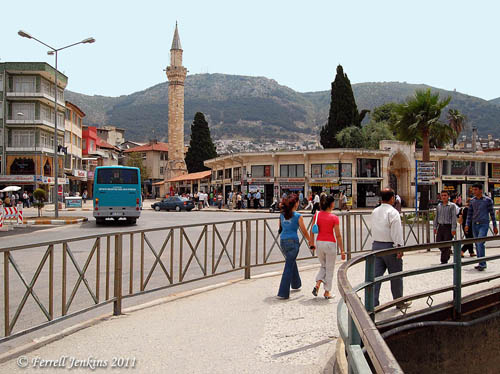
The photo below was made from the bridge crossing the Orontes River with a view east toward Mount Silipius. Click on the photo for an image suitable for use in presentations.

Antakya, Turkey. Antioch of Syria of the New Testament. Photo by Ferrell Jenkins.

View east toward Mount Silpius from the Orontes River. Photo by Ferrell Jenkins.

A church called the Cave Church of St. Peter honors Peter’s visit to the city (Gal. 2). This is a late Roman Catholic addition to the city, having become a Catholic church in 1946. Not the best choice, I think. Peter’s association with Antioch did not turn out too well. At first he ate with the new Gentile converts, but under pressure from James of Jerusalem played the hypocrite and withdrew from the Gentiles.

But when Cephas came to Antioch, I opposed him to his face, because he stood condemned. For before certain men came from James, he was eating with the Gentiles; but when they came he drew back and separated himself, fearing the circumcision party. And the rest of the Jews acted hypocritically along with him, so that even Barnabas was led astray by their hypocrisy. (Galatians 2:11-13 ESV)

I suggest you read Galatians 1 and 2, for a more complete account of this event.

From here the great journeys of Paul to take the Gospel to the Gentile world began (Acts 13:1-2).

Carchemish after a century

The ancient site of Carchemish was identified by George Smith in 1876, and later excavated by the British Museum beginning in 1911. The various directors included Hogarth, Thompson, Wooley, and Lawrence. Many remains of Assyrian and Neo-Hittite periods were uncovered.

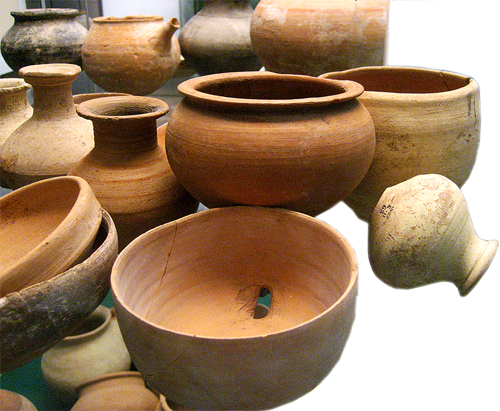
Surveys of the vicinity around Carchemish revealed tombs, pottery and weapons from the Middle Bronze Age. The photo shows one such collection displayed in the British Museum.

Pottery found near Carchemish between 1911-1914. Photo by Ferrell Jenkins.

Pottery found near Carchemish between 1911-1914. Photo by Ferrell Jenkins.

The sign that accompanies this display of pottery says,

During the course of the British Museum’s excavations at Carchemish in north Syria between 1911 and 1914, the field directors, Leonard Wooley and T. E. Lawrence, made regular visits to various sites in the vicinity. One such site was Amarneh and it was from here that Wooley acquired large numbers of objects which had been looted from the associated ancient cemetery. The majority of the finds, consisting of pottery vessels and metal weapons, date to the third and early second millennnium BC. Although it is impossible to reconstruct the early tomb groups, it is clear from Lawrence’s notes and sketches that they were large, collective chambers, lined and roofed over with stone slabs, each tomb containing several individuals and hundreds of pots.

The border between Syria and Turkey is now immediately south of Carchemish. The tell is now in Turkey.

New excavations at Carchemish

Carchemish is mentioned only a few times in the Bible, but it was one of the most significant cities in the ancient Bible world.

  • Isaiah made a reference to Carchemish (Isaiah 10:9). The city had been sacked by Sargon II in 717 B.C.
  • Pharaoh Necho of Egypt went up to Carchemish on the Euphrates to assist the Assyrians against the Babylonians in 609 B.C. (2 Chronicles 35:20; Jeremiah 46:2). King Josiah of Judah tried to stop him, but was killed.

One of the Babylonian Chronicles says that Nebuchadnezzar “crossed the river to go against the Egyptian army which lay in Carchemish.”

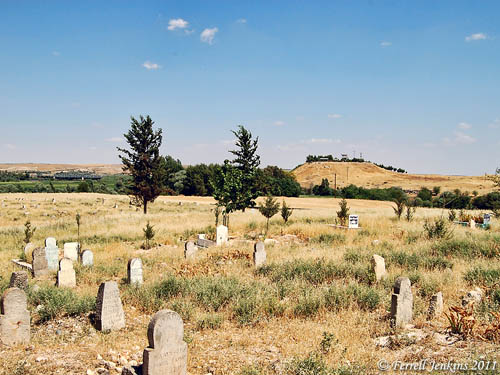
Our photo shows the tell in the distance. The tell is in Turkey today. In the far left of the photo you may see a bridge over the Euphrates River. The bridge crosses into Syria.

Cemetery at Carchemish, Tell in the distance. Photo by Ferrell Jenkins.

Cemetery at Carchemish, Tell in the distance. Photo by Ferrell Jenkins.

We are informed that a new excavation will begin at Carchemish this year. The area has been cleared of 1200 land mines. A few details, along with a photo of some of the land mines, may be viewed here.

HT: Bible Places Blog.