Category Archives: Bible Places

The diolkos of ancient Corinth

Surely a greater percentage of tourists who have visited ancient Corinth have stopped at the Corinth Canal for a photograph. The canal was constructed between 1881 and 1893. A much smaller number probably recall that there was an ancient paved road, called the diolkos, on which smaller boats could be dragged across the isthmus.
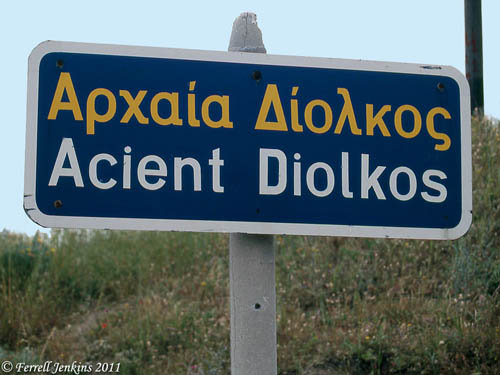
Ancient Diolkos Sign. Photo by Ferrell Jenkins.

Ancient Diolkos Sign. Photo by Ferrell Jenkins.

Pettigrew (Corinthian Matters) says that Strabo uses the term diolkos of the narrow land strip, rather than a physical road.

Interestingly, the modern use of the term “diolkos“ is one of the great misnomers of modern scholarship.  Strabo uses the word in a geographic sense to describe a land strip visible from Acrocorinth and equivalent to the narrowest part of the Isthmus.  No one in antiquity associated the term with the physical road.
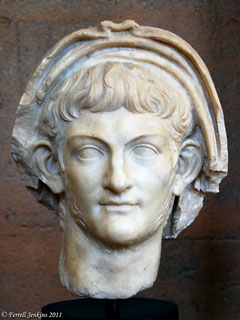
Bust of Neo. Corinth Museum. Photo by Ferrell Jenkins.

Bust of Neo. Corinth Museum.

The cargo of larger ships was unloaded and carried across the isthmus and reloaded. Ships that could be dragged across the land bridge avoided the 200 mile journey around the Peloponnesus. Nero abandoned his attempts to dig a canal across the isthmus in A.D. 67. Josephus records that 6,000 of the strongest men involved in the Galilean revolt were sent to Nero, “to dig through the Isthmus [of Corinth]” (JW. 3.540).

David Pettigrew recently spent two days touring the diolkos. He includes some nice photos (here) that are large enough for use in presentations. He also includes a plan allowing identification of each photo.

Yesterday I received a new scanner and decided to pull out my old slides of the diolkos. The date is so faded on the slide frame that I am unable to read it. I think the photos were made in the early 1970s. Compare this will Pettegrew’s recent (first) photo of the same area.
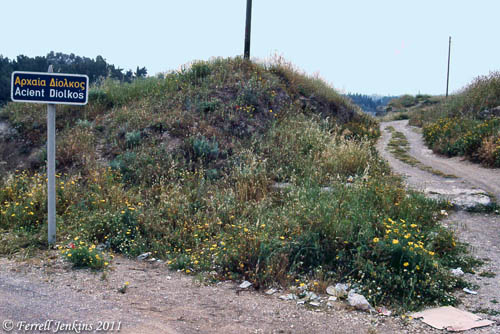
Diolkos Sign and a portion of Sector G. Photo by Ferrell Jenkins.

Diolkos Sign and a portion of Sector G. Photo by Ferrell Jenkins.

Here is a closer view of the same sector. In Pettegrew’s photos this area has been cleared of dirt to show more of the paving.
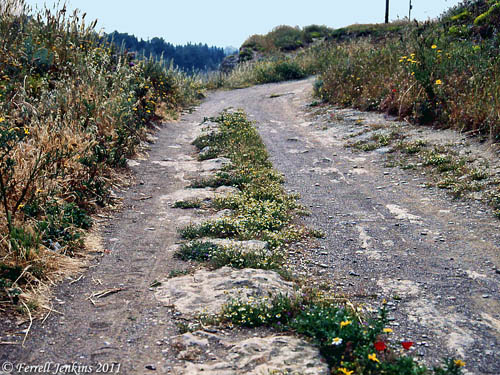
Diolkos Sector G. Photo by Ferrell Jenkins in 1970s..

Diolkos Sector G. Photo by Ferrell Jenkins in the 1970s.

Below is my photo of Sector E from the early 1970s. Compare with Pettegrew’s photo (which appears to have been made earlier than his other photos). Leon Mauldin has a photo made in early 2010 here.
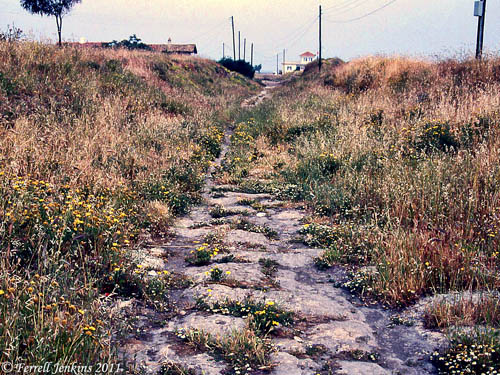
Diolkos - Sector E in the 1970s. Photo by Ferrell Jenkins.

Diolkos - Sector E in the 1970s. Photo by Ferrell Jenkins.

Dr. Pettegrew was able to visit Sector K, the only section on the north side of the Corinth canal. His post documents the damage being done to the diolkos by ships passing through the Corinth canal. In addition to the new photos here, he has a section dealing with the diolkos under the heading Isthmus.

The diolkos was in use during the time Paul was at Corinth. The commercial benefit to Corinth, as well as to the port cities of Lechaion and Cenchrea, was significant.

And he stayed a year and six months, teaching the word of God among them. (Acts 18:11 ESV)

In addition to the video’s at Corinthian Matters, there is one here featuring comments by Sophia Loverdou.
Continuing dispute over the Mughrabi Bridge

For many years visitors to the Western Wall in Jerusalem were able to climb the earthen ramp up to the Mughrabi Gate and enter the Temple Mount platform. In biblical times the temple of Solomon was located there, then the rebuilt temple of Zerubbabel after the return from Babylonian captivity, and then Herod’s Temple. Today this is where we find the Mosque of Omar (commonly called the Dome of the Rock) and the Al Aska Mosque.

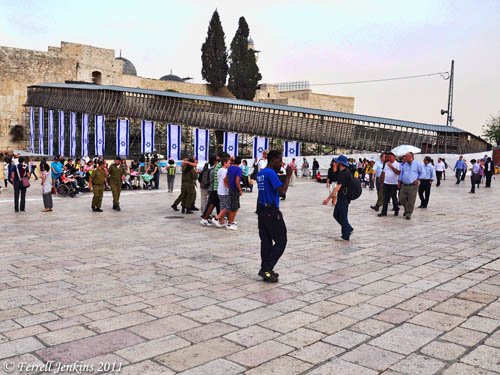
Israel built wooden bridge from the Western Wall Plaza to the Temple Mount platform and excavated the earthen ramp. This has become a controversial diplomatic issue. Itamar Eichner reports in Ynet here.

A diplomatic crisis is brewing between Israel and Jordan over the planned renovations of the Mughrabi Gate Bridge, Yedioth Ahronoth reported Monday.

Plans for razing the old Mughrabi Gate bridge, which leads from the Western Wall plaza in Jerusalem to the to the al-Aqsa Mosque and Temple Mount, in favor of a new one have been in the works for a while. According to the report, the bridge was to be torn down next week, but upon signing the final agreement, Israel was stunned to learn that Jordan, along with Egypt, Iraq and Bahrain, filed a complaint against Israel with the United Nations Educational, Scientific and Cultural Organization (UNESCO) over the planned renovations. The motion asks for a UNESCO censure of Israel. Jordan is also demanding that UNESCO order Israel to stop the archeological excavations in the Old City.

This photo of the bridge was made in early May.

Mughrabi Bridge from the Western Wall Plaza. Photo by Ferrell Jenkins.

Mughrabi Bridge from the Western Wall Plaza. Photo by Ferrell Jenkins.

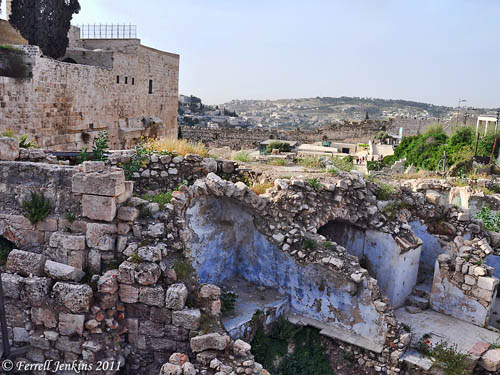
We know that the level below the bridge, both north and south, is from the first century. Here is the view from the bridge looking down on the former earthen ramp.

Excavation below Mughrabi Gate Bridge. View to the south. Photo by Ferrell Jenkins.

Excavation (or clean up?) below Mughrabi Gate Bridge. View to the south. Photo by Ferrell Jenkins.

I have no specific knowledge about the dating of these ruins, but I would venture to say that they are later than the 7th century A.D. Perhaps a reader can help.

Update. After completing this post last evening, I was looking at the Bible Places Blog and noted that Todd Bolen has written about this bridge. He has given links to the background of the controversy and posted some photos. Check here.

Ha’aretz has two more articles for those who are interested in the far-reaching repercussions over what happens in Jerusalem. Check here and here.

HT: Joseph Lauer

Comments on the detestable shepherds in Egypt

A few days ago we wrote in response to the question, “Why were shepherds detestable to Egyptians?”

We get more comments on the posts at Facebook than on the blog itself. Often I wish the (serious) comments were added here. I am going to share some comments made on this post. Christine, a regular reader of the blog and a friend from church, wrote:

“the cattlemen and the sheep herders of the American west were at odds, and I have read that sheep eat roots and all of the grass, ruining the grazing for cattle…could have an economic basis. And I could be wrong.”

Mark T., former student, wrote: “I learned that from reading cowboy books as a teenager. :-) ” [During class? FJ]

Mark B., former tour member, wrote:

“I never thought about the animosities between cattlemen and sheep herders here in the old west and how the sheep tear up the good grass if left to graze too long in one spot. What a great point!”

Listening to the sound tract of Oklahoma would give a tip about the conflict between the cowmen and the farmers. I think the point about the cattlemen and the farmers is a great one to show the conflict that often exists in a society.

However, we must not overlook the point made by John T. Willis that the term livestock includes cattle, sheep, goats, etc. Note the comment.

John T. Willis points out that the term livestock (or cattle; Hebrew, miqneh) is “a comprehensive term including cattle, sheep, goats, and the like” (Genesis in The Living Word Commentary on the Old Testament).

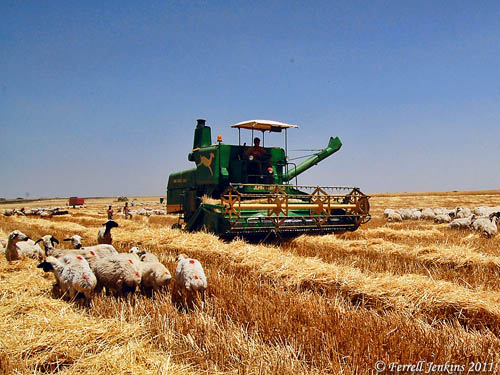
It is common in the Middle East for shepherds to take sheep into a grain field as soon as the harvesting is complete. This could be a real problem if cattle of any kind got into the fields in advance of harvesting. Remember that fences are virtually unknown there.

This photo is one I made in eastern Turkey north of Sanliurfa (and Haran). Even before the combine gets out of the field the shepherds are there with their sheep.

Sheep grazing as a field is being harvested. Photo by Ferrell Jenkins.

Sheep grazing in Eastern Turkey as a field is being harvested. Photo by Ferrell Jenkins.

Recently we posted a photo of sheep grazing in a field that had been harvested in the Shephelah of Israel here.

Searching for info on David (or other Bible characters)

A former student left a comment at another place on this blog:

I’ve been enjoying your blog and the pictures! What a blessing that you’ve been able to travel to all these places and then share that info with those of us who have never been! I’m looking for some information about David for teaching 7th-8th graders and was wondering if you could direct me to where to look on your blog or website. I wanted to be able to show them some ancient historical evidences. Also, may I have permission to use some pictures as visual aid in the classroom? Thank you!

Always nice to hear from former students and friends.

First, regarding permission. You certainly have permission to use any of this material in Bible classes as long as the credit line is maintained. I am honored and delighted that you find the material helpful.

Locating material on David (or anyone else, or any place). The search box on the blog is not the greatest in the world, but it can be helpful. Just put the word David in the search box. It is true that you may get a mention of some other person named David, but I think you will find it helpful. Also try Saul, Elah, Kiriath (as in Kiriath Jearim), En Gedi, stronghold, Ziklag, Bethlehem, Jerusalem, or any other person or place you are studying about. We certainly haven’t covered every Bible character or place, but we have covered a lot in past four years.

Also take a look at the Biblical Studies Info Page. Look under Scholarly, then Photos and Art, for photo sources. I think every church should have the collection of photos from Bible Places. Good photos can be found at Holy Land Archives, and Bible Land Photographs.  Also check the Maps of Bible Lands category. Bible Atlas is especially helpful in identifying the places associated with David (or any other Bible character).

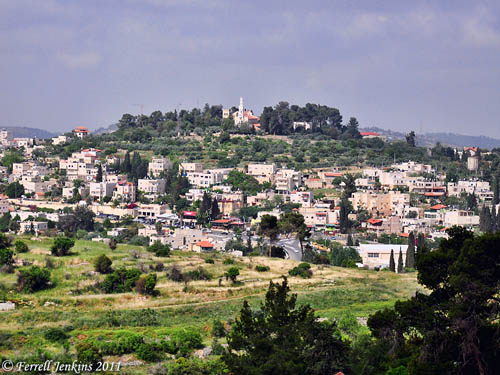
I am including a recent photo of Abu Ghosh and the site of biblical Kiriath-jearim (or Kiriath Jearim). The view is to the west.

Abu Ghosh and the site of Kiriath Jearim. This is where the Ark of the Covenant rested for 20 years until David took it to Jerusalem. Photo by Ferrell Jenkins.

Abu Ghosh and the site of Kiriath Jearim. This is where the Ark of the Covenant rested for 20 years until David took it to Jerusalem. Photo by Ferrell Jenkins.

Kiriath-jearim’s highest honor is in the association with the ark of the covenant. The Israelites took the ark from the tabernacle at Shiloh to the battle field at Ebenezer when they were fighting with the Philistines (1 Samuel 4). The ark was captured by the Philistines and taken to Ashdod, then to Gath, and finally to Ekron before they decided to get rid of it. The ark was returned to Beth-shemesh (1 Samuel 4-6).

The men of Beth-shemesh sent messengers to the residents of Kiriath-jearim asking them to come and take the ark to their town. The ark was brought into the house of Abinadad on the hill. His son, Eleazar, was consecrated by the men of the city to keep the ark of the LORD. The ark remained there for many years until David had it brought to Jerusalem (1 Samuel 6:21-7:2; 2 Samuel 6).

Check Bible Atlas here for maps showing Kiriath-jearim.

Why were shepherds detestable to Egyptians?

A readers asks about Joseph’s instruction to his family when they moved to the land of Goshen in Egypt.

“When Pharaoh calls you and says, ‘What is your occupation?’ you shall say, ‘Your servants have been keepers of livestock from our youth even until now, both we and our fathers,’ that you may live in the land of Goshen; for every shepherd is loathsome to the Egyptians.”  (Genesis 46:33-34 NAU)

Why was every shepherd loathsome (an abomination, disgusting, abhorrent, detestable) to the Egyptians. Here are some suggestions.

G. J. Wenham says,

Shepherds are detestable to the Egyptians probably reflects a common distrust of nomadic peoples by urban dwellers (cf. attitudes to gypsies and ‘travellers’ in modern society). (The New Bible Commentary)

The IVP Bible Background Commentary says,

It is unlikely that native Egyptian herdsmen would be detested by other Egyptians. Joseph’s advice to his father is both a warning about Egyptian attitudes toward strangers and a piece of diplomacy in that they would claim independent status (they had their own herds to support them) and show they were not an ambitious group who wished to rise above their occupation as shepherds.

Derek Kidner likes the explanation of J. Vergote:

A more likely explanation is that of J. Vergote, that this is only the perennial antipathy of the town-dweller for the nomad or the gipsy [gypsy]. Joseph saw the importance of emphasizing this, to ensure that Pharaoh’s goodwill would be to the family’s real benefit, not to their detriment by drawing them into an alien way of life at the capital. ( Tyndale Old Testament Commentaries)

Howard Vos says,

The reason for Joseph’s concern was that Egyptians considered shepherds an abomination. Settlement in Goshen would separate them from the Egyptian cattlemen of the Nile Valley and thus reduce friction with Egyptians and preserve their distinctiveness as a people. (Genesis in Everyman’s Bible Commentary)

John T. Willis points out that the term livestock (or cattle; Hebrew, miqneh) is “a comprehensive term including cattle, sheep, goats, and the like” (Genesis in The Living Word Commentary on the Old Testament).

The biblical Land of Goshen, where Israel settled, is the eastern portion of the Nile Delta. This was the home of the Israelites for many years.

Joseph went and told Pharaoh, “My father and brothers, with their flocks and herds and everything they own, have come from the land of Canaan and are now in Goshen.” (Genesis 47:1 NAS)

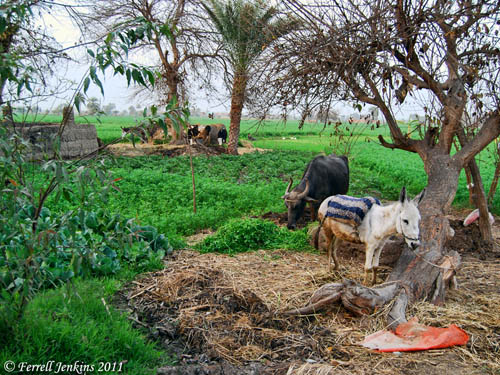
A typical scene in the Eastern Nile Delta. Photo Ferrell Jenkins.

A typical scene in the Eastern Nile Delta near Tel Daba. Photo Ferrell Jenkins.

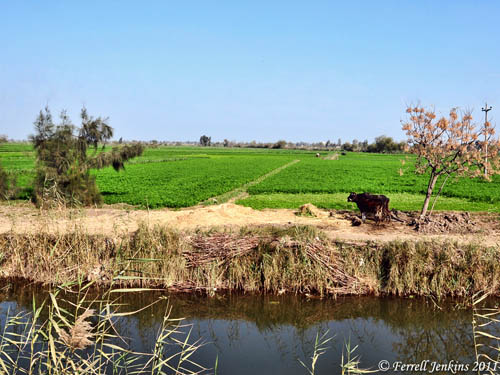
To think of the stereotypical view of Egypt as a pyramid in the desert is to misunderstand the area where Israel settled.  Goshen is a flat, fertile, area, situated along the Pelusiac branch of the Nile River. That branch has now been replaced by a canal that runs generally along the same course. Cattle, including sheep, are common in the Eastern Nile Delta today. The canal in the photo below is one of the numerous smaller canals providing water to the farm land of the region.

The land of Goshen near ancient Tanis. Photo by Ferrell Jenkins.

The land of Goshen between ancient Tanis and Tel Daba. Photo by Ferrell Jenkins.

I enjoy the vividness of The Five Books of Moses by Everett Fox. Fox translates Genesis 46:34 as follows:

Then say: Your servants have always been livestock men, from our youth until now, so we, so our fathers—
in order that you may settle in the region of Goshen.
For every shepherd of flocks is an abomination to the Egyptians.

This will give you something to consider. Hopefully it will be helpful. We have mentioned Goshen several times in this blog. Put the word goshen in the search box to locate them.

Abraham at Beersheba (Beer Sheba)

Bible students associate the town of Beersheba (Beer Sheba; Be’er Sheva) with the patriarch Abraham (Genesis 21-22).

  • The first reference to Beersheba is when Abraham sent Hagar and Ishmael to wander in the wilderness of Beersheba (21:14). This is the region known as the Negev.
  • Abraham dug a well and called the place Beersheba (21:30-31). Abraham and Abimelech, the king of Gerar, made a covenant. Abraham presented seven ewe lambs to Abimelech. The name Beersheba means “the well of the seven.”
  • Abraham planted a tamarisk tree at Beersheba and called upon the name of the LORD, the Everlasting God (21:33).

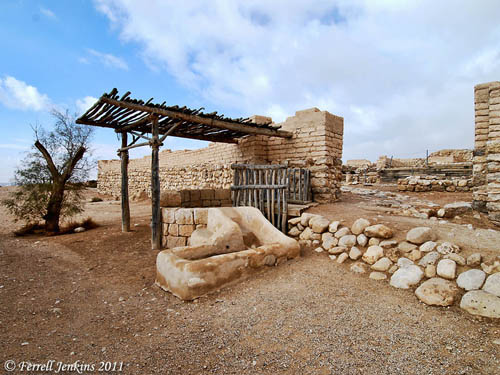
Archaeological excavations were conducted at Tel Beersheba by Tel Aviv University Institute of Archaeology under the direction of Yohanan Aharoni (1969-1973). The excavation indicated that there was no city at the site before the Iron Age. The outer gate of the reconstructed Iron Age city, an older well, and a tamarisk tree, in the photo below, serve as a reminder that Abraham lived in this general vicinity.This tamarisk tree has been cut back and is putting out fresh branches.

Abraham planted a tamarisk tree at Beersheba, and there he called on the name of the LORD, the Everlasting God. (Genesis 21:33 NAU)

The outer gate, well, and tamarisk tree at Tel Beersheba. Photo by Ferrell Jenkins.

The outer gate, well, and tamarisk tree at Tel Beersheba. Photo by Ferrell Jenkins.

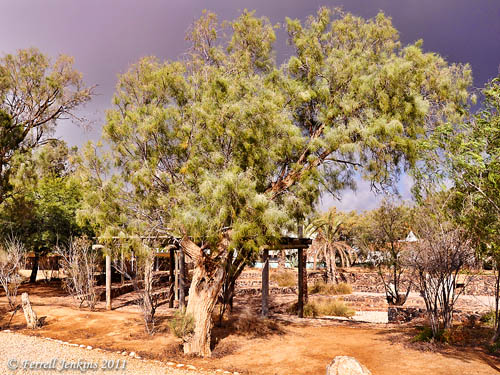
The Negev is suitable for the tamarisk tree. Here is a larger tamarisk at the entry to the site. This photo was made in the month of December. Heavy clouds are visible to the west.

Tamarisk trees at Tel Beersheba. Photo by Ferrell Jenkins.

Tamarisk trees at Tel Beersheba. Photo by Ferrell Jenkins.

Fauna and Flora of the Bible describes the tamarisk this way:

The Tamarisk is a small, fast-growing tree with durable wood, to be found abundantly in deserts, dunes and salt marshes.

Tamaris Aphylla is leafless and has green branches and a wide crown. It has small white flowers, and its fruit is a capsule with feathery seeds. (p. 182)

Photos suitable for use in teaching are available by clicking on the images above.

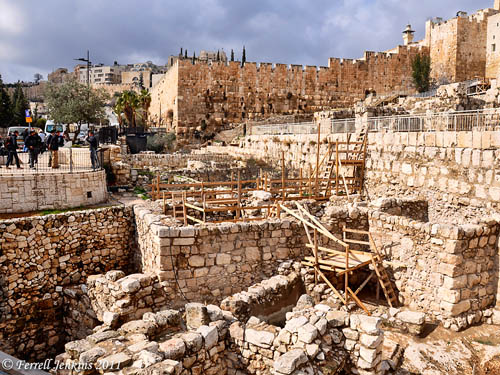
More on the Ophel City Walls site

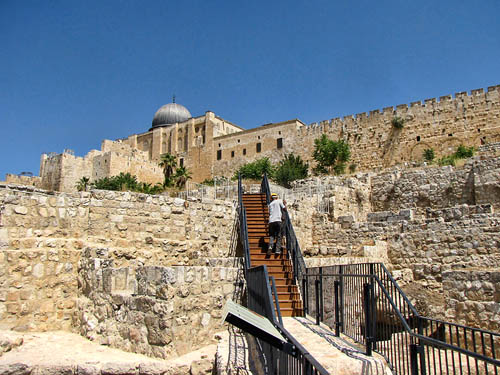
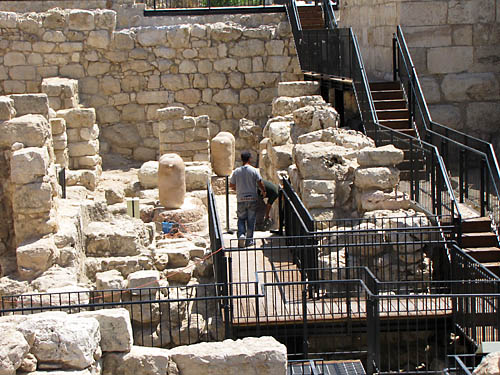
The Israel Antiquities Authority provided several good photos of the Ophel City Walls site. I thought this was an especially nice photo. The view from the site looks at the new steps leading to and from the excavation. The southern wall of the temple mount enclosure is visible in the distance.

Ophel city walls site. Photo: IAA

Ophel City Walls site. Photo: Israel Antiquities Authority.

Leen Ritmeyer provides insight into the excavation dating back to the mid-1970s when he supervised some of the excavations under the direction of Prof. Benjamin Mazar. Take a look here.

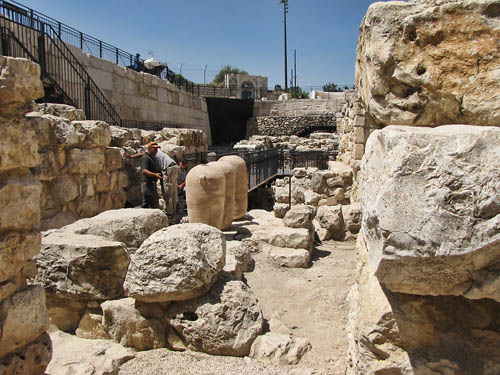
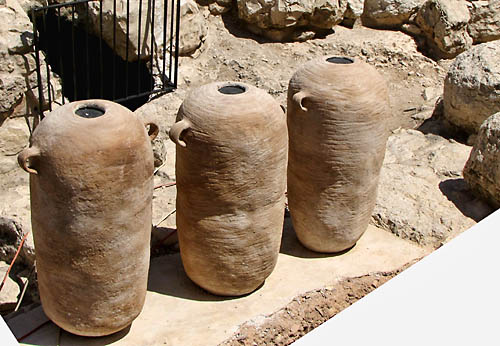
The next photo shows workmen putting the finishing touches on some of the stones. Three pithoi are visible. The view is toward the southwest.

Ophel City Wall site. Photo: Israel Antiquities Authority.

Ophel City Wall site. Photo: Israel Antiquities Authority.

Ophel City Walls site opened in Jerusalem

The Israel Antiquities Authority announced the opening today of what is being called the First Temple Period Ophel City Walls Site in the Walls Around Jerusalem National Park.

In a festive ceremony that was held Today – Tuesday, June 21, 2011, the Ophel City Wall site, a complex of buildings uncovered along the route of the fortifications from the First Temple period (tenth-sixth centuries BCE), and the display of the earliest written document ever uncovered in Jerusalem was inaugurated. The opening of the site, located in the Walls Around  Jerusalem National Park, and the exhibit in the Davidson Center are made possible through the generous donation by Daniel Mintz and Meredith Berkman.

Upon completion of the excavation and conservation work at the Ophel City Wall site, visitors will now be able to touch the stones and walls whose construction tells the history of Jerusalem throughout the ages.  It is now possible to walk comfortably through the built remains, in places that were previously closed to the public, to sense their splendor and learn about the history of the region by the signage and the different means of presentation and illustration.

This photo shows construction work in the area a few months ago.

Ophel First Temple Site during construction of park. Photo by Ferrell Jenkins.

Ophel First Temple Site during construction of park. Photo by Ferrell Jenkins.

Here is a more recent view showing workmen putting final touches on the nice stairs and overviews for those who enter the site through the Davidson Center.

Ophel Site Park. IAA.

Ophel Site Park being prepared for opening. Photo: Israel Antiquities Authority.

The IAA news release continues,

The architecture at the site that was exposed includes an impressive building thought to be a gate house, a royal edifice, a section of a tower and the city wall itself. Dr. Mazar suggests identifying the buildings as part of the complex of fortifications that King Solomon constructed in Jerusalem: “…until he had made an end of building his own house, and the house of the Lord, and the wall of Jerusalem round about” (1 Kings 3:1). In addition to the fortifications of the First Temple period, sections of the Byzantine city wall and two of its towers were exposed. This wall was built at the initiative of the Byzantine empress Eudocia in the fifth century CE. In addition to the complex of fortifications, the excavation of two rooms from the Second Temple period (first century CE) was completed, which were preserved to a height of two stories.

The highlight of the excavations is the complete exposure of the gate house. The plan of this impressive building includes four rooms of identical size, arranged on both sides of a broad corridor paved with crushed limestone. The plan of the gate house is characteristic of the First Temple period (tenth-sixth centuries BCE) and is similar to contemporaneous gates that were revealed at Megiddo, Be‘er Sheva’ and Ashdod. The excavator, Eilat Mazar, suggests identifying the gate house here with the ‘water gate’ mentioned in the Bible: “…and the temple servants living on Ophel repaired to a point opposite the Water Gate on the east and the projecting tower” (Nehemiah 3:26). The ground floor of a large building that was destroyed in a fierce conflagration can be seen east of the gate. Mazar suggests that this structure was destroyed by the Babylonian conquest of the city in 586 BCE. Twelve very large, clay store jars (pithoi), which probably contained wine or oil, were discovered on the floor of the building. Engraved on the shoulder of one of these pithoi is the Hebrew inscription “לשר האו…”. The inscription indicates that this pithos belonged to one of the kingdom’s ministers, perhaps the overseer of the bakers.

This photo shows (replicas of?) some of the pithoi on display at the site.

Pithoi displayed at the Ophel Site. Photo: Israel Antiquities Authority.

Pithoi displayed at the Ophel Site. Photo: Israel Antiquities Authority.

A fragment of a clay tablet written in Akkadian cuneiform script was discovered in the recent re-excavation of the area by Dr. Mazar. The tablet is typical of those “used in antiquity throughout Mesopotamia for international correspondence.”

Analyses of the writing and the clay used to produce the tablet show that the document originated in the Jerusalem region. It seems that it is a copy of a letter that the king of Jerusalem at the time, Abdi-Heba, sent to the king of Egypt. It was customary that a copy of this correspondence would be kept in the archives of the city Salem, which was Jerusalem in that period. The fragment of the tablet constitutes credible evidence of the status of Jerusalem as an important royal city in Canaan, which was administered as a city-state under the auspices of the pharaonic Egypt kingdom.

We have posted info about the first temple period (suggested) gate and wall here, and about the clay tablet earlier here and here.

The site also may be viewed from Ma’aleh Ha-Shalom Street a short distance east of Dung Gate.

HT: Joseph Lauer

Hezekiah’s Pool – a modern garbage dump

Ha’aretz reports on the political “garbage” associated with an effort to clean up Hezekiah’s Pool in the Old City of Jerusalem.

After years of neglect, Hezekiah’s Pool in the Old City of Jerusalem is finally being cleaned up. The work is being done by the Jerusalem Municipality, the Environmental Protection Ministry and Jerusalem Development Authority. As with anything in Jerusalem, the cleanup may cause a diplomatic crisis with Egypt and Jordan – and a conflict with the Waqf Muslim religious trust and the Coptic Church.

Hezekiah’s Pool, also known as the Pool of the Pillar, is located in the Christian Quarter, not far from Jaffa Gate. It is ancient and covers over three dunams (three-quarters of an acre ). But it is completely hidden from the public, with stores and homes surrounding it. Thousands of tourists coming through the gate and the Arab market pass right by it without having a clue that the historic site is nearby.

The pool was used at least from Second Temple times and was an important part of Jerusalem’s ancient water system until the 19th century.

However, over recent decades, the pool became an unofficial garbage dump for neighborhood residents, who used it to dispose of tons of trash.

In winter, water still collects there, and some Christian Quarter residents use parts of the ancient water system as an improvised sewage system.

Hezekiah’s Pool has turned into a serious health hazard in a densely populated area.

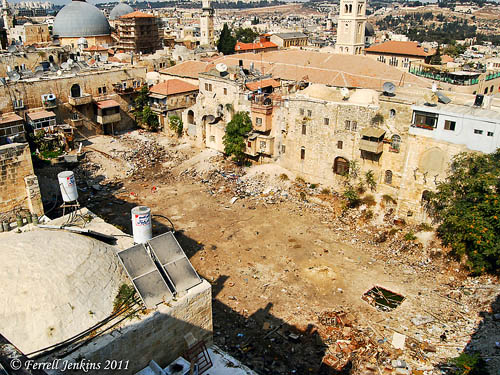
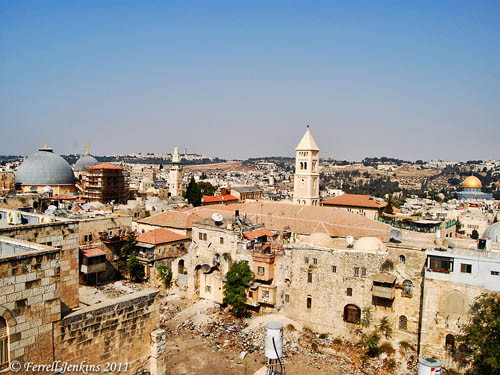
I think the last time I asked permission to go to the roof of the Petra Hotel to make a photo of Hezekiah’s Pool was in September, 2008. At that time the cleanup had already begun. The previous time I viewed the pool it was much more trashy. This pool is just a short distance from Jaffa Gate. Note the proximity of the Pool to the Church of the Holy Sepulchre and the Lutheran Church tower.

Hezekiah's Pool from roof of the Petra Hotel. Photo by Ferrell Jenkins.

Hezekiah's Pool from roof of the Petra Hotel. Photo by Ferrell Jenkins.

The next photo provides more perspective. You can see the pool in the bottom of the photo. In the middle of the photo (top to bottom) you can see the dome of the Church of the Holy Sepulchre (left), the Lutheran Church tower (just right of center), and the Dome of the Rock (right). In the distance to the east is Mount Scopus (left) and the Mount of Olives.

Hezekiah's Pool in the Christian Quarter of Jerusalem. Photo by Ferrell Jenkins.

Hezekiah's Pool in the Christian Quarter of Jerusalem. Photo by Ferrell Jenkins.

Jerome Murphy-O’Connor describes Hezekiah’s Pool.

This great reservoir is entirely surrounded by buildings, and is accessible through the Coptic Khan…. At present the dry pool is used as a rubbish dump by the dwellings which surround it on all sides, but a much needed restoration project is on the drawing board. — The Holy Land

Murphy-O’Connor says the pool “is thought to date from the Herodian period when it was fed by an aqueduct (visible outside Jaffa Gate) coming from Mamilla Pool.” He says Josephus mentions the pool under the name Amygdalon (Almond Tree) (War 5:468). He says this name, Amygdalon, is probably a deformation o f the Hebrew migdal (tower). The reference is to the towers of Herod’s palace.

Israel Antiquities Authority announced in February, 2010, the discovery of the high-level aqueduct that brought water into Hezekiah’s Pool in the Roman City of Jerusalem. See our earlier comments here.

The complete Ha’aretz article may be read here. An aerial view of this area is available here.

P.S. You know the pool has nothing to do with Hezekiah, don’t you?

HT: Joseph Lauer

A new tomb at Nazareth Village

Nazareth Village has become a necessary stop on my tours to Israel. The eyes of ministers and Bible class teachers are opened quickly to the reality of Bible stories. Some of the “exhibits” change with the season; others remain constant.

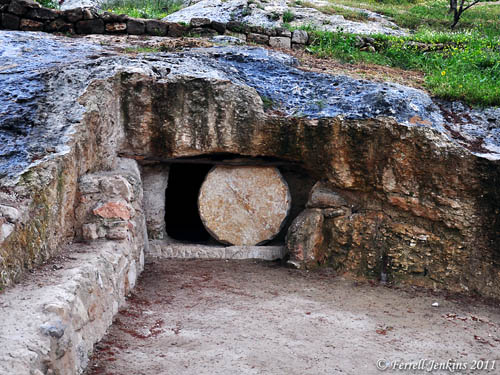
There was something new at Nazareth Village this year — a tomb cut out of the rock with a rolling stone.

New tomb with rolling stone at Nazareth Village. Photo by Ferrell Jenkins.

New tomb with rolling stone at Nazareth Village. Photo by Ferrell Jenkins.

This new tomb “where no one had yet been buried” is a good reminder of the type of tomb in which Jesus was buried (John 19:41 NET).

After Joseph bought a linen cloth and took down the body, he wrapped it in the linen and placed it in a tomb cut out of the rock. Then he rolled a stone across the entrance of the tomb.  (Mark 15:46 NET)

An image suitable for use in teaching is available by clicking on the photo above.