Category Archives: Bible Places

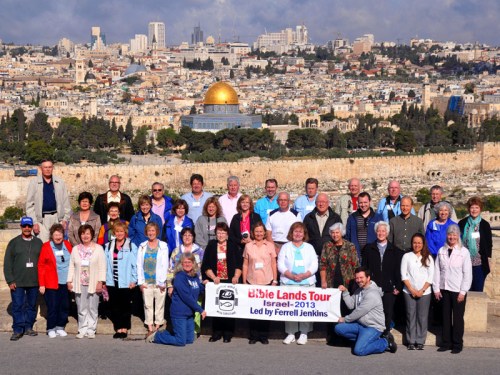
The 2013 group in Jerusalem

It is traditional for groups to have a photo made on the Mount of Olives with a view of Jerusalem in the background. I like the tradition, so I try to do that each time I bring a group to Israel.

Here is the photo we made this morning. You may click on the photo for a larger image.

Jenkins Bible Land Group - Jerusalem - April 22, 2013.

Jenkins Bible Land Group – Jerusalem – April 22, 2013.

In addition to the Mount of Olives, we visited the Garden of Gethsemane on the western slope of the Mount of Olives. After that we made our way to the Christian Quarter of the Old City to visit the Church of the Holy Sepulcher. A local lunch was enjoyed in the Old City.

In the early afternoon we went to the Israel Museum. There were three major things to see there:

  1. The Second Temple Model of Jerusalem.
  2. The Shrine of the Book.
  3. The Israel Museum. We visited the Herod the Great: the kings final journey exhibit as well as the archaeology section of the Museum.

There was time enough to go to Bethlehem to visit the Church of the Nativity, and to do some shopping at the Kando shop.

Everyone in our group seems to be staying well. For this, we are thankful.

A pleasant stop in Samaria

It was still raining quite a bit in the north of the country yesterday, but we enjoyed some good visits. The morning was clear for the visit to Beth Shean (Beth-shan). We approached the overlook of the Jezreel Valley from Jezreel in a light drizzle.

From that spot one gets a view of Jezreel Valley, Mount Gilboa, the Hill of Moreh, and the spring below Jezreel. We discussed Gideon and the Midianites, the Ahab and Jezebel and their deaths, Naboth’s Vineyard, Elijah and the prophets of Baal, the coming of Jehu. What a great visual backdrop this provided!

We were able to travel along the central mountain range through Samaria. This is not always possible when traveling in the country. The road up to the Hill of Samaria is in bad repair (what a shame), but our driver was able to negotiate the ruts and get us to the top.

I have eaten several times before at the Samaria Restaurant in Sebastia. It is located across from the Roman agora of ancient Samaria. The owner, Mahmud Ghazal is a pleasant person. He studied at the University of Alabama, with a degree from UAB. If you are able to go to Samaria I suggest you try this restaurant, and then visit his shop.

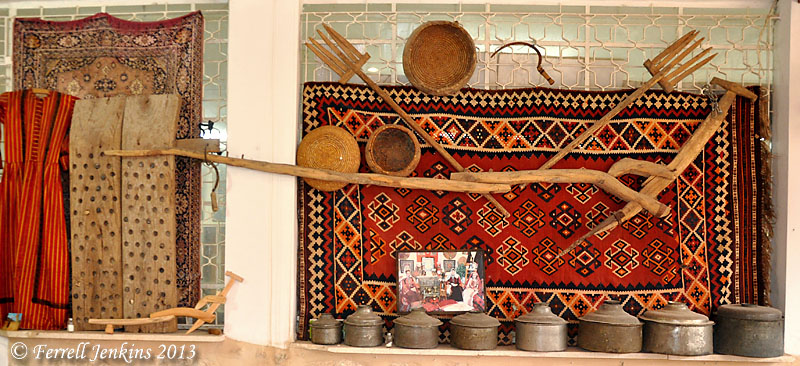
There is a nice wall exhibit in the restaurant showing some of the antiques from the area – from the not too distant past. Take a look.
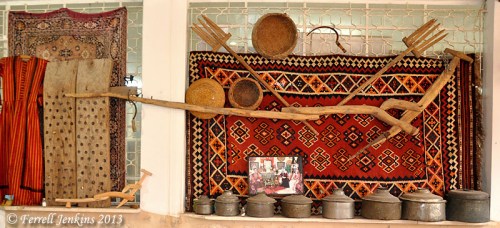
Antiques at the Samaria Restaurant, Sebastia, Palestine. Photo by Ferrell Jenkins.

Antiques at the Samaria Restaurant, Sebastia, Palestine. Most of these have to do with agricultural practices. Photo by Ferrell Jenkins.

Most of these antiques have to do with agricultural practices that were common in Bible times. On the right you have a wooden plow with a metal plow point. On the left is a threshing sledge. On the right you see two winnowing forks and a sickle. I don’t have the time to list biblical references for all of these items. Many of them we have discussed before on this blog.

The rain let up long enough for us to have a good visit of the archaeological ruins of ancient Samaria.

We also stopped at Jacob’s Well, drove up on Mount Gerizim for a view of the area below. Then we continued to our hotel in Jerusalem.

Rain was forecast for Jerusalem today, so we went through the Wilderness of Judea and drove along the Dead Sea to Masada. There were large crowds at Masada. Some of them probably had the same idea we did and changed their plan to be in a dry place for the day.

Hopefully the skies will be clear tomorrow. We are having a great learning experience, and a great time, anyway.

Rainy days in Galilee

We visited the area north of the Sea of Galilee today. Gentle rain was still falling when I first looked out at the Sea of Galilee this morning. By the time we reached Hazor the weather had cleared and we had a bright and sunny visit. A light rain fell at Dan, but at Caesarea Philippi there was a downpour like I have never seen during one of my tours.

After lunch there was clearing and we returned to the site for a more complete visit.

The right amount of rain is a wonderful blessing from the LORD. He promised His people that he would send the early rains and the late rain. The late rain comes about this time of year, and we are expecting more the next two days.

“It shall come about, if you listen obediently to my commandments which I am commanding you today, to love the LORD your God and to serve Him with all your heart and all your soul, that He will give the rain for your land in its season, the early and late rain, that you may gather in your grain and your new wine and your oil. “He will give grass in your fields for your cattle, and you will eat and be satisfied.  (Deuteronomy 11:13-15 NAU)

The rain is a good thing to help correct a long-term drought that has afflicted Israel in recent years. Nowhere have we seen this more clearly than at the Sea of Galilee.

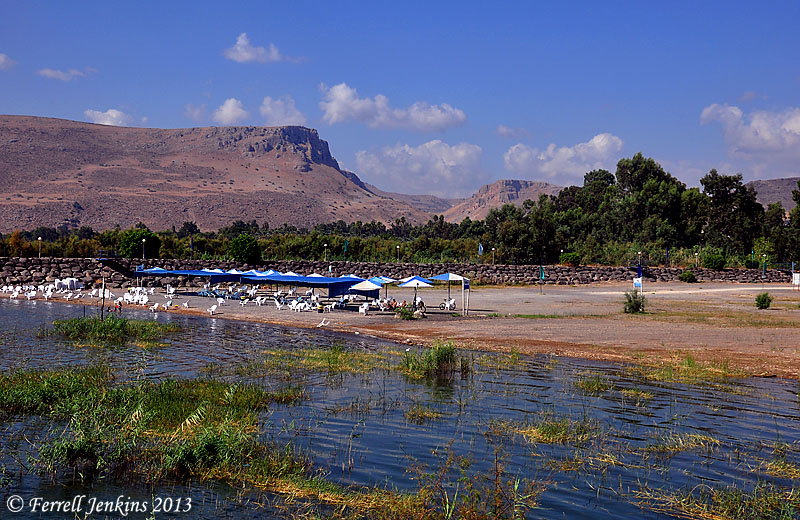
Here is a photo I made yesterday at Nof Ginosaur in the Biblical Gennesaret (Matthew 14:34). I walked out to the end of the pier that has been built to allow boats to drop off passengers.

Sea of Galilee at Nof Ginosaur, April 18, 2913. Photo by Ferrell Jenkins

Sea of Galilee at Nof Ginosaur, April 18, 2913. Photo by Ferrell Jenkins

And here is the same area in September, 2012.

The Sea of Galilee at Nof Ginosar, September, 2012. Photo by Ferrell Jenkins.

The Sea of Galilee at Nof Ginosar, September, 2012. Photo by Ferrell Jenkins.

Kinneret Bot reports for April 18 that the Sea of Galilee is –209.94 meters below sea level. Americans typically translate that as –688.78 feet. A year ago the level was –693.44 feet (211.36 meters) bsl.

Touring Israel again

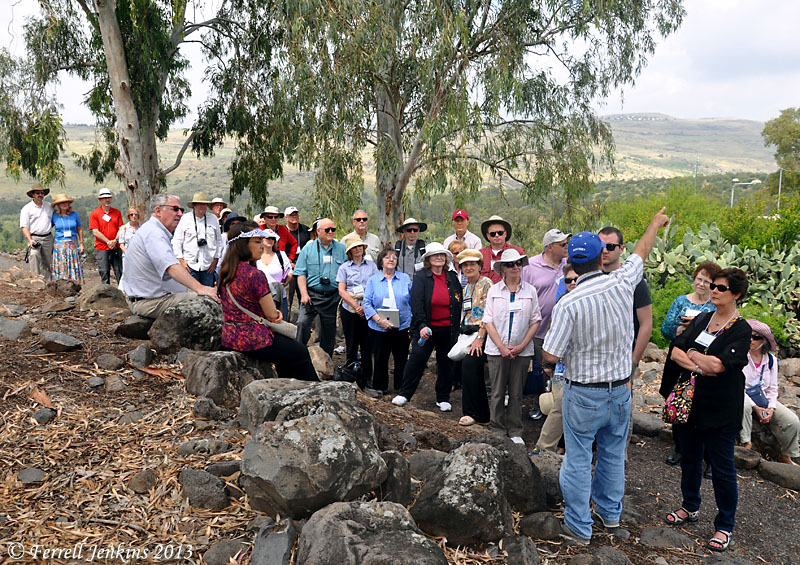
We completed our second full day of study in Israel today. The photo below shows our guide explaining the geographical/topographical features of the area around a site northeast of the Sea of Galilee. The site is known as et-Tell, and is identified by some as the New Testament site of Bethsaida, and perhaps the Old Testament site of Geshur.

Bethsaida is listed in the New Testament as the home of Andrew, Peter, and Philip (John 1:44; 12:21).

The land of Geshur was located in this same area. David married Maacah, the daughter of Talmai, king of Geshur (2 Samuel 3:3). Absalom, the son of David and Maacah, spent three years in Geshur after he killed his half-brother Amnon (2 Samuel 13:30-38; cf. 14:23, 32).

Tour group at "Bethsaida". Photo by Ferrell Jenkins.

Tour group at et-Tell. Photo by Ferrell Jenkins.

While traveling I do not have time to elaborate on the arguments about the identity of this site with Bethsaida.

Don’t mess around with nature

Shmuel Browns has a nice article here on Agamon (Hula) Lake in northern Israel. Perhaps we all know that Lake Hula (Hulah; Huleh) is the small body of water about 10 miles north of the Sea of Galilee.

Browns tells how the lake came to be drained a few decades back, and the reason for its reclamation. I was especially impressed with the number of “creatures” found in the area around the lake. And also of the number of species lost as a result of the draining of the lake.

Josephus refers to Lake Hula by the Roman name of Lake Semechonitis (Ant. 5.199; Jewish Wars 3:515; 4:3).

My earliest association for the site (about 60 years ago) was to identify it as the Waters of Merom (Joshua 11), because this is what Hurlbut suggested in A Bible Atlas. This identification is doubtful, and many modern atlases pass over the issue.

In the new Satellite Bible Atlas, Bill Schlegel says the Canaanites gathered at

…  the Waters of Merom, of uncertain location. The name is preserved at a spring and mountain in Upper Galilee. If this is its location, the Canaanite gathering there is the only significant event described in the Bible that occurred in Upper Galilee. (Map 3-7).

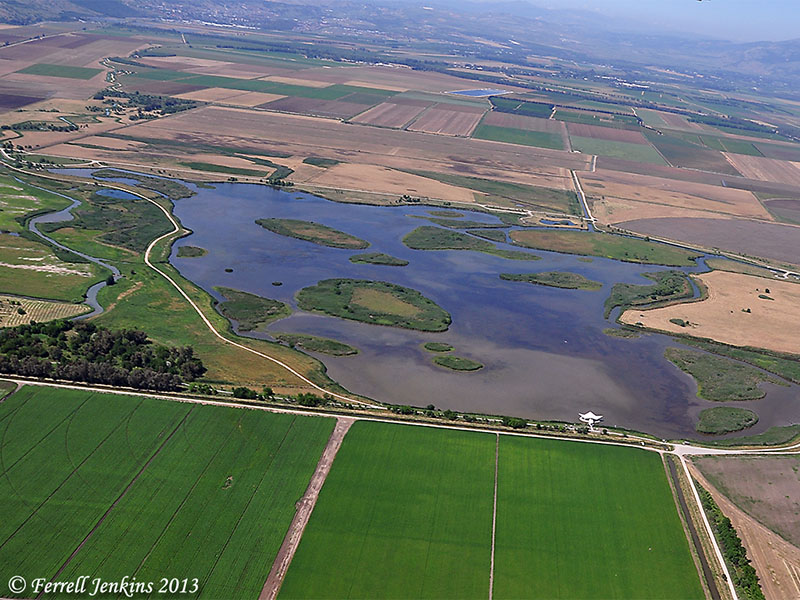
Shmuel shows you some good land photos, and I will show you an aerial photo I made of the reclaimed lake now known as Agamon (Hula) Lake.

Reclamation of Lake Hula. Aerial photo by Ferrell Jenkins.

Reclamation of Lake Hula. Aerial photo by Ferrell Jenkins.

In the late 1960s, I saw the former location of Lake Hula. By that time there was a line of trees standing where the shore had once been.

Photos worth 1000 words (or more)

Locusts

Shmuel Browns, Israel guide and photographer, has posted the best photo of a locust that I have seen. And the photos of flowers in the Judean Desert are something most tourists never get to see. Look here.

From the top of the Great Pyramid

Carl Rasmussen, at his HolyLandPhoto’s blog, calls attention to some photos made by some Russians from the top of one of the Great Pyramid of Giza here. There you will find links to the Mail Online (British) and English Russia.

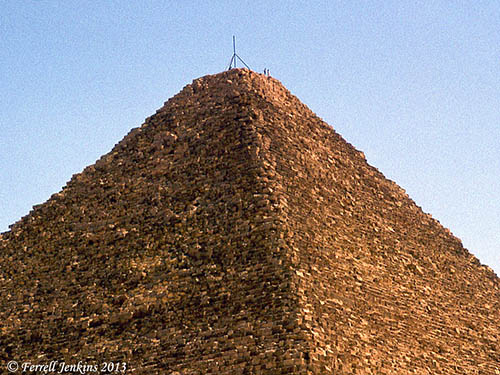
I suppose I never wished to climb the Great Pyramid, but I had two men with me in 1978 who wanted to do so. In the photo below you might be able to make out two men (Jim Puterbaugh and Bob Lyman) to the right of the marker showing the original height of the structure. Click on the photo for a larger image.

Two climbers on top of the Great Pyramid in 1978. Photo by Ferrell Jenkins.

Two climbers on top of the Great Pyramid in 1978. Photo by Ferrell Jenkins.

The Great Pyramid of Cheops (or Khufu) was constructed about 2500 B.C. No, not by the Israelites. That is even earlier than the biblical Patriarchs. It is said to contain more than 2,300,000 blocks of stone, each weighing an average of 2½ tons. The height was originally 479 feet, but now is 449½ feet.

It is April 1, but this is no joke.

Jerusalem Panorama

Look at this great high resolution panorama of Jerusalem from the Mount of Olives here. Spend some time with it. (HT: Bible Places Blog.)

Crucified skeleton found near Jerusalem

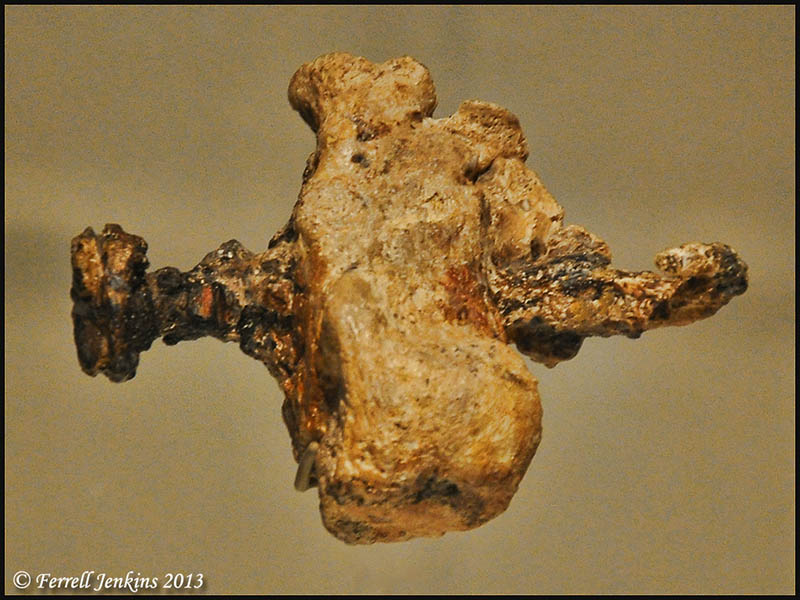
The Romans were adept at crucifixion, according to many historical sources. The first archaeological evidence of crucifixion was uncovered in 1978 [1968; see comments] when an ossuary (bone box, or receptacle) was found north of Jerusalem containing the bones of a man who had been crucified. His name was “Yehohanan, the son of Hagakol.” He is thought to have been between 24 and 28 years of age, and was about 5 feet 6 inches in height.

Both the ossuary and a replica of the heel bone are displayed in the Israel Museum. When Yehohanan was removed from the cross the nail pulled away from the wood.

Ankle bone of a man crucified outside Jerusalem in Roman times. Photo by Ferrell Jenkins.

Nail through the heel bone of a man crucified outside Jerusalem in Roman times. Display in Israel Museum. Photo by Ferrell Jenkins.

On Pentecost, Peter proclaimed the truth about Jesus. He said,

This man was handed over to you by God’s deliberate plan and foreknowledge; and you, with the help of wicked men, put him to death by nailing him to the cross. (Acts 2:23 NIV)

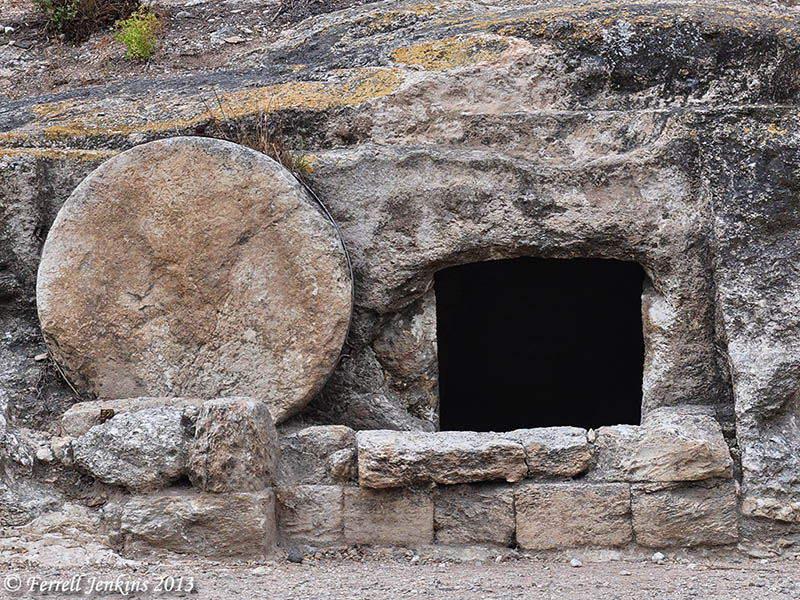
No ossuary, or bones belonging to Jesus, have ever been found. The angel at the empty tomb of Jesus announced to the women who had gone to complete the burial,

He is not here, for he has been raised, just as he said. Come and see the place where he was lying. (Matthew 28:6 NET)

Rock tomb with rolling stone near Jezreel Valley. Photo by Ferrell Jenkins.

Rock tomb with rolling stone near Jezreel Valley. Photo by Ferrell Jenkins.

SourceFlix has posted a nice brief video of Passion Week Archaeology here.

Logos Community Pricing

Logos Bible Software has a feature called Community Pricing. It works like this. A book (or set) is chosen for publication. Interested persons are asked to place a bid on the completed digital publication. When there are enough bids to pay for publication the book is published. After the initial publication, the price goes up. I have purchased many Logos publications using Community Pricing and Pre-Publication Specials.

To use the Community Pricing or Pre-Pub specials you must already have Logos (or the older Libronix) on your computer. You may purchase a base package from Logos (here), or buy a relatively inexpensive set of books from someone like Rejoice Christian Software. I suggestion you buy something like the  Baker New Testament Commentary ($79.95 here), the Norman Geisler Apologetics CD-Rom Library ($29.95 here), or one of the other great specials they offer.

thompson_land-and-the-bookHere is a Community Pricing special too good to miss for anyone interested in the land of the Bible: The Land and the Book by William M. Thomson. This is an old work that is rich in information about the land and the culture of the Bible land.

Rich with scriptural landmarks and filled with hundreds of beautiful pen-and-ink illustrations, Thomson’s The Land and the Book has been a popular classic for over 100 years. Learn more about the people, places, and historical events behind the text you’re studying. Incorporate pictures, illustrations, and graphics into sermons, school papers, or Sunday school lesson plans. Whether you are a student, pastor, scholar, or layperson, the 3-volume Land and the Book is a must-have resource for Bible study or reading.

A work like this does not replace current studies, but it supplements them. Just go to Logos (here) and bid $18 on this work. If it sells for less you will pay less.
In the next post I will share another special pre-pub bargain.

Locusts video from Israel

Recently we mentioned the plague of locusts that devastated crops in Egypt. The southern portion of Israel might have been affected except for the effective use of pesticides.

When Joel Kramer, Executive Director of SourceFlix, learned that the locusts were in the southern part of Israel he drove from Jerusalem through the Negev and wilderness to photograph the locusts near the Egyptian border. He shares this with us in a high quality video here.

Joel includes wording from the book of Exodus 10 to remind us of the biblical plague of locusts in the time of Moses.

The writer of Proverbs describes the locusts this way:

 the locusts have no king, yet all of them march in rank; (Proverbs 30:27 ESV)

In studying the book of Revelation, I am impressed at the way in which locust plagues, which were (and still are) common in the Middle East, are used in the sounding of the fifth trumpet (Revelation 9:1-11). The comparison between the locusts and a literal army in their movement and damage is impressive.

 In appearance the locusts were like horses prepared for battle: on their heads were what looked like crowns of gold; their faces were like human faces,
8 their hair like women’s hair, and their teeth like lions’ teeth;
9 they had breastplates like breastplates of iron, and the noise of their wings was like the noise of many chariots with horses rushing into battle.
10 They have tails and stings like scorpions, and their power to hurt people for five months is in their tails. (Revelation 9:7-10 ESV)

HT: Bible Places Blog.

Hidden treasure

The discovery of hidden treasure is fairly common in and near ancient sites. Individuals may not have a bank account, but they keep the funds they have stored in what they consider a safe place.

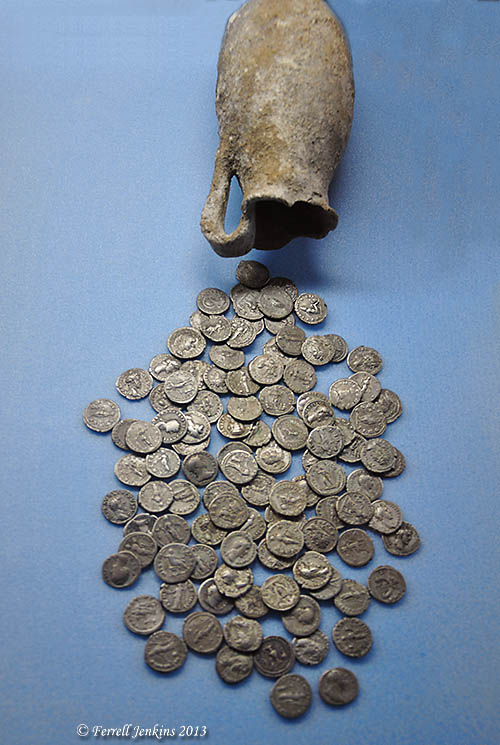
The photo below shows a clay jar with a hoard of silver coins displayed in the Samsun (Turkey) Archaeological Museum. These coins date from the Roman Imperial Period (69-79 A.D. and 238/244 A.D.). The earliest coins are not far removed from the time of the delivery of Peter’s Epistles to saints in Pontus and other Roman provinces (1 Peter 1:1). For more information about the delivery of Peter’s Epistles, see here.

For more information about the museum, check here and here.

Hoard of Roman coins displayed in Samsun Archaeological Museum. Photo by Ferrell Jenkins.

Roman coins displayed in Samsun Archaeological Museum. Photo by Ferrell Jenkins.

Photos such as this remind us of several Biblical passages. For today, consider Paul’s instruction to Timothy regarding what he was to teach those who set their hope on the uncertainty of riches.

 17 As for the rich in this present age, charge them not to be haughty, nor to set their hopes on the uncertainty of riches, but on God, who richly provides us with everything to enjoy.
18 They are to do good, to be rich in good works, to be generous and ready to share,
19 thus storing up treasure for themselves as a good foundation for the future, so that they may take hold of that which is truly life. (1 Timothy 6:17-19 ESV)