Category Archives: Bible Places

Sea of Galilee now 703 feet below sea level

A headline in a recent The Times of Israel reads,

“Thirsty Sea of Galilee sinking toward lowest level ever recorded.”

The article by Melanie Lidman reports that…

Northern Israel is experiencing one of the worst droughts in 100 years, leaving the country’s water tables with a deficit of 2.5 billion cubic liters of water, compared to non-drought years, Water Authority spokesman Uri Schor announced on Monday.

Lidman says,

The Sea of Galilee is currently at 214.13 meters (703 feet) below sea level, or 1.10 meters (3.6 feet) below the lower red line.

She adds that the Sea of Galilee reached a similar level in 2001 and 2008. When I first studied Bible Geography back in 1953 we learned from popular Bible atlases that the Sea of Galilee was 596 feet below sea level.
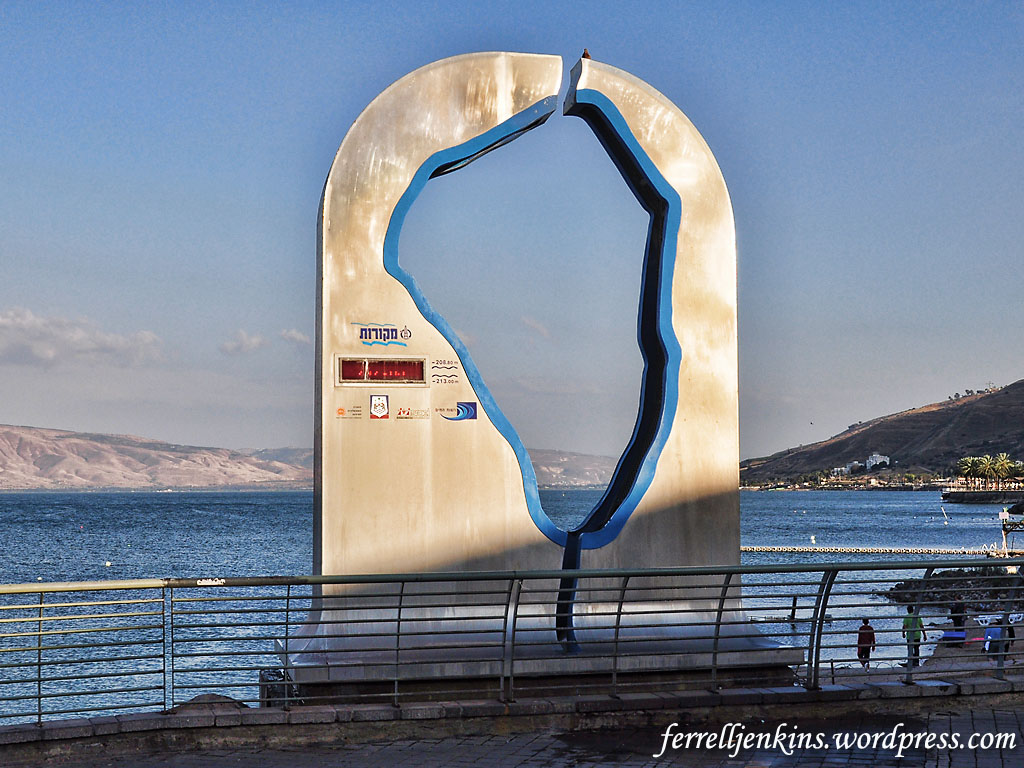
This gauge at Tiberias measures the level of the Sea of Galilee. Photo by Ferrell Jenkins.

This gauge at Tiberias measures the level of the Sea of Galilee. Photo by Ferrell Jenkins.

The article discusses the social and climatic problems Israel is facing today, and is well-worth the read.

The late Mendel Nun, of En Gev, discovered no less than 16 bustling ports from the time of Jesus. When the harbors and anchorages were originally built the water level was about 695 feet below sea level, considerably lower than in recent time. (See “Ports of Galilee.” BAR 25:04, July/Aug 1999).

Droughts in recent years have brought about changing water levels. We know that the famous Roman boat now displayed at Nof Ginosar was found when the water level was low in 1986. This also allowed the discovery of additional ports.

During the time I have been visiting Israel (since 1967), I have seen these changes in the water level of the lake and have mentioned it in several posts. Here I wish to use Tabgha (Heptapegon = the place of seven springs) as an illustration.

The Church of the Primacy of Peter was built in 1933. A good case can be made for this being the location where Jesus called some of His disciples to become fishers of men (Luke 5:1-11), and where Jesus met His disciples after the resurrection (John 21). The issue of the primacy of Peter over the other apostles is a matter for theological and exegetical study which I think comes up short.

The chapel is built on a large rock called the Mensi Domini (the Lord’s Table) where it is said Jesus prepared breakfast for the disciples.

In this 1980 photo you see the water reaching the building.
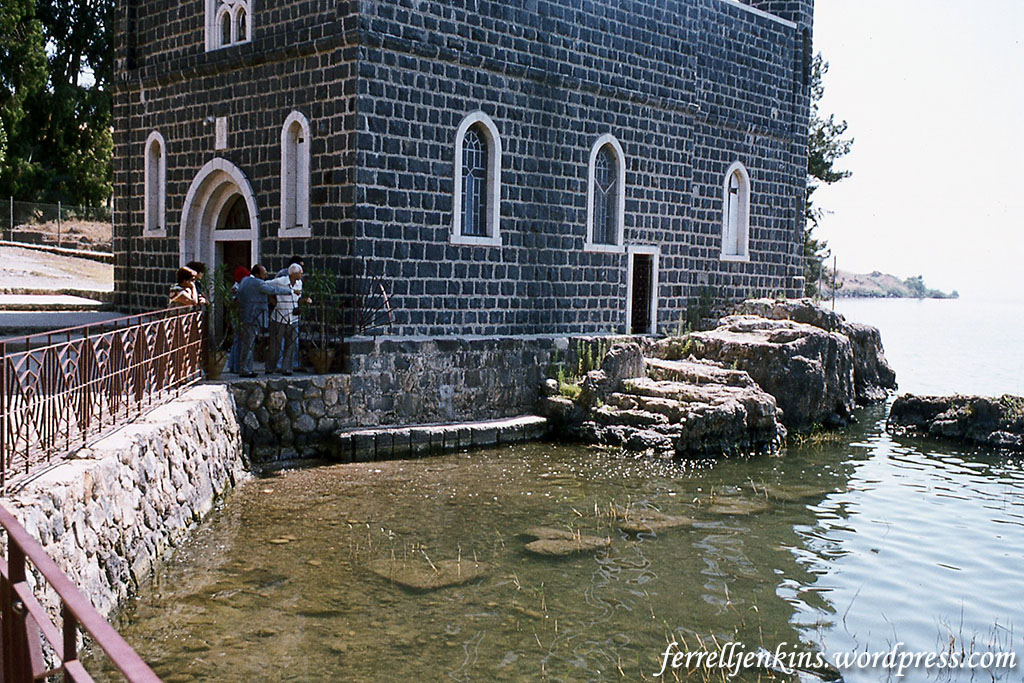
This photo shows the water level in 1980 at the Church of the Primacy. Photo by Ferrell Jenkins.

This photo shows the water level in 1980 at the Church of the Primacy. Photo by Ferrell Jenkins.

The rock-cut steps were mentioned by Egeria (about AD 383), but we do not know when they were cut. Now take a look at the same location in December of 2009 when the water was low.
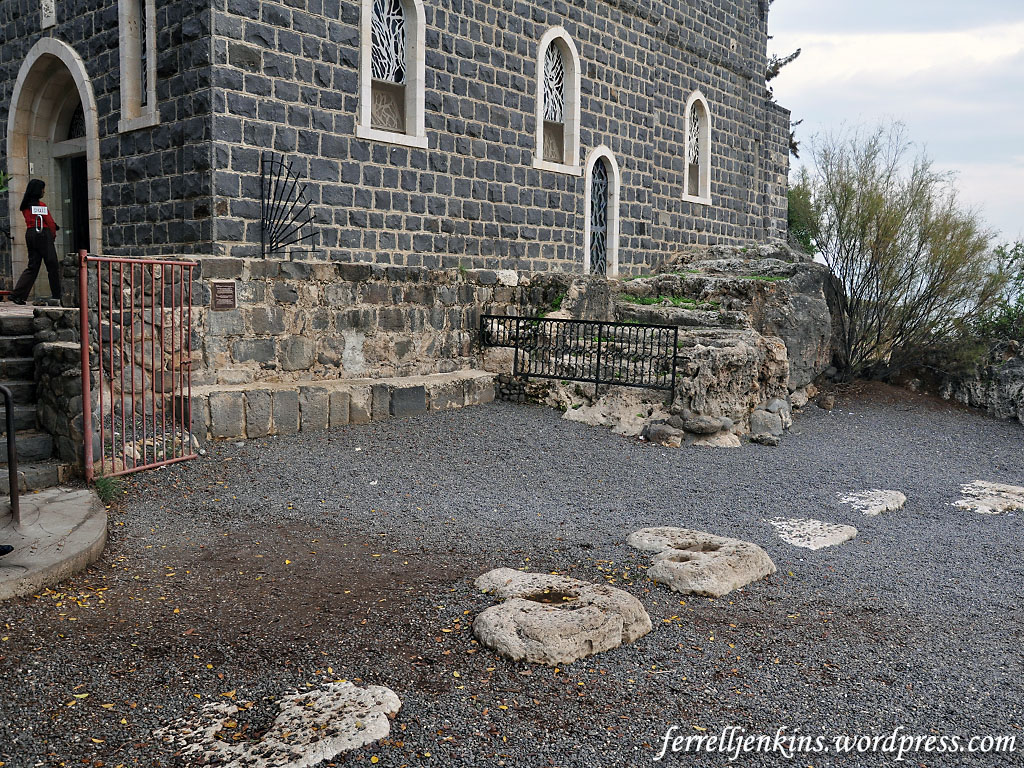
The Church of the Primacy in 2009. Photo by Ferrell Jenkins.

The Church of the Primacy in 2009. Photo by Ferrell Jenkins.

These 2009 photos were made during a personal study trip with Leon Mauldin. While we were enjoying the quietness of the experience a group of tourists came to hunt for a special souvenir rock or shell to take home. I made the next picture from the edge of the water to illustrate how far the water had receded.
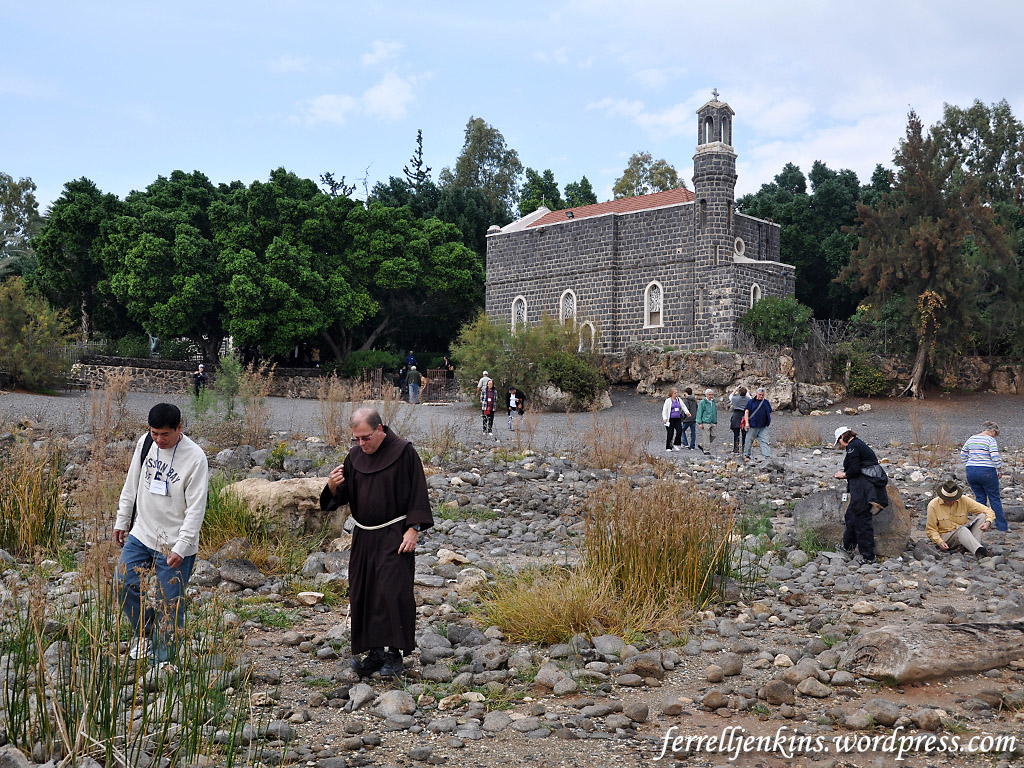
These photos were made during a personal study trip that Leon Mauldin and I made in 2009. While we were enjoying the quietness of the experience a group of tourists came to hunt for a special souvenir rock or shell to take home. I made the next picture from the edge of the water to illustrate how far the water had receded.

View of the Church of the Primacy from the edge of the water. Photo by Ferrell Jenkins.

View of the Church of the Primacy from the edge of the water. Photo by Ferrell Jenkins.

Hopefully this illustration from Tabgha will allow us to see how the harbors that had become lost in time could become known in the past few years.
Barclay’s Gate in the Western Wall

In this post we wish to follow-up on the work of Dr. James Turner Barclay, medical missionary to Jerusalem in 1851-1854 and 1858-1861, which we have written about here (with other links).

Perhaps Turner’s best known discovery was a gate in the Western Wall of the Temple Mount, now known as Barclay’s Gate. Lewis describes briefly the account given by Barclay in The City of the Great King.

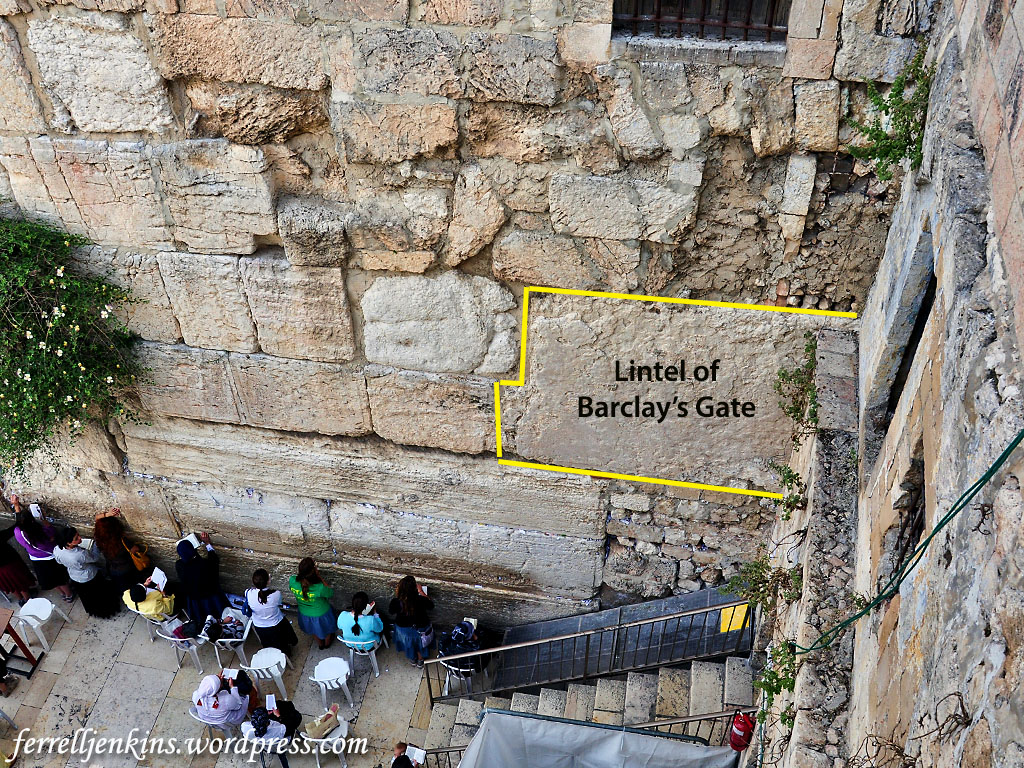
While surveying the Haram precinct [which Christians and Jews call the Temple Mount], Barclay noticed a blocked-up entrance, located 82 meters from the area’s southwest corner. The lintel of this gate is below the Maghrabi gate, which tourists use today to enter the Haram from the west. It is above the women’s area of the western wall, just over the stairway that leads into a room on its south side. Only a part of the lintel is still visible. Some time after the gate was filled in, the corridor into which it led was made into a cistern.

Lewis states that Barclay’s discovery was confirmed by Charles W. Wilson, and later by George Adam Smith. He says,

Barclay considered it to have been one of the four gates mentioned by Josephus in his description of the western wall (Jewish Antiquities, book 15, chapter 11, paragraph 5; see Marcus and Wikgren 1963: 199). Benjamin Mazar has identified Barclay’s Gate as the Kiphonos [Coponius] Gate of the Mishnah (Middoth, chapter 1, mishnah 3; see Danby 1933: 590):

Its tremendous single-stone sill, twenty-five feet long and over seven feet high (7.5 x 2.1 meters), rests on the master course of the Western Wall, that is, at the level of the thresholds of several of its gates. The gateway (opening) is 28.7 feet (8.75 meters) high, but the threshold is missing.… Inside the gate, there was once a vestibule which is now blocked by a wall. Behind the wall a passage leads through one or two ancient cisterns with vaulted roofs which are situated under the Haram platform. Before they were converted into reservoirs, they were stone hallways and formed an underground ramp leading in a southerly direction from the Kiphonos Gate to the upper courts of the Temple area (Mazar [The Mountain of the Lord] 1975: 133–34).

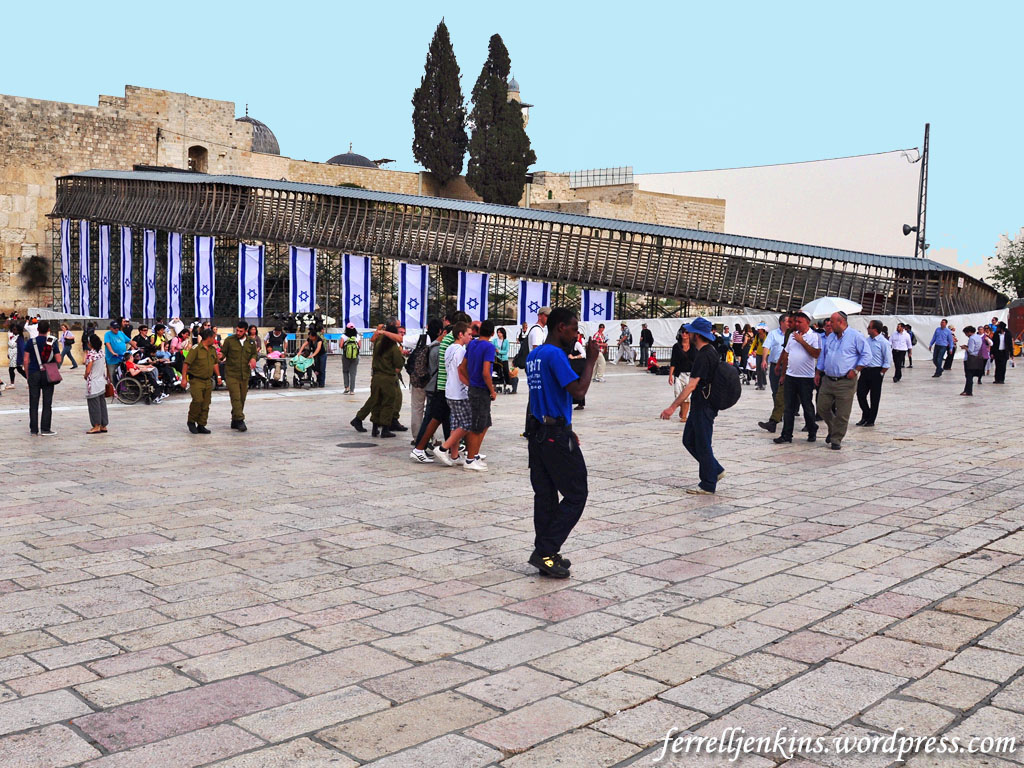
I am hopeful that our photographs will make clear the location of Barclay’s Gate for those who wish to get a glimpse of it on their next trip to Jerusalem. The first photo shows the Mughrabi Bridge entrance.

Mughrabi Bridge. Tourists usually enter from Dung Gate and take the bridge up to the only entrance to the platform where the temple once stood allowed for non-Muslims. Photo by Ferrell Jenkins.

Mughrabi Bridge. Tourists usually enter from Dung Gate and take the bridge up to the only entrance to the platform where the temple once stood allowed for non-Muslims. Photo by Ferrell Jenkins.

Notice where it appears that the bridge reaches the Western Wall. In fact, it makes a right turn to the south, and then a left turn to the east where it reaches the gate. That gate is at the level of the platform where the Temple of Solomon, and Herod’s Temple once stood.

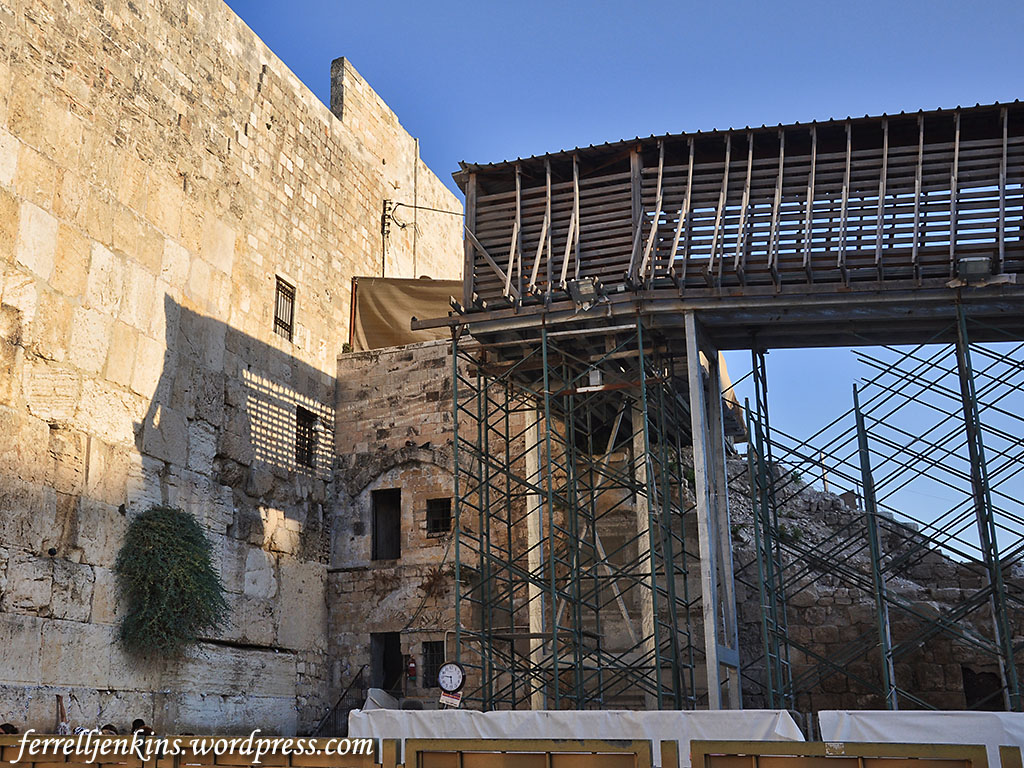
This photo shows the structure covering most of the lintel of Barclay's Gate. Photo by Ferrell Jenkins.

This photo shows the bridge and the structure covering most of the lintel of Barclay’s Gate. Photo by Ferrell Jenkins.

This photo was made from the Mughrabi bridge and shows the left side (north end) of the lintel of Barclay’s gate marked in yellow.

Photo made from Mugrabhi gate bridge with the north end of the lintel identified. Photo by Ferrell Jenkins.

Photo made from Mugrabhi gate bridge with the north end of the lintel identified. Photo by Ferrell Jenkins.

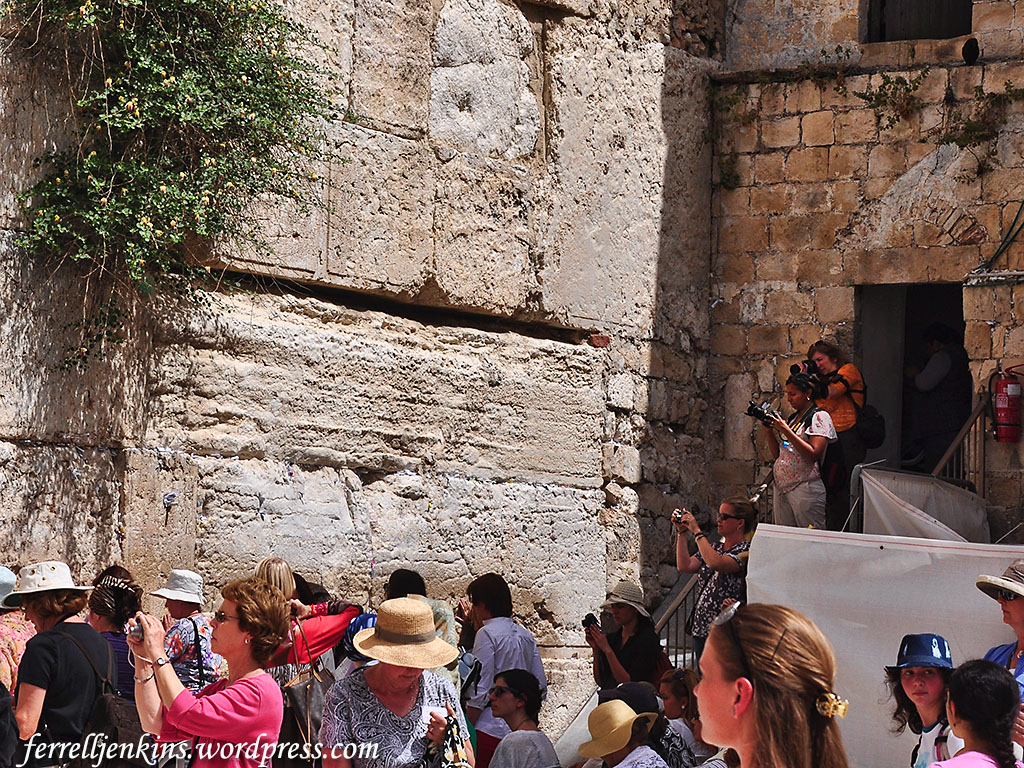
The next photo was made from ground level over the dividing screen that separates the women’s section of the prayer wall from that of the men. The visible portion of the lentel looks smaller here than in the previous photo. Two ladies are standing on the steps at the entrance into the small room where more of the lentel can be seen.

Ground level view of the southern end of the lentil showing. Photo by Ferrell Jenkins.

Ground level view with the northern end of the lentel showing. Photo by Ferrell Jenkins.

Leen Ritmeyer has provided numerous drawing of Barclay’s Gate in his books and blog. I recommend that you go there for a better understanding of the gate structure.

  • Ritmeyer Archaeological Design. See the post on “Barclay’s Gate in the Western Wall of the Temple Mount” here. This post includes a photo of the central part of the lintel over Barclay’s Gate.
  • Ritneyer, Leen & Kathleen. Jerusalem: The Temple Mount. See our notice here.
  • Ritmeyer, Leen. The Quest, Revealing the Temple Mount in Jerusalem, pp. 26, 28.
  • Ritmeyer, Leen. Understanding the Holy Temple Jesus Knew, pp. 22-23. The drawings and photos in this book are very nice. See our notice here.

Two books that caught my attention are,

  • Ben-Dov, Meir. In the Shadow of the Temple, pp. 140-143. Ben-Dov includes a full-page drawing of the gate showing the present level, the Omayyad level, and the Second Temple level. He shows eight layers of Herodian stones below the present level. This work incorrectly identifies Barclay as “an American consul in Jerusalem at the end of the nineteenth century and one of the first scholars of Jerusalem.” Barclay was a medical missionary who lived in Jerusalem on two occasions (1851-1854 and 1858-1861).
  • Mazar, Benjamin. The Mountain of the Lord, pp. 133-134. Mazar mistakenly identified Barclay as a “British architect.”

Initially I began with a reference to the following works.

  • Lewis, Jack P. “James Turner Barclay: Explorer of Nineteenth-Century Jerusalem.” Biblical Archaeologist 51 (1988).
  • Lewis, Jack P. Explorers of Bible Lands. Abilene Christian University Press, 2013. This work includes the essay on Barclay and other biographical portraits by Lewis.

Lewis discusses some of the other discoveries made by Turner.

Barclay’s book is not to be forgotten. The City of the Great King; or, Jerusalem As It Was, As It Is, and As It Is To Be is available in Logos format. It seems to be available only in a 10-volume collection of Archaeological and Theological Studies of Jerusalem. It is also available free at Google Books. I note that a cover of the book shows a drawing of the Temple area, including the “Wailing Place” and nearby an “Old Gateway.”

Added Notes – Sept. 29, 2017

The comment below by Outremer [Tom Powers] was held up by WordPress for my approval, and by some appointments I had. When Tom writes I listen. He always adds something of value. I want you to read the comments in full, but I am including the photos here. I knew that one of them was in Ritmeyer’s blog and for that reason did not include it. And I thought of Todd Bolen’s Historic Views of the Holy Land. One of these photos is in the 8-volume set, “The American Colony and Eric Matson Collection.” Details here.

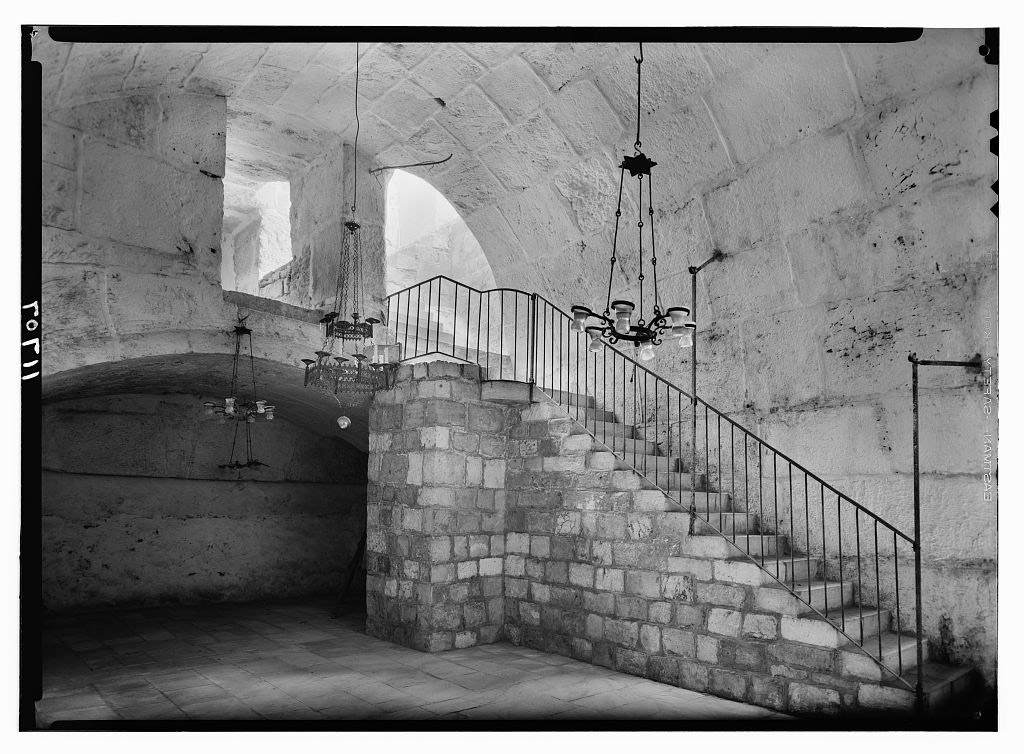
Here is the first photo Tom mentions.

The "al-Buraq" Mosque "built into the vaulted internal gate passage of Barclay's Gate." Eric Matson Photo.

The “al-Buraq” Mosque “built into the vaulted internal gate passage of Barclay’s Gate.” The dark line on the far wall (left of the photo) is “apparently the top of the lintel” (Powers). Eric Matson Photo, 1940s.

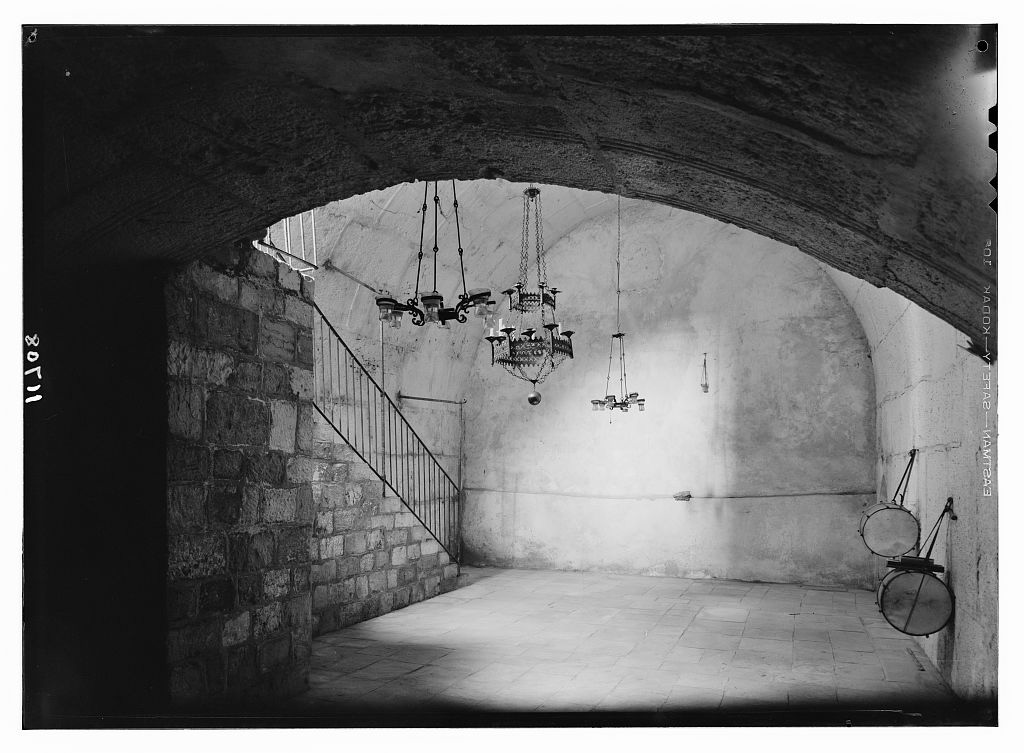
The second photo is shown here.

The "al-Buraq" Mosque "named for the winged beast of Moahmmed's legendary Night Journey -- is built into the valulted internal gate passage of Barclay's Gate" (Powers). Photo by Eric Matson.

The “al-Buraq” Mosque, “named for the winged beast of Moahmmed’s legendary Night Journey, is built into the vaulted internal gate passage of Barclay’s Gate” (Powers). Photo by Eric Matson in the 1940s.

Shofar announces the Jewish new year

Our Jewish friends are currently celebrating Rosh Hashanah, the Jewish new year. The ram’s horn is blown leading up to the celebration.

The ram’s horn was important in the history of Israel. One of the words often used for the horn is shofar (or shophar).

  • A long blast on the ram’s horn was used to alert the Israelites when they could approach Mount Sinai (Exodus 19:13).
  • The ram’s horn was sounded at the beginning of important feast days (Leviticus 25:9). On the first day of the seventh month of the Jewish calendar trumpets were to be blown (Numbers 29:1). This festival was known as the Feast of Trumpets.
  • After Israel marched around Jericho they would hear a long blast on the ram’s horn (Joshua 6:5). The word horn in this verse is qeren, but the word shofar is translated trumpet.

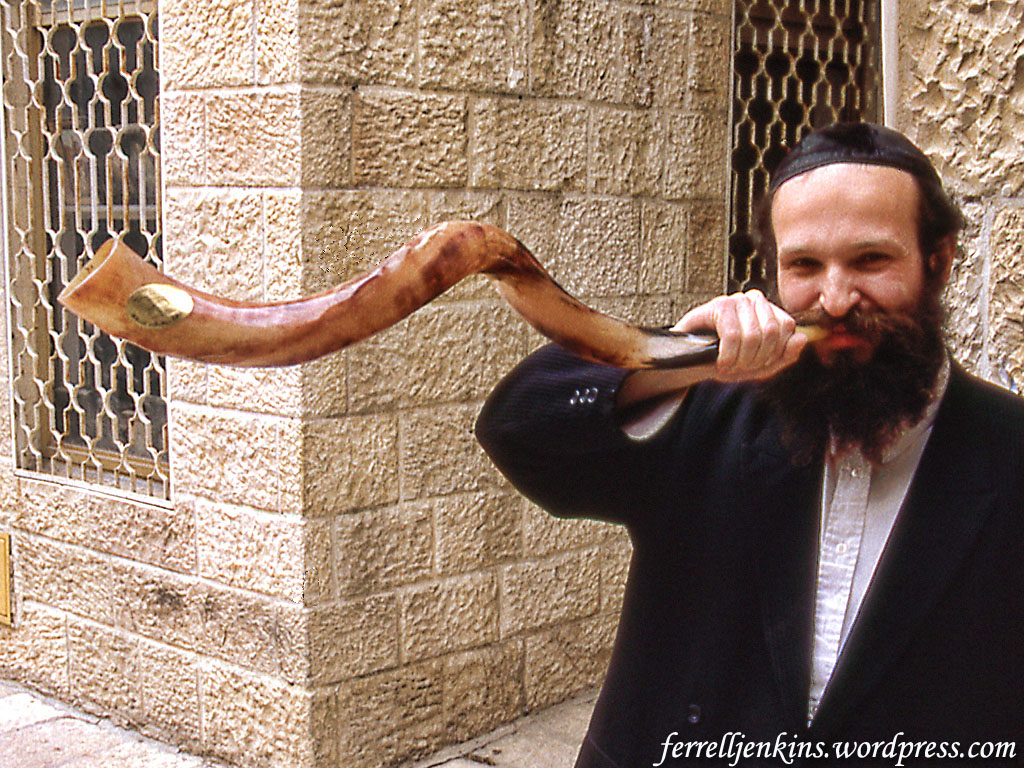
Sometimes in the Jewish Quarter of Jerusalem one of the shopkeepers will demonstrate the sounding of the shofar in hopes of attracting customers. That beautiful horn was a little above my budget. I do not know the animal from which it came. It may be a Yemenite shofar made from the horn of an African kudu.

Shofar sounded by a shopkeeper in the Jewish Quarter, Jerusalem. Photo by Ferrell Jenkins 1993.

Shofar being sounded by a shopkeeper in the Jewish Quarter, Jerusalem. Photo by Ferrell Jenkins 1993.

Silver trumpets were also to be blown on certain occasions (Numbers 10:1).

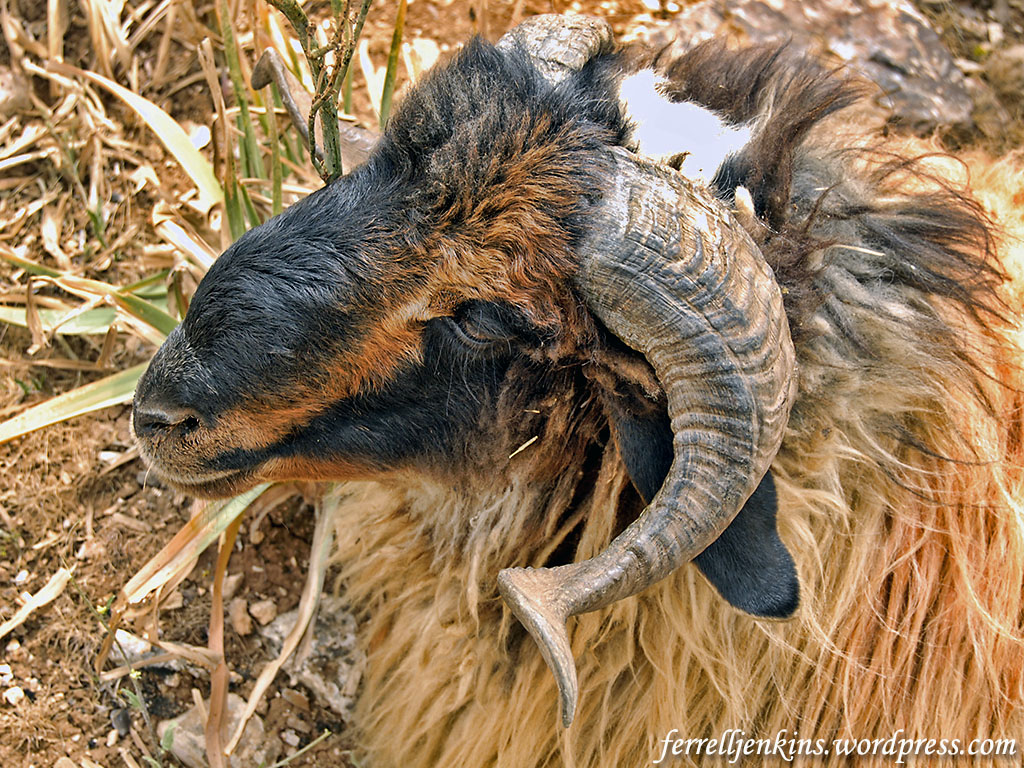
I have observed that shepherds are proud of the ram of the flock. This photo was made in northern Jordan not very far from Ramoth in Gilead and the border with Syria.

Ram with large horns. Photo made in northern Jordan near ancient Ramoth Gilead, near the Syrian border. Photo by Ferrell Jenkins.

Ram with large horns. Photo made in northern Jordan near ancient Ramoth Gilead, near the Syrian border. Photo by Ferrell Jenkins.

Christians of the Apostolic period, even Gentiles, studied the Old Testament (Hebrew Bible) as a book like 1 Corinthians illustrates. Paul tells the Corinthians that the sound of a trumpet will signal the coming of the Lord and the resurrection.

For the Lord himself will descend from heaven with a cry of command, with the voice of an archangel, and with the sound of the trumpet of God. And the dead in Christ will rise first.  Then we who are alive, who are left, will be caught up together with them in the clouds to meet the Lord in the air, and so we will always be with the Lord.  Therefore encourage one another with these words. (1 Thessalonians 4:16-18 ESV)

Behold! I tell you a mystery. We shall not all sleep, but we shall all be changed, in a moment, in the twinkling of an eye, at the last trumpet. For the trumpet will sound, and the dead will be raised imperishable, and we shall be changed. (1 Corinthians 15:51-52 ESV)

Dr. James Turner Barclay remembered in the Cathedral of St. George, Jerusalem

A little more than two years ago I wrote two posts about the discovery of Solomon’s Quarries (also called Zedekiah’s Cave) here and here. I will reproduce only a few comments from those articles in hope that you will check them and the many photos I have included there.

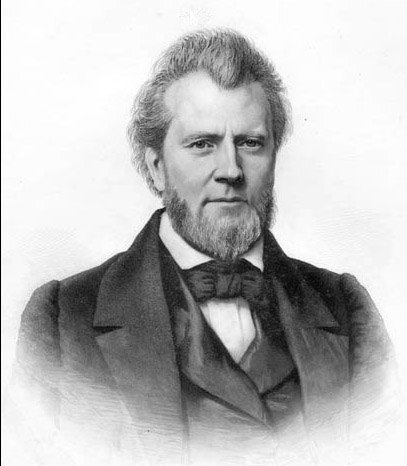
Portrait of Dr. James Turner Barclay from about 1848.

Portrait of Dr. James Turner Barclay engraved by John Sartain. This image may also be found on the Scottsville Museum (Virginia) web page here. The photo is from Barclay’s book, The City of the Great King (1858).

Dr. James Turner Barclay was sent to Jerusalem by the American Christian Missionary Society in 1851 as a medical and evangelistic missionary. During his first trip he stayed until 1854 and returned for a second stint from 1858 to 1861. Barclay was active in medical work, treating more than 2,000 cases of malaria during his first year in the city.

Barclay is known not only for the aforementioned discovery but for the discovery of an ancient gate in the Western Wall now known as Barclay’s Gate. I gathered all of my sources to write about that when I wrote the previous articles, but eventually had to put the books away to make room for something else. Perhaps someday.

While admitting mistakes that Barclay made in those early days, Dr. Jack P. Lewis says,

The significant steps that Barclay took toward the scientific study of Jerusalem will keep his contribution to scholarship from being forgotten. (Biblical Archaeologist, 1988).

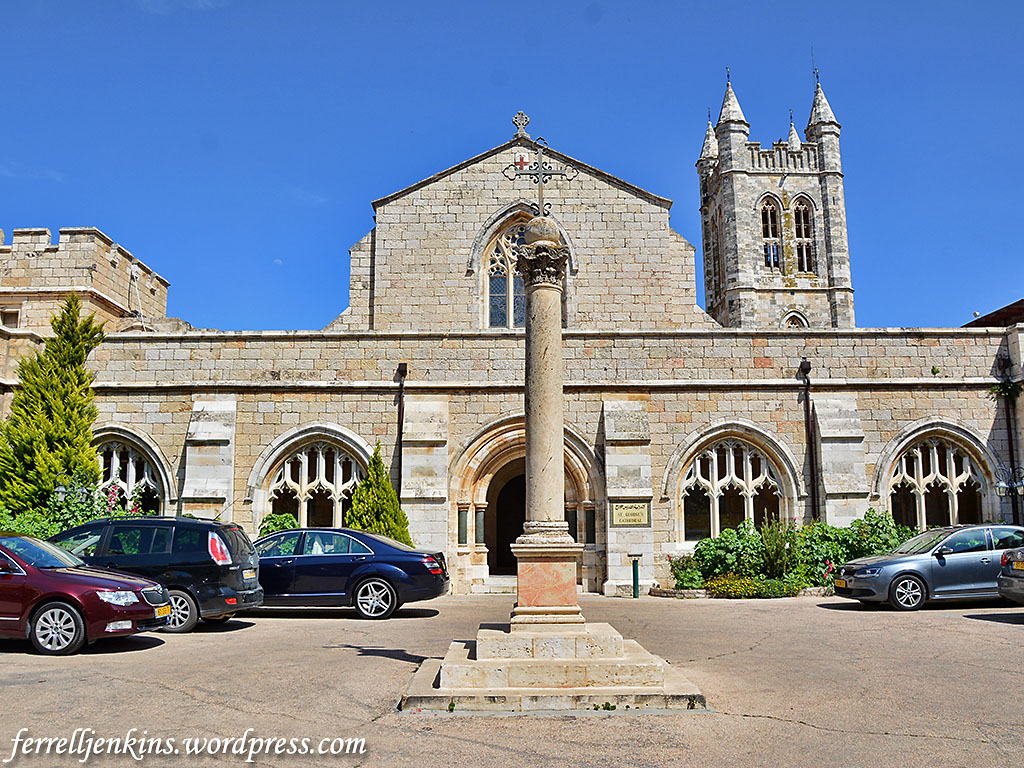
A few decades ago a church in Atlanta, Georgia, provided two stained glass windows for the Cathedral of St. George to honor and maintain the memory of Dr. Barclay. The Cathedral is the seat of the Episcopal Church bishop of Jerusalem. Our first picture shows the courtyard and entrance along Nablus (formerly Damascus) Road. It is near the famous American Colony Hotel and other well-known tourist hotels (e.g., the Grand Court Hotel where many of my groups have stayed).

The courtyard and entrance to St. George Cathedral in east Jerusalem. Photo by Ferrell Jenkins.

The courtyard and entrance to St. George Cathedral in east Jerusalem. Photo by Ferrell Jenkins.

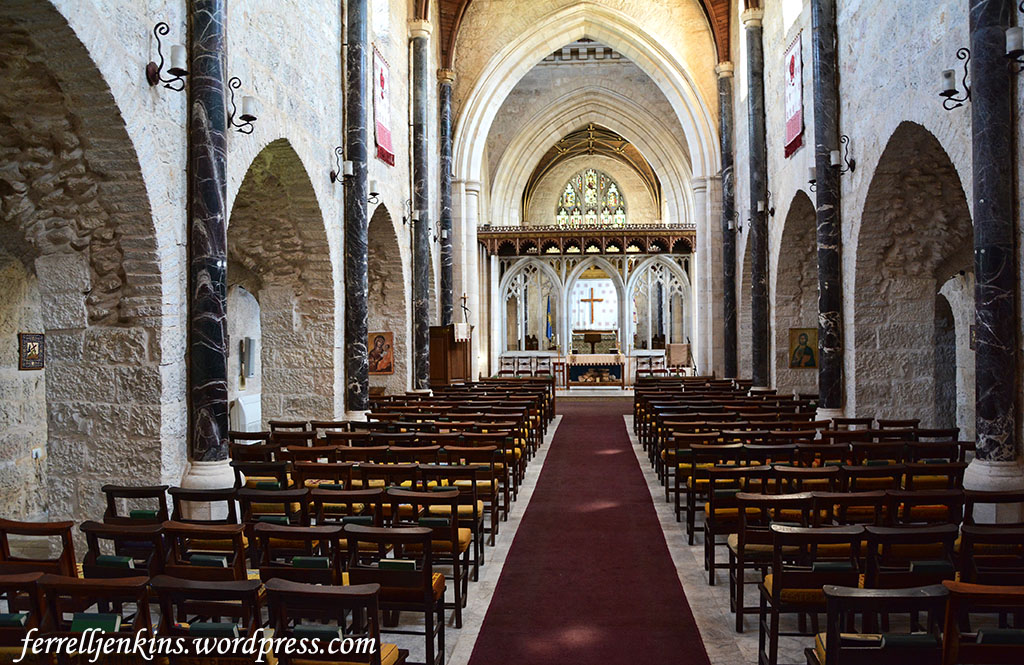
Our next photo shows the interior of the building. The stained class windows, not visible in this photo are on the left and near the front of the building. The building seems to be open for visits at most times.

The interior of the St. George Cathedral. The stained glass windows are on the left side. Photo by Ferrell Jenkins.

The interior of the St. George Cathedral. The stained glass windows are on the left side. Photo by Ferrell Jenkins.

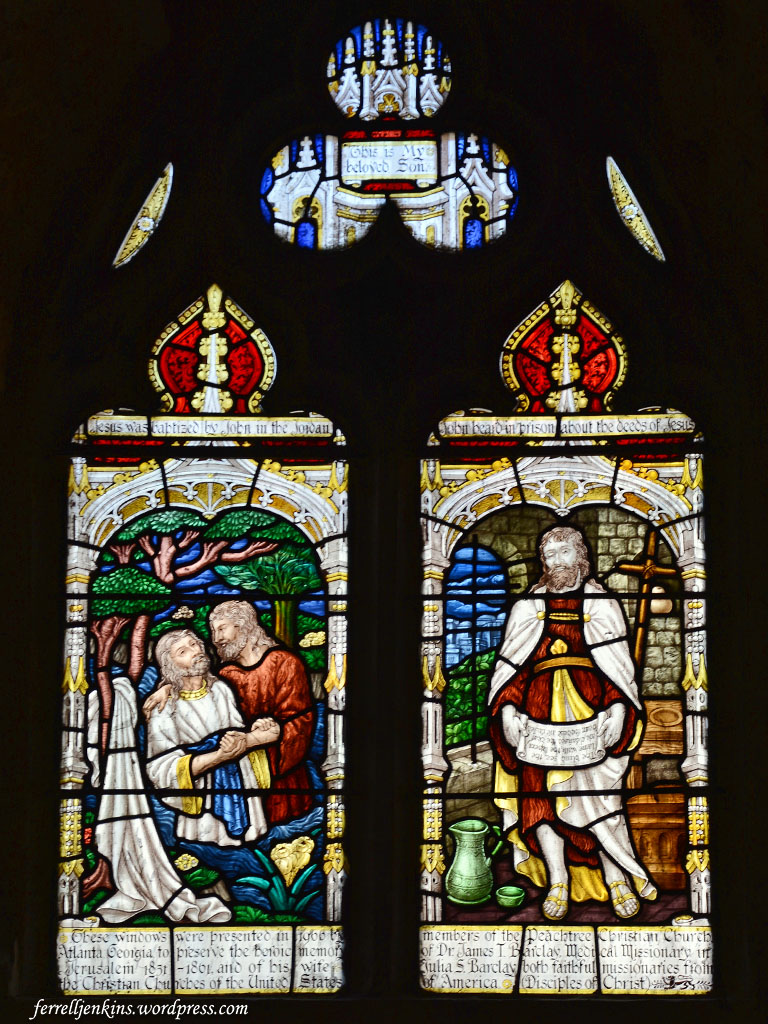
There are two other windows depicting the naming of John the Baptist and the preaching by John of “a baptism of repentance.” The ones we show below are the ones honoring Dr. Barclay. The window on the left bears the title “Jesus was baptized by John in the Jordan” and the one on the right has “John heard in prison about the deeds of Jesus” as a title. John is holding a manuscript with a portion of the text of Matthew 11:4-6.

And Jesus answered them, “Go and tell John what you hear and see: 5 the blind receive their sight and the lame walk, lepers are cleansed and the deaf hear, and the dead are raised up, and the poor have good news preached to them. 6 And blessed is the one who is not offended by me.” (Matthew 11:4-6 ESV)

The windows honoring Dr. Barclay. Photo by Ferrell Jenkins.

The windows honoring Dr. Barclay. Photo by Ferrell Jenkins.

The dedication reads across both windows:

These windows were presented in 1966 by members of the Peachtree Christian Church, Atlanta, Georgia, to preserve the heroic memory of Dr. James T. Barclay, Medical Missionary in Jerusalem 1851–1861, and of his wife Julia S. Barclay, both faithful missionaries from the Christian Churches of the United States of America. (Disciples of Christ).

I have made mention of the Restoration Movement, sometimes called the Stone-Campbell Movement, at other times. Just as a matter of record, my life’s work has been among more conservative Churches of Christ, rather than among Christian Churches or Disciples of Christ. The introduction of the American Christian Missionary Society was one of the things that precipitated the division.

It is good to see the work of men like Barclay honored by whomever wishes to do so.

As a courtesy to those who would like to use these photos in teaching, you may click on them for an image suitable for PowerPoint presentations.

New books from Carta Jerusalem – # 2

The Twice Told Tale parallel study of Samuel, Kings, Chronicles, and more.

The Twice Told Tale parallel study of Samuel, Kings, Chronicles, and more.

The Twice-Told Tale. This hardback book of 284 (6½” x 9½”) pages is written by Abba Bendavid, with an introduction by Mordechai Cogan. ($64). Cogan says,

It is well-known that readers of the Bible generally skip over the Book of Chronicles [1-2 Chronicles], the last book of the Hebrew Bible [chronologically]. All too often Chronicles is seen as merely a recap and summary of the historical books that preceded it….

This book includes an index to biblical citations. It will be extremely helpful to those studying Samuel, Kings, and Chronicles.

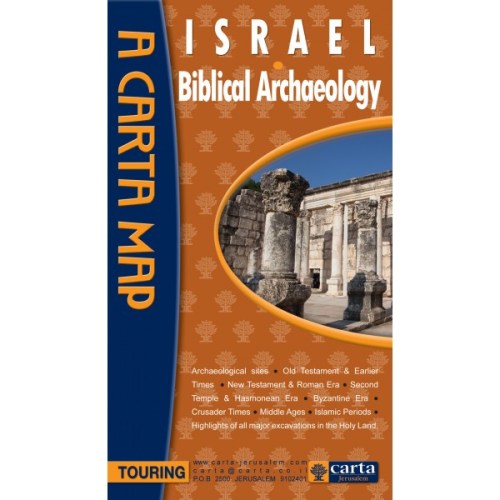
Israel Biblical Archaeology touring map.

Israel Biblical Archaeology touring map.

Israel Biblical Archaeology (A Carta Touring Map) $14.95. Carta Jerusalem describes this folding map:

 The first major comprehensive map of  archaeological sites in the Holy Land, together with over a dozen annotated historical vignette maps of major sites and events throughout the land that provide an insightful overview of all archaeological sites related to the Bible and later historical periods.

This 24 × 35½ in. map folds to 5¼×9¼ in. For those interested in locating archaeological sites this can be a very helpful resource. On the back side of the map there are numerous smaller maps and diagrams helpful in study and travel. My preference would be to have this material in spiral bound atlas format, but I expect to use the map in planning and during my next personal study trip.

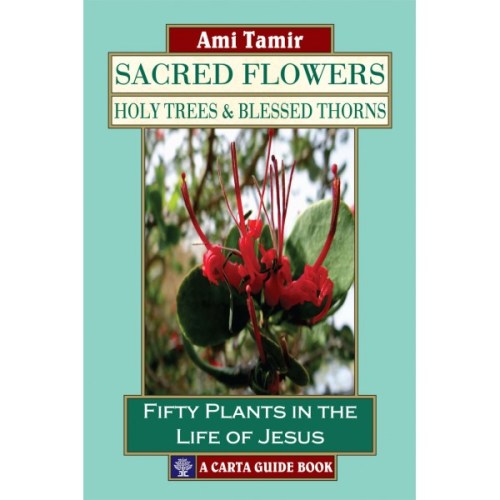
Sacred Flowers, Holy Trees & Blessed Thorns by Ami Tamir is a new book published this year. The Introduction explains,

This book tells the stories of fifty plants connected to Christian tradition which can be found, in season, by the Christian pilgrim visiting the land of Israel. Illustrations that enable the pilgrim to identify the less-recognizable plants are included, and encourage the study of the rich botanical variety he/she will find on footpaths between pilgrimage sites, churches and archaeological remains.

“The encounter with the plants brings to life the wondrous tales of the Holy Family: here they acquire a deeper religious significance. That is the magic secret: to touch the matter, the rocks, the clumps of earth, and the flowers growing on them.” (From the Introduction)

Sacred Flowers Holy Trees & Blessed Thorns.

Sacred Flowers, Holy Trees & Blessed Thorns.

My personal interests are not as much attuned to the traditions and legends that have grown up around certain plants, but more to the various plants and thorns mentioned in the Bible. Nonetheless, this is a beautiful little book and one that many visitors to Israel will find helpful.

This 8″ x 5½” paperback book of 176 pages belongs to the Carta Guide Book series. It is lavishly illustrated and sells for $25.00.

Check the Carta online catalog to learn more about each book. The books also are available from Hendrickson, Amazon, and some other publishers. The books mentioned here were sent to me by Carta Jerusalem, but the comments are my own opinion.

Jesus used the camel in His illustrations

Camels are first mentioned in the Bible in the time of Abraham (Genesis 12:16), and they are prominently mentioned in other Old Testament stories such as the account of  Genesis 24. John the Baptist is noted for wearing a garment made of camel’s hair (Matthew 3:4).

A mother camel and her young calf in Palestine (or West Bank). Photo by Ferrell Jenkins.

A mother camel and her young calf in Palestine (or West Bank). Photo by Ferrell Jenkins.

Jesus used the camel to illustrate His teaching. He said,

Again I tell you, it is easier for a camel to go through the eye of a needle than for a rich person to enter the kingdom of God.” (Matthew 19:24 ESV)

and, to the Scribes and Pharisees He said,

You blind guides, straining out a gnat and swallowing a camel! (Matthew 23:24 ESV)

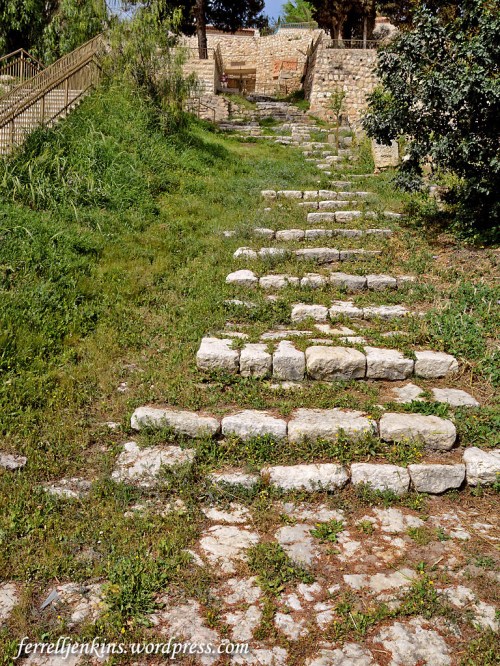
Did Jesus use these steps?

Jesus observed the Passover of the Jews somewhere in the upper city of Jerusalem, the present Mount Zion. Scholarly consensus locates the house of Caiaphas at a site near the Cenacle on Mount Zion. Another site, further down the slope toward the Pool of Siloam, is held by some as the house of Caiphas. It is  called St. Peter in Gallicantu (cock-crow). According to this tradition, it is the place where Jesus was taken after His arrest (Matthew 26:57). If correct, this would be the site of Peter’s denial of the Lord.

The late W. Harold Mare says,

Whatever interpretation is accepted, one is impressed with the ancient stone stairs that run from the vicinity of the Cenacle down past the Church of St. Peter in Gallicantu to the Pool of Siloam, stairs that are thought to be from the Jewish period. It could be that these were the very stairs used by Jesus as he went down from the Last Supper to the Kidron Valley and on to Gethsemane (John 18:1). (The Archaeology of the Jerusalem Area. Baker, 1987)

My understanding is that Jesus would have observed the Passover and instituted the Lord’s Supper in the Upper City. He then went with His disciples to Gethsemane. From there He was taken to the House of Caiaphas. Jesus may have taken these steps in both directions. Here is a photo of those stone stairs that I made last year.

First century steps leading to the Upper City. Photo by Ferrell Jenkins.

First century steps leading to the Upper City. Photo by Ferrell Jenkins.

New books from Carta Jerusalem

Carta Jerusalem, publisher of some wonderful resources about the Bible, Biblical History, and the Bible Land, recently sent me several new books. I will make brief mention of these books in hope that you will check the Carta online catalog to learn more. The books also are available from Amazon and some other publishers.

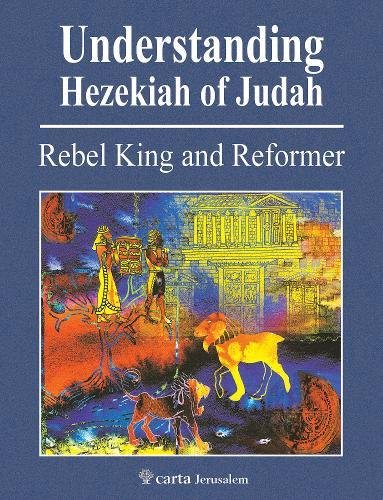
Understanding Hezekiah of Judah (Rebel King and Reformer) by Mordechai Cogan. This full-color paperback is 9″ x 11¾”, 40 pages. The book is based on the Bible and extra-biblical sources including archaeological discoveries. $14.95.

Carta Jerusalem's new Understanding Hezekiah of Judah.

Carta Jerusalem’s new Understanding Hezekiah of Judah.

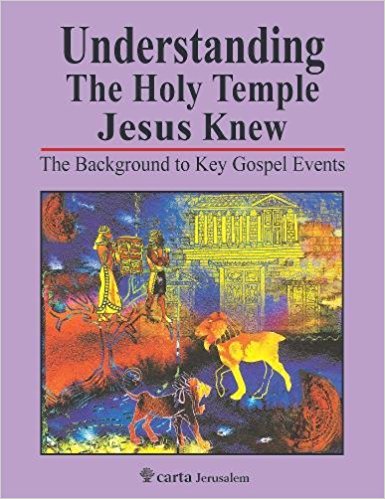
Understanding the Holy Temple Jesus Knew (The Background to Key Gospel Events) by Leen and Kathleen Ritmeyer. This full-color paperback is 9″ x 11¾”, 48 pages. $14.95. We have frequently mentioned the superb work of the Ritmeyer’s on the temple that Jesus knew.

Leen and Kathleen Ritmeyer's Understanding the Holy Temple Jesus Knew.

Leen and Kathleen Ritmeyer’s Understanding the Holy Temple Jesus Knew.

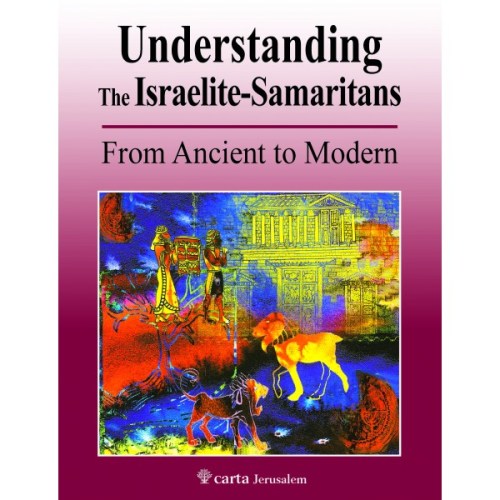
Understanding the Israelite-Samaritans (From Ancient to Modern) by BenyamimTsedaka. This full-color paperback is 9″ x 11¾”, 40 pages. The author is an Elder of the Samaritan community living in Israel. Having visited the Samaritan community on Mount Gerizim, I found this work to be extremely interesting. $14.95.

Understanding the Israelite-Samaritans by Carta Jerusalem.

Understanding the Israelite-Samaritans by Carta Jerusalem.

The Carta books mentioned above are lavishly illustrated with photos, drawings, and maps.

In a future post or two I will mention a few more of the new books supplied by Carta Jerusalem.

The women of Mount Samaria are like the cows of Bashan

Amos of Tekoa is recognized as a straight forward, no-nonsense, prophet (Amos 1:1). He called the women of the northern kingdom of Israel cows. Nothing politically correct about that.

Listen to this message, you cows of Bashan who live on Mount Samaria! You oppress the poor; you crush the needy. You say to your husbands, “Bring us more to drink!” (Amos 4:1 NET)

The sn (study note) in the NET Bible is worth reading.

The expression cows of Bashan is used by the prophet to address the wealthy women of Samaria, who demand that their husbands satisfy their cravings. The derogatory language perhaps suggests that they, like the livestock of Bashan, were well fed, ironically in preparation for the coming slaughter. This phrase is sometimes cited to critique the book’s view of women.

Bashan is in the area we now call the Golan Heights. It is located to the east of the Sea of Galilee and northward. Golan in Bashan was one of the cities of refuge located in the territory of eastern Manasseh (Joshua 20:8). The region was noted as good pasture land.

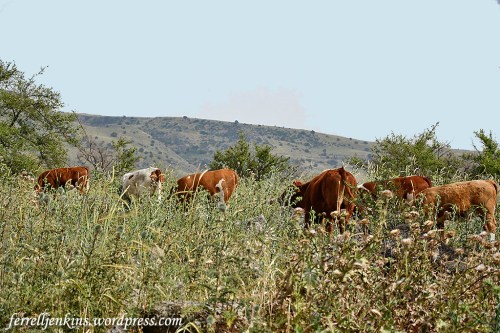
In the modern state of Israel we notice an attempt to grow crops known from biblical times in the same area where they were grown then. And the same is true of cattle. Here is a photo I made earlier this year of some of the cows grazing in ancient Bashan (modern Golan Heights).

Cows grazing in the Golan Heights, the area known as Bashan in Old Testament times. Photo by Ferrell Jenkins.

Cows grazing in the Golan Heights, the area known as Bashan in Old Testament times. Photo by Ferrell Jenkins.

The water system at Megiddo

Ancient people built their villages and towns near water sources. If there was not a spring at the base of the hill where they settled they would need to dig a well, a shaft, or a tunnel to reach the water source.

Many visitors to Israel have made their way through the water system at Megiddo. Professor David Ussishkin, who is able to include Megiddo among his numerous excavations, says,

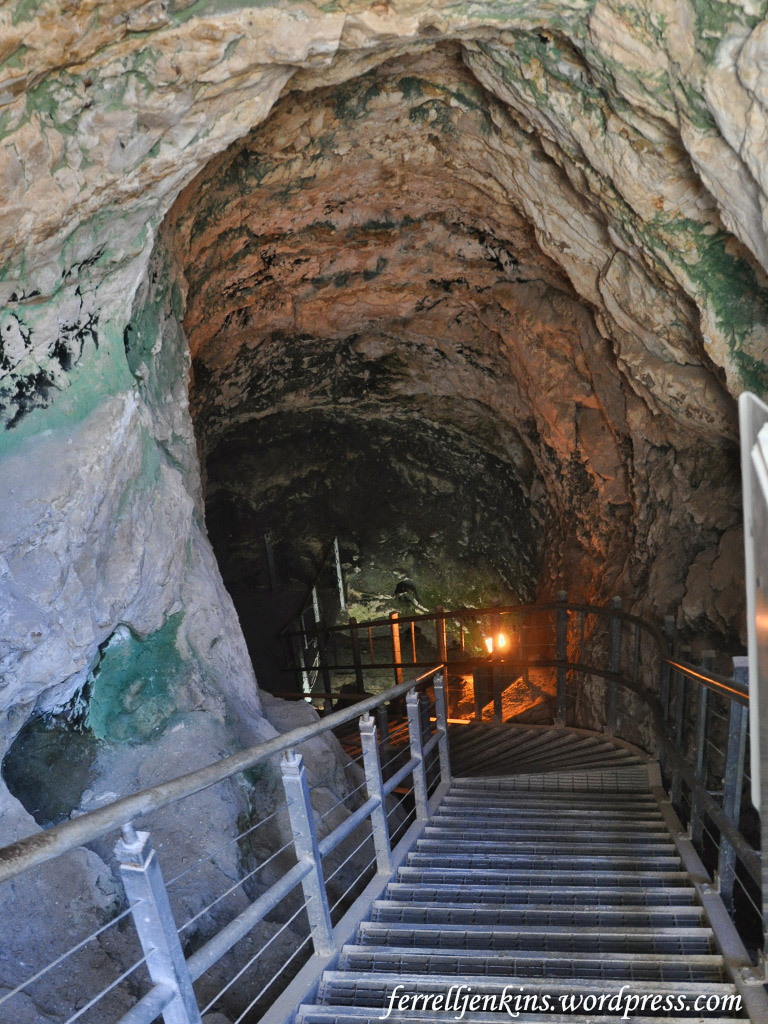
As mentioned before, there were two springs at Megiddo. The nearer one was located on the western side, at the bottom of the mound. There were two obvious difficulties in the use of the water by the inhabitants of the city. First, in order to obtain water for daily use, the inhabitants – and these were most probably the ladies – had to descend the steep slope down to the spring and then carry the water in jars back to their homes which were situated on the summit of the mound. Second, in time of siege, the spring remained outside the city-walls, and thus inhabitants could not reach it while the besieging army had easy access to the water. These difficulties were overcome by constructing a huge water system (Figs. 2.5; 2.22; 2.27). A vertical shaft was cut in the rock from the surface of the mound. Starting from the bottom of the shaft, a horizontal tunnel was cut in the rock till it reaches the spring. At the same time the approach to the spring from outside was blocked and hidden from view. The way to the spring now became easier and safer: one had to descend by rock-cut steps down the vertical shaft, and then walk through the horizontal tunnel to the spring.

In a later stage, the bottom of the horizontal tunnel was lowered, so that the water flowed by gravitation from the spring to the bottom of the vertical shaft. From here, the water could be raised with the aid of pulleys to the surface of the mound, saving a lot of work and energy.

Naturally, as time passed and the settlement was abandoned, the water system was filled with debris. The Chicago expedition [1933-1939] made a huge effort excavating and cleaning up the water system, restoring the steps in the vertical shaft, and preparing the place for visitors. The water system is now one of the major attractions for visitors to Megiddo.
Source: Ussishkin, David. On Biblical Jerusalem, Megiddo, Jezreel and Lachish. Hong Kong: Divinity School of Chung Chi College, Chinese University of Hong Kong. 2011: 66-67.

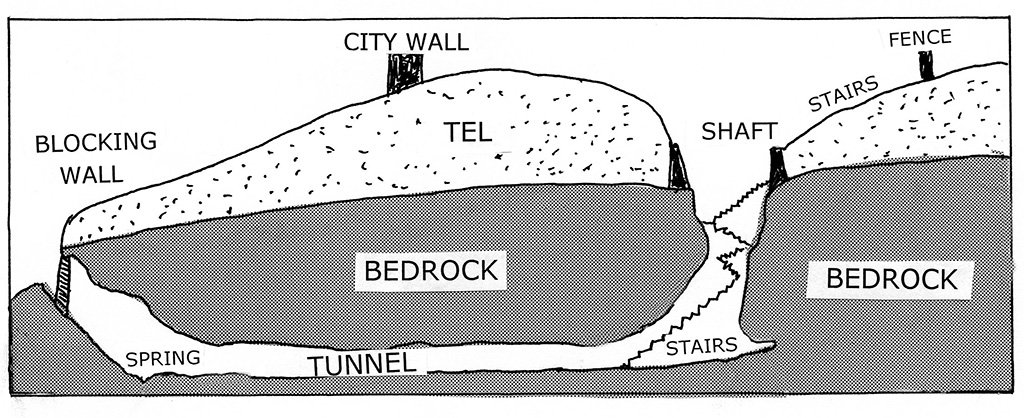
The sign at the entrance to the water system was in poor condition when I made my photo. I have made a drawing based on that sign showing the various elements of the system.

The Megiddo water system. Based on the sign at the site.

The Megiddo water system. Based on the sign at the site.

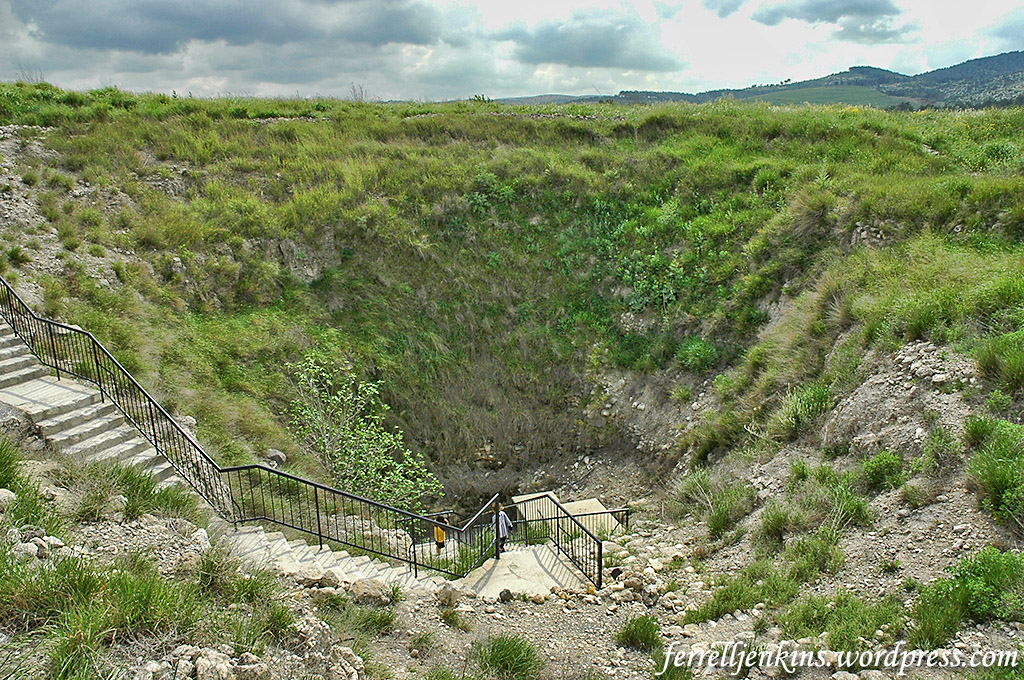
Our photos will take you through the water system step by step. The first photo shows a view of the entrance to the system from the top of the tel.

The shaft of the Megiddo water system from the top of the tel. Photo by Ferrell Jenkins.

The shaft of the Megiddo water system from the top of the tel. Photo by Ferrell Jenkins.

I see a variety of figures regarding the depth of the shaft and the length of the tunnel. The brochure distributed by the Israel Nature and Parks Authority says the shaft is 36-meters-deep [119 feet]. (Download the brochure here.) There are more than 180 steps down to the tunnel.

The same brochure says,

The tunnel was cut on an incline so the water would flow to the bottom of the shaft and the inhabitants could draw water while standing at the top. The outer entrance to the spring was sealed with a massive stone wall, concealed with earth so that an enemy besieging the city would not discover its location.

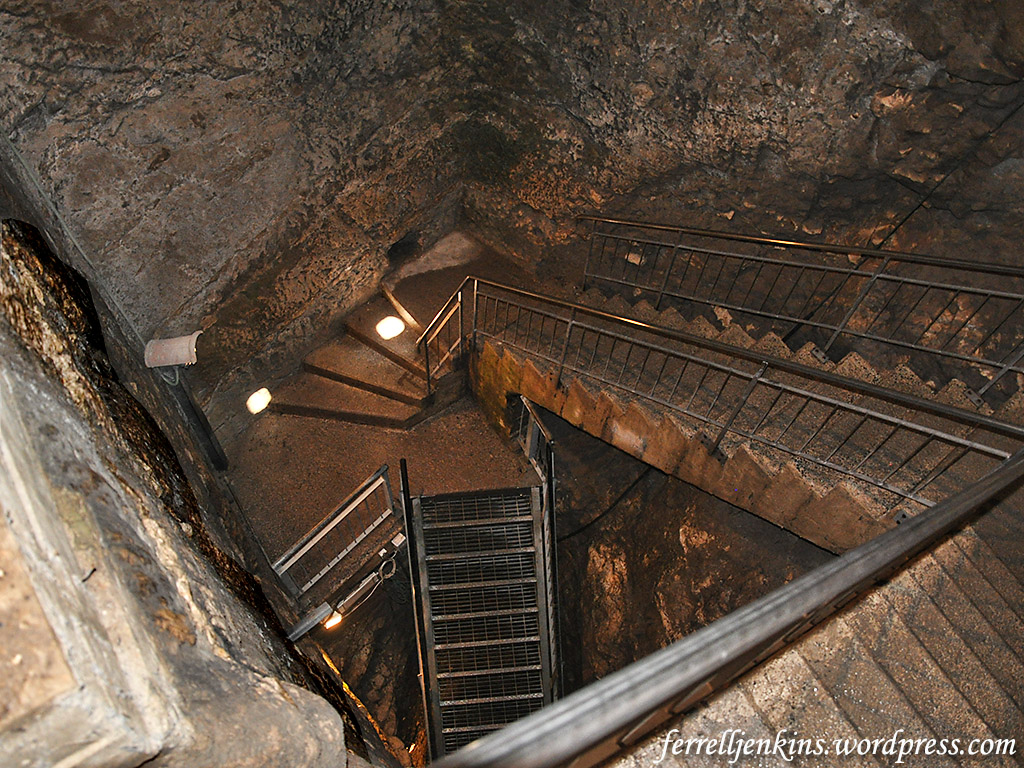
Steps going down to the level of the tunnel. Photo by Ferrell Jenkins.

Steps going down to the level of the tunnel. Photo by Ferrell Jenkins.

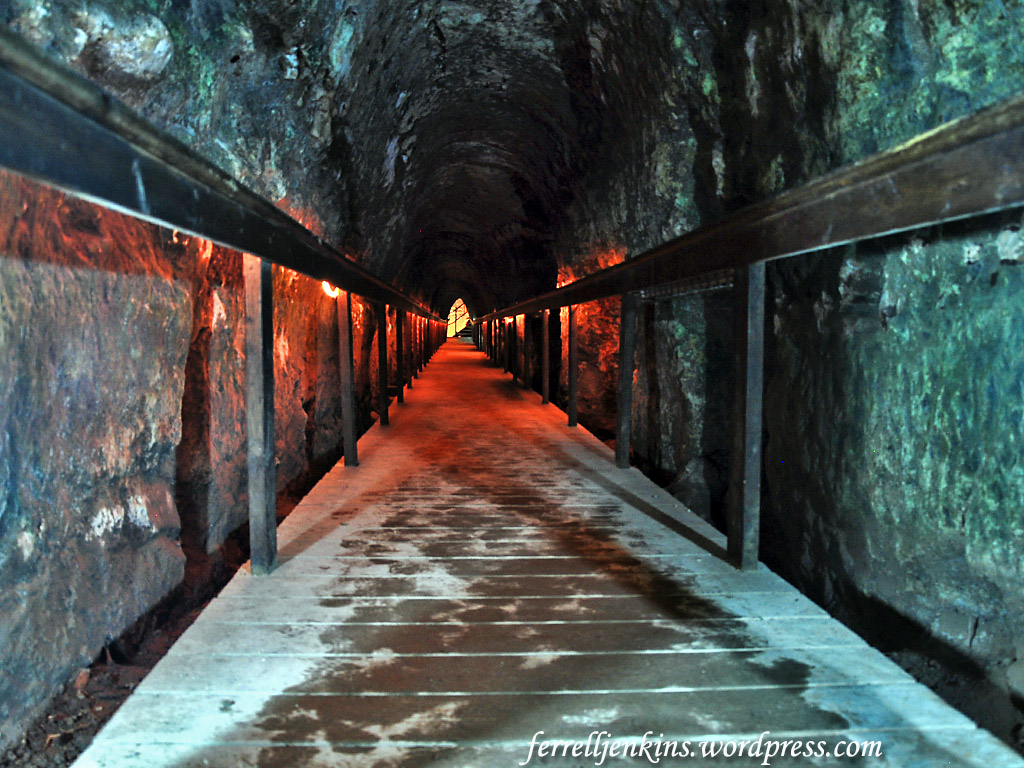
The water flowed from the spring on the western side of the tel through a 70-meter-long [230 feet] tunnel. I have never seen the water in the tunnel, but I recall a few times when tours were not allowed to go through the tunnel due to high water.

The tunnel at Megiddo with a modern walk for ease of traversing the length. Photo by Ferrell Jenkins.

The tunnel at Megiddo with a modern walk for ease of traversing the length. Photo by Ferrell Jenkins.

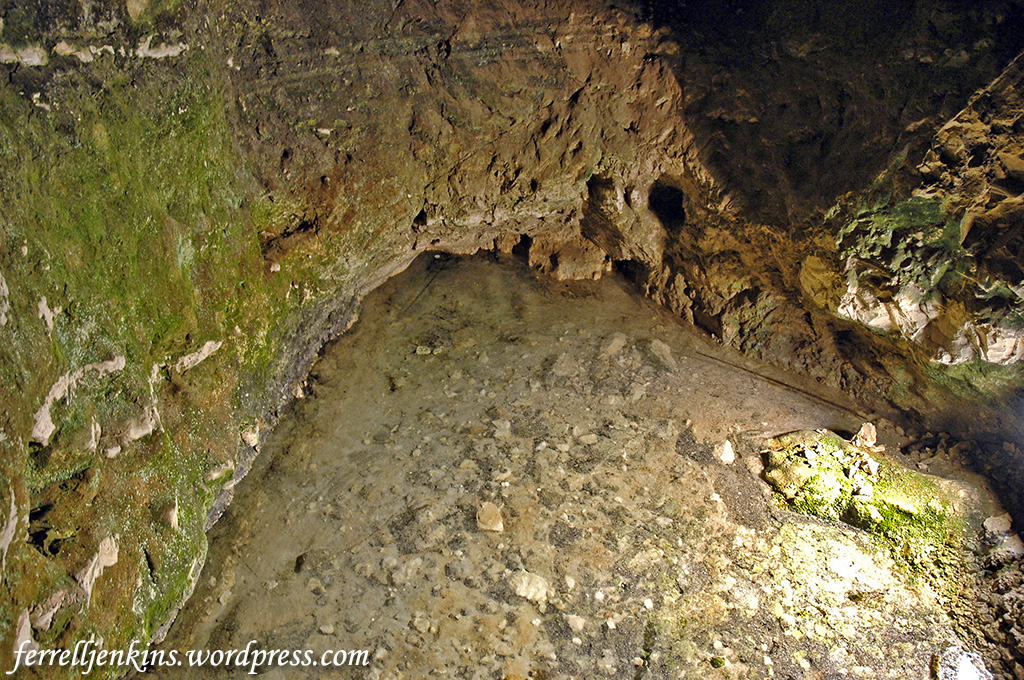
Only a small amount of water was seen at the spring in this 2006 photo.

The spring at it was on April 02, 2006. Photo by Ferrell Jenkins.

The spring at it was on April 02, 2006. Photo by Ferrell Jenkins.

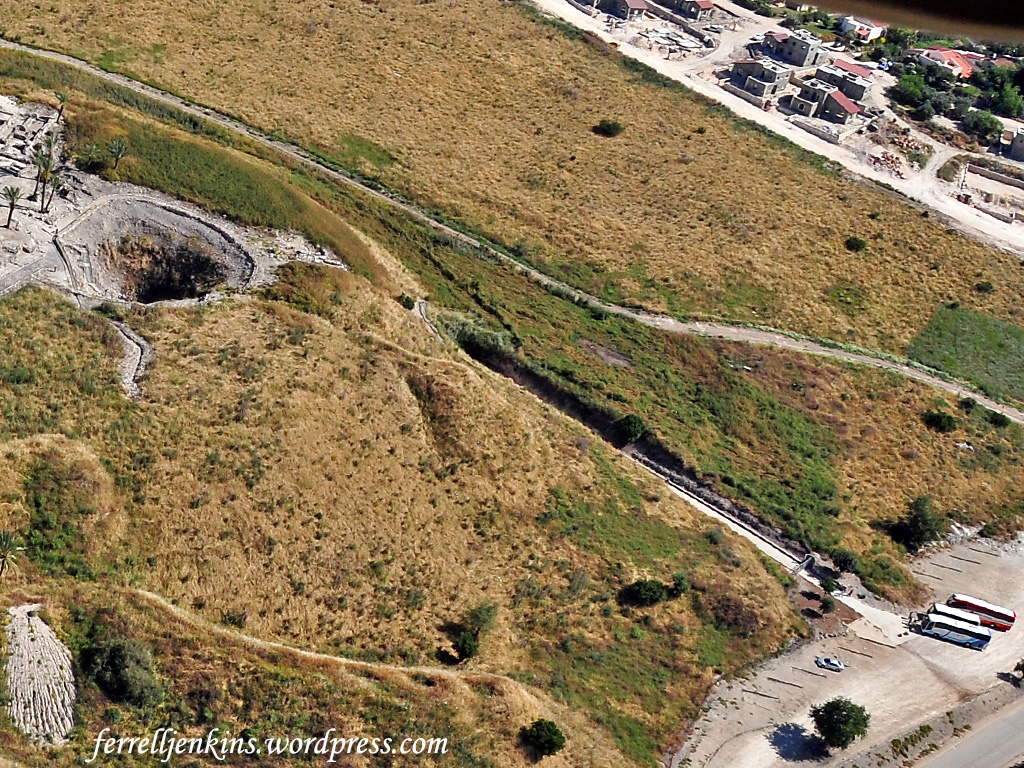
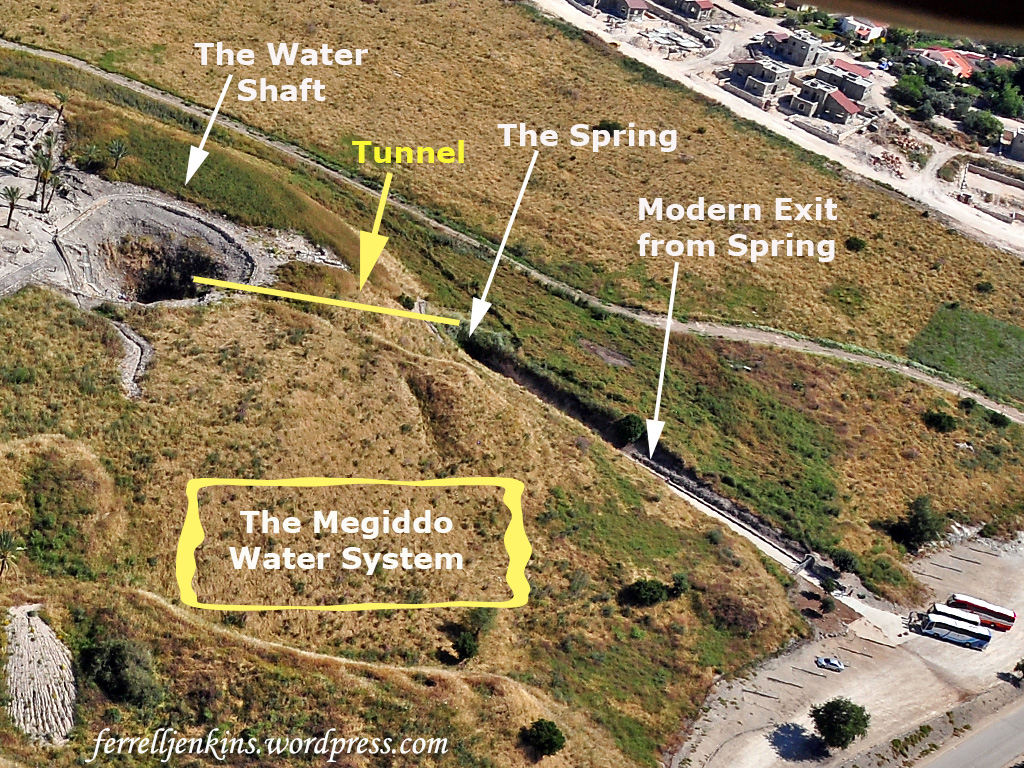
The aerial photo below shows the portion of the tel where the water system is located. You can see the opening of the shaft, and you can see there the tour buses are parked awaiting the tourists who have visited the tel and walked through the tunnel. A modern cut has been made to the modern steps leading to the spring.

Aerial view of the Megiddo water system. Photo by Ferrell Jenkins.

Aerial view of the Megiddo water system. Photo by Ferrell Jenkins.

Our next image is the same photo annotated to show the various parts of the system. Compare this with the drawing above.

Annotated aerial photo showing elements of the water system. Photo by Ferrell Jenkins.

Annotated aerial photo showing elements of the water system. Photo by Ferrell Jenkins.

The next photo was made near the top of the steps that lead from the spring to the exit.

After exiting the tunnel, this is the view down the steps to the spring. Photo by Ferrell Jenkins.

After exiting the tunnel, this is the view down the steps to the spring. Photo by Ferrell Jenkins.

During the early days of my visits I prepared a book about places we visited throughout the Bible Lands. In 1976 the book was published under the title The Book and the Land. In it I stated the understanding at the time that the water system dated to the 12th century B.C. (p. 63)

In the most recent tour guide (2016) I said,

A water system and tunnel which brought water from a spring outside the city is now thought to belong to the time of Ahab.

Chris McKinny gives the dates of Ahab’s reign as 874-863 B.C. in The Regnal Chronology of the Kings of Judah and Israel.

Not all of the smart people live in the 21st century A.D.