Category Archives: Bible Places

Laodicea Photos

Laodicea is known to us from the book of Revelation (1:11; 3:14-22), and from Paul’s epistle to the Colossians.

For I testify for him that he has a deep concern for you and for those who are in Laodicea and Hierapolis. Luke, the beloved physician, sends you his greetings, and also Demas. Greet the brethren who are in Laodicea and also Nympha and the church that is in her house. When this letter is read among you, have it also read in the church of the Laodiceans; and you, for your part read my letter that is coming from Laodicea. (Col 4:13-16 NAU)

Ben Witherington has posted several nice photos recently made at Laodicea. Take a look here. These photo are high resolution and may be reduced and enhanced a bit for use in class and sermon presentation. Ben concludes his post with these words:

There is much more to be said, but let this be said at this juncture.  The archaeological evidence at Laodicea simply confirms what the NT suggests about the city– it was large,  rich in the first century, a city materially on the rise, but sometimes prosperity has a deadening effect on spirituality as John of Patmos reminds.   The reconstruction of the city today is a work still in progress— but then, so are we. If even Laodicea warrants a visit from the Master who knocks and promises to enter and sup with them, despite all its sin and shortcomings, then there is still hope for us.

The photo below is one I took showing what was labeled “North Temple” at the time. I see on the new sign Ben includes among his photos the structure (# 15) is labeled “Corinth Temple and North Basilica.” The white area on the hillside across the Lycus River valley marks the limestone formations of Hierapolis (Colossians 4:13; modern Pamukkale).
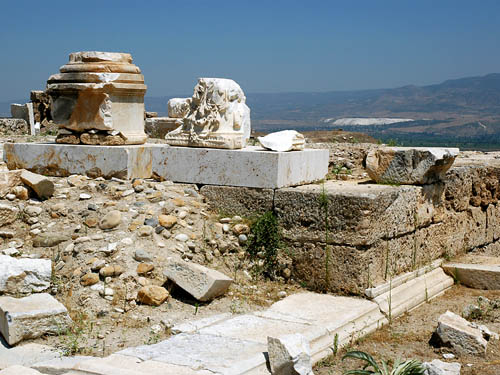
Temple ruins at Laodicea. View north to Hierapolis. Photo by Ferrell Jenkins.

Temple ruins at Laodicea. View north to Hierapolis. Photo by Ferrell Jenkins.

Thanks, Ben. We look forward to more good material from Turkey.

We called attention to the water distribution system of Laodicea here.

HT: Brooks.
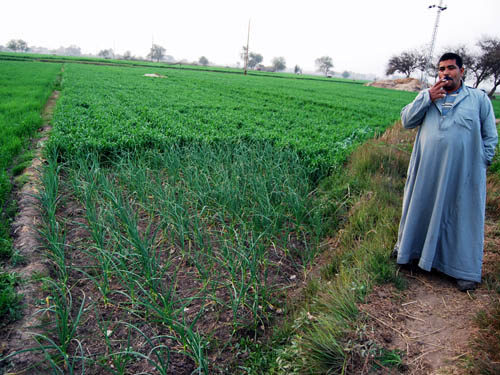
Leeks in the land of Goshen

Israel’s experience in the Sinai wilderness might be summarized by the two words complained and murmured. One such account is given in Numbers 11.

We remember the fish we ate in Egypt that cost nothing, the cucumbers, the melons, the leeks, the onions, and the garlic. But now our strength is dried up, and there is nothing at all but this manna to look at.” (Numbers 11:5-6 ESV)

The Land of Goshen, where the Israelites lived, was located in the eastern Nile Delta along the Pelusiac Branch of the Nile. The land is flat and fertile, and their are canals with water. Because water is rare in the wilderness (or desert) crops are also rare.

From the wilderness, the great meals of fish and vegetables in Egypt looked good to the Israelites. The hard days of oppression were overlooked. (A lot like the bondage of sin!) I had an opportunity to be in some of the fields in Goshen. The farmers grow crops for the cattle, but they use the corners of the fields to grow vegetables for their own use. I saw leeks and cabbage.

Field in the land of Goshen. Photo by Ferrell Jenkins.

Field in the land of Goshen. Photo by Ferrell Jenkins.

The white object in the field is one of the pieces of the colossal statue of Rameses that we mentioned in an earlier post. Smoking is widespread in Egypt.

The Samaritans

Samaritan Priest with Samaritan Pentateuch Scroll. Photo by Ferrell Jenkins.

Samaritan Priest with Samaritan Pentateuch Scroll. Photo by Ferrell Jenkins.

“Samaritans use modern means to keep ancient faith” is the title of an informative article about the modern Samaritans on Mount Gerizim at Reuters. A slide show of 10 good photos is included. I especially liked the one showing the priest in the museum with a painting of Jesus and the Samaritan woman at the well.

We recently wrote about the meeting of Jesus with the woman of Samaria at Jacob’s Well here. We wrote about Jesus passing through Samaria here.

Todd Bolen’s article on the Samaritan Passover may be read here.

Years back I made black and white photos for use in publications. This one shows a Samaritan priest displaying a copy of the Samaritan Pentateuch. He said it was the oldest book in the world. Textual scholars think it is no older than the 12th century A.D.

A Reuter’s Blog here gives some additional information about how the reporters got to Mount Gerizim. Check the video at the bottom of the page.

HT: Joseph Lauer; Paleojudaica.

New discoveries in the land of Goshen

The storage city of Rameses was identified with Tanis in the past, but it is now identified with Tell el Daba in the eastern Nile Delta. Here is what the Bible says about Rameses in the land of Goshen:

  • It is called the land of Rameses (Genesis 47:11).
  • The Israelites built the storage cities of Pithom and Rameses (Exodus 1:11).
  • Rameses was the starting point of Israel’s exodus from Egypt (Exodus 12:37; Numbers 33:3, 5).

Prof. Dr. Manfred Bietak.

Prof. Dr. Manfred Bietak

Austrian archaeologists, under the direction of Professor Dr. Manfred Bietak and Irene Forstner-Mueller, have been working at Tell el Daba for several years. The history of this area may be divided into three periods:

  • Pre-Hyksos, when the city was named Rowaty (the door of the two roads).
  • Hyksos (about 1663-1555 B.C.), when the city was named Avaris.
  • Post-Hyksos, when the city was named Peru-nefer (happy journey).

The excavators recently uncovered a cuneiform letter written in southern Mesopotamian style. It is thought to date to the time of the Old Babylonian Kingdom of Hammurabi. The news release indicates a date of about 1600-1550 B.C. This illustrates a significant contact between Egypt and Mesopotamia.

Cuneiform Tablet from Tell el Daba.

Babylonian Cuneiform Tablet from Tell el Daba in the land of Goshen.

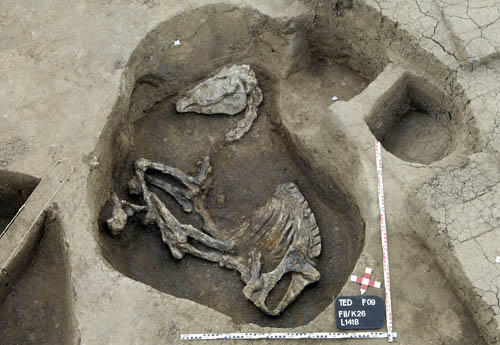
A second discovery was the burial of a horse, a mare likely used for breeding. Horses were introduced into Egypt by the Hyksos. The location of the burial near the palace of the Hyksos king Khayan suggests that this mare was a pet of the king.

Hyksos horse skeleton discovered at Tell el Daba.

Hyksos horse skeleton discovered at Tell el Daba.

The complete news release may be read in German here. Photos Copyright: Österreichisches Archäologisches Institut (ÖAI) Kairo. I had the pleasure of visiting Tell el Daba in January, 2009.

HT: Joseph I. Lauer

Paul in Ephesus

Paul taught in the school of Tyrannus during his stay in Ephesus. We need not think that Paul was assigned as an Associate Professor, or Lecturer. He may have simply used a rented facility or hall for his teaching.

But when some were becoming hardened and disobedient, speaking evil of the Way before the people, he withdrew from them and took away the disciples, reasoning daily in the school of Tyrannus. (Acts 19:9)

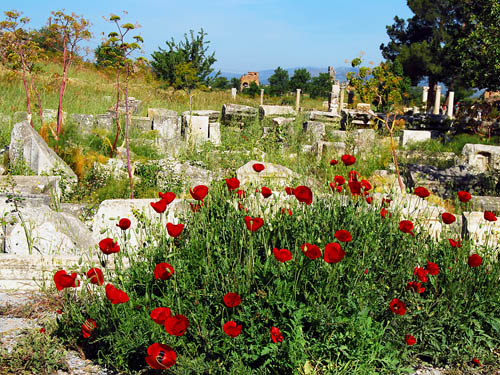
When we visit Ephesus today we see nothing but ruins and a few partially reconstructed buildings. We wonder about all of the things that happened to Paul, Apollos, Aquila, Priscilla, and Timothy in these places. Meditate on these things as you enjoy today’s photo.

Flowers blooming among the ruins at Ephesus. Photo by Ferrell Jenkins.

Flowers blooming among the ruins at Ephesus. Photo by Ferrell Jenkins.

Discovery of the Roman Pool of Siloam

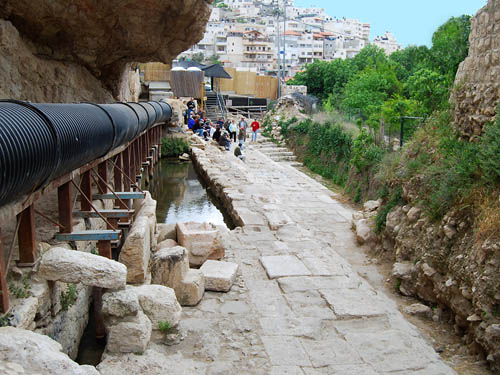
In early June, 2004, an announcement was made by Ronny Reich and Eli Shukron of the discovery of a pool dating to the Second Temple period (Herod’s temple). Continuing excavations have revealed three sets of stairs leading down into the pool. Most of the pool has not yet been uncovered. In November, 2005, I spoke with Professor Reich at the pool and he explained several things about the discovery.

A feature article was published in Biblical Archaeology Review, Sept.-Oct., 2005. Todd Bolen of BiblePlaces.com, who assisted in the excavations at the site, included some comments on his BiblePlaces Blog here in August, 2005. Many reports that appear in the news media are incomplete and sometimes misleading.

Pool of Siloam. View toward East. Byzantine pool is to our back. Photo by F.Jenkins.

Pool of Siloam. View toward East. Byzantine pool is to our back. Photo by F. Jenkins.

See Todd’s photos and comments about The Pool of Siloam Revealed at BiblePlaces.com.

Our photo shows the northern steps and the eastern corner of the pool. You can detect the present road level at the top of the wooden steps. In the distance, across the Kidron Valley, you can see a hill south of the Mount of Olives, sometimes called the Hill of Evil Counsel. Beyond that lies the Judean Wilderness.

Get 1,000 Bible Images now

Logos has announced the publication of 1,000 Bible Images for the pre-pub price of $19.95. Estimated ship date is June 2. This means you should buy today! Check full info here. I think these are all black and white drawing, but they will look good in PowerPoint or for use in class handouts. Here is a brief description of the program.

Don’t just read the Bible, see the Bible!

Now you can literally see the people, places, and events of the Bible text—right in front of your eyes! Bring your study of the Bible to life with this collection of 1,000 images, drawings, and illustrations—all produced by professional artists under the supervision of biblical scholars, in association with the German Bible Society. This vivid artwork shows the biblical sites, religious objects, plants and animals, archaeological findings, scenes from daily life in the Bible, and much more! As reliable documentation of biblical life, these images often give a better illustration and explanation than the text itself can give.

Each image includes information which explains the historical and archaeological background, giving you context and study material to understand scenes from the Bible, making this collection a must-have for teachers and pastors, as well as anyone interested in the history, archaeology, and culture in the Bible.

What’s more, with Logos, you can quickly access the Bible text relevant to each image! We make it easy to search for images by keyword, by Bible reference, or by each image description. These images will aid your personal study and sermon preparation, and will serve as a valuable teaching tool when you use them on your handouts or projected presentations. As you study the Bible, you can instantly see what you’re reading about!

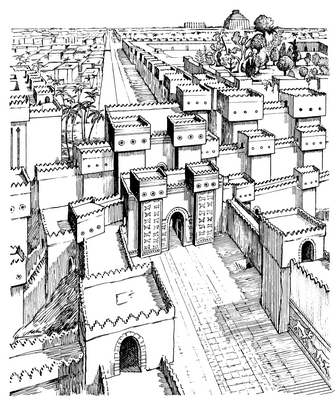
This program is in the Libronix Digital Library System and may be downloaded (by those who have the LDLS installed, or by DVD. Here is a reduced illustration from the publication.

Drawing of Ancient Babylon from 1,000 Bible Images.

Drawing of Ancient Babylon from 1,000 Bible Images.

HT: Bible Places Blog.

The Lion of Babylon

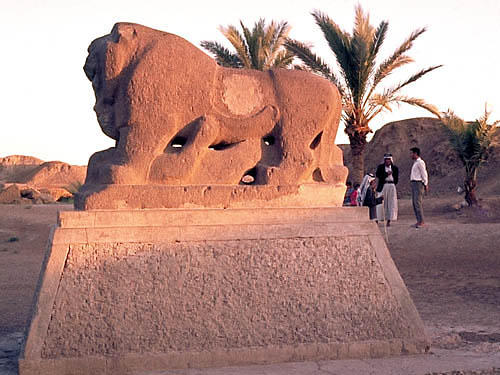
Babylon was excavated by Germans between 1899 and 1917. Local villagers discovered the image of a lion trampling a man during one of the periods when the archaeologists were not present. Upon return, the archaeologists completed the excavation of the image. This is the way the sculpture looked in 1970. I have noticed the image in several photo by American military personnel.

The Lion of Babylon trampling a man. Photo by Ferrell Jenkins.

Andre Parrot says,

There is … no such certainty about the basalt statue of a lion trampling on a man. This extraordinary work, which represents a beast overcoming a man, does not seem to be Mesopotamian in origin; it has been thought to be Hittite. (Babylon and the Old Testament 29-30)

Parrot also points out that the lion was associated with the goddess Ishtar.

The Bible records that Nebuchadnezzar and the Babylonians captured the city of Jerusalem in the days of Jehoiachin the king of Judah (2 Kings 24).

He carried away all Jerusalem and all the officials and all the mighty men of valor, 10,000 captives, and all the craftsmen and the smiths. None remained, except the poorest people of the land. And he carried away Jehoiachin to Babylon. The king’s mother, the king’s wives, his officials, and the chief men of the land he took into captivity from Jerusalem to Babylon. And the king of Babylon brought captive to Babylon all the men of valor, 7,000, and the craftsmen and the metal workers, 1,000, all of them strong and fit for war. (2 Kings 24:14-16 ESV)

Another view from Babylon

The early part of the week finds me traveling in Alabama, but I brought along another old slide scan of a photo I made at Babylon in 1970. When I compare the quality of the camera I used that year with the one I use today it is amazing that the old photo is this good. Slides fade even under the best home conditions.

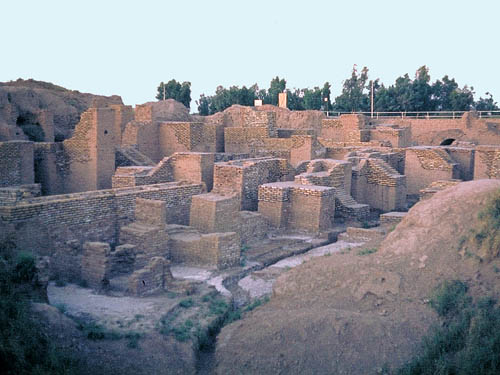
This site is identified as Nebuchaznezzar’s Principal Palace. You will notice that even then, long before Saddam Hussein, some reconstruction had been carried out at the site. The lighter colored bricks at the top of the walls are part of the reconstruction to give the viewer some idea of what was original. It also helps one to visualize the size of the rooms, etc. This is the sort of thing we see at Masada, Megiddo, and other sites in Israel where the black line distinguishes the original from the reconstructed.

Nebuchadnezzar's Principal Palace in 1970. Photo by Ferrell Jenkins.

Nebuchadnezzar's Principal Palace in 1970. Photo by Ferrell Jenkins.

I understand the white on the ground to be salt residue.

The prophet Isaiah predicted the overthrow of the Neo-Babylonian Empire.

And Babylon, the glory of kingdoms, the splendor and pomp of the Chaldeans, will be like Sodom and Gomorrah when God overthrew them. (Isaiah 13:19 ESV)

God spoke, and it happened.

Colonial archaeologists and the Ishtar Gate

Recently we called attention to an article in The New York Times about Babylon. Writer Steven Lee Myers says,

Colonial archaeologists packed off its treasures to Europe a century ago.

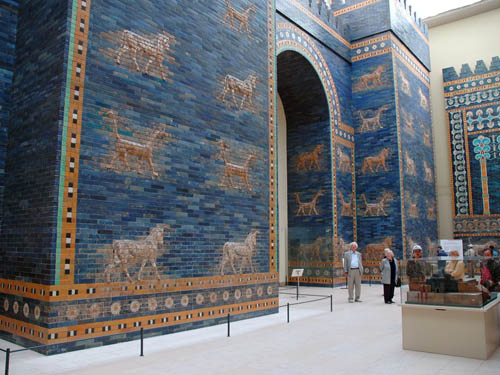
This statement seemed significant enough to be repeated under the photo of the miniaturized Ishtar Gate at the site. My immediate reaction to the statement is, “Well, aren’t we glad!” Anyone who has visited the Pergamum Museum in Berlin has seen the reconstructed Ishtar Gate. It looks like this.

Ishtar Gate in the Pergamum Museum of Berlin. Photo by Ferrell Jenkins.

Ishtar Gate in the Pergamum Museum of Berlin. Photo by Ferrell Jenkins.

Now, it’s not that the German archaeologists, under the direction of Robert Koldewey, “packed off” what you see here. All of these lions, bulls, and dragons were excavated from the mound of ancient Babylon between 1899 and 1912. Eventually they were taken to Berlin in 1926. Even under the Communist government of East Germany this gate was preserved. I saw it a few times before the Berlin Wall came down. Anyone able to travel to Berlin may see the Ishtar Gate as well as the reconstructed Procession Street. Can one say as much for the ruins of Babylon and the museum in Baghdad?

Babylon was once the greatest city of the world when the Neo-Babylonian Empire reigned supreme in the Ancient Near East (626-539 B.C.). The prophet Daniel was active in Babylon from 605 B.C. until after the fall of the city to the Persians (Daniel).  I can not imagine that he failed to see this gate.

Nebuchadnezzar was a megalomaniac. His pride is evident in the statement recorded by the prophet Daniel.

The king uttered these words: “Is this not the great Babylon that I have built for a royal residence by my own mighty strength and for my majestic honor?” (Daniel 4:30 NET Bible)