Category Archives: Bible Lands

Biblical Studies Info Page

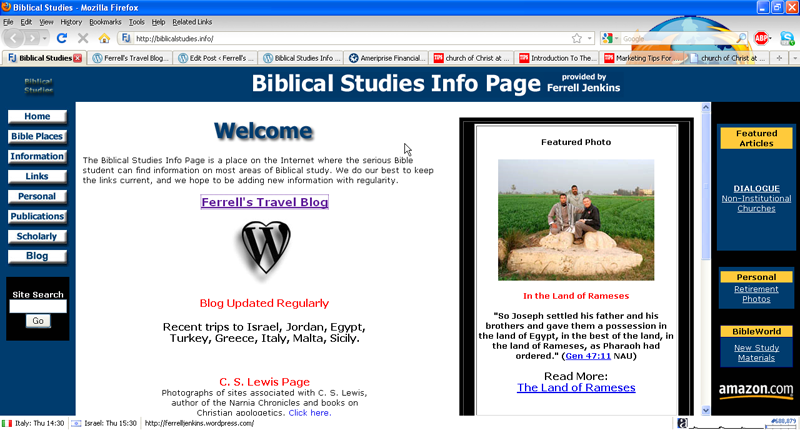
Biblical Studies Information Page. For the past ten years I have maintained the Biblical Studies Info Page here. The site was established under another name about four years earlier, then transferred to my own domain. While there are some articles posted there, the site is mostly a series of links to material that I consider worthwhile, especially for the person who has a limited number of sources available in his/her own library. I have fewer hits now than I did several years ago. I think one major reason is that people use search engines such as Google and Yahoo.

Let me suggest that there is still a value to using the Biblical Studies Info Page. The material is divided into several categories which are noted on the left side of the home page. The Links page is of primary interest to readers associated with churches of Christ. The Bible Places category can be very helpful if one is looking for information on biblical sites. (Incidentally, to my knowledge this page was online a few months prior to the highly popular Bibleplaces.com.)
Biblical Studies Info Page

Front page of the Biblical Studies Info Page.

Probably the most important category is marked Scholarly. This page is not scholarly in the sense of doctoral dissertation’s are scholarly (or should be!). I envisioned it as a page of material that a “lay” person could read and be able to have some confidence in. Sometimes there are two links to differing views on a subject. I intend for people to think, examine, and draw their own conclusions. The categories within the page are important: Apologetics, Culture; Archaeology & the Bible; Bible Study Software & Tools; Bibles Available Online; Biblical Backgrounds; Biblical Criticism: Manuscripts & Translations; Blogs and News Pertaining to Biblical Studies; Books; Church History; Documenting Your Online Research; Evangelism; Greek Studies; Judaism; Maps of Bible Lands; Museums and Traveling Exhibits; New Testament Background; Old Testament Materials; Patristics; Periodicals: Scholarly Journals; Photos and Art; Resource Indices; Restoration Movement (history); Study Materials: Online; Theology.

A Video Surprise

By surprise one day I received an Email from Tony Eldridge, a young author and book marketing expert. Tony writes a blog filled with good tips for people who have books to promote. Begin with his home page here, and move on to the blog.

What surprised me was that Tony had prepared a short video explaining the value of the Biblical Studies Info Page for members of the church where he is a member. You might enjoy his introductory video here. He also reviews other web sites that he considers helpful to Bible students.

Our thanks to Tony.
The vineyard of the man lacking sense

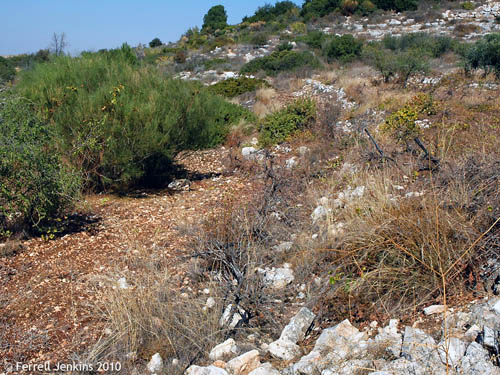
I passed by the field of the sluggard And by the vineyard of the man lacking sense, And behold, it was completely overgrown with thistles; Its surface was covered with nettles, And its stone wall was broken down. When I saw, I reflected upon it; I looked, and received instruction. “A little sleep, a little slumber, A little folding of the hands to rest,” Then your poverty will come as a robber And your want like an armed man. (Proverbs 24:30-34 NAU)

Neglected vineyard at Neot Kedumim. Photo by Ferrell Jenkins.

Neglected vineyard at Neot Kedumim. Photo by Ferrell Jenkins.

A broken stone wall of the vineyard. Photo by Ferrell Jenkins.

A broken stone wall of the vineyard. Photo by Ferrell Jenkins.

These images might also provide some insight into the statement of the Shulammite girl.

Do not stare at me because I am swarthy, For the sun has burned me. My mother’s sons were angry with me; They made me caretaker of the vineyards, But I have not taken care of my own vineyard. (Song of Solomon 1:6 NAU)

Many worthwhile applications may be drawn from the Scriptural truth illustrated by these photos. I hope you will take a little time today to meditate on these things.

Larger photos suitable for use in sermons and Bible classes are available by clicking on the image.

Palestine Exploration Fund’s photostream

The Palestine Exploration Fund has posted some fascinating historical photos from the nineteenth and early twentieth-century that will be of interest to students of historical geography and archaeology. The link is here.

Once you get there scroll down to the second line of photos where you will see a photo made sometime between 1930 and 1936 of John Garstang working at Jericho. He is making photos of the abundance of pottery found at that spot.

Working through this collection is going to be fun.

The photos are marked “© All rights reserved.” Those who wish to use them for educational purposes should be able to do so under the copyright Fair Use provision.

HT: Paleojudaica and Biblical Paths.

Sharks at Sharm el-Sheikh in the Sinai

Even our local TV news is reporting on the shark attacks at Sharm el-Sheikh in Egypt. Sharm el-Sheikh is located  on the tip of the Sinai Peninsula. The Huffington Post includes numerous links for those who have an interest in this subject here.

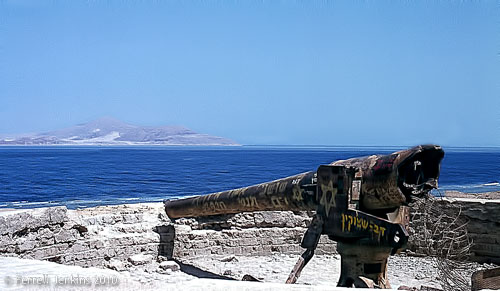
I have been in the Sinai peninsula several time, but have visited Sharm el-Sheikh only once in 1973. At that time the Sinai was under Israeli control. The site played an important role in the June War of 1967. The United Arab Republic closed the Straits of Tiran to Israeli shipping and blockaded all ships headed for Eilat. This narrow waterway and one of the Egyptian guns is seen in the old photo I made. Today Israel and Egypt share diplomatic relations and the Sinai is under Egyptian control. Sharm el-Sheikh is one of Egypt’s most popular resorts.

Egyptian gun taken by Israel at the Straits of Tiran in 1967. Photo by Ferrell Jenkins.

Egyptian gun taken by Israel at the Straits of Tiran in 1967. Photo by Ferrell Jenkins.

The Sinai is significant in biblical history because the traditional location of Mount Sinai is located there, equated with Jebel Musa.

The glory of the LORD settled on Mount Sinai, and the cloud covered it for six days. On the seventh day He called to Moses from the cloud. (Exodus 24:16 CSB)

Scholars are not in agreement on the location of Mount Sinai. In the beautiful revised edition of the Zondervan Atlas of the Bible, geographer Carl G. Rasmussen says,

… there are at least twelve different candidates for Mount Sinai: five in the southern part of the peninsula, four in the north, one in the center, one in Midian (Saudia Arabia), and another in Edom (southern Transjordan). — page 103

Uriah’s trip from Jerusalem to Rabbah

Last evening I was looking at the biblical account of David’s battles against the Ammonites (2 Samuel 10-11).

In the spring of the year, at the time when kings normally conduct wars, David sent out Joab with his officers and the entire Israelite army. They defeated the Ammonites and besieged Rabbah. But David stayed behind in Jerusalem. (2 Samuel 11:1 NET)

You probably know the rest of the story. David is attracted to Bathsheba, commits adultery, learns Bathsheba is pregnant, calls Uriah home in hope that he will spend the night with Bathsheba. Uriah acted in the true warrior way by not enjoying the benefits of the marriage bed while his companions were camping in the open field. David sent Uriah back to the battle with a letter to Joab to put Uriah in the forefront of the battle.

Have you thought about the journey made by Uriah and the other Israelite soldiers as they traveled from Jerusalem to Rabbah and back? You know where Jerusalem is located. It is situated on the eastern side of the water parting ridge of Israel at an elevation of about 2400 feet above sea level. Numerous times we have discussed the journey from Jerusalem to the Jordan Valley. See here and here.

The distance from Jerusalem to the Dead Sea is not more than 20 miles. The elevation drops from about 2600 feet at the Mount of Olives to (currently) about 1384 feet below sea level at the surface of the Dead Sea. The point of crossing at the Jordan River would be a little higher. From there one must go up into the Transjordan Tableland to reach Rabbah. The general elevation of the Transjordan Tableland is about 3000 feet above sea level. Amman is about 2500 feet above sea level. That makes this a difficult route of travel.

Rabbah (Rabbath), the capital of ancient Ammon, is the site we now know as Amman, capital of Jordan. During the Hellenistic period the city was renamed Philadelphia.

The total distance from Jerusalem to Rabbah is about 40 miles as the crow flies. Men rarely travel like crows. The distance by road is longer and more difficult.

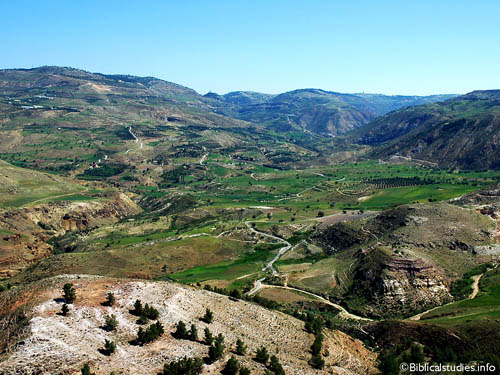
The photo I wish to share today was made in early April. It was made along a road a little east of the Jordan Valley and the Plains of Moab. From here you can see the terrain David’s men, including Joab and Uriah, had to travel on their way from Jerusalem to Rabbah. Modern Amman is located in the mountains we see on the horizon.

View looking east toward Amman. Photo by Ferrell Jenkins.

View looking east toward Amman. Photo by Ferrell Jenkins.

Learning routes of travel is one of the most important values in visiting the Bible lands. I hope this photo will help you with your study of the biblical account.

Astronaut photo of Egypt, Israel and Jordan at night

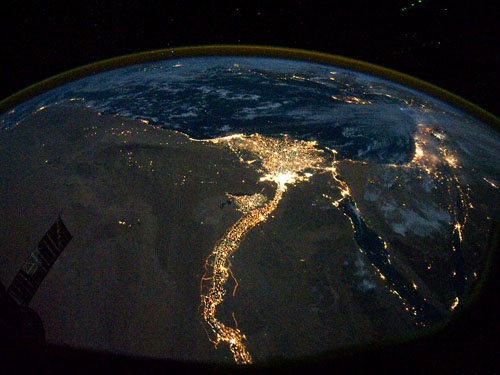
The satellite photo below is one of the fabulous photos made by NASA astronauts from space. The emphasis in this photo is the Nile Delta at night. You are able to see the portion of Egypt where most of the people live. The Sinai, Israel and Jordan are also visible. To the north, the island of Cyprus and the south shore of Turkey can be seen.

NASA Astronaut Photography of the Egypt and Israel by night.Astronaut photo of Egypt, Israel and Jordan at night.

NASA provides a helpful explanation of the photo.

One of the fascinating aspects of viewing Earth at night is how well the lights show the distribution of people. In this view of Egypt, we see a population almost completely concentrated along the Nile Valley, just a small percentage of the country’s land area.

The Nile River and its delta look like a brilliant, long-stemmed flower in this astronaut photograph of the southeastern Mediterranean Sea, as seen from the International Space Station. The Cairo metropolitan area forms a particularly bright base of the flower. The smaller cities and towns within the Nile Delta tend to be hard to see amidst the dense agricultural vegetation during the day. However, these settled areas and the connecting roads between them become clearly visible at night. Likewise, urbanized regions and infrastructure along the Nile River becomes apparent (see also The Great Bend of Nile, Day & Night.)

Another brightly lit region is visible along the eastern coastline of the Mediterranean—the Tel-Aviv metropolitan area in Israel (image right). To the east of Tel-Aviv lies Amman, Jordan. The two major water bodies that define the western and eastern coastlines of the Sinai Peninsula—the Gulf of Suez and the Gulf of Aqaba—are outlined by lights along their coastlines (image lower right). The city lights of Paphos, Limassol, Larnaca, and Nicosia are visible on the island of Cyprus (image top).

Scattered blue-grey clouds cover the Mediterranean Sea and the Sinai, while much of northeastern Africa is cloud-free. A thin yellow-brown band tracing the Earth’s curvature at image top is airglow, a faint band of light emission that results from the interaction of atmospheric atoms and molecules with solar radiation at approximately 100 kilometers (60 miles) altitude.

The image is used courtesy of the Image Science & Analysis Laboratory, NASA Johnson Space Center. You may access various images at their website here. An annotated photo is available there.

HT: Aantekeningen bij de Bijbel

“Lands of the Bible” 2011 calendar

Lands of the Bible 2011 CalendarEveryone who has visited Israel, or those who wish they had, enjoy seeing good pictures of the lands of the Bible. Orange Circle Studio, a leading calendar publisher, produced a beautiful calendar for 2011 using the photographs of Todd Bolen.

A friend sent me a copy of the calendar as a gift. I enjoyed it as soon as I browsed through it, and expect to enjoy it for the next 14 months. I thought some of our readers who appreciate good photos of the Bible land would enjoy the calendar. Todd has a few of the calendars available at a discount price (postpaid). For more information go to the Bible Places Blog, or directly to the order page here.

Attention: Logos users. Please read and help.

Logos Bible Lands collectionIf you use Logos software you are probably aware of pre-publication specials, and community pricing. Please read what Todd Bolen has written here about the Travel Through Bible Lands Collection. Then, help us get enough orders for community pricing to get these books at a reasonable price. I would really like to have the volumes by Tristram.

The Ostrich in Bible Times

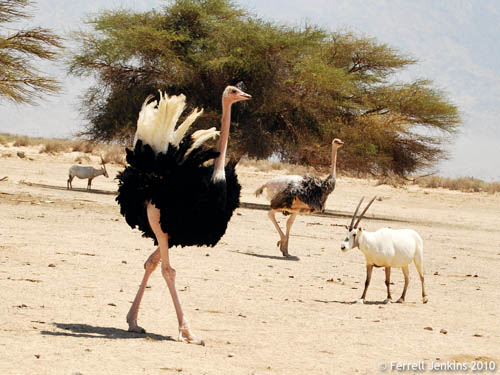
The ostrich is listed among the unclean birds for the Israelites in Leviticus 11:16 and Deuteronomy 14:15. Job laments that he is “a companion of ostriches” (Job 30:29). The longest section of scripture mentioning the ostrich is in the the response by the LORD.

“The wings of the ostrich wave proudly, but are they the pinions and plumage of love? For she leaves her eggs to the earth and lets them be warmed on the ground, forgetting that a foot may crush them and that the wild beast may trample them. She deals cruelly with her young, as if they were not hers; though her labor be in vain, yet she has no fear, because God has made her forget wisdom and given her no share in understanding. When she rouses herself to flee, she laughs at the horse and his rider. (Job 39:13-18 ESV)

Ostrich at the Hai Bar Nature Reserve. Photo by Ferrell Jenkins.

Ostriches at the Hai Bar Nature Reserve. Photo by Ferrell Jenkins.

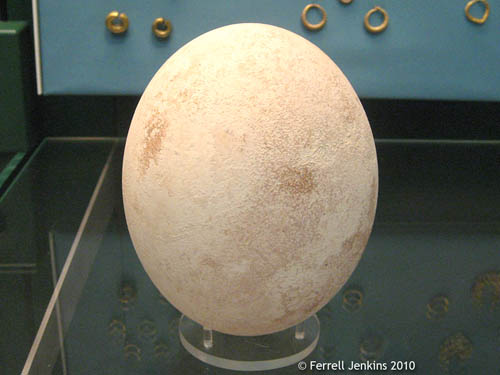
Archaeologists uncovered this ostrich egg pictured below from the MB II level (1750–1550 B.C.) at Lachish. The sign with the display at the British Museum says,

Ostriches were native to the Levant and their eggs, plain or decorated were often included in tomb deposits.

Ostrich Egg discovered at MB II Lachish. British Museum. Photo by Ferrell Jenkins.

Ostrich Egg discovered at MB II Lachish. British Museum. Photo by Ferrell Jenkins.

After the destruction of Jerusalem in 586 B.C., Jeremiah lamented that “the daughter of my people has become cruel, like the ostriches in the wilderness.” (Lamentations 4:3 ESV)

The olive shoots

The Bible is filled with illustrations from the agricultural practices and daily life activities of ancient Israel. We frequently pass over these images because we no longer understand the practices.

Here is an interesting one. In describing the happy home, one of the Psalms of Ascent says this,

Your wife will be like a fruitful vine within your house; your children will be like olive shoots around your table. (Psalms 128:3 ESV)

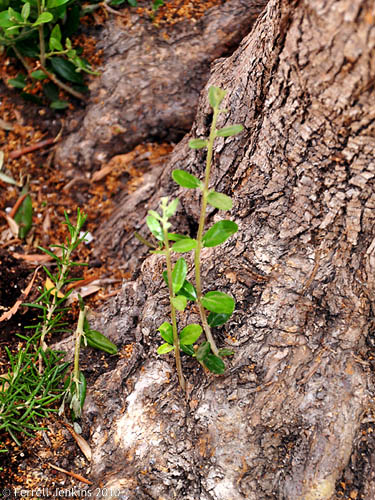
I must have photographed a dozen different examples of what the writer is alluding to. Perhaps this one will help you to enjoy it a little better.

Olive shoots coming from an olive tree. Photo by Ferrell Jenkins.

Olive shoots coming from an olive tree. Photo by Ferrell Jenkins.