Category Archives: Bible Lands

Mark Wilson speaks to group in Antalya

Dr. Mark Wilson shared a meal with us at the hotel one evening in Antalya, Turkey. After dinner Mark spoke to the group about his work in Turkey. He is the founder and director of the Asia Minor Research Center, and spends most of each year working and doing research in Turkey. He has updated several of the works of Sir William M. Ramsay, and written several helpful books on the book of Revelation. You will find much helpful material by Dr. Wilson on the Seven Church Network web site.

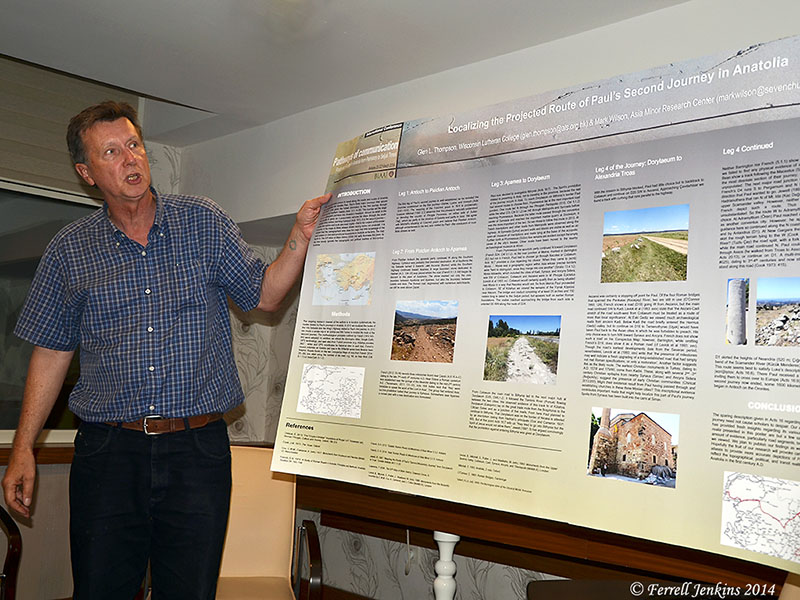
Our tour group heard a brief preview of the presentation Dr. Wilson plans for one of the upcoming annual professional biblical studies meetings in San Diego, California. He has been working on discovering the projected route of Paul’s Second Journey in Anatolia based on the biblical text, known roads, milestones, etc. from the first century. This was ideal for our group who had just completed a tour visiting all of the sites associated with Paul’s First Journey in Anatolia (modern Turkey).

Dr. Mark Wilson speaks about the route of Paul's second journey. Photo by Ferrell Jenkins.

Dr. Mark Wilson speaks about the route of Paul’s second journey in Anatolia to a tour group in Antalya, Turkey. Photo by Ferrell Jenkins.

We were pleased to see Dr. Wilson’s book, Biblical Turkey: A Guide to Jewish and Christian Sites of Asia Minor, available in many of the museum books stores including the Istanbul Archaeological Museum. Many of our tour members who did not already have a copy of the book got one from Mark after the presentation. You may purchase a copy from Amazon by clicking on the title above.

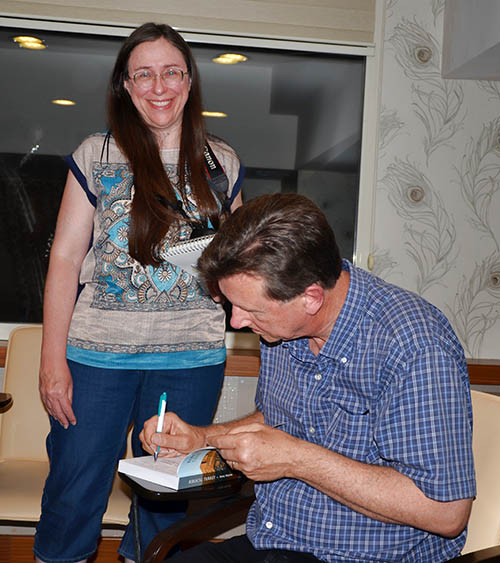
Tour members were delighted to have their book autographed by the author.

Dr. Wilson autographs a copy of Biblical Turkey for Stacy. Photo by Ferrell Jenkins.

Dr. Wilson autographs a copy of Biblical Turkey for Stacy. Photo by Ferrell Jenkins.

Traveling in Turkey

“Turkey? Why would you want to go to Turkey?” That is a question I have been asked a number of times over the years since my first visit in 1968. My response usually goes something like this. If you are interested in Bible history, Turkey is very important both for the Old Testament and the New Testament. Of course, the land was not called Turkey at the time of the Bible, but had various names depending on the historical period and the geographical region.

Think of the Old Testament history.

  • It is possible that the Garden of Eden was located somewhere in the mountains of eastern Turkey near the source of the Tigris and Euphrates Rivers (Genesis 2:10-14).
  • For sure, Noah’s Ark came to rest on the mountains of Ararat (ancient Urartu) (Genesis 8:4).
  • Haran, and the region known as Padan-aram in Mesopotamia, became the ancestral home of Abraham and his family before he went to the land of Canaan (Genesis 28:2; et al.).
  • Bible kings were involved in battles with world powers at the town of Carchemish (Jeremiah 46:2).
  • The Hittites lived in central and eastern Turkey (1 Kings 10:28-29; 2 Kings 7:6). Kue designates Cilicia in Turkey.
  • Both the Assyrians and Babylonians, enemies of Israel, were active in this region (Isaiah 10:9; Jeremiah 46:1-2).
  • The Euphrates and the Tigris, great rivers of Turkey, were important in Bible times (Isaiah 27:12; Genesis 2:14; Daniel 10:4). The Euphrates is often designated simply as the River (Isaiah 11:16).

Think of New Testament history.

  • Paul was a native of Tarsus in Cilicia (Acts 21:39). Timothy was a native of Lystra (Acts 16:1).
  • From Acts 11 onward throughout the New Testament, most of the events take place in Roman Asia Minor.
  • The town we know as Antioch in (the Roman province of) Syria is now located in the Hatay province of Turkey (Acts 11; Galatians 2:11).
  • Paul, Barnabas, and John Mark sailed from Seleucia to begin the first missionary journey (Acts 13:4).
  • With the exception of Salamis and Paphos in Cyprus, all of the places associated with the first journey are in Turkey (Acts 13-14).
  • Many of the towns visited on the second and third journey are in Turkey (Acts 15-16).
  • Paul made stops at the coastal town of Myra on the voyage to Rome (Acts 27:5).
  • Paul’s letters to the Galatians, Ephesians, Colossians, and Philemon were address to churches or persons in Asia Minor.
  • Peter’s two letters were addressed to Christians in Pontus, Galatia, Cappadocia, Asia, and Bithynia, now in Turkey (1 Peter 1:1; 2 Peter 3:1). Peter also visited Antioch in Syria (Galatians 2:11).
  • The apostle John spent some of his latter years in Ephesus, and addressed the book of Revelation to seven churches in Asia (Revelation 1:4, 11).
Hot air balloons are moved by the wind over the lunar-like landscape of Cappadocia while the pilots control their altitude. Photo by Ferrell Jenkins.

Hot air balloons are moved by the wind over the lunar-like landscape of Cappadocia while the pilots control their altitude. Photo by Ferrell Jenkins.

Post New Testament church history.

  • The Book of Revelation describes events that would affect the saints of Asia (Revelation 1:4). The information we have about the Roman Emperors and the temples erected to their honor throughout Turkey fit perfectly with what we read in Revelation.
  • The Ecumenical Councils met in the place we now call Turkey in the following cities: Nicaea, Constantinople, Ephesus, Chalcedon.
  • Some of the better known early church fathers are associated with places in Turkey.

Good enough reasons to visit Turkey, I’d say.

Note: This is intended only as a suggestive list; not a complete one.


Choosing a guide; Losing a guide and friend

During my first two or three tours I remember guides asking if I had been “here” before. Actually I have had guides that made up answers to things they did not know, but I did not use them again. Finding and keeping a good guide became an important part of planning a good tour. In the comments to follow I will limit myself to Israel.

My first tour was a few weeks prior to the Six-Day War in 1967. The Old City of Jerusalem and the West Bank were still part of the Hashemite Kingdom of Jordan. We crossed from Jordan into Israel through the Mandelbaum Gate. Today the Grand Court and Olive Tree hotels stand nearby. After the war I continued to use Arab guides, all of whom would designate themselves as Christian (usually Lutheran or Greek Orthodox). My two favorite guides for many years were John and Anise. Both were knowledgeable in the events of Scripture and the places of these events. And both of them were good in handling a group. As these men reached the time of their retirement I had to scurry to locate other guides. One year all of the young Arab guides were called in for training by the Israelis. I had a Jewish young lady who had led only two tours prior to mine. I had to do a lot to help her with the group and the information.

In the mid-80s I began to listen in on other guides when visiting various sites. I looked for someone who was knowledgeable in the Bible and the history of the sites. I wanted someone whose English would be understandable to visitors from the United States. I would introduce myself to guides I though might be good with my groups, and we would exchange cards. I needed someone who knew the land and the book, and who was informed in archaeological matters.

In looking through old group photos I find two guides that begin to dominate. Eliemelech Ben Meir was my guide in 1994, but I see Yehuda Guy in some of the photos as late as 1998. I liked both men, and we worked together well I thought. They were both willing for me to make additional comments and explanations for the benefit of the group.

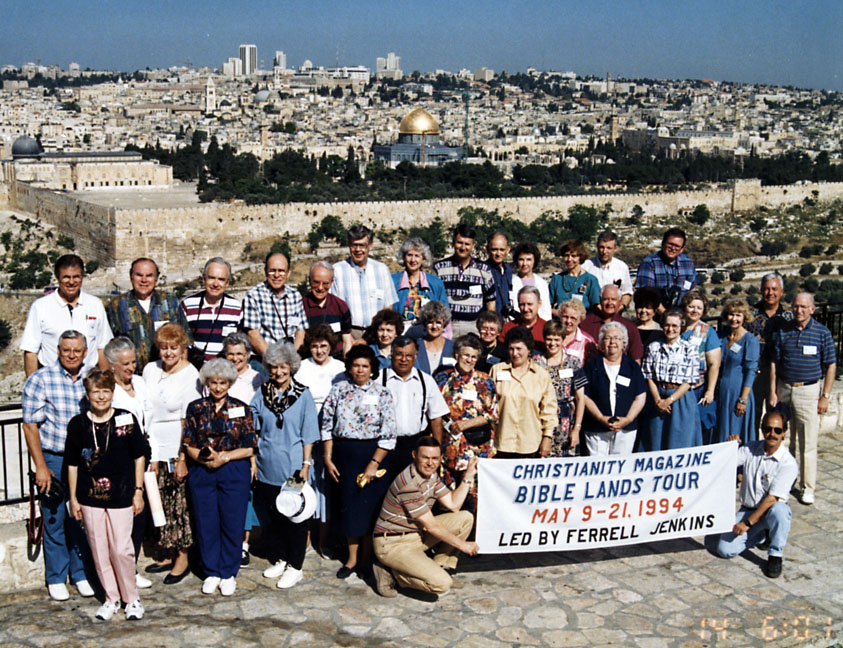
In looking through old group photos, the first photo I find with Elie Ben Meir is a tour twenty years ago in May, 1994. Elie is helping me hold the tour banner. I see that Yehuda continued to guide some groups for a few years. Some years I had two tours to Israel. Eventually it was also Elie guiding some tours. Elie told me that he was introduced to me by my Arab guide Anise whose health was failing.
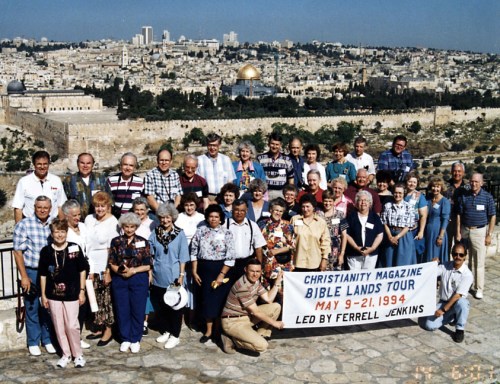
Ferrell Jenkins 1994 group with Elie Ben Meir.

1994 Group with Elie Ben Meir.

Over the past twenty year period Elie and I became good friends. In addition to the group tours I have made several personal study tours to Israel. Almost always I would be in touch with Elie. He brought his wife Maxine and the young daughters Adi and Danya to have dinner with the group in 2000. From year to year I would see them grow into beautiful young ladies. (I have a few digital photos made on a Sony camera that used a 3½ inch floppy drive, but the quality is too poor to use.)

Elie was not what we might call a “religious” Jew. He told me that on his first visit to Israel he stayed at a “religious kibbutz,” but by the time that stay ended he decided he would not be “religious.” Elie and Maxine wanted their girls to learn the Jewish customs, but bacon from the Armenian butcher would not be uncommon on a weekend morning. Some of the members of my groups would ask me how could Elie know the Bible so well and not be a Christian.

Elie’s family lived mostly in the Cleveland, Ohio, area. When he visited his mother or sister he would give me a call and talk a while. During the mid-2000s I told Elie about my mother who was suffering from Alzheimer’s Disease. Then the time came when Elie wanted to talk with me about a similar condition his mother was enduring. His trips to the USA became more frequent to assist his siblings in the care for her. I ferried items that Elie or his family needed from the USA to Israel − some special hair-care product for the girls or some beef jerky for the family. Even when I stayed over to visit sites I had not yet been to, Elie and one or both girls would come to the hotel and eat with me.

Elie enjoyed Bluegrass Music. Sometimes, as we drove away from the Tel Aviv airport at the beginning of a new tour he would ask, “Does anyone in the group play Bluegrass?” He kept his guitar in the storage area under the bus so he could pick a little in the evening at the hotel.

On Elie’s last trip to the USA he went to Cleveland to visit family. He left me a call on May 7, but I was already in Turkey by that time and did not receive the call until May 30. On the same day he sent me an Email with this heading and message.

Adi Meyerson, bass | Spring ’14 Ensemble & Recital Series | New School Jazz – New York City – The New School.
Hey Ferrell!
In case you happen to be in NY City!
Hope you and Elizabeth are well!
Sincerely,
Elie
http://events.newschool.edu/event/adi_meyerson_bass_spring_14_ensemble_recital_series_new_school_jazz#.U2rftO29Kc2

Elie was really on his way to NYC to hear his daughter perform. He had sent me other clippings about her.

By May 14 Barry Britnell was forwarding Emails that he received from Maxine because Elie was to be Barry’s guide in early June. She wrote,

There has been a tragedy and Elie had a serious stroke on Sunday night and is now in hospital in Cleveland in critical condition.

I was also receiving updates from Susan who was in touch with Elie’s sister Lynne in Cleveland. Elie had been having headaches for a few days when Lynne took him to the hospital. At some point he had a stroke. By May 18 the outlook did not seem good. Maxine sent Barry, John Barnett (I have not met John, but Elie always spoke highly of him), and me the following Email on May 24th.

So sorry to have to bring you the sad news that Elie passed away on Friday night 11:30pm. He died peacefully with all his siblings, daughters and myself by his side. Much love to all
Maxine

The complete obituary from the Cleveland Plain Dealer reads as follows:

MEYERSON ELIE MELECH BEN MEIR (MALCOLM MEYERSON), beloved husband of Maxine (nee Rabinowitz). Loving father of Adi and Danya. Dear brother of Jay (Jacquie) Meyerson, David (Honey) Meir-Levi, Lynne (Jacob) Meckler. Cherished son of Evelynne and the late Bernard Meyerson. Graveside services will be held Sunday, May 25 at 11:30 a.m. at the Mt. Sinai Cemetery, (SOM Center and White Rd.), Mayfield Village, OH. Family will receive friends at the residence of Jacquie and Aaron Meyerson,… SUNDAY FOLLOWING SERVICES UNTIL 8 P.M.

Elie had a number of qualities that were admirable. He was always ready to recommend the businesses of Moslems and Christians that he thought were honorable people. He warned his groups about those he thought were less than honorable. He always insisted on Fawzy (of Bethany) as the driver for my tours. Fawzy is an excellent driver whom I have known since the days of working with Anise. Elie knew woodworking. He spent time at that during those hard years of 2001-2005 when practically no tourists visited Israel. He did the electrical work for Yigael Shiloh in the City of David excavation. Elie had on his phone the personal numbers of acquaintances such as Sam Wolff (Gezer) and Eilat Mazar (City of David).

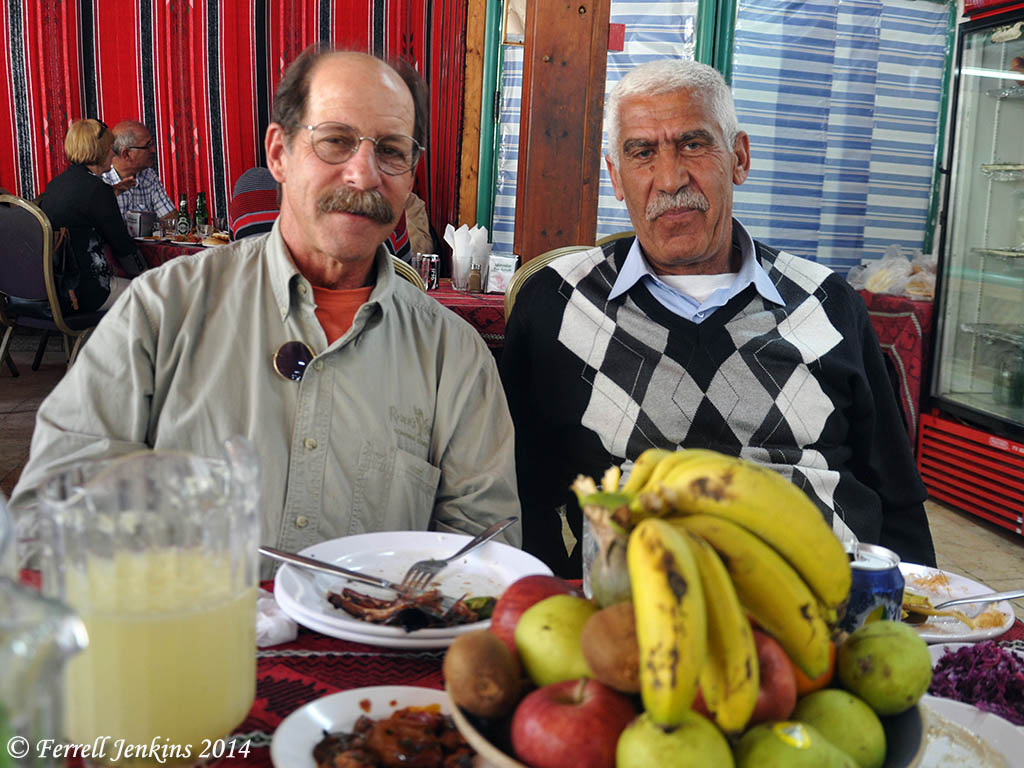
On my tour in 2013, Elie and Fawzy invited me to eat with them at Jericho. Here is the photo I made of them. You can see that Elie was a young man. I remember talking with him about his age and retirement, but I will not try to depend on my memory for that.
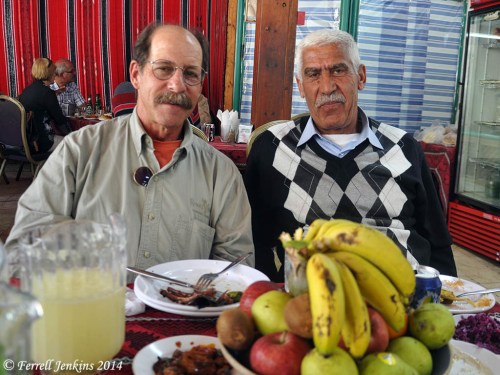
Elie and Fawzy in Jericho. Photo by Ferrell Jenkins.

Elie and Fawzy in Jericho. Photo by Ferrell Jenkins.

I extend my deepest sympathy to Maxine, Adi, and Danya, whom I have met, and to other family members whom I have not met. I think the hundreds of persons who have spent about 10 days listening to Elie help turn the Bible places from black and white to color, one of his favorite expressions, will share my sentiment.



A visit to Harran – home of Abraham

This morning we flew from Istanbul to Gaziantep in eastern Turkey, picked up our rental car and headed east to Zugma. This is a Roman period town that has been mostly flooded as a result of a dam built on the Euphrates River.

We continued east to Sanliurfa, and then south to Harran (some English Bible versions use Haran). Harran is located in biblical Padan-Aram (Genesis 25:29, et al.). Abraham and his family lived in the area (Genesis 11:21). The city has a long history which I will not go into now.

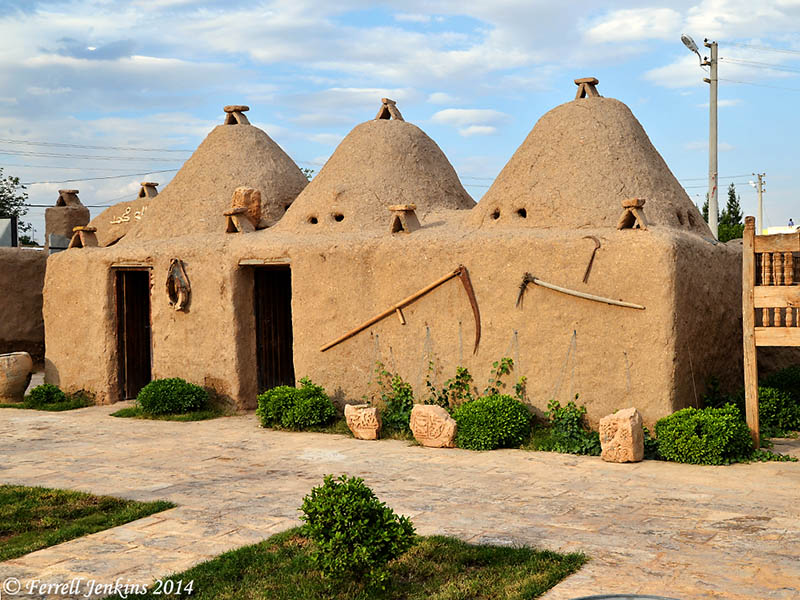
For the past two hundred years the people who live here have built mud brick conical, beehive-shaped houses. I have also seen some of these houses in northern Syria.

At the present time very few people still live in the beehive-shaped houses. For touristic and educational purposes some of the houses have been reconstructed to show how people used them for dwellings.

If you have seen the houses at Haran over the past few decades, you may think that these in my photo look entirely too good.

Having been here twice before, I must admit that I was a bit letdown when I saw the condition of the town today. On the north side of town a large number of new houses have been built. Some apartment buildings now stand on the west side. One young man told us that very few of the residents keep sheep. Most, he said, are involved in raising cotton on the plains about Harran.

Beehive-shaped houses at Harran. Photo by Ferrell Jenkins.

Beehive-shaped houses at Harran. Photo by Ferrell Jenkins.


A visit to Nicaea in Bithynia.

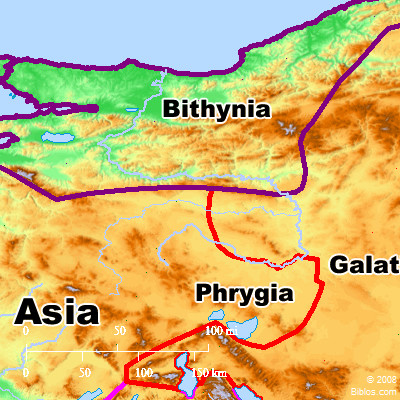
Today  my friend Leon and I made a 10 hour trip from Istanbul to Iznik, Turkey. Iznik is the name of ancient Nicaea (Nicea) in Bithynia. This is a region of Asia Minor into which Paul was not allowed by the Spirit to travel. Instead, he was directed to go down to Troas where he received the call to come over into Macedonia.

And when they had come up to Mysia, they attempted to go into Bithynia, but the Spirit of Jesus did not allow them. So, passing by Mysia, they went down to Troas. (Acts 16:7-8 ESV

Bithynia is across from Istanbul on the south side of the Sea of Marmara. It is a beautiful mountainous region with valleys filled with olive trees and fruit orchards.

The Epistles of Peter are addressed to saints living in Bithynia, but no specific towns are mentioned (1 Peter 1:1; 2 Peter 3:1).

The Roman province of Bithynia. BibleAtlas.org.

The Roman province of Bithynia. BibleAtlas.org.

The modern town of Iznik utilizes the layout of ancient Nicaea. Nicaea was the site of the first and seventh of the ecumenical councils held between 325 and 787 A.D. Hopefully I will be able to write more about these councils and their importance in the history of Christianity at a later time.

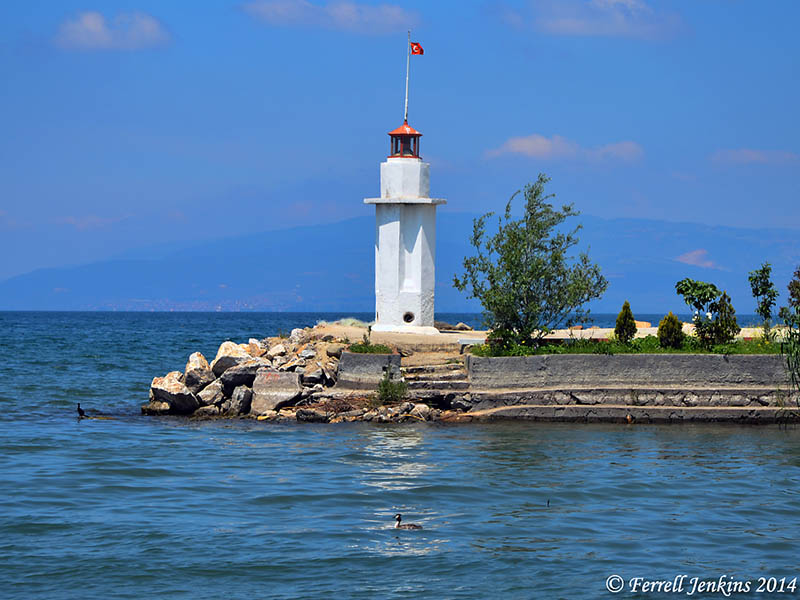
For today I wanted to share a photo I made of a little lighthouse in the fresh water Lake Iznik.

Lighthouse in Lake Iznik. Photo by Ferrell Jenkins.

Lighthouse in Lake Iznik. Photo by Ferrell Jenkins.

Some Museums in Turkey

My Ancient Crossroads Tour of Biblical and Historical Turkey is compete. Yesterday most of the tour members returned home. A few had other plans of travel before returning.

There are some wonderful museums in Turkey, but many of them are undergoing restoration at this time.

We missed seeing the main section of the Museum of Anatolian Civilizations in Ankara due to restoration. A nice,  small section containing mostly classical materials was open, but the great collection of Hittite materials (our reason for going there) was closed. According to an article in the Harriyet Daily News it reopened last Friday.

The Archaeological Museum in Antakya (Antioch of Syria, Acts 11, 13) was almost bare. Only a few of the lesser quality mosaics were on the walls. A new museum will open soon. I had told the group that we would see some good Hittite materials there, but they had already been moved. Incidentally, the Church of St. Peter and the Simon Stylites Monastery were also closed for renovation.

We did better at the fabulous museum in Antalya (Attalia of Acts 14:25). The Roman period statuary from Perga in Pamphylia (Acts 13:13-14; 14:25) is housed there.

In Istanbul we were able to visit the Ancient Orient section of the Archaeological Museum. The museum containing material from the classical world was closed. An excellent selection of materials was housed in a small area of the Museum.  The third floor, where artifacts from Palestine are housed was closed. Our appeal for entry failed.  There is where some very famous pieces are housed − the Siloam Tunnel inscription, the Gezer Calendar, the Herodian Temple inscription forbidding gentiles from entering the Temple, et al.

The Ancient Orient building houses a large number of bulls, dragons, and oxen from the procession street of ancient Babylon. I think it is second only to the Pergamum Museum in Berlin. There are excellent Hittite materials, including the oldest treaty between nations. It is the treaty between the Hittites and Pharaoh Ramses of Egypt after the battle of Kadesh on the Orontes. There are several pieces from the Assyrians, and a clay cylinder from the time of Nebuchadnezzar.

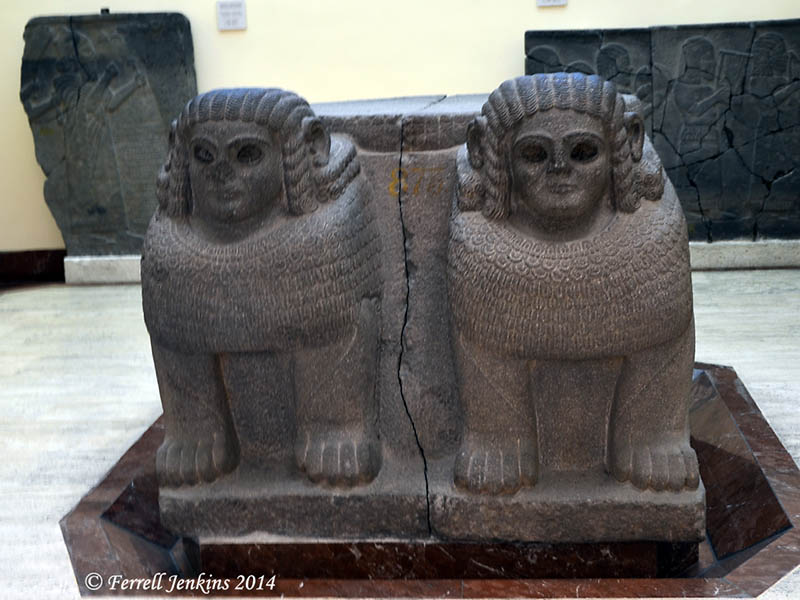
Here is a picture of one of the basalt Hittite column bases from Sinjerli. It is a double sphinx, dating to the 8th century B.C., that came from the entrance to Palace III.

Hittite Column Base from Sinjerli. Photo by Ferrell Jenkins.

Front view of Hittite column base from Sinjerli. Photo by Ferrell Jenkins.

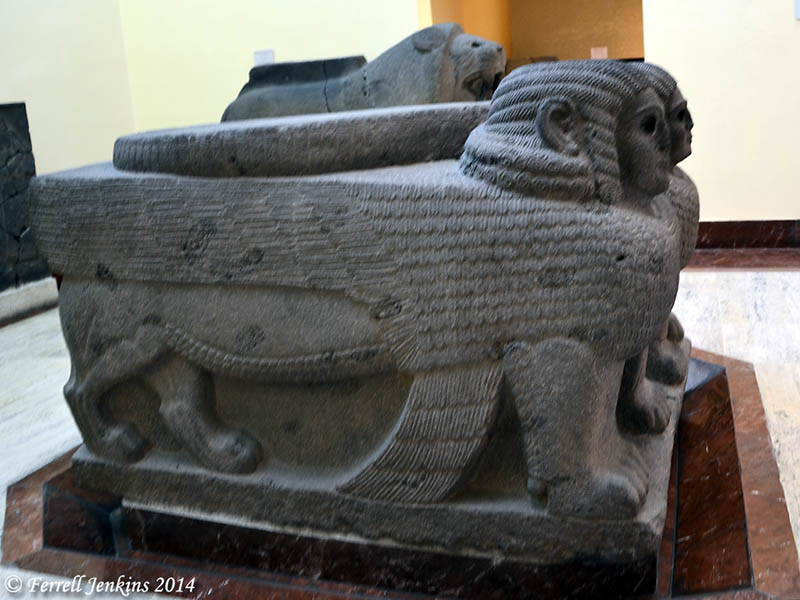
Below is the side view of this column base. Note that the figure of a lion shows a human head and wings of a bird. This provides a good illustration for the apocalyptic imagery in Daniel, Ezekiel, Zechariah, and Revelation.

Side view of Hittite Column Base from Sinjerli. Photo by Ferrell Jenkins.

Side view of Hittite Column Base from Sinjerli. Photo by Ferrell Jenkins.

These are the Hittites with whom the ancient Israelites had dealings. Solomon imported horses and chariots from Egypt and Kue and exported them to the Hittites (1 Kings 10:29). See 2 Kings 7:6 for another reference to these people in the days of the prophet Elisha.

All things considered, maybe it didn’t turn out so bad after all.

The tour photo

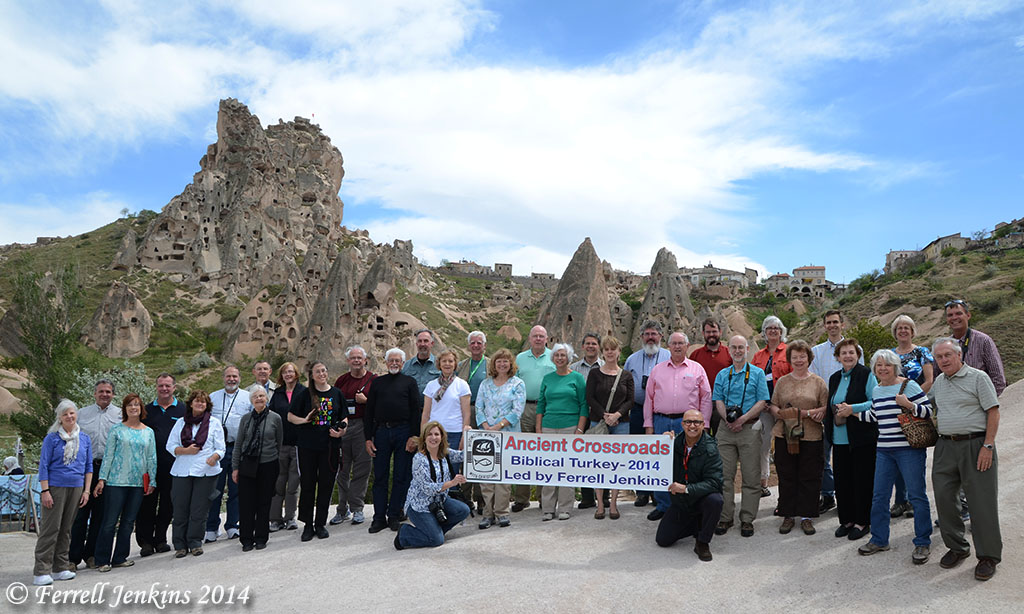
We spent the full day in Cappadocia. As usual with our tour, we have a local photographer to make a group photo at one of the interesting spots we visit. Our photo this time was made at Uchisar. Do you know anyone in our group?

Ancient Crossroads Tour of Biblical and Historical Turkey. Photo taken at Uchisar in Cappadocia. Photo by Ferrell Jenkins.

Ancient Crossroads Tour of Biblical and Historical Turkey. Photo taken at Uchisar in Cappadocia. Click on photo for a larger image.

The Bible tells us that Jews of Cappadocia were present in Jerusalem on the day of Pentecost (Acts 2:9). Peter wrote his epistles to saints scattered throughout Cappadocia and other places in Roman Asia Minor (modern Turkey).

Peter, an apostle of Jesus Christ, To those who are elect exiles of the dispersion in Pontus, Galatia, Cappadocia, Asia, and Bithynia,  2 according to the foreknowledge of God the Father, in the sanctification of the Spirit, for obedience to Jesus Christ and for sprinkling with his blood: May grace and peace be multiplied to you. (1 Peter 1:1-2)

John Freely describes Cappadocia in these words:

“Most of this part of Cappadocia is covered with a deep layer of tufa, a soft stone of solidified mud, ash and lava which once poured down from the now extinct volcanoes on Hasan Dagi and Ericiyes Dagi, the two great mountain peaks of Cappadocia. In the eons since then the rivers of the region have scoured canyons, gorges, valleys and gulleys through the soft and porous stone, and the elements have eroded it into fantastic crags, folds, turrets, pyramids, spires, needles, stalagmites, and cones, creating a vast outdoor display of stone sculptures in an incredible variety of shapes and colours” (The Companion Guide to Turkey, 238).

In the centuries after New Testament times many Christians settled in this volcanic region of perhaps 50,000 cones.

Traveling in Turkey

Tuesday afternoon our group arrived in Ankara, capital of the Republic of Turkey. Wednesday traveled about three hours of Ankara to Bogazkale, the capital of the ancient Hittite (Hatti) kingdom.

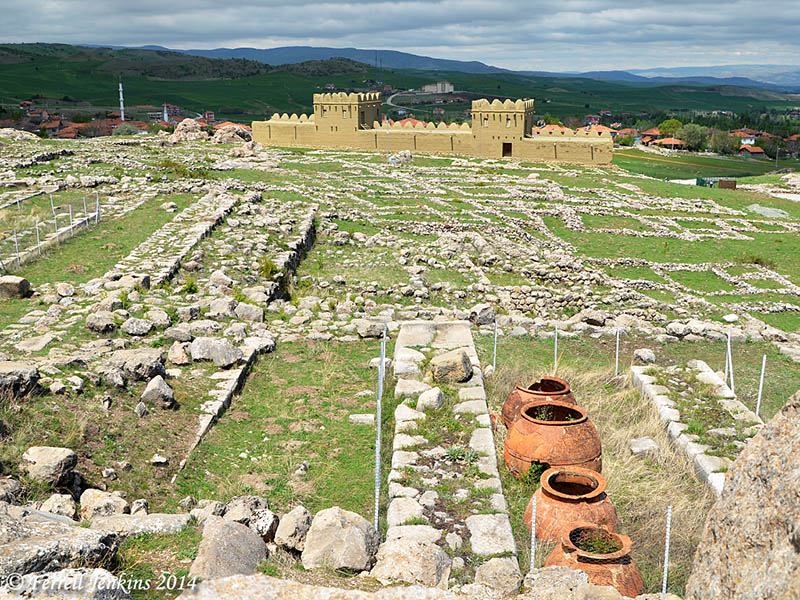
The photo below shows ruins of what is designated Temple 1 in the Lower City of ancient capital. The walls seen here are the only reconstructed walls from the ancient city. The ruins belong to the most sacred building of the city. The jars in the foreground are samples of many that were found. They were used to hold cuneiform tablets, and grain, wine, and oil used in the temple services.

Temple area and reconstructed walls at Bogazkale. Photo by Ferrell Jenkins.

Temple area and reconstructed walls at Bogazkale. Photo by Ferrell Jenkins.

I don’t seem to be finding the time to blog, but several of our travelers are doing so. You may find what they write more interesting because they tend to write about things as they see them through fresh eyes that have not been here before. All of them have traveled with me before, and I think most of them have visited Western Turkey on a previous tour.

Alexander’s Adventurehttp://jimmyanddarlene.wordpress.com/
This is the blog of Jimmy and Darlene Alexander. What an appropriate title for a tour in Turkey. Jimmy and Darlene are new to blogging, but they have traveled a lot, and Darlene has recently learned how to use an iPad Mini, photo editor, etc., and doing a good job of it.

Braman’s Wanderinghttp://bramanswanderings.wordpress.com/
Steven Braman is literally a world traveler in his work. He blogs on a wide variety of things.

The other side of the worldhttp://stacyjobe.blogspot.com/
Stacy Jobe blogged during our Steps of Paul and John tour in 2012. She has updated her blog for this tour. Stacy is a multi-talented young lady who finds something interesting in whatever she sees.

Scene With Sharon http://scenewithsharon.blogspot.com/
 According to the NASA website, Sharon Cobb “is the lead scientist developing an important facility for studying materials in the International Space Station.” She loves traveling on earth, too. Sharon blogged from Egypt during our 2009 tour.

Turkey is a wonderful place to visit for those interested in ancient and biblical history. Enjoy the country through the eyes of these people are traveling with me on this journey.


Regarding the Visualizing Isaiah series

The response to the Visualizing Isaiah series has been good by my estimation. Numerous readers have written that they enjoyed/profited by the series. Several bloggers have linked to the series and a few have re-blogged almost all of them to their readers.

This was an ambitious project. First, there was the responsibility to understand Isaiah well enough to make appropriate comments. Second, the selection of good photos was quite a task. I often looked through photos from various Bible sites and/or several museums with Ancient Near Eastern collections to locate what I thought was the right image. Some chapters offered numerous possibilities; others were a bit more difficult.

Hopefully I will be able to continue the series later. At this time I must take a break because I will be traveling in the Bible world most of May. I do plan to post something most days to indicate where I am traveling.

I trust that the Isaiah series has illustrated how you can enhance your study and teaching with visuals. You may say, “but I haven’t been to all of those places.” But you can search this blog for illustrations. Some time back we provided illustrations for the entire book of Acts. You can go to your Pictorial Library of Bible Lands collection and find the photos you need. Or, search the Bible Places Blog, or the Holy Land Photos’ Blog, or the vast collection at Holy Land Photos, or David Padfield’s collection here.

For my next series, I plan to select a shorter book such as Philemon or Jude.

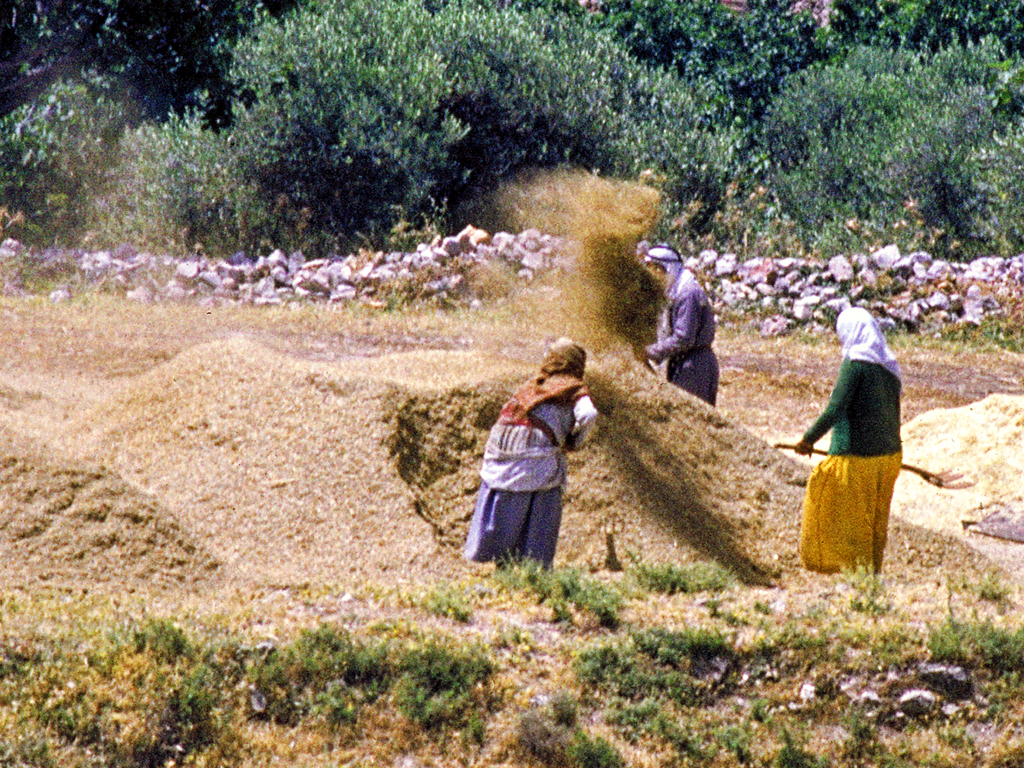
Just in case some of you are looking ahead to Isaiah 41, I will include an image to help with verses 15-16.

Behold, I make of you a threshing sledge, new, sharp, and having teeth; you shall thresh the mountains and crush them, and you shall make the hills like chaff; you shall winnow them, and the wind shall carry them away, and the tempest shall scatter them. And you shall rejoice in the LORD; in the Holy One of Israel you shall glory.  (Isaiah 41:15-16 ESV)

Winnowing at Shechem. Photo by Ferrell Jenkins.

Winnowing at Shechem. Photo by Ferrell Jenkins.

Visualizing Isaiah 40: He will tend His flock like a shepherd

The LORD comforts His people. Isaiah 40 is a beautiful chapter showing the care the LORD has for His people, even when they go astray.

He will tend his flock like a shepherd; he will gather the lambs in his arms; he will carry them in his bosom, and gently lead those that are with young. (Isaiah 40:11 ESV)

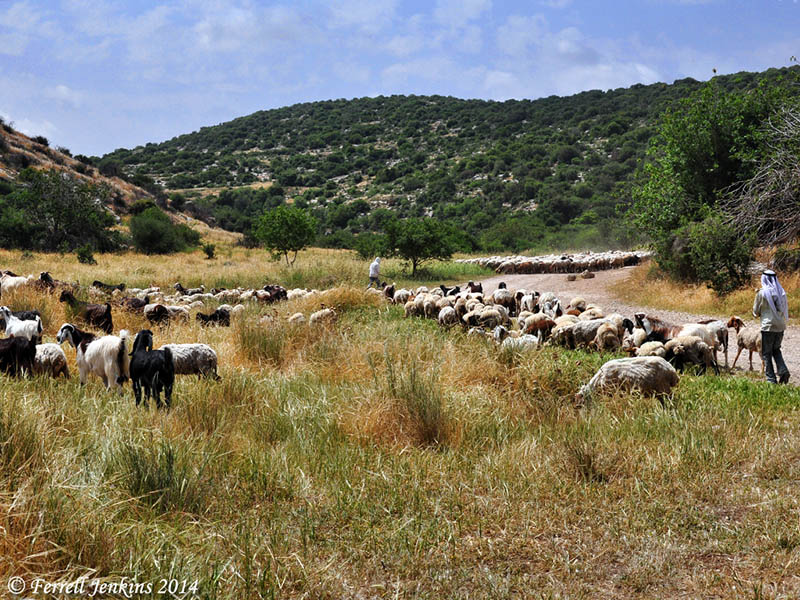
The photo below is just one of hundreds that I have made of shepherds with their sheep. Notice that there are two separate flocks and two shepherds.

Shepherds tending their flocks at Socoh. Photo by Ferrell Jenkins.

Shepherds tending their flocks at Socoh. Photo by Ferrell Jenkins.

Socoh is identified with the tel on the left of the photo. It is located on the south side of the Elah valley. Socoh was a city of Judah where the Philistines gathered to fight with Saul and the men of Israel (1 Samuel 17).

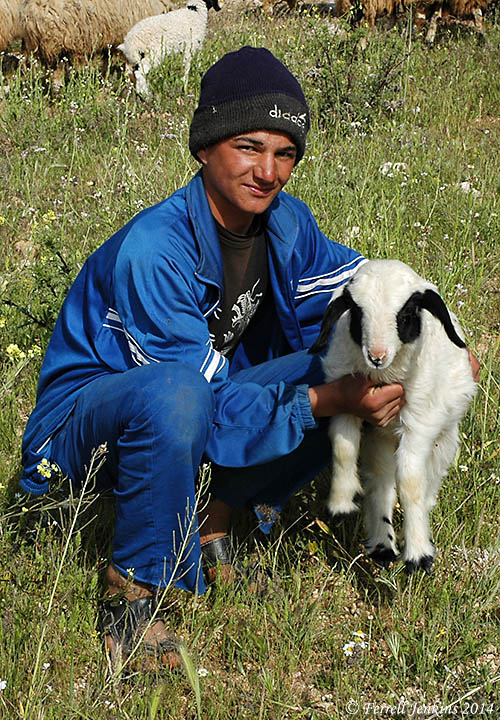
Shepherds frequently take the lambs in their arms. The Photo below was made near Heshbon in Jordan.

A shepherd and a lamb. Photo by Ferrell Jenkins.

A shepherd and a lamb. Photo by Ferrell Jenkins.