Category Archives: Archaeology

Paul, Silas, and Timothy pass through Amphipolis

Amphipolis was situated about 30 miles west of Philippi on the Via Egnatia. Luke remained at Philippi while Paul, Silas and Timothy continued to Thessalonica. There is no indication of any preaching done in Amphipolis and Appollonia. In fact, the reference to the city barely attracts notice.

Now when they had passed through Amphipolis and Apollonia, they came to Thessalonica, where there was a synagogue of the Jews. (Act 17:1 ESV)

The River Strymon runs past Amphipolis and continues for about 3 1/2 miles south where it flows into the Aegean Sea. The photo of the River Strymon below was made in the late afternoon against the sun, but I like the effect.

The River Strymon at Amphipolis. Photo by Ferrell Jenkins.

The River Strymon at Amphipolis. Photo by Ferrell Jenkins.

K. L. McKay, in an article in The New Bible Dictionary, describes the city briefly:

Prized by the Athenians and Macedonians as the key both to the gold, silver and timber of Mt Pangaeus and also to the control of the Dardanelles, it became under the Romans a free town and the capital of the first district of Macedonia. Amphipolis is about 50 km WSW of Philippi on the Via Egnatia, a great Roman highway, and Paul passed through it on his way to Thessalonica (Acts 17:1).

The city is somewhat difficult to reach and there is little is to be seen.

Amphipolis Archaeological Site. Photo by Ferrell Jenkins.

Amphipolis Archaeological Site. Photo by Ferrell Jenkins.

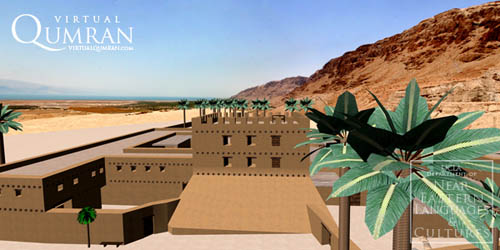
Virtual Qumran Reconstruction

Dr. Robert R. Cargill announced here that images and a movie of Virtual Qumran are available for free download. To view the images go directly to www.VirtualQumran.com. These images will be helpful in any teaching about Qumran and the Dead Sea Scrolls. Cargill is Chief Architect and Designer of the Qumran Visualization Project.

Virtual Qumran. North East View. UCLA Qumran Visualization Project.

Virtual Qumran. North East View. UCLA Qumran Visualization Project.

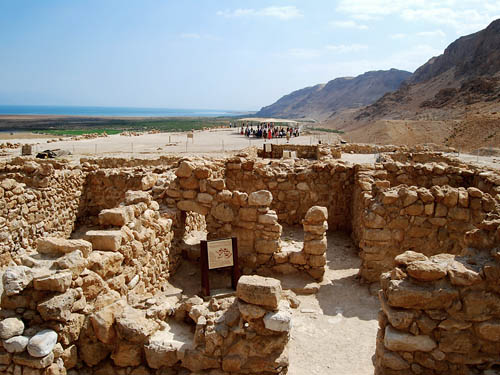
Here is a photo I made at the reconstructed ruins of Qumran.

View of proposed study room at Qumran. View NE. Photo by Ferrell Jenkins.

View of proposed study room at Qumran. View NE. Photo by Ferrell Jenkins.

The sign in the room reads,

The members of the Qumran Sect occupied themselves with studying the books of the Bible. Hundreds of pottery lamps were discovered in this room, validating the supposition that it was used for study during the night.

I am not sure this is a valid conclusion.

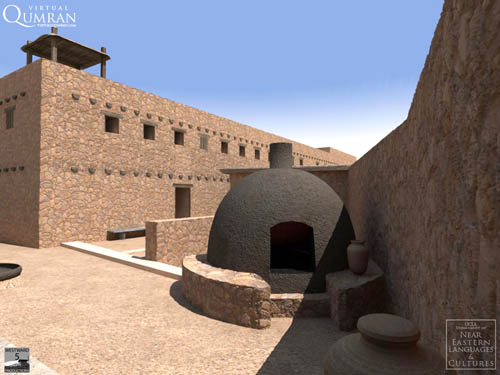
Qumran Potters Quarter. UCLA Qumran Visualization Project.

Qumran Potters Quarter. UCLA Qumran Visualization Project.

Check our earlier discussion of the Dead Sea Sect here.

Laodicea Photos

Laodicea is known to us from the book of Revelation (1:11; 3:14-22), and from Paul’s epistle to the Colossians.

For I testify for him that he has a deep concern for you and for those who are in Laodicea and Hierapolis. Luke, the beloved physician, sends you his greetings, and also Demas. Greet the brethren who are in Laodicea and also Nympha and the church that is in her house. When this letter is read among you, have it also read in the church of the Laodiceans; and you, for your part read my letter that is coming from Laodicea. (Col 4:13-16 NAU)

Ben Witherington has posted several nice photos recently made at Laodicea. Take a look here. These photo are high resolution and may be reduced and enhanced a bit for use in class and sermon presentation. Ben concludes his post with these words:

There is much more to be said, but let this be said at this juncture.  The archaeological evidence at Laodicea simply confirms what the NT suggests about the city– it was large,  rich in the first century, a city materially on the rise, but sometimes prosperity has a deadening effect on spirituality as John of Patmos reminds.   The reconstruction of the city today is a work still in progress— but then, so are we. If even Laodicea warrants a visit from the Master who knocks and promises to enter and sup with them, despite all its sin and shortcomings, then there is still hope for us.

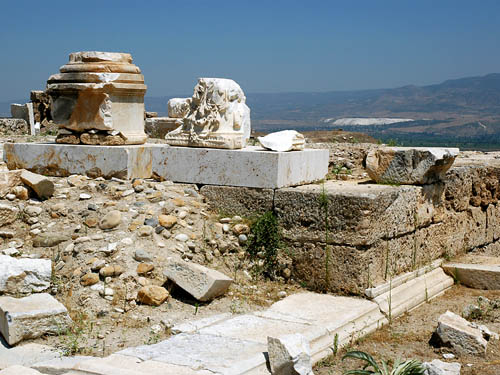
The photo below is one I took showing what was labeled “North Temple” at the time. I see on the new sign Ben includes among his photos the structure (# 15) is labeled “Corinth Temple and North Basilica.” The white area on the hillside across the Lycus River valley marks the limestone formations of Hierapolis (Colossians 4:13; modern Pamukkale).

Temple ruins at Laodicea. View north to Hierapolis. Photo by Ferrell Jenkins.

Temple ruins at Laodicea. View north to Hierapolis. Photo by Ferrell Jenkins.

Thanks, Ben. We look forward to more good material from Turkey.

We called attention to the water distribution system of Laodicea here.

HT: Brooks.

“Our IAA which art in Israel”

Tourist confesses to taking a stone from an Israel Antiquities Excavation 12 years ago.

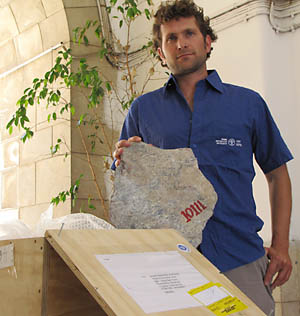
Twelve years after a stone disappeared from an Israel Antiquities Authority Excavation south of the Temple Mount, a tourist from New York confessed: “I Took It. My Conscience Bothers Me and I Am Asking for Forgiveness” The stone, which weighs 21 kilo, was returned to Jerusalem this week.

Here is part of the account released by the IAA in Jerusalem.

In 1997, a twenty one kilogram fragment of a marble column disappeared from one of the excavations the Israel Antiquities Authority was conducting south of the Temple Mount.

Several weeks ago, the IAA received an unexpected e-mail from a clergyman in the state of New York: “I am requesting forgiveness for a member of my congregation”, he writes. “The fellow confessed to me that twelve years ago he took a stone from Jerusalem and his conscience has bothered him ever since. I wish to return the stone to Israel and hope that you will forgive the man for his transgression”.
A letter from the fellow was attached to the heavy stone fragment, which arrived in Jerusalem in a wooden crate that was specially constructed for the flight back to Israel. “I came to Israel on an organized trip. As a student of archaeology, I was very excited when we visited an excavation south of the Temple Mount. I asked how I can purchase a stone from the excavation because I wanted a souvenir with which to pray for Jerusalem and was told it was not possible. On the last day of the trip our Israeli tour guide approached me and took the stone fragment from inside his coat. ‘Take it’, he said. ‘It’s a present from me’. I asked him how he obtained the stone and he replied, ‘It’s okay; don’t worry’. I was very happy and took the stone with me on my flight back to New York. Only later did I realize that he probably took the stone from the excavation without permission. For the past twelve years since then, rather than remind me of the prayer for Jerusalem, I am reminded of the mistake I made when I removed the stone from its proper place in Israel. I am asking for your forgiveness”.

Shay Bar Tura displays the package and the returned stone. Photo by IAA.

Shay Bar Tura displays the package and the returned stone. Photo by IAA.

Shay Bar Tura, Deputy Director of the Unit for the Prevention of Antiquities Robbery in the IAA, stated,

It should be emphasized that any activity conducted at an antiquity site requires permission from the IAA. Taking archaeological artifacts from antiquities sites constitutes a severe criminal offense which is punishable by law with imprisonment”.

Who was the tour guide?

HT: Joe Lauer

New discoveries in the land of Goshen

The storage city of Rameses was identified with Tanis in the past, but it is now identified with Tell el Daba in the eastern Nile Delta. Here is what the Bible says about Rameses in the land of Goshen:

  • It is called the land of Rameses (Genesis 47:11).
  • The Israelites built the storage cities of Pithom and Rameses (Exodus 1:11).
  • Rameses was the starting point of Israel’s exodus from Egypt (Exodus 12:37; Numbers 33:3, 5).

Prof. Dr. Manfred Bietak.

Prof. Dr. Manfred Bietak

Austrian archaeologists, under the direction of Professor Dr. Manfred Bietak and Irene Forstner-Mueller, have been working at Tell el Daba for several years. The history of this area may be divided into three periods:

  • Pre-Hyksos, when the city was named Rowaty (the door of the two roads).
  • Hyksos (about 1663-1555 B.C.), when the city was named Avaris.
  • Post-Hyksos, when the city was named Peru-nefer (happy journey).

The excavators recently uncovered a cuneiform letter written in southern Mesopotamian style. It is thought to date to the time of the Old Babylonian Kingdom of Hammurabi. The news release indicates a date of about 1600-1550 B.C. This illustrates a significant contact between Egypt and Mesopotamia.

Cuneiform Tablet from Tell el Daba.

Babylonian Cuneiform Tablet from Tell el Daba in the land of Goshen.

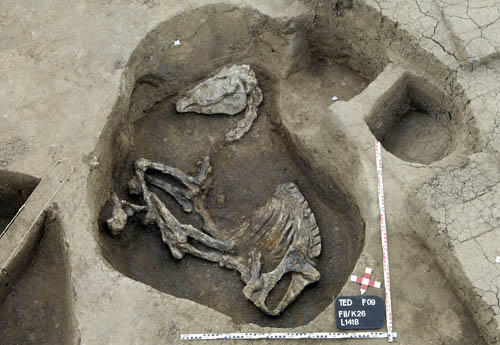
A second discovery was the burial of a horse, a mare likely used for breeding. Horses were introduced into Egypt by the Hyksos. The location of the burial near the palace of the Hyksos king Khayan suggests that this mare was a pet of the king.

Hyksos horse skeleton discovered at Tell el Daba.

Hyksos horse skeleton discovered at Tell el Daba.

The complete news release may be read in German here. Photos Copyright: Österreichisches Archäologisches Institut (ÖAI) Kairo. I had the pleasure of visiting Tell el Daba in January, 2009.

HT: Joseph I. Lauer

Discovery of the Roman Pool of Siloam

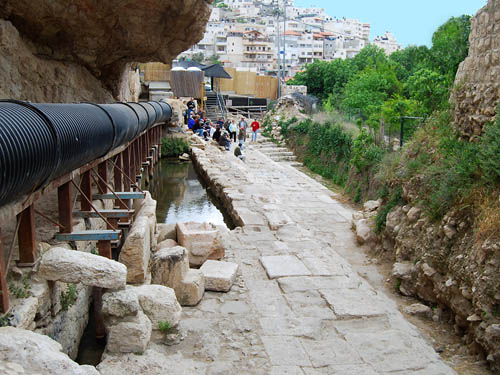
In early June, 2004, an announcement was made by Ronny Reich and Eli Shukron of the discovery of a pool dating to the Second Temple period (Herod’s temple). Continuing excavations have revealed three sets of stairs leading down into the pool. Most of the pool has not yet been uncovered. In November, 2005, I spoke with Professor Reich at the pool and he explained several things about the discovery.

A feature article was published in Biblical Archaeology Review, Sept.-Oct., 2005. Todd Bolen of BiblePlaces.com, who assisted in the excavations at the site, included some comments on his BiblePlaces Blog here in August, 2005. Many reports that appear in the news media are incomplete and sometimes misleading.

Pool of Siloam. View toward East. Byzantine pool is to our back. Photo by F.Jenkins.

Pool of Siloam. View toward East. Byzantine pool is to our back. Photo by F. Jenkins.

See Todd’s photos and comments about The Pool of Siloam Revealed at BiblePlaces.com.

Our photo shows the northern steps and the eastern corner of the pool. You can detect the present road level at the top of the wooden steps. In the distance, across the Kidron Valley, you can see a hill south of the Mount of Olives, sometimes called the Hill of Evil Counsel. Beyond that lies the Judean Wilderness.

Hebrew seal of “Saul” found in Jerusalem

A Hebrew seal dating to the time of the First Temple was displayed yesterday in the City of David in Jerusalem.
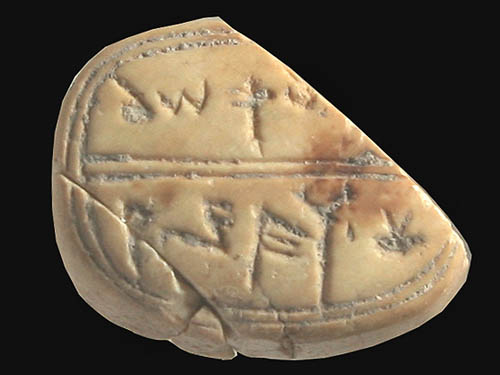
Hebrew Seal bearing name of "Saul." Photo by Vladimir Naykhin, IAA.

Hebrew Seal bearing name of "Saul." Photo by Vladimir Naykhin, IAA.

The news release issued by the Israel Antiquities Authority follows:

The seal, which is made of bone, was found broken and is missing a piece from its upper right side. Two parallel lines divide the surface of the seal into two registers in which Hebrew letters are engraved:

לשאל
]ריהו

A period followed by a floral image or a tiny fruit appear at the end of the bottom name.

The name of the seal’s owner was completely preserved and it is written in the shortened form of the name שאול (Shaul). The name is known from both the Bible (Genesis 36:37; 1 Samuel 9:2; 1 Chronicles 4:24 and 6:9) and from other Hebrew seals.

This name appears many other times in the Bible. Our minds are immediately drawn to the name of Saul, the first king of Israel.

Now there was a man of Benjamin whose name was Kish the son of Abiel, the son of Zeror, the son of Becorath, the son of Aphiah, the son of a Benjamite, a mighty man of valor.  He had a son whose name was Saul, a choice and handsome man, and there was not a more handsome person than he among the sons of Israel; from his shoulders and up he was taller than any of the people. (1 Samuel 9:1-2 NAU)

Saul, the son of Kish, lived several decades before the First Temple period. Saul was king of Israel from about 1050-1010 B.C. The temple was built by Solomon about 966 B.C. Do not make the mistake of saying that this is the seal of Saul the king. Seals and bullae (seal impressions) are fairly common. What they reveal is that the names found are the ones we might expect in given time periods, and similar, or sometimes identical, to those names found in the Bible.

The news release continues:

According to Professor Reich, “This seal joins another Hebrew seal that was previously found and three Hebrew bullae (pieces of clay stamped with seal impressions) that were discovered nearby. These five items have great chronological importance regarding the study of the development of the use of seals. While the numerous bullae that were discovered in the adjacent rock-hewn pool were found together with pottery sherds from the end of the ninth and beginning of the eighth centuries BCE, they do not bear any Semitic letters. On the other hand, the five Hebrew epigraphic artifacts were recovered from the soil that was excavated outside the pool, which contained pottery sherds that date to the last part of the eighth century.

It seems that the development in the design of the seals occurred in Judah during the course of the eighth century BCE. At the same time as they engraved figures on the seal, at some point they also started to engrave them with the names of the seals’ owners. This was apparently when they started to identify the owner of the seal by his name rather than by some sort of graphic representation.

It appears that the “office” which administered the correspondence and received the goods that were all sealed with bullae continued to exist and operate within a regular format even after a residential dwelling was constructed inside the same “rock-hewn pool” and the soil and the refuse that contained the many aforementioned bullae were trapped beneath its floor. This “office” continued to generate refuse that included bullae, which were opened and broken, as well as seals that were no longer used and were discarded into the heap of rubbish that continued to accumulate in the vicinity.
Professor Ronnie Reich is well known for his work in uncovering the Pool of Siloam and the street leading from the Pool to the Temple Mount. The Pool of Siloam is mentioned in John 9. This photo was made at the Pool of Siloam in 2005.
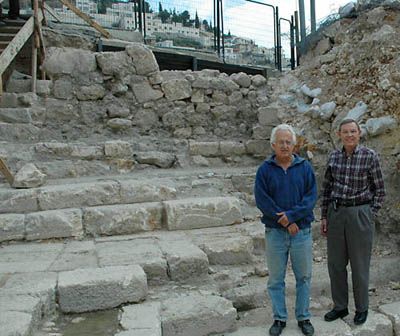
Professor Reich and Ferrell Jenkins at the Pool of Siloam. Photo by Leon Mauldin.

Professor Reich and Ferrell Jenkins at the Pool of Siloam. Photo by Leon Mauldin.

HT: Joseph Lauer

Sir William M. Ramsay – New Testament Scholar

As a student Ramsay had been influenced by Baur and the Tubingen School and doubted the historical trustworthiness of the New Testament. His studies in Asia Minor caused him to study the book of Acts, which he accepted as a document of the second half of the second century. He tells in The Bearing of Recent Discovery on the Trustworthiness of the New Testament how he came to change his mind about this. In a study of Acts 14, Ramsay saw that Luke listed Lystra and Derbe as cities of Lycaonia, but did not include Iconium (Acts 14:6). He thought this had been deliberately invented by Luke because he was under a false impression. Check maps you have in your Bible and various Bible Atlases. You will probably see that some of them still have this incorrect. The SN (Study Note) in the NET Bible contains this note:

Iconium was a city in Lycaonia about 90 mi (145 km) east southeast of Pisidian Antioch. It was the easternmost city of Phrygia.

This comment relies on the older classical location of Iconium, but it was not this way during the Roman Imperial period.

In The Bearing of Recent Discovery…, Ramsay says that the purpose of his book, St. Paul the Traveler and the Roman Citizen, is to show:

“that Luke is a historian of the first rank; not merely are his statements of fact trustworthy; he is possessed of the true historical sense; he fixes his mind on the idea and plan that rules in the evolution of history, and proportions the scale of his treatment to the importance of each incident. He seizes the important and critical events and shows their true nature at greater length, while he touches lightly or omits entirely as much that was valueless for his purpose. In short, this author should be placed along with the very greatest of historians” (222).

The people of Lystra spoke the Lycaonian language (14:11). They called Barnabas, Zeus, and Paul, Hermes (14:12). Inscriptions have been found that identify these particular gods with Lycaonia.

F. F. Bruce mentions his debt to the writings of Sir William Ramsay, and frequently calls attention to Ramsay’s works. Colin Hemer’s works on Acts and Revelation build on the work of Ramsay.

Dr. Mark W. Wilson, of Seven Churches Network has edited and updated at least four of Ramsay’s works: The Letters to the Seven Churches (Hendrickson), St. Paul the Traveler and Roman Citizen (Kregel), and Historical Commentary on First Corinthians (Kregel). This makes these older works much more valuable.

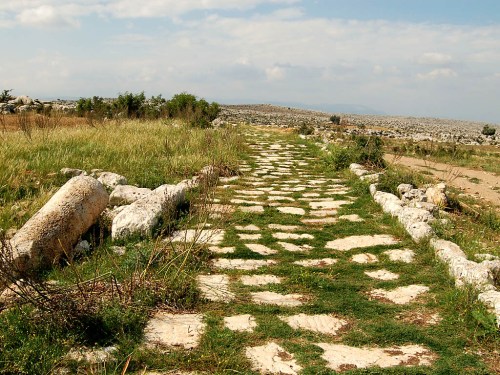
Our photo below shows a portion of a Roman road a few miles north of Tarsus, home of Saul of Tarsus. I think this is the route that would have been taken by Paul and Silas to connect them to the Cilician Gates and the Anatolian plateau. See Acts 15:41 – Acts 16:2.

Roman Road north of Tarsus. Note the fallen milestone. Photo by Ferrell Jenkins.

Roman Road north of Tarsus. Note the fallen milestone. Photo by Ferrell Jenkins.

The Lion of Babylon

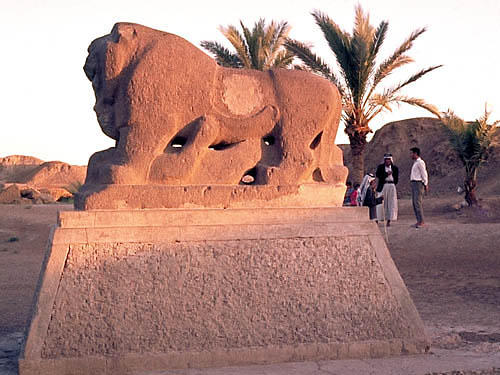
Babylon was excavated by Germans between 1899 and 1917. Local villagers discovered the image of a lion trampling a man during one of the periods when the archaeologists were not present. Upon return, the archaeologists completed the excavation of the image. This is the way the sculpture looked in 1970. I have noticed the image in several photo by American military personnel.

The Lion of Babylon trampling a man. Photo by Ferrell Jenkins.

Andre Parrot says,

There is … no such certainty about the basalt statue of a lion trampling on a man. This extraordinary work, which represents a beast overcoming a man, does not seem to be Mesopotamian in origin; it has been thought to be Hittite. (Babylon and the Old Testament 29-30)

Parrot also points out that the lion was associated with the goddess Ishtar.

The Bible records that Nebuchadnezzar and the Babylonians captured the city of Jerusalem in the days of Jehoiachin the king of Judah (2 Kings 24).

He carried away all Jerusalem and all the officials and all the mighty men of valor, 10,000 captives, and all the craftsmen and the smiths. None remained, except the poorest people of the land. And he carried away Jehoiachin to Babylon. The king’s mother, the king’s wives, his officials, and the chief men of the land he took into captivity from Jerusalem to Babylon. And the king of Babylon brought captive to Babylon all the men of valor, 7,000, and the craftsmen and the metal workers, 1,000, all of them strong and fit for war. (2 Kings 24:14-16 ESV)

Another view from Babylon

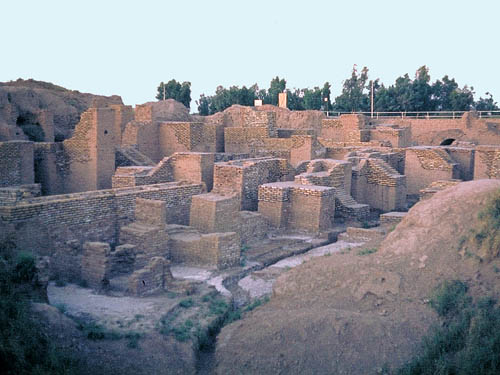
The early part of the week finds me traveling in Alabama, but I brought along another old slide scan of a photo I made at Babylon in 1970. When I compare the quality of the camera I used that year with the one I use today it is amazing that the old photo is this good. Slides fade even under the best home conditions.

This site is identified as Nebuchaznezzar’s Principal Palace. You will notice that even then, long before Saddam Hussein, some reconstruction had been carried out at the site. The lighter colored bricks at the top of the walls are part of the reconstruction to give the viewer some idea of what was original. It also helps one to visualize the size of the rooms, etc. This is the sort of thing we see at Masada, Megiddo, and other sites in Israel where the black line distinguishes the original from the reconstructed.

Nebuchadnezzar's Principal Palace in 1970. Photo by Ferrell Jenkins.

Nebuchadnezzar's Principal Palace in 1970. Photo by Ferrell Jenkins.

I understand the white on the ground to be salt residue.

The prophet Isaiah predicted the overthrow of the Neo-Babylonian Empire.

And Babylon, the glory of kingdoms, the splendor and pomp of the Chaldeans, will be like Sodom and Gomorrah when God overthrew them. (Isaiah 13:19 ESV)

God spoke, and it happened.