Category Archives: Archaeology

High places of the Gate

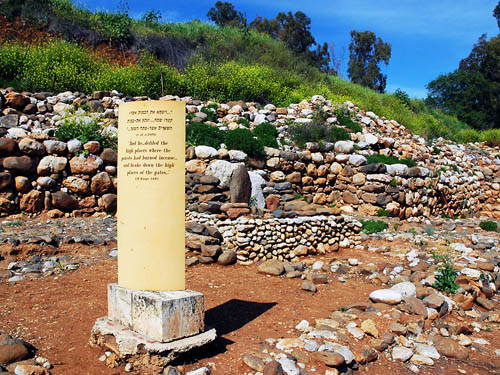
Standing stones (high places, bamah) are often found at the gate of Biblical cities. The photo below shows some standing stones from the gate of Tel Dan.  The informational sign immediately to the left of the standing stones includes a quotation from 2 Kings 23:8. The text describes the reforms of King Josiah of Judah (641/40–609 B.C.).

He brought all the priests from the cities of Judah and ruined the high places where the priests had offered sacrifices, from Geba to Beer Sheba. He tore down the high place of the goat idols situated at the entrance of the gate of Joshua, the city official, on the left side of the city gate. (2 Kings 23:8 NET)

[On “goat idols” see Leviticus 17:7 and 2 Chronicles 11:15]

Standing stones at the gate of Tel Dan. Photo by Ferrell Jenkins.

Standing stones at the gate of Tel Dan. Photo by Ferrell Jenkins.

Here is a closer view showing the standing stones. The placement of these stones at the gate of the city allowed everyone who came into the city to make obeisance to whatever god was represented.

Standing stones at the gate of Tel Dan. Photo by Ferrell Jenkins.

Bamah at the gate of Tel Dan. Photo by Ferrell Jenkins.

See the previous post (here) for more information about the standing stones.

Cultic complex at Hazor

Hazor was one was the most important Canaanite cities when the Israelites entered the land.

And Joshua turned back at that time and captured Hazor and struck its king with the sword, for Hazor formerly was the head of all those kingdoms. (Joshua 11:10 ESV)

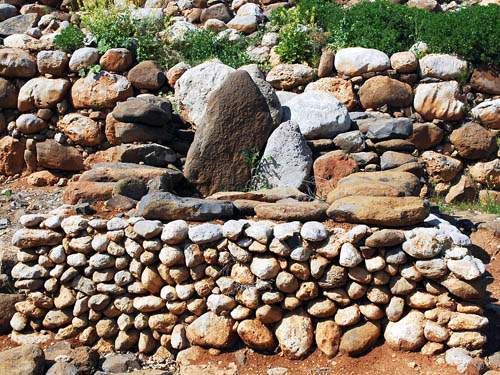
Stone stelae are commonly found during the excavation of Biblical cities. Archaeologists and Biblical scholars refer to an area of this type as a cultic center or complex. The word cult is used in several ways in modern writing and conversation, but it has a specialized meaning when we think of the archaeological context. The Hypertext Bible Commentary – Amos defines cultic as it is used in this context.

To do with organized religion and public worship, so “Israel’s cult” refers to the organized public religion of the kingdom of Israel. The word, when used in biblical studies, implies nothing (either way) about how theologically correct such worship or practice might be. It simply means public religion rather than private.

The photo below shows a cultic center found at Hazor from the Middle Bronze Age II (c. 1800-1550 B.C.). Sharon Zucherman, co-director of the Hazor excavations, refers to an area like this as “a ceremonial religious precinct” and “a cultic and ceremonial precinct” (BAR March/April 2006). An area like this is sometimes called a high place (Hebrew bamah).

Then I said to them, “What is the high place to which you go?’ So its name is called Bamah to this day.” (Ezekiel 20:29 NAU)

The crudely chiseled stones are designated by the Hebrew word massebah (plural masseboth). Some English translations use the phrase “standing stones” to translate massebah. Others use “sacred pillars” (NAU, NKJ, CSB) or “sacred stones” (NIV). The New Jerusalem Bible uses the phrase “cultic stones.”

The Israelites were instructed by the Lord to destroy these religious centers.

You will not bow down to their gods or worship them or observe their rites, but throw them down and smash their cultic stones. (Exodus 23:24 NJB)

In the left foreground of the area below there is a round basin. Perhaps for a libation?

Middle Bronze Age cultic complex at Hazor. Photo by Ferrell Jenkins.

Middle Bronze Age cultic complex at Hazor. Photo by Ferrell Jenkins.

The Fountain of Peirene at Corinth

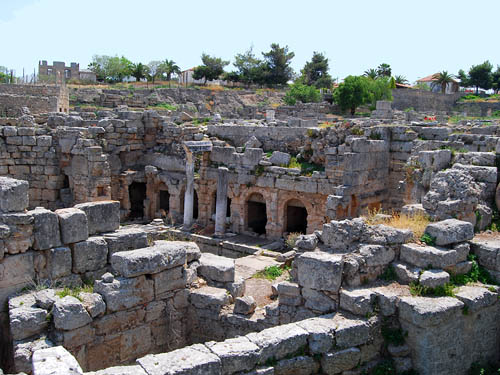
Food, Water, and the ability to defend, were the most important features in ancient cities. Corinth’s most important reservoir, the Fountain of Peirene, was fed from subterranean springs. It had a capacity of over 81,000 gallons.

Take a look at the horizon in the photo below. That was the level of the earth more than a century ago before archaeological excavations began at Ancient Corinth. The entire structure that we know as the Fountain of Peirene was covered with debris. This structure was built along the Lechaion Road which led from the Agora (Marketplace) to the Gulf of Corinth on the west side of the city.

The fountain is no longer in use, but if you walk close to the arches you can hear water flowing underneath the city.

Fountain of Peirene at Ancient Corinth. Photo by Ferrell Jenkins.

The Fountain of Peirene at Ancient Corinth. Photo by Ferrell Jenkins.

Paul visited Corinth on his second journey (A.D. 50-53). In spite of obstacles that brought fear to the heart of Paul, the Lord assured him that He had many people in the city (Acts 18:10).

And he stayed a year and six months, teaching the word of God among them. (Act 18:11 ESV)

A new Bible atlas

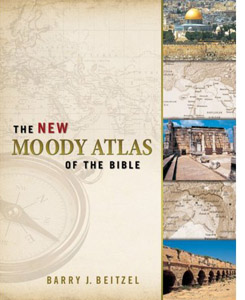
For the past three weeks I have had the opportunity to consult The New Moody Atlas of the Bible by Barry J. Beitzel.
The New Moody Atlas of the Bible
This work is a revision of The Moody Atlas of the Bible, published in 1985. This edition is a worldwide co-edition organized and produced by Lion Hudson in Oxford, England. You surely have seen some of their beautiful work in other publications. The USA edition is published by Moody Publishers. Many high quality books today are printed in the Orient. This one was printed in China. Amazing, isn’t it.
I don’t intend this as a review, but I am impressed with the clarity with which Beitzel discusses controversial material. In “The Route of the Exodus” he clearly discusses the historical background, the geographical setting, searching for Mt. Sinai in Saudi Arabia/South Jordan, searching for Mt Sinai in the northern Sinai peninsula, and searching for Mt. Sinai in southern Sinai. Pros and cons of the various positions are briefly set forth. No, I won’t tell!
This atlas sells for $49.99. I wish the publisher would sell it for $50. Does that one cent difference make anyone think they are getting a bargain? Amazon currently has the book for $31.49 (there we go again) from this link: The New Moody Atlas of the Bible.
Beitzel, with degrees from Dropsie, Fuller, and the University of Pennsylvania, is professor of Old Testament and Semitic Languages at Trinity Evangelical Divinity School.

Ancient Egypt in Pictures

Ancient Egypt in Pictures is the title of a slide-show collection of 47 nice photos on the Fox News web site here. Archaeology is alive and well in Egypt these days.

Egypt is an important travel destination for students of ancient history and archaeology, as well as for those interested in background studies for the Bible.

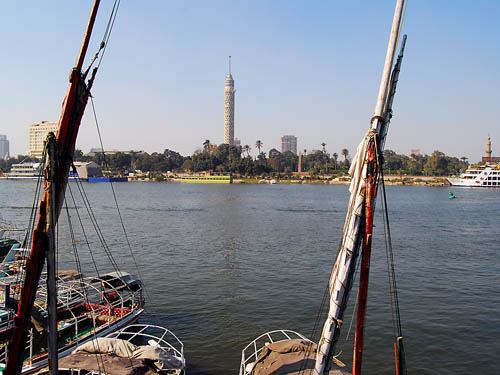
Nile River at Cairo. El Borg tower across river. Photo by Ferrell Jenkins.

Nile River at Cairo. El Borg tower across the river. Photo by Ferrell Jenkins.

HT: David Padfield

Jarmuth – a city of the Shephelah

Jarmuth (or Yarmuth) is located about 1 1/4 miles north of  the Valley of Elah, and 5 miles south of Beth-shemesh and the Sorek Valley. The site is mentioned 6 times in the book of Joshua (10:3, 5, 23; 12:11; 15:35), and in Nehemiah 11:29). The name is used in Joshua 21:29, but the Jarmuth mentioned there seems to be a town in the territory of Issachar.

Jarmuth was a Canaanite city conquered by the Israelites in the days of Joshua. It became part of the kingdom of Judah.

Michael Avi-Yonah says,

It has been identified with Khirbat al-Yarmūk (Eusebius calls it Iermochus), a large and prominent mound east of Kafr Zakariyya where surveys have revealed a large city surrounded by a massive stone wall from the Early Bronze Age and a smaller but higher mound containing pottery ranging from the Late Bronze to Byzantine periods. (Encyclopaedia Judaica)

Some excavations were conducted in the 1980s by Pierre De Miroschedji. The excavator says,

Given its size and the density of its construction, the EB III [about 2300 B.C.] city of Jarmuth may have had a population of about 3,000, engaged mainly in agriculture (cereals, vegetables, grapes, and especially olives) and animal husbandry (mostly sheep and goats, cattle and donkeys being used for traction and transport). (The Anchor Bible Dictionary 3:646)

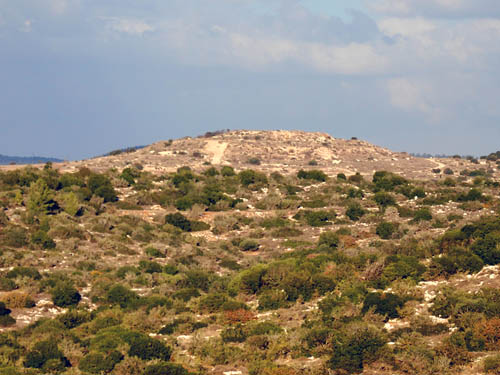
The photo below was taken from Khirbet Qeiyafa, 1 1/4 miles south of Jarmuth.

Jarmuth from Khirbet Qeiyafa. Photo by Ferrell Jenkins.

Jarmuth from Khirbet Qeiyafa (above the Valley of Elah). Photo by Ferrell Jenkins.

More on Paul’s shipwreck on Malta

Gordon Franz has written a critique on his Life and Land blog (here) of the CBN 700 Club’s program about Robert Cornuke’s “amazing Biblical discovery” on Malta. Previously we have called attention to Gordon’s blog and writings, and especially to his series on “Cracked Pot Archaeology” here.

The CBN video includes some nice footage and is, for that reason, worth viewing. If you have interest in this subject, I suggest you go to Life and Land and take a look at the video and read the critique.

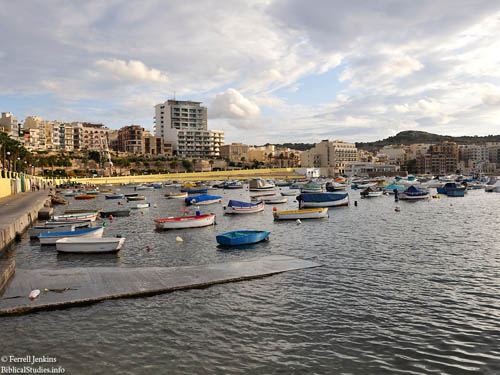
Our photo below shows one of the small pleasure harbors around St. Paul’s Harbor on Malta.

St. Paul's Harbor at Malta. Photo by Ferrell Jenkins.

St. Paul's Harbor at Malta. Photo by Ferrell Jenkins.

You may read our account of visiting Malta here and here. This is a significant topic because of the account of Paul’s shipwreck in Acts 28.

After we had safely reached shore, we learned that the island was called Malta. (Acts 28:1 NET)

The sacred standing stone at Shechem

Robert J. Bull, in a 1960 article in Biblical Archaeologist, tells the story of the earlier discovery of the sacred standing stone that still stands in the courtyard of the temple of Baal-Berith at Shechem.

“Sellin records that the altar base, when uncovered in 1926, was 2.20 meters long and 1.65 meters wide. Today there remain only a few stones arranged in an irregular pattern roughly 1 by 1 1/2 meters in extent. A large hollowed-out stone base and a broken piece of hard white limestone were uncovered by Sellin just southeast of the altar. The hollow in the base was 40 centimeters deep, and measured 45 cms. in width and 1.65 meters in length, while the limestone slab was 1.45 meters by 40 cms., and stood 1.65 meters in height. Since the limestone slab would fit into the base neatly; Sellin concluded he had found the main standing-stone or maṣṣebah of the city. A story which I am not able to confirm relates that Dr. Aage Schmidt, visiting the tell during a temporary absence of Sellin, came upon one of the workmen breaking up the limestone slab with a maul and prevailed upon him to cease until Sellin could be summoned!

Thus it was that some portion of the maṣṣebah was saved. In 1956, the Drew-McCormick Expedition found the socket and slab cast down from the bank of altar fill into the palace area some 6 meters below. One end of the base had been broken off, so that only an open ended niche remained, four-fifths of the original length. Of the maṣṣebah, only 1.45 meters of its original height remained on one side and only 62 cms. on the other. With great effort, a team of workers tugged and hauled these massively heavy stones back up onto the forecourt of the temple, securing the standing stone in its original base with cement. Once again the maṣṣebah dominates the area from a point where it probably stood originally, at least from what we can learn from the drawings and photographs in the Sellin and Welter reports” (Robert J. Bull, Biblical Archaeologist : Vol. 23 1-4, electronic ed. (American Schools of Oriental Research, 2001, c1960).

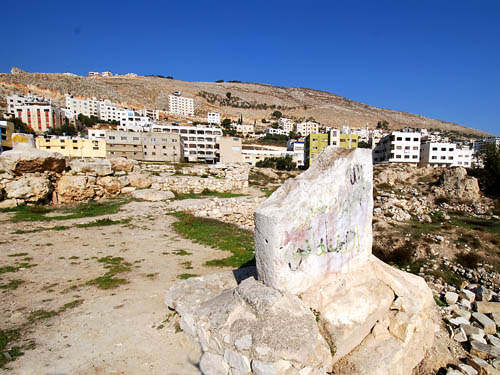
The broken sacred standing stone (massebah) stands in the courtyard in front of the entrance to the Temple of Baal-Berith. The near-barren Mount Ebal, where the curses of the law were read (Deuteronomy 27); Joshua 8:30-33), is visible to the north.

The sacred standing stone at Shechem. Photo by Ferrell Jenkins.

The sacred standing stone at Shechem. Photo by Ferrell Jenkins.

Dr. Bryant Wood says,

Since the temple existed in Joshua’s day, it is possible this was the “large stone” he set up “under the oak that was by the sanctuary of the Lord” at Shechem (Josh. 24:26). The stela is undoubtedly the “pillar” where Abimelech was made king (v. 6)” (Bryant Wood. “From Ramesses to Shiloh.” Giving the Sense. Kregel, 2003).

The entrance to the temple of Baal-Berith

Edward F. Campbell, in a report on the 1960 excavation at Shechem, tells about Sellin’s discovery more than three decades earlier.

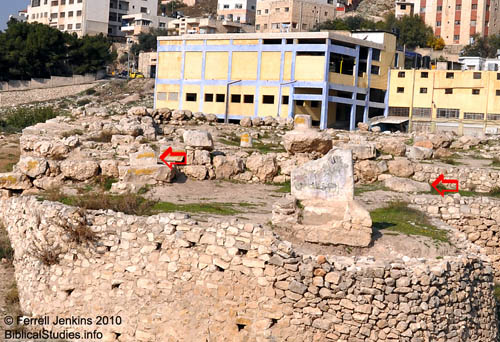
“While this work was underway, he found time to study some stones in the court before the temple. On each side of the door there was a large stone block, one of them nearly 4M ft. long, the other nearly 6 ft. long. Both had long depressions cut into their tops, and Sellin had first thought that they were watering troughs—though how such small depressions could have served any such purpose in front of the temple is difficult to imagine. Directly in front of the door in the courtyard to the southeast was a much larger stone with a similar though much deeper and wider trough, which also had been interpreted as a receptacle for water. Now, however, Sellin took note of a large, flat stone with rounded sides lying nearby. Though broken and much of it gone the reminder is still over 5 ft. high, some 4M ft. wide and 1 m ft. thick. Experiment showed that the smooth flat stone had been made to stand up in the trough, so Sellin put the two together. Two more flat stones were found to fit together in the left (southwestern) stone base beside the temple door. Sellin concluded that these three could only be installations of sacred standing stones that once framed the temple entrance—stones that in Old Testament Hebrew are called massebot” (Biblical Archaeologist: Vol. 20 1-4, electronic ed. (American Schools of Oriental Research).

The stone bases on either side of the entrance to the temple are visible today, and marked here by the red arrows. The base on the left has the broken sacred standing stone in place.

Courtyard and entrance to temple of Baal-Berith. Photo by F. Jenkins.

Notice the courtyard in front of the temple entrance. In a future post we will report how the largest standing stone was almost destroyed.

The temple of Baal-Berith at Shechem

The book of Judges describes the situation at Shechem after the death of Gideon.

After Gideon died, the Israelites again prostituted themselves to the Baals. They made Baal-Berith their god. (Judges 8:33 NET)

Abimelech, the son of Gideon was such a desperate politician that he took money from the Shechemites from the temple of Baal-Berith (Judges 9:4). Dr. Bryant Wood describes the temple of Baal-Berith.

References to the “house of Baal-berith” (v. 4), “Beth-millo” (v. 6,20), “house of their god” (v. 27), “tower of Shechem” (vv. 46,47,49), and “temple of El-berith” (v. 46), all appear to be the same structure at Shechem. Berit is the Hebrew word for covenant, so the temple was for “Baal of the covenant.”

A large fortress (or Migdal) temple discovered on the acropolis of Shechem has been identified as the temple of Judges 9. It was  constructed in the seventeenth century B.C. and lasted until the destruction of the city by Abimelech in the twelfth century B.C. The largest temple yet found in Canaan, it measures 21.2 x 26.3 m, and has foundations 5.1 m thick that supported a multistoried superstructure of mud bricks and timber. On the east, two towers containing stairwells to the upper stories flanked the entrance. Inside, two rows of columns, three in each row, divided the space into a nave and two side aisles (cf. vv. 46-49)” (Bryant Wood. “From Ramesses to Shiloh.” Giving the Sense. Kregel, 2003).

The photo shows the foundation of the Temple of Baal-Berith at Shechem. This structure was brought to light in the
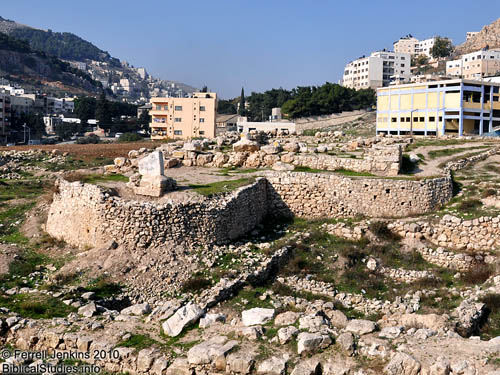
Temple of Baal-Berith in center of photo. Ebal in distance. Photo by F. Jenkins.

Temple of Baal-Berith in center of photo. Gerizim (L) & Ebal (R). Photo by F. Jenkins.

G. Ernest Wright says, “Before 1903 biblical geographers all thought that Shechem was once located where the modern city of Nablus is.” They associated the Roman city of Neapolis with Nablus. The German scholar Herman Thiersch found the walls of “old Shechem” June 26, 1903. He said, “The place is somewhat under cultivation with vegetables and seed-crops.” (G. Ernest Wright, Biblical Archaeologist: Vol. 20 1-4, electronic ed. (Philadelphia: American Schools of Oriental Research, 2001, c1957). This site is identified with the mound of Tell Balata.

The first excavations at Shechem were conducted by Prof. Ernst Sellin in 1913 and 1914. More extensive excavations took place between 1926-1928.