Category Archives: Archaeology

The Scribe

Baruch, the scribe (Hebrew, sopher), served as the amanuensis or secretary of Jeremiah the prophet.

Then Jeremiah took another scroll and gave it to Baruch the scribe, the son of Neriah, who wrote on it at the dictation of Jeremiah all the words of the scroll that Jehoiakim king of Judah had burned in the fire. And many similar words were added to them. (Jeremiah 36:32 ESV)

A few years back a bulla of the seal of Baruch the scribe was discovered during an archaeological excavation in Jerusalem. A bulla is a piece of hardened clay bearing the impression of a seal.

A scribe working in the synagogue at Masada. Photo by Ferrell Jenkins.

A scribe working in the synagogue at Masada. Photo by Ferrell Jenkins.

A scribe was copying a manuscript in a small room of the synagogue at Masada last May. This was the first time I had noticed a scribe there. In the days prior to the invention of the printing press the scribe played a highly significant role in society.

King of Israel felled by stray arrow

The story is in 1 Kings 22. Ahab, king of Israel (874-853 B.C.), and Jehoshaphat, king of Judah (870-848), decided to try to take back the city of Ramoth-gilead which had fallen under the control of the king of Aram (Syria). Ramoth-gilead is a city of tranjordan, now in the northern part of Jordan near the border with modern Syria.

Ahab was fearful to be seen in battle and disguised himself to avoid attack.

Now an archer shot an arrow at random, and it struck the king of Israel between the plates of his armor. The king ordered his charioteer, “Turn around and take me from the battle line, because I’m wounded.” (1 Kings 22:34 NET)

The king of Israel died and was taken to Samaria for burial.

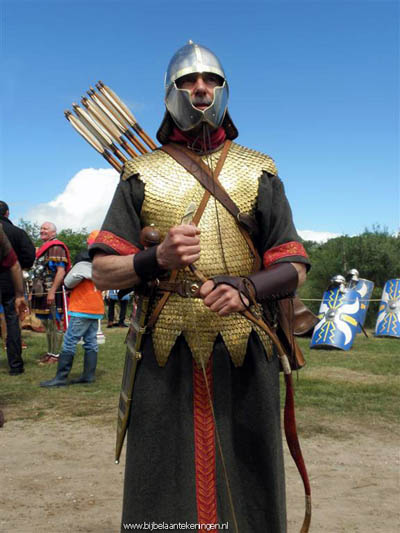
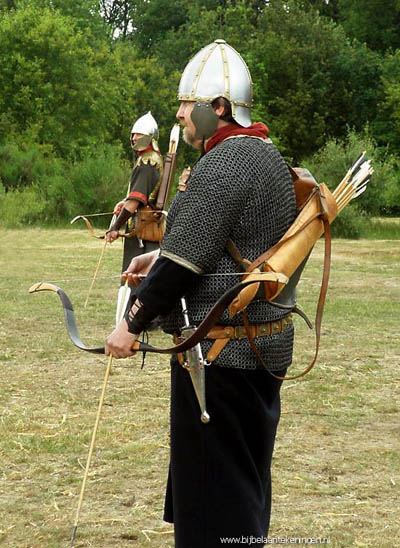
JP van de Giessen, a fellow blogger at Aantekeningen bij de Bijbel, has kindly granted permission for the use of these wonderful photos he made at the Romanfestival in Nijmegen (the Netherlands). He tells me that the festival is organized every two years with many actors. At this festival there were about 100 soldiers, 10 calvary and 120 civilian people (from slave to noble).

JP says the archers he photographed are Persian archers dressed according to the time of the Seleucids (the period between the testaments). They provide great illustrations for a lesson on 1 Kings 22.

Persian archer dressed as at the time of the Seleucids. Photo: JP van de Giessen.

Archer from the time of the Seleucids. Photo: JP van de Giessen.

According to JP, one of the archers he spoke with said he needed a year to create his costume, and another year for his bow and sword.

Archer from time of Seleucids. Photo by archer dressed as at the time of the Seleucids. Photo: JP van de Giessen.

Archer dressed as at the time of the Seleucids. Photo: JP van de Giessen.

More photos may be viewed here. JP van de Giessen holds the rights to these photos, but I think he is pleased when they are used in teaching. Click on the photo for a larger image.

The deal is the thing; buying & selling in the Middle East

Most Americans who have traveled with me find the bargaining that goes on in a shop  in the Middle East difficult at first. Items are not marked with a price. The seller, whether in a high class shop or a vendor on the street, tries to make as much as possible. He tries to convince his prospective buyer that this is the first sale of the day, will bring him luck, or is a good deal.

The Jerusalem Post Online Edition ran an article yesterday about an auction in Tel Aviv of the coin collection of Wolfgang Masser. The article says he “has spent decades assembling one of the best private collections of ancient coins in Israel.” He said that he did not “wish to burden his children or grandchildren with the sale.” I imagine they are happy, too!

Masser explains how he became involved in collecting biblical era coins.

“I must admit that I became enthusiastic quite quickly,” he said. “Can one really find and acquire coins that lay in the hands of men and women who lived in this country 2,000 years ago and bore names from ancient writings such as Shimon Bar-Kochba, Pontius Pilate and Herod? “My Zionist idealism was mixed with curiosity and romanticism. The time was indeed opportune – the situation had ‘normalized’ after the events of the Six Day War. People from the “field” – Jews, Arabs and, of course, officials interested in archeology began to search for coins, and relatively many specimens came into the open.”

Since Masser had a car and Yashin [the neighbor who got him interested in coins] didn’t, the two began to drive regularly to Bethlehem and Jerusalem on Saturdays in search of rarities.

“The main and richest source was a young Greek-Catholic Arab dealer from Bethlehem called Kando,” Masser recalled. “This slightly built young man had been introduced to the ‘profession’ by his father, Khalil Eskander, an antiquities dealer nicknamed Kando.

“The father became known in connection with the discovery and sale of the famous scrolls of Qumran near the Dead Sea to Hebrew University Prof. Eliezer Sukenik (father of Yigael Yadin). He made some money with the scrolls, which he used to set up an antiquities shop for his son in Bethlehem and to buy himself a hotel in Jerusalem, where he set up a similar shop – but where we only rarely found anything of interest,” continued Masser.

“The antiquities shop of Kando Jr. was a modest place in the main street of Bethlehem, not far from Manger Square and the Church of the Nativity. As you came inside, there were display cases on the right and left with ancient ceramic, glass and a few ancient metal artifacts. No coins in view. In the background stood an enormous desk and behind it, Kando Jr.”

Negotiations over a sale involved an elaborate and time-consuming ritual, recalled Masser. “If he had a visitor, then he would bid him a hasty farewell and turn to us. First coffee, family and politics. Then he would slowly bring out for us his latest acquisitions in a ceremony – the longer it lasted, the more beautiful and valuable were the coins he presented.

“This was intended, and put us in a heated state of anticipation. The coins were examined with a magnifying glass and their history and year of issue were discussed.

“Finally the price was mentioned. This part of the conversation was usually handled by Haim, who had much more experience than me. In most cases, there was a discount.

“Kando was, despite his youth, clever enough to know how to handle regular customers who were market-savvy. On especially successful occasions he made us a present of an ancient oil lamp from the same period, or invited us to lunch. He was a very good salesman. There was full trust on both sides.

“When he showed us especially valuable pieces which I desired but did not have enough money on me for – I never bought on credit – he would let me take the coin with me, saying, ‘So we shall meet in 14 days, with the money or with the coin.’ Everything took place without written agreements.”

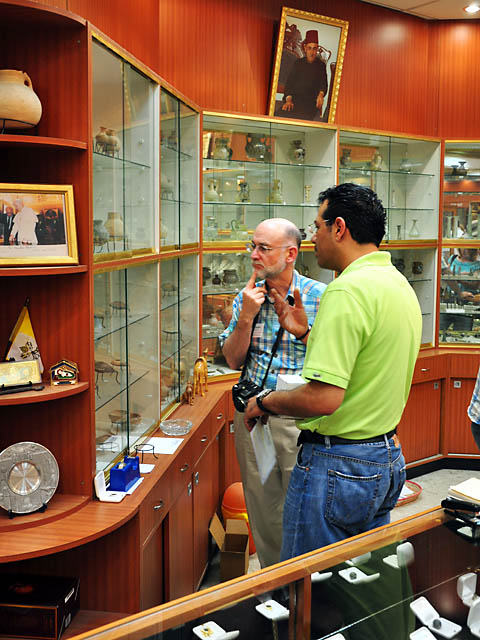
Read the full article here. Kando’s store in Bethlehem is still open, and similar dealing still goes on. The store is run by Shibly (in the green shirt), grandson of Kando, and other family members. Kando, from his portrait over the cases, still looks down on the deal.

Kando's Antiquities Shop in Bethlehem. Photo by Ferrell Jenkins.

Kando's Antiquities Shop in Bethlehem. Photo by Ferrell Jenkins.

The sort of dealing mention in the article is reminiscent of what we read regarding Abraham’s purchase of a burial place for Sarah from Ephron the Hittite (Genesis 23).

HT: Joseph Lauer

Samaritan synagogue discovered near Beth-shean

The Israel Antiquities Authority announced the discovery of a 1,500 year old Samaritan synagogue southwest of Beth-shean (Bet She’an).

The remains of a synagogue and farmstead that operated in the Late Byzantine period, which were unknown until now, were exposed in an archaeological excavation conducted on behalf of the Israel Antiquities Authority and underwritten by the Ministry of Construction and Housing, prior to enlarging a residential quarter south of Bet Sheʽan, c. one half kilometer west of the Jordan Valley highway (Route 90).

According to Dr. Walid Atrash and Mr. Ya’aqov Harel, directors of the excavation for the Israel Antiquities Authority, “The discovery of another Samaritan synagogue in the agricultural hinterland south of Bet She’an supplements our existing knowledge about the Samaritan population in this period. It seems that the structures uncovered there were built at the end of the fifth century CE and they continued to exist until the eve of the Muslim conquest in 634 CE, when the Samaritans abandoned the complex. The synagogue that is currently being revealed played an important part in the lives of the farmers who inhabited the surrounding region, and it served as a center of the spiritual, religious and social life there. In the Byzantine period (fourth century CE) Bet She’an became an important Samaritan center under the leadership of Baba Rabbah, at which time the Samaritans were granted national sovereignty and were free to decide their own destiny. This was the case until the end of the reign of Emperor Justinian, when the Samaritans revolted against the government. The rebellion was put down and the Samaritans ceased to exist as a nation.”

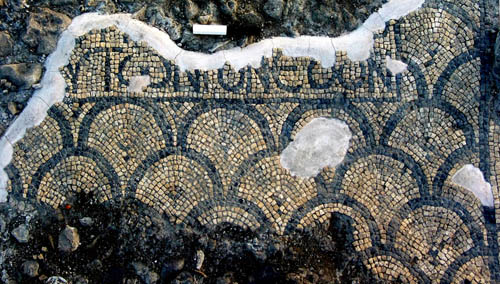
The building, facing Mount Gerizim, had a mosaic floor. The last line of a Greek inscription was revealed. According to the report, the inscription reads,

T[ ]OUTON NEWN — meaning “This is the temple.”

There will likely be other suggestions on the reading of the inscription.

Samaritan Synagogue Inscription. Photo by Tal Rogovski, IAA.

Samaritan Synagogue Inscription. Photo courtesy IAA.

This is the third Samaritan synagogue to be found in the vicinity of Beth-shean.

The full report may be read here.

Bible students know that the Samaritans play an important role in both the Old Testament and the New Testament. Follow these references for some information: 2 Kings 17:29; Luke 9:52; John 4; Acts 8;25.

HT: Joseph Lauer; Todd Bolen, Bible Places Blog.

Apollo signet ring discovered at Tel Dor

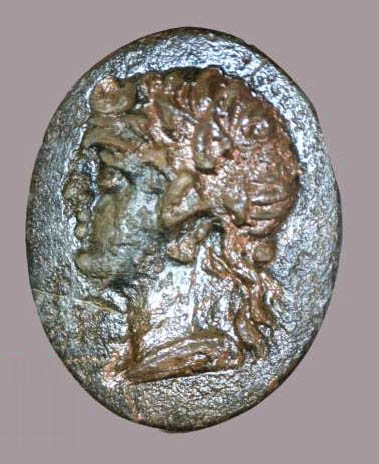
More and more discoveries from Israel are revealing the influence of Hellenistic and Roman culture in the area. The most recent announcement comes from the University of Haifa excavation at Tel Dor.

Bronze signet ring with portrait of Apollo (Microscope photo adapted by Paula Weimann Barak, courtesy of the Tel Dor Expedition.

Bronze signet ring with portrait of Apollo (Microscope photo adapted by Paula Weimann Barak, courtesy of the Tel Dor Expedition.

The report says,

A rare bronze signet ring with the impression of the face of the Greek sun god, Apollo, has been discovered at Tel Dor, in northern Israel, by University of Haifa diggers. “A piece of high-quality art such as this, doubtlessly created by a top-of-the-line artist, indicates that local elites developing a taste for fine art and the ability to afford it were also living in provincial towns, and not only in the capital cities of the Hellenistic kingdoms,” explains Dr. Ayelet Gilboa, Head of the Department of Archaeology at the University of Haifa, who headed the excavations at Dor along with Dr. Ilan Sharon of the Hebrew University of Jerusalem.

When the ring was recovered from a waste pit near Hellenistic structures, it was covered with layers of earth and corrosion, and the archaeologists had no indication whatsoever that it would reveal the shape of a legendary figure. Only after the ring was cleaned up at the Restoration and Conservation laboratory at the Hebrew University’s Institute of Archaeology, was the profile of a beardless young male with long hair, clean shaven and adorned with a laurel wreath, revealed. The ring was examined by Dr. Jessica Nitschke, professor of classical archaeology at Georgetown University in Washington DC, and by Dr. Rebecca Martin, assistant professor of art at Southeast Missouri State University, both of whom are partners in the Tel Dor excavations. Both confirmed that the image is that of Apollo – one of the most important of the Olympian gods in Greek mythology, god of the sun, of light, music and song.

The archaeological context and style of the signet ring date it back to the 4th or 3rd century B.C.E. This type of ring was used as a seal or was dedicated to the temple of the god imprinted on the ring. Since it was found in an urban context and at an orderly archaeological dig, the discovery is of great significance: Most of the small pieces of art originating in the Near East until now are of unknown origin, having been displaced through illegal antique trade, or purchased by museums and collectors before scientific archaeological research began.

The ring also testifies to the cosmopolitan character of this region as far back as 2,300 years ago. Despite the damage caused over the centuries, its high quality is easily recognizable. The precious object was found in the same area as a small gemstone with an engraved image of Alexander the Great and a rare, exquisite Hellenistic mosaic floor that were unearthed during earlier excavation seasons. All these discoveries are very likely to be linked to a nearby structure which is currently being excavated, the architectural features of which indicate that it is a grand elite structure.

These finds indicate that the circulation of fine art objects was not limited to the capital cities of the Hellenistic kingdoms in the east, such as Alexandria in Egypt or Antioch and Seleucia in Syria, where the main populations were Greek, but also spread to smaller centers, such as Dor, which was primarily populated by local Phoenician inhabitants.

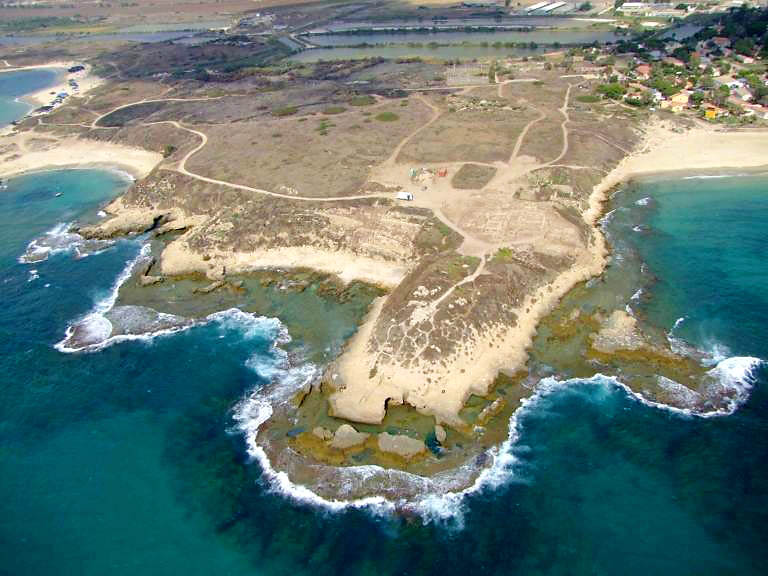
The town of Dor was an important port on the Mediterranean shore from 2000 B.C.E. until 250 C.E. Pieces of Greek-style art, such as signet rings and miniature gems, began to appear in the east at the time of the Persian Empire (6th-4th centuries B.C.E.) and became more common after Alexander the Great conquered the region, passing through Dor on his journey from Tyre to Egypt in 332 B.C.E. Subsequently, the town of Dor became one of the centers of Greek culture in the land of Israel, and that culture left its mark even after Dor was conquered by Alexander Jannaeus, King of Judea, around 100 B.C.E. and its impact is evident well into the Roman era.

The full report which provides some information about the dig may be read here.

Tel Dor. Photo by Sky View. Courtesy of the Tel Dor Expedition.

Tel Dor. Photo by Sky View. Courtesy of the Tel Dor Expedition.

Dor is mentioned only a few times in the Old Testament Scriptures.

  • When Jabin, king of Hazor, heard of the victories of Joshua and the Israelites he put together a confederacy of armies including the king of the “heights of Dor on the west” (Joshua 11:2).
  • Joshua conquered “the king of Dor in the heights of Dor” (Joshua 12:32).
  • Dor was allotted to the tribe of Manasseh (Joshua 17:11). The writer of Joshua quickly acknowledges that Manasseh could not take possession of these cities, “because the Canaanites persisted in living in that land” (Joshua 17:12; see Judges 1:27).
  • Solomon appointed his son-in-law Ben-abinadad over the height of Dor (1 Kings 4:11).
  • Ephraim’s territory extended to the border of Manasseh, including “Dor with its towns” (1 Chronicles 7:29).

HT: Joseph Lauer

Royal theater box at the Herodium

Last week reports began to circulate about Herod’s royal theater box at the Herodium. Here are some excepts from the News Release published by the Hebrew University of Jerusalem.

Royal box uncovered at Herodium reveals further evidence of luxurious lifestyle of famed King of Judea

A “royal box” built at the upper level of King Herod’s private theater at Herodium (Herodion in Greek) has been fully exposed in recent excavations at the site, providing a further indication of the luxurious lifestyle favored by the famed Judean monarch.

The excavations, in the frame of Herodium’s National Park at the eastern edge of Gush Etzion, were conducted by Prof. Ehud Netzer under the auspices of the Hebrew University of Jerusalem Institute of Archaeology.

The theater, first revealed during the years 2008-2009, is located halfway up the hill close to Herod’s mausoleum, whose exposure in 2007 aroused worldwide attention. The highly decorated, relatively small theater was built in approximately 15 B.C.E., which was the year of the visit to Judea of Marcus Agrippa, second in the hierarchy of the Roman Empire, said Prof. Netzer, who has been assisted in the excavations by Yakov Kalman, Roi Porath and Rachel Chachy.

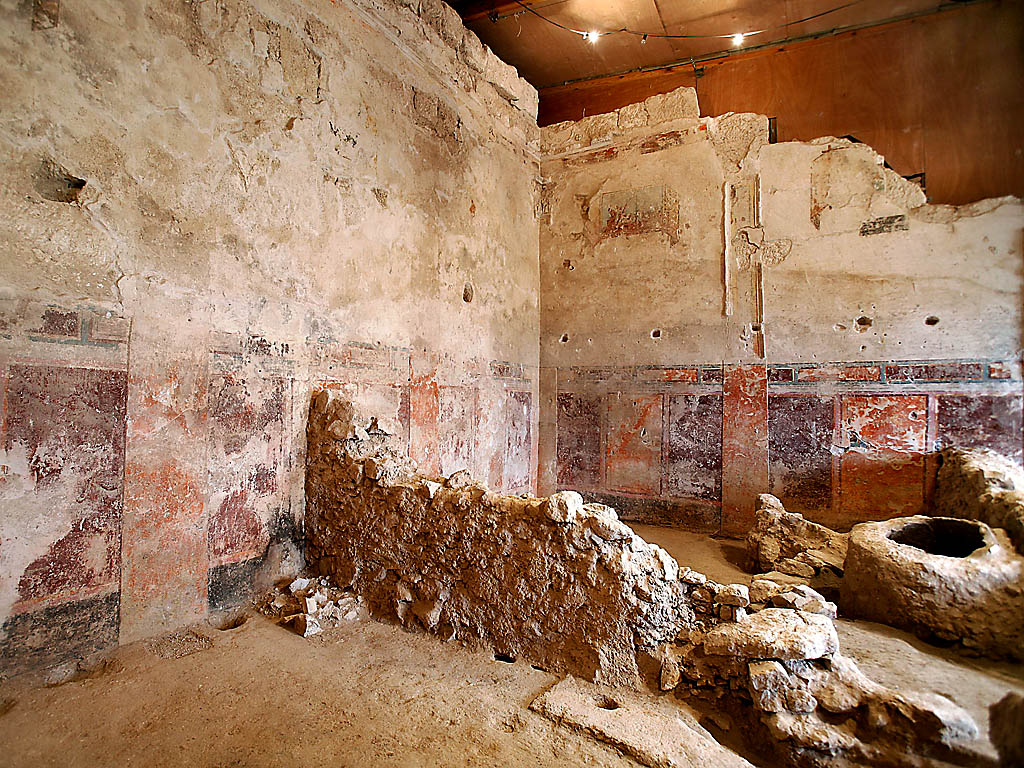
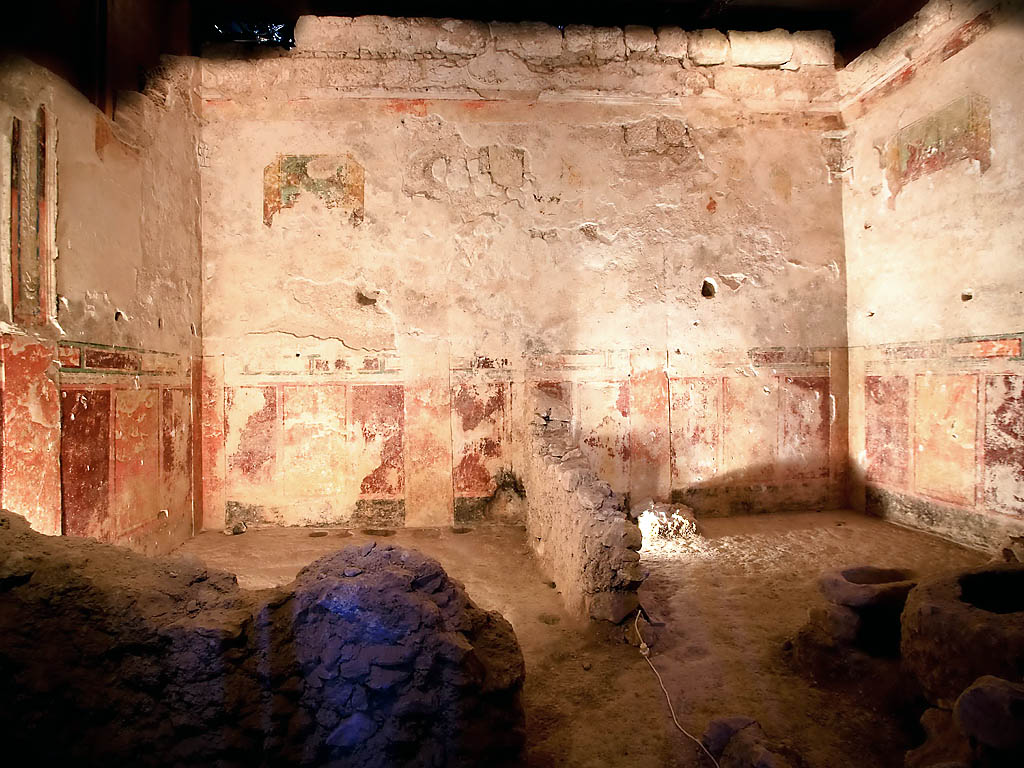
The royal box (measuring eight by seven meters and about six meters high) is the central space among a group of rooms attached to the upper part of the theater’s structure. This impressive room doubtlessly hosted the king, his close friends and family members during performances in the theater and was fully open towards the stage.

Its back and side walls are adorned with an elaborate scheme of wall paintings and plaster moldings in a style that has not been seen thus far in Israel; yet, this style is known to have existed in Rome and Campania in Italy during those years. This work, therefore, was no doubt executed by Italian artists, perhaps sent by Marcus Agrippa, who a year before his visit to Judea met Herod on the famous Greek island of Lesbos said Netzer.

On the upper parts of the walls are the room’s highlights: a series of unique “windows” painted with outfolded shutters on either side and various naturalistic landscapes within. They include scenes of the countryside, the Nile River and a nautical scene featuring a large boat with sails. One can identify features of trees, animals and human beings. Some of these windows have survived intact on the walls, whereas others were found in fragments on the floor and are undergoing restoration in the Israel Museum’s laboratory.

Painted windows with shutters appear in the late Second Pompeian Style in Italy, and mainly depict unrealistic views like theater settings and still-life. The closest parallels for the windows at Herodium are known from the “Villa Imperiale” at Pompeii, dated to the early Third Style, 15 to 10 B.C.E.

The News Release may be read in its entirety here.

Joseph I. Lauer secured the available photos and has been kind enough to share them.
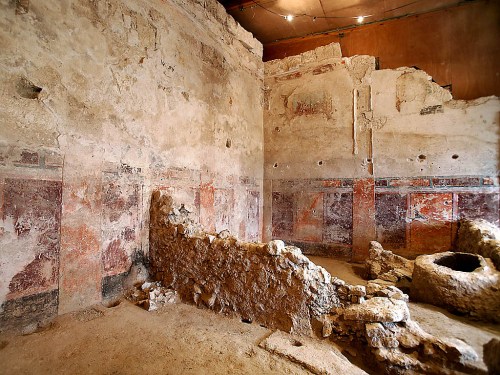
Herodium theater royal box. Photo by Gabi Laron, Hebrew University.

Herodium theater royal box. Photo by Gabi Laron, Hebrew University.

The Hebrew University report says,

The data accumulated during the excavation proves that the theater’s lifetime was very short, less than ten years. Slightly before Herod’s death, It was deliberately destroyed in order not to disrupt the conic shape of the artificial hill. During the construction of the artificial hill (as well as the famous monumental stairway which begins at the bottom of the hill), parts of the theater, including the “royal box,” were temporarily used by the builders, leaving their footsteps in the form of subdivision walls, cooking installations and graffiti.
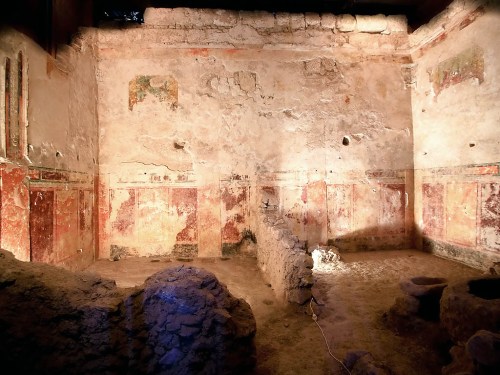
Herodium royal box. Photo by Tal Rogovski, Hebrew University.

Herodium theater royal box. Photo by Tal Rogovski, Hebrew University.

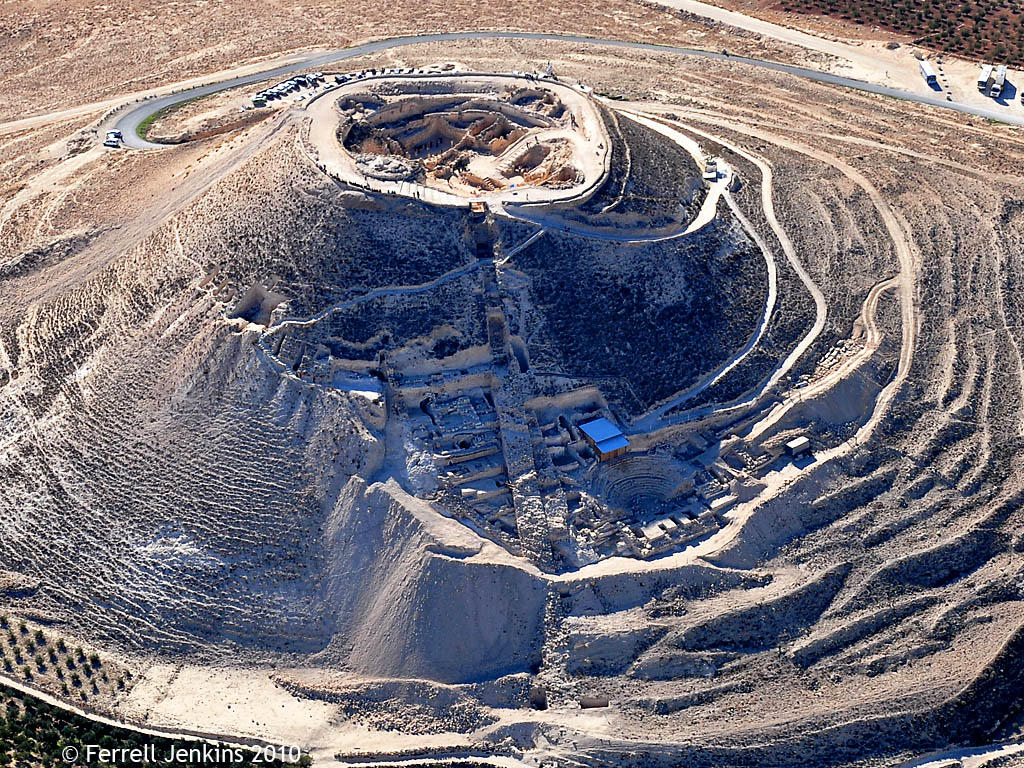
I had the opportunity to make some aerial photos of the Herodium December 15, 2009. Shadows were on the north side of the Herodium, but the massive area of the excavation can be seen. Note especially the theater. I feel certain that the royal box described above is under the blue roof. Click on the image to for a larger photo.
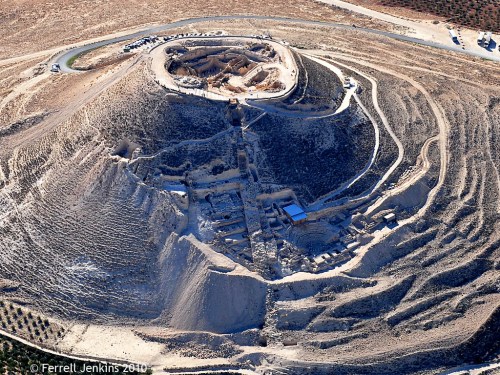
Aerial photo of the Herodium. Photo by Ferrell Jenkins.

Aerial photo of the Herodium. Photo by Ferrell Jenkins.

The Herodium is located about four miles southeast of Bethlehem. When we think of these two places together we recall Herod’s frantic attempt to kill Jesus.

Then Herod, when he saw that he had been tricked by the wise men, became furious, and he sent and killed all the male children in Bethlehem and in all that region who were two years old or under, according to the time that he had ascertained from the wise men. (Matthew 2:16 ESV)

All of the photos are suitable for use in teaching presentations.

The ziggurat at Ur

The pyramids of Egypt are fairly well known to students in the Western world. Some study is made of them in the elementary grades. The ziggurats of Mesopotamia (mostly present day Iraq) are not as well known. In Egypt we have some pyramids, like the great pyramids of Giza, which are still standing to almost their original height. Having been made of stone, they have been fairly well preserved.

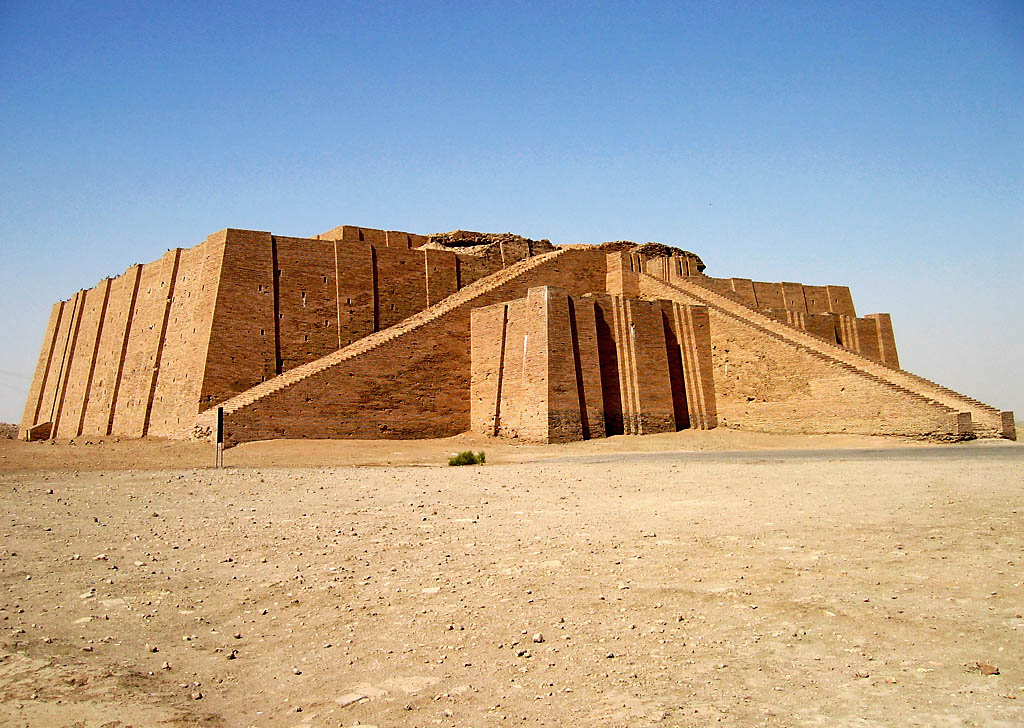
The ziggurats of Mesopotamia were made of baked bricks. Over the centuries they have tended to become piles of mud. The only one I saw during my only visit to Iraq in May, 1970, that had any semblance of a defined shape was the ziggurat at Ur. That was because it had been reconstructed up to about the fourth story.

The ziggurat was a staged temple tower. The temple at the top of the tower was considered the dwelling place of the particular god worshiped at a site. The kings of Ur are thought to have built the first ziggurat about the 27th century B.C., though some may have been erected on older structures going back to about 3100-2900 B.C. (The Middle East, Hachette World Guides, 1966). A model, like the one below from the Pergamum Museum in Berlin gives us a good impression of the original appearance of the ziggurats.

Ziggurat Model at the Pergamum Museum, Berlin. Photo by Ferrell Jenkins.

Ziggurat Model at the Pergamum Museum, Berlin. Photo by Ferrell Jenkins.

Every now and then I search the Internet for photos of Iraq. Sometimes I locate a nice photo made by a soldier who has been stationed there. One day I came across a really great photo on Flickr made by Josh McFall. It took a while to track down Josh and ask his permission to use the photo on the web site. He enthusiastically grated permission, only asking that I comply with the attached Creative Commons license. That, I was pleased to do. The Creative Commons license on this photo requires Attribution, Non-commercial Use, and No Derivative works. Josh, I am sure many of my readers thank you.

The ziggurat at Ur is attributed to the third dynasty of Ur (2124-2015 B.C.).

Ziggurat at Ur in Iraq. Photo by Josh McFall.

Reconstructed Ziggurat at Ur in Iraq. Photo by Josh McFall.

Perhaps we should think of something like the ziggurats when we study the account of the building of the tower of Babel in Genesis 11.

Then they said, “Come, let us build ourselves a city and a tower with its top in the heavens, and let us make a name for ourselves, lest we be dispersed over the face of the whole earth.” (Genesis 11:4 ESV)

And it might help with the understanding of what Jacob saw in his dream at Bethel.

And he dreamed, and behold, there was a ladder set up on the earth, and the top of it reached to heaven. And behold, the angels of God were ascending and descending on it! (Genesis 28:12 ESV)

When John calls attention to this scene he says the angels were ascending and descending on the “Son of Man” (John 1:51).

Both photos are available in presentation size for those who would like to use them. Just click on the image.

The Ostrich in Bible Times

The ostrich is listed among the unclean birds for the Israelites in Leviticus 11:16 and Deuteronomy 14:15. Job laments that he is “a companion of ostriches” (Job 30:29). The longest section of scripture mentioning the ostrich is in the the response by the LORD.

“The wings of the ostrich wave proudly, but are they the pinions and plumage of love? For she leaves her eggs to the earth and lets them be warmed on the ground, forgetting that a foot may crush them and that the wild beast may trample them. She deals cruelly with her young, as if they were not hers; though her labor be in vain, yet she has no fear, because God has made her forget wisdom and given her no share in understanding. When she rouses herself to flee, she laughs at the horse and his rider. (Job 39:13-18 ESV)

Ostrich at the Hai Bar Nature Reserve. Photo by Ferrell Jenkins.

Ostriches at the Hai Bar Nature Reserve. Photo by Ferrell Jenkins.

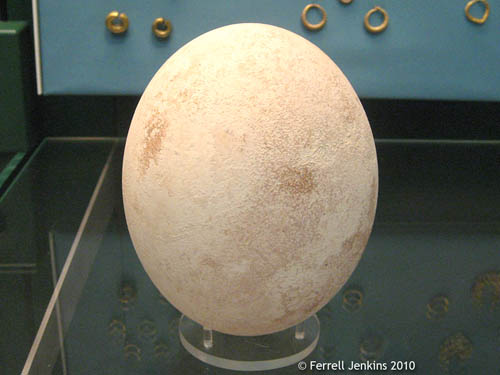
Archaeologists uncovered this ostrich egg pictured below from the MB II level (1750–1550 B.C.) at Lachish. The sign with the display at the British Museum says,

Ostriches were native to the Levant and their eggs, plain or decorated were often included in tomb deposits.

Ostrich Egg discovered at MB II Lachish. British Museum. Photo by Ferrell Jenkins.

Ostrich Egg discovered at MB II Lachish. British Museum. Photo by Ferrell Jenkins.

After the destruction of Jerusalem in 586 B.C., Jeremiah lamented that “the daughter of my people has become cruel, like the ostriches in the wilderness.” (Lamentations 4:3 ESV)

Cyrus Cylinder loaned to Iran

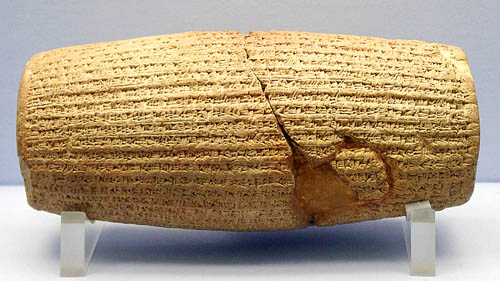
The Cyrus Cylinder came from ancient Persia. Now the British Museum, where it has been housed for many years, is loaning the artifact to the museum in Tehran, Iran.

Todd Bolen calls attention the the agreement, the historical significance of the Cyrus Cylinder, and the biblical reference (Ezra 1:1-4) to one of the events mentioned in the Cylinder.

The the account at the Bible Places Blog here, and be sure to follow the link to his list of the British Museum: Top 10, yeah 15.

If you plan to visit London, and you are interested in Bible study, be sure to download my short list of “Some Biblically Related Artifacts in the British Museum” here.

The Cyrus Cylinder in the British Museum. Photo by Ferrell Jenkins.

The Cyrus Cylinder in the British Museum. Photo by Ferrell Jenkins.

Have no fear of the authorities

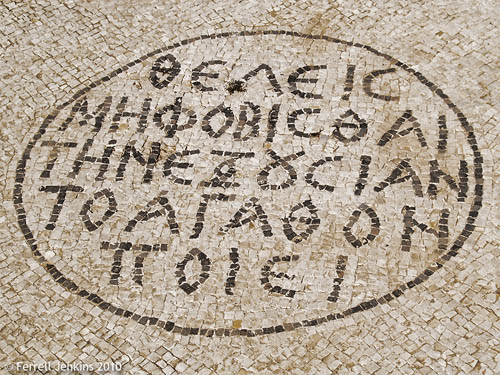
While reading Romans 13 I came to Paul’s admonition to the saints at Rome, ” Would you have no fear of the one who is in authority? Then do what is good.” My mind immediately turned to the mosaic which was discovered during the excavation of the Byzantine public area at Caesarea Maritima.

The context in Paul’s Epistle to the Romans reads this way.

For rulers are not a terror to good conduct, but to bad. Would you have no fear of the one who is in authority? Then do what is good, and you will receive his approval, for he is God’s servant for your good. But if you do wrong, be afraid, for he does not bear the sword in vain. For he is the servant of God, an avenger who carries out God’s wrath on the wrongdoer. (Romans 13:3-4 ESV)

The sign at the site describes the building where the mosaic was found as a Tax Archive. The original is said to be on display at the Kibbutz Sdot Yam Museum. The edifice is identified as “Byzantine government offices where clerks recorded tax revenues.”

Mosaic at Caesarea Maritima. Photo by Ferrell Jenkins.

Mosaic at Caesarea Maritima. Photo by Ferrell Jenkins.

I suppose they did not understand that this is politically incorrect!