Category Archives: Archaeology

Attending the Near East Archaeological Society

For the past few days I have been attending the annual meeting of the Near East Archaeological Society and the Evangelical Theological Society. NEAS is a small organization which meets in association with the ETS each year. This gives one the opportunity to attend meetings of either society. ETS has grown tremendously over the years that I have attended — first about 1976, I think. This year more than 2600 persons registered for the meeting. Even though I no longer teach, I like to attend these meetings in order to keep abreast of recent scholarship in areas in which I have special interest.

Among the lectures I heard at NEAS are the following:

Douglas Petrovich (University of Toronto) presented an impressive lecture on “More signs of societal upheaval in Egypt during the days of Joseph.”

Randall Price (Liberty University) was scheduled to make a presentation on Messiah in the Temple: A New 3-D Digital Computer Model of the Second Temple based on historical and archaeological data,” but his co-presenter was not able to make the trip from Germany. Dr. Price gave a presentation in refutation of the recent claims of a Chinese group who claimed they had found Noah’s ark on Mount Ararat.

Mark Wilson (Asia Minor Research Center) and Nadin Burkhardt (University of Frankfurt) spoke about the new excavation of the Priene synagogue (in Western Turkey).

Steven Ortiz (Southwestern Baptist Seminary) spoke about the most recent excavations at Gezer. Dr. Ortiz is one of the directors of the dig where much evidence from the 9th and 10th century B.C. is coming to light.

Eric Mitchell (Southwestern Seminary) told about the landscape archaeology associated with the current excavations at Gezer.

Bryant G. Wood (Associates for Biblical Research) presented the finds from the 2009 and 2010 seasons at Khirbet el-Maqatir. Wood thinks that this site is an excellent candidate to be identified with biblical Ai, rather than the generally accepted site at Et-Tell. Wood is director of this dig in the Palestinian West Bank.

I asked Michael Luddeni, photographer for Bible and Spade and several excavation projects, to make a photo of Leon Mauldin and me with Dr. Bryant Wood.
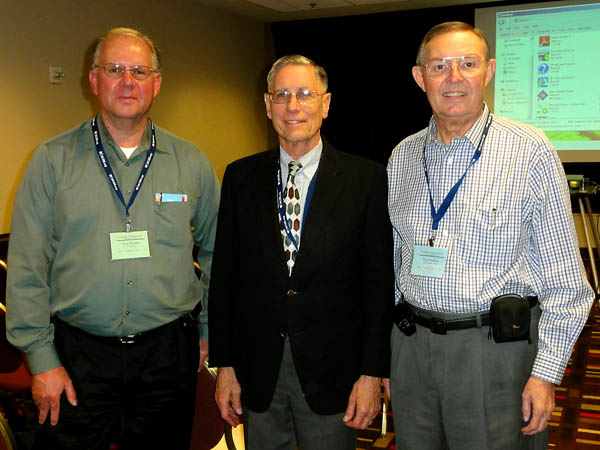
Leon Mauldin, Dr. Bryant Wood, Ferrell Jenkins at NEAS annual meeting.

Leon Mauldin, Dr. Bryant Wood, Ferrell Jenkins at NEAS annual meeting.

Steven Collins (Trinity Southwestern University) made an excellent presentation on the rise and ruin of a bronze age city-state at Tall el-Hammam, Jordan. Collins is director of this dig.

James H. Charlesworth (Princeton Theological Seminary) was an invited speaker who gave a lecture on two Herodian pools north and south of the Jerusalem temple as they relate to the Gospel of John (chs. 5 and 9). These, of course, were the pools of Bethesda and Siloam. He argued that both pools were mikvaoths (ritual pools) at the time.

There were other good lectures at NEAS. Some of these scholars make similar presentation at the ASOR or SBL meetings.

Among the lectures I heard at ETS, I found these two to be extremely good:

British scholar N. T. Wright (St. Andrews University) spoke on “Justification yesterday, today and tomorrow.”

Eugene H. Merrill (Dallas Theological Seminary) gave the presidential address at the banquet on “Old Testament Scholarship and the man on the street: whence and whither?”

When I was still teaching I attended lectures dealing primarily with the subjects I was actively teaching. Now I attend anything that strikes my fancy. Because I frequently travel to the Middle East I enjoy keeping up with the archaeological excavations in those areas.
Ritmeyer’s Image Library now online

Dr. Leen Ritmeyer is well know for his archaeological drawings of the biblical era buildings, especially the temple. He now has much of his material online for immediate download. The Image Library is described this way:

The Image Library of Ritmeyer Archaeological Design contains authoritative reconstruction drawings and models which you will not find on any other website. The photos of ancient sites in the lands of the Bible have also been taken through the informed lens of an archaeological architect. A treasure-trove for teachers, pastors, lecturers and picture editors, it is the result of years of experience digging and researching in Israel and traveling in the surrounding countries.

The Image Library is arranged in different categories and is fully searchable. The different categories are designed to help you find the picture you are looking for easily. All preview illustrations are watermarked, but these won’t appear on the downloads.

For ease of use, each image comes with a descriptive note and, where applicable, full Scripture references. With the explosion of information coming from excavations, we hope that this will become an ever-expanding resource vital for all who wish to incorporate both beauty and authenticity into their portrayal of the Bible background.

Go here for additional information, and to browse the collection. The architectural drawings are $5 each, and the photographs are $3 each.

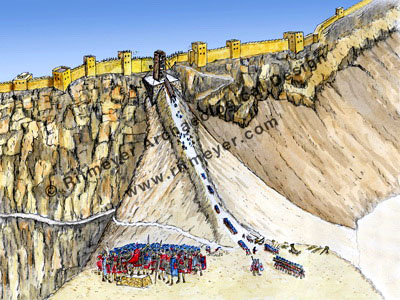
Here is a small sample of one of the drawings. This one shows the siege ramp built by the Romans at Masada in A.D. 72.

Roman siege ramp at Masada. Ritmeyer Image Library.

Roman siege ramp at Masada. Ritmeyer Image Library.

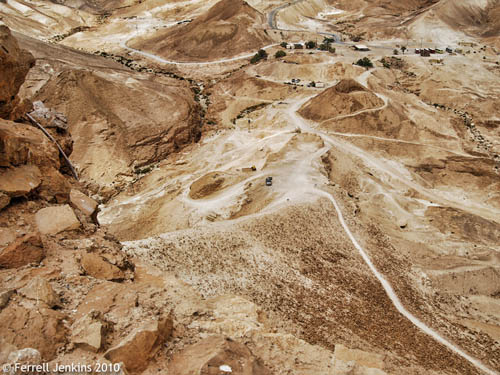
Here is one of my photos showing the siege ramp from above. The wall of Masada is visible in the left of the image.

The siege ramp at Masada. Photo by Ferrell Jenkins.
The Roman siege ramp at Masada from above. Photo by Ferrell Jenkins.

Certainly there is no excuse for presenting a dull, image deprived Bible class lesson or sermon.

Riblah — important in Old Testament history

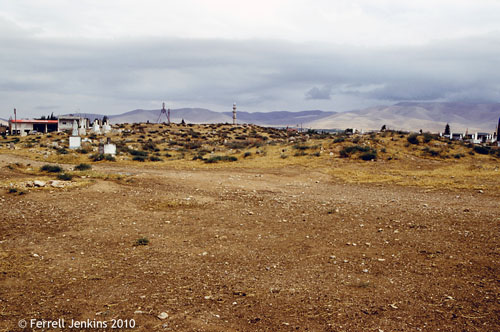
Riblah served as a base of operation for the Egyptian Pharaoh Necho and the Babylonian King Nebuchadnezzar. The city is located on a broad plain about 50 miles south of Hamath (modern Hama in Syria), on the main road between Egypt and Mesopotamia. The Orontes River flows past the site on the west side. On a modern map you will locate Riblah in Syria immediately north of the border with Lebanon.

There is little more than a “country store” at the site today, but the name Riblah is preserved as Ribleh, Syria.

  • Pharaoh Necho imprisoned Jehoahaz, king of Judah, at Riblah. He later took him to Egypt where he died. The date was about 609 B.C. (2 Kings 23:31-34).
  • Zedekiah, puppet king of Judah, tried to escape capture by the Babylonians. He fled Jerusalem but was captured on the plains of Jericho and brought to Riblah. There Nebuchadnezzar passed sentence on him. His sons were slaughtered in his sight and he was bound with brass fetters and taken to Babylon. The date was 586 B.C. (2 Kings 25:5-7; see also Jeremiah 39:5-6; 52:9-10).
  • The officials of Zedekiah were taken to Riblah where they were put to death (2 Kings 25:19-21; see also Jeremiah 52:26-27).

In 2002 a colleague and I spent several days visiting sites in Syria. Riblah was the most difficult to locate. Most folks, after seeing the site, would probably say, “What’s the big deal?”  Even though Riblah is mentioned only these few times in the Old Testament, it’s location makes it important in all movement between the south (Egypt and Israel) and Mesopotamia.

Riblah in the land of Hamath. Photo by Ferrell Jenkins.

Riblah in the land of Hamath. Photo by Ferrell Jenkins.

The slopes of this tell are now used as a cemetery. We know that this would make it difficult to negotiate rights to excavate.

This post was published March 2, 2009, but I had some slides scanned and am able to post a new photo of the tell of Riblah. A photo suitable for use in teaching is available by clicking on the image ago.

Scientific study of “headless” gladiators

Discovery News reports here on a new study about the “headless” gladiators found in a cemetery at York, England, a few years ago.

Britain’s enigmatic “headless Romans” lost their heads far away from home, according to a multi-isotopic analysis of the 1,800-year-old skeletal remains.

Unearthed between 2004 and 2005 in a cemetery in York, England, the remains belong to 80 individuals, almost all males, who died violently at ages ranging between 19 and 45.

At least 46 of them had been carefully decapitated, with their heads placed by or between their legs or pelvis.

Believed by some to be gladiators, losing their heads after their last fight, the heavily built men were buried in one of the most prestigious cemeteries of York during the 2nd and 3rd century A.D.

A new scientific “multi-isotopic analysis of the skeletal remains” has shown that many of the men were from other parts of Britain and the Roman Empire. It is a fascinating technical study.

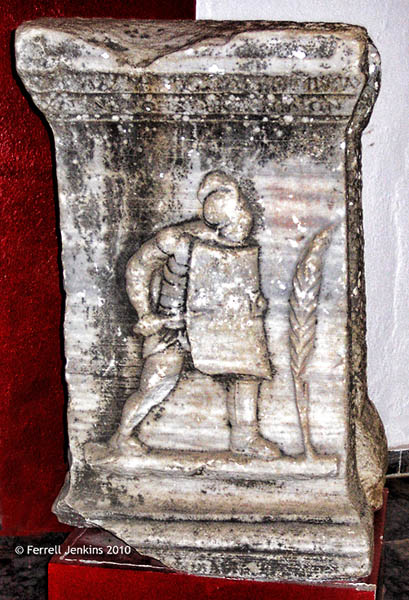
Gladiator at Ephesus. Photo by Ferrell Jenkins.

Gladiator at Ephesus. Photo by Ferrell Jenkins.

The Science Channel web site has a nice video in which Dr. Karl Großschmidt, Medical University of Vienna, discusses the discovery at Ephesus of skeletons belonging to 70 gladiators. Click here to view the video and a second one discussing the weapons used by the gladiators.  Großschmidt thinks that most of the men died in combat before the age of 35.

HT: David Padfield

In a post to follow I will discuss Paul’s use of the gladiator in one of his epistles.

A report today says that Pompeii’s house of gladiators collapsed Saturday morning. Check CNN.

Attention: Logos users. Please read and help.

Logos Bible Lands collectionIf you use Logos software you are probably aware of pre-publication specials, and community pricing. Please read what Todd Bolen has written here about the Travel Through Bible Lands Collection. Then, help us get enough orders for community pricing to get these books at a reasonable price. I would really like to have the volumes by Tristram.

Royal gardens at Ramat Rachel

Archaeologists working at Ramat Rachel, between Jerusalem and Bethlehem, say they have uncovered an ancient royal garden. They say this will be “the first full-scale excavation of this type of [an] archaeological site anywhere in the pre-Hellenistic Levant.”

According to Prof. Oded Lipschits and graduate student Boaz Gross of Tel Aviv University’s Department of Archaeology, this dig is an unparalleled look into the structure and function of ancient gardens. “We have uncovered a very rare find,” says Prof. Lipschits, who believes that this excavation will lead to invaluable archaeological knowledge about ancient royal gardens in the Middle East.

The discovery, which dates back to the 7th century B.C.E., was recently reported in Quadmoniot, the journal of the Israel Exploration Society, and another paper on the dig is forthcoming in Near Eastern Archaeology.

Read the news release in its entirety here.

The identity of Ramat Rachel with a specific Bible city is not known.

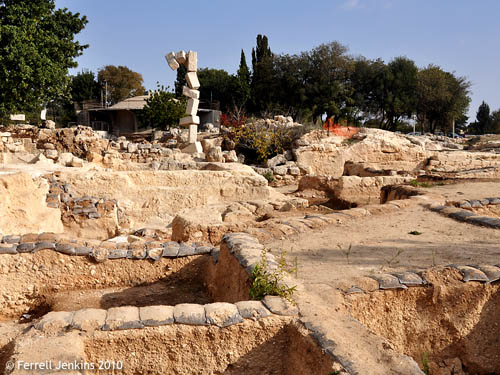
This photo shows some of the excavation area at Ramat Rachel after the 2009 season.

Excavation at Ramat Rachel. Photo by Ferrell Jenkins.

Excavation at Ramat Rachel. Photo by Ferrell Jenkins.

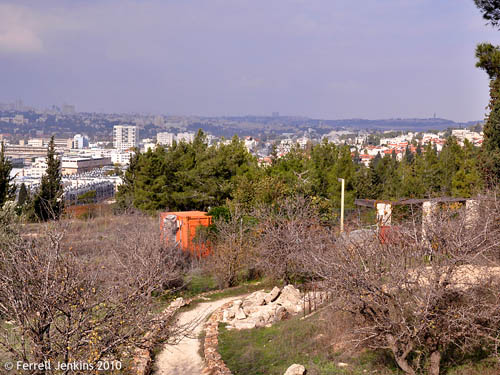
The elevation of Ramat Rachel is about 2684 feet above sea level. This gave the inhabitants a view of the ancient city of Jerusalem which was about 200 feet lower. Even on a less than clear day, you can see the Old City of Jerusalem on the far right of the photo below.

View to north of Jerusalem from Ramat Rachel. Photo by Ferrell Jenkins.

View to the north of the city of Jerusalem from Ramat Rachel. Photo by Ferrell Jenkins.

Ramat Rachel was inhabited from “the last century of the kingdom of Judah (7th century BCE) until the early Muslim reign in Palestine (10th century CE).” The excavators think the royal palace at Ramat Rachel was first built in the days of King Hezekiah (2 Kings 18-20).  More information is available at the excavation web site here.

New website on biblical archaeology

Rob Bradshaw, in the United Kingdom, adds another website where he provides out-of-print books and periodical articles. This time the subject matter is biblical archaeology. I expect that we will see it grow in helpfulness as has been true of his other sites. Here is his own announcement.

I am very pleased to announce that my new website aimed at providing resources for those studying the archaeology of the Bible lands is officially launched today.

Over the last few months it became apparent that the range of material relating to archaeology would no longer fit within the structure of the biblicalstudies.org.uk website. The new site will eventually offer detailed coverage of all aspects of biblical archaeology from artefacts to bibliographies of noteable archaeologists. Collapsible menus will be added once the site structure is finalised.

Click here to visit the new site.

Model shrines from biblical sites

Model shrines have been uncovered in numerous excavations of biblical cities, but they are common throughout the Ancient Near East. Ziony Zevit says,

Some model shrines were found to contain built-in images of deities while others were empty. In the latter case, some scholars assume that a small portable image was placed inside when the shrine was in use. (The Religions of Ancient Israel, 328).

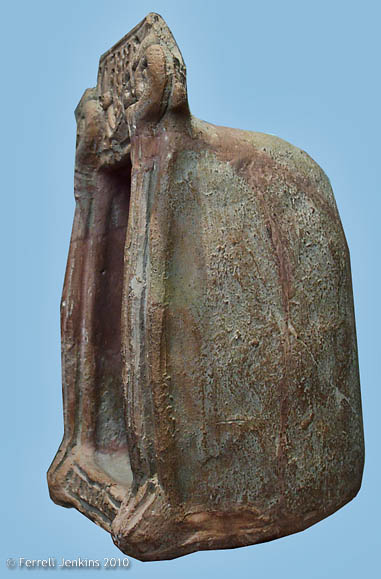
The model shrines come in a variety of sizes. Here is one excavated at Tell el-Farah, the biblical site of Tirzah.

Model shrine from Tell el Farah. The Louvre. Photo by Ferrell Jenkins.

Model shrine from Tell el Farah. The Louvre. Photo by Ferrell Jenkins.

Tirzah served as the capital of the northern kingdom of Israel during the reigns of Baasha (1 Kings 15:21) Elah and Zimri (1 Kings 16:17-18). Omri reigned six years in Tirzah before he purchased the hill of Samaria and moved the capital of Israel there (1 Kings 16:24).

The shrine discovered at Ashkelon is significant because it included a silver plated bull. See a low quality photo here.

Luke Chandler reports on the 2010 discovery of a shrine at Khirbet Qeiyafa, and includes two nice photos here.

Decorations from Herod’s tomb

Joseph I. Lauer calls attention to a photo-essay of the announcement of the discovery of Herod’s tomb at the Herodium. This essay dates back to May 10, 2007, but there may be new readers who have not seen this. Check here.

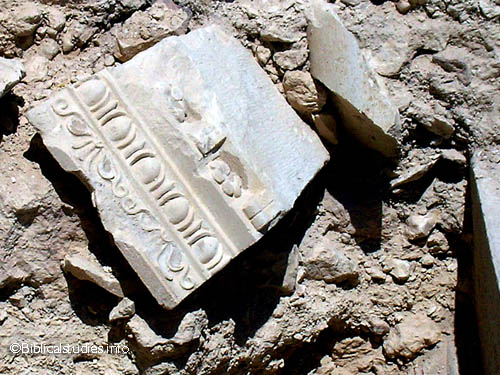
Shortly after the announcement, Elie Ben Meir, a guide/friend of mine in Israel, shared a few of his photos made at the Herodium on June 24, 2007. I had intended to publish, with his permission, some of these earlier but overlooked it. You might enjoy these closeup of some of the stone decorations found at the site.

Herodium tomb ornament. Photo by Elie Ben Meir.

Herodium tomb ornament. Photo by Elie Ben Meir.

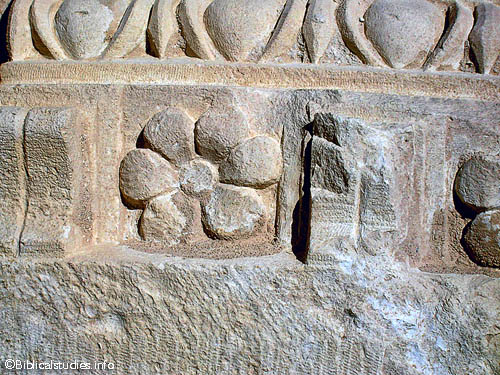
Notice the beautiful carvings.

Decoration of Herod's tomb at the Herodium. Photo by Elie Ben Meir.

Decoration of Herod's tomb at the Herodium. Photo by Elie Ben Meir.

I found Leen Ritmeyer’s post about the passing of Prof. Netzer interesting. Check it here.

Herod the Great was the “king of Judea” from 37 to 4 B.C. Near the close of his reign Jesus was born in Bethlehem.

After Jesus was born in Bethlehem of Judea in the days of King Herod, wise men from the east arrived unexpectedly in Jerusalem, (Matthew 2:1 CSB)

Archaeologist Netzer dies after fall

The Jerusalem Post reported here this afternoon that Prof. Netzer succumbed to the injuries sustained during his fall at the Herodium.

Renowned archaeologist Ehud Netzer died of his wounds at the Hadassah Ein Kerem hospital in Jerusalem Thursday night, days after he fell during an excavation.

On Monday Prof. Netzer was hospitalized in critical condition after a wooden railing he leaned on gave way, at the Herodion archeological site in the West Bank.

Jim West was kind enough to leave a comment on our blog this  morning once he was certain that Prof. Netzer had died.

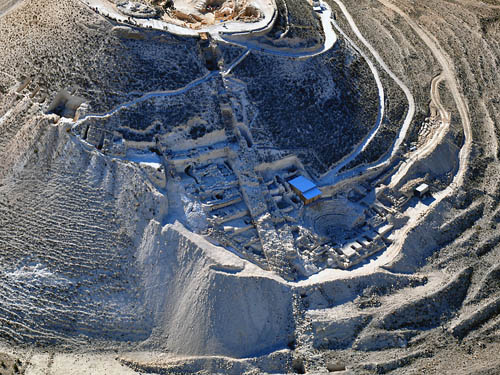
Recently we discussed here some of the work at the Herodium. Below I am including a closer view of the area where Prof. Netzer was working. This aerial photo shows a clear view of the theater. The roofed structure covers the royal theater box.

The Herodium excavation. Photo by Ferrell Jenkins, Dec. 15, 2009.

The Herodium excavation. Photo by Ferrell Jenkins. Dec. 15, 2009.

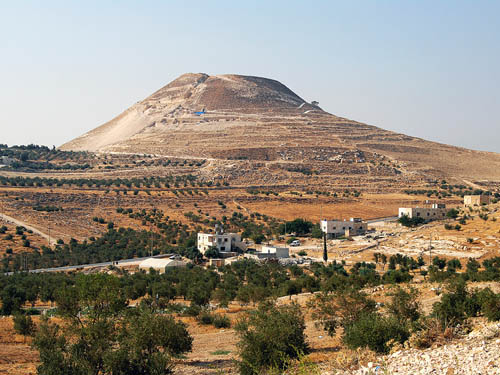
Without the determination of Ehud Netzer the north side of the Herodium would still look like the view below, and we would still be wondering about the location of Herod’s burial place.

The Herodium from the north. Photo by Ferrell Jenkins, Aug. 23, 2008.

The Herodium from the north. Photo by Ferrell Jenkins, Aug. 23, 2008.

The Herodium is located a few miles east of Bethlehem, the birthplace of Jesus (Matthew 2).