Category Archives: Archaeology

A pretty picture for today

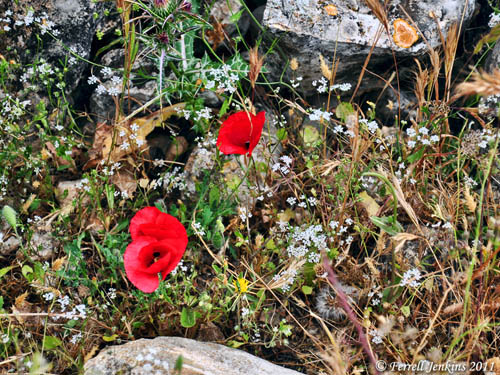
During the spring in Israel the fields and roadsides are filled with little flowers. They often grow among the stones of an ancient site. Our photo below was made May 8 at Khirbet Qeiyafa (the Elah Fortress) overlooking the Valley of Elah.

Flowers of the field at Khirbet Qeiyafa overlooking Elah Valley. Photo by Ferrell Jenkins.

Flowers of the field at Khirbet Qeiyafa overlooking Elah Valley. Photo by Ferrell Jenkins.

Many readers will think of the statement of Jesus:

Consider the lilies, how they grow: they neither toil nor spin, yet I tell you, even Solomon in all his glory was not arrayed like one of these. (Luke 12:27 ESV)

The NET Bible uses the term flowers instead of lilies. A Translator’s Note says,

Traditionally, “lilies.” According to L&N [Louw-Nida] 3.32, “Though traditionally kri,non has been regarded as a type of lily, scholars have suggested several other possible types of flowers, including an anemone, a poppy, a gladiolus, and a rather inconspicuous type of daisy.” In view of the uncertainty, the more generic “flowers” has been used in the translation.

I observe that Bauer (Arndt-Gingrich-Danker) comments:

in this connection the principal opinions include the autumn crocus, Turk’s cap lily, anemone, or gladiolus, but the data do not permit certainty. Perh. Jesus had no definite flower in mind, but was thinking of all the wonderful blooms that adorn the fields of Galilee.

Enjoy the beauty and think of God’s care for you. A larger image is available by clicking on the photo.

Luxor’s Avenue of Sphinxes set to open in October

Many changes are taking place in Luxor. The residents of certain areas are being moved from their older houses in town to new locations. All of this is happening in order to do additional archaeological work and turn the town into an even more popular tourist area. At least that is my idea of what is happening.

The Luxor Times report on the scheduled opening of the Avenue of Sphinxes here.

A grand opening is due to take place in October 2011 to celebrate the newly restored Avenue of Sphinxes.…

Lined with sphinxes, the 2.7 km [1.68 miles] route that connects the grand temples of Luxor and Karnak will be lit by the Sound and Light Company of Egypt.…

For the last 5 years, the restoration project has focused on excavation, conservation, treatment of the water table, and the establishment of protective walls and entrances for tourist. The 120 million LE [20+ million US$] project also involved relocating houses and removing roads, with full compensation paid to all those affected by the development.

The impressive avenue has long been a place of religious significance. In her red chapel in Karnak, Queen Hatshepsut (1502-1482 BC) recorded that she built six chapels dedicated to the god Amun-Re on the route. Successive construction and restoration work commenced during the reigns of Akhenaten (1353-1336 BC), Tutankhamun (1336-1327 BC) and Horemheb (1323-1295 BC).

King Nectanebo I (380-362 BC) of the 30th Dynasty constructed the Avenue of Sphinxes on the older path. It was used for religious ceremonies and processions, marking the annual journey of the sacred boat of Amun on the god’s visit to his wife, Mut, at Luxor temple. An inscription from this time reads “I have built a beautiful road for my father Amun-Re surrounded by walls and decorated with flowers for the journey to the temple of Luxor”. Another inscription bears a cartouche for Queen Cleopatra. It is most likely to be from her visit to the avenue during a Nile trip with Mark Anthony.

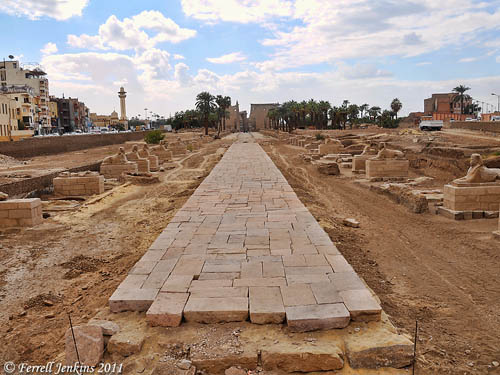
Here is a photo I made of a portion of the Avenue of Sphinxes with a view toward the Luxor Temple.

Avenue of Sphinxes with view toward Luxor Temple. Photo by Ferrell Jenkins.

Avenue of Sphinxes with view toward Luxor Temple. Photo by Ferrell Jenkins.

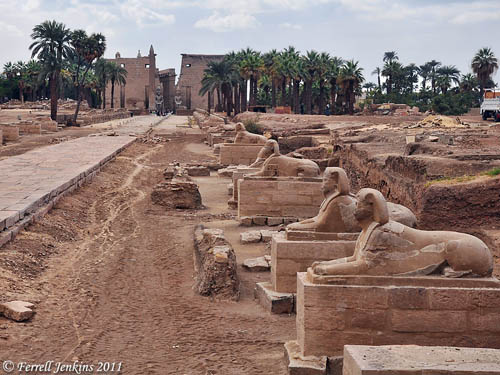
And here is a closer view.

Avenue of Sphinxes with a view view the Luxor Temple. Photo by Ferrell Jenkins.

Avenue of Sphinxes with a view toward the Luxor Temple. Photo by Ferrell Jenkins.

Luxor was known as Thebes in Old Testament times. Both Jeremiah and Ezekiel prophesied the Lord’s judgment of the city. Jeremiah says,

The LORD of hosts, the God of Israel, says, ‘Behold, I am going to punish Amon of Thebes, and Pharaoh, and Egypt along with her gods and her kings, even Pharaoh and those who trust in him’” (Jeremiah 46:25; see also Ezekiel 30:14-16).

HT: Bible Places Blog

Ossuary belonging to Miriam, granddaughter Caiaphas, discovered

The Israel Antiquities Authority announced earlier today that a 2,000 year old ossuary belonging to a daughter of the Caiaphas family of high priests has been discovered.

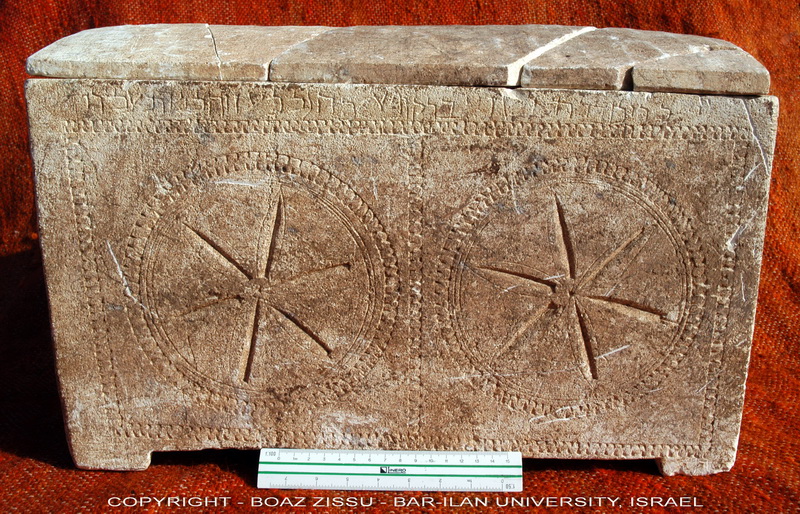
The ancient ossuary bears an Aramaic inscription from the time of the Second Temple: ‘Miriam Daughter of Yeshua Son of Caiaphas, Priests [of] Ma’aziah from Beth ’Imri’. The researchers: “The prime importance of the inscription lies in the reference to the ancestry of the deceased — Miriam daughter of Yeshua — to the Caiaphas family, indicating the connection to the family of the Ma’aziah course of priests of Beth ’Imri”. The high priest Yehosef Bar Caiaphas, is especially famous for his involvement in the trial and crucifixion of Jesus.

Three years ago the Israel Antiquities Authority Unit for the Prevention of Antiquities Robbery acquired a decorated ossuary bearing an engraved inscription. The ossuary was discovered by antiquities robbers who plundered an ancient Jewish tomb of the Second Temple period. During the course of the investigation it was determined that the ossuary came from a burial cave in the area of the Valley of Elah, in the Judean Shephelah.

To check the authenticity of the artifact and the significance of the engraved inscription, the Israel Antiquities Authority turned to Dr. Boaz Zissu of the Department of the Land of Israel Studies and Archaeology of Bar Ilan University and Professor Yuval Goren of the Department of Archaeology and Ancient Near Eastern Civilizations of the Tel Aviv University.

This week, the two scientists published the results of their research, which summarize the importance of the find and confirm its genuineness. The study appears in the Israel Exploration Journal (Volume 61) published this week by the Israel Exploration Society.

This photo of the decorated ossuary with the inscription is made available through the courtesy of Dr. Boaz Zissu, Bar-Ilan University. Click on the photo for a larger image.

Ossuary of Miriam, daughter of the Caiaphas family of High Priests. Photo: Dr. Boaz Zissu, Bar-Ilan University.

Ossuary of Miriam, daughter of the Caiaphas family of High Priests. Photo: Dr. Boaz Zissu, Bar-Ilan University.

We are not surprised to hear of the discovery of an ossuary of another member of the Caiaphas family of high priests. We recall that a tomb containing 12 ossuaries, two of which contained the name of the well-known family of high priest by the name of Caiaphas, was discovered south of Jerusalem in 1990. One ossuary bore the inscription Qafa. The other bore the name Yehosef bar Qayafa (Jospeh, son of Caiaphas), and Yehosef bar Qafa (Joseph, son of Caiaphas). The beautiful ossuary is now displayed in the Israel Museum.

Caiaphas, son-in-law of Annas, was a leading character in the trial and crucifixion of Jesus .

So the Roman cohort and the commander and the officers of the Jews, arrested Jesus and bound Him, and led Him to Annas first; for he was father-in-law of Caiaphas, who was high priest that year. (John 18:12-13 NAU)

This is just one more in a long series of archaeological discoveries showing the historical context of the New Testament.

HT: Joseph Lauer

Continuing dispute over the Mughrabi Bridge

For many years visitors to the Western Wall in Jerusalem were able to climb the earthen ramp up to the Mughrabi Gate and enter the Temple Mount platform. In biblical times the temple of Solomon was located there, then the rebuilt temple of Zerubbabel after the return from Babylonian captivity, and then Herod’s Temple. Today this is where we find the Mosque of Omar (commonly called the Dome of the Rock) and the Al Aska Mosque.

Israel built wooden bridge from the Western Wall Plaza to the Temple Mount platform and excavated the earthen ramp. This has become a controversial diplomatic issue. Itamar Eichner reports in Ynet here.

A diplomatic crisis is brewing between Israel and Jordan over the planned renovations of the Mughrabi Gate Bridge, Yedioth Ahronoth reported Monday.

Plans for razing the old Mughrabi Gate bridge, which leads from the Western Wall plaza in Jerusalem to the to the al-Aqsa Mosque and Temple Mount, in favor of a new one have been in the works for a while. According to the report, the bridge was to be torn down next week, but upon signing the final agreement, Israel was stunned to learn that Jordan, along with Egypt, Iraq and Bahrain, filed a complaint against Israel with the United Nations Educational, Scientific and Cultural Organization (UNESCO) over the planned renovations. The motion asks for a UNESCO censure of Israel. Jordan is also demanding that UNESCO order Israel to stop the archeological excavations in the Old City.

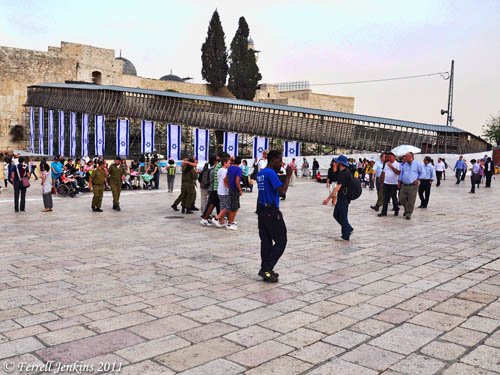
This photo of the bridge was made in early May.

Mughrabi Bridge from the Western Wall Plaza. Photo by Ferrell Jenkins.

Mughrabi Bridge from the Western Wall Plaza. Photo by Ferrell Jenkins.

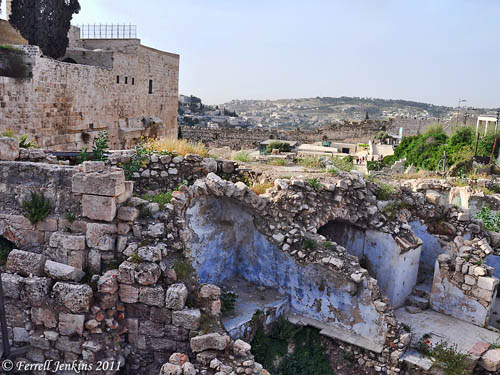
We know that the level below the bridge, both north and south, is from the first century. Here is the view from the bridge looking down on the former earthen ramp.

Excavation below Mughrabi Gate Bridge. View to the south. Photo by Ferrell Jenkins.

Excavation (or clean up?) below Mughrabi Gate Bridge. View to the south. Photo by Ferrell Jenkins.

I have no specific knowledge about the dating of these ruins, but I would venture to say that they are later than the 7th century A.D. Perhaps a reader can help.

Update. After completing this post last evening, I was looking at the Bible Places Blog and noted that Todd Bolen has written about this bridge. He has given links to the background of the controversy and posted some photos. Check here.

Ha’aretz has two more articles for those who are interested in the far-reaching repercussions over what happens in Jerusalem. Check here and here.

HT: Joseph Lauer

Abraham at Beersheba (Beer Sheba)

Bible students associate the town of Beersheba (Beer Sheba; Be’er Sheva) with the patriarch Abraham (Genesis 21-22).

  • The first reference to Beersheba is when Abraham sent Hagar and Ishmael to wander in the wilderness of Beersheba (21:14). This is the region known as the Negev.
  • Abraham dug a well and called the place Beersheba (21:30-31). Abraham and Abimelech, the king of Gerar, made a covenant. Abraham presented seven ewe lambs to Abimelech. The name Beersheba means “the well of the seven.”
  • Abraham planted a tamarisk tree at Beersheba and called upon the name of the LORD, the Everlasting God (21:33).

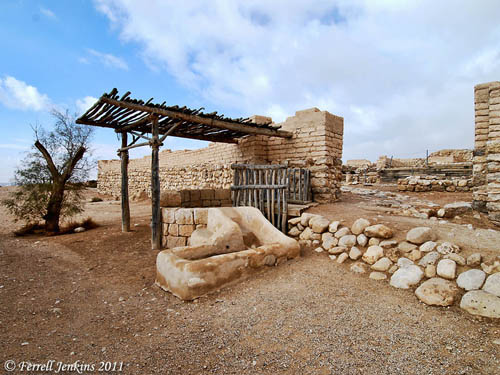
Archaeological excavations were conducted at Tel Beersheba by Tel Aviv University Institute of Archaeology under the direction of Yohanan Aharoni (1969-1973). The excavation indicated that there was no city at the site before the Iron Age. The outer gate of the reconstructed Iron Age city, an older well, and a tamarisk tree, in the photo below, serve as a reminder that Abraham lived in this general vicinity.This tamarisk tree has been cut back and is putting out fresh branches.

Abraham planted a tamarisk tree at Beersheba, and there he called on the name of the LORD, the Everlasting God. (Genesis 21:33 NAU)

The outer gate, well, and tamarisk tree at Tel Beersheba. Photo by Ferrell Jenkins.

The outer gate, well, and tamarisk tree at Tel Beersheba. Photo by Ferrell Jenkins.

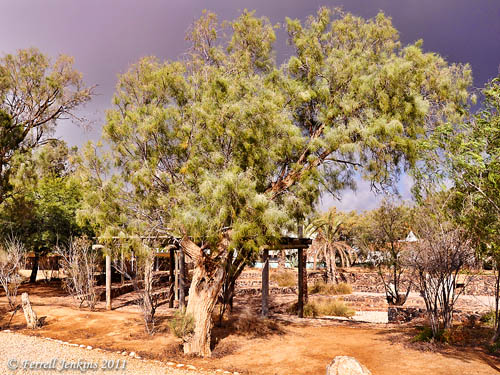
The Negev is suitable for the tamarisk tree. Here is a larger tamarisk at the entry to the site. This photo was made in the month of December. Heavy clouds are visible to the west.

Tamarisk trees at Tel Beersheba. Photo by Ferrell Jenkins.

Tamarisk trees at Tel Beersheba. Photo by Ferrell Jenkins.

Fauna and Flora of the Bible describes the tamarisk this way:

The Tamarisk is a small, fast-growing tree with durable wood, to be found abundantly in deserts, dunes and salt marshes.

Tamaris Aphylla is leafless and has green branches and a wide crown. It has small white flowers, and its fruit is a capsule with feathery seeds. (p. 182)

Photos suitable for use in teaching are available by clicking on the images above.

More on the Ophel City Walls site

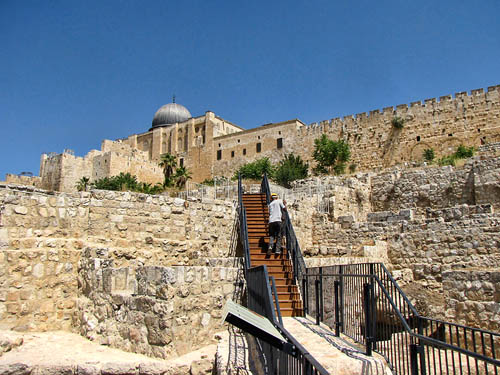
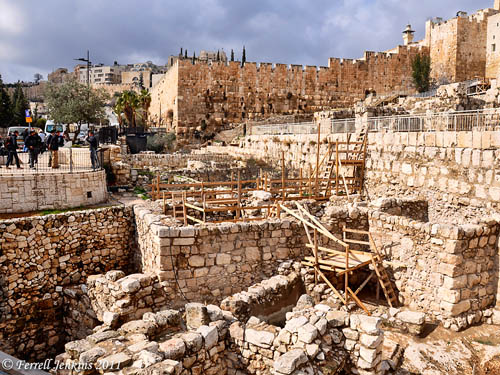
The Israel Antiquities Authority provided several good photos of the Ophel City Walls site. I thought this was an especially nice photo. The view from the site looks at the new steps leading to and from the excavation. The southern wall of the temple mount enclosure is visible in the distance.

Ophel city walls site. Photo: IAA

Ophel City Walls site. Photo: Israel Antiquities Authority.

Leen Ritmeyer provides insight into the excavation dating back to the mid-1970s when he supervised some of the excavations under the direction of Prof. Benjamin Mazar. Take a look here.

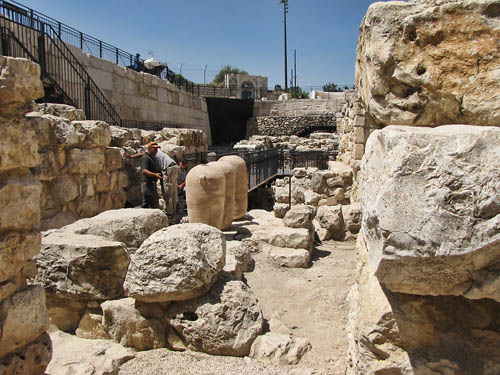
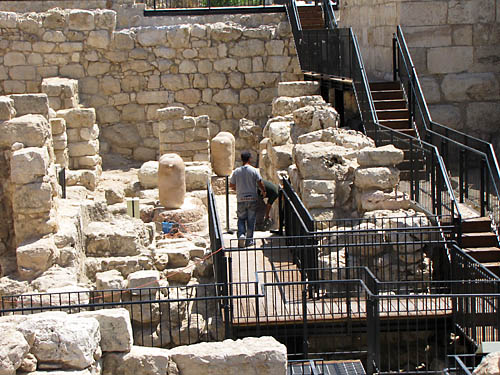
The next photo shows workmen putting the finishing touches on some of the stones. Three pithoi are visible. The view is toward the southwest.

Ophel City Wall site. Photo: Israel Antiquities Authority.

Ophel City Wall site. Photo: Israel Antiquities Authority.

Ophel City Walls site opened in Jerusalem

The Israel Antiquities Authority announced the opening today of what is being called the First Temple Period Ophel City Walls Site in the Walls Around Jerusalem National Park.

In a festive ceremony that was held Today – Tuesday, June 21, 2011, the Ophel City Wall site, a complex of buildings uncovered along the route of the fortifications from the First Temple period (tenth-sixth centuries BCE), and the display of the earliest written document ever uncovered in Jerusalem was inaugurated. The opening of the site, located in the Walls Around  Jerusalem National Park, and the exhibit in the Davidson Center are made possible through the generous donation by Daniel Mintz and Meredith Berkman.

Upon completion of the excavation and conservation work at the Ophel City Wall site, visitors will now be able to touch the stones and walls whose construction tells the history of Jerusalem throughout the ages.  It is now possible to walk comfortably through the built remains, in places that were previously closed to the public, to sense their splendor and learn about the history of the region by the signage and the different means of presentation and illustration.

This photo shows construction work in the area a few months ago.

Ophel First Temple Site during construction of park. Photo by Ferrell Jenkins.

Ophel First Temple Site during construction of park. Photo by Ferrell Jenkins.

Here is a more recent view showing workmen putting final touches on the nice stairs and overviews for those who enter the site through the Davidson Center.

Ophel Site Park. IAA.

Ophel Site Park being prepared for opening. Photo: Israel Antiquities Authority.

The IAA news release continues,

The architecture at the site that was exposed includes an impressive building thought to be a gate house, a royal edifice, a section of a tower and the city wall itself. Dr. Mazar suggests identifying the buildings as part of the complex of fortifications that King Solomon constructed in Jerusalem: “…until he had made an end of building his own house, and the house of the Lord, and the wall of Jerusalem round about” (1 Kings 3:1). In addition to the fortifications of the First Temple period, sections of the Byzantine city wall and two of its towers were exposed. This wall was built at the initiative of the Byzantine empress Eudocia in the fifth century CE. In addition to the complex of fortifications, the excavation of two rooms from the Second Temple period (first century CE) was completed, which were preserved to a height of two stories.

The highlight of the excavations is the complete exposure of the gate house. The plan of this impressive building includes four rooms of identical size, arranged on both sides of a broad corridor paved with crushed limestone. The plan of the gate house is characteristic of the First Temple period (tenth-sixth centuries BCE) and is similar to contemporaneous gates that were revealed at Megiddo, Be‘er Sheva’ and Ashdod. The excavator, Eilat Mazar, suggests identifying the gate house here with the ‘water gate’ mentioned in the Bible: “…and the temple servants living on Ophel repaired to a point opposite the Water Gate on the east and the projecting tower” (Nehemiah 3:26). The ground floor of a large building that was destroyed in a fierce conflagration can be seen east of the gate. Mazar suggests that this structure was destroyed by the Babylonian conquest of the city in 586 BCE. Twelve very large, clay store jars (pithoi), which probably contained wine or oil, were discovered on the floor of the building. Engraved on the shoulder of one of these pithoi is the Hebrew inscription “לשר האו…”. The inscription indicates that this pithos belonged to one of the kingdom’s ministers, perhaps the overseer of the bakers.

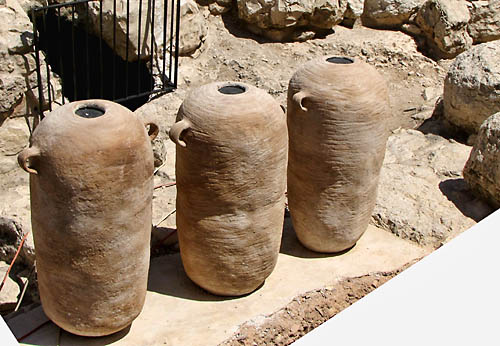
This photo shows (replicas of?) some of the pithoi on display at the site.

Pithoi displayed at the Ophel Site. Photo: Israel Antiquities Authority.

Pithoi displayed at the Ophel Site. Photo: Israel Antiquities Authority.

A fragment of a clay tablet written in Akkadian cuneiform script was discovered in the recent re-excavation of the area by Dr. Mazar. The tablet is typical of those “used in antiquity throughout Mesopotamia for international correspondence.”

Analyses of the writing and the clay used to produce the tablet show that the document originated in the Jerusalem region. It seems that it is a copy of a letter that the king of Jerusalem at the time, Abdi-Heba, sent to the king of Egypt. It was customary that a copy of this correspondence would be kept in the archives of the city Salem, which was Jerusalem in that period. The fragment of the tablet constitutes credible evidence of the status of Jerusalem as an important royal city in Canaan, which was administered as a city-state under the auspices of the pharaonic Egypt kingdom.

We have posted info about the first temple period (suggested) gate and wall here, and about the clay tablet earlier here and here.

The site also may be viewed from Ma’aleh Ha-Shalom Street a short distance east of Dung Gate.

HT: Joseph Lauer

Latakia, Syria, and possible biblical connections

News coming out of Syria is not good. Syria’s dictatorial leadership has oppressed the people of Syria and tried to keep them uninformed about world events.

My first visit to Damascus, the capital of Syria, was in 1967 — just a day visit from Beirut. I returned several times during the next decade and made one trip by road from Beirut to Damascus and on to Amman. During that trip I left my camera in the seat of the car when we stopped at the Syrian border with Jordan. When I got back in the car I noticed that my camera back was open. The film had been exposed. I still remember that some of my best photos ever were on that roll. Sort of like the fish that got away. 🙂

My only visit throughout the country of Syria was in May, 2002, when a teaching colleague and I spent a week in the country driving to most of the major cities and historical sites.

We drove along the Mediterranean coast from south to north in order to visit Ras Shamra (Ugarit), significant because of what the site revealed about Canaanite culture. This means that we needed to spend the night at Latakia, about 6 or 7 miles south of Ugarit. We stayed at the nice LeMeridien seaside hotel.

Internet use was difficult. I recall dialing long distance from the Commodore Hotel in Damascus to Beirut in order to have dial-up service to AOL. We had set up AOL and Excite accounts, having heard that some hotels would allow one, and some another. AOL generally was not allowed in the country. I have a copy of the short Email we sent home from Latakia.

Today we go to Ebla and on to Aleppo. We are unable to check our mail here. Access to AOL and Excite are prohibited on this server, but the hotel staff was kind to allow us to use one of the office computers. So we can at least let you know we are fine. Hope to have some mail from you when we arrive in Aleppo.

Later from Aleppo I wrote,

Hotel personnel are helpful and friendly. I am not able to go to AOL or Excite to get mail. A backroom manager-type allowed me to use the hotel email to write.

Latakia is not named in the Bible, but the city is important in wider biblical history. In 1967 I purchased a copy of The Middle East, one of the Hachette World Guides, published in 1966. Here are a few facts garnered from that book.

  • In the 2nd millennium B.C. Latakia was part of the territory of Ugarit
  • Latakia became part of the Assyria empire during the 9th century B.C.
  • In 604 B.C. Latakia was controlled by the Babylonians.
  • The town became part of the 5th Persian satrapy.
  • After the Battle of Issus (333 B.C.) Alexander conquered the city.
  • Seleucus I named the city Laodicea in honor of his mother.
  • The city later came under Roman, Byzantine, Islamic, Crusader, again Islamic, French, modern Syria, etc.

This late afternoon photo shows the harbor on the north side of Latakia. This is probably not more than 30 miles south of the Syria-Turkey border.
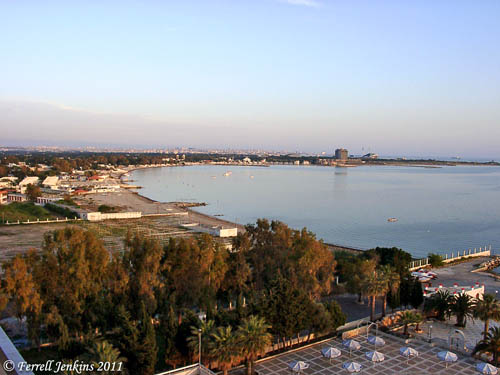
Harbor north of Latakia, Syria. Photo by Ferrell Jenkins.

Harbor north of Latakia, Syria. Photo by Ferrell Jenkins.

The next photo was made in the center of town. Ross Burns, Monuments of Syria, says,

In Jumhuriye Square (where the Damascus and Ugarit roads start) stand a grouping of four elegant monolith columns, topped with Corinthian capitals. This may have been part of the Temple of Adonis whose myth, sourced to the mountainous region of Northern Lebanon, was strong in this area. (p. 145)
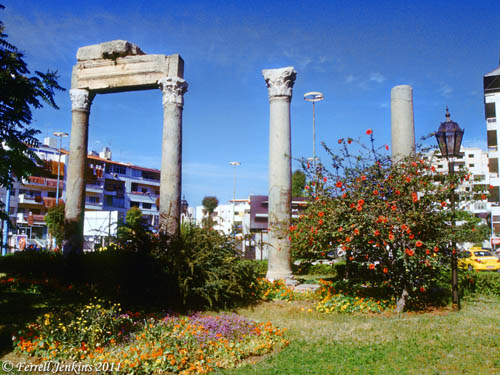
Surviving columns may be from the temple of Adonis. Photo by Ferrell Jenkins.

Surviving columns may be from the temple of Adonis. Photo by Ferrell Jenkins.

It would not be out of place to suggest that Paul (Saul) sailed by Latakia (Laodicea) when he went from Caesarea to Tarsus (Acts 9:30), and when he sailed from Caesarea to Rome (Acts 27:3-5). Perhaps Barnabas and Saul traveled this way when they took the financial aid from Antioch to Judea (Acts 11:29-30).

Hezekiah’s Pool – a modern garbage dump

Ha’aretz reports on the political “garbage” associated with an effort to clean up Hezekiah’s Pool in the Old City of Jerusalem.

After years of neglect, Hezekiah’s Pool in the Old City of Jerusalem is finally being cleaned up. The work is being done by the Jerusalem Municipality, the Environmental Protection Ministry and Jerusalem Development Authority. As with anything in Jerusalem, the cleanup may cause a diplomatic crisis with Egypt and Jordan – and a conflict with the Waqf Muslim religious trust and the Coptic Church.

Hezekiah’s Pool, also known as the Pool of the Pillar, is located in the Christian Quarter, not far from Jaffa Gate. It is ancient and covers over three dunams (three-quarters of an acre ). But it is completely hidden from the public, with stores and homes surrounding it. Thousands of tourists coming through the gate and the Arab market pass right by it without having a clue that the historic site is nearby.

The pool was used at least from Second Temple times and was an important part of Jerusalem’s ancient water system until the 19th century.

However, over recent decades, the pool became an unofficial garbage dump for neighborhood residents, who used it to dispose of tons of trash.

In winter, water still collects there, and some Christian Quarter residents use parts of the ancient water system as an improvised sewage system.

Hezekiah’s Pool has turned into a serious health hazard in a densely populated area.

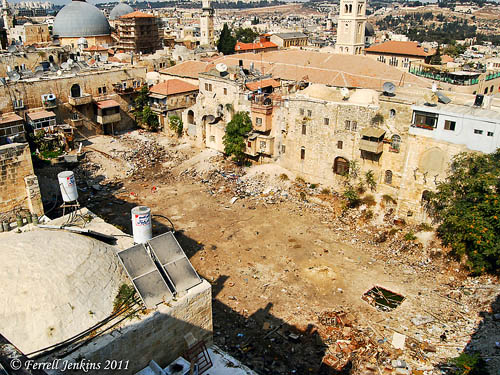
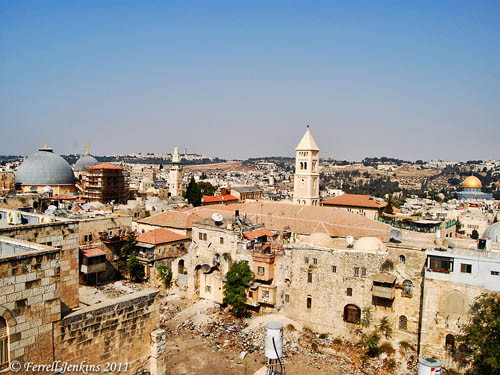
I think the last time I asked permission to go to the roof of the Petra Hotel to make a photo of Hezekiah’s Pool was in September, 2008. At that time the cleanup had already begun. The previous time I viewed the pool it was much more trashy. This pool is just a short distance from Jaffa Gate. Note the proximity of the Pool to the Church of the Holy Sepulchre and the Lutheran Church tower.

Hezekiah's Pool from roof of the Petra Hotel. Photo by Ferrell Jenkins.

Hezekiah's Pool from roof of the Petra Hotel. Photo by Ferrell Jenkins.

The next photo provides more perspective. You can see the pool in the bottom of the photo. In the middle of the photo (top to bottom) you can see the dome of the Church of the Holy Sepulchre (left), the Lutheran Church tower (just right of center), and the Dome of the Rock (right). In the distance to the east is Mount Scopus (left) and the Mount of Olives.

Hezekiah's Pool in the Christian Quarter of Jerusalem. Photo by Ferrell Jenkins.

Hezekiah's Pool in the Christian Quarter of Jerusalem. Photo by Ferrell Jenkins.

Jerome Murphy-O’Connor describes Hezekiah’s Pool.

This great reservoir is entirely surrounded by buildings, and is accessible through the Coptic Khan…. At present the dry pool is used as a rubbish dump by the dwellings which surround it on all sides, but a much needed restoration project is on the drawing board. — The Holy Land

Murphy-O’Connor says the pool “is thought to date from the Herodian period when it was fed by an aqueduct (visible outside Jaffa Gate) coming from Mamilla Pool.” He says Josephus mentions the pool under the name Amygdalon (Almond Tree) (War 5:468). He says this name, Amygdalon, is probably a deformation o f the Hebrew migdal (tower). The reference is to the towers of Herod’s palace.

Israel Antiquities Authority announced in February, 2010, the discovery of the high-level aqueduct that brought water into Hezekiah’s Pool in the Roman City of Jerusalem. See our earlier comments here.

The complete Ha’aretz article may be read here. An aerial view of this area is available here.

P.S. You know the pool has nothing to do with Hezekiah, don’t you?

HT: Joseph Lauer

Herodium and the tomb of Herod the Great

Shmuel Browns has an article in Popular Archaeology on “Netzer’s Legacy: The Wonders of Herodium” here. One of the comments by Browns caught my attention as being especially important for all of us who use photos in our teaching.

When visiting an archaeological site, one often cannot see the artifacts that were discovered there as they have been removed and are displayed at a museum.

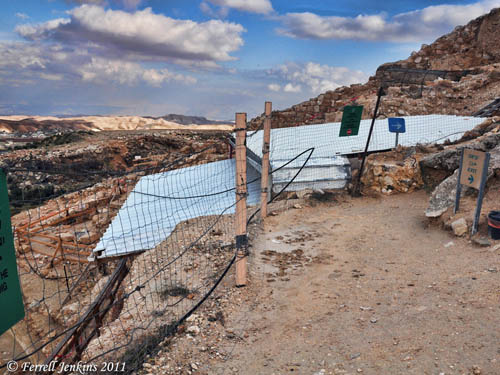
Browns gives an illustration of part of the Roman bath from the lower city at Herodium. I often think about how important it is to be at an archaeological site at just the right time. When I visited the Herodium in January, and again in May, this is what I saw at the place of Netzer’s most recent work.

Herodium - Place of Herod's Mausoleum. Photo by Ferrell Jenkins.

Herodium - Place of Herod's Mausoleum. View to the East. Photo by Ferrell Jenkins.

How disappointing. My thought is that some day the Antiquities department will have this site prepared for visitors. Until then…

Herod's Tomb. Shmuel Browns.

Herod's Tomb. View to NW. Shmuel Browns.

Browns has a couple of nice photos of the Mausoleum as it looks under the tin roof. I am including a thumbnail of one of his photos to encourage you to go to the article. A site begins to look different after the winter rains. Unless it is continually cleaned (which requires money), it deteriorates quickly.

Herod the Great is known in Scripture as the wicked king who inquired about the birth of Jesus in order to eliminate any opposition to the throne.

After Jesus was born in Bethlehem in Judea, in the time of King Herod, wise men from the East came to Jerusalem  saying, “Where is the one who is born king of the Jews? For we saw his star when it rose and have come to worship him.”  When King Herod heard this he was alarmed, and all Jerusalem with him.  After assembling all the chief priests and experts in the law, he asked them where the Christ was to be born. (Matthew 2:1-4 NET)

Joseph, Mary, and Jesus did not stop to see the tomb of Herod on their return from Egypt.

But when he heard that Archelaus was reigning over Judea in place of his father Herod, he was afraid to go there. After being warned in a dream, he went to the regions of Galilee.  He came to a town called Nazareth and lived there. (Matthew 2:22-23a NET)

Chris McKinny recently posted a paper on “The Growth of Herod’s Kingdom” at Seeking a Homeland here. The well-documented paper includes maps and charts.

Tom Powers reported in February that the Israel Post has issued a series of stamps featuring Herod’s building projects. Click here for photos of the beautiful stamps.

HT: Bible Places Blog.