Category Archives: Archaeology

Travel in the Plain of Acco and the Plain of Sharon

We saw most of what we had intended today, but due to a late start from Tiberias it was a long day. We got to Jerusalem a little late, went immediately to the dining room, and then made it to our room about 9:30 p.m.

We drove from Tiberias to Acco (Akko, Acre), a city of the biblical tribe of Asher, is mentioned in Judges 1:31. The city was known as Ptolemais in New Testament times. Paul stopped at Ptolemais and stayed with the brethren for a day on the return from his third journey (Acts 21:7).

We continued north along the Plain of Acco past Achziv (English versions use Achzib) (Joshus 19:29) to the Ladder of Tyre. More explanation latter. This natural formation has served as a natural boundary for centuries.

In the late afternoon we stopped in the Plain of Sharon, a few miles north of Caesarea, at the town of Beit Hananya to see a portion aqueduct that carried water to Caesarea. This portion of the aqueduct was constructed during the reign of the Roman Emperor Hadrian in the early second century A.D.

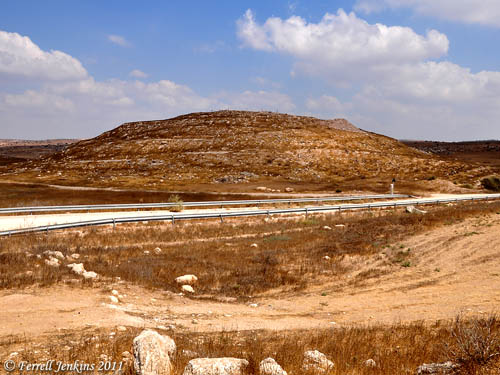
For a photo I want to share Tel Hannathon, the site of a town once belonging to the tribe of Zebulon.

The border circled around it on the north to Hannathon, and it ended at the valley of Iphtahel. (Joshua 19:14 NAU)
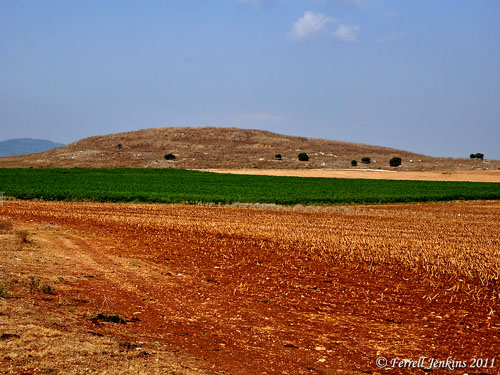
Tel Hannathon. Photo by Ferrell Jenkins.

Tel Hannathon. Photo by Ferrell Jenkins.

Hannathon is one of those places mentioned in the Bible that is simply passed over by most readers and teachers. The city was a real place in Bible times, occupied by real people who really did the things recorded in Scripture. Don’t let the details pass you by. Sometimes they can be highly significant.

We have an exciting day planned for tomorrow with a driver who will go with us to visit sites in the West Bank. Most of the rental car companies in Israel do not allow their cars to be driven in the West Bank.
Roman temples and hard to reach cities

Today was a busy day and one of the most productive of this trip. Several of the places we visited are difficult to reach today, but at the time of their glory they were on main routes of travel.

Our first stop was at Omrit in northern Israel, about 4 miles SW of Banias. Two temples have been found here. One of them dates to the late first century B.C. Some scholars suggest that this is the Temple of Augustus built by Herod the Great.

Omrit is not mentioned in the Bible, but may prove to be significant in accounts of the ministry of Jesus. It was located in the region known as Ituraea. Philip, the son of Herod the Great, was “tetrarch of the region of Ituraea and Trachonitis” (Luke 3:1).

Though not new to us, we stopped for a while to make some photos at Hazor.

Next stop was for lunch at McDonald’s.

We stopped at Khirbet (or Horbat) Amudim, site of an ancient synagogue. Our main interest was in seeing the area of travel between Cana and the towns around the Sea of Galilee.

A stop at Hannathon allowed us to get a photo of the tel. This site is mentioned as being in the territory of Zebulon in Joshua 19:14.

Yodfat (or Jotapata) is important because it is where Josephus led Jewish rebels against the invading Romans in 66 A.D.

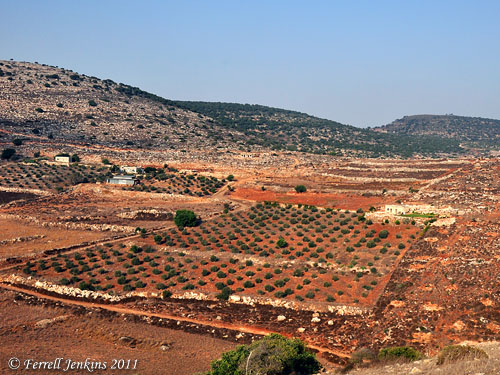
The photo below is of one of the beautiful valleys around Yodfat.

Fertile valley below Yodfat. Photo by Ferrell Jenkins.

Fertile valley below Yodfat. Photo by Ferrell Jenkins.

With the help of a local farmer we were led to an overlook where we could see Khirbet Kana (Cana), likely the site of the events of John 2. We had too little time left to make the full walk to the site. Always a reason for another visit.

We arrived back at the hotel in Tiberias about 7 p.m. In coming weeks we hope to share some of the new photos. with our readers.

Somthing new, something old in Israel

No, we did not attend a wedding today. Leon and I are trying to see some places we have missed before. I have traveled here more than Leon, so I don’t like passing up a place he hasn’t visited.

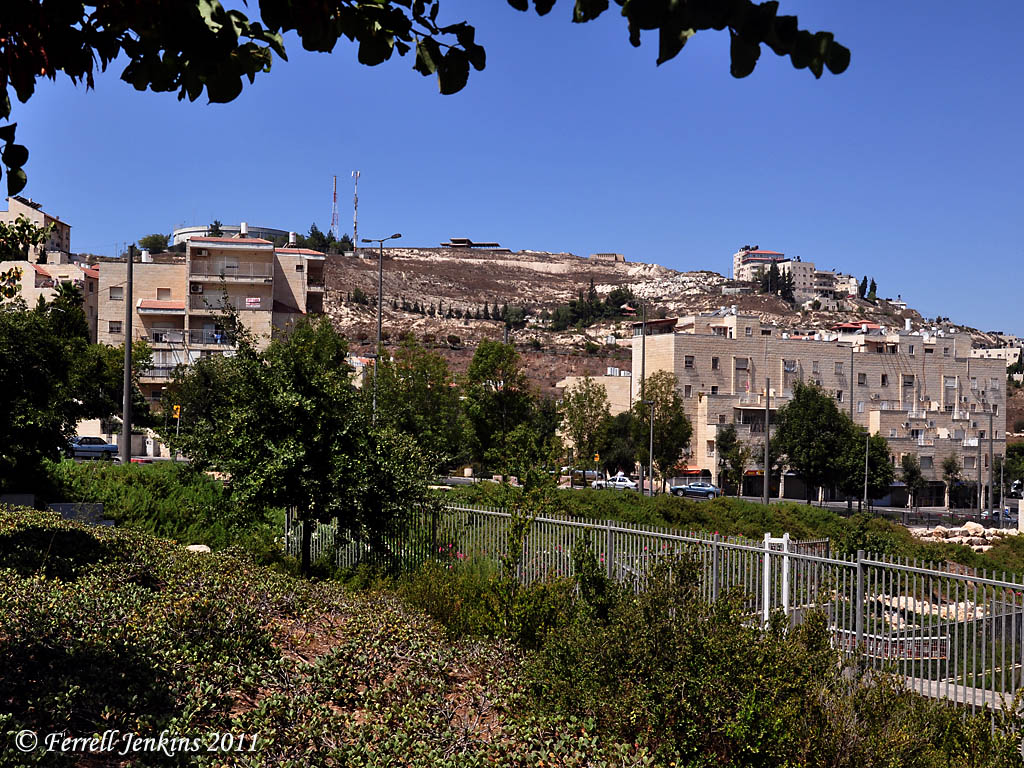
As we left Jerusalem this morning we missed a turn and ended up in one of the new Israeli suburbs called Pisgat Ze’ev Ma’arav (West). This suburb is on the east side of Tell el-Ful (Hill of Beans in Arabic), identified as biblical Gibeah. In an effort to find our way back to the main street to get on the highway to go to the Jordan Valley I saw a side of Tell el-Ful that I had not seen before. I had always seen the tell from the West, but now I was was looking at the East side.

How does one recognize Tell el-Ful? Beans no longer grow on the mound. Prior to the 1967 war, when the Old City of Jerusalem and the area under consideration was in Jordan, the late King Hussein of Jordan was beginning to build a palace on the top of the tell. The uncompleted structure still stands there as a silent monument to a failed plan.

The view from the east is impressive. The tell can be seen framed between the new buildings of Pisgat Ze’ev Ma’arav (West). I was beginning to fume a bit about missing the road I intended to take until I saw Tel el-Ful (Gibeah).

Gibeah of Saul (Tel el-Ful) from the east. Photo by Ferrell Jenkins.

Gibeah of Saul (Tel el-Ful) from the east. Photo by Ferrell Jenkins.

Several biblical references mention Gibeah as the home of Saul. In fact the city is even called Gibeah of Saul in 2 Samuel 21:6, and Gibeah of Benjamin in 1 Samuel 13:2. Saul was the first king of Israel from about 1050 to 1010 B.C.

William F. Albright excavated Tell el-Ful and found evidence of a fortress. Many think this would have been the palace of King Saul. An iron plowshare was also found in the excavation.

There is a nice photo by Eli Berckovitz of the skeleton structure of King Hussein on Wikipedia here.

We visited some new places, too. But it is late, and those will have to wait.

David escaped to the Cave of Adullam

One of the important places on our “bucket list” was the Cave of Adullam. The main reason we had never visited Adullam before is that it requires a long, difficult, walk or a four-wheel-drive vehicle. We made arrangements with Haelah Desert Tours, a company at Aderet, a moshav on the north side of Adullam, for a guide/driver who could take us there. Once we reached the forested mound we enjoyed a wonderful view to the north, east, and south. Our guide, Daphna, inquired first about our interest in the site. How did we even know about the site, she wondered. She is a Sabre, a native-born Israeli, who lives at Aderet.

The view below is to the east where you will see the border between Israel and the West Bank. The central mountain range is visible in the distance.

Daphna, our guide, and Leon look east from Tel Adullam. Photo by Ferrell Jenkins.

Daphna, our guide, and Leon look east from Tel Adullam. Photo by Ferrell Jenkins.

There is a large cave at Adullam. Is it the cave where David stayed while fleeing from Saul? Can’t say, but if it was not this one it had to be another one near by. The next photo was made from inside the cave.

View north from interior of the Cave of Adullam. Photo by Ferrell Jenkins.

View north from interior of the Cave of Adullam. Photo by Ferrell Jenkins.

Adullam is significant in several biblical accounts. Here are a few.

Judah stayed with an Adullamite man named Hirah. He married the daughter of a Canaanite man named Shua.

At that time Judah left his brothers and stayed with an Adullamite man named Hirah. There Judah saw the daughter of a Canaanite man named Shua. Judah acquired her as a wife and had marital relations with her. (Genesis 38:1-2 NET)

The episode of Onan and his failure to fulfill his responsibility to bring up children to his deceased brother (the Levirate marriage; Genesis 38:3-10).

Joshua defeated the king of Adullam during the Conquest (Joshua 12:15), and became one of the Shephelah (lowland) cities of the tribe of Judah (Joshua 15:35).

The cave of Adullam is associated with David. When he left Gath he went to Adullam before sending his parents to Moab for safety.

So David left there and escaped to the cave of Adullam. When his brothers and the rest of his father’s family learned about it, they went down there to him. (1 Samuel 22:1 NET)

In fact, David spent much time at Adullam. I suggest you read the entire account in 2 Samuel 23:13ff.

When the prophet Micah warned Judah about the coming Assyrian invasion he said,

…the leaders of Israel shall flee to Adullam (Micah 1:15 NET)

Just like David did about three centuries earlier.

One more point. Jesus was a descendant of David and Judah, both of whom had an association with Adullam (Revelation 5:5).

What a wonderful experience.

My thanks to Gordon Franz and Carl Rasmussen with whom I have corresponded about Adullam.

Update. In my orignal post I made a mistake in saying that Judah married the daughter of Hirah. I caught this mistake a few days ago and have now corrected it. Judah married the daughter of a Canaanite man named Shua.

Places less visited in Israel

Today we got a fairly early start and went through the Shephelah to Lachish. This takes about an hour or so from Jerusalem. We did not go to visit Lachish, but to continue east to a small kibbutz called Shekef. From here we would try to locate Tel Eiton (also Tel ‘Eton and Tel Aitun). I had been in the area before but did not locate the tel. The reason for going so far out of the way to get to the site is that it is situated on Israel’s border with the Palestinian West Bank. Just before reaching Shekef we began to  drive on the new highway 358 to Beersheba, parallel to the border. Soon we realized that we must be bypassing the place we want to go.

We backtracked and eventually after doing what men “never do”, ask for directions, we located Tel Eiton. Palestine is on the east side of the mound and a military firing range is on the west side. We decided it would be best to stick to the gravel road without straying too far to the left or the right — sort of like Joshua.

“Be very firm, then, to keep and do all that is written in the book of the law of Moses, so that you may not turn aside from it to the right hand or to the left,  so that you will not associate with these nations, these which remain among you, or mention the name of their gods, or make anyone swear by them, or serve them, or bow down to them.  (Joshus 23:6-7 NAU)

Tel Eiton currently is equated with biblical Eglon by many scholars. Recent excavations have been conducted under the direction of Prof. Avi Faust, now of Bar Ilan University.

Here is a photo of the tel from the south and perhaps a little to the east.

Tel Eiton (Tel Aitun), possibly biblical Eglon.

Tel Eiton (Tel Aitun) from the south (and east). Photo by Ferrell Jenkins.

Eglon is mentioned at least eight times in the Bible, all in the book of Joshua (10:3, 5, 23, 34, 36, 37; 12:12). The Scripture emphasizes that Israel defeated the king of Eglon. Notice the relationship between Lachish, where we started our trek, and Eglon.

And Joshua and all Israel with him passed on from Lachish to Eglon, and they camped by it and fought against it.  They captured it on that day and struck it with the edge of the sword; and he utterly destroyed that day every person who was in it, according to all that he had done to Lachish.  Then Joshua and all Israel with him went up from Eglon to Hebron, and they fought against it.  (Joshua 10:34-36 NAU)

We also visited the following places.

Tel Bet Mirsim, a site identified as Debir by William F. Albright (Joshua 10:38, 39). Albright identified Tel Eiton as Libnah, but scholars today question this.

Tel Halif, north and slightly east of Beersheba, is thought by some to be biblical Ziklag, . Others place the biblical city at Tel Shera, northwest of Beersheba.

Finally we visit the Brook Besor and Tel el-Farah South. Israel calls the site Tel Sharuhen (1 Samuel 30). This tel is located in the Plain of Philistia, not far from the borders with Egypt and the Gaza Strip.

Hopefully we will be able to share more photos and information about this places with you at a later time. It is all very fascinating to the student of the Bible. Right now it is too late and I need to be sleeping.

Traveling in Israel

Last evening I arrived in Israel with Leon Mauldin. We made our way from the Ben Gurion Airport at Lod in the Plain of Sharon up to Jerusalem in the mountains of Judah.

There is always a bit of jet lag to deal with. I got a good night of sleep on the flight from Atlanta to Tel Aviv, but didn’t do so well the first night at the hotel. Nonetheless, after a late start and securing a data card for the air card we spent a good bit of time in the Shephelah (lowlands) of Israel (Deuteronomy 1:7).

We have determined for this trip that we will concentrate on places we have not seen before, or where we think we need new photos for use in teaching.

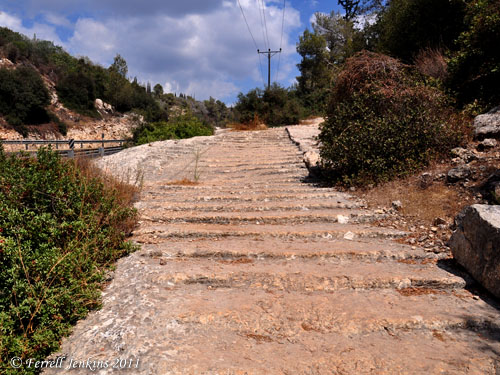
Our first major stop was 4.2 km west of Mata on Highway 375. I am not sure of the date of this unusual stretch of Roman Road, but I think most of the Roman roads date to the late first century or the second century A.D.

These steps would have made the trip up into the mountains of Judea easier for both man and beast.

Roman Road 4.2 km west of Mata on Hwy 375. South side of road. Photo by Ferrell Jenkins.

Roman Road 4.2 km W of Mata on Hwy 375. S of Hwy. Photo by Ferrell Jenkins.

Incidentally, this road is only a short distance from the Valley of Elah.

Later we photographed three significant archaeological mounds (tel or tell, depending on the languages), and saw several others.

  • Tel Goded (Tell ej-Judeideh is thought my many to be Moresheth-Gath, the home of Micah the prophet (Micah 1:1, 14).
  • Tel Burna is thought by the current excavators to be Libnah (2 Kings 19:8).
  • Tel Zayit is thought by the current excavators to be Libnah.

Yes, you read that correctly. More at a later time, perhaps.

Most of our time was spent searching for the correct field road to get close enough to Tel Batash, the site of Timnah, for a photograph. We succeeded! We remember Timnah because Samson got into trouble with a woman of Philistia there (Judges 14).

Be assured that this is fun as well as educational. Who knows what excitement awaits us tomorrow.

Monday meandering — August 29

Looking for a beautiful photo of the Cedars of Lebanon. Try one of these by Mark Connolly, posted by Carl Rasmussen on the HolyLandPhotos’Blog here. I understand that the oldest of the cedars are located at an elevation of about 6,500 feet above sea level at the village of Bchareé  in Mount Lebanon. The cedars are beautiful at any time of the year, but these snow photos are especially beautiful. I have seen them twice, but only with a little bit of snow. Note just two of the significant references to the cedars in the Bible.

  • Hiram of Tyre floated cedar from Lebanon to Joppa for Solomon’s Temple (966 B.C.; 2 Chronicles 2:16).
  • Cedars were floated to Joppa for the rebuilding of the temple (520-516 B.C.; Ezra 3:7).

Gordon Franz sent me an advance notice of an article you may read on his Life and Land blog. He is coining a new phrase be included in his Cracked Pot Archaeology category. It is a sub discipline of pseudo-archaeology called “Apostolic” Archaeology.

The practitioners of this discipline are usually adventurers, sometimes treasure hunters, and generally with neither field training in archaeological methodology nor academic credentials in Near East archaeology, but perhaps a superficial knowledge of the Bible. They claim to have discovered objects or places of great Biblical importance and declare it to be whatever they want it to be. They usually try to justify their pronouncements with a Bible verse. Their declarations are made as if they were speaking ex cathedra (i.e., with authority).

Read more here. We will be on the alert for more of Gordon’s exposés.

Dr. Claude Mariottini writes about what it is like to go back to teaching after the summer break. He comments on the plague of Email here.

In addition, with the advent of computers, we also had the birth of emails, that modern plague that invades one’s life day and night.  With the growth of technology, now one can check emails at the office or at home.  In addition, email follows you on your iPad and on your smart phone.  Emails are everywhere.

Last month my wife and I went on a vacation.  When I returned to the office, I had to process hundreds of emails.  I have an email at school, one at home, and another for the blog.  Just to process all the emails that had accumulated over a two-week period, it took me almost two days.  Maybe, some of us are luddites at heart, yearning for the good old days that never existed.

There is more good stuff there. I suggest you read it.

Which reminds me. I get more questions by Email, comments, and messages on FB, than I am able to answer. I want to answer most of them, but it is difficult to get to them. Hope you understand.

Evidence suggests Qarqur (Qarqar) continued when other civilizations saw a period of collapse

Archaeologists from the University of Arkansas “have found evidence for the continuity of civilization across a time period when civilizations throughout the Middle East and elsewhere were collapsing. Their work occurred at Tell Qarqur, an important archeological site in the Orontes River Valley in northwestern Syria.” (I typically use the Anglicized spelling Qarqar.)

“This new evidence shows the survival of a city through this tumultuous period about 4,000 to 4,200 years ago,” said Jesse Casana, associate professor of anthropology. “Our discovery offers a rare glimpse of what cultures were during this transitional time and challenges ideas about the reasons for the collapse in the first place.”

The end of the third millennium B.C. — roughly 2200 to 2000 B.C. — is often described as a dark age because this period experienced the collapse of many major states, including the Akkadian Empire in Mesopotamia, Old Kingdom Egypt and the Harappan culture of the Indus Valley. Major cities and small towns across the Middle East that had been occupied for centuries were suddenly abandoned, leaving a gap in the archaeological and historical record.

Read the full news release here. Several photos from the album may be seen at Live Science here.

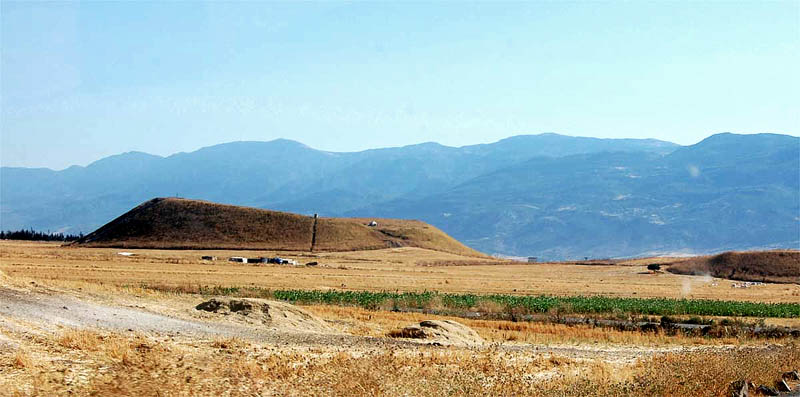
Matt McGowan, science and research communications officer at the University of Arkansas, has kindly granted permission for us to use this photo. It shows Tell Qarqur from the east. Qarqur is located in the Orontes River Valley in northwestern Syria.

Qarqur from the east. Photo by Prof. Casana, courtesy University of Arkansas.

You will see an archaeological trench cut in the side of the tell. This allows the excavators to go down to bedrock and get a slice of every civilization that occupied the site.

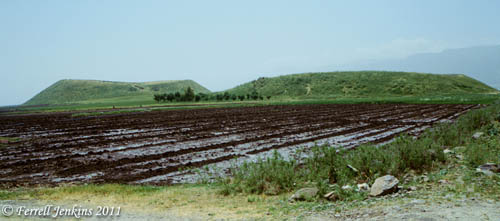
Notice a portion of a second mound on the right of the image. I had the opportunity to visit the area in 2002 during early May. At that time the fields were wet and the tells were green.

Tell Qarqar. Photo by Ferrell Jenkins, May, 2002.

Tell Qarqar. Photo by Ferrell Jenkins, May, 2002.

The Assyrian Empire ruled the ancient near east from the battle of Qarqar (853 B.C.) till the battle of Carchemish (605 B.C.) when they were defeated by the Babylonians. Nineveh had fallen seven years earlier. This was the time of the Divided Kingdom period in Israelite history, and Assyria had contact with a numerous biblical kings. Ahab, for example, fought against the Assyrians at Qarqar. Qarqar is north of Hammath (Hama). Both are on the Orontes River.

For a photo of the other side of the tell now being excavated, click here.

Finds from the excavation are said to be displayed in a museum at Hama. In light of the recent unrest in Syria, I suspect there won’t be many visitors there for a while.

HT: Joseph Lauer

“Known but mostly unknown”

The late Paul W. Lapp is well known among students of archaeology for his 1963 article saying that the archaeology of Palestine (West Bank and Israel) is “known but mostly unknown.” Lapp died in a swimming accident in Cyprus in April, 1970) a few months prior to his 40th birthday.

Lapp’s article in Biblical Archaeologist (Vol. 26) begins this way:

Palestine (West Bank Jordan and Israel today) is perhaps the most excavated land in the world. Certainly the archaeological history of no country is better known. Since the beginning of archaeological work in Palestine at Tell el-Ḥesī in 1890 there have been few periods when there were not several expeditions in the field.

He continues by asking,

How Much Do We Know?

With some knowledge of the scope of archaeological activity in Palestine visitors in Jerusalem frequently ask: Are there still new sites to dig? Are there still exciting finds to be made in Palestine? One might go on to ask: Isn’t our knowledge of biblical times fairly complete? Don’t we have a picture of daily life at the time of Jesus which can be modified only in detail by future discoveries? The confidence with which archaeological conclusions are frequently drawn and the long books devoted to daily life in Palestine at the time of Jesus might suggest an affirmative answer.

My viewpoint here is that such a tiny fraction of the archaeological material has been excavated, and such a small fraction of that satisfactorily published, that even the most assured archaeological conclusions must still be considered far from final. This does not mean that all archaeological conclusions must be basically vague and noncommittal. Our knowledge of Palestinian archaeology has been built step by step, from the best hypothesis explaining evidence available at an early stage of exploration to the best hypothesis to explain evidence currently at hand. Without the discipline of continuous updating of hypotheses as new evidence comes to light chaos would prevail. The nonspecialist would find it much more difficult to judge among interpretations than is now the case. All that is stressed here is that in view of the vast amount of unknown material, archaeologists will be forced to modify or reformulate many, if not all, their hypotheses regarding the development of Palestine as the flood of new evidence continues to grow. Palestinian archaeology may be past infancy but has hardly gotten beyond childhood.

I have no current figures about the percentage of known sites that have been excavated. Often in speaking about the archaeology of Israel and the West Bank I say that the surface has hardly been scratched.

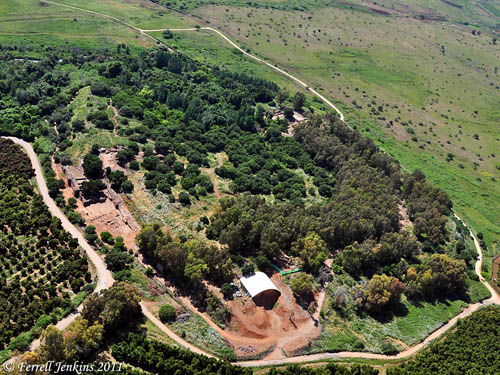
What got me to thinking about Lapp’s article was this aerial photo of Tel Dan that I made in May. Prof. Avraham Biran began the excavations at Tel Dan in 1966 and worked at the site for more than 30 years. Others have continued the work. If you have been to Tel Dan you will recognize the three main areas that have received attention (1) the Middle Bronze city gate, (2) the Iron Age gate complex, and (3) the High Place (bama). Would you agree that there may still be some work to be done at the site?

Aerial view of Tel Dan. Photo by Ferrell Jenkins. 2011.

Aerial view of Tel Dan. Photo by Ferrell Jenkins. 2011.

Is there still much archaeological work to be done? Is it still mostly unknown? Are you kidding? Extend this thought to Jordan, Syria, Lebanon, Turkey, Greece, Turkey, et al.  This is why we must sometimes be satisfied with a limited amount of evidence.

Got to go. Today is Grandson Day prior to school beginning tomorrow.

Hama, Syria = Hamath of the Bible

The city of Hama has been in the news quite a bit lately as the unrest of the citizens has been put down by the Syrian government. This is not something new to that city.

In 1982 Hama was the scene of the bloodiest episode of Syria’s modern history. (Footprint Syria & Lebanon Handbook 215).

At that time the protest was against the father of current president Bashar al-Asad. Estimates of the number killed range from 10,000 to 25,000.

Perhaps many Bible students read or see/hear the news about Syria today and fail to realize that this city is the site of an important city in the history of Israel. Hama is at the site of Biblical Hamath  (2 Kings 14:25; 2 Chronicles 8:4).

He [Jeroboam] restored the border of Israel from Lebo-hamath as far as the Sea of the Arabah, according to the word of the LORD, the God of Israel, which he spoke by his servant Jonah the son of Amittai, the prophet, who was from Gath-hepher. (2 Kings 14:25 ESV)

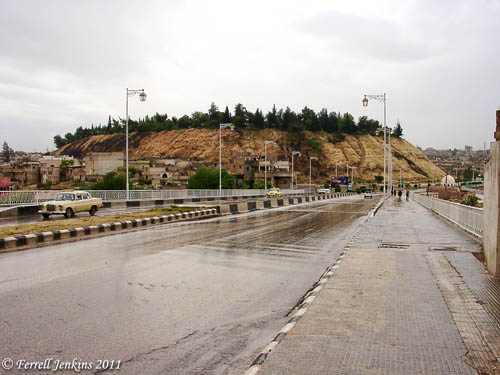
Our photo shows the tell or mound of Hamath situated on the left bank of the Orontes River as we approach from the north.

Citadel Mound of Hamath on the left bank of the Orontes River. Photo by Ferrell Jenkins.

Citadel Mound of Hamath on the left bank of the Orontes River. Photo by Ferrell Jenkins.

The work of Danish archaeologists at Hamath between 1931 and 1938 revealed occupation from the 6th millennium B.C. to the Middle Ages (Marie-Louise Buhl, Anchor Bible Dictionary). German archaeologists have been working in Hama recently, but I do not know whether it involves the tell.

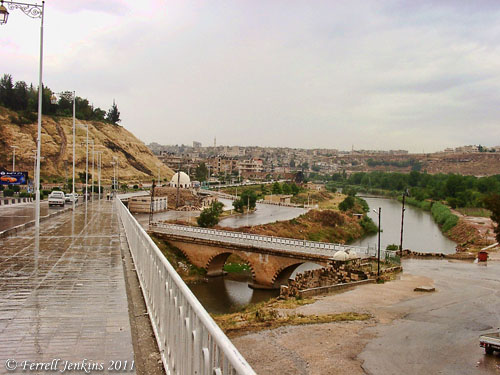
The next photo shows a small portion of the tell with the Orontes River below. It was raining when we visited Hama in 2002.

Hamath on the Orontes. Photo by Ferrell Jenkins.

Hamath on the Orontes. Photo by Ferrell Jenkins.

King Toi of Hamath is mentioned twice in the Bible (2 Samuel 8:9-10; 1 Chronicles 18:9-10). One scholar recently equated biblical King Toi with a King Tatais whose name is known from inscriptions. See here.

Current news becomes much more interesting and meaningful once we know the history of a place.